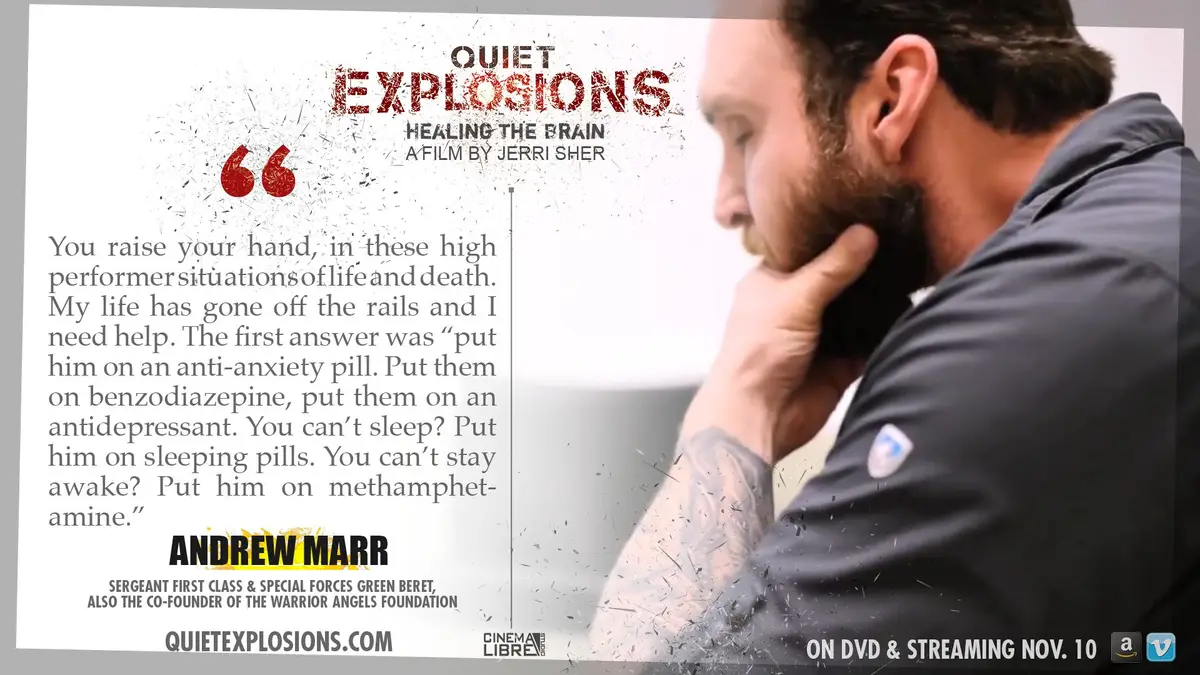
Andrew Marr is a medically-retired Special Forces Green Beret, and author of the book Tales from the Blast Factory that was recently turned into a full-feature documentary called Quiet Explosions.
Quiet Explosions follows the life and mission of Andrew Marr, a Special Forces Green Beret Veteran and the founder of the Warrior Angels Foundation.
Andrew also recently wrote the book Tales from the Blast Factory, chronicling the ways in which his life was affected by Traumatic Brain Injury and the road to recovery he took using a unique therapy delivered by Dr. Mark Gordon.
That book was recently turned into a documentary called Quiet Explosions with the help of Emmy Award-winning filmmaker Jerri Sher. LOGLINE Traumatic brain injury (TBI) impacts 2 million people per year. Professional athletes, military, veterans, and first-responders share their recovery stories after suffering severe PTSD and depression. Joe Rogan and Super Bowl MVP Mark Rypien, NFL running back Anthony Davis and Ben Driebergen, Marine veteran and winner of CBS’s 35th “Survivor” season, are featured in this enlightening documentary.
SYNOPSIS OF QUIET EXPLOSIONS
Special Forces Green Beret, Andrew Marr, returned from his third deployment, a quietly broken man. The explosives expert suffered a multitude of concussions while detonating hundreds of blasts in Afghanistan. Unable to cope with his illness, he fell into a spiral of drug and alcohol abuse; even contemplating suicide at one point. When it was nearly too late, he met Neuroendocrinologist Dr. Mark L. Gordon, who properly diagnosed his condition as Traumatic Brain Injury (TBI). Since then, Gordon has been helping veterans impacted by Post Traumatic Syndrome (PTS)and Traumatic Brain Injury (TBI)through the Warrior Angels Foundation founded by Adam and Andrew Marr and supported by podcast personality Joe Rogan. Professional athletes Mark Rypien (Washington Redskins Super Bowl XXVI MVP) and Anthony Davis (running back USC, Tampa Bay Buccaneers), candidly share their methods of coping with TBI and PTS, which they experienced from repetitive blows to the brain. Renowned big wave surfer Shawn Dollar and Ben Driebergen, a Marine veteran and winner of CBS’s 35th “Survivor” season, reveal their struggles toward brain health. A former gymnast, a 9/11 first responder, and the victim of military sexual trauma (MST) offer insights into their healing process from the disease which is estimated to have impacted 80 million people in the past 40 years. Additional hope and insightful methods are offered from experts Dr. DanielG. Amen, Dr. Scott Sherr, and Dr. Robert Sammons in this growing field.
Click HERE for the Quit Explosion’s trailer.
Click HERE for the Quiet Explosion’s Website
Click HERE for Andrew’s TEDX Talk
Transcript
Machine-generated from the episode audio and lightly edited — may contain errors.
Chris Albert (link to this point)
What is going on, ladies and gentlemen? Welcome to the Warrior podcast. This is Chris Albert. And today, man, I got a really great show for you. It's a guest I've had on many times before.
He's worked with me in the past here on the Warrior Soul podcast, served as cohost for a bit, and then went off and and on to some bigger and honestly better things. This guy is doing amazing work out there. And, you know, I'm always saying it's not your problems that make you special, it's how you deal with them, right, how you respond to them. And there is nobody out there that better exemplifies this than this individual. His name is Andrew Marr.
He served as a Special Forces Green Beret, served multiple times in Afghanistan, and then he suffered the medical consequences, had numerous low level traumatic brain injuries that went undetected. He was medically retired, forcefully medically retired out of the army, got into a downward spiral, ended up drinking a lot, dealing with prescription drugs. At the same time, he was struggling to be a father, had five children at the time. Today, he has seven. And you know what?
He woke up one day and said, I'm gonna change things, and that's what he did. He went to work. He searched for a solution. He found doctor Mark Gordon. And he not only helped himself, he started the Warrior Angels Foundation to help others.
And that's what he's on a quest to do now. He's written a book called Tales from the Blast Factory. That book is now being turned into a full featured documentary called Quiet Explosions that's due out on November 10. And I couldn't be prouder of the guy. He's gone on.
He's gotten his MBA. He's working as as an executive now. He's running his foundation. He's got a full time staff for the foundation. He's got this documentary coming out, and the guy is a husband and a father to seven children.
What an example for our community. What an example for our country that you can completely take your life, turn it around if you're dedicated, if you want it bad enough, and honestly, if you have the passion. And that's what drives this guy. It's passion. Passion not just to help himself, but to help others and to put a better face on the better veteran community, to help the veteran community, and to drive this country forward.
So we're gonna get in my latest conversation with Andrew Marr in a second. I wanna say this. We have a new sponsor. It is the Citadel, the Military College of South Carolina, and you might have heard of the Citadel before. They have a legendary corps of cadets.
They've got an illustrious history of producing top military leaders and top business leaders, and they also have some amazing programs out there for active duty military members and for veterans. They've got programs where active duty military members can actually come. They can go to class during the day, and they can work with the ROTC cadets at night. If you're in the Marine Corps' MECEP program or in some of the Navy's programs to become an officer, you can take part in those. They also have programs where veterans can come in and go to school during the day and, you know, go to class amongst the corps of cadets.
You can get your bachelor's degree. You can get your master's degree. They're also working on programs where you will get a degree in tactical readiness. It's an absolutely great institution, a really great education, and I think more veterans should take advantage of this. And we're gonna get some more information up here on the show about how you can take advantage of these programs regardless of where you're at, And we're gonna be talking quite a bit about Citadel in the future.
I wanna thank them for their partnership, and we're gonna be talking to a few Citadel alums and a few Citadel cadets here on the show to get the story of these great programs out to you. To learn more about these programs, please head over to www.citadel.edu. Now with that, I wanna thank you guys so much for listening. Let's get into this absolutely outstanding conversation with Andrew Marr, author of the book Tales From the Blast Factory, subject of the documentary, Quiet Explosions, Special Forces Green Beret veteran, and all around badass, awesome guy. I also wanna say this, if you're gonna be looking for the documentary or the Warrior Angels Foundation or anything else that Andrew go has going on, I'm gonna have all those links up on the show notes.
One thing Andrew's really good about is getting data out there. So we're gonna have tons of data for you guys who wanna take advantage of some of the programs. He talks about some of the ways that you can help yourself. So let's get into the conversation.
This is Chris Albert, and I'm here to remind you of one thing. Someday, you're going to die. That's not some morbid statement or scary idea. It's solid fact. Your time here on this earth is limited.
We need to be reminded of this as much as possible for one simple reason, to live your best life while you can. This is the Warrior Soul podcast.
Andrew Marr, welcome back to the Warrior Soul podcast. How are you doing my brother?
Andrew Marr (link to this point)
Man, every day is an amazing day above ground as my mom used to say. So doing good. It feels good to be back here on the Warrior Soul podcast.
Chris Albert (link to this point)
Feels good seeing you, man. So, you know, lots happened since last time we talked. You are now back in the great state of Texas, right? You want to tell me a little bit about that?
Andrew Marr (link to this point)
Yeah. You're in Florida and I'm in Texas. We were in California for the last three years, like my most favorite geographical location in the union. And I was finishing up my MBA out there on the West Coast and, you know, involved in a lot of other things with the foundation and the movie we've got going on and whatnot. Had no plans in my foreseeable future to relocate or get out of California.
We were up North Of Los Angeles in Oak Park, just East of Malibu, just a beautiful area. I was up in the Santa Monica Mountains three days a week, you know, loving life. I was very unhappy with how the states responded to the current pandemic. And what I thought was, you know, a loss of, you know, a lot of liberties and personal freedoms that I thought Americans could have been responsible enough to just enact on their own and in Texas, that's the case. So anyways, I was unhappy with that.
I'm happy with that current state administration is running things out there. I got a lot of issues with Newsom and some of the things he's doing, man. And for the first time in my life, I had to think really hard about like, Hey man, like we have the unbelievable freedom in this country to go and live wherever we want. I don't have to be here. And if I don't like it, then I can go back to a place that is more in align with what I think is the way I want to raise my family and, you know, the values that we ascribe to.
So, you know, took a long look at it and then looked at the financial implications. California is not by any means an inexpensive place to live. And it just started, it wasn't a problem before, but like when you start taking all these other variables and factors, and I'm positive that you went through the same decision making matrix, if you will. But it just like, man, you could get hit with this ridiculous income tax, not happy with how it's used and all these other taxes and everything else. Was just like, man, we're going to go back to Texas and had an opportunity to come out here and get into the energy sector and continue our mission with the Warrior Angels Foundation and everything else that we're doing.
So it was kind of a segue from California back out here to Texas.
Chris Albert (link to this point)
Yeah. Yeah. I'm I'm with you a 100% on all that. And it breaks my heart honestly, because such a beautiful state. You know, it's it's and and I think people have a misconception that, like, everybody in California is, like, Marxist and all these different things.
But there are real hardworking, Americans out there who just wanna wanna survive, just want the best for their families and things like that. And, I mean, it's a tragedy because if you look at the mismanagement that's going on, if you look at the kind of attacks on civil liberties that have happened over the past few months, and and the justifications for it just don't add up. I mean, I was sitting there every single day kinda bit banging my head up against the wall. And when you're running a business out there, I mean, it's not the the most business friendly place in the world. I mean, there's been many times when I wanted to hire people, when I wanted to expand, when I wanted to grow, and it just seemed like they weren't on your team.
They're not they they wanna make it as difficult as possible, you know?
Andrew Marr (link to this point)
Yeah. They are not in favor of the business owner in that state. I mean, I think you can sum it up with this, man, rolling blackouts and heat waves. And they want to talk to everybody else in the country about how we need to get off fossil fuels and move to renewables. And we're having rolling blackouts wave in California. Absolutely hysterical.
Chris Albert (link to this point)
Yeah. No. I mean, it's insane. And like, again, I I remember fondly, like, hiking with you through the hills out there in San Bernardino Mountains and things like that. And like, all these other things that I wish we could continue doing.
But you know, California could be a great place to visit, you know, and and and not have to live under the thumb of those things.
Andrew Marr (link to this point)
That's basically what we came up with, man. We're like, you know what, like, we'll come back two to four weeks out of the year.
Chris Albert (link to this point)
Exactly. Exactly. Exactly.
Andrew Marr (link to this point)
Like we'll go, our kids will be able to go back to school and do these other things. And, you know, in Texas, there's no state income tax, you know, all kinds of, veteran benefits out here on steroids. Like it's just a good place to, it was a good, it's a good place to be for us. So that's why we came back. Yeah.
Chris Albert (link to this point)
Absolutely, man. Well, there's a lot also going out there in the world. There's COVID. There there's been all these riots and uprisings and things like that. We're we're in the midst of an election right now.
And, you know, I don't want to get full blown political, but what do you think about everything going on and like how people are reacting to things? You know, I'll preface that with saying
Andrew Marr (link to this point)
that, you know, I've remained out of any kind of political commentary and really have had zero interest since returning from my last deployment. I really got it's kind of fed up with politics, politicians, and wanted nothing to do with it from either side, having I either didn't participate in the twenty sixteen election and just didn't care to. What I've seen over the last four years, three and a half plus years is policy that in my estimation has had an outstanding effect on a lot of different things. The, our economy, the job creation. What are we, the foreign policy that's been administered over the last three and a half years.
I've never, we've never seen you and I in our lifetime, the things that are happening with this administration. No new wars are being fought and there's peace deals being brokered now with Israel seems like on a month by month basis, like it's pretty remarkable. And the wealth that was created prior to the global shutdown of the pandemic induced shutdown was off the charts as well. So, you know, there's just a lot of good things. What I'll say about Trump is that I, you know, I believe and he has full of character flaws, full of them, you know, as am I.
There's a lot of things that that I don't necessarily agreed with. I think he has America's best interests at heart. And I think, you know, 56% of the people polled, was it Reuters or I forget which poll it was, but said they thought they were better off than they were four years ago. You know what I mean? So it seems to be the situation.
So I'm fully supportive. I think given the alternative, he's the right person to continue to do and lead the country. And what I'm seeing from the democratic party is that this party has been hijacked by the radical left. And that's evident that what we're seeing in these mostly peaceful protests and how those have come about and everything else that we're seeing with these kinds of this radical ideology infiltrating the party as a whole and becoming as I see it more mainstream. So, you know, you sent me a link the other day, said a man versus a movement, you know, there's a movement to just eradicate the social structure of which this country was founded on.
And there's those that think, you know what, America is a good idea and it's done a lot of good and we're going to continue to move and trend in the right direction. So that's kind of how I see it, man. I think America is the best country. That's the best idea that's ever come across. It's full of inadequacies.
We fought a civil war and what 600,000 individuals died to right a wrong that, we weren't living up to in the constitution. We had a civil rights movement in the 1960s to make sure that rights were applied equally to everybody as the constitution said. Today, like, you know, despite what you hear in the news, like I don't see systemic racism anywhere that I go. I don't, I just, it's not an issue. So, I think the country seems to be incredibly polarized. I don't know if that's the case, for me it was just like, Hey, like which way do we want the country to go? I mean, the left is pretty clear.
It's rooted in Marxist ideology that experiments been run. I'll stay with life, liberty, the pursuit of happiness and the right to own my labor and to own property over the other side any day of the week.
Chris Albert (link to this point)
Right, right. And again, I'm with you a 100% on that. I mean, I was never a really political person. I always like I grew up in a very liberal state up in Connecticut. And, you know, up up till fairly recently, I thought, you know, I was more aligned with maybe the Democrat party. And and, you know, after the last few years, I've been more and more, like, not understanding the logic of where they're coming from.
I mean, at its base, America is a fantastic place. There's no other place in the world like it. And, you know, the big thing for me has always been looking at these wars that we get into and how we waste blood and treasure on adventures that that, you know, we probably could have done without. And what I've seen from this administration is is a concerted effort to keep us from those things, to rely heavily on talented individuals like yourself rather than bringing out the bulk of of the forces to bear on on places and wasting that blood and treasure, and being very efficient about things. Know, I'm I'm I'm results oriented person, and I know you are too.
And up till COVID, things were appeared to be going phenomenally, you know, and and, you know, with COVID, it just seems like seems like there was every effort made to kind of throw a wrench into to what had been done. And and and I'm not talking conspiracy wise, I'm just talking about, you know, what I've seen out there, and it's just absolutely insane to me that that there's people who just seem like they don't want America to be successful.
Andrew Marr (link to this point)
It's a good strategy. I mean, if you think about it from a strategic perspective, like, because you can't really point to any faults of the policy. So what do you do? You assassin character assassination and you pull to, you know, the thing that everybody's talking about, which is COVID-nineteen, which no, you know, no country has a handle on as far as like, what is what's the one best way to handle this? Like, like, we're figuring out as we go, you know, type of thing. I'll say this, man, with the change of administrations from the Obama administration into the Trump administration back right after that happened, I I had friends personally on the grounds in combat zones, and they said it was a complete one hundred and eighty night and day difference between being handcuffed with ROE, not being able to do the job that you were sent there to do. Trump takes over an office, we eradicate ISIS, no problem in a very small amount of time. And they said from Obama administration passing to Trump administration coming in overnight, they got to go out and enforce and do the things that they were trained to do for the reasons that we were supposed to be there, got the job done and then moved on.
So like that, I mean, that's pretty clear cut from the people on the ground. What happened day one, the last day of this administration, day one of this administration, completely different mindset. Let's finish the job, let's get them out of there, and let's figure out how we can bring some stability to this region.
Chris Albert (link to this point)
Right. Right. And it just seemed like everything was so much more efficient and just from my perspective watching it from the outside. And, you know, it's when I when I it's funny because we have a choice right now between a man who seems like he's done everything he could to make that situation better, to make that efficient, versus somebody whose voting record, honestly, you know, it it it's gotten us into a lot of these blunders. So that's where I'm coming from with it, you know.
Andrew Marr (link to this point)
Yeah. I don't know of any policy, foreign policy wins from from Biden's forty seven years of tenure.
Chris Albert (link to this point)
Yeah. Yeah, exactly. Exactly. And you went out and you got your MBA, man. How was that?
And what kind of experience was that for you? And what are your recommendations on that?
Andrew Marr (link to this point)
Yeah, it was great. You know, I mean, we have so many benefits, entitlements, which are earned, you know, from serving this country. And that was one of them. So I wanted to pay respects for that, you know, entitlement being there and take full advantage of it. And really, wanted to apply it to a way that can magnify areas that I was already in and interested in.
So being with the foundation, I realized that's business 101, MBA 101, trying to figure out, one, how to have a compelling thing to talk about, a compelling solution to a unique problem, and then motivate and incentivize others to invest in your effort to go and do that without a product or a service exchanging hands. So, there's that whole aspect to it. But I also realized like, hey, man, if you're gonna play the game, you need to know all the rules. And so I was like, this is perfect. In my estimation, I'm pretty black and white, like you're either trained or you're not trained. So I was like, okay, well I need the fundamentals. So let's go and learn the fundamentals and that will make me better at being able to go out and do the things that it is that I want do with my life. So, that was kind of the reason and the rationale behind it. Went and got my MBA at Pepperdine, which was a phenomenal experience. You know what I mean?
Because it's a very flexible program. I got to still work full time, have a family. I mean, we had twins in the middle of it, doing all the things that we're doing with Quiet Explosions, our movie. And then their schedule, I was able to work around that. So essentially doing nights and internets and weekends, I was able to bang that out over the course of two and a half years.
So, you know, some of that is check the block type of stuff. Yeah, absolutely. That comes with it. But if you're not, if you don't have a conceptual basis for all that, then it's very beneficial. And with anything in life, I think you get out what you put in.
So, you know, I was all in. So what I came away with is I had a concentration in entrepreneurship, which kind of validated some of the principles that I already understood, but helped to really expand that to another level, one. Two, I was really able to understand the framework for how to properly strategize and be strategic in how you run an operation. And then three, which is, you know, every any, you know, graduate degree or anything you do is the network ability or capability there. So, you know, Pepperdine has a very big network, you know, whether it's LA or here in Texas or wherever.
So, you know, that was a deciding or contributing factor that led me to go there. But, you know, would I pay for it on my own without the GI bill? That's a difficult question because I was only in that position because of, you know, the path that I traveled to get there. So, you know, I don't know, but I know I had the GI Bill and it made sense to me and I jumped in and I don't second guess that, you know, that decision for one second. So it's been very beneficial for me.
Continue what we're doing with the foundation with Quiet Explosions now come in and I'm in the energy sector for Apache Industrial Services coming in at an executive level and being able to understand an industry I have no experience come in and understand how the industry works, what the vision and mission is of the company, where we've been, and how to strategize where we need to go based off of that and reading in-depth financial reports. For all those things, it was for me, it was very it's been very rewarding.
Chris Albert (link to this point)
Yeah. You know, I think, one of the things that happens with veterans, they get so entwined in that they got trained for this job, and then they think, Oh, I can't apply any of this to the civilian world. And the thing is, when you start to understand business and what it really is, you know, you take what you've done with the Warrior Angels Foundation, and you know, you basically had this idea, you created an organization around it, and then you went to work as far as reaching out to who you had to reach out to, speaking to who had to speak to, getting in front of the audiences you had to get in front of, and then getting this concept out there, and now translating over to your movie Quiet Explosions, you know, that's that's really an op that you did. Right? And and I think the if more of us understood that about business, there'd be more, way more business leaders coming from the veteran community. There's a lot, but I think there should be way more.
Andrew Marr (link to this point)
I agree. I actually think veterans overall are much more entrepreneurial than I guess when compared to the regular civil sector. But it's that phased approach, man. You just think about it as a mission planning. You know what I mean?
You got your pre mission, the whole entire lead up to that executing and everything that needs to be done afterwards to get ready for the next month. You're looking at trends, you're looking at lessons learned, you're looking at what is to shape what needs to be, how do we move from where we are to where we need to be based off of, you know, these trends, these behaviors, this analysis and moving forward, just all in the business context. So the parallels absolutely are 100% in there. And I'm with you, man. I think, you know, you learn that, oh my God, like these skill sets I learned over here are 100% applicable.
I just need to be able to maybe turn it and look at it in a slightly different angle. And then boom, starts to make sense.
Chris Albert (link to this point)
One of the things I want to do here, because I want this to be kind of a standalone podcast for those those out there who might not have heard of you before. They're seeing you now. You know, you're in this position. You're an executive in the oil industry. You got a movie coming out and things like that.
But for those who might not have heard you here on Joe Rogan or any of the other awesome podcasts you've been on, can you kind of talk about where you came from and and and how this because it is a remarkable transition that you made. You've, you've, it's literally almost superhuman. Can you talk about where you were?
Andrew Marr (link to this point)
Yeah. Well, I, I had a, at a high level, I spent almost a decade in special forces. And in that line of work, was exposed to a lot of blasts. You know, I had a lot of minor blows to my head, but without a visible wound on my body, I was forced to be medically retired from the army. And this is after seeing a number of specialized providers and physicians put on a 13 different medications labeled with this laundry list of disabilities and mood and neuro cognitive disorders and things of that nature.
And what really stood out for me was the contrast. The contrast when compared to who I was at the pinnacle there of special forces and kind of my biographical history up until that point into who I was when I exited the military, which was a completely debilitated, broken down, broken individual who thought life was basically over, thought I was going to be on all these medications. My wife was my caregiver. I couldn't remember anything. It was just an absolute disaster.
But here's the big key takeaway from all of that is that what we, and what we've learned about head injuries overall is that you don't have to be knocked unconscious to receive a head injury. So just being in that environment can predispose you to kind of the symptoms that I kind of fell to. And it's the delay in those symptoms that can lead to a misdiagnosis or an undiagnosis, which then results in the care plan does not properly assess or treat, the brain. And that kind of made my life into a living nightmare. And now being where I'm at today, being still heavily involved in helping others that are in the same or similar positions, that is the story of so many veterans, so many service members, a disproportionate number of special operations soldiers.
So my story is one of looking outside to what we'll say is a non traditional therapies, evidence based and scientifically, you know, backed and valid by science, but non traditional in the Western medical model we'll say. And so finding something that was able to identify my underlying conditions, treat them, and then be able to make essentially a full recovery where today I'm performing, as good, if not better than my pre injury status. And we rolled that into our organization Warrior Angels Foundation was provided that same level of care to over 300 individuals now since 2015. And we put that into our book, Tales From The Blast Factory, which got picked up to become a full feature, you know, now an award winning full feature documentary by Emmy and Academy Award winners, and that's due out November 10. So but it's really all around understanding that what I was talking about, hey, man, you don't have to be knocked unconscious to receive a head injury.
The symptoms from those, which we just alluded to earlier, can manifest sometimes years after that initial injury. That was what makes it difficult for a provider, for a family member, for the individual going through it to identify what is this coming from? Too often it gets relegated as a psychological issue and away we go because now we're not fixing the problem. We're just trying to manage symptoms. So I don't know that was kind of going all over the place, but that's kind of the my background of what got us to here.
Chris Albert (link to this point)
No, that's great.
And you know, just knowing you personally, you know, you're a father of seven now. At the time when you're going through a lot of this stuff, you're a father of five. And, you know, there were situations where, you know, and I don't know if you mind me bringing this up, but you were walking around with a whiskey bottle, taking Dilaudid, exhibiting all the classic symptoms of what people would have called PTSD. And and, you know, I guess there was one situation where your wife was in labor, your your youngest son at the time was going through a medical issue, and you had a deep vein thrombosis in your in your leg, because of everything going on. And it was a crazy situation that you got yourself through, right?
Andrew Marr (link to this point)
Yeah, you know, was it just, life had thrown a lot of curveballs at me and kind of in the state that I was in, it was in this, you know, very defeated position where I was asking myself, you know, how does this happen to me? And, you know, what are these, I'll never have these things back and things continue to go from bad to worse. Like you said, my, my oldest boy was 13 at the time. He had a lymphatic malformation that we knew about, you know, when Becky was pregnant with him, my son, Jason, he got sick and that got infected and it just, its neck blew up to like the size of a small softball, I would say. So we rush him into the ER, Becky's nine months pregnant for our second son, Jojo at the time, and I've been having this incredible calf pain in my neck.
So essentially we all got triaged in the same, all three of us in the same ER at the same time. So Jace got rushed to emergency surgery on his neck. Becky goes into labor and I'm kind of going back and forth on like two different floors, like the 3rd Floor and the 5th Floor of this hospital that we're at. So my leg has quit working at this point. So I'm having to drag it with me to go back and forth, you know, to see both of them.
Long story short, Jace gets on the other end of the surgery. He had like three or four more after that, but he's, you know, all his vital signs are good and he's breathing and things are good there. Becky has, gives birth to our son, Jojo. You know, they're up and running. The medical staff had finally convinced me to get imaging on my leg and it turns out, boom, there was a deep vein thrombosis in your leg and now it's broken off and it's traveled to both lungs with what they call a bilateral pulmonary embolism, which they're told like, oh, there's the ninety five percent mortality rate with this.
So we got to act fast if we're going to make it out of it alive. And so that was kind of the situation on the ground there. And this is after like I had real like my whole identity was in special forces of being a Green Beret. It just come to the understanding that wasn't going to happen anymore. I was on this road to the medical retirement.
Like everything was just reality is I knew it was fracturing around me and it looks like the hits just kept on coming. And so that was kind of like all these things that was kind of like one pinnacle moment where it like, you know, shit, man, how much lower can we actually get, And, know, it's just when you think that, you know, you'll find a way to keep going, but at some point, you know, you hit a crossroads, at least I did. Was fortunate enough for that happened at my son's bedside, after his last surgery. And I came to this understanding that, and I spoke about this in a TEDx talk I did last year, but I came to this understanding and this is no shit a true story, man. I'm sitting there and I had this moment of clarity, like boom, it just snapped in.
And I realized at that moment that I was of zero value to my son who is recovering in ICU in the hospital bed or my family. And the path that I was on was going to just kill me and ruined everything that it is that I said that I love. So the other option as I saw it was to revert back to my most foundational level of training to embrace that current level of pain that I was experiencing. Except this time I was going to channel it and a, you know, in a way that was productive, you know, and right there at Jason's hospital bed, I promised him and myself three things. One, that I would return to the man of my pre injury status.
Two, that I would find a way to come off all the medication that I was told I was going to have to be on for the rest of my life. And I didn't care what mountain I had to scale, where I had to go, how much money it costs, what anybody had to say about it. Because in my mind at that time, those two things were non negotiable. And number three was after we accomplished one and two, I was going to turn around and spend the rest of my life helping other individuals who were the exact same position as myself. And that was enough to pull me out on a different alternate path than the one I was on.
And the reason that we've been able to move out at the trajectory that we have since that day.
Chris Albert (link to this point)
Yeah. I mean, that's that's just an amazing story. I mean, every time I hear it, I am like, wow, wow. And you know, I know your family personally, I know Becky, your wife, very, very strong woman, very, very, very strong woman. And I think you hit the jackpot there as far as that goes.
Andrew Marr (link to this point)
Yeah, no doubt.
Chris Albert (link to this point)
But as far as everything goes, what you've been able to create from that is absolutely awesome. You ran into Doctor Mark Gordon out there in California. And to me, it seems like we have talked about all these things like synchronicity, putting something out into the universe and having it come back. But along with all the planning that you had there, you had this protocol that Doctor Gordon had come up with. And what was that like? I know you made that promise that you were going to search this stuff out. How soon after that did you come in contact with Doctor Gordon and, and when did you start this stuff?
Andrew Marr (link to this point)
Yeah, it was about two, two months after that, you know, crossroads decision set at my son's hospital bed that, Mark Gordon appeared in my life. But before I get into that, I wanna touch on suicides and I'll tell you why this is important to this conversation is that SOCOM just released several years ago, this psychological autopsy study of suicides among US special operation forces. So there's been a disproportionate amount of suicides in SOCOM when compared to the military on the whole. And military on the whole is still above the average per thousand when compared to the regular population. So when you compare special operations according to the statistics from SOCOM to the regular military, SOCOM suicides were about a 30% higher than the regular military rate.
Now the study was conducted, I think numbers through 2015. So things could have changed since then. Here's the point I want to make. They looked at a section of those suicides and they did what the study said, a psychological autopsy, which they go back and they look at all the events that led up to the individual committing suicide. And they try to look for lessons learned, so to speak like, Hey man, how can we identify this?
Where are we falling short? What criteria could we, implement to make sure that, this doesn't happen in the way that it does in the future? And what they found is like, almost fifty percent of the individuals they looked at SOCOM in this study had a mental health disorder, a mental illness. So sixty two percent of the individuals they looked at, and it was twenty nine, so we're talking about what, fourteen, fifteen individuals had at least one, in addition to their mental illness, one sign that it's called is path warm, which is isolation, substance abuse, purposelessness, anxiety, feelings of being trapped, hopelessness, withdrawal, warm anger, recklessness, mood changes. Least sixty two percent exhibited at least one of those signs as they went back and looked.
Almost half of them exhibited more than one sign. So here we have, we're looking at the population of SOCOM, we're looking at the suicides that are higher, we're looking at mental illness. Half of the individuals that they looked at in this, study found that they had a mental illness or a comorbidity, one or more mental illnesses that led or contributed to them committing suicide. And they looked at a number of other factors, but here's the point I want to make. Brain injuries, like I said, you can miss the subtle changes in somebody's day to day life that leads from a high performing individual or an individual to having all these symptoms and all these mental health problems.
We know without a shadow of a doubt, the evidence is very clear up to one out of every two head injuries will develop a major mental disorder after the injury. All right, I'll say that again, up to one out of every two head injuries will go on to develop a major mental disorder after the injury. So now they're looking very good. They got, we have all this data and it's black and white, at least fifty percent of the suicides that we have, they had a mental disorder. It only said that they believe that there was only five head injuries in that population.
They did no predictive analytics. They did no biological assessments, nothing like that. Just purely psychological. So the argument that we're making is that head injuries lead to two things, inflammation, neuro inflammation, which creates what's called a non neuro permissive environment, fancy word, what's it mean? This is a tie in back to Doctor Gordon, the world famous practitioner of neuroendocrinology who came up the protocol to identify and treat this. Neuro inflammation creating a non neuro permissive environment just simply means think of a plant that's trying to grow in a cesspool. It's not going to be able, some might spring up and be able to have life, but for the most part, it's going to be a disaster. You need good soil. You need good air.
You need good clean water and sunlight. Mess with any of those factors, it's going to have a difficult time thriving. So the brain is no different. If this environment is now compromised and how does it get compromised? Well, certain chemistry gets turned on.
That's very necessary in a short acute phase in a repair or healing phase. But for some people that chemistry doesn't get turned off. Well, that's very damaging when it runs long term. So it's that long term process that then can downgrade, make you become deficient or insufficient in the chemistry that runs your body. That neuro inflammatory process then leads to hormone centers being influenced negatively and not being proficient or sufficient, in a way that is optimal for us going through life.
So that's the process. That's how Gordon is able to identify it. We can identify that through very specific laboratory markers. That is where the medical model, be it military or anything else is missing the mark because they'll say this person has a host of psychological conditions or issues. They have relationship issues.
They've had financial problems. They have a humiliating legal concerns, a lack of access to mental health care in the military. Every one of those cases that they found in the SOCOM study, they said had significant emotional trauma after their first deployment. Well, you can't So all these things lead to like, man, we should be looking a little bit further past surface level. And so this is where it ties all back in the suicides to my personal story, SOCOM, the military at large, our nation globally and globally at large, and then back to Doctor Gordon. It's identifying, hey, is the brain in the right environment? We can do that very easily. If it's not in the right environment, what do we got to do? Because this, our body has this incredible innate ability to heal itself given the right environment.
So we, Gordon is able to mitigate and modulate that inflammatory process that gets turned on. So that's the very first component to it, very important. And then two, depending on how long that inflammatory process has been going on, we have to replace or replenish the chemistry that the body no longer makes. So when you couple those two things together, you have the, the workings of a personalized brain injury protocol that is tailored specifically to the unique bio, individuality of that person. So that applied to me incredibly successful.
We've now been a close, we've helped, but I'm not special nor specific. So we've replicated results just like mine in the organization alone, my organization over 300 times. Gordon's now done that over 3,000. Helped to train over 500 providers in the last five years. So the word is continuing to get out, but that's why we're continuing to bring this fight forward because it's still not readily recognized or understood to be a major contributing factor to mental illness, to suicide.
Nobody's saying it's the only factor, what we are arguing is that the evidence suggests that it's a major contributing factor that does not oftentimes get accounted for. I can tell you from my firsthand experience directly and being so close to all these other cases with the foundation, it's still not accounted for in the military or the Veterans Administration today.
Chris Albert (link to this point)
Right. Right.
And, you know, one of the things you've conveyed to me in the past is that, you know, you went for an exam and you had your hormones checked and it was the army who checked your hormones and everything was shut down and they actually had accused you of using performance enhancement substances, right? Because they couldn't figure out why everything was so was to zero.
Andrew Marr (link to this point)
Yeah. Yeah. That's accurate, man. It was an endocrinologist and I went through several different rounds with different ones, but I was so floored because it's not easy to get to these appointments in the middle. You got to wait all this time to get in there.
It's just ridiculous. Now I'm to get into it, but to sit down there to have him look at like, like I'm figuring out what labs need to be administered and how to sway that and how to figure out to go in there and score, you know, testosterone from the base medical command, you know, to pump up. It's ridiculous. But the guy said, hey, the only physiological explanation for these levels being this low is that you abuse anabolic steroids and I will consider treating you with testosterone only after you take a urinalysis proving that you're not on anabolic steroids. And I was like, well, how long is it going to take to do the turnaround on that?
It's like four to six weeks. You know, I was like, go fuck yourself, man. I was out of there. So that was about the last time I think I went to one of those military medical appointments. Was just, I was just done with the whole system.
Chris Albert (link to this point)
That's crazy.
That's crazy. And you know, one of the things about, you know, what the foundation does, what Doctor Gordon does is, I mean, it's not as simple as getting a vial of testosterone cypionate and injecting yourself, right? I mean, has to be consideration of the precursors of the entire hormonal cascade. Right?
Andrew Marr (link to this point)
Yeah. That's it, man. If I've learned anything and, you know, I'll preface that with saying, all I'm doing is is parodying things that I I've been told and research I've read, you know, don't have any medical degrees or or anything like that. So to take that into account. But yeah, so my understanding is like, you go to like, let's say the men's low T clinic, all right, and you get put on a testosterone, well, that individual feels great for six months.
And I actually experienced this myself working with the military. And then after that six month mark, it was like all the benefits that I was getting before just kind of went away and actually started to see some of the side effects that you hear kind of vibe with anabolic steroids that you would normally think And so that was puzzling to me. Then come to find out, like if you don't address the precursors, you're going to burn those out and lose the benefits of putting that thing back into your body. So those things need to be addressed. So this is body is such a complex, beautiful symphony.
You can't just think you're going to work on one pathway and there's not going to be feedback loops or there's no free lunch, man. So you need to figure out, you know, hey, what's the pros and cons of his and how do we, you know, what's our game plan to mitigate the cons. But especially if the precursors might even solve the problem and going upstream and figuring out what that is like, that's necessary. That just is not readily understood in like a regular medical practice. You know, like not everybody can just go to a neuroendocrinologist or somebody who's an advanced practitioner of this methodology.
So it's just the education, even though it's valid, is not widely disseminated or understood by most providers in this arena.
Chris Albert (link to this point)
Right. Right. No, that's I mean, it's just fascinating stuff. So with the the Warrior Warrior Angels Foundation, when you you started getting this rolling, you guys were were helping other veterans out and things like that. And then how did the documentary come about?
Andrew Marr (link to this point)
We wrote the book, Tales From The Blast Factory. It was my brother Adam's, idea. And after that hospital situation that that you asked about and I talked about earlier, when I got home from the hospital, like, I couldn't believe, like, I can't believe this shit just happened, man. This is unreal. I got to write this down.
No one's gonna believe that this happened. And I was really unhappy with the treatment that I was getting. So even in kind of this decapacitated inhibited state, I was like, I need to write down all this stuff because I'm going to forget it. So I started to chronicle it. And then Adam was a really, my brother Adam pushed really hard.
He's like, no man, you need to turn that into a book. And we worked really hard on that because we didn't want, there's plenty of combat memoirs out there and things of that nature. We wanted to put together a story that identified through the lens of combat, how that led to the condition that I was in and how that led to rock bottom and then how to work back out of it. You know, and I would say the mindset is as important as the medicine or the science behind it, because I think it's the, the things that we tell ourselves is that what really matters the most.
Chris Albert (link to this point)
Right.
Andrew Marr (link to this point)
And that kind of was a recurring theme that was this inner fight with me that I fought to win and to kind of take back control and then show, you know, the scientific evidence, you know, in layman's terms, hopefully, so other people could understand it. Because everything that we went through, why not special or significant to me, there just wasn't a wealth of information out there. And now there's just like so much information overload. It's almost hard to wave through it all. So, you know, I was like, well, we just want to put forth truth as we know it.
So that was the book. So one of the our publisher, one of the ladies working on that knew this director in Hollywood. Now I forget if she was like a babysitter. I think she was a babysitter for her kids, like something wazoo. She told me like she had a close relationship with this, you know, acclaimed Hollywood film director, and could she pass her on the document, Tales From The Blast Factory.
We're like, yeah, sure. Coming to find out like she had been following her career, but they hadn't had any contact since she was like her babysitter in Massachusetts twenty years ago. So it just, yeah, it was a wild thing. Jerri, two time Emmy award winner of four documentaries in the health realm, got the document, read it, and said this needs to become the next the focus of my next documentary. And as crazy as that sounds.
And, you know, we got to talking, had several conversations. I lived in Dallas Fort Worth at the time I flew out to California to meet her. She had just sold a piece that she had done, worked on for the last few years to one of the, what was it? One of the different science channels they had the documentary on there. It was phenomenal.
I was familiar with a lot of different neuroscientists and scientists that she'd worked with. So I knew she had a good science background and also this really, you know, tied into being humane and advancing a positive uplifts, uplifting message. So we just clicked, man. We hit it off, right? I just, some things in like life, you just know, like I knew that with my wife, Becky, I knew that with Jerri.
And if you asked me to replicate the, you know, the methodology that I would go to get to that decision. I don't know what it was. I just knew it wasn't knowing. And I knew that to be the case with Jerri. So that was probably 2016.
We first started talking. I want to say, Chris, we started filming to mid two thousand and seven. So we've been working on this since 2016, filming since 2017. Then we were started, we were done in 2019. We had our first viewing with the screen, with the cast and the crew in 2019.
Now we're going into all the, film festivals slated to do them in 2020, right? And then we led off with the Spokane International Film Festival, which was February of this year. And we actually won it, not just best documentary, but best film overall. And then we were, yeah, we're supposed to run the gauntlet through all the film festivals this summer, of course, COVID happens. And so we had to, obviously that got canceled.
So we had to look at Jerry really wanted to put this, make it a theatrical release, but on this day and age, like nobody's doing that. So that wasn't a hard decision. We're like, all right, we're ready. Let's do it digitally. So we got lined up with a distributor who was a well known in the indie document, documentary circles, cinema Libre, and, they took on distribution and now we're ready to push this out, to the world come November 10.
Here's what's really cool, about the movie. It provides a new understanding, I'll say of head injuries in a way that as far as I know, anybody associated with the film has not been done before. And it shares the effects of not only the individual, but the family through 10 unique stories. And we're talking about NFL Super Bowl MVPs, big wave surfers, the winner of survivor, Special Operation Soldiers, and kind of everybody in between. And six of the leading neuroscientists and practitioners in the brain injury space are there as well.
And so the main thing is everybody, no matter if you're an NFL Super Bowl MVP or an accountant, rock bottom looks the same for everybody. And here's these evidence based, non traditional therapies that are producing some rather remarkable turnarounds as evidenced by the film. So like that is the uniqueness of this film, and we're really, really excited to push it out. And Joe Rogan played a big part as featured prominently in the film as well.
Chris Albert (link to this point)
That's amazing. That's amazing. And it just makes me so happy to hear all this, you know, just knowing you, knowing the story, you know, and and and kind of seeing all this come to fruition. I gotta ask this, man, because, know, with everything you've been through, you know, you you you're you're in an executive position in in your professional life. You've got the Warrior Angels Foundation.
You got this movie coming out. You're a father of seven freaking children. How do you manage all this, man?
Andrew Marr (link to this point)
Something you're very good at, man, task prioritizing. You know what I mean? I want to make sure that every second that I use invest is invested wisely and not wasted. So I'm scripted, man. My day is scripted from very early like yours till when I fall asleep.
And there's some things that we just don't compromise on. Like every week, my wife and I, we're going to go on a date, just the two of us. Every week, one child and I will have a one on one afternoon outing where we do things. And then something, I'm gonna do this with this business interest, this with this. And I just, it's just a rank of what's important to you and that can be your value system, whatever.
But I don't think I'm anything special with that. I've just hyper focused aware. Like if I feel like I'm not doing something that's in alignment with these areas that we've identified as important, like I have to have a serious conversation with myself. Have, I just don't feel right, man. So I just apply my myself to the things that we deemed important.
And I don't make any apologies for having to say no, because something is not in alignment with that.
Chris Albert (link to this point)
Right, right.
Exactly. I know I know I look like I'm good at task management. But if I had as much as you going on, I'd have to do some serious like, reworking. Yeah.
Andrew Marr (link to this point)
Whatever, man. I know Piper's keeping you busy. You had to plan out Piper's day well in advance.
Chris Albert (link to this point)
Piper and Shauna.
Andrew Marr (link to this point)
Yeah.
Chris Albert (link to this point)
Yeah. Exactly.
Andrew Marr (link to this point)
Yeah. Yeah. And if you get out of line, Shauna's gonna whack you over the head and make sure you're wearing
Chris Albert (link to this point)
No doubt.
Andrew Marr (link to this point)
Be in the right uniform at the right time.
Chris Albert (link to this point)
Yep. Yeah. Exactly. Exactly. And and so you've got this coming out.
It's coming out November 10. Where can people go to watch?
Andrew Marr (link to this point)
Yeah. So the the movie is called Quiet Explosions. Excuse me. The website's quietexplosions.com. It's on Amazon and Vimeo November 10.
Those are the two, platforms that it will be on initially. So November 10, Amazon, streaming on Amazon, streaming on Vimeo.
Chris Albert (link to this point)
That's outstanding. That's outstanding. And we'll get links up to where people can go and watch this. Doubt everybody needs to watch this and you need to share it with everybody who you know, and and and get the word out about this. Because I think what Andrew is doing and his foundation is doing and what Doctor Mark Gordon is doing and what Jerri Sher has worked so hard to help to bring to fruition, this is something that could really exact change in our community. I mean, it's it's really something that that I feel like is action oriented, that is not gonna be another thing where we're we're just sitting around talking about things. Everything Andrew does is action oriented. It's meant to get this knowledge and this therapy into the hands of veterans and other people who have been who have been affected by TBI. So definitely check this out.
Andrew Marr (link to this point)
I appreciate it, Chris. It's been an honor as always coming back on here.
Chris Albert (link to this point)
Absolutely, man. And anything for the future? Anything else you got going on in terms of the near future?
Andrew Marr (link to this point)
You know, we feel like we have a viable solution here. Our friend who's also been on the show, Doctor Michael Lewis, who's the author of When Brains Collide, know, did a specific study when he was, you know, leading the Department of Defense Brain Injury Defense Program about how we could identify very accurately if we just looked at the individuals omega-three to omega-six's ratio, they were able to go back and look at individuals who committed suicide and at a higher rate, of identify like, hey, if your ratio is as out of whack like here, like you're at a much higher propensity to fall to suicide than if you were to witness your friend die in battle type of thing. And he put forth the warrior die and all these other recommendations to actually go out and effect change in that arena. We, in addition to that, with, what we've been doing with the foundation and the Gordon protocol, have arenas where we can build off of that.
So, you know, we have a lot of good data on what's wrong and the recommendations are not anything new, innovative, or suggests that anything will change. So now we have, real advocacy arms in Washington DC that can work to affect policy. So that's going to be another main focus of ours over the next few years to see if like, okay, like we put out these information, we put out these studies, none of the recommendations adds up to anything lasting or beneficial to change the course, we're gonna see about now we can put forth these evidence based things from people who've already produced very well respected peer reviewed scientific articles and research on it to actually put those into play. So that's the that's the next, you know, domain that we'll be really focusing some time in in addition to just continuing to help the community as as we can.
Chris Albert (link to this point)
Awesome, brother. Awesome. Well, it's great. It's been great talking with you again. It's been great seeing you again.
And, I'm really excited for this launch. I think that movie is going to be outstanding. I'm looking forward to watching it. And you know what, man? Just got to acknowledge you, man.
It's everything you've done, everything you've worked on in the last couple of years. Thank you. Thank you for what you've done. Thank you for for all the knowledge you've tried to put out there into the world. And thank you for your efforts in turning your own story into something that could help so many other people.
Andrew Marr (link to this point)
That's right back at you, bro.
Chris Albert (link to this point)
Thank you. Thank you. Alright, to everybody out there. Man, I think that was a great show. Make sure you're watching Quiet Explosions when it comes out on November 10.
And let us know if you got anything. We'll be putting all the links up for that on the show notes, and we'll be back at you next week with some more awesome content. This is Chris and Andrew, and we are out.
Alright. There you have it. That is my latest interview with Andrew Marr, Special Forces Green Beret, founder of the Warrior Angels Foundation, author of Tales From The Blast Factory, and subject of the new documentary, Quiet Explosions. We are gonna have all the links to all the resources. There's a lot of information given in this episode.
And as with anything I ever do or anything you ever find on the Internet, you wanna get out there. You wanna do your own research on this. And one thing I said at the beginning of the show, Andrew is fantastic at gate getting data out there. So we are gonna have a bunch of resources up on the show notes for this episode at www.warriorsoulagoge.com that you can check this out. So, again, wanna thank you guys all so much for listening to the Warrior Soul podcast.
My name is Chris Albert. And, man, it's been my pleasure to serve you guys. Please let me know if you have any questions. Let me know if you want to talk about anything. You can always hit me up on social media.
I'm at warrior soul Agoge on Instagram, at warrior soul Gear on Twitter. And, that's it. Get out there. Live your best lives while you can. This is Chris Albert with the Warrior Soul Podcast, and I am out.
Host of the Warrior Soul Podcast and founder of Warrior Soul. Worldwide trainer and nutrition coach, contributing author at Testosterone Nation and Muscle and Strength.