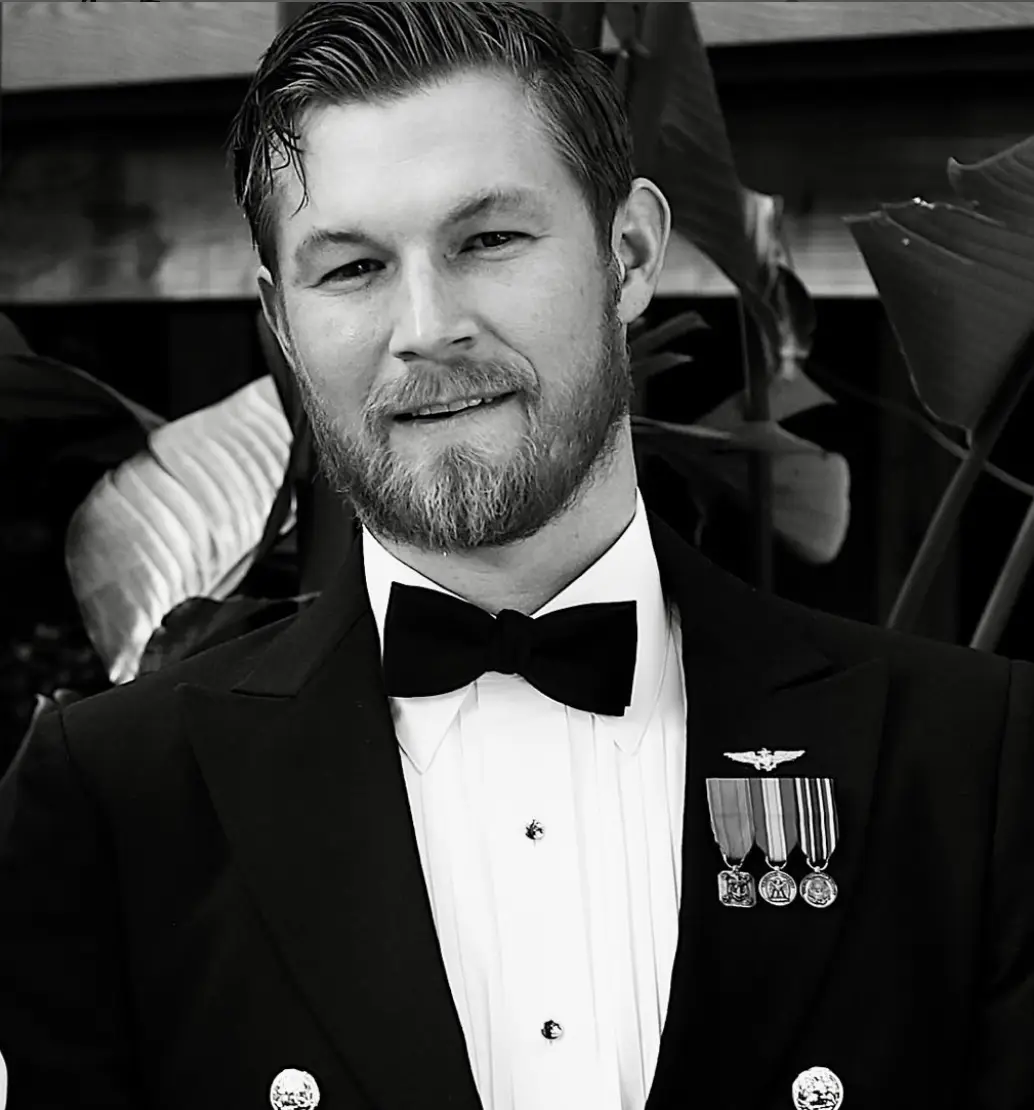
Kegan Gill served as a US Navy Fighter Pilot. During a training exercise he ejected into the sound barrier and sustained traumatic injuries. He eventually returned to duty, but suffered from severe complications due to his traumatic brain injury.
Kegan Gill is a US Navy Veteran who suffered traumatic injuries when he ejected into the sound barrier.
Kegan Gill has been through things that would kill most people. As a US Navy Fighter Pilot, Kegan was forced to eject into the sound barrier as his plane was going down during a training exercise over the Atlantic Ocean.
In the process of ejecting, Kegan sustained catastrophic injuries that literally ripped his limbs apart along with a severe traumatic brain injury.
His body landed in the ice cold waters of the Atlantic, and his wet suit had ripped open. With his parachute still attached, and unable to move his arms, Kegan was continuously dunked into the freezing water for two hours before his rescue. Luckily, his hypothermic condition kept him from bleeding to death.
Kegan spent the following months focusing on his recovery, and despite his catastrophic injuries, was eventually able to score a perfect PFT and was able to return to flight duty.
But his battle was not over. Due to his traumatic brain injury, Kegan began to experience severe, but temporary, psychosis. After being rushed to the emergency room during a psychotic episode, Kegan was admitted to a VA Mental Health Facility.
Kegan did not react well to pharmaceutical treatments, and in many ways, they made him feel worse. After explaining this to his caregivers, they treated him as a trouble maker, and began doing things like keeping him up all night long by flashing a flashlight in his eyes every 15 minutes.
Kegan has since been seeking alternative treatments for his brain health. He found the Warrior Angels Foundation several months ago and is on the path to recovery through nuttracutical and hormonal interventions.
I caught up with Kegan in person at the Warrior Angels Foundation 4X4X48 in Texas. As he told me his story, my jaw hit the floor. In addition to fighting for his health, Kegan is also fighting to maintain his family. He has a wife and two young children.
This is one of the most mind-bending, jaw dropping, and inspiring episodes I've ever done, and I really appreciate Kegan for being so open.
If you are dealing with issues related to trauma, depression, brain health, or anything of the like, head over to www.warriorangelsfoundation.org to learn more. You can also donate to the cause of helping Veterans get their lives back.
Learn more about Kegan's Injuries in this addendum to the episode: https://youtu.be/68qWQxHM-ac
Follow Kegan's journey at: https://www.instagram.com/poeticcaveman/
Transcript
Machine-generated from the episode audio and lightly edited — may contain errors.
Chris Albert (link to this point)
What is up, Warrior Soul Nation? This is Chris Albert Palmitessa coming to you. I am down here in the Houston National Forest hanging out at the Warrior Angels Foundation four by four by forty eight challenge. This is an awesome event over here at a piece of land that the Warrior Angels Foundation procured. We're gonna be running four miles every four hours for forty eight hours.
It's a David Goggins inspired challenge, and we've got amazing people coming in from all over the country. I'm here right now with Kegan Gill. He's a United States Navy veteran. I am recording out here in the field, so you're gonna hear a little bit of background noise. We're also sharing a mic because I have a really ghetto setup.
But I I was listening to Kegan's story a little bit. Wanted to get into a conversation with him. So Kegan, welcome to the Warrior Soul podcast. Can you give the audience just kinda like a thirty second synopsis of who you are, where you're coming from, and and a little bit of your background?
Kegan Gill (link to this point)
Yeah. Thanks for having me. Yeah. I've I spent nine years in The United States Navy. I was a Navy f eighteen Super Hornet pilot.
I was involved in a high speed ejection. I basically punched out into the sound barrier and wrecked my body and spent two years rehabilitating, doing every kind of therapy known to man. I got back to flying super hornets again. Thought I was in the clear. Everything seemed to be going good.
And then about two years back at it and, started experiencing some pretty wild, TBI related ailments.
Chris Albert (link to this point)
That's crazy.
Kegan Gill (link to this point)
Yeah.
Chris Albert (link to this point)
Let me ask you this. So I mean, I can't imagine what that feels like ejecting at that level of speed. Like, you remember that day? Do you remember when it happened and everything like that?
Kegan Gill (link to this point)
So I have I have retrograde amnesia through through a lot of it. I was in and out of consciousness. I kind of remember little clips of it. Sometimes I'll have nightmares of some of it, but I have a pretty good idea between talking to the rescue swimmers and people that were on scene commanders overhead and talking to the medical personnel and people who, were involved in every aspect of it, I've kind of rebuilt the whole picture, of everything that happened that day and they also use data from the aircraft, you know, the black box that comes out in the ejection seat. So they were able to see exactly what was going on with the jet, what all happened, what parameters I was at when I ejected And I've kind of been able to recreate everything, even all the stuff I can't remember.
I've gotten a pretty good idea what all happened.
Chris Albert (link to this point)
Where were you when you ejected?
Kegan Gill (link to this point)
So I was off the coast of Virginia Beach, Virginia, about 50 miles in one of our working areas that we go out to. Yeah. The the day was, 01/15/2014. We went out. We were just, mission for that day was actually just to do a little check on one of our aerial refueling systems that had just come out of maintenance.
We're gonna go up. One of the guys in the squadron, Buddy, he he had the ARS refueling pod on his Super Hornet. My flight lead was my skipper, and he was flying with me that day. I'd been in my squadron at that point eight months, so I was still a fairly new guy. I'd been there long enough that I wasn't the newest guy in the squadron anymore, but I was definitely still pretty new to the squadron.
And anyway, we went out on that flight that day. We we did a few plugs on the air refueling pod to see how it was working to air air refueling. That all went great. And so we had some extra gas and some extra time.
Chris Albert (link to this point)
And so Keep going to the white flags.
Kegan Gill (link to this point)
What we ended up doing is setting up for some air combat maneuvering or basic fighter maneuvering, which is something that requires a lot of practice, and kind of I'm sure like, infantry guys would practice hand to hand combat and shooting their pistols and shooting their rifles. They got to practice that and do it a lot, or otherwise use proficiency. So that's basically what we're doing, and is one of my favorite parts of flying fighter jets is getting to fight the jet in the visual arena with another jet, where you can basically keep your eyes on the other guy the whole time and try to shoot him down. You know, it's good old fashioned dog fighting.
Chris Albert (link to this point)
Let me ask you this. So so you said you were fairly new to the squadron. How long had you been in the navy at this point? And like, how'd you get into the navy? Like, did you did you go through like a ROTC program?
Did you go through academy and stuff like that or or, you know?
Kegan Gill (link to this point)
Yeah. I so I I started off I went through OCS. I was a flight instructor in college and then flew for a small business for about a year after I got out of college, and kind of got some exposure to corporate America and, anyways, didn't end up being the path for me in short and, my buddy was applying to go to OCS to be a pilot and I was like, wait, don't you, doesn't your dad have to be an admiral and, you know, you gotta go to the Naval Academy. He's like, no, man. You can just put together a package and go to OCS.
And so that's exactly what I did.
Chris Albert (link to this point)
That's awesome. That's awesome. Like, so how long did that process take you? You went from you were, like, fine. You went to, like, Embry Riddle or one of those one of those colleges or something like that or like
Kegan Gill (link to this point)
I just went to a little community college up in Northern Michigan called, Northwestern Michigan College. Highly recommend it for anybody, getting into aviation. It's it's a fraction of the price of going to some of those big universities and the training you get is to train you to be a decision maker and to be a pilot. Where I feel a lot of the big universities kind of train you and tailor the program to make you a first officer for an airline, which is great if you wanna go that route and pay a lot of money to do it. But, yeah, NMC was definitely a good way to go for me.
Chris Albert (link to this point)
That's awesome. That's awesome. So, man, like, I'm I'm talking a little bit, like, with you over this whole weekend and, you know, I know that you ejected. You had to deal with some some severe injuries. What was that like for you? Because you're fairly new, you got your whole career for in front of you, and then this happens, like, what was that like?
What was going through your head in the few days afterward?
Kegan Gill (link to this point)
So yeah, after after I came to in the hospital, I was in a coma for about two weeks, undergoing a good dozen surgeries. They basically had to perform, fasciotomies on all four of my extremities. They did, kind of rebuilt my skeleton out of titanium and steel plates. My x-ray looks like Wolverine if he were an undersized dude, and did a bunch of vein grafts and eventually had a bunch of tendon transfers and all sorts of frankenstein stuff going on in my body, but, yeah, I kind of came to two weeks after all that surgery and then being in the coma and there was a good week there where they're like, we don't think this guy's gonna come out of it.
And so it's, you know, pretty hard on family and squad members were up. I was not. No. But, when I did come to you, had no idea, like, where I was or how I got there. I had no idea that I was even injured.
Like, from the brain injury, I was just completely out of it. Combination probably of the brain injury and all the drugs that they had me on, for the pain. But I I had no idea how I got there. And my whole body was basically vacuum sealed in like a plastic wrap because of all the fasciitis. I had open wounds all over my body, so they're trying to keep it from getting infected.
So they put this, like, vacuum seal over me. I was paralyzed, so I couldn't move on my own. I was hooked up to a catheter, and just completely out of it. And it took me at least several weeks before I kinda started to comprehend that I had been in this high speed ejection and that my body was jacked up. And I remember the doctors coming in and saying, hey, man.
We're just trying to be real with you. You're never gonna walk again. You're never gonna use your arms again. Your flying career is over. And there was just something in me who that was just like, fuck that.
You know, I'm I'm going to prove you guys all wrong. So that's kind of what I started doing, and every day was kind of just like try to try to wiggle something, you know, try to scoot a little bit on the bed. And little by little, like, I started regaining some function, and it started like I could kinda scoot my torso. I remember trying to move under the blanket, that was on me. It was just a little thin wool blanket, and it felt like the the blanket was made of lead, you know.
It was so heavy and I couldn't move it. But little by little, like, first one of the first things that started working was my left pinky and my left ring finger on my left hand. So I I started to be able to use that and eventually I was learning how to like brush my teeth with just those two fingers, how to wipe my ass with just those two fingers. And for a while they're like, this is great. Like, you got a little bit of function in your left hand and your arm and so for a while, they're like, that that's great.
That's more than we expected to happen. But as it progressed, like, I slowly started to get a little bit more here, a little more there. They almost amputated my right hand because when I broke my right humerus, the upper arm bone on that, it ripped through my brachial artery. And so it did quite a bit of nerve damage. And, anyways, I have four limb salvages on all four extremities, but my right arm was my right hand was really bad initially, but one day it just started.
It started working. It started kind of shaking a little bit and then I was able to control it and at first it was real shaky and weak, but yeah, just, it just, this is the process that kind of unfolded over months and, in the whole way through, you know, they're pumping me full of, you know, a dozen different medications for pain management and the pain was really bad. The worst pain was my left leg had a lot of nerve damage and open fracture and it had severed one of the nerves in my leg and the nerve pain from that was it would vary from feeling like someone was electrocuting my foot or lighting my foot on fire or crushing my toes with a pair of pliers. And this was would just come randomly, and sometimes it would last for hours. Sometimes it would go away, within a few minutes, and they were trying everything. They had me on Dilaudid and oxycodone and OxyContin and Gabapentin and Amitriptyline and Trazodone and Tramadol, and the list goes on and on of all this stuff they're pumping me full of to try to make that more manageable, and one day a doctor came into the room, he had me sign this little form and he's like, have this treatment I can try on you, it's kind of experimental, but I was like, yeah. I'll do anything to try. And what he did is he took a syringe and he filled it full of glucose, just sugar water, and then he injected it subcutaneously all around my leg and made these little pockets of sugar water just under my skin all around the leg and within a few minutes that pain that was so severe that I was on all this medication was 90% relieved and it lasted permanently from some freaking sugar water.
Chris Albert (link to this point)
That's insane, man. That's insane. How how much body weight did you lose over this whole thing? Because you're not a very big guy right now. Yeah.
Like, I imagine you were you were you were pretty small pretty small at the time. Right?
Kegan Gill (link to this point)
Yeah. I mean, I was I was five seven at the time of the ejection and about a hundred and eighty pounds, so I was pretty stocky for a shorter guy. I was pretty fit. I was lifting weights all the time, running, and that's, you know, part of the reason I survived and didn't get torn apart is because I was a a short stockier dude. And, but in the course of it, I think I got down to a 140 pounds and maybe a little less at one point.
I've kind of rebound and back up to about one fifty five now. Been trying to put on muscle mass, with a lot of nerve damage has been a challenge, but, yeah, little by little getting stronger and stronger. And so
Chris Albert (link to this point)
so how you eventually got back in flying, right? And and how long did that take and and what was that process like?
Kegan Gill (link to this point)
Yeah. So I I went from them saying you're never gonna walk again. I was, I was in the polytrauma center at Richmond, Virginia after I had come out of the ICU, and then I spent three months basically living as an inpatient in that, Polytrauma Center, and the Polytrauma Center was one of the best places I could have been for what had happened to me. You know, there's guys there that have been blown up by RPGs, guys whose parachute didn't open, and they landed on the ground with all their gear on and just destroyed their hips, and you know, a lot of severe injuries with multiple injuries. And every morning you'd wake up and it was speech therapy, vision therapy, kinesio therapy, occupational therapy, physical therapy.
All day every day was just doing everything that they could to try to get you better and they had some incredible care there. The people that were there wanted to be there and really did an awesome job. They had just redone the facility, so it was in really good shape. You know, fresh paint. Every room was very nice.
Talking to talking to some of the Vietnam vets that had come back to a very different situation. You know, 12 guys in a room covered in piss and shit. You're lucky to see any medic a nurse once a day, you know, like, it it was much better, you know, than what those guys went through. Some frustrating parts of it were how terrible the food was, and kind of the tremendous amount of medications they were putting people on, this polypharmy, polypharma. I felt like they could have they could have reduced the medication I was on by one pill throughout the day and maybe it provided, a meal of sustenance.
I remember one of the meals we got was called the holiday feast, and it was, you know, it was supposed to be like this nicer meal, and it was sliced. It looked like stale, sliced, slimy turkey from the deli that had expired that they put out, and then the mashed potatoes were like box mashed potatoes with like the chunky hard stuff in it. The, the freaking, the gravy on it is it looked like it came out of a dog food can, know. It still had, like, the rings on it. Yeah.
And then one of the best parts was the cranberry sauce was a little generic white jelly packet that just said cranberry. Oh my God. When you open it up and it's just like this purple jello basically. Crazy. Anyways, that that was like one of the better meals, you know, and and every every night, you know, you're trying to sleep like here's some basic things you're trying to do.
You just you want to heal. They've got all this money into the therapy and all this, all these people that work for you, all the equipment, and then all night long, they're waking you up to take your vitals, and it's like, well, how about we let guys sleep, let them get some rest and feed them something decent like and a lot of these guys there, you know, despite all of the all the money poured into this place and all the therapy and all the equipment, they were not getting better. And I firmly believe it's because they're not sleeping well and they're getting fed garbage. And I was lucky because I had friends and family bringing me food from outside. And so that's what I think made a difference for me was I was getting better food. But anyways, I spent, basically three months living in there.
I went from paralyzed to walking on a walker and having some arm function and then I spent the next two years basically after I got out of there doing therapy as an outpatient and then a lot of therapy on my own and one of my one of my squadron mates and wives, aunt Smuggs as we call her affectionately, she, she's a physical therapist and she started working with me on my own, like outside of the clinic and she had a she had a Nalgene bottle for her water bottle and it said patient tears on it, so she was there and she was not there to fuck around, and so she she proceeded to just beat my ass and I showed up for the first day with her and I had a cane at that point. She's like, give me that shit. She threw it away. You're not gonna use that anymore.
Chris Albert (link to this point)
That's great. And, Let me ask you this because like, I've been through similar experience like checked into a VA hospital, had tons of sugar every day because that's what they were feeding me. Got woke up like, you know, four times a night like freaking were were you ever able to, like, get rest while you were there? Was there a point where you're able to, like, modulate that that whole experience at all? Like like like, did that did that let up at all while you were there? Yeah.
Kegan Gill (link to this point)
So as as I was there longer, the the regular checks started to decrease throughout the night and I was able to get more sleep and I was also on so many drugs, you know, that I was pretty out of it at night just from the medications alone. So I did start getting better sleep while I was in there.
Chris Albert (link to this point)
Now, this lady, so she she she put her work in right with you, like you what was was did you feel frustration like at first? Were there was it were you with the program right off the bat or was it like, you know, were you fighting with her at all or anything like that?
Kegan Gill (link to this point)
No. I mean, I I had I had always been big into fitness, you know. I I I used to race triathlons in college, and then I got into more like Olympic lifting and CrossFit, and so I had I had always kind of been into fitness. I was a wrestler in high school and played soccer growing up, so I I had always, like, really loved just being athletic and and being fit, so it wasn't it wasn't hard for me at all. I I loved like her attitude of kicking my ass and I I came every day and was just excited to, you know, she'd whip out a deck of cards and we do like the deck of cards workout, you know, I would leave where I could barely walk anymore.
So I I love that and I think just loving that workout and the beat down helped me and in my attitude, the whole thing was just like, I'm gonna prove all these fuckers wrong. I'm gonna get better. I'm gonna go back to flying again and after two years of that, I was, you know, command PT, was like outrunning most people in the squadron and I was I was maxing out the Navy PRT again and, you know, I felt like I was back on top of it again and that was when, the command I was with, like, put in the recommendation and they got me back and, like, I I had basically very little notice, and they class me back up with a new class to go through the f 18 training to get recurrent, and, next thing I knew, I was back flying Super Hornets again. I spent about a year, getting back, qualified in the jet and then went back to the fleet and, was sent out to California to serve with VFA one thirty six Knighthawks in Lemoore, California, and I was out there and seemed like, you know, I'm back at it and everything's going great.
And then I had a flight. We were on detachment Tyndall Air Force Base in Florida and we were doing a missile shoot down there, and I came back from a flight where I got to shoot a AIM-9 Mike, air to air missile, and I didn't remember like 90% of the flight, and at first I was kinda like, didn't really know what to do about it. I went I went to bed that night and I was like, I'll just I'm just gonna sleep it off. And I remember the floor felt like it was pulsing under me. I remember trying to do the math to set my alarm clock for the time I needed to be up the next day and I just couldn't do the math to set my alarm clock, you know.
I kinda had vertigo. I had a really like a sleepless night. The next day I kinda I went in. I was just on duty that day, so I wasn't flying. Was like, I'm just gonna kinda ride it out and see how it goes.
And that the next night, things were even worse. So I I ended up contacting the, the safety officer in the squadron, and being like, hey. I think I might have, it might be type two decompression sickness because at that that time, it was kind of a hot topic in the Super Hornet was, they're having an issue with some of the valves in the in the environmental control system, the ECS causing, pressurization fluctuations. And what that can do to you is you kinda hear this happening to, like, scuba divers where if you come up too quickly, the the nitrogen in your blood can turn into little tiny bubbles, and you can get that in your in your joints, and that's when they call it the bends, and your joints can get real achy and it can really be painful. What type two DCS is is when that little bubble forms in your brain, and that can cause anything from mild mental problems, like memory loss, and and things like I felt I was experiencing. It can even cause, you know, somebody to die if it's extreme enough. But this is caused by the the pressure of the cabin fluctuating rapidly, but it can cause that same thing to happen. So I'm like, maybe that's what's going on.
Maybe maybe I've got one of these little bubbles somewhere in my brain. And so they ended up immediately taking me to a a navy dive base that was nearby, and they put me in the decompression chamber, or the hyperbaric chamber, and they, squeezed me. And I spent, like, three hours in this tube. The dudes doing that were awesome. Like, while I was sitting there talking to one of the guys, he's telling me about how these decompression chambers can sometimes, you know, back when they were kinda first learning about them, they would squeeze guys and they would rapidly decompress.
And, basically, these guys would just turn into pink mist in these tubes when things would malfunction.
Chris Albert (link to this point)
Oh.
Kegan Gill (link to this point)
So we're just kinda talking about that, just, talking about the divers and, like, the crazy stuff they have to deal with where they they do these deep dives for extended periods where they're working on welding something deep down in the ocean, and how they have to spend months basically living in these little tiny pods, and when they're done with the job, then they have to spend months decompressing because they've been down for so long. Anyways, kinda got a glimpse into the the world that those guys have to live in. Pretty wild, but I I started feeling better, like, I went into the tube and and I was just out of it. One of the guys eloquently put it that I was just being an asshole kind of. And by the end of it, I was kinda like laughing and smiling and just telling stories, and I felt better.
And the next day I went in to talk to the doc, because this kind of happened in the middle of the night. I went in to talk to the doc there, and he's like, know, maybe it was decompression sickness, but I think there's something else going on here. Because he looked at my medical history, and he saw that I had TBI and all these physical trauma. So he's like, when you get back to base in Lemoore, I think you should go see the psychiatrist in the psychology department. And so I did that and going in, you know, I was like, going to see psychology is never a good thing when you're, you know, a pilot or, you know, in any role like that in the military.
So I had my hesitant hesitation, but I knew something was wrong, and I knew I needed to try to get help.
Chris Albert (link to this point)
Yeah. Because you go through that that traumatic experience of a high speed injection ejection, and then, you know, you're back flying, you go through that whole whole recovery process, and it must have been felt must have felt awesome to be back up in a plane again. But now you're dealing with this. Like, were was that crushing for you? Was it like like what what were your thoughts going on at that point?
Kegan Gill (link to this point)
Yeah.
I mean, at this point, it started to, you know, that the the light started to go away at the end of the tunnel again. It was kind of, you know, holy shit, like, maybe I'm not better, maybe this can be fixed. It was definitely depressing, especially having just gotten back and like, I felt I felt the whole support from the fighter community to get me back to flying and like all these people like had my back in it and I was I just felt like I was letting people down and like I just got into the squadron and now like now I'm having medical issues again and it was the biggest thing was just feeling like I'm letting these people down. It was pretty frustrating, the fact that maybe I'm maybe I'm done flying for good, you know. But they're like, hey, we're gonna we're gonna get you the best care we can.
We're gonna we're gonna take care of you. I had some residual issues with my left leg, so they they sent me down to Stanford, and they were getting me some of the best care they could to I got a couple more surgeries on my leg to help some of the leg issues I was having, some pain, and that kind of helped a little bit and then they did another surgery and that one kind of made things worse. And then kind of they were turning to the route of, alright, we're gonna have to give you some some drugs again. So they started me on a few, It didn't really seem to help. And then before I knew it, you know, more drugs and then the problems kept getting worse.
And it started getting to the point where I was going into psychosis. It started fairly mild, and then it got to the point where I thought I was being hunted by the government. I thought my food was poisoned. I thought my water was being poisoned. I thought I thought I couldn't go by the windows because someone was gonna shoot me, and I kinda went into this alternative reality. I kinda felt like I was in the Truman Show, like everybody around me was kind of fake, and I I was, like, being videotaped all the time. And luckily, I had my wife there at that point.
Chris Albert (link to this point)
I was gonna say that because I see a ring on your finger. When did you meet your wife, and and at what point did you guys get together?
Kegan Gill (link to this point)
So I I knew, Cara, my wife when we were in college just through, mutual friends. We didn't date or anything, but we kinda knew each other in college. And then, about a decade later, I was back on leave after another surgery I had, a tendon transfer in my left arm and so I was back on leave about a year after my accident and, we started hanging out and we just kind of hit it off And she invited me down to, her her family, lives on a a sailboat, and they go down to the Exuma Bahamas in the in the wintertime. They they bust their ass all summer. They they they have a small business, up in Northern Michigan, doing everything from they basically they can they can do everything from build you a house, to fix your boat, to do your landscaping and everything in between, but they bust their ass in the summer up there and then they take their time in the winter and they go down and they sail around the Exuma Bahamas and and elsewhere, but that's about their favorite spot, and so they invited me down on the sailboat and see if I could hang, I guess, and it was awesome.
Like, it was kind of like camping, like, we didn't have a whole lot. You kind of ate what you caught for the day out spearfishing, but, yeah, I was I was able to go out with a spear and catch fish and help clean the fish and cook and and and just really meshed well with her family, and, we really hit it off after that, and, then we got married, as I was finishing up the f 18 training, and she moved with me out to California.
Chris Albert (link to this point)
So she was with you through the high speed injection?
Kegan Gill (link to this point)
She was not. No, we didn't start dating till about a year after. But, but yeah, she's stuck with me through all this stuff after, and if if I didn't have her and didn't have my kid, my my son Leo, I know at one point I would have definitely I would have definitely ended my life at one point, and the only thing that stopped me was I looked over. This is kind of after the surgeries weren't working, the medications were giving me these psychosis, and I remember I had a pistol in my in my little, end table by the bed, and I was starting to wonder what is that gonna feel like on my teeth, you know, what's the gun oil gonna taste like, and I looked over and my wife is sitting there with our son sleeping, and I was like, can't do that. I don't wanna wake him up, and and and luckily, I didn't go through with it.
Chris Albert (link to this point)
So what was you know, you're going through this period of psychosis. What what was that like for her and and were your children old enough to realize what was going on at that point, like like, you know, how did she deal with the whole thing?
Kegan Gill (link to this point)
So luckily, our our son was a newborn, basically, as this started to happen. So he didn't he didn't realize what was going on. My wife is a trauma nurse, so she had dealt with psych patients before in the ER. And so luckily, was able to she was able to take care of me. At a certain point, they were gonna hospitalize me, and she was an advocate to keep me out of that hospital, at least initially when we were in California. So she I was so lucky to have her as an advocate because had I not had her, I mean, one, I would have been dead from suicide for sure, and even if I hadn't have been going through the process that I next went through, which is the medical board alone, without her, I mean, it would have been bad. But she was a huge advocate. I when it kinda became time for them to say, hey, you know, we think you need to go to a medical board.
It had been over a year. I'd been on limited duty, and they're like, this isn't getting better. It kinda became time to make plans for the future, and that's when, you know, kinda decided I need to go through the medical board and and get out of this. And and so that whole process is is something I wouldn't wish on my enemies. You know?
It it was it was terrible, to say the least. And and I had the support of my command. I had the support of the medical team on base. I had the support of my family. I had everybody's support going into that.
I had a well documented variety of injuries. And even with that, the whole process through felt like everything was riddled with these cracks for you to fall through. And I mean, it almost went to the point where I was gonna get get out with very little benefit. They're gonna give me 50% for PTSD and that was it. Luckily we we were able to appeal that decision, and we ended up flying out to Washington DC to do this formal med board in front of, three high ranking military members.
And luckily they they decided in my favor that day. And and, you know, I've heard this story from so many others. I talked to a marine. He he had received three purple hearts. He had served seventeen years.
He had done several combat deployments. He he had been shot twice. He had been blown up by an IED, and then he had been blown up, I think, by an RPG. He had miss he had a missing leg. He had TBI.
He had all this stuff. He had multiple awards. He was served honorably. He was a badass. And he went through an even worse situation than I did going through the medical board.
The treatment that people get going through it is they kind of treat people like you're a criminal and that you're trying to get away with something, and I get it, there's, you know, maybe there's some people trying to game the system and and and get get some benefits that they may not really be qualified for, but, I hear so many cases of guys going through that have very legitimate cases, and they fall through the cracks. And now they're living under a bridge somewhere. And this is I mean, this happens over and over and over again to people who have served their country, who who know were top performers and and and did a hell of a lot more than I did in their service and still get this treatment. But anyway, I was fortunate to get out. I was medically retired.
Eventually, the process took, I think a little over two years of kind of having life in limbo, not knowing. And then once I got out, we moved back to Northern Michigan, still kinda dealing with the mental issues, dealing with psychosis. And then and then I went into the worst psychosis I had the worst psychosis I had yet, and it was also at the point when I was on the most Seroquel that I had been. They had just upped my dose of Seroquel because things were getting worse, it just seemed the more of this medication they gave me, the worse things got, but I would go in and say, hey, I think this isn't working, and they would say, that's just because you need more of it, basically. And so they upped the dose, And when that happened, within a few days, my wife came out from the bedroom of sleeping with our little boy, and I had shaved off most of the hair off my head.
I had shaved off my eyebrows. I was dressed in nothing but a black garbage bag. And this is February in Northern Michigan, so it's snowing out. I was about to go outside and fight crime like Batman. That was how out of it I was.
And so my wife obviously saw this and was pretty terrified. She called 911, and they sent over a cop car who was gonna take me to the ER. And luckily, at that point, she's like, hey. I I think it would be better if I drove them. So I I think my mom was nearby at that point.
She stayed with our son, so she could take me to the ER. And I remember going to the emergency room in the car and looking in the rearview mirror, and it looked like there was a nuclear explosion had gone off before us. And I was just I was hallucinating that we were basically escaping the blast of this nuclear bomb, and there were cars flying by us and trees knocking down and lightning and thunder, and it was extremely intense. They got me to the I was completely out of it. I ended up as we walked into the ER, I think I had taken off all my clothes, so I was just walking naked through the the hospital lobby.
Chris Albert (link to this point)
Good morning.
Kegan Gill (link to this point)
A cop came up, I think they were about to arrest me, you know, for being a naked dude, but luckily my wife's like, hey, listen, here's what's going on. He's having a serious psychosis. We're just trying to get a medical help, but I I think they almost took me to jail instead of put me in the ER. Once I got me in there, I don't I don't know what all they gave me and I was pretty in and out of it. I remember I thought there was when I was in the ER room, I thought there was like a monster that lived on the other side of the door and I was trying to feed him snacks.
I was pretty out of it, and so after they had stabilized me there initially for a couple days and then they drove me down in an ambulance to the Battle Creek VA mental hospital, and that place was a nightmare to say the least. I started to kind of come out of the psychosis a little bit. I was still definitely having some symptoms in and out of it, but I started to regain some of my mental faculties down there and and and and to put it lightly, like, you know, going through SERE School prepares you in the event that you have to undergo torture and things like that. And that was that was nothing compared to what the way they're treating people in a VA mental hospital is absolutely like torture. And I'm I'm not I'm not blowing this out of proportion.
I mean, the way they treat people there is like you're a prisoner and that there's something wrong with you. And the only answer is we're gonna give you more drugs and more pills. And if you don't wanna cooperate and take those drugs and pills, you're a problem you're a troublemaker. And I remember, you know, I was trying to take some of the medications that they recommended, and I remember some of them were making me feel terrible and worse, and I remember trying to say, hey, this this is not helping right now, and all I wanted was to get some sleep. And what they did instead of me getting a good night's sleep is every fifteen minutes they would come into your room and shine a flashlight in your face.
And you know the the facilities, everything echoed in this in this hospital, so you could hear everybody walking in the hallway, you could hear keys clanking, you could hear other patients in there moaning and yelling, people shouting at each other. Sometimes it would be the the staff would be like having a pizza party in the middle of the night, and and I gotta say for the most part, the staff was was excellent, they had some really good people working there, but they're incredibly understaffed and and some of the people that work there were, I don't know, I guess you could say they were put in a position of authority and they wanted to flaunt that authority more than they cared about caring for veterans And and just the there's this sort of mentality that you these are these are disabled veterans. These are guys who got hurt serving their country, and and they're treated worse than prisoners. And there and there were several guys in there who had been to prison, and they said and they all concurred talking about this, over a meal. It's like, we would way rather go to prison than have to be here.
One, you're you're not getting sleep hardly. The food is is god awful. You were lucky if like one of the best meals that I remember getting was you got a little bowl of spinach and it actually had like fresh spinach in it, but there was hardly any fresh produce. Most of it was just processed garbage, and, you know, they had Oreos and Frito Lay and all this junk food. I remember the water tasted just like a chemical bath, so most people would just drink this artificially sweetened raspberry tea stuff because it made it taste halfway decent, and God knows what was in that.
But between the bad food, you know, the sleep disruption, you were lucky to get outside for twenty minutes a week and just go walk around in a concrete yard, and because of budget cuts, you know, they were understaffed, they didn't have enough people to take people outside, regularly, and everybody had kind of been corralled and corralled into this one corner section of this facility and it was a huge building, but a lot of it had been, you know, shut down. They just didn't have the staff to run it.
Chris Albert (link to this point)
I got it. I got it. Like, so I try to explain this to people a lot. Right? Like and like you said, there was good people there.
Right? But you take good people and you put them into a bureaucratic organization, they're gonna follow the bureaucratic protocols. Right? Like those nurses in the VA probably didn't wanna wake you up, like, every 15 minutes. Like, there's probably a logical part of their brain that's saying, don't but when you put governmental authority and governmental protocols into something and they don't look at things on a case by case basis, they're going to fuck it up royally. And that is a fucking problem.
What you went through is fucking shameful. That's fucking horrible. Like like and the way we treat mental health in this country in general, not just amongst the veterans, but like in general, that is a fucking tragedy. How do you well, as you're coming out of that, how do you come back from something like that? That kind of demoralizing fucking experience because most people would have PTS just from that experience.
Like, how do you come back from that and how do you say, you know what? I because they're basically gaslighting you. Right? They're saying, oh, this stuff is working. You're just not following the rules.
Right? How do you come back from that mentally and how do you have the mental strength to say, you know what? I can do this. I can frigging bring myself back up. Like, how did you do that?
Kegan Gill (link to this point)
So, yeah. I spent I spent about a month there and, you know, I saw, you know, the mistreatment of all these other guys including myself, despite there being really good, there were some excellent people working there, who heart was in the right place and yet they were powerless to really change the way things were, just because, like you said, this is this big bureaucracy and and everything's based around pharmaceutical drugs, you know. That is that is the primary go to treatment for everybody and they're mandatory and if you don't want to take them, you're a problem maker and if if you refuse them long enough, what happened to me was they they held me down and they stuck me full of Haldol and and what Haldol does to you is it makes you feel like your skin is crawling with ants and that all you can do is run and scream. It's the most restless feeling. If you've ever felt a little restless where you just had to move and stretch, it was like that, only the most powerful I've ever felt it. And all I want to do is run and scream and yell, and, you know, that was supposed to help me, but that in itself was just more, you know, maybe maybe that helped in the short run the short term.
Maybe there's a place for some of these drugs to, like, get somebody out of an intense psychosis where they're being violent, but that's it. You know? And once that's done, you need to start getting good sleep, getting outside, getting exercise, having some peace, meditate, do yoga, stretch, like these really basic things is where the standard needs to be for the care, not just take your drugs forever, you're permanently fucked up, just take your drugs and go home. So luckily I had my family advocating for me while I was in there and I was telling them the stuff that was going on and that I needed to get out of there and, you know, had my parent and my family not been there advocating for me, I don't know how much longer I would have been in there, you know. I think I talked to one guy who was in there, he, you know, he didn't, he knew the drugs weren't working for him and when he refused that, they did electroshock treatments and and he was still locked in there and he didn't have somebody advocating for him. So he was just this labeled as this troublemaker and then subjected to whatever treatments they felt they should do, which were usually more drugs, barbaric therapies like electroshock therapy. I mean, there's guys in there with lobotomies, like, you think a lot of that stuff's gone though.
They're they're still freaking giving people lobotomies in there. And anyways, because of the advocacy of my family, you know, was a lot of pushback. They kept saying, no, we need to keep him in here for his safety. We can't let him go. And luckily my wife is a nurse, my my mom is a physician, and they were, you know, health care professionals.
My dad's a health care, professional, he's a respiratory therapist, but they not really applicable mental health, but they all, they all at least were advocating and they had this medical background and that was the only reason that they were able to get me out of there and I spent the better part of the next six months still in a psychosis, gradually coming out of it, but what helped me get out of it was being back home, being outside, getting fresh air, eating healthy food, eating fresh fruits and vegetables and you know, venison that I had procured previously, before going in like eating good stuff and getting fresh air and exercising and you know, it took me a long time to come out of that and I was in and out of several more psychosis after that and then this past summer through a friend, I was still struggling and and, you know, I was still doing the here, just take more drugs, so that'll make it better, and again, the more drugs I was getting, the worse I was feeling, and every time I would go into the VA and talk to the psychiatry folks, it was just always, nope, you just you just gotta keep taking it.
And, you know, I will take some more. We're gonna prescribe you some little ones that you can take as needed in, just that same insanity. And luckily, had a friend who had done a guided psilocybin, retreat in in our area, and I talked to her and she and she gave me the person's contact information, and I went and I did a guided psilocybin retreat one night, and it and it really I wouldn't say it cured everything overnight, but it it it gave me the self awareness and the hope and just a different outlook on life to improve from there. And I've heard the explanation. I think it's my in Michael Pollan's book, How to Change Your Mind, his kind of, explanation of it is like it's like a fresh snow on a hill that has all these rutted paths that you've been skiing down or sledding down your whole life and this psilocybin kind of fills all of those ruts in, be those negative emotions, anger, all these things that were rutted in my brain so deeply, from everything that had happened and it filled those in and then the next day I was able to like take new paths, go down the hill on a fresh line of powder and and and get out of those ruts and so I I had been still doing a lot of good eating and exercise but it kind of put me on this path towards, hey, I need to get off.
I need to get off these medications and there's this kind of fear mongering that goes on like, oh, if you get off your meds, you're just going to go into a psychosis, but at that point I was like, it's not working And it's making me a shell of who I used to be. It had turned me into this angry person that I was not. I mean, before my accident, a lot of friends described me as like a happy golden retriever, you know? Like, I was not this angry, depressed, pissed off guy, and that was affecting my family so negatively. I mean, my wife was ready to divorce me, you know?
We had talked about it. We were just trying to plan how could we do that with the kids, and that that kind of stalled it luckily until I had gotten this psilocybin treatment and, you know, things eventually started getting better after it. I had kind of self weaned myself off the medication, and then I started learning about the Warrior Angel Foundation and this new approach to treating brain injury, which I most certainly had a severe TBI in the fact that the whole time through this process that had kind of been like the elephant in the room that kept getting ignored. And and they kind of kept trying to put this on like, oh, well, maybe maybe you've just always been schizophrenic or maybe this is, you know, something else and it I I felt like I was basically being gaslit, you know, every time I would be like, hey, I have a brain injury, isn't this related to this? And then learned about the Warrior Angel Foundation and this approach like, let's let's make the conditions ideal for your brain to heal and it can heal itself by first seeing what you're maybe deficient in because the a common thing with brain injury is you don't produce the hormones at the levels you're supposed to.
And and as we know, like, when people's hormones get out of balance, it can throw off your mood and your behavior. And then in more extreme cases, with brain injury because of the shearing of the neurons and the ganglion I think the cells that kind of work together to make communication in these networks in your brain when when that becomes sheared from a brain injury it's essentially like, I've heard the analogy, it's like an oil leak. Like rather than this oil flowing through your body and going somewhere to be used the way it's supposed to, it's because of the shearing it just breaks loose and that can cause all sorts of mental dysfunction, all the way to the point of going into psychosis from the brain injury. But this was the first time I heard, like, hey. There's a there's a relationship between what's going on with your mood and behavior and your brain and it being from a TBI.
And so that gave me so much hope just to hear that hey, here's here's a treatment that we can do that's pretty simple really. Mean just basic supplementation of things like fish oil that help to get your hormones under condition, under control, put your body in a state where you're not in a state of inflammation by not eating foods that cause inflammation, getting regular exercise, you know, all these basic things to create a good baseline and create the conditions where your brain can heal itself.
Chris Albert (link to this point)
Let me ask you this. Let me ask you this because, you know, with the VA, they hang that thing over your head. We're gonna pull your benefits for non compliance. Have they tried to do that at all? Or
Kegan Gill (link to this point)
No. I mean, I'm I'm fairly early in, on this going on, and it hasn't come to I haven't had to deal with all that yet. I don't know what's gonna happen with that and and I'm hoping that, you know, I'm just starting this new path. I mean, I I literally just found out about this a few weeks ago. So this is all new to me, but but yeah, it's it's spooky to think like, are they gonna are they gonna take me not wanting to take medication anymore and then be like, okay, you're being a non compliant patient, so we're gonna you yank yank your way kind of your life support that you have right now that's helping to hold your family together while you get shit figured out, and and I'm hopeful in that this is the first time I've heard this idea that, hey, you don't have to be permanently screwed up like this. Like, we can actually get your brain to heal itself if we give it the right conditions. So I'm really hopeful that this is going to be a way forward that I don't have to be this permanently screwed up person the rest of my life and that I can regain some, if not all of the function I had prior, and get back to being, you know, an active member of society and and get back to being myself and, but yeah, it's definitely a real fear and I hear that happening to people where they they they realize the medication is not doing what it's supposed to do. They want to try different treatments and they get smacked with this label, you're being non compliant and yoink.
There goes your lifeline that's maybe helping you keep shit together at this point where you're kind of desperate and and they lose that support and then everything else falls apart. It was like, it's like, it's like being at the top rung of the ladder. You're almost to the top of this thing and then have someone yank it out from underneath you right before, like, maybe you're gonna get to the top of that thing and now now you're homeless, you know.
Chris Albert (link to this point)
It's like a self serving machine because like they have this population of people that they that have to stay on the meds, right, to to maintain their benefits. And then them seeing the meds pay pays the pharmaceutical companies, and then the pharmaceutical companies then, you know, benefit the politicians. And then it's like this self serving cycle, and we live with it. Everybody sees it going on, but you talk about it. You're a conspiracy theorist, and and that's the fucked up thing. Right?
But I look at you and and I've, you know, gotten to know you over the last twenty four hours, and and you look like a a strong person who who is really really trying here and really pushing to, like, get their life together. What's your plans? Where where are you trying to go right now? What what do you see for yourself in the next five years?
Kegan Gill (link to this point)
I mean, my goal right now is just to just to take part in the this protocol that that the Warrior Angel Foundation is is helping people get into
Chris Albert (link to this point)
Yeah.
Kegan Gill (link to this point)
And and kinda see where that goes. My goal initially is just to be not this angry shell of the man that I once was and and get back to being myself to feeling good again, to to having creativity again, to having my brain firing, to not to not be constantly varying mental states where I, you know, can't remember what happened the last two minutes, needing lists to do everything around the house, like, I really just wanna get to a point where I get some of that mental function back and and see where that can go, and you know, once I see people in this program and what's happening to them and you see these guys who are deemed permanently screwed up, brain injury, physical trauma, PTSD, and being told like there's nothing, that you're always going to be like that, and then you see these guys and and when they when the stuff gets fixed at the level of your brain and it heals, then you see these guys getting that motivation back that that put them in these positions to be these elite military members in the first place. And when they become that person again, which is happening all around here talking to guys, they go back and they do incredible stuff in the world. They And to think like what if this was the treatment when I first started having these issues after I'd returned to flying? What if instead of them being like, here's a bunch of drugs, what if they had put me on this protocol? You know?
Would I have maybe gotten better and returned to flying after a year? I think that's totally possible, you know? And and and I I'm really hopeful for the future where this goes for other people too. Like, this could be an option where somebody's struggling, they're having they got blown up, they have brain injury, and and they go from being these elite guys to being just depressed, dealing with drug abuse, alcohol problems, just becoming a shell of who they were and falling out of that person they once were. This is like something that could be a lifeline to people and it could be done so early on in the process that all this other stuff that's gone on wouldn't have to happen.
It wouldn't ever have to come to that. And that's pretty awesome, pretty awesome to think about. But, yeah, I just I just wanna be myself again. You know? I just wanna be myself again and and and be a good dad again and be a loving husband again and be, you know, not this shell.
Chris Albert (link to this point)
Let me ask you this. So a lot of members of of our audience here on Warrior Soul, they're probably going through much the same thing that that that you went through. What's your advice for them, you know, on, given the journey that you've taken?
Kegan Gill (link to this point)
Yeah. Just know that you're not alone in this, and you really gotta keep hope somewhere, somehow. And and I know guys have been through a hell of a lot more than I have, you know, but just try to hang in there and and and try to reach out, listen to podcasts, listen, talk to other vets, know that you're not crazy because you think the drugs aren't working, know that know that if you have a brain injury, this stuff is real. And and you know, there seem to be so many people getting gaslit over this, getting told like, you don't know. We're the medical experts we know.
Know that you're not alone, and know that you're not crazy because you think that the drugs aren't working. It's not you. Like, yeah. Reach out. There's there's a number of organizations growing, and they're providing support like the Warrior Angel Foundation, VETS Organization, which is, Veterans Exploring Treatment Solutions.
These these organizations are giving guys their lives back. And and, yeah, try to reach out and and try to try to learn about these organizations, try to become a part of it. There there's hope. Like, there you don't have to be in the state you're in anymore. You there's a way out of it.
Yeah. Just just fucking hang in there.
Chris Albert (link to this point)
Well, Kegan, one, I I wanna thank you so much for sharing your story. I think a lot of people are gonna find inspiration in that, and and I wanna acknowledge you because you've been putting the work in. You know? A lot of people, given what you've gone through, would have given up a long time ago, and and you haven't.
You're you're still out there. You're still pushing. And, you know, above all, you know, I just wanna wish you well on the rest of this journey. I think that that you're on the right path now, and and, I wanna just encourage you to keep going, man. I think I think that, events like this, we're doing what we're doing right now.
We slept under the stars last night. We're getting out here camping. We're about to do some physical activity, you know, being around other veterans, being around other men. Things like this really help. So, you know, really wanna wanna keep pushing you toward that.
Anything you wanna end in? Anything we haven't talked about that you wanna talk about or anything like that?
Kegan Gill (link to this point)
I'm just honored to be here in this group and to have been invited to do this and just to have this whole world opened up to me to have this camaraderie of, you know, some badass dudes like yourself that have been through this shit and and we're all here together and we're ready to fight, you know, to keep on fighting and, you know, you see these guys here healing and then getting back at it and that's pretty powerful and and I think this is gonna create a force of just so much good in this world of broken mental health, broken health care in general, you know. It's pretty inspiring and and so happy to be here as part of this with you, man. This is awesome.
Chris Albert (link to this point)
Me too, man. And, you know, to everybody out there, I think, you know, there's hope. Right? There's hope. And that's the biggest message we're all trying to convey here.
It's it's an honor for me to be here. It's been an honor for me to talk to you, Kegan. And, you know, we're gonna put in some physical work over the next couple of days. And, you know, to everybody out there, keep pushing, you know. You only get one life.
Live your best lives while you can. Alright? This is Chris Albert Palmitessa and Kegan Gill, and we are out. Hey, guys. This is Chris again.
Just wanted to throw this out there. Kegan and I just also recorded a video where he goes into the actual ejection and the story behind that. It's insane when you hear about the level of injuries and and what he actually went through with that that trauma. But you guys should check that out. It's gonna be up on YouTube on the Warrior Soul Agoge page.
It's also gonna be on the, Warrior Soul Agoge account for IGTV. So check that out. Definitely listen to, to, to that story there because it just adds to everything that that Kegan just talked about on this episode, and we'll give you some context. So thank you guys so much for listening. This is Chris Albert Palmitessa, and I am out.
Host of the Warrior Soul Podcast and founder of Warrior Soul. Worldwide trainer and nutrition coach, contributing author at Testosterone Nation and Muscle and Strength.