Podcast episode
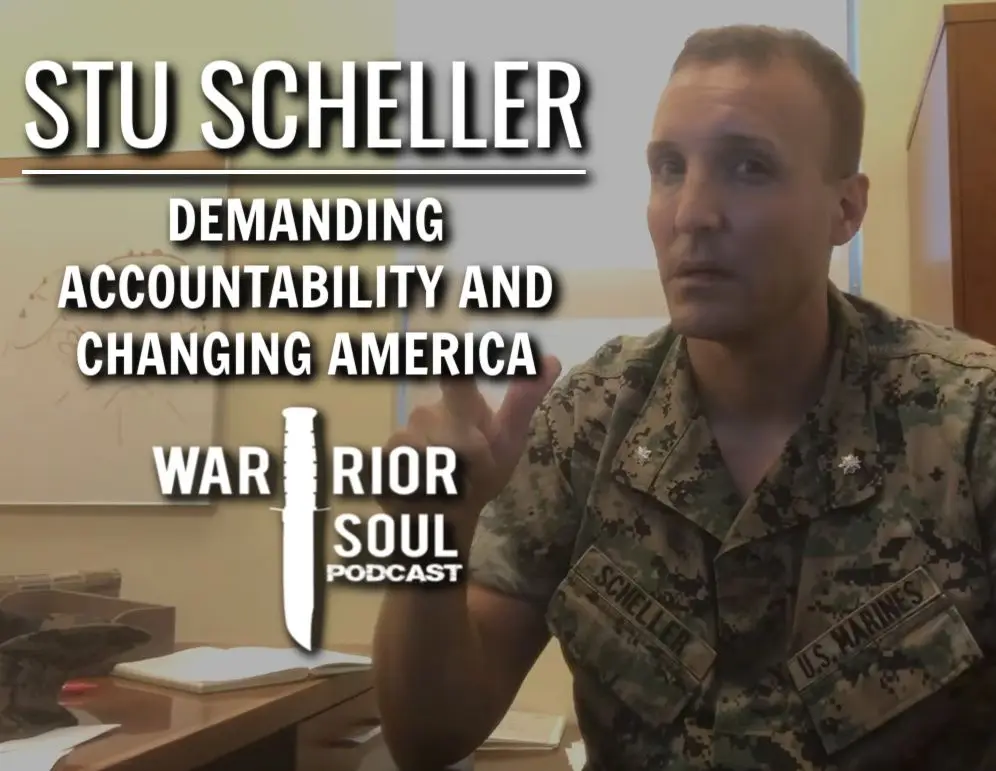
Stu Scheller: Demanding Accountability and Changing America
Hosted by Chris Albert
The Warrior Soul Podcast
Lt. Col. Stu Scheller served as a Marine Corps Officer. He was relieved of command and court martialed after creating a viral video criticizing senior military leadership and the Biden Administration.
Lt. Col Stu Scheller served as a United States Marine Corps Officer, and was relieved of command and court martialed after producing several viral videos criticizing senior military leadership and the Biden Administration for its handling of the withdrawal from Afghanistan.
In August 2021, Lt. Col. Stu Scheller made a video that went viral and rocked the Marine Corps. Amidst the US Military's disastrous pullout from Afghanistan, and after the deaths of 13 service members, including 11 Marines, due to a suicide bomber, Scheller made a video demanding accountability from senior leaders for the failures of the US withdrawal.
In the aftermath of this video, Scheller was relieved of command from his position as the battalion commander of the Advanced Infantry Training Batallion at the School of Infantry - East at Camp Lejeune, North Carolina.
Following this, Scheller posted several more videos criticizing Marine Corps leadership, and calling for accountability from the Presidents and Generals who oversaw the war in Afghanistan.
Scheller, a combat Veteran with multiple deployments to Iraq and Afghanistan, was sent to the brig for defying a gag order. He remained there for eight days until a plea deal was struck.
Lt. Col Scheller's story has been widely told. In this interview, I wanted to discuss what he is up to now. Scheller has since left the Marine Corps, and has created Authentic Americans which is "a virtual town hall where independent thinkers can network, think, and discuss critical issues facing the American representative democracy across all political ideologies, ethnicities, classes, and religions." Its goal is to reunite the United States.
In this discussion, we also talk about the immense pressure Stu was placed under for criticizing the Administration, what his family was put through, and how he got through it.
You can follow Stu on Instagram at www.instagram.com/stuartscheller
And you can catch up with Authentic Americans at www.authenticamericans.com.
Transcript
Machine-generated from the episode audio and lightly edited — may contain errors.
Chris Albert (link to this point)
Stu Scheller, welcome to Warrior Soul podcast. How are you doing today?
Stu Scheller (link to this point)
Good, Chris. Thanks for having me on.
Chris Albert (link to this point)
Awesome. Awesome. You know, like I told you before we hit record, I've I've been following you since everything happened. I'm sure most of the audience knows who you are. But, you know, for those because podcasts apparently survive forever.
For those who are gonna be listening to this for for five, ten years from now, Could we go into, like, a little bit of a background of of who you are and where you're coming from?
Stu Scheller (link to this point)
Yeah. Thanks. So my name is Stu Scheller. I was a Marine Corps infantry officer for seventeen years, and I was thrust into the spotlight when as a battalion commander in my uniform, I made a video that demanded accountability of my senior military leaders because there were some things in the Afghanistan withdrawal slash evacuation that were mishandled in my opinion. It wasn't something that was isolated.
This was something that had been building in me for a while. And that was just kind of the straw that broke the camel's back. I knew no one else was going to say it. And it wasn't an easy decision. I didn't do it haphazardly.
I thought through it, but I ultimately did it. And then after that was a series of escalating events between myself and the Marine Corps, ultimately resulted in me being imprisoned, court martialed, and then I resigned from the Marine Corps short of my retirement. And so now I am that process was very difficult because I was under a gag order. I couldn't do any media. I couldn't speak.
I couldn't post. I couldn't do anything. So there was a lot of narratives about me because it seemed like everyone wanted to listen to some reason I was doing what I was doing other than I believed in what I was saying. Right. So it was either he was a violent extremist, he's a right wing extremist.
It's about the money. It's about politics. I mean, you pick a justification that they could apply to me. It was hard because I couldn't say anything to counter those narratives as they were running. And so I got out Christmas Eve.
It's the second week of March. For the last my goal was to do a bunch of media through February and then kind of back off. I did just complete a book that'll probably be out this summer that really goes into detail of not only the experience that I went through, but really the experience of my career. And so, like I said, it had been building for a while. And so through the book, I'm able to really illustrate in detail a lot of, in my opinion, mismanagement.
The military's focus should always be on war fighting, on winning wars. And since World War Two, we've gotten away from that. And the singular focus on impressing a boss so that you can navigate your career has detracted from our ability to win wars. And we have people in senior positions that don't push back because they got promoted because they didn't push back, because they pleased their bosses. And so then when they get to the senior ranks, they don't have the internal fortitude or the ability to push back when things don't make sense.
That's why we have incidents like Benghazi. That's why we have incidents like the Afghanistan evacuation. And we just don't hold these people accountable. So accountability isn't the answer to the complex problem of the promotion and retention system. That's a complex problem that I address more thoroughly in my book.
But at a minimum, accountability causes a course correction and forces senior leaders to realize that in addition to navigating their career, they also have to be responsible for winning wars. And so right now what I'm doing is just getting out there and talking to people and trying to let my voice be heard. I'm not hyper political. This was never political for me. I am a conservative, but I'd like to think that most of my messages are apolitical.
But I have gone out and dealt with a lot of people running for Congress and work with some people trying to endorse people. Because even Congress, I went through my ordeal, apolitically, they all argued with the generals, brought up why the generals fell short, but then nothing happened. And what I was really disappointed, not in the media, was that their leverage of control over the generals in the DoD is the budget. Congress controls the DoD budget and concurrently to all their vocal outrage, none of them stood against the budget or used the budget at a minimum as a tool for leverage in terms of demanding some of the things that the American people should be demanding. And so I'm active.
I don't plan on running for politics, at least in this twenty two season. I've got to kind of recalibrate myself, but I still am very committed to having these conversations and talking about how we can get back on the course where I think we need to be headed.
Chris Albert (link to this point)
Yeah. You know, when when I first when I saw your first video come out, I I was automatically thinking in my head, man, this this guy is really putting it all on the line. And, you know, I I remember those days, right, because I felt immense frustration at at the situation that happened. When when those marines and the soldiers died, I felt even more frustration to the point of anger, and I know so many other people did as well. And it felt like you were the only one who was punished for the whole ordeal by by trying to call people out, by trying to to to call for accountability.
It felt like you were were the only only member of the military who was punished for for anything to do with that situation. And, you know, the UCMJ is what it is. Right? It it they they they'll always find something to charge you with. But, you know, and I know you've talked about this before on on podcast, but what was going through your head after you actually hit publish on that video?
What what we what were you feeling like? Because I know you've had a great career. I know from other podcasts, never thought you would you would go as far as you did in the military. You you actually never never saw yourself as a careerist or anything like that, which is probably why you think the way you do. But but what was going through your head in those following days?
Stu Scheller (link to this point)
Yeah. Like I said, I didn't come to the decision lightly. And I understood. I mean, I articulated in the video that I knew I was risking my job, my retirement, my family stability. So I obviously had thought through it.
But again, this is just something that I've dedicated my whole life to. I was very personally invested. I mean, was emotional. I tried to be rational with my arguments, but to say that I was divorced from emotion would be disingenuous. Like I was very invested in it.
And I just you get to a point where you just can't remain quiet anymore. A lot of the arguments were he may have been right, but that's not the way you address it. That was even the Marine Corps public response. And I, in my book, illustrate the processes that I went through after the fact that were all essentially denied. So there are processes.
But when you when your complaint is an indictment on the very senior leaders of those processes, they just don't go very far. And so I was in a no win situation. I could have silently gone through the processes and gotten nowhere and had that conversation ended. And I still, even if I had silently gone through those processes would have put an X on my back. Then I would have been a battalion commander that was complaining that didn't believe in senior leaders.
My career ultimately would have been over. It just would have been much quieter.
Chris Albert (link to this point)
Right.
Stu Scheller (link to this point)
I could go very public, start the conversation public and still be fired, but have a voice be louder and resonate more. And so I chose to go public with it.
Chris Albert (link to this point)
Mhmm. When in the response, like you said, there were people saying multiple different things about you from from he's lost his mind. He's he's not mentally right. The Marine Corps, I believe, itself was was saying that they were doing mental health checks on you when they actually weren't or doing anything thing of the sort. I've been on your LinkedIn page, and and, you know, I've noticed there was a there's people out there trying to claim that you were sitting behind a desk the whole time you were in the Marine Corps and never went out, which I also know is not true.
You know
Stu Scheller (link to this point)
That person is a senior adviser to the chairman of the Joint Chiefs of Staff. So that's not like a random person. Like That's senior leaders in our government system are saying that. I mean, factually incorrect things.
Chris Albert (link to this point)
Yeah. That's it's insane. And and so, you know, I mean, to set the record straight, you know, multiple deployments in combat, you know, performed exemplary. You know, you you you definitely have the record to show it. Are where are you in terms of being able to, you know, take any kind of legal action against these people who who have been able to who've been, you know, spreading these types of things.
You know?
Stu Scheller (link to this point)
Yeah. So the one situation you described, I was upset because that person said that I had publicly gone after the general. They said that I didn't have combat experience. All these things that were factually untrue. Like you can have an opinion and disagree with the methods with which I did it.
You can have an opinion. That's what we want. We want healthy discourse. When you say factually untrue things, that's where I draw the line. So I actually, I waited to respond to that one because I sought legal counsel and I was like, this isn't a random person.
This is a person that has the ear of the chairman of the joint chief of staff. And my lawyers basically said it wasn't winnable because I'm a public figure now and that could be construed as opinion. The other lawsuit that I'm thinking about, there was another article that compared me to Hitler, called me a fascist. When I said that I was going to prefer charges against General McKenzie, the title of the same author's article said he can't. And it's just like, that's factually incorrectly.
He quoted some law professor that was a former JAG officer. And that guy was like, I haven't read the Manual Court Martials in a while, but I don't think he can. And I'm like, looking at it, like Article three zero seven, Manual Court Martials. I guess black and white that I can do it. And so like that guy, for example, left his article up for ten days and then revised it, but didn't put why he revised it.
And that same article is the one that received my full investigation that had my medical records in it. And then they stated, we have the full investigation, which implies it has my medical records. And then they revise their article to drop that because they realized they published something that was potentially illegal. And so when I went to my court martial, the judge was even like, if that's true, if they leaked all this stuff, like those people should be held criminally liable. And so the Marine Corps was forced to do a separate investigation on my leaked investigation.
And ultimately, they concluded that they couldn't figure out where the leak came from. And that's that. And they're not going to further investigate it. So I've had to request. I asked for that.
They wouldn't give it to me. So I'm going through the Freedom of Information Act to pull that investigation. Once I have that, I'll decide if I'm gonna pursue legal action against the Marine Corps and this publication. But I mean, these are not just two examples of it's like, it was very difficult this entire situation.
Chris Albert (link to this point)
Right. You know, and the most frustrating thing is because in the Marine Corps, you know, I went through boot camp in 1999 to Parris Island. You know, every step of the way, it it was about accountability. Accountability. Accountability.
Accountability. You've if you fucked up, you you you paid for it. Right? Every single step of the way throughout my career when when I eventually became an an NCO, everything was about accountability. And you're calling for accountability, which is, you know, one of the the core foundations of of being a marine.
And they're they're spreading all these things about you. They're they're making up rumors. They're and it just seems we're in this time and place where somebody who who makes a very sane call like you did can can be criminalized and and and and made out to look like like a villain, you know, through the whole thing. And and, again, yeah, were there different ways you could have done this whole thing? Absolutely.
But at the same time, you know, if nobody's listening, if nobody's paying attention, if if if, you know, we're going through this whole debacle that occurred over there and nobody steps up and says anything at all, where are we gonna be? Right? It's gonna be written out of the history books. It's gonna be nobody's ever gonna find out about it. The young marines are never gonna find out out about it.
The the and our military is just gonna keep going on into this never ending downspin of of crap, you know, along with the whole country. I mean, it's an insane situation to me.
Stu Scheller (link to this point)
I completely agree.
Chris Albert (link to this point)
Yeah. Yeah. It's awful. You have a family. Right?
And this is one of the things I, you know, I I've heard you talk about in other podcasts, but I wanted to get in a little bit more detail about it because most of our audience, combat veterans, US Army, US Marine Corps, you know, they they're dealing with their own situations at home. Right? And and what I really wanna get from this episode at the end of it is, you know, your advice to to those veterans out there who who are also frustrated, but also to the young marines who might still be in, who listen to this show, and and and and the young service members who might be listening to this show. We all deal with family situations. Haven't been in the military.
It's it's ubiquitous. Your family situation was put under a mess immense stress because of this. And I want to ask you, how are you doing right now? And and, you know, how's your wife doing? How how are your kids doing?
Stu Scheller (link to this point)
Yeah, so I'll come back to that last question with how my family is doing, but I'll just say so in my book, I think I developed this pretty thoroughly because it's understated the pressure that's applied to a family through a career. I mean, it's immense. And even there's this facade of B billets where you get time off and that's not true. Anyone that says there's a time off billet is disingenuous. Every commander gets one command despite the operational significance, and that's their one shot to prove their worth.
And so they figured out how to apply pressure to key high performers and work them fifteen to eighteen hour days, no matter where you're at. You add deployments, you add time away for training, you add all the moves every couple of years. And it is very challenging to maintain a stable family life. And I understand, like the work life balance is supposed to be something that we figure out. But at the same time, it's very hard to navigate a successful career and remain committed to your family and provide them the time and things that they need.
It's just I struggled with it. And I think I outlined that in my book pretty well. So right now I'm going through a divorce. Not divorce is tough. I still love my ex wife.
Like she was with me for seventeen years. She's the mother of my three kids. I don't have anything bad to say about her. In many ways, this situation may be illustrated that our paths are going in different ways. And like I said, she's been moved so many times and just been through so much.
And quite honestly, like seventeen years, we may have only spent eight of those together. Right. So it's just been tough on us. And I think she had a vision of retirement and time with me. And when that all got taken from her, it just added a lot of pressure to our marriage.
So we're trying to navigate the new normal. Like I said, I've got a good relationship with her. I'm not going to speak ill of her, but I think that's just another situation of how the military just doesn't really care. It's got to be you as an individual to figure out how to strike that balance. But mean, it was tough.
I had friends, reporters, people in the military calling her when we're going through in this, adding stress to the situation, not reaching out and helping. And it's just the betrayal that I went through in a lot of different fronts really made it even more challenging to not lose my mind a little bit because everyone was trying to take something or project something upon me. It didn't seem like there was a lot of people willing to help.
Chris Albert (link to this point)
You're basically gaslighted through the whole thing on a personal level, on a professional level. And and I actually think that the same thing occurs, you know, throughout the military in a wider, maybe less severe basis when when when you don't have a target on your back. But, you know, you take take things like veterans coming off of active duty, and they're they're expected to go out into the civilian world with with very little preparation for for how to conduct business out there. You know, and and I think that the whole thing is gaslighting on a wider basis because we go out into the world thinking it's supposed to be one way, and then we're told we're crazy when it actually isn't. And and I think, you know, in your situation, it puts a spotlight a spotlight on something that's actually happening throughout the military.
Just in your situation, you know, they they were actively trying to gaslight you.
Stu Scheller (link to this point)
Yeah. Yeah. So hopefully, people that are struggling with things, they listen to this podcast or any of my other podcasts or read the book that I'll have come out this summer that they realize like we're all in the same situation. Hopefully we can help each other. But I don't there is no simple answer to it.
I thought I was going to be married forever. I was married for seventeen years. It's just one of those unfortunate things.
Chris Albert (link to this point)
What's the title of your book?
Stu Scheller (link to this point)
Right now, it's Crisis of Command. I don't know if that'll stick. Like we put a preorder out there. I just finished writing it like last week, the initial manuscript and got it through the initial editor, and now it's up with the publishing crew. So I don't know when they wrote the description.
I didn't write the description and theirs was more on the macro level. I wanted to tell my personal story and weave the trends that I saw through it so that may evolve. But ultimately, it is my story from when I joined the Marine Corps up to the incident is about half the book describing the macro trends that I see and the struggles with the families and how we're kind of overworked, underappreciated, how we're not a war fighting focus, how there's other initiatives that have kind of detracted from that. And then I go into the other half of the book is really my ordeal, which kind of continues to illustrate the themes that I brought out in the first half of the book.
Chris Albert (link to this point)
Right, right. How long did it take you to write the whole thing?
Stu Scheller (link to this point)
I actually wrote it in probably a month, but I mean, I had done a bunch of podcasts. I had wrote a lot of posts. Had already formulated a lot of what I wanted to say through different correspondence. So once I sat down, it flowed pretty easily. The hardest part of writing a book is just getting started, right?
You sit down, you're like, once upon a time, once I got into about my chapter three, chapter four, it started flying. And then, you you just go back, refine, refine, refine, weave the themes throughout. So I'm pretty proud of it.
Chris Albert (link to this point)
That's awesome. That's awesome. And when are you expecting it to come out and where can people go preorder it right now?
Stu Scheller (link to this point)
Yeah, you can, my website authenticamericans.com has all my social media tied to the bottom. It's got a pre order for the book. It's even got a merchandise store where we added a button for a signed copy of the book, but it's also on Amazon. You can go on Amazon and preorder it Crisis of Command. So either my website, authenticamericans dot com or Amazon is where you can preorder.
Chris Albert (link to this point)
Awesome. So let's talk a little bit about Authentic Americans because I know you've been very active. Like you said, you've been you've been doing the podcast circuit and things like that, and and you've created this this kind of organization. What is Authentic Americans, and and and what's your message?
Stu Scheller (link to this point)
I ultimately think that the Republican and Democratic Party used to have like a definition of what that meant, and I feel like they both kind of lost their way a little bit in terms of like, is the ideals of your party? And it seems like you can find hypocrisy on both sides. They'll pick one issue and then a year later, they'll be on the other side of the issue, just depending on how it reflects on the party. And so that's that's the central theme is like we need independent thinkers that cannot necessarily be beholden to just a party. I started with like, I'm a conservative, but that doesn't mean that all of my views align with the Republican Party.
In fact, many of them don't. And I've been talking to Tulsi Gabbard a lot. We're connected and she's a Democratic Congresswoman. And she says the exact same thing. Like, the Democratic Party that I joined is not the Democratic Party anymore.
We need more accountability. So it's like, you have a guy that's a conservative and a girl that was a Democrat and we're both military minded and both kind of see the problem the same way. So I think there's a lot of people that feel that way. And so that was kind of the pull of the website was just, hey, we need honest discourse. I just made a social media post last night about Ukraine and Russia.
It was an unpopular view. It was, hey, I think Zelenskyy could have done more to prepare. He's begging us to do more when I felt like he could have done more. And it was just like the same things. It was like, you're a Russian puppet, you're a wash up, you're a disgraced military officer.
It's all these personal attacks. I don't care if you disagree with me, but attack the argument with logic. And that's what I feel like we've gotten away with, specifically in the two party system. It's like these personal attacks on the people without developing a logical argument and defending it. Like, I appreciate opposing views.
And that's what authentic American says. Like, You need them. It makes me smarter when people disagree with me on my social media post and make these very insightful disagreements. That makes me a smarter person. That makes me better.
I'm not so entrenched in my views that I can't change. I literally modified the post last night because I said Ukraine hadn't supported the wars in Iraq and Afghanistan. A lot of people hit me with facts. And I was like, all right, you made me smarter. I went back and updated the post like that.
We have to have a healthy dialogue, but it becomes in our modern day, just these personal attacks without logic. And I think social media is partly to blame for that. I think the two party system and the media also have a hand in it. And so it's just getting back to the ideals of the founding fathers where they didn't want political parties. They wanted a healthy discourse and people to be able to be educated enough to see through a lot of the half truths.
And so to me, that's what Authentic Americans is. It's real Americans that maybe don't all agree, but can have healthy dialogue and think through the issues about just like divisive name calling.
Chris Albert (link to this point)
Right. Right. It's funny because, you know, I'm I'm I'm what you'd call an ex democrat. Right? Because I grew up in New England.
People from New England typically vote democrat. And and, you know, I that was prior to, I wanna say, like, 2015. And around 2015, I started opening my eyes and and kinda seeing, you know, the way the party what I thought was the party of tolerance, what I thought was the party of of logic was becoming highly illogical and highly intolerant. And I just couldn't couldn't agree with anything anymore. And and and, you know, they they did do things like, you know, things like calling Tulsi Gabbard a a a Russian puppet or calling you a Russian puppet and I know.
Crazy. For a differing view. And I I just can't understand that. And one of the things I'm noticing out there is I think that that the Republican Party has come around on a lot of issues. I I don't think it's come around on everything.
I think that that there's definitely changes that need to be made, but I think that there's a lot of us out there who who don't identify with either of them anymore, and and we wanna see something that that works. We wanna see we wanna see common sense again. And and I think that projects like this are outstanding, but at the same time, they're also often violently resisted. Know? There was just an event at Yale University.
You know, it was supposed to be a bipartisan event that that that got shot shouted out, and everybody in there had to get escorted out with security. So it's it's becoming impossible to even speak your mind about these things anymore. You know, I think Bret Weinstein tried to create a bipartisan project on on Twitter, and he got kicked off Twitter. I mean, it's it's insane. You know?
Are you facing any of that type of resist? Well, obviously, you are. People are calling you a Russian puppet, but like, have you seen a lot of that coming out?
Stu Scheller (link to this point)
Yeah. So like when I got out, I focused on media shows. So we'll start with the media. Again, I wanted to engage all demographics. CNN, MSNBC covered my story. I have a PR agent now.
We reached out to all those talk show hosts and they won't bring me on. And so the media gets a vote in terms of your ability to project to a different demographic if they refuse to allow you. So then I'm relegated to all these conservative talk shows and they're like, oh, you're a right wing talking puppet. I was like, well, what do I do? Like, what's the answer?
Do you just not speak unless you can get both of them to engage? And so I just came to the conclusion that I'm going to speak to anyone that's willing to engage me. My only stipulation is that it's live and it's not edited out to make me look stupid. So if we can have a healthy discussion back and forth, we may not agree, but I'm willing to speak to anyone that's willing to engage me. And so that's been a problem.
And yes, I've watched Ben Shapiro. I don't agree with everything he says, but he also pointed out exactly what you're saying. How common the hecklers vote has become, where he goes to all these speaking engagements and a lot of people disagree with them. And what happens is the people in the audience just start yelling so much that he can't even have the conversation. I watched one where he was trying to engage the heckler and he's like, hey man, there's 500 people in this room.
I will give you the first question and we can have an intelligent conversation. All I ask is that you allow me to speak for the other 500 people that are in here. And he just like, he wouldn't allow that. He just kept heckling to the point where security had to take them out. And so it goes back to everything we're talking about.
When you don't have a logical argument, what it turns into is you're a racist, you're a bigot, you're a fascist, you're a Russian puppet. And it's these name calling things that don't actually provide illogical counter response. And it really, I think is maybe the biggest threat to our democracy. If we continue down this road of just not having intelligent conversations and just name calling, it's I don't know how we solve that.
Chris Albert (link to this point)
No. It's horrible. And I think it's it's it's only gotten worse. I I I think that social media is definitely amplifying it. But, you know, I mean, it's some people could throw their hands up and say, know, what else do we do?
And I think the answer is, while we keep having conversations in platforms like this where where things aren't edited, where where where, you know, we're not trying to create, like, some clickbait headline that's trying to to make people scared and make people afraid.
Stu Scheller (link to this point)
Podcasts are a symptom. Their popularity is an offshoot of everything we're talking about. Like, people now are going to podcast because you just can't get a straight view from the media because it's always through their context. I did an interview with Newsmax the other day, and they told me I was going to talk about Russia and Ukraine. So I'm ready to talk about Russia and Ukraine.
Got a lot of opinions on that. In the interview, he plays a clip of Joy Behar from The View talking about how she can't go to vacation in Eastern Europe. And then he comes to me and he's like, disconnected much. What are your thoughts? And I had to say, like, on an alive interview, I'm not gonna answer that question.
I wanna talk about Russia Ukraine. And then I went into Russia Ukraine, but like that's, and it almost makes me look bad because like I'm on his interview, but it's like, dude, I'm not falling into your trap. It's like they almost wanna like, put you on the spot and get you to say something that is, like you said, clickbait and it's challenging.
Chris Albert (link to this point)
Yeah. You know, and I remember back in 2000 probably 2001, 2002 after 09/11, we're going into the lead up to the Iraq war when when it was a debate about whether or not we're gonna do it. And and, you know, you noticed the language back then, we were eating freedom fries rather than french fries. We were we were talking about the axis of evil. We were we were dealing with all these things.
And, you know, in my opinion, we got ourselves into a foolhardy, you know, 10 war in Iraq when we should have been focusing on other things. And, you know, I think that I've been seeing the same thing. I saw the same type of language with with coronavirus, right, the way they were describing the the unvaccinated. I saw the same I'm starting to see the same type of language with Russia and Ukraine and and things like that. Do you notice these types of patterns and and with things like like Russia, with with Ukraine, do you think we're we're headed for another engagement over there?
Stu Scheller (link to this point)
I hope not. You know, if they if they spills into Poland or Latvia or Romania, then I believe we will. Quite honestly, Biden. Biden led us to this with the Afghanistan evacuation, it was so mishandled that created a domino of instability. But his he didn't start the Russia invasion.
That was Putin. And quite honestly, Biden did a pretty good job of calling out what Putin was doing. Zelenskyy even said, stop saying it because you're hurting my economic markets. And that was kind of my post the other night, like Zelenskyy could have done more to prepare. If you go back to Crimea, that was five years ago.
He's had five years to build tunnels like the Hezbollah did against the Israelis in 2006. Like, why don't we have those? Like, what have you been doing? Why are you so unprepared? So Biden hasn't completely mismanaged this portion of it.
And another point would be the no fly zone. To your point, would we get drawn into this? Biden has said, I'm not getting involved in the no fly zone because that would be us fighting over the skies and could lead to quick escalation. And again, I agree with that. And so, like I said, I have independent thoughts.
I just couldn't have been more disgusted with how he handled Afghanistan. I think it led to some of the events in Russia. But up to this point, he he he's made some right decisions in terms of how to handle what is happening that is ultimately out of our control in a lot of ways.
Chris Albert (link to this point)
Yeah. I see. And and right there on display right there, you're you're very open minded about these things, you know, because they I see here, and and, like, I think I wear some very, like, skeptical glasses when it comes to our government and these types of things. You know? And and and that's me because, you know, I've seen us get drawn into wars before, and and and it feels like it almost feels like in some ways, wars is just the common state of affairs for our country.
Stu Scheller (link to this point)
Yeah. 100%. At least it has been for my whole adult life.
Chris Albert (link to this point)
Yeah. And and I I constantly feel like there's somebody out there trying to get us into a war somehow, you know? And so that's the way I think. And and, you know, I think I definitely have those prejudices and particularly when looking at this president. You know?
I I but but you're right. He has done he has done a good job of keeping us out of things so far. What else are you working on besides True Americans, besides everything, your book? What else do you have planned for yourself?
Stu Scheller (link to this point)
Yeah, right. So did this media, did the book. I'll probably promote the book again in the summer when it comes out. I'm starting a veteran town hall. So our first one is in Jacksonville, Florida.
The premise is veterans and first responders come in and they articulate their concerns, whether it be VA, whether it's accountability. And then we go advocate in DC. So I've been working with some political action committees and some lobbyists. Right now we're trying to get the GI Bill amended so that people can use that money for businesses, for entrepreneurial endeavors rather than just getting a college degree. A 45 year old that gets out doesn't necessarily want go get a bachelor's, but they could definitely use that money for starting a business.
And I think starting a business is something that we've gotten away from in our generation because everyone was told to just go get a degree and be a professional in an organization where honestly, I think America's greatness comes from people going out and starting businesses. And so in doing that, I've made a lot of connections. I already told you I was endorsing a bunch of candidates. So I have, I think, the ability to influence some things within the veteran community. So I'll be doing one of those a month.
I mean, we're going everywhere, whether it's Tennessee, California, Texas, you name it. So we haven't published all the locations. Right now, We're looking at how to get media coverage. And like I said, I've been talking to Tulsi. So like the Tulsi Gabbards and the Pete Hegseths and the people like that, I'd like to get maybe our younger generation that fought in the GWOT wars to talk about what we can do to advocate for the community.
And so, I mean, between that and everything else I got going on, man, that's that is my full time job.
Chris Albert (link to this point)
No, that's awesome. That's awesome. You're doing so much. Entrepreneurship, I think, is is so important because it's being able to write your own your own fate. Right?
Like, in in some ways. But also, I think I think that if everybody in our country was an entrepreneur, I think more people would have a better understanding of economics, more understanding of of the impact taxes have on people, more understand more care about who was on their city council or or, you know, who was their mayor and and local politics and things like that, and and more care about their neighborhoods. I feel like I feel like entrepreneurship should be taught everywhere, and and everybody should be required to at least learn a little bit about it. Right?
Stu Scheller (link to this point)
Yeah. A 100%. If you go to my YouTube channel, you'll find an old video before this whole ordeal where I said just that. I mean, I've been advocating for active duty to be entrepreneurs for a while now. So I started a business while I was on active duty and I got real involved with an organization called Bunker Labs that advocates for veterans that own businesses.
And my problem was when I went to these events, I was kind of an outsider because I was active duty and most of their almost all of their clientele were veterans. And I like, what are you guys doing for the active duty? And I talked to the CEO at the time. His name was Todd Connor. And I was like, hey, man, what are we doing to make inroads in the military so that active duty has more ability?
I mean, there's these boots to business. There's these things that they have, but they're all during transition. There's not like you've been in for six years and you might do twenty. Here's resources to build a business rather than that person going and seeking out different things. And his point was general officers primary concern is war fighting capability and anything other than that is a detractor.
But my position was, yeah, that's true. But look at when I first came in, the College degree was seen the same way. Right. So it's like, if you're doing a College degree, you better do it in secret or it'll look like you're not busy with your job and you got too much time on your hands. Script has flipped over the last twenty years where now it's almost a requirement like the Marine Corps pushing to have enlisted or be required to have an undergraduate to get to staff sergeant because they see the effects that it has on war fighting, right?
Having a more educated person produces better results. And to everything that you just said in terms of entrepreneurship, I think the same thing, if not even more is applicable for someone that's starting a business than just getting a college degree. Now there is limitations when you're active duty. Like you're not going to go start a restaurant. Like I acknowledge that.
But there are ways that you can create a product, go through the patent process, network, build trade skills, all of these things. And quite honestly, the problem why suicide is so high is when they get out of the military, there's this steep drop in purpose that they had that they lose. You can't just start a business and have it be successful overnight. So laying groundwork for some of these things, and there's a lot of purpose in owning your own business. If these veterans were able to walk out from active duty into veteran status and have a platform already built for a business, I think they'd be much better positioned.
And so for all those reasons, I've been advocating. That's why I'm trying to write legislation now to get it through the GI Bill. I've an advocate for entrepreneurship for a long time.
Chris Albert (link to this point)
Yeah. That and I also think real estate is a because I think veterans a lot of veterans don't realize we have an unfair advantage when it comes to real estate with the VA loan. And I wasn't educated about this until, I think a decade and a half after I got out. I actually had a guy named Marke on Sytch on on this podcast. He runs an organization called Active Duty Passive Income.
What a lot of veterans and and active duty military members don't understand is, like, you can use that VA loan. Right? While you're in, you can you can buy a house. Alright? You can hold on to that house and refinance out of there, get yourself into another one at the next location.
Or what you could do is something called house hacking, where where you live in the house, and then you rent out rooms to help pay for the mortgage. Like, right now, I live in a house. I bought off the VA loan. It's it's a single family home with an attached efficiency. I live in the efficiency, and then I rent out the house, and and everything's covered.
And that that's my my foot into real estate. And I think that's if we got into property ownership and and and and understood that a little bit more, if guys were spending their money or saving their money rather than spending on crap, it would go a long way into ensuring veterans had a stronger footing in the civilian world once they got out.
Stu Scheller (link to this point)
100%. I'm glad you brought that up. A great example. I've got a as I was going through my entrepreneurship stuff, there was a lot of people that I met that were, seven figures, staff sergeant. No one really knows how savvy some of these guys are.
I think Rich Dad Poor Dad is probably a great book to read along those lines in terms of real estate investing. That one did a lot for me. But yeah, 100%. There is a lot of opportunities, especially when you're I mean, even if you're not an investor, but just staying somewhere for three years and then moving instead of just selling your house, willing to assume the risk to renting it out and allowing appreciation to build. Yeah, 1100% agree.
Chris Albert (link to this point)
Absolutely. What about fitness? You look great, right? And I think a lot of people would expect, you know, you get out of the military, you went through the ordeal you went through, expect you to be out of shape by now. You look great right now.
What are you doing?
Stu Scheller (link to this point)
I work out every day, man. I have my whole life. I've struggled with anxiety. Know, it was exacerbated by the Marine Corps and a lot of people fall into the false trap of pills and drugs. But for me, working out is what clears my mind.
I think better after I work out. So I try and work out every day.
Chris Albert (link to this point)
That's awesome. That's awesome. Do have any particular diet or anything like that too?
Stu Scheller (link to this point)
I'm not a big dieter. I mean, if I ever was disciplined enough in one of the APAC abs, I probably should do that. But I mean, I'm cognizant of it. But really, the secret to that, to me more than anything is not drinking more than maybe a couple on the weekend. Alcohol, I think, will put a gut on me faster than anything else.
But I try to stay healthy, high protein after I work out and stay off the sugars. But I don't I'm not a Nazi about it. I allow myself without being too critical, just trying to eat healthy as best I can.
Chris Albert (link to this point)
What types of things are you doing for your mental health? Right? And and, like, we all know about, you know, the the VA and and and things like that. But, you know, like I said, you you you seem happy. You seem, like, really, really, I don't want to say comfortable with everything that happened, but you've accepted it and you moved on.
What plays into that? What are you doing for yourself to make sure that you stay focused?
Stu Scheller (link to this point)
Yeah. I mean, I brought up the pills. I think almost all of our diseases and I don't take this to an extreme, but most of them can be solved by natural remedies. I think we all have the power within us to make lifestyle changes to a lot of the things that we seek pills for. That's not true in every situation.
Like, you've got to be smart enough to apply judgment to that. But mostly, I think there's a lot of ways that we can analyze our diet, our behaviors and make changes to get on a healthier course. All things flow from a stable physical base. Right. So I place more emphasis on my intellectual capability.
But at the same time, if I'm having chest pains or if I'm don't pick your poison, then I can't do all the other things that I want to do. And so I try to maintain a good physical base. And I've gotten I always kind of frowned on yoga, but I had I was just trying everything that I could and yoga with like a balance of meditation in it is kind of my jam right now. I like to do that. Sometimes people look at the focus of yoga as stretching.
But if you look at it more of a just kind of quieting your mind, I think it can be very helpful. So between yoga and then just I think a problem with a lot of us and I fall into this trap is electronics. Electronics can just always be in your face and not allow you to to calm yourself. And I was in jail for nine days and in a lot of ways, being in a solitary confinement cell forces you to sit there and be silent in your mind and kind of address all these things. And so a lot of ways, it was healthy for me.
And I found that the best part of my day, every day in jail was I got a cup of coffee in the morning. And I found myself at night ready, excited to go to sleep just so that I could get up and slowly drink my cup of coffee in the morning and kind of have a moment to myself. And I've actually continued that after I got out. So now a lot of people get up and the first thing they do is they check their phone, they check their emails. I purposely allow myself to make my cup of coffee and sit there and slowly drink it and work through the morning.
And then once I've drank my cup of coffee, then if I want to check electronics, I can. But you got to kind of figure out in your own schedule how to carve out times for whatever your mechanisms are to decompress and have time with your thoughts. I mean, sometimes in the car, it's a great way to just kind of sit in the car and think.
Chris Albert (link to this point)
How are you setting up your day these days?
Stu Scheller (link to this point)
Yeah, I mean, like I said, all the things I was talking about, it's I love being an entrepreneur. My goal was going to be to retire twenty years and start a business. And so I just didn't want to work for a boss anymore. And so what I've really enjoyed is being able to build my own schedule. So I've got different people. So in my website, I've got her title as COO, but she's really the Jack of all trades.
So it's like anything Authentic Americans, like I'm using her when we're talking to veteran town halls or the political action committees. I've got a guy that runs the political action committee and I kind of push it to him if it's something else. So I've got like these different people in these different areas that I use to help me. But when it comes, I've got a PR agent, so a lot of media appearances go to her. So I built like this team of people that I use and the rest of it, I try and build my schedule based on what I want and and trying to incomplete the goals that I've set out for myself.
Chris Albert (link to this point)
I'm going to ask you a few questions to finish up here that are kind of typical podcast questions. But but these are questions that I've been particularly for for this interview, really want to know the answers to. If you could go back seventeen years to Stu Scheller, right before he's heading OCS, what advice would you give yourself?
Stu Scheller (link to this point)
Yeah, that's a tough one. I would say that being a Marine Corps officer will provide you purpose. That's what I was looking for at that time in my life when I joined. I wanted a larger purpose. And the Marine Corps absolutely provided that for me.
I think sometimes our patriotism and our desire to serve can be manipulated by people, by Hollywood. I mean, I watched Black Hawk Down maybe 10 times when I was in college thinking that it was just the ideals of America and it glorified combat. But when you actually study the operational failures of Somalia, it's mind blowing how more senior leaders weren't fired that put the people in those positions that allowed them to make that movie. And so I just didn't have any perspective for that. Like you said, when we went to Iraq, I thought that that was pro America.
I thought pushing our ideals on other people was the right thing. And a lot of the arguments people have used against me were like, why now? You've served in seventeen years and done all these things. Why are you just speaking out now? And the answer is I've evolved as a person.
I have educated myself. I have experiences. I have read things that have brought me to a different understanding of the world. And quite honestly, that whole argument seems weird to me because it seems if that's your argument, it's like we don't want any general officers to ever admit fault because they have been part of the system for the last thirty, forty years. Therefore, they can't now speak out.
The logic doesn't make sense to me. And so going back to my original self, there was just a lot I didn't understand about the world, about foreign policy. But I don't know if 23 year old me really needed to be concerned about that. 18 to 23 year olds should join just to serve a higher purpose. And there should be trust in the system that the senior leaders are making the right decisions to put them in those positions of conflict only if absolutely necessary, only if it increases the sources of national power.
And I think I just got a little disenfranchised along the way when I realized that all my selfless sacrifices weren't necessarily towards the greater good of making America stronger.
Chris Albert (link to this point)
The next question goes the opposite direction. Five, ten years from now, what Stu Scheller doing? What does life look like for him?
Stu Scheller (link to this point)
That's one that one's tougher for me to answer. Know, a lot of people came to me and wanted me to run for politics in '22. And I thought about it actually. But then I came back and told them no. And I'm still thinking about it for '24.
And if you had talked to me a month ago, I'd have said I'm absolutely going to run at 24. But now it's like even the longer the time goes, the more I'm like, I don't know if that's my purpose. I'm maybe too honest to be a politician. But then again, that's what I wanted my politicians is authenticity, honesty. I don't see anyone else providing it.
I made that second video on a tree farm I have with school buses. Like part of me wants to just go out to the farm and grow vegetables and be a recluse and just write books and read. And so I think I need to figure out what I want. Ultimately, I want to make a difference in the world. My whole life has been that as my guiding principle.
Like, I want to leave a better world to my sons. And I don't know if I could do that just working on the farm. But does that mean I jump into politics? I don't know. Maybe working through these political action committees and advocating for legislation and doing better in town halls and writing books, I have more of an impact.
So I just need to kind of evaluate is where do I have influence? What makes me happy? What's good for my family and make decisions? But right now, my future is uncertain.
Chris Albert (link to this point)
It's hard. It's always hard to think about that, especially at somebody at such a crossroads like you are right now. And I think a lot of guys at home are experiencing that right now. I think it helps to hear from someone like you who's been through so much to you know, hear your that kind of perspective on on, you know, being okay with not knowing. Right?
And and and and kind of accepting that. Couple more things. So who are your heroes? Like, do you have any heroes out there that living or dead that that that you refer to?
Stu Scheller (link to this point)
Yeah, I think. Yeah, that's a great question. First of all, Abraham Lincoln, I mean, that guy fired more generals in the war, the Civil War. He wanted it to be a limited war. And he came to the conclusion that it had to be all out war for him to win.
It was the most important thing was winning and was just firing. He assumed that the general officers knew what they were doing, and he found through trial and error that they didn't. And he had the internal fortitude, not having any military experience to just continually fire people until he got to Grant, who, quite honestly, wasn't a great tactician. But Grant's strength was not quitting and maintaining the engagement with Lee. And so I was always impressed with Abraham Lincoln when he announced that he was going to free all the slaves based on the Union's victory.
When I read some journals and books about him, his wife adamantly opposed that. I relate to that very strongly. Right. Like, imagine being in a house where your wife is like, don't do that and you doing something at the risk of your marriage. Mean, it was different time and divorce wasn't as common then.
But he did something that was completely counter to what his wife wanted. I mean, just a guy with great internal fortitude. And I respected him a lot. Another one is Martin Luther King Jr. I mean, that guy talks about not discriminating based on color and talking about equality of people.
And I feel like his message has almost gotten lost. And it's almost this equal opportunity where racism is prevalent under his name. And when you go back and read actually what he wrote and what he said, I feel like his message has gotten lost. And he was just a very prophetic speaker, deep thinker. He was very strategic, too.
So he did things understanding public opinion and how to do things to create the greatest impact. I don't know if he played chess or not, but he strikes me as a chess player and his message was a solid message. And so I could keep going. Mean, a president that not a lot of people remember is President Truman. President Truman fought in Belleau Wood in World War One.
And then in World War Two, I'm sorry, in Korea, General MacArthur, this legendary general that we just don't build generals like anymore, He single handedly convinced the Navy to land in Inchon. We didn't have combatant commanders back then. So this is a guy that's basically convinces everybody, convinces the President. There wasn't a SecDef really back then. They were just creating a Department of War.
And he convinces this very aggressive naval landing, achieves operational surprise. But then MacArthur assumed he was going to continue going north and use tactical nukes against the Chinese. And Truman, after MacArthur had done all these brilliant things, had the ability to say, no, you're not going to do that. And then ended up firing him in the end. And just the way that system worked between the president and a very intelligent general is lost in a lot of ways.
And so I respected Truman a lot for his ability to kind of take a stand. And so there's three examples.
Chris Albert (link to this point)
Yeah, those are great examples. I love the Lincoln one, not only because of the story there where he brought the union back together. But but you're right. His wife was a very difficult woman. I I mean, at one point, I think she tried to spend government funds on completely refurbishing the White House, and and he figured it out.
And and he he didn't have much money. He was actually a very poor president, but but used his own money to to to pay the government back and things like that. And then, you know, of course, Martin Luther King and and and his message, it's just, you know, absolutely amazing and and absolutely aspirational, something we should all aspire to. But Truman, that and MacArthur had MacArthur gotten his way and had Truman not made that stand, it would have set, I think, a precedent for us to eventually be a military dictatorship.
Stu Scheller (link to this point)
And we would have set the precedent for nuclear war in other places post World War II. I mean, that historical example is lost in a lot of ways, but I mean, very significant event.
Chris Albert (link to this point)
Yeah.
Stu Scheller (link to this point)
Huge, huge.
Chris Albert (link to this point)
Well, Stu, man, I got to acknowledge you, man, because you took your stand. Right? And one of the things I try to do with this show, particularly with the individuals I bring on, is I I like to get these stories out. I like to show our audience the human being. I I brought on Eddie Gallagher as well.
I've had him on twice. And and just because I I know the man, I I know what the media said about him, and it was a 100% off, you know, the stories they created around him. And and and the same with you. You know, to go through something like you've gone through and to not get so discouraged that that you just throw your hands up and give up, I think that's absolutely amazing. You paid a hefty price for it.
You know? And and and in a lot of ways, I'm embarrassed for my country because of the price you've had to pay for this whole thing. But but I really do appreciate you, and and I know that so many audience members out there appreciate appreciate what you've done. Can you tell the audience where to catch up with you on social media? I know I know you you mentioned your websites before, but let's mention those one more time so people can get over there and link up with you.
Stu Scheller (link to this point)
I appreciate it. So authenticamericans.com. At the bottom, you'll find all my social medias. Almost all of them are at Stuart Scheller. But I'm on Facebook, LinkedIn, Twitter, Instagram, Gettr.
So I'm on most YouTube, most of platforms. But there are some fake accounts out there that we've gotten rid of most of them. But Twitter still got a couple of fake ones, so a lot of people use my name to try and spread their own messages. Just make sure you're on the right one. You can find it through authenticamericans.com.
Chris Albert (link to this point)
Absolutely. Once again, Stu, thank you so much for being on here to everybody out there. You know, I hope you got a chance to go through this episode and and really listen to the things that Stu brought to the table. I hope that you're able to make difficult decisions in your life when when the time comes. And, you know, above all, I hope that our country starts to figure some of these things out that that that we talked about today because I I love America.
I love this country. That's why I served this country. I know that's why you guys served this country. You know, let's not just let go. You know, let's let's let's keep up this fight because I think America is worth fighting for.
The real America is worth fighting for. And, you know, I wanna wish you guys the best of nights, and I want you to get out there and live your best lives while you can. This is Chris Albert, and this is Stu Scheller, and we are out.
Stu Scheller (link to this point)
Awesome.
Host of the Warrior Soul Podcast and founder of Warrior Soul. Worldwide trainer and nutrition coach, contributing author at Testosterone Nation and Muscle and Strength.