Podcast episode
The 20 Year War with Dan Blakeley and Beau Simmons
Hosted by Chris Albert
The Warrior Soul Podcast
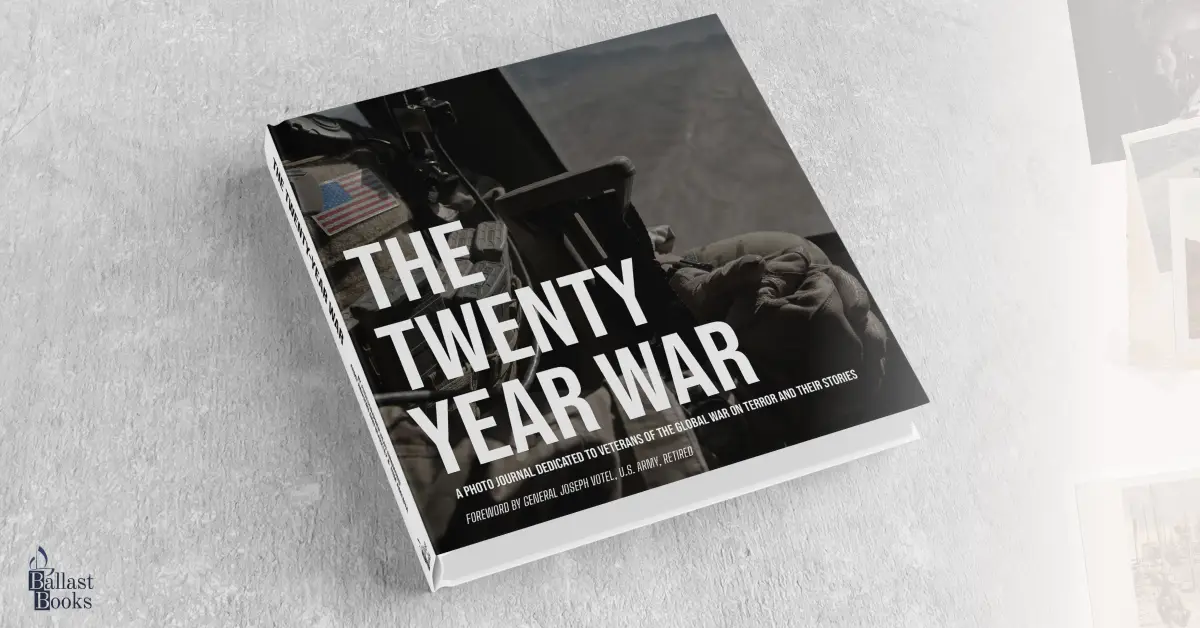
The Twenty Year War by Beau Simmons, Dan Blakeley, and Tom Amenta
The Twenty Year War chronicles the transition stories of over 70 post-9/11 veterans with pictures and discussions of their lives post-service.
Since the beginning of the Global War On Terror, we have started chronicling the story of this conflict. The history of warfare is typically written by generals. They give their thousand foot view, talk about the big strategic picture, and pay little homage to the perspective of those who actually fought the war.
In recent history, we have seen much more of the perspective of the average warfighter. This is largely due to the increased opportunities technology affords the average person to tell their story.
Yet, we have seen very little perspective on what happens after the war is over. How does a Veteran carry on after serving in combat? Despite the efforts of podcasts and other media outlets like this one, very few media outlets have covered these stories.
The Twenty Year War by Dan Blakely, Tom Amenta, and Beau Simmons is unique for this reason. It is a photo book that chronicles the post-service stories of over 70 veterans. Rather than focusing on combat, the book focuses on the trials, tribulations, and lessons learned from these veterans' transitions into the civilian world.
Beau Simmons is a professional photographer who grew up in the high desert in California. He got his start in the fashion industry, but has since transitioned his work to focus on classic Americana and the American landscape. He gained his commitment to telling authentic stories about veterans through the nonprofit, Heroes and Horses.
Dan Blakeley served in the United States Army's 2nd Batallion, 75th Ranger Regiment. He went on to get an engineering degree from Appalachian State University where he helped start the school's Solar Power Racing Team. Dan's transition out of the military was not easy, and he has a passion for telling the stories of veterans who've succeeded, which is what inspired him to create The Twenty Year War.
Tom Amenta also served in the 75th Ranger Regiment. After leaving the Army, Tom spent 8 years as COO of the veteran clothing brand Ranger Up and was an Executive Producer on the film Range 15. Tom's passion for helping and advocating for veterans led him to coauthor The Twenty Year War.
You can find The Twenty Year War at twentyyearwar.com. When you use the code VET21, you can get 20% off your purchase through Sunday November 14.
Transcript
Machine-generated from the episode audio and lightly edited — may contain errors.
Chris Albert (link to this point)
What is going on, ladies and gentlemen? Welcome to the Warrior Soul podcast. To those of you who are new to the show, my name is Chris Albert. This podcast is where we deliver tools, tactics, strategies, and ideas to empower The US military veteran community to live their absolute best lives. A lot of times, I'm on here doing interviews, interviews with people like Robert Greene, the author of the 48 laws of power, people like Ryan Michler, the host of the Order of Man podcast, people like Bas Rutten, former MMA fighter.
And I talk to all these people because they have insights. They're Ryan's a veteran, but but there's a lot of people who were not veterans who I bring on to the show to bring ideas, tools, and tactics that that, you know, many of us might not have heard of. And what I want you to do is apply these to your lives. Today, I am speaking to both a veteran and a civilian. And I have on Dan Blakeley, who served in the second battalion seventy fifth Ranger regiment.
And I have his lifelong friend, Beau Simmons on, who is a photographer, who has worked in the fashion industry. And they came together. They grew up together, but they came together to work on a project called the twenty year war. And they got together with another second battalion seventy fifth Ranger regiment veteran named Tom Amenta. Tom was, at one time, the COO of Ranger Up, a very famous veteran clothing brand.
And this book that they put together is a photo book, and it's photos of veterans. And unlike a lot of other books, there's not a lot of talk about combat or anything like that in the book. It's about veterans' stories of their transitions into the civilian world. And they talk about the the difficulties they've had. They talk about the successes they've had.
They they talk about advice for other veterans. They've got some some famous veterans in the book, like Tim Kennedy, like Vince Vargas, and others. And then they've got some veterans in there who who just had amazing stories. And what interested me about this project is that it's so unique. Right?
There there there's not a lot of stories out there about veterans who have gone off and and and, you know, continued their lives and and gone on to do other things. And one of the things I said about this about the community at the start of the show was I was sick of just hearing about suicide, and I was sick about just hearing about veteran homelessness and drugs and all the other problems we've had. I wanna hear the real stories of people who've gone out there to succeed, and that's what we need to hear. Right? And maybe they haven't had an easy road to success.
Maybe there's a little bit of darkness in there. Maybe there was some failure. Maybe they tripped up over themselves and and and and came back. We need to hear about all of that, warts and all, because that is what is going to give us the guide points for living our lives. You know, as I'm recording this, it's Veterans Day twenty twenty one. We are at the end of an era. You know, twenty years ago, we started this global war on terror. I don't think at the time we knew exactly what we were getting ourselves into. But through that time, we applied ourselves.
We overcame. We met obstacles. We adapted. We made mistakes. We lost people.
We lost lives. And a lot of us have come back, and, you know, we're we're civilians now. We have a whole new life to live, and that's what we need to focus on. The mission right now is here on the home front. It's in our communities.
It's in our families. It's in our places of work. That's where we are right now. That is where the war is being fought, and we all need to take part, every single one of us, to move this community forward, to move this country forward, to make it what we fought for. Right?
And I hear a lot of people talking about, well, the promise of America, you know, is kinda lost on me. Guess what? That's up to us. That's up to us. We have to fulfill that promise because America is us.
Right? And I think you'll get the sense of that from this conversation. I really enjoyed speaking with Beau and speaking with Dan here. I think they they both brought their unique unique perspectives. It was really interesting hearing what Beau had to say being a civilian about his experience being out there interviewing the veterans.
It was also great to hear what Dan had to say being a a a seasoned veteran who who had served for so long and and and who had wanted to get this project together. And I I think these are both great guys, and I think it's an outstanding project. It's called The Twenty Year War. I'm gonna have the links up to the up to it on the show notes for this episode. You should all go and check out this book.
I think it's a worthwhile project. They are gonna be donating to various organizations out there. And with that, I've already talked too much. I'm gonna stop yapping my gums. Let's get into this conversation with mister Dan Blakeley and mister Beau Simmons.
Beau Simmons and Dan Blakeley, how are you guys doing today?
Dan Blakeley (link to this point)
Doing great. Doing great. Thanks for having us on, Chris. We really appreciate your time.
Chris Albert (link to this point)
Awesome. Yeah. I really appreciate you guys coming on. We're also gonna have, Tom Amenta. He's gonna be coming on a little bit potentially.
But I wanted to bring you guys on. You guys have a a book, a project that you've been working on called twenty year war. And I wanna get into that. I wanna get into the project. It looks absolutely awesome.
But first, I wanna hear a little bit about you guys, your backgrounds, and and how you came together on this.
Dan Blakeley (link to this point)
Yeah, so Beau and I have actually known each other since I was six, and I think he was five years old. My dad was in the Air Force, but my grandparents lived two doors down from Beau. And every time I would visit my grandparents in the summers, I basically would hang out. I remember the first time that I met Beau, my mom was like, Hey, I think there's a boy down the road that you might want to play with or something like that. And I was like, all right.
So I walked down the road, knocked on his door, and said, hey, do you have a son? And what do you want to play? And then from there, basically, we just became best friends and hung out every summer. And eventually, when my dad got out of the Air Force after twenty one years, we moved to Yucca Valley, California permanently, and so me and Beau went to school for a little bit of time. I ended up graduating actually a year early and then enlisting in the army and going to second ranger battalion, which is where I served for six years.
Beau and I kind of stayed off and on connected throughout many years. Eventually I moved out to North Carolina. We just every couple years, maybe every couple months, if I was in in California, we would hang out. He would try and find a reason to come out to North Carolina to come visit me. And we just stayed connected in that way.
And our paths crossed again this last year, and and we'll get into that a little bit. But, you know, that's kind of a little bit about my history.
Beau Simmons (link to this point)
Awesome. Yeah. It's funny enough, too. I mean, I dunno how your mom let you hang out with me, because I think I was a really bad influence at that age. We got in real And the funny thing is like what you just said, you graduated a year early and I almost got held back my senior year.
That explains it. But no, so like Dan said, you know, I grew up with him and our lives took several paths. He went into the army, which really motivated me at 17 to want to enlist in the Marine Corps. And I took my ASVAB, I scored pretty high on it. I went down to MEPS, so I was waiting in line to get the physical and sign your documents and everything, and then my dad showed up in the car and picked me up that night.
And basically I was still underage and he just didn't want me to go to war, I'm his only son. And I think it was kind of a hard place between mine and my father's relationship, but it short lived. You know, I was angry for a few months and then I kind of picked back up where I was going when I turned 18, and my other passion was photography. So I pursued that between working in fashion for over about twelve years between Los Angeles and New York City, and I got really burned out on it, and you know, 2020 came around, and I think all of us were forced to follow the decisions of what we want to do with our life with the pandemic and everything else going on. So like Dan said, I packed up everything in my car.
I spent about a month and a half driving across the country, and moved in with him and his wife for probably about seven or eight months before I finally got settled down in my own place here in North Carolina.
Chris Albert (link to this point)
Oh, wow. Wow. So that's moving on a dime. That's crazy.
Beau Simmons (link to this point)
Yeah, I remember the last time I visited Dan, this was in probably, it was June 2020. I flew out and was visiting him and his wife, and I think I spoke to him a week later when I got home, and he was like, What do we gotta do to get you to move out here? And I was like, Not much. Like, I'm really considering it already. So literally, I told him January 2021 that I would move out, and it was actually in August, I moved like two months later.
So I basically found the right opportunity, had a little money saved up, and just kind of went with my heart on it. And it was great, because obviously what we're gonna be talking about in this episode is it led to us creating a book that I know we're just very honored and privileged to be doing.
Chris Albert (link to this point)
Yeah, absolutely. Dan, let me ask you this. Know, growing up with Beau, growing up out in in the desert, joining the joining the military, what what made you join the military? And then and then I also want to ask you, as you got out, what what types of things were you trying when you got out? What types of how was your transition in in coming out?
Dan Blakeley (link to this point)
Yeah. Well, you you can ask Beau this. You know, he grew up in Yucca Valley, but I I didn't necessarily. I just visited every summer. And at the time, and, you know, those early 2000s, Yucca Valley was really on a downward spiral.
It just had crazy drug problems, not only just in the community, but also within the school. You know, I came from a pretty good school in Bellevue, Nebraska, and then ended up coming to Yucca Valley, which was a, I'll just say, a pretty significant step down to a different school in a different environment. And I would have told you up until that point that I wasn't going to join the military, but really, that was my only opportunity to get out. And I decided, you know what, I need to do something to take on my own responsibility for my life and my path, and I wanted I felt the need to serve at that point. And so I was like, you know what, I'm going do it.
And I convinced my parents to do it. It's a funny story. I convinced my mom to let me join. And she told me not to do anything dangerous. So I initially signed the delayed entry program contract as a parachute rigger, because at least I could jump out of airplanes, but I wouldn't be in direct combat.
And then when I went to sign my formal enlistment papers, they told me that that MOS wasn't available anymore. So I said, okay, I'll take the other airborne job. And I remember the colonel sitting on the other side being like, you mean airborne ranger? And I was like, yeah, that one, I'll do that one. So needless to say, I didn't tell my mom for many years what I was doing.
But, yeah, when I got out, it was, it was not easy. You know, everybody talks about how their transition was difficult. Some people, you know, go through transition in different ways. For me, it was a complete disconnection from my military service. I just don't know why, looking back, you know, I can make a plethora of excuses of why, but I just didn't talk to a lot of the people I served with.
I didn't identify as a veteran. I didn't go to, you know, veteran student resource centers or anything like that. I went to school immediately after, you know, immediately after I initially got out. And yeah, I just didn't identify myself as a veteran. I just tried to kind of put it behind me.
And it took me eight years, it took me until 2020, to really realize that that was a huge mistake, that I should not have pushed it off to the side, but instead, I should have leaned into it and leaned into my experiences and everything that I've been through and, and really use those life lessons to, you know, make my family stronger, my teams I work with stronger, my friends and co workers stronger, and just, you know, just use again, the lessons I've learned in the leadership capabilities that I've had to really just be stronger for everybody around me. And I'm doing that now. But it took a long time.
Chris Albert (link to this point)
That's crazy. Because when I got out, I did the same exact thing. I wouldn't call myself a veteran. I didn't I didn't even go to the VA for years after I got out. I wouldn't I wouldn't talk about it.
I wouldn't I wouldn't let anybody know at all. I I ended up moving out to California, went to school out there, and it was the worst mistake I ever made in my life. And and I'm a 100% in agreement with you there. What what caused you to lean back into it? What what was the the thing?
Was there like an event or something like that?
Dan Blakeley (link to this point)
Yeah. It was, you know, it probably started the fall of twenty nineteen. It's really where it like started, you know, the juices started flowing. Of my friends that I served with, he started a podcast, he actually asked me to come on to the podcast and just share a little bit about my story and my background and what I was doing, especially in the professional world. But it definitely caused me to think about my past and what it meant to me.
And that got me to realize, you know what, I should have been talking about this a lot more up to that point. And it really started getting me to think like, how can I help other veterans? And how can I get them to realize that the path that I went through is the wrong path? And that there are more resources out there for veterans, and there are more resources out there for transitioning service members it's like reach out and like figure out what's going to work for you because there is no single solution for every veteran. Every veteran's got to figure out what's going to work for them.
But I wanted to figure out how to do that. And so that's that's how we eventually got to to me and Beau kind of working on the book together.
Chris Albert (link to this point)
Yeah. Now, Beau, you said you had a background in fashion, you know, the career you've working out in LA, and that's that's something that, you know, I lived in LA for a little bit. Everybody there is trying to make it at something. Right? And and They are. You're in this career path where where you made it.
Right? You're you're you're you're you're working with models. You're you're doing that stuff. What caused you to say pivot and say, I don't want to do this anymore. I don't want to be here anymore.
I want to go do something else.
Beau Simmons (link to this point)
You know, I think that you brought up a good point that, you know, when people, when they don't grow up in California, you get a lot more transplants than move out to LA, because, you know, they're not there every day to see it, and it's totally understandable. They kind of see the highlight reel of what it can bring and opportunities and potential. And I saw that too, but, you know, I grew up two hours away from it my whole life's like, I would drove out all the time to go to the beach and all that. I knew that it was kind of a place to where you could easily become somebody you're not. And that's just what happened to me.
You know, basically when I was starting to pick up some momentum with work around, I would say '23, '24, it took me a solid probably four or five years to really get my foot planted in the fashion industry. And once I was kind of making some good money, and you're getting invited to events almost every night of the week, like a fashion event or whatever it is, it just gets overwhelming. I honestly, I started acting like somebody I wasn't. I started thinking my shit didn't stink. I started to hang out with, you know, people that you work with, where you're just surrounded by models or people that are in the music scene or whatever.
And I had to kind of take a step back because I had a couple friends I grew up with in the desert, who I just lost touch with. It's more like I, you know, ignored them and I let it go, and I even had my own family kind of talk to me and be like, Hey, you're starting to get like a chip on your shoulder, you're starting to change a little bit. And I kind of had to sit down one day, and it was after a very stressful job, and I remember I went camping, like the next day, I went out for like a three day trip, out with just me and one friend, and I sat down, I remember talking about like all weekend long with him, and feeling kind of the energy of just being outdoors, and I was like, man, this isn't me. Like, I grew up a small town desert kid, and I've always, you know, cared more about taking care of people and doing things that are gonna matter, and having my friends and my family close, And I think it was just kind of overnight. It was just this kind of awakening, if you will, to where I cold turkey, you know, quit my job essentially.
I had a little bit of money saved up, not much, from the lifestyle I was living, and I had two or three retainers from companies that were supposed to go on for another six months, and luckily enough, I was friends with those companies that could replace me with other artists, so I was able to cut my contract clean, but I had nothing. I basically just quit overnight. And so, yeah, I think it just comes full circle that I realized that I was becoming somebody I wasn't, and I wanna find the right purpose in my life. I wanted to take my ability to take photos and what I love and find a way to help others with it.
Chris Albert (link to this point)
That's awesome and that's crazy, you know. Was that scary for you just giving it up or was it, did you feel like it was clean, like?
Beau Simmons (link to this point)
No, it definitely was, because, you know, right after I did that, I started going into like fine art. So I didn't know anything about sales. I knew how to sell my, you know, my photography. I knew how to pitch projects and jobs to companies, but I didn't know what it was like to actually sell like a physical product. So I went into, you know, the next alternative, which was I was working for National Geographic and selling fine art for them.
And then I was working in like a couple galleries in Laguna Beach, selling fine art to, you know, some of the wealthiest people. And I personally loved it. I got to learn sales. I got to learn the inside out of what it's like when you take your photography and you blow it up large scale. You know, what painters do when they get to paint on a big canvas and frame it and sell it.
So it was definitely scary because there was a huge transition and I didn't have much to my name. I remember like selling all my equipment besides my film cameras, and yeah, so basically, long story short, my life then transitioned into fine art, which I still do mostly full time now, as I sell my own art within galleries across The United States.
Chris Albert (link to this point)
And how did you guys come up with the idea for this project? And and and what was the what was the spark that kinda gave you guys the idea?
Dan Blakeley (link to this point)
Well, know, Beau had just moved his whole life from California to to North Carolina, and he was talking about one of the projects that he had just been working on, which is a photo series for Heroes and Horses, which is an incredible organization that Beau could tell you more about, but they do, you know, they help combat veterans with severe PTSD to kind of get through it through a myriad of ways. They've got a really, really powerful program, but Beau had just Mostly, done the equine therapy. Yeah. Beau had just done that, and we were meeting up and he was talking about what the next project was. And he was like, I love what I did because it was giving back something to veterans, and I think that's really important.
I was like, well, I've been trying to figure out also what I can do to help the veteran community in some way. And then we were just going back and forth about different projects we individually wanted to work on just kind of separately. And then I remember Beau talking about how he wanted to do a photo book about his journey across The United States. And I said, well, what if we do something that kind of hits both of what we want do? It's like, I wanna get back to veterans and figure out a way to, like, give a voice to veterans.
You wanna do a photo book? I've never seen very many, if any, veteran photo books, especially not ones that are produced while the war is still going on, or at least towards the end of a war. And I said, and not to mention this next year, 2021, marks the twentieth anniversary of the global war on terror. And I said, that's going to be a huge event, a huge opportunity, you know, to share these stories. And, you know, we went into it very early and saying, you know, I did not want to share the combat story.
So I feel like that's going to be shared, that's going to be played, always gonna be the thing that people are attracted to and excited about. But the stories that don't get told very often are the transition stories and like, where veterans have gone after service. So we talked about that very intently. It was like, yes, we need to give some qualifiers. We need to tell a little bit about their story about them serving, but let's focus on the transition piece and what veterans are doing today.
So that's kind of how we set out at the very, very beginning. I'm pretty proud of the fact that our original idea yeah. Minor tweaks here and there of, like, what it looks like, the look and feel of the book. But for the most part, our original idea is what the final product was. Mhmm.
Chris Albert (link to this point)
That's awesome. That's awesome. Yeah. Seems like there's always some sort of pivot, especially when people are going for books, like you come out with an idea, and then and then it kind of drifts and but but yeah, you guys stayed true to what you wanted to do. How do you how do you start something like this?
What was what was the conceptualization like?
Beau Simmons (link to this point)
I think from my perspective, Dan, I'll let you answer right after. But, you know, basically I think last year, November is when we started actually working on what we were gonna do with the book, you know, how many veterans we wanna interview. I think our number originally was like 60, as far as, you know, fitting it into like a 200 page coffee table book. And basically, I remember, you know, Dan was talking to Tom, who's the author, one of the authors of the books who wrote all the stories, and was kind of letting him know about the idea that we were doing with this book. And I remember, you know, Tom got so excited about it.
He started sending out emails to his list of veterans and people that he knew. And it kind of started to get some momentum to where we could at least build a list of people that we were going to be interviewing and photographing. But it was, it took a lot of time because once we got a publisher on board, that was probably December and a month later. And basically, when we told them we want to release this book on September 11 for the twenty year anniversary, they were like, you got like three months. Like you gotta get to work now.
And I remember I only had maybe two or three veterans interviewed at that time. So beginning of January, I basically told Dan, I was like, I gotta hit this thing hard. Like I gotta do another cross country road trip, drive back to California, and then back again. And spend about a month and a half on the road. And let's try and get like 30 veterans, like get half done within a month.
And sure enough, we had maybe seven or eight signed up when I left. But by Dan, you know, navigating all that chaos and reaching out to all the veterans and then calling me and being like, Hey Beau, you need to be here tomorrow to meet so and so and take their photo. We ended up with like 35 veterans at the end of that month and a half. And then it kind of just, you know, when I got back, it then sent me to Maine with Dan, where we did a little winter trip up north. And then I went to Florida a few times, flew to Texas a couple times.
But that was kind of the, I guess, my side of it.
Chris Albert (link to this point)
How did you guys find the veterans?
Dan Blakeley (link to this point)
It was very interesting because the the quickest way that we could do this was like, alright. I can hit my immediate network, and I can hit the people that I know, and and that's exactly what I did. And but I wanted to be very intentional. We we we had a few goals in mind from the very beginning. We wanted to make sure that we were doing a good like, we were hitting all the branches.
We were hitting all of the people who have served at different areas and things like that. So if I would have just gone to my network solely, then you would've had a book full of rangers that served from, you know, 2002 to 2016, and that's all you would've had. But that's not what we wanted. So, you know, we initially reached out to a few people in my network just to get them going, and then we it was all word-of-mouth from there. I said, okay, who else do you think would be good for this book?
Who would have a good story? And we were also very intentional because, know, we we talked about Tom a little bit, but Tom is was the one of the founding members and COO of Ranger Up, which was the first kind of military lifestyle apparel company, you know, in in 2008 when they were first founded. So he had a ton of contacts, lot of, you know, in a lot of different places, from senior level leadership all the way to like celebrity veterans to other people you just haven't heard of and things. And I told him that I didn't really want to focus on celebrity veterans. I wanted to tell the untold stories.
And so, you know, from there, he just, like Beau said, started firing off emails. We, from there, just kind of started spreading it. And it was very organic. It wasn't like we were targeting necessarily very many people. We targeted maybe three or four veterans specifically.
Other than that, it was just word-of-mouth. It was like, who else do you think would be great for this book? And the really amazing thing, I think speaks volumes about the message behind the book is not a single veteran said no. Yeah, you know, there's countless veterans who don't want to share their story. And there's countless veterans out there that think that, you know, somebody is just trying to get a piece of their story or whatever the case may be trying to capitalize on it.
But I think, because we were doing a book that it was like, no, this is your story written in your first person voice. And we're focusing more, not on the gore and glory of war, but more so on the transition and what it means to be a veteran today. Everybody was like, Yes, that's the story I want to tell. That's what I want people to hear from me. And so not a single veteran said no.
And and we didn't leave out any veterans either. So out of all 71 that we interviewed,
Beau Simmons (link to this point)
all 71 made it in.
Dan Blakeley (link to this point)
Yep.
Chris Albert (link to this point)
Awesome. That's awesome. I I want to ask you how you guys ran into Tom, but I think it's important to ask this now. What what types of themes did you see throughout the the the veterans who you interviewed? And what did you learn about veterans through doing this?
Dan Blakeley (link to this point)
I'll hit the themes real quick, and I think Beau should hit what do you learn about veterans, because it is really important to have the civilian side of understanding of veterans and how that has shaped throughout the process. But there there are two themes, and what's interesting is they're kind of related, but they're counterintuitive, is everybody's transition was not easy. In some regard, in some point, whether it was, you know, the first few days when they took off the uniform, or it took years down the road to finally figure out their transition, or they're still in the process of it, and they're still trying to figure things out. But the other piece of it is that every veteran, even though they're transitioning, still wants to find a way to serve and still wants to find a way to give back. And I think that's such a powerful thing to understand about veterans is like, yeah, we all decided to raise our right hand and, you know, swear an oath and allegiance to the country and to the uniform that we wore.
And even once we took off that uniform, we're still looking for a way to give back, whether it's to the smallest level of our family, our community, or all the way to like the national level and trying to serve, you know, in Congress or in our government or however the case may be. But everybody's looking to give back still, they're still trying to find a way to serve. And it's, it's such a cool thing about the veteran community that I don't think you can find really anywhere else.
Beau Simmons (link to this point)
Yeah, and I think coming, you know, as a civilian like myself, I didn't, you know, even though growing up next to Twenty Nine Palms Marine Base, I didn't really understand like the veteran community. I always respect the military. I mean, hell, I wanted to be in it myself. But I always looked at veterans as like, what the media represents them by, as like these like bearded bad ass guys that are just out there killing people, and I was like, you know, so when I went into it, I obviously, you know, have Dan as a best friend since we were kids, it kind of helped me kind of understand it a little bit more, but really, you know, interviewing these 71 people, like meeting up for the first time in their home or in their workplace, around their family, sitting down, asking them like the same questions through a list of like 15 or 20 questions. I'm gonna remind you, like Dan and Tom always laugh at this because I'm a civilian asking these questions.
So there's definitely a few questions that I ask where they're like, I wouldn't have asked that, but it's cool that these veterans are being really nice to you about it. And for people listening, I didn't ask the dumb question like, Did you kill anybody? I know better than that. But it was more just like, you know, some of the guys that are in this book that have had, I would say, countless deployments. I'm like, so how many numbers exactly of deployments have you had?
And Dan and Tom are just laughing like, yeah, you don't ask that guy that. But on the more serious note, what I learned and took back from this whole experience was that, you know, veterans, these men and women are just like, you know, you and me, myself. These are men and women that wore the uniform, and when it came time to hang it up, they're just trying to get out there and make a living, you know? They enjoy the regular day pleasures that we do, and I think that a lot of people, and I'm just saying civilians for that regard, sometimes get a little nervous around speaking with veterans, because they somehow like trick themselves into thinking, I gotta avoid this, you know, question, or how should I talk to them? And it's not that complicated. Like, they're human beings.
If you know how to talk to somebody and just, and listen, I think that's the most important thing that you can do. And the second that I stopped trying to kind of understand veterans, is the second that I started actually learning more about them. Like when I actually just spent time with them, treated them as regular people, and they became my friends, they started opening up to me and telling me like experiences or combat stories or whatever, and that we found ways to connect, even though I've never experienced those things. And I think that a lot of people need to understand that the way that I look at it, and I'll never know what it's like to be in a veteran or an active military member's shoes, but what I can kind of gauge from it is that imagine you're at a young age of 18, you know, that fragile age to where you go in and you have all these brothers and sisters that you spend years and years with, away from family, away from friends, and you become like a group, you become like a brotherhood and a sisterhood, and then all of a sudden, one day that's just stripped away overnight. It would be hard.
It would be devastating, and it's gonna be hard for you to try and adapt from that and figure out, okay, well now I gotta start up a whole new tribe in this like civilian community where nobody even understands like where I came from. So I totally understand the struggles that veterans face, but I think that we as civilians, if we can do more to kind of open up and talk and actually listen to veterans, I truly believe that it can make it easier for veterans to want to try and bridge that gap.
Chris Albert (link to this point)
I'm gonna ask you guys this, and this might not be an easy question to answer, but did every veteran you talk to give you hope, or did you see any darkness in this journey at all?
Beau Simmons (link to this point)
I would say both from my perspective. I know Dan did too. I think I was a little more hands on. I was the only one really traveling for a majority of the the trips. So I was sitting down and interviewing these people on my phone, and then I would send those stories to Tom to write out in first person.
And the one thing that I did collect from every veteran, and I would honestly say about 95% of them, is that they all had a hard transition. And then even some of them were dealt a bad hand. You know, I've noticed that there was probably, my numbers can be way off, and Dan correct me if they are, but I would almost say twenty five percent to twenty percent attempted to commit suicide at one point or another, struggle with alcohol, drug abuse. And it's hard to hear those things. It's hard for me.
And then to give you an example, like one of the, I think the first like two or three veterans that I met with, remember pulling around the side of the road and calling Dan, because I just had tears in my eyes. And I was like, no matter what we do, and no matter how hard this gets, I need you to push me to continue to do this until we get this done. Because I can't give up on even just these two or three people, because then I'd be wasting their time. And I actually want to see their story in this book. And it was just an incredible moment to kind of go through those hard times and hear those hard stories that people would tell.
And there was tears that were shed between me and a couple veterans. And there's times where there's laughter, and you know, you get to see how they went through kind of the dark times of transitioning, and now some of the amazing success stories that have come out of it. Some of these people have opened multimillion dollar businesses. Some of them, maybe it's not about money, maybe it's like they're part of their community and they're starting up organizations. There's just so many kind of ebb and flows that go with it.
Dan Blakeley (link to this point)
Yeah, I think in general, absolutely, I was inspired. I think it reinforced a lot of my beliefs of what I thought about the veteran community and what, what I was seeing portrayed, whether it was on social media or it was in the national media or it was from the VA, wherever it was coming from, all these narratives and topics that were being talked about, and I felt like they just were not being talked about in the right way. And after talking to a majority of these veterans and listening to all of their stories and reading all of their stories, I realized that veterans are, to put it in Tom's words, he actually put this in the afterword, is annoyingly normal. Like, we are just like every other person, and yes, we have struggles, but you need to understand there's a reason behind that. We've experienced a lot of trauma, whether, you know, even even just in basic training, all the way through combat rotations, like there's a lot of trauma that you go through.
And there's got to be a way to deal with it. And so there was, like Beau said, and I said, you know, the transition was difficult for a lot of veterans, but everybody gave me hope, absolutely gave me hope. And they had something that they clung to that made them excited about what their future was or excited about what, you know, what they've done up to that point and how they've given back. Because, again, every veteran in this book were, you know, maybe one or two is an exception, but every other veteran in this book, you know, is looking for a way to serve. They want to continue to give back.
And that's just, again, that's inspiring in itself.
Chris Albert (link to this point)
That's awesome. I I think it's so important to get both sides of the story there. Right? Like, I think that, yeah, we wanna show success stories. Yeah.
We also wanna show darkness. And and the reason for that is because that's the real story. Right? And if we just show one side of it, you know, it's not going to help anybody or anything. So like, I think like, there was this period of time, probably around like 2016, 2015, 2016, when we first started hearing about veteran suicide, where the media was kind of making veterans look like they were all on the edge.
Like, they were all, like, about to crack. And, like, we had these these killers out there in society who were who were hanging by a thread, who who were, you know, at risk of killing themselves and and and all these different things. And I think that was the wrong way to look at it. And I also think, you know, maybe the the rose colored glasses version of everything where, you know, the the it was just a happy go lucky story. They came back.
They lost people, but they came back and restarted their lives. That's not not the case either. It's somewhere in between. Right? And and and I think, like, you know, folks like this, opportunities like this to actually go out there and talk to veterans as real people are so important because of that.
Dan Blakeley (link to this point)
Mhmm. Yeah. Oh, go ahead. I couldn't agree more. And I think you've got to break down those barriers of having these conversations and and make it to where, you know, we have this large media format with this book now, but that can't be the end all be all.
That needs to be just the starting off point of people to read these stories, you know, see these photos and see these people. And One thing we haven't talked about yet, but we were very intentional about the photos that we take to these people are them today, what they look like out of uniform. Because to Beau's point, he had a certain stereotype and perspective in his mind of what a veteran is supposed to look like. Well, when you look through these photos, you don't see that at all. You see just a person.
And I think, again, this is just the beginning, and we need to have more of these conversations, and veterans need to be more open to having these conversations, and civilians need to be more open to having these conversations. And, you know, there's going to definitely be a moment, and maybe we're at that moment right now, where, we're moving on from these wars, and we're transitioning more into a peacetime military, and we're going to have to reflect back on the last twenty years, and we're going to have to reflect back on our service and our deployments and what they've meant to us as a country, but then also what they've meant to us as veterans who have served over the last twenty years.
Chris Albert (link to this point)
Absolutely. Dan, what were you doing during the during this whole period of time as a as a profession? What were what was your what was your job?
Dan Blakeley (link to this point)
During the the building of the book? Yeah. So I was I was working as a project engineer, project manager for a controls and automation company. And luckily, like, you know, COVID was a blessing and a curse, I guess, because I was able to work remotely. So I was kind of able to weave the things that needed to be done for the book also into my life of, you know, doing my daily job as well.
So my wife was very irritated with me for a while, because I think I was working, you know, fourteen to sixteen hour days pretty consistently while we're doing this book. I think we all were. And, yeah, that's what I was doing. And it was it was a it was a grind for a while.
Chris Albert (link to this point)
Yeah. I imagine that these types of projects, I mean, anything you do is is that you love doing is gonna take a lot of time, but but I imagine this probably took a good good amount of your free time up. And and Beau, how are you how are you working this in with your commercial shoots and things like that?
Beau Simmons (link to this point)
You know, I, I didn't have anything to do. I had all the time in the world to work on this. Cause like I said, I was living with Dan and his wife at the time, and they were fortunate enough to kind of give me a bedroom and a bed and say, Hey, you might as well just stay here until we get this book done. Like, you're putting all your money into this thing, and you know, the housing market is horrible right now. Just wait till we're done with this, and then, you know, we'll kick you out.
And basically, it was like Dan said, it was full days of, you know, him doing his job, and then I'm upstairs in the other room, sitting behind a computer screen for ten to twelve hours, and editing every single page of the book. So after, you know, I'm out in the field photographing these veterans and interviewing them, and then getting my film back, and for people listening, like I don't shoot on digital cameras, like I shoot everything on film, you know, back from like the seventies and eighties. So when I send it into a lab and I get those photos scanned and all that, I can put them on my computer, I can edit them. And I was basically just spending all day, you know, aligning the text and creating the designs. The neat thing about every single veteran and the pages are so unique is that I wanted to give it like an old kind of Polaroid style, you know, to go with my film photos.
So there's portraits of each veteran, but then there's also, you know, Polaroid kind of mock ups, if you will, of their photos from their service. So a lot of them from deployments and, you know, the neat thing is you've got husband and wife that serve together, you've got two sisters, you've got two brothers, you've got a father and son. It really is a crazy thing, but that was kind of the majority of the time that I was spent. Know, we had a three month window to get this done. Most publishers would be like, yeah, get out of here, that's not gonna happen.
And I learned real fast working with, you know, two guys that were in the military that you can get stuff done real fast if you're all working together.
Chris Albert (link to this point)
That's awesome. There must have been kind of like this crazy reveal then when you were developing the film, because, you know, if you don't have like the digital image of everything, you can't see it right away, which would drive most people these days crazy. There must have been like this crazy kind of like reveal where you said, Oh man, I hope this photo came out good. And then it came out.
Beau Simmons (link to this point)
Yeah, it's I know this is just an audio podcast and what you and I can see Dan laughing right now, and the reason why he's laughing at your question is because there was a couple of times, and one in particular, to where I've been shooting film for probably, oh shoot, almost ten years now. So I feel pretty confident in my ability to capture exactly what I want with one photo. But there was a time to where Dan and I were getting ready to go meet up with a pretty high leader in the military in his time, and meeting up with him and his son, the father and son that actually got to do a mission together. And I remember I looked at my camera, and I only have 10 shots per roll of film. I have three left, and I didn't have any new film with me, and I had to take exactly three photos. I had to take one of the father, one of the son, and one of them together. And Dan was like, You only have three shots, and we have to get three shots. So I think Dan was sweating bullets.
And I was like, Dan, we're fine. We're good. I got this.
Dan Blakeley (link to this point)
I would have been going out.
Beau Simmons (link to this point)
I think we sat there and sweated for about a week and a half, because that's about how long it takes to get the film back. And then once we got it back, I think I was upstairs and I was like, Dan, relieve your nerves. It came out and he was like, Oh, thank God, don't ever do that again.
Chris Albert (link to this point)
It's all about redundancy, man. It's all about redundancy.
Beau Simmons (link to this point)
That's all it is. Anybody that works in a field where they've been doing it for a while, yes, there's room for mistakes, and knock on wood, I hope I don't ever do a serious project where I goof up on film. But yeah, I just felt confident in it, and I did every step of the way with every veteran. I would take approximately three to four photos of each veteran, you know, in different places or environments, and we'd kind of just pick the best image to go along with it.
Chris Albert (link to this point)
How did you guys run into Tom? How did how did he become involved in the project?
Dan Blakeley (link to this point)
So when I initially got out in 2012, I I joined the North Carolina National Guard for two years. And Tom was serving in the North Carolina National Guard, we we kind of ran into each other. And he actually was also a former two seventy five Ranger, but he was an era before me. So he served from '99 to 2005. I got in in 2006, so we just missed each other.
And so we ran into each other in North Carolina National Guard. Again, like I said, he was the COO of Ranger Up. And so, you know, we kinda just stayed in contact throughout the years. He he left Ranger Up, I think, in 2016, 2017, something like that. But even after he left that, you know, we just stayed in contact throughout the years, and and it just was by complete happen chance that he, he was just on a podcast that he posted on his social media.
And I was listening to it. And I was like, he he had one question in there where he kind of hit exactly what I was trying to do with this book. He was right on point with it was like, let's talk about the transition. Let's stop talking about, you know, glorifying war and things like that. And I was like, that's spot on.
That's what I want to do. So I called him up, like, pretty much right after that. And, you know, from there, we were like, let's do it. Let's get this started. And and anybody who knows Tom, Tom is really good of he's the crusher of hopes and dreams.
And he could have easily said, hell no Mhmm. To the project. But he was he was so excited. He as soon as we hung up on the phone, he just started, you know, firing off emails left and right to everybody. One of the people that he emailed was General Votel, who's the one that wrote the foreword to our book.
He's former JSOC commander, former USASOC commander, former CENTCOM commander. So he was in charge of the entire theater in The Middle East for a period of time, and he wrote our foreword, which is honestly a huge honor for us. But yeah. So that that's kinda how Tom got, you know, into the into the fold with us.
Chris Albert (link to this point)
That's awesome. That's awesome. So, you know, you guys working on this project for a while. You you have a a publisher. Then, of course, with books, writing it's half the battle.
Getting it together is half the battle. The next step is getting everybody to know about it and actually getting it into the hands of people. How did you guys approach that? What what what's, what was the, marketing plan like?
Dan Blakeley (link to this point)
So we it was unfortunate perfect time how everything happened. You know, we wanted to launch this book on 9/11. You know, that marked the twentieth anniversary of 9/11 this year. And then, you know, everything with the Afghanistan withdrawal kind of happened. And it was it was crazy for several weeks for us, because Tom, when when the collapse was clear that the collapse of Afghanistan was going to happen, so you know, middle of August, I think I think it was actually on my anniversary, August 14.
He was quoted in a New York Times article. I think it was New York Times Washington Post. Thank you. Article kind of just given his feelings of what was happening in Afghanistan. And that kind of jump started everything.
We started getting hit up by every single media outlet you could possibly think of. Between Tom and I, I think, you know, Tom probably did 60 to 70% of the media hits, but we were on every single national news media to like lower level news you could possibly think of, because we're the only authors out there that have a book titled The twenty year war, and everybody's news headline at the time was The twenty Year War, The twenty Year War, The twenty Year War. So of course, they started hitting us up, and we kind of went with that, and it was really difficult, honestly. To be 100% honest, you could ask Tom, it was difficult for him too. It's like, not only balancing your day job, but then also trying to be the de facto voice for the veteran community of like, we feel about what's happening in Afghanistan. And it was not something that we wanted to do necessarily, but it was something that we knew was put on our shoulders because we wrote this book. And so that's that's, again, unfortunate perfect timing. We had a different plan around it. We had a different plan of like how we were gonna market this book.
But because of the collapse of Afghanistan, we kinda had to pivot to really, you know, kinda utilize, I guess, a lot of the media that was behind that.
Chris Albert (link to this point)
You know, unfortunate perfect timing, like, in in in in thinking about everything that's happened over the last few months with Afghanistan and and, you know, we're we're wrapping up these what seem to be forever wars going on. You know, how how do you feel about everything? I mean, and and what does the outcome mean for the veteran community, or at least our generation of the veteran community?
Dan Blakeley (link to this point)
I you know, I've been hearing this from a lot of veterans, and it was it was hard to hear, but this is what I'll say is, a lot of veterans came to us and said, you know, was it worth it? Was what we did even worth it? Did we even get anything out of it? And I think it's a really good analogy to have of, you know, you could stop the bleeding, you can prolong somebody's life, you can try and give somebody freedom, even if it's just for a day, a week, a month, years, twenty years that you can provide for somebody. And yes, our mission changed from going after terrorists to then, you know, propping up a new nation to try and, you know, experience some of the freedoms that we have here in The United States.
And you can say that it wasn't worth it because we lost people, but at the same time, it was worth it because we inspired a new generation of people in Afghanistan. There's a whole population, whole society, a whole factor of Afghanistan now, that looks to The United States as being the model of what freedom can look like. And I think that's why you fight. That's why you put on the uniform. That's why you decide to deploy is you want to spread our ideals.
Yes, it's to protect ourselves and our allies. But at the same time, it's also to hopefully give people that American dream, to give them a reason to live, to give them a reason to try and want to have that freedom. And so it was absolutely worth it. And you know, what we need to do moving forward, is what we've been talking about, is we need to talk as veterans. We need to lean on those experiences of combat over the last twenty years and teach those lessons that you can only learn in combat to our civilian counterparts, and become the leaders in our communities and our government, and in our businesses, and make sure that, you know, we inspire the next generation and become, you know, the next next greatest generation, the second greatest generation, you know, coming out of this long war.
And I'm inspired. Yes, it's it's hard to see what's happening in Afghanistan, but I am inspired for the future for sure. Absolutely.
Chris Albert (link to this point)
Well, how can people get this book? Where can where can they find it? Or can they purchase it?
Dan Blakeley (link to this point)
So people can go to the 20or20yearwar.com. It's spelled out, you can actually screw it up any way you want. We bought all the URLs. It's 20yearwar.com. And you can buy it directly there on our website.
We actually are doing a few things, you know, I don't, and I apologize, I don't know when this episode is going to release, but right now for Veterans Day, we do have a promotion for a discount. Then in the future, we're actually partnering with quite a few nonprofits to where we're going to be donating proceeds to them. So you can buy, there's two editions actually on our website, a standard edition and a limited edition, which comes with additional, you know, really nice slip case, a coin, a leather patch and things like that. So yeah, go to 20yearwar.com.
Beau Simmons (link to this point)
And to add a little bit to what Dan was saying too, even purchases now directly through our site, are donating proceeds to. We just have a list of organizations that we're working with in, and we're gonna be doing different organizations, you know, rotating them out. So we're just happy to be able to do that. We're hoping that, you know, anybody that opens a book and sees the portraits and read the stories gets motivated by it as much as we are. And, you know, like Dan said, they can just go to twenty year war and there's two different editions that they can order.
Chris Albert (link to this point)
Outstanding. Outstanding. Anything you guys wanna leave off with? Anything, I should have asked? Anything our audience can help you guys out with, besides this?
Beau Simmons (link to this point)
No. I think from my perspective, I'm kinda curious, Chris, if we have the time, I kinda wanna hear, you know, your perspective on kinda veteran transition and kinda maybe some of the things that you've learned from doing your podcast and having other people on.
Chris Albert (link to this point)
Yeah, man. Well, a few different things. One, you gotta keep going no matter what. When I got out of the military, I I tried a bunch of different things. Right?
So I went to grad school, went to to do a PhD, Learned four years later that that definitely wasn't what I wanted to do with my life, and that I was doing it not for myself, but because I thought it was what other people wanted me to do. And I wanted to have this other title that, you know, Doctor. Albert, would be people could look highly upon, and and was kind of pursuing my own insecurities. And then after that, I spent, you know, three more years building a gym in Long Beach, California, because I thought that's what I wanted to do. I wanted to, to build this gym and eventually figured out, well, no, that that wasn't what I wanna do.
I I learned a lot from that. I built a world famous gym, became a moderately well known bodybuilder, but it wasn't up my alley. And then from there, I went and was in a spiral that I didn't really know what I was doing. And I worked for a media company. I was doing like weird entrepreneurial online things for a while.
I was doing a lot of online training. But but the one thing that I love doing was giving back to this community and doing this podcast. And what I figured out was that I could have saved myself a whole hell of a lot of time if I was more in tune with myself. I actually took a few minutes every day to sit down in the morning and listen to my thoughts, meditate on it a little bit. And I think we we think of that as like some hippie dippie stuff.
But if I had been more in tune with who I am, and and who I actually wanted to be and what I actually wanted from life without, you know, filling my my head with garbage from from popular culture and things like that, then I would have figured out where I wanted to be a lot sooner. And so what I tell guys out there and and, you know, what I tell tell them every week here is number one, get to know yourself, figure out what you want. Number two, don't give up. Number three, focus on making yourself the best person possible. And what I mean by that is continue to give back, continue to serve.
Don't just sit there and complain about things. Get out there and actually make a change in your community. Learn what you got to learn, get the skills that you need to get. And then, you know, learn how to build yourself up and put yourself into a position where you can have an impact.
And I truly think that the veteran community is a sleeping giant in this country. And that, when we wake up, that's the the thing that's going to change this country for the better. So that's my perspective.
Dan Blakeley (link to this point)
That's awesome. I couldn't agree with you more. I I I wrote a intro. We all wrote an intro in the book, and mine was specifically about the transition. And something you said said there is, like, learn who you are is basically reworded of exactly what I put in the book is like, do the self reflection and understand what your service meant to you and what you're gonna do about it. And I think if every veteran can figure that out, some it takes a day, some it takes eight years, some it may take even longer.
Once you figure that out, you know, it's it's an incredibly powerful thing. And you're you're spot on. So was awesome.
Chris Albert (link to this point)
Yeah. And it's it's the case. I mean, you could have all the money in the world. You could have all the the the stuff in the world. You could have fame.
You could have anything. But if you're not listening to yourself and knowing yourself, then you're gonna be in a really bad place. You know? Yep. So well, I really appreciate you guys.
And I I think this is an awesome conversation. And and, you know, I really I really admire you for doing this, both of you and and and Tom as well. I think that, you know, taking action and actually creating something and and building it and and having that thing become this thing that's other than you right now. Because what you've done is you've taken this idea, and you've created something that's gonna stay there, and that's gonna that's gonna be out there for for the rest of history. And and I think that's awesome.
It takes a lot of guts to do that, and and it's also super inspiring. So so thank you guys for doing this project. Dan, thank you for your service and, happy Veterans Day. And, you know, thank you for coming on.
Dan Blakeley (link to this point)
Yeah, of course. Thank for having us. Was an honor.
Chris Albert (link to this point)
Awesome.
To everybody else out there, listen.
Find the twenty year war, go over to their website. Highly recommend getting this book. I'll have all the links up on the show notes for this episode. And, you know, take the lessons you got from this podcast and this conversation and apply them to your life. I mean, life is too short to to not go after what you want in this world, and we all know that in this community.
We know it too well.
So Mhmm.
Get out there and do it while you can. Get out there and do it while you're conscious and live your best lives while you can. This is Chris Albert, Beau Simmons, and Dan Blakeley, and we are out.
Host of the Warrior Soul Podcast and founder of Warrior Soul. Worldwide trainer and nutrition coach, contributing author at Testosterone Nation and Muscle and Strength.