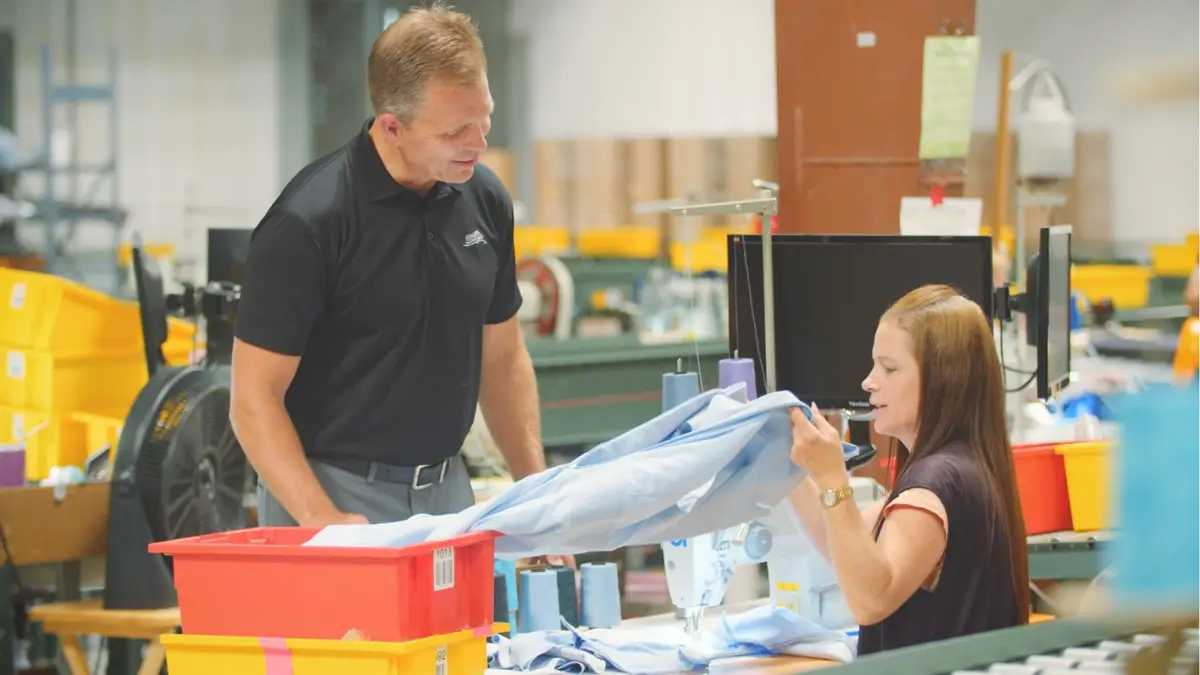
Dean Wegner is a US Army Veteran who founded the clothing company, Authentically American
Dean Wegner is a US Army Veteran and graduate of West Point who founded the clothing company Authentically American.
Dean started his company with the intent of bringing clothing manufacturing back to the United States.
Our conversation centered around Dean’s entrepreneurial journey. These journies are never easy, and Dean had to overcome an immense amount of obstacles to be where he is today.
You’ll be sure to get a lot out of this conversation, and Dean offered a 25% discount code when you use the code FOUNDER at checkout at http://www.authenticallyamerican.us.
Transcript
Machine-generated from the episode audio and lightly edited — may contain errors.
Chris Albert (link to this point)
The Warrior Soul podcast is written, edited, and produced by me, Albert. Our mission is to provide tools, tactics, strategies, and ideas that help The US military veteran community to show up as the wisest, strongest, most capable versions of themselves in the civilian world. If you're not a veteran, stick around because anything we talk about will most certainly apply to you as well. This podcast is made possible with the help of f bomb nutrition. They make delicious packets of fats that you can carry around anywhere with you in little portable packets.
They make macadamia nut butters. They mix them up with chocolate. They mix them up with sea salt. They mix them up with coconut butter. They're absolutely delicious, and they're really good for you.
They don't have any sugar. They also make a lot of cheese snacks. They make meat sticks, and it's just a great company. These guys send packages of this stuff to the troops who are on the front lines overseas to supplement their MREs, and we didn't ask them to do that. They just did that on their own initiative.
Really great company. If you wanna get 20% off your first order of f bombs, head over to www.dropanfbomb.com and use the code Warrior Soul at checkout. This podcast is also brought to you with the help of Save the Brave. Savethebrave.org is a five zero one c three charity for veterans. They run camaraderie events that include fishing, golfing.
They also do a lot of work with gold star families. And unlike a lot of other organizations, their board doesn't take a salary. Really great organization that is doing amazing work. So go and check them out at savethebrave.org. With that, thank you guys so much.
Let's get into today's programming.
This is Chris Albert, and I'm here to remind you of one thing. Someday, you're going to die. Now that's not some morbid statement or scary idea. It's solid fact. Your time here on this earth is limited.
And we need to be reminded of this as much as possible for one simple reason, to live your best life while you can. This is the Warrior Soul podcast.
You know, we talk a lot about heroes on this podcast. And, obviously, I have great and deep respect for The US military veteran community and the things that they've done to serve this country. And in my opinion, in this country, we have a lot of different kinds of heroes. We have our military members and our veterans. We have our first responders.
But in my opinion, we also have entrepreneurs. And, you know, there's a lot of debate in this day and age as as to whether or not capitalism is a good thing, whether or not we should look up to entrepreneurs and things like that. And and here's the deal. You know, the backbone of the American economy is made up of small business. You know, people like you and me who decided to go out there and take a risk and to try to build something.
And in that process, what they do is they create opportunity. They create opportunity for all of us through jobs, through through better products, through better services. And there there there's something about somebody who treks out there and turns nothing into something, and I've got deep respect for that. And what always warms my heart is when I hear about somebody who fits into two categories. When we get a veteran, somebody from our community who goes out and and builds a business, every time that happens, we're adding to that knowledge bank, that knowledge bank in our community, that knowledge bank that's gonna push each of us to do what we need to do to to to get ahead and to allow this community to take its rightful place in this country as a a group of leaders.
Right? And that's what we should be. We've served in the American military. We've gone through some of the best leadership schools the world has ever offered. And it's it's really up to us to bring that back to society.
And when a veteran goes out and they they they start building a business, that's essentially what they're doing. They're taking their tools, the talent that they learned in the military, and they are bringing it to their communities and to our society. My conversation today is with a man named Dean Wegner. Dean is a retired US army officer. He served as a helicopter pilot, and he's also a West Point graduate.
And he founded a clothing company called Authentically American. And what he's doing is he is taking American clothing manufacturing back to The United States. Right? So we've lost so much in terms of manufacturing over the past few decades. So much of it has gone overseas.
And and, you know, in some places, it's it it was a dying knowledge, a dying knowledge base. But people like Dean, they're keeping it alive. And people like Dean are the people who are gonna help us to get through this crisis. And I take nothing away from first responders, from the medical workers, my my my girl, Shauna, she is a nurse, and I have deep respect for their what they're doing. And I'm not even saying that this is, the same category.
But on a societal level, in in what's gonna truly change society, we've got to have respect for what these entrepreneurs are doing. These entrepreneurs who are continually pushing forward despite this crisis and who are doing what they need to do to keep their businesses alive and to keep the opportunities for employment alive and to keep American business alive. So you guys are gonna enjoy this conversation with Dean. He puts out a fantastic discount code for for everybody out there, And I'm gonna have that discount code up on the show notes for this episode. And with that, let's get into the conversation.
Dean Wegner, welcome to the Warrior Soul podcast, man.
Dean Wegner (link to this point)
I'll take Chris. It is fantastic to be here, and I'm honored to be a guest.
Chris Albert (link to this point)
Thank you. I really appreciate you coming on. I was reading a bit about your story. For the audience at home, could you just give a quick synopsis of who you are, when you served, and and what you're doing right now?
Dean Wegner (link to this point)
Got it. So a quick high level overview, Chris. I'm a man of faith, so leave with my Christian faith. You know, family is very important to me. My wife and I will celebrate anniversary number twenty six in two weeks.
We have four amazing kids, two daughters, two sons, the youngest son we adopted from Ethiopia. Oh, I'm a veteran, So graduated from West Point in 1993, went to flight school, the Army Special Forces Ranger School, served seven years active duty. And now I'm an entrepreneur. And three years ago, officially launched Authentically American, and we are a veteran owned American made premium apparel brand.
Chris Albert (link to this point)
That's outstanding. You are a blessed man. That's a how how do you manage four four kids? That's amazing.
Dean Wegner (link to this point)
Well, you should ask my wife, Chris, because she says she has five kids. She counts me as the fifth.
Chris Albert (link to this point)
That's awesome. That's awesome. So, what you know, going from the military and becoming an entrepreneur, I it's something that that a lot of people talk about. A lot of people in this community definitely want to get into business. What led you to decide that this is what you wanted to do?
Dean Wegner (link to this point)
I'll tell you, Chris, leaving the military, I had no idea there was that entrepreneurial spirit within me. And I left the military in 2000. So I did not officially launch Authentically American until 2017. And pseudo entered the entrepreneurial world in 2012 when I bought my first business. But it's interesting looking back and just seeing now hindsight's always 20/20, but seeing those little inklings of that entrepreneurial spirit and I'll give you a couple examples.
So one, graduating from West Point, you choose a branch. I ultimately chose aviation. So went to flight school. And on one side of the army, Chris, is the special forces, rangers, infantry side, and on the complete opposite side is aviation. And I was a little torn, did I choose the right branch?
And at flight school, they made an announcement and said, hey, guys, once in a lifetime opportunity, we're going to hold a competition and send wannabe to Ranger School. And I thought, well, here is my opportunity to go ahead and see how the other half lived. And we can talk more about that later. But I had so many people saying, Dean, what's wrong with you? Are you crazy?
Why in the world would you ever want to go do that? And that was just looking back and thinking about wanting to do it a little bit differently. And as well, I spent six years in two thousand and two to two thousand and eight with Procter and Gamble, just a world class marketing and branding company. And they've been in business forever. And I work with brands like Crest and Tide.
I'll tell you, Chris, the thing I heard most there was, Dean, what are you doing? I'm like, what are you talking about? And they would say, Dean, that's not how we do it. That's not the Procter way. And just always thought, you know what?
I want to do things a little bit differently. And as I look back, I've heard that repeatedly over my career that sometimes just want to do things a little bit differently and not to do things differently. Just had some different ideas and perspectives. So it's interesting looking all the way back through right after graduating from West Point early after the college years, seeing those little glimpses of having that entrepreneurial spirit. And really in 2017, when I launched Authentically American, it was all about creating jobs.
It was all about making a difference. And ultimately, if we're successful, we're going to leave an incredible legacy.
Chris Albert (link to this point)
Yeah, yeah, no, that's amazing. I mean, that's the thing, and I think us in this community, the military veteran community, I think that in some ways, we're and this might go against the grain of what people think, but we're made to think outside the box. If you've done that job, you've done a job that less than 1% of Americans have ever even thought about doing. You know, where I grew up, I grew up in New England. People don't go into the military where I come from.
I'm from Connecticut. You know, everybody's thinking about college. Everybody's thinking about, you know, maybe getting a job afterwards. But but, you know, most of my friends were were doing hacky sack and and doing other things. They didn't they didn't wanna join in the military.
And when I decided to join, people are like, are you insane? My own mother asked me if I was insane, you know, and and I think I think we're bred as as, you know, people who've who've followed this path to kinda think outside the box a little bit. And and, you know, yourself going to West Point, that's four years and one of the hardest institutions, one of the best institutions in the world, one of the hardest institutions in the world. And then choosing to go to Ranger School, which by the way, that's a heck of a prize for a competition. That that that that's something that that stokes that fire in your mind is saying, I don't wanna be like everybody else.
And and Right. You know, and and even for to you guys at home in the veteran community who who've been out for a while, you know, I know there's this idea of trying to blend in and trying to fit in. But if you don't fit in, that's an awesome thing too. It means you're different. There's something about you that's standing out amongst the others.
Dean Wegner (link to this point)
I absolutely agree, Chris. And I think one thing that the military taught me was around structure and organization. And as a business, you need that to be successful. But I think when you have that grounded and have that background, that, in many essences, allows you to think even more freely and have more creative thoughts be a problem solver, have the creative dialogue and those thoughts that it will lead to something new and innovative. So I think military, more than most professions, really prepares you for that entrepreneurial journey.
Chris Albert (link to this point)
So you're at Procter and Gamble, I think you went into consulting for a while as well, right?
Dean Wegner (link to this point)
Yes. So that was actually the first stop, after the Army was a big five consulting firm was KPMG, spent two years there, Chris, which experience, love my clients, but love my family more. I never saw them. I was on the road Monday through Friday, and that ultimately led to the transition to Procter and Gamble.
Chris Albert (link to this point)
Yeah, that's a it's a crazy life as a consultant, because you're on the road constantly, you're visiting visiting clients. And in some ways, hurt it could be almost more brutal than being in the military itself.
Dean Wegner (link to this point)
It was incredibly challenging because the work never stops. And I'm being fortunate now, invited more and more to share our authentically American story with chambers, with universities, with colleges, and feeling honored to share here. And I always get asked the question, Okay, what are some lessons learned? What are those tips? And I will tell you, one of them, steadfast, is around priorities.
Because I will tell you, we are three years into this, Chris, and it's amazing how much we've accomplished, but how much more still needs to be done. I mean, I could literally work 24/7 for the next year and still not get everything done. So I think one side, it's an incredible amount of work to go out on your own to be an entrepreneur. But I think so important is keeping that balance and keeping those priorities in life, because building a successful business is not a sprint. Right.
And it's a long term journey. And for me, those priorities really manifest in three areas. One is never sacrificing my faith. Number two is my family. It's rare that if ever I miss one of the kids events, one of the kids games, always home at dinner at night.
And then the third one, fitness is very important to me. And my workouts aren't nearly long, Chris, as I would like. But I make sure it's twenty, thirty, forty minutes every day I get it in. And that gives me the extra stand up stamina and capacity I need to go and be the best not only at work, but for my family.
Chris Albert (link to this point)
That's awesome. That's awesome. That's what it's about. I mean, I was a trainer for a long time too, and I've seen a lot of people that come in, they say, I want those six pack abs. I want I want to get that 500 pound squat.
But at the end of the day, it's it's really about being the best that you can be at at at everything else. Because the the goal for a 500 pound squat or six pack abs, that's gonna get kicked out the window as soon as you face a little bit of adversity. But if you're doing it for your family, if you're doing it to be the best version of yourself, to be better at everything else, then then that's something you can't throw away as easily. Right?
Dean Wegner (link to this point)
Oh, absolutely. And that just dials back to priorities. What's most important to you in life? And a new startup venture and entrepreneurial journey can be all consuming, but it's so important to make sure you keep that balance and those priorities.
Chris Albert (link to this point)
So when when it comes to authentically American, what was the thing that made you say, hey, this is something that I need to do, or this is something that I need to start? What problem were you solving?
Dean Wegner (link to this point)
It's a great question, Chris. And I'll give you the quick background, because I oftentimes get asked, well, how did you get into apparel? How did you decide apparel? And we talked a little bit about my background with having graduated from West Point, served seven years active duty, two years with a Big five consulting firm. Also spent six years at Procter and Gamble and five years at Mars.
And when we arrived, Chris, in 2010 in Nashville, it was move number 10. And my wife grew up in Tennessee. So this was like a homecoming. So I knew if move number 11 was coming, I was going by myself. Nobody was going with me.
And that ultimately led me in 2012 to buy a business. And it was a business that was eighteen years old that had a great niche producing uniforms for the military. So dress trousers, slacks, skirts for Army, Navy, Air Force and Marines. And I love that because it indirectly connected me with the military. And Chris, one of the things I'm most passionate about is job creation. And the goal was to win more contracts because I thought the more contracts that we win, the more jobs we create. But I kind of had an epiphany and realized that when we win contracts, we don't really create jobs. We just outfit another contractor. And that's where I started to get this vision. I said, what if, instead of being in the contract business, we were in the brand business.
We created this iconic American brand. And the American piece is important because in 1993, just to give you some historical context, when I graduated West Point, over 50% of the apparel in The US was made in The US. Today, Chris, it's less than three. That is all that's made here. And as I started to think about this vision to build this brand, I thought if not only it was a brand, what if we made a decision, this intentional choice to only produce here in The US?
And what if we had the success along the lines of Nike or Under Armour, just this iconic brand that we built? Think of the jobs that we create. Think of the difference we'd make, and ultimately think of the legacy we'd leave when we're successful. So that's ultimately what made the decision, just a strong desire to ultimately make a difference.
Chris Albert (link to this point)
That's amazing. That's amazing. You know, and I come from New England, the town I come from, it's a place called Norwalk, Connecticut. They had a hat factory there, right? They would manufacture hats there.
They had shoe factory there. Up the road a bit, if you go to go further into New England, you know, New Hampshire, Maine, they had a lot of textiles up there.
Dean Wegner (link to this point)
Oh, yeah.
Chris Albert (link to this point)
And that's something we you're very right about. We lost, right? Now, today, I work in American manufacturing, we manufacture something very different, we manufacture anchors. But I see it every single day. The ability to create something here on our soil, something that's giving jobs to people, something that's helping people to to to, you know, put food on the table for their families.
There's nothing like it. I mean, there's a million ways you can open up a business this this day and age. But if you are helping people to create something here in America, that means that you are doing something that's going to help so many people. And and I really applaud you for that.
Dean Wegner (link to this point)
Well, I appreciate it, Chris. It has not been easy, doing what we're doing and building a brand from scratch. But I will tell you, in the middle of a global pandemic, our business has never been stronger. And just to reinforce your point, now more than ever, Americans are actively seeking American made products. And one of our taglines, Chris, is where's yours made?
It is designed to be provocative and heighten the awareness that you make a decision every single day on what clothes you're to put on your body. And we're in an election year, so people think, well, I'm going to cast my vote. That's how I'm going to have that influence. But you can literally vote every single day with your wallet. And we've sat with clients because, Chris, we have a client side of our business where we provide custom branded polos and t shirts and jackets for businesses, for example.
And I've sat with a client and say, hey, Chris, great looking polo. Where's yours made? And they're like, well, Dean, I have no idea. And they'll go ahead and look at the tag, they'll be like, Bangladesh, which nothing's wrong with Bangladesh. But if you are an American patriot, you believe in the American worker like we do, and then you experience our product and see that forget where it's made, it's amazing product, then you want to understand more about who we are and how we can partner with you.
Chris Albert (link to this point)
That's awesome. That's awesome. So when you were first laying out the vision for this, I'm sure there's a lot of questions you had to solve, right? So ranging from how we're going to manufacture these these these pieces to, you know, how are we going to set our pricing in a way that's going to be competitive to to, you know, trying to figure out the personnel. How how did what did you tackle first?
Dean Wegner (link to this point)
So I think I'll give you one of the challenges that ultimately led to the business I was in. So I had mentioned that company that I bought in 2012. We were a manufacturing company. And I was trying to build a brand on top of the manufacturing piece. And Chris, when I'm honest with who I am, when I'm honest with what I'm good at, it's not manufacturing.
It's not that side. With my background at Procter and Gamble and Mars, my strength, my expertise, my passion is more on the marketing, on the branding, on the business development strategy side. So as we started from a blank sheet of paper, and I did my due diligence, I went more the route of a Nike or Under Armour instead of being vertically integrated and owning our own manufacturing. We established a contract manufacturing network. So we have 12 different states right now that we produce.
People, for example, love our t shirts. They're amazing t shirts. We produce those in Texas. I joke now that socks. Socks are the new ties.
Nobody wears ties anymore. So we produce incredible socks in North Carolina that are Carolina cotton. So amazing socks. We also have hats we produce in New Jersey, so all across The US and only The US. And that was one of the important choices to make up front is, what am I good at?
So let me focus there. And that's going to be on building the marketing, the branding, the storytelling, everything behind our brand. But having those five years owning my own company in the apparel industry, that's what created the understanding and the knowledge of the apparel industry. So I knew who the best darn T shirt maker in the country was. I knew who can do an amazing job with socks for us.
So that's ultimately what led to the choice in our business model.
Chris Albert (link to this point)
That's awesome. That's awesome. And, you know, when you're deciding what types, what pieces you wanted to make, so you mentioned polos. What other what other pieces did you include in there? You said t shirts as well.
Was there slacks? Where what what other what other types of things did you bring in? And why did you decide to make those pieces?
Dean Wegner (link to this point)
Well, Chris, it's a great question and something I wrestled with. And here was another example where people said, Dean, are you crazy? Why in the world would you do this? Because tied to our vision to build this iconic American brand, I didn't want to build just a t shirt company. Didn't want to build just a hoodie company.
And most people, I sought counsel, said, Dean, pick just one product. Pick one thing and do it well. And I seriously weighed that. But I thought it will probably take longer in the short term, at least, to go ahead and not only have an amazing t shirt, but have socks, have polos, have hoodies, have jackets, have an entire portfolio of products. Because if we're going to build this iconic American brand, we just can't have one item.
So we've spent two plus years building that portfolio with an extensive range of what we offer. But now is when it's really starting to pay dividends. Because if you're a Fortune five hundred customer of ours, you not only have polos for your team, you have t shirts, you have hats. So now we can provide everything. I'm a hockey player, so played hockey.
Chris back at West Point, still playing a men's league now. So we have our first NHL merchandise with the Nashville Predators. And we got in with a T shirt, but they're like, Dean, everyone loves this product, love your brand. So pre COVID, we have a six foot display plan that would have a whole assortment of products that would have had a polo, a jacket, a quarter zip, socks, hat, everything. So it was a difficult choice, and it's been a long term building this supply chain, but it was very important tied to our long term vision.
Chris Albert (link to this point)
Nice. And so you said you've been in business for two years, right?
Dean Wegner (link to this point)
Oh, I'm sorry, three years.
Chris Albert (link to this point)
Three years. Three years. So that's that's a good amount of time, but it's also not a long amount of time to happen before, you know, March 2020 when COVID nineteen has come down the pike. Right? So so as you were going, right, we the economy is booming, everything's going great.
This thing starts to happen where states start to shut down. What was going through your mind in March, when when everything was coming down the pike?
Dean Wegner (link to this point)
Chris, it was initially complete panic. Yeah. Like, we'd only been in business for two and a half years. And the thought was, can we even survive? You know, will we even make it?
And, you know, this is our hockey stick year, because we've spent two years building a foundation. We were really planning to grow. And we were up 400% in January and February, and then it leveled off in March. And it was really a thought of, are we going to survive? And we got the team together and thought, Okay, what can we do ultimately to survive this storm, to ultimately come out stronger on the backside?
And if you had a chance to look at our website, you'll not only see our vision and mission, but you'll see our core values. And Chris, one of them is around giving back. And we really manifest that in two ways. So one, we donate 10% of our profits to veteran and first responder charities. But also, when we partner with a charity, we provide our goods and services at cost.
And we were really, as a team, stricken with a sense of perspective. Because we thought, you know what? We're struggling, but we're still having orders. People are still partnering with us. But think if you're a charity.
Think if you're a veteran charity that's relying on donations and unemployment's at the highest level since the Great Depression. Nobody's writing those donation checks, so what we decided was to help keep our doors open and also help other charities survive, proactively reached out to specifically veteran charities and said, hey, guys, are you struggling to raise funds? And I'm like, well, absolutely. And we've got some pretty amazing product. We can do a show and tell later, Chris.
But we went to veteran charities and said, we've got a whole platform. We've got a whole program. We'll provide our goods and services at cost. We can go out at your members and help you raise funds and build your brand. And the outpouring was incredible.
That helped us survive. So now our business is back and finished the year up four, five hundred percent. But equally, charities, we're so thankful of our partnership with them and helping them survive during these challenging times.
Chris Albert (link to this point)
That's amazing. That's amazing. And what's your main sales channel right now? Are mostly going off the internet? Are you in retail?
Dean Wegner (link to this point)
So I guess back to two sides. So there's a client side of our business. And lot of people are familiar with Lands' End. So you can call up Lands' End and get your company logo on an Oxford or Polo. So there's that side of our business. So that's a direct selling side. When people go to our website, they can inquire.
But it's literally meeting with our team. But on the consumer brand side, so Chris, if you as an individual want to buy our brand, the number one place you can go is to our website, authenticallyamerican.us. And we are just now starting to expand into retail. So if you're familiar with AAFES, the Army and Air Force Exchange, so we've got a big test at AAFES right now.
Chris Albert (link to this point)
Nice. Nice. That's a good place. That's a good place to be. So, you know, that's it's amazing what you're doing.
And obviously, this is all built on a foundation, a foundation that you learned growing up, a foundation that you learned at West Point, a foundation that you learned at Ranger School. And I want to get back to to you being in aviation, and then all of a sudden, you win this competition and you head over to Ranger School. What was that like for you? And how did that prepare you for everything else you faced since then?
Dean Wegner (link to this point)
Yeah. Well, first, Chris, I forgot to mention this earlier, but thank you for your service. You're one of our American heroes we talk about by our donations we make at Authentically American, but I have a special affinity for the Marine Corps. And it's a twofold reason why my father-in-law served in the Korean War, he was one of the frozen chosen. So, I mean, had an incredible journey as a Marine.
And I shouldn't say was a Marine's past, but once a Marine, always a Marine.
Chris Albert (link to this point)
Right.
Dean Wegner (link to this point)
And then also at Ranger School, you're assigned a Ranger buddy who never leaves your side. And Chris, my Ranger buddy, was a Marine Corps infantry sergeant.
Chris Albert (link to this point)
Oh, nice. Nice.
Dean Wegner (link to this point)
And I needed that because here I am an aviator at most, you know, places, most military army posts that you would go from Ranger School, you would go from there to Ranger School, they have a Ranger orientation program. Well, at Fort Rucker, Alabama, there is no Ranger orientation program because they don't send anyone.
Chris Albert (link to this point)
Right.
Dean Wegner (link to this point)
So here I am naive aviator showing up with two brand new pairs of boots under my arm and ready to go. And it was a rude awakening. And thank you to Roy Backey, who was that Marine Corps Infantry Sergeant, because he helped keep me motivated, helped keep me driving through. And it's interesting because looking back, I didn't know it back then, Chris, but Ranger School was such great training for leading a startup. Because most people aren't familiar with the details. And there's a lot of military and doctrine and tactics with Ranger School. But really, its core, Ranger School is a leadership school. And what they do is they deprive you of food and sleep and put you in incredibly stressful situation. So you're living on one meal a day and an average two hours of sleep a night and then incredible stress. And I'm thinking now, this is the life I'm living now. I mean, stress and no sleep. That's the life of a startup.
So didn't know back then, but Ranger School was such great training for leading a startup.
Chris Albert (link to this point)
Yeah, no, I think about that all the time. And obviously, I didn't go to Ranger School, but but being in the infantry, you know, those nights when you're cold and and, you know, you're shivering to death, and you haven't eaten anything in a while. And, you know, you're just trying to keep your mind on what you're doing. And I think back to you know, when I first started this podcast and I first started this brand, working all night, you know, coming in after work and trying to build a website and you know, just pushing through and I think that's a skill. That's a skill that you're not going to get taught at some four year university outside of West Point.
But you're not going to get taught you know, whatever four year university you're going to go to. And I think that so many people in this community don't understand the advantages they have. And I think that's great that you're able to highlight that and talk to them about that experience and how it translated over for you.
Dean Wegner (link to this point)
And Chris, I'll tell you the number one advice I give to military veterans that want to start an entrepreneur entrepreneurial career or, you know, the number one piece of advice I give anyone that's going ahead to look down the space is find what you love, pursue your passion, because if you're doing what you love, if you're pursuing your passion, it's not a job. I mean, it's pursuing a hobby, it's pursuing a profession that you love. And I will tell you, Chris, I have never worked more hours in my life. And I've never been one that's been shy about working. But I get forty hours in by lunch on Wednesday, and put some incredible long hours, but it does not feel like work.
Mean, I'm pursuing life's passion. And I think that is a probably the number one advice I give is, you know, find what you love, find what you're passionate about, because then it doesn't feel like work.
Chris Albert (link to this point)
And and how do you balance that with family? Because, you know, you mentioned how important family is to you and and and how important your faith is to you. How do you balance everything? What what is your typical day like?
Dean Wegner (link to this point)
Chris, I'm laughing because it is not easy. It is literally a struggle each and every day. And I think it really boils down to an intentional choice. Because for example, if everyone's home, and dinner's planned, I don't care what else I have going on at 06:00, I'm leaving, so I'm sitting at the dinner table at 06:30. And what that means, if there were still things that need to be done for the next day, that means after everyone goes to bed, or oftentimes before the alarm goes off, I'm up at two, three, four in the morning, not because I set the alarm, but you know what, I'm excited. I'm fired up. I'm passionate. I want to get involved in the day. And I've got so many things on my mind.
So I think it ends up being just those choices that say, Okay, what truly is mission critical that has to get done now? But what is it that's just work that's there that, you know what, spend time with my family, what's most important, and we'll pick it up tomorrow. And I'll give you one example, another example. A week and a half ago, I was in Madison, Wisconsin. And I had mentioned I have two daughters, 22 and 19, have a 16 year old son and have a 10 year old son we adopted from Ethiopia.
But my 16 year old has a dream to play in the NHL. He wants to be a professional hockey player. And he had this tier one junior camp in Madison, Wisconsin from Wednesday to Sunday. And it's an incredibly busy time for us. But he needed me there.
He needed me to take them. So what did I do? We hopped on a flight together, went up to Madison, Wisconsin, was there with him during that camp. And when he wasn't on the ice, you know, I was working, I was doing everything I needed to, but working remote. So that was where you had to balance both to say, okay, incredibly busy, but what's most important is being there for my son.
Chris Albert (link to this point)
Right, right. And that's the amazing thing about this day and age. Yes, technology can be incredibly invasive. Yes, there's a lot of horrible things that happen with social media. But at the same time, are, you know, there are so many options working from home, managing your time.
And and we are and and I think people forget this too. We are all truly blessed to be living in this time and in this place, you know, where where not only do we live in the greatest country on earth, but we also live in a time period where things are actually easier than they have ever been.
Dean Wegner (link to this point)
Chris, there's no doubt about it. And the fact that you and I are sitting here, you're in Florida, I'm in Nashville. And it's as if we're sitting here face to face, know, having this discussion that so that's been enabled by technology.
Chris Albert (link to this point)
Absolutely. Absolutely. So where where are you taking authentically American? Do you see for your company in the next two to three years?
Dean Wegner (link to this point)
So the number one word is growth, but is controlled growth, we want to continue to expand and grow and have more clients, more businesses, more charities that work with us. We want more individual consumers going to our website. But it has to be controlled growth because we need to make sure that first and foremost, we deliver a high quality product. And sometimes if you go too fast, you can sacrifice certain areas. And then also, got to make sure financially, we're responsible.
Oftentimes growth takes more capital. So we're balancing that as well. But that is the number one thing, Chris, to deliver on our vision is I bet of the 30,000 downloads you'll get this month, there's probably a handful that will have heard of Authentically American. And I'm grateful for the opportunity. I'm hoping a few of your audience say, you know what, let me check them out.
They go to authenticallyamerican.us. And I'll share this with the audience. If you enter the discount code founder, F O U N D R, at checkout founder, that will be good for a 25% discount because we believe Chris and the American worker, and we have amazing product. And we go ahead and offer that authentically American guarantee because if you try it, it is rare if ever that we've had somebody that has not had their expectations exceeded, which is why we offer the guarantee and why I want to offer, you know, this discount to your audience.
Chris Albert (link to this point)
Outstanding. Outstanding. People definitely better take advantage of that. And I'm gonna make sure that that discount codes up on the show notes for everybody as well. That's that's amazing.
Now, I want to get back to another aspect to your past, and that's West Point. And and one of the things that I think that a lot of veterans and a lot of active duty military members don't realize is that they too can apply to the service academies. There are slots that are open for people who are active duty. And I wanna talk about this a little bit because I've had some other service academy graduates on. We had somebody from Navy come on, which I don't want to start any rivalry stuff over here.
But but, you know, that that is something that is open to them. And I want to, you know, just talk about this a little bit for the community. What did West Point do for you? And what would you say about going there?
Dean Wegner (link to this point)
So, Chris, it was not easy. It was incredibly challenging. I mean, back then one of the most difficult things I've ever done in my life. But I would not trade my education at West Point for anything. I mean, it was so formative.
It was so foundation building. And I've mentioned, for example, the values that I have for authentically American. I mean, the values focus, that principle focus started at West Point. You know, one thing that most people know about West Point is duty, honor, country. And it was so such an incredible experience and such a strong focus on values and not only values of the institution, but your values as an individual and the value and character and integrity.
And that is a foundational part of who I am as a man, as part of who I am as a father and a husband. And same thing with Authentically American. You know, we're very intentional about who we are and respect Chris, for example, as one of our values. And I was invited on Fox and Friends now twice. And the first time was three days after Nike launched the Kaepernick campaign.
And there were some thoughts about how I wanted to handle that question. But I thought, you know, with respect in mind, you know, we treat everyone with dignity and respect, even somebody we disagree with. So that's something if you wanted to share as well, that was an incredible experience, being on national TV, having 2,000,000 viewers and being asked that question. But West Point was one an incredible education. But one of the things I take away was that incredible focus on values.
Chris Albert (link to this point)
That's amazing. That's amazing. And finally, you know, if you could go back and talk to yourself that, you know, 18 year old, 18 year old plebe, Dean, you know, stepping on the parade deck for the first time, what would you tell him?
Dean Wegner (link to this point)
You know, that plebe me back then Chris was so immature, you know, so full of himself that so highlight myself. And it's not who I am right now. Back then it was all about me. And a big part of that was the training at West Point and education because now something I embrace is that servant leadership. And now everyone else is more important to me.
And oftentimes, I wake up at two, three, four in the morning, because I know my team needs something before the day started that I need to provide for them. So it's been just a complete shift in focus from Okay, it's all about me that young immature person to Okay, somebody that is very faith focused, somebody that's focused on others and really prescribed to the theory of servant leadership.
Chris Albert (link to this point)
Alright, and then let's go back to the day that you got out of the army. What would you tell yourself at that point?
Dean Wegner (link to this point)
You know, for me, I would say have more of an open mind, and do more research. And, you know, the fact that I'm here right now as an entrepreneur talking to you, that thought and that idea did not even come across because my dad had worked for Alcoa for thirty years, our friends and neighbors were, you know, career of people that worked at these big companies. So I thought that was the only path that was out there. So I would encourage anybody that's transitioning from the military, reach out and see what all is out there. And there's amazing careers at bigger companies.
There's amazing entrepreneurial careers. There's so much out there. And Chris, I don't know how you share contact information, but I've had so many people reach out to me. Had a young Marine, you know, Sergeant reach out to me two weeks ago, he's transitioning and he has that entrepreneurial bug as well. So he came over to our home and shared some thoughts and perspective and didn't really have time for it.
But it was just making it a priority and said, is somebody that's in a real decision making process and needs my help. So, you know, my email is dwegner@authenticallyamerican.us. And you can also find me on LinkedIn. So I'm happy to help anyone that's in that process of transitioning.
Chris Albert (link to this point)
Outstanding. Outstanding. Well, Dean, you know, number one, want to I want to acknowledge you, I love what you're doing. I love that you built this brand and that you're supporting American manufacturing and that you are helping people to, you know, get through this crisis by providing jobs. I think that's outstanding.
I love your message, and and I love the fact that, you know, you you've kept what's important first and foremost in your life, you know, family, faith, and and your values. I think that's absolutely outstanding. And I think that's an example that all of us in this community need to emulate. So thank you so much for everything that you're doing.
Dean Wegner (link to this point)
Well, Chris, I appreciate it. It's an honor to be a guest. And again, thank you for your service to our great nation.
Chris Albert (link to this point)
Absolutely. Absolutely. And and you mentioned your email, where do you hang out on social media? Instagram, Facebook? What what's your primary outlet there?
Dean Wegner (link to this point)
So primarily for the business, and for me personally, is LinkedIn and Facebook. And, you know, as we're building our team, we are also building more of a presence on Instagram and Twitter. But right now, the two primary social platforms are Facebook and LinkedIn.
Chris Albert (link to this point)
Outstanding. Outstanding. Awesome. Well, hope people reach out and get in touch with you there. One more time, what's your website URL?
Dean Wegner (link to this point)
Authenticallyamerican.us. And the .us is important, and that was, again, tied to our brand. So authenticallyamerican.us, you visit there, you can find all about us. And again, remember that discount code founder.
Chris Albert (link to this point)
Outstanding. Outstanding. And that's f o u n d r, right?
Dean Wegner (link to this point)
Correct.
Chris Albert (link to this point)
Great. Great. Well, Dean, again, thank you so much to everybody out there. I hope you got a lot out of this episode. I know I did.
This is an absolutely amazing story. Definitely check out authentically American and definitely check out Dean. And you know what? Take the bull by the horns while you can't. Right?
We're we're we're not here forever. We don't get to be here forever. Someday, each and every one of us is gonna get called home. And while you're here is the time to act, the time to pursue those passions, the time to make things happen, and the time to impact others while you're here on this earth. So get out there and live your best lives while you can.
This is Chris Albert and Dean Wegner, and we are out. Alright, guys. There you have it. That is my conversation with mister Dean Wegner of Authentically American. I hope you guys got a lot out of the talk there.
You know, are tough times, guys, And I'm not taking anything away from the fact that these are tough times, but there are people out there who are still making things happen, who are still pushing forward. And it's like something I said a few years ago during much better times than this, I said hard times breed hard people. This is our time to prove ourselves. Right? There's a challenge in front of you.
You don't give up. You don't walk away. Right? This is our time to show what we're truly made of. And if you've got that heart and you've got that will, you can make something happen during these times.
There's a lot more opportunity right now than you really think there is. Right? There's a lot more opportunity during hard times than there is when everything's good. So a little bit of chaos never hurt anybody. And with that, guys, I hope you guys are doing well.
I hope that you're thinking about how you can push forward during these crazy times, and I hope that at the end of the day, you're living the best life that you can. This is Chris Albert with the Warrior Soul podcast, and I am out.
Host of the Warrior Soul Podcast and founder of Warrior Soul. Worldwide trainer and nutrition coach, contributing author at Testosterone Nation and Muscle and Strength.