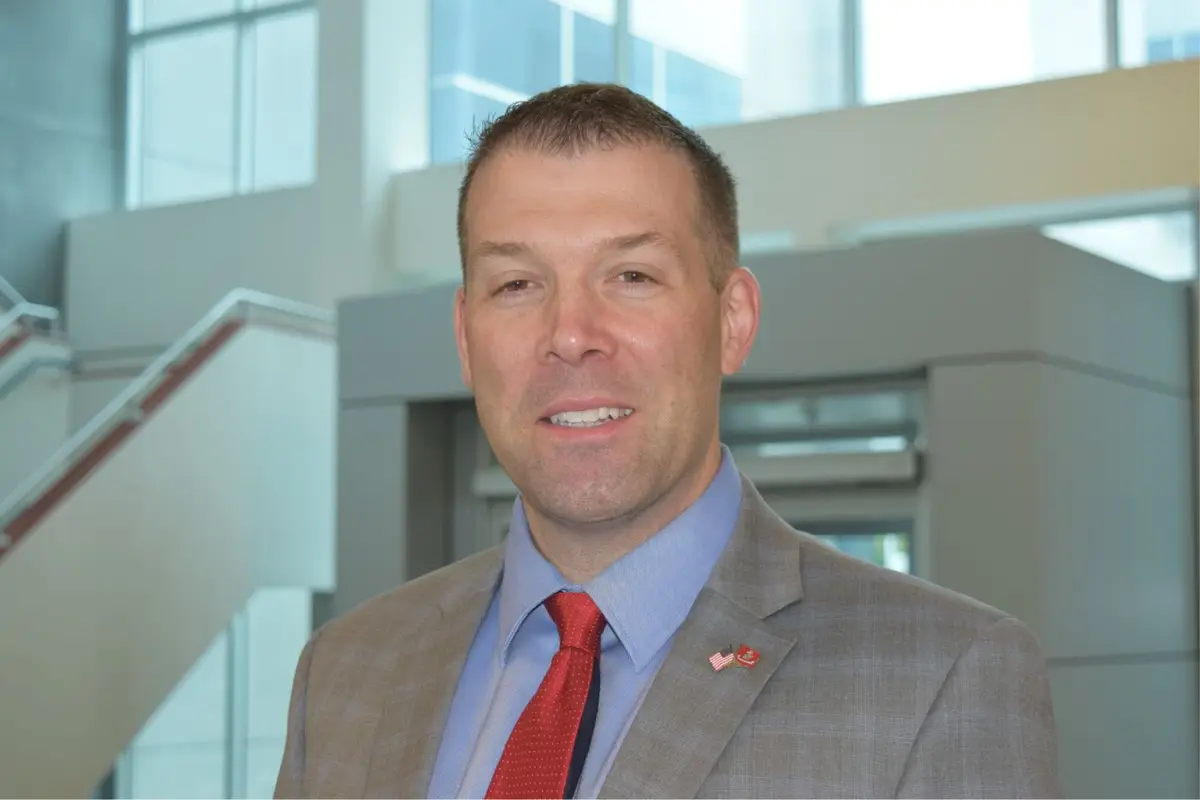
Chad Lennon is a Marine Corps Officer and Lawyer who helps veterans get their VA benefits
Chad Lennon is a US Marine Corps Officer and a lawyer who works to help veterans get their VA benefits
Chad Lennon grew up in Bayville, New York and graduated from Wagner College, Adelphi University, and Touro Law Center. He was commissioned in the Marine Corps as a Second Lieutenant in 2008. Today he is a Major in the Marine Corps Reserves serving as the Company Commander for Bravo Company. Chad
has served in a number of billets including a platoon commander, intelligence officer, and international engagements officer. He was deployed to Afghanistan in 2010 and received the Purple Heart Medal. After graduating law school Chad worked as a criminal defense attorney in Maryland and a prosecutor in
Suffolk County, New York. While as a prosecutor Chad worked in the Veterans Treatment Court for the District Court and East End court. In February 2019 Chad was appointed Director of the Veterans and Servicemembers’ Rights’ Clinic at Touro Law Center. Chad works with a number of charitable organizations focused on assisting veterans and holds the world record for pulling a 400lb chain for 1 mile in 63 minutes and 18 seconds while raising money for the Semper Fi Fund. He resides in Rocky Point with his wife, Denni, son, Gunnar, daughter, Thalia, and their two Siberian Huskies.
Transcript
Machine-generated from the episode audio and lightly edited — may contain errors.
Chris Albert (link to this point)
The Warrior Soul podcast is written, edited, and produced by me, Albert. Our mission is to provide tools, tactics, strategies, and ideas that help The US military veteran community to show up as the wisest, strongest, most capable versions of themselves in the civilian world. If you're not a veteran, stick around because anything we talk about will most certainly apply to you as well. This podcast is made possible with the help of f bomb nutrition. They make delicious packets of fats that you can carry around anywhere with you in little portable packets.
They make macadamia nut butters. They mix them up with chocolate. They mix them up with sea salt. They mix them up with coconut butter. They're absolutely delicious, and they're really good for you.
They don't have any sugar. They also make a lot of cheese snacks. They make meat sticks, and it's just a great company. These guys send packages of this stuff to the troops who are on the front lines overseas to supplement their MREs, and we didn't ask them to do that. They just did that on their own initiative.
Really great company. If you wanna get 20% off your first order of f bombs, head over to www.dropanfbomb.com and use the code Warrior Soul at checkout. This podcast is also brought to you with the help of Save the Brave. Savethebrave.org is a five zero one c three charity for veterans. They run camaraderie events that include fishing, golfing.
They also do a lot of work with gold star families. And unlike a lot of other organizations, their board doesn't take a salary. Really great organization that is doing amazing work. So go and check them out at savethebrave.org. With that, thank you guys so much.
Let's get into today's programming.
This is Chris Albert, and I'm here to remind you of one thing. Someday, you're going to die. Now that's not some morbid statement or scary idea. It's solid fact. Your time here on this earth is limited.
And we need to be reminded of this as much as possible for one simple reason, to live your best life while you can. This is the Warrior Soul podcast.
What is going on, ladies and gents? I got a good show for you today. It's a practical show. You know, when you're in, a lot of guys rack up injuries. I know so many guys who by the time they were 25 serving in the infantry, they had bad knees, bad backs, bad shoulders, and they were still young men, and they gotta live the rest of their lives with that stuff.
And, you know, when I got out, I made some dumb mistakes, a lot of dumb mistakes. But one of the dumb mistakes I made was like, I was saying, I don't need veterans benefits. I'll save those for the people who really need them, and I will not try to apply for anything. I don't even want to be in the VA system. That was a mistake.
And it was a mistake because I had things that were adding up too. And one of the things about the VA is that if money isn't getting used, the VA doesn't get money. Right? That's how the government works. Right?
It's it's super inefficient. It's not like a company where, you know, if you're continually going over budget, you are you're you're gonna get fired in a regular company. But the way the government works is if you're not if you're using a lot of money, then the government tries to give you more money, or it allows you to justify that you need more money. Right? And if we don't get enough veterans applying for VA benefits, then the VA is not gonna get the money that it needs to do the job that it does.
And, you know, knowing that, you'd think that they'd make applying for benefits a lot easier than it actually is, but but it's actually pretty freaking difficult. You gotta file an intent to file. You gotta you gotta, you know, make sure all your documents are in order. And again, they tell you while you're in. If you guys are still in, make sure you're documenting everything.
Make sure you got everything in your record. Make sure you don't if you got a nick on you, make sure that you get that shit documented because it could add up into something later on. So what I did was I got this gentleman, Lennon. He is a lawyer, and he works with veterans to help procure VA benefits. Chad's also got a a really awesome story.
He was a he was a Marine Corps officer, and when he got out, he had real issues trying to find a job, like real issues. No law enforcement agency would hire him. Kept trying to do different things, so he decided to go to law school, and he got through law school, And he, you know, went and he worked as a prosecutor and a defense attorney for a while, and we talk a bit about that. We talk about his background, you know, what life was like after the service, how he decided to make these changes that got him on the path he's on today. But we also talk in-depth about VA benefits and how you can go out there and get those benefits for yourself, what the processes are like, and things like that.
So you get a lot out of this episode both from hearing Chad's story and from the knowledge he's bringing to the table. I hope you get a lot out of it. If you got any questions about any of this stuff, Chad gives his contact information during the episode, and we'll have it up on the show notes as well. So, yeah, maybe I should say something about the podcast. You guys, if you haven't listened to this podcast before, this is the Warrior Soul Podcast, and my name is Chris Albert.
I've been doing this podcast for five years, and essentially the whole idea behind it is to help veterans to help themselves. My goal is to empower you to live your absolute best life by bringing tools, tactics, strategies to the table. Normally, we're not talking about things like VA benefits. We're talking about actual tools you can apply to your life to move yourself forward, to push you toward the top of your game. That's what this community is about.
Right? And I always say this, the veteran community is a sleeping giant in this country. When we wake up, that is when we're going to see this country get on a path like we've never seen it before. We've got more veterans out there right now who are of age to effect change in this society than ever, aside from World War II and the Civil War, of course. But there are plenty of us out there.
We can do the amazing things that we need to do to change this country, to change our lives, to make society better, to teach our children properly, to to, you know, make this world into what we wanna make it into. And that's what the Warrior Soul podcast is about. So I hope you get a lot out of this show. Hope you get a lot out of this episode, and I'll be back afterward to give you the closing. Chad Lennon, welcome to the Warrior Soul podcast.
How are you doing today?
Chad Lennon (link to this point)
Great. Thanks for having me on. I really appreciate it.
Chris Albert (link to this point)
Yeah. You reached out to me actually a couple days ago, and I said, why don't we, why don't we hop on? Can you tell the audience a little bit about yourself? Give them like a, two minute synopsis of who you are, where you're coming from.
Chad Lennon (link to this point)
Sure. So I was, in the Marine Corps, active duty 2008 to 2012, deployed to Afghanistan 2010, separated from the active service and a few months later joined the reserves. I'm a major in the reserves now, and I've been in the reserves since 2012. When I first got out, I couldn't get a job for like a year, a year and a half. I took the LSATs, which the is entrance exam for law school.
And I finally said, man, I gotta, I gotta get off my ass and do something. So applied to law school, got into one, and finished it in about two and a half years, went out and became a criminal defense attorney down in Maryland at first. And then I took a job as an assistant district attorney in Suffolk County, New York. While I was there, I worked in the Veterans Treatment Court, and then I applied for what I thought was a part time job, turned out to be full time and the director of the Veterans and Servicemembers' Rights Clinic at Touro Law Center. Been there for a couple of years, doing the reserve thing and trying to get involved in about five or six different charities and just giving what I can to help out the veteran and service member community.
Chris Albert (link to this point)
How'd you end up becoming an officer? What made you do that?
Chad Lennon (link to this point)
My dad.
Chris Albert (link to this point)
Oh, really?
Chad Lennon (link to this point)
Yeah. My dad was enlisted in the Navy, and, he was actually real nervous on nine eleven because I was in Staten Island. And, I was on the roof of my, dorms when I saw the second plane hit. And my dad's like, If you're gonna go in, that's fine, but you're going in as an officer. I know what it's like to be enlisted.
Now he was enlisted in the Navy in the fifties, so it's definitely a different time, but, he was very adamant about that. So I promised him, when him and my mom were able to come up, I said, Fine, I'm not going to go in now, go in as an officer, but it's going to happen at some point. So I checked out all the branches. My father was in the Navy, so I felt a connection to that immediately. And then I went to go talk to the Air Force, and no one was ever there.
And I talked to the Army. And then I actually watched one of these videos from the Navy about boot camp and all. And I was like, Oh, there's a Marine there. Oh, the Marines are hard asses. Let's go do it, man.
So just stepped up and was like, I'm going in the marines, and was the only one in my family who was in the marines.
Chris Albert (link to this point)
Where were you going to school? Were you at Hofstra? Where whereabouts were you?
Chad Lennon (link to this point)
Wagner College. It's Wagner.
Chris Albert (link to this point)
I know Wagner. Yeah. Yeah. I had a football coach who went there.
Chad Lennon (link to this point)
Yeah.
Chris Albert (link to this point)
That's awesome. That's awesome. Did you play any sports in college?
Chad Lennon (link to this point)
No. I did, baseball and basketball in high school. I got into MMA just after college. Taught that for a little bit and had a couple of fights here and there. But yeah, I wasn't in any organized teams in college.
Chris Albert (link to this point)
That's cool. That's cool. And then, you know, going from college into the Marine Corps becoming an officer, what was that that that shift like for you? What was most of the officers I've had here were service academy graduates. So I gotta I gotta get this contrast on here, seeing what the college was like versus going to OCS and and and get in the Marine Corps.
Chad Lennon (link to this point)
Partying one on one in college. I wouldn't have been able to survive the academies at that time, man.
No way. Yeah, it was definitely, interesting to see. So I went to OCS and we went to TBS. So anyone who was in a service academy didn't do OCS. So they essentially did four years to skip ten weeks. I was like, I don't have to do ten weeks. I had all my freedoms in for four years. Well, for me, five years. But anyway.
Chris Albert (link to this point)
Yeah. That's awesome. That's awesome. And, were you were you mostly with infantry in the Marine Corps? What what were you doing there?
Chad Lennon (link to this point)
No. I I went in and, so officers, we don't get to choose our MOS. You make a list, and they break it up into thirds at the basic school. You got the top third, middle third, bottom third, and they spread load all the MOSs. I was at the bottom of the top third.
So I got like my seventh or eighth choice, which was logistics. So I went out, was a platoon commander. We had a truck platoon, in the Afghan deployment, came back and did the assistant APO. And then when I transitioned to the reserves, lot moved into intel, and I've been doing that since. And it's awesome.
Chris Albert (link to this point)
Nice, nice. And what does that consist of? You what is intel for all of us?
Chad Lennon (link to this point)
It's not just the weather. Not just ISO preps. No, but it's awesome. You can do a lot of cool things there. I've been a production officer.
So when I was with one of the dets, we focused on Sub Sahara and the threats with Al Qaeda and all the organizations tied to them. Then I was an XO for one of the companies, it was a production and analysis company. And that was, you know, ops, logistics, that kind of stuff sent everyone out. But what I did, which is really cool, was I did Bold Alligator operational exercise with multiple nations. Then I went out to Morocco and did African Lion.
And that was really interesting. I was a captain at that time, expecting to be like, you know, just my own little cell doing stuff with the Moroccans, and there was like 16 other countries there. And there was no one in charge of the intel section. So all of a sudden, there's the captain sitting in the colonel seat as the chief of staff for the intel And I had an Italian lieutenant colonel who didn't want to do a damn thing. Didn't like the Spanish colonel.
The Moroccan colonel didn't want anything to do with intel. So I was like, alright, I guess, I'm running it here. So I was running around my hair on fire for two weeks.
Chris Albert (link to this point)
Oh, man.
Chad Lennon (link to this point)
Oh, man.
Chris Albert (link to this point)
That's, that's, hilarious. Capitan Lennon, go do this. Yeah. It's awesome.
Chad Lennon (link to this point)
We had translators there, and I just got hammered on something. So I come in and I tell them what, you all need to fucking do this. I turned to the translator. I'm like, don't translate fuck.
Chris Albert (link to this point)
That's awesome. That's awesome. So, and then you said you got out in for a year and a half, were searching for a job out there and couldn't find anything. What was going on there? Where were you applying?
What were you trying to do?
Chad Lennon (link to this point)
I was applying to everything, man. I had this whole plan set up. I was like, all right, I'm going to get out of active duty. I'm going to go to law school with the GI bill. Part time I'm going to be a cop and I'm going to be a reservist.
So I applied to ATF and the marshals. And at that time they were pretty much only taken veterans. And they're like, I sent them my DD-214 and I get a response. Hey, we can't read your DD-214. All right.
What the hell does that mean? I'll send it again. No, we still can't read it. So we're not going to take you. All right.
That's kind of weird. I applied for Jersey State Troopers. I killed it on the physical, passed the written. I had a master's degree at that time already. I was an officer in the military and they didn't take me.
So I called the recruiter. I'm like, Hey, man, you know, got all this going on. What happened? Like I passed everything, never had an issue, did the background stuff. And, the troopers like, you know, you sound like the perfect guy we want to have, but we send everything out.
So with third party, it does some kind of algorithm and you didn't fit the algorithm. I'm like, all right. Yeah.
Chris Albert (link to this point)
So government at its finest.
Chad Lennon (link to this point)
Yeah. So I tried for so much stuff. I just, it wasn't working out. I was close to doing like a, was it a financial management or something like that before I went to law school. But that at that point, it was just desperation.
I didn't want to go be a barista at Starbucks. You know, I just I wanted to get into a career. You know, I'd already done a master's, I already did service before I went in. I was teaching MMA. I was working construction.
Yeah. I wanted to step into that career mode and it just wasn't working. Finally I was like, I got to get off my ass and do something and school it is.
Chris Albert (link to this point)
Mhmm. And and how were you holding it together during that year and a half? Were were were you taking side jobs, things like that? Or like
Chad Lennon (link to this point)
I thought I was doing fine, and I wasn't. Mhmm. I wasn't working. Actually, thinking about it now, I remember my father so my parents moved down to South Carolina and, I was staying in the house in New York. And I told my dad, Hey, you guys can sell the house.
I'll move out. He's like, No, no, no. We're going to wait till you're more set up. I was like, No, no, seriously. Like, I don't want you to do that.
So he came up one time and the house was a mess. It was dusty. And he's like, Are you all right? I'm like, Yeah, I'm fine. You know, I don't want to worry my dad.
But thinking about it now, yeah, I wasn't doing well. I was having troubles adjusting because one thing I always tell folks too, it's not just the deployments, but when you're in active duty for four years, it's this is my lane. I got to stick in my lane. I got to make sure what else sticks in their lane. And then you come back to civilian life and everyone's in each other's lanes.
And it's just a complete culture adjust. You know, you're working on base. Most folks are living on base. You're hanging out with service members. It's 24/7 for four years at least.
And then you come home, it's all gone. And you don't know how to adjust back because you're just stuck in that mindset of military lane, stick here, do this, do that. Just sitting down for a haircut. I was like, I have no idea what to do right now.
Chris Albert (link to this point)
Yeah.
Chad Lennon (link to this point)
Yeah.
Chris Albert (link to this point)
Yeah.
Chad Lennon (link to this point)
Been there. Yeah. I was definitely, definitely not doing well looking back at it now. But at the time you're just like, no, I'm fine. No, I'm fine.
No, I'm fine. And I was just living off savings, applying to tons of jobs. But I think the mistake I made was not tailoring my resume and my applications. I was just like trying to burn them all out. So yeah.
Chris Albert (link to this point)
That's crazy. That's crazy. Yeah. And I've definitely been there where you just don't know what to do. And you know, you're wondering, you wake up each day, you're hoping something will go your way and it just doesn't, you know, and a lot of times it's like the simplest tweak, like you said, maybe tailoring your applications and things like that.
And in those cases, it really helps to get a second set of eyes on everything you're doing. And the problem is a lot of guys, they don't want to do that. Just want to keep to themselves. Isolate more and things like that. And and that makes things makes everything worse.
You know, the more you isolate, the more you get yourself out of the world, the more the the the more you're you're you're digging yourself into a hole.
Chad Lennon (link to this point)
You know? Yeah. Especially, you're sitting there like, you know, I I led missions of over a 100 guys and 30 trucks in Afghanistan. You know, we we got hit with IEDs, we took fire. I don't need anybody's help.
You know? I'm a marine. I got this. And yeah, yeah, you don't wanna show that weakness to anyone. And that's what's really tough, man. Even just like going for USA jobs. I had no idea about these keywords you're supposed to put in. I I went to this tap and temp class that was pathetic. I'm sitting there as an officer getting out, and there's a a private in his utilities because he's getting kicked out. He's been in the brig.
It's like the audience is completely, you don't know what audience they have. Can't give me like, Hey, here's how to write a resume for two days. Like, know how to write a resume. I need other help.
Chris Albert (link to this point)
Right. Right.
Chad Lennon (link to this point)
Yeah.
Chris Albert (link to this point)
So so you decided to go to law school, you studied for your LSATs, you passed. Where did you go to law school?
Chad Lennon (link to this point)
So I went to Touro Law Center. It's in Central Islip in New York. I did not do well in the LSAT's, but I got good enough to get in. And I think the LSATs are pointless because I graduated cum laude, which, you know, what all I'm saying that for is like, you can get the worst scores getting in, but the best scores getting out. So that really isn't, I don't think a barometer of your performance. It's got nothing to do with law.
Chris Albert (link to this point)
Yeah.
Chad Lennon (link to this point)
I went there because they had the GI bill and it had the, post nine eleven, I'm sorry, post nine eleven GI bill and the yellow ribbon program.
Chris Albert (link to this point)
Gotcha. Gotcha. And what was it like? How was law school?
Chad Lennon (link to this point)
So I went in like, oh, yeah, you know, I'm gonna go to school. I'm gonna do my studies. I'm gonna get back to martial arts, and I'm gonna lift when I have time to get a lot of other stuff done. Nope. It's all work, man.
Chris Albert (link to this point)
Yeah. Yeah, man. It's a I hear it's a I hear it's a beast.
Chad Lennon (link to this point)
Oh, yeah. It's like you got sleep, social life, and your work. Choose two of them, because that's all you're be able to do.
Chris Albert (link to this point)
Oh, man. Yeah, that's that's crazy. That's crazy. But you got through three years, right? And then you get out and you said you became a prosecutor, right?
Chad Lennon (link to this point)
Well, first I did a criminal defense down in Maryland. My wife and I, we got married during that time, we went down to Maryland. She was working with Johns Hopkins. She's a research scientist. And I was like, all right, great.
I might, I'll probably be able to get a job, you know, in the government. I got the clearances, you know, I got the law degree. And it was a tough time, because that's kind of around the time when they put that freeze on hiring. I was pretty much set to get a job with Naval Air Systems Command, but it was frozen. And I was really waiting for that, never happens.
And then my wife and I, she was pregnant at the time, and we had no real support. The closest family or friends was like an hour away. So we're like, all right, we're gonna go back to New York. And I applied for jobs in New York, got called in for a job interview with Suffolk County District Attorney's office got offered the job and took it.
Chris Albert (link to this point)
Nice. Nice. And what was that like being a criminal defense attorney?
Chad Lennon (link to this point)
Man, that was probably the worst job I ever had. And I definitely did not get fired because I was a reservist. Definitely because you're not definitely not because you're military. It's definitely because you're military.
Chris Albert (link to this point)
Yeah.
Chad Lennon (link to this point)
But it was crazy because one thing I learned from there, it's not just getting a job that you fit, the job's got to fit you. So you got to have a match both ways. Like I went there. I was like, listen, I'm new. I don't know what the hell I'm doing.
I want to learn from you. It's like, yes, people go out once a week at lunch. I'll teach you stuff. I'll show you how to do things. That never happened.
I went down to go to a DWI trial. And I'm sitting there going through all these papers, like, all right, all right, think I got all this. Fifteen minutes before I leave, he's like, this is how it's all done. Oh my god. This guy's screwed.
Chris Albert (link to this point)
Oh my god. Yeah. That's nuts. That's nuts.
Chad Lennon (link to this point)
But it was I'm sorry. Go ahead, man.
Chris Albert (link to this point)
Did did how long did he serve in jail?
Chad Lennon (link to this point)
I got not fired right in the middle of a trial. I have no idea.
Chris Albert (link to this point)
Oh, man. But were were you ever sitting there? And I I don't know if I can ask you this as a lawyer, but like, were you ever sitting there and like, you you had a guy who you knew was guilty? And like, you were like, oh man, what am I doing here? Yeah.
Chad Lennon (link to this point)
The people, a lot of people you interact with suck. Cause they're just, there's a reason there's like repeat offenders, repeat customers. They're whatever reason they're always getting in trouble with the law. There are some cases where it's like, I feel really bad for him. For instance, this mother came to us and her son was addicted to heroin.
And he was a great kid in high school, was going to college on that straight and narrow. And he got in a car accident, went through the windshields, got really jacked up. He's in the hospital, and they're just giving him painkillers and painkillers and painkillers. And then next thing you know, he's addicted to opiates, and he can't kick it. And now he's got a bad heroin addiction.
And it's just because he got in this car accident. And it's life can really, you know, really suck for you at times. And, you know, that kid just had a tough draw of it. I hope he turned his life around. He's got a pretty good support network from what I saw, but it just shows it's not just kids that are out there just drug addicts doing whatever.
It can really hit anybody at any
Chris Albert (link to this point)
Yeah, 100%. 100%. And then after that, did you go become a prosecutor?
Chad Lennon (link to this point)
Yeah, at that point. What's funny is I moved up to New York. And the week I started that new job, Naval Air Systems Command is like, hey, you wanna come in and start next week? I'm like, well, I took another job. I'm moving to New York now.
Chris Albert (link to this point)
Man, you got some luck.
Chad Lennon (link to this point)
Luck of the Irish. My call sign in Afghanistan was Murphy's Law for a reason.
Chris Albert (link to this point)
That's awesome. That's awesome. So so you got they just called you right when you started the new job. What did you have any regrets about moving over and doing the prosecutor work or?
Chad Lennon (link to this point)
Not really. Would have I would have loved to have done Naval Air Systems Command because I would have been working with commands could have been a marine unit, a naval unit. And I just, you know, I know that lifestyle, know that culture, would love to done it. But life just took me in a different direction. But I liked being in the prosecutor's office, and I worked in two bureaus.
And one of them was what's called the East End, which is like where the Hamptons are. And my God, what a crazy world it is out there on that East End.
Chris Albert (link to this point)
All kinds of craziness going on in that that little area of the world. Yeah. Did you get any interesting cases?
Chad Lennon (link to this point)
Yeah. There's no DWI is probably the most common case you see in criminal law, at least from my perspective. Yeah, I don't know how much I can talk about cases, but yeah, there's some names that are out there.
Chris Albert (link to this point)
Yeah. Yeah. That's my dumbass. I don't know the law or anything like that. But yeah, I'm sure you dealt with some shit while you're out there.
For those who don't know, the Hamptons are like, like, the super rich from like, New York City, they all get summer homes on the end of Long Island, and they all go out there every weekend in the summertime. The trains are all packed with with rich socialites and things like that.
Chad Lennon (link to this point)
Yeah.
Chris Albert (link to this point)
Yeah, it's interesting. That's interesting. So, so what are you doing now?
Chad Lennon (link to this point)
So, director of the veterans and service members rights clinic, we do, pro bono services for veterans and service members. It's myself. There's a retired judge who did Veterans Treatment Court in Suffolk County, actually started the court for Suffolk County, and then another attorney. And what's ironic, his son is the veteran justice outreach specialist from the VA who works in the Veterans Treatment Court now. So it's the three of us.
And we'll do any case that we can take discharge upgrades, correction of military records, VA benefits appeals, landlord tenant driver's license, just pretty much anything we can do to help out veterans. There's some cases that are just so complex that we just can't take it because we don't have the resources because we're all grants, we're all funding from outside sources.
Chris Albert (link to this point)
Right. Right. And so did you set this up? Or was it an organization that you came to work for?
Chad Lennon (link to this point)
I actually worked in the clinic when I was a student there. So it's been around almost about nine years now. So it was there before I even started, law school, but it's got a good name. We're the only, law school in Suffolk County, Hofstra, which is a Nassau County has its veterans clinic, but they do only VA law, veterans law. So we're the only two on Nassau and Suffolk County, the island that that work with veterans from the law school perspective.
Chris Albert (link to this point)
Gotcha. Gotcha. And so, you know, for for everybody out there dealing with this stuff, what what kind of cases are you working with? What veterans out there and he needs help? When should he or she decide to call you?
Chad Lennon (link to this point)
Anytime. If you just have questions, that's the time to call. So for instance, discharge upgrades, most veterans who have discharge that's not honorable don't realize you can put in applications to the discharge review boards to get upgrades. Not a lot of them are successful for a couple of reasons. Sometimes veterans just be like, Hey, I want my discharge upgrade to get my benefits. It's not going to work. They don't look favorably upon court martialed, those who've been court martialed, but that doesn't mean can't be successful. And what they have now is, anyone with a diagnosis of PTSD, TBI, MST, that can be connected with the service who have anything other than an honorable discharge, they give what's called liberal view to it, which is they're more forgiving for that. So especially if you think about someone who's seen some shit out there and they come home and to try to deal with it, they get into these substances could be marijuana, pills, whatever the case is, and they pop on a piss test and they get that OTH or general under honorable conditions, you can put a petition together. That's one of the things we do is submit it to the discharge upgrade board. And it's possible you can get upgraded to an honorable discharge.
So it's definitely possible to correct that mistake that's been in the past. And especially with what's going on in the last twenty years, you know, constant deployments, we're coming up on service members are going to be retiring, and our entire career has been at war. What a change that's going to be.
Chris Albert (link to this point)
Yep. Yep. TBI is a tricky one. Because there's, you know, there's a lot of evidence suggesting you get a TBI just from, you know, manning a 50 cal, or something like that. It's interesting.
Are finding ways of service connecting those incidences of a low level TBI where the brain might be affected, but there was never actually a case where they got knocked out?
Chad Lennon (link to this point)
Oh, yeah, for sure. So when I was in in 2010, we hit an IED, and at that point, there was three grades of concussion. Grade one, I think it was, was, you were just around something or got hit in the head, but you don't have a concussion. Grade two, head injury was you got a concussion and you're out for weeks. Like I had a concussion.
I couldn't do anything for a week. And grade three is you got like knocked out. So there's documentation for that. And what's interesting is when my vehicle got hit with the ID, the vehicle directly behind us, the driver, I think he got the concussion of the explosion, and felt that because he was like freaked out all of a sudden, like it just, cause it's, you have no chance to react. It's the split second.
And you're like, what the hell just happens? So there's more and more science coming out with it. But as long as you can say, like, you've hit your head somewhere, I think you can make that connection to TBI. So for the VA benefits purposes, you can have service connection for 0% still connection. You can still get medical benefits for the rest of your life through the VA for free.
So it's awesome to have at the very least as a backup, whatever anyone wants to say about the VA health system. So myself, I got 10% for TBI because I had that grade two, where I couldn't go out for a week. The VA told me I had TBI. I never really got any tests done because when I got the concussion was go sit in a dark room and I didn't sit in the dark room and. They did like a scan of my brain when I got out with the VA and they were like, yeah, you had TBI, but, we'll give you a test. You have a little bit of TBI.
It wasn't really a lot of information on it either.
Chris Albert (link to this point)
That's, that's interesting. That's interesting. And and so what are you finding in in doing this work? What kind of what kind of impact are you guys having out there on the guys?
Chad Lennon (link to this point)
Go get your benefits, man. Don't sit around and wait. I remember my tap and tap classes, there was retired gunny who came in and he's like, had 50% for my VA. That wasn't good enough. I got 70.
It wasn't good enough. I kept fighting and fighting. So I got a 100%. And I was like, man, we're lucky you used to get anything. But now being in it and seeing the big pushback and the lack of consistency, nah, man, go out and fight for those benefits.
100% do that because you can take a look at a package one day and be like, they get 10%. I can take a look at that same package and be like, they get zero. Someone else can say they're getting 60%. There's no consistency at that first level, but you can go out and look up on the internet for the connected illnesses, injuries, what each rating is. So not every rating single gets to 100%.
Tinnitus maxes out at thirty. Sleep apnea maxes out at fifty percent. And it could be zero, ten, 50% like for sleep apnea. But you can look up all the symptoms for it and see what you should get. So if they're having bronchitis or the flu, you may not have every single symptom, but a doctor will say you have six out of eight symptoms.
You are diagnosed with bronchitis. It's the same thing with your rating. So like for sleep apnea, if you're prescribed a CPAP machine, that's 50% right there. No, have to use it. Just like when you're prescribed medication, you may not use it, but you're prescribed it. That's all that's required.
So you could sit there and go, yeah, they're prescribed the CPAP machine. Don't see them using it. Get 30%. Now, that's not the law. The law says it has to be prescribed.
You're trying to change legislation. You can't do that. So that's why you have to fight for it.
Chris Albert (link to this point)
That's interesting. That's interesting. So it's completely subjective at a certain level. And are these doctors making the decision? Are they bureaucrats?
Chad Lennon (link to this point)
No, it's just someone who works at the VA. Heard there were attorneys that look at the initial packages, or they could be caseworkers, but it's not a medical professional from my understanding that that's doing this. So when you have someone review your package, they're just looking at it and going, okay, okay, okay, great. Then you get that rating back and you could say, that's not what I should get. The first thing you could do, there's two ways for your first appeal.
You can have someone else in a similar position, look at it, or you can have what's called a higher level of review, which is someone who's a little more senior. If you're still not happy, you can go to the Board of Appeals, which is someone from the VA who is like an arbitrator or a judge will take a look at the package again. You may be able to have an interview with them, and they'll make a determination at that point. If you're still not happy, you can go to the federal level with the Court of Appeals for Veterans Claims and the judges will hear the advocacy on the side of it and make their determination. If still you're not happy, you can go to the federal court, federal circuit, and then eventually the Supreme Court, but not many cases go above the Court of Appeals for veterans claims.
Chris Albert (link to this point)
Gotcha. Gotcha. And what percentage would you say of the people who come to you? What percentage of them actually get increases on their benefits? And what percentage do they get denied?
Chad Lennon (link to this point)
I don't I say more. Most of them get, increase or they hold the appeal. For instance, we had somebody who, their spouse passed away. So they were so let me just back up a second. So if you're a 100% VA disabled, and you're married for ten years in one day, you die on day two, your spouse can get some of those benefits. So when that spouse notifies the VA, Hey, I shouldn't be getting these benefits. Hey, I shouldn't be getting these benefits. And the VA is not doing anything about it. That's on the VA. So then years later they come back.
You owe us $110,000 Like, oh my God, what? So you appeal it and we saved that person over a $100,000 in back pay. It's, you know, look at all the evidence right here. You guys screwed up. She contacted you back this, this, this and this that you didn't do anything about it.
What do you want to do? Like, there's no one to give the money back to at that point. There's no single point of contact.
Chris Albert (link to this point)
Right. Right. Exactly. Exactly. What should our audience know, about this?
For that guy or that gal who's at home right now, might have had an injury or might be dealing with somebody, something, let's say they they experienced early onset symptoms of something while they were in, and then didn't really get it checked up, and then now they are out and it has become a more serious problem. What would you say to them?
Chad Lennon (link to this point)
Do a little research. Just look up VA disability benefits and you could find out what illnesses and injuries are out there. You'll need your medical records. You can order your medical records, your VA records. So anything that's documented while you're in service can be connected.
Just about everything that you have documented after you separate for the first year through the VA can be connected. After that, you'll need a doctor to sign off saying this is connected to service for disability compensation. There are veteran service officers through county agencies, state agencies. There's organizations like DAV, American Legion, VFW that does this law clinics throughout many law schools. There's a National Law School Veterans Clinic Consortium, NVLSP, NOVRS, lots of organizations of advocates for veterans who do this work and want to help veterans with it.
Contact somebody and just talk to them. And you can look up yourself for the ratings. Have PTSD, TBI, sleep apnea, headaches, injuries to your joints, knees, your back, mental disorders, everything is out there. You can look it up. You can see what the ratings are and be like, oh wow, this is, you know, I think I should be getting this.
The first thing they're going to do is an intent to file. And that's just putting the VA a notice. Hey, I'm going to put in my disability claim. And you have three sixty five days from the day you put that intent in to actually file your claim. And that's important because once you get your rating, that whole time that you waited from the intent, when you put your letter of intent to file, you can get back pay and it's all tax free.
Chris Albert (link to this point)
Yeah.
Chad Lennon (link to this point)
There was somebody who appealed, appealed, appealed for like ten years all the way up to court appeals for veterans claims. They got $400,000 in back pay tax free.
Chris Albert (link to this point)
Wow. Wow. There's, so I tried to go on to e benefits, and and I think I've done an intent to file. I've never gotten any notification. Nothing like that.
How does that work? You go you go on to e benefits, you put your intent to file. Do they do they give you a confirmation or anything like that?
Chad Lennon (link to this point)
They don't they don't do much.
Chris Albert (link to this point)
Yeah. It's it's really, really I mean, if you're somebody at home who's not used to dealing with the government or anything like that, it's really difficult.
Chad Lennon (link to this point)
Yes. And you know what? It's even putting my claims through. It's like a heavy burden, man. You're just like, oh God, I hope I have everything.
They're constantly going to not have everything. They're going to fight me on everything. I got a friend of mine who does the same stuff. I'm like, just take my case. I'm taking your case.
And it's such a load off because then when you have someone who does this all the time too, and it's not your case, they look through it all. They make sure everything's there. They're that neutral party to go, listen, this is what we need. You write statements for yourself. My wife wrote a statement, friends can write witness statements and all that helps you with your cases.
So yeah, it is a lot medical records, all that stuff. But if you can, kind of deal with the pain in the neck, that can be the VA and that bureaucracy is worth it in the end. When you get that tax free, if you get 30%, you get to add in your benefits. So your spouse, your children, parents can add to your pay. When you get 50% for those who retire, you can receive retirement pay and your disability pay.
If you hit 70%, sometimes that adds in more benefits and every county and state is different with the percentages. So can reduce your tax bill for your house? You may be able to get into, like the state veterans homes when you get older. I mean, there's just a ton of benefits out there and you just got to go out there and you got to fight for a man. You fought for your country, go fight for those benefits.
Cause if you don't do that, they're gonna get shot because they're always looking to chop, in the budget.
Chris Albert (link to this point)
Yeah. Yeah. Exactly. Exactly. Well, I really appreciate you coming out here and talking to us about this.
You're doing some great work out there. Is there anything else you'd like to cover before we get off here?
Chad Lennon (link to this point)
I would just say just reach out for help to someone if you're looking for this. And if you're a civilian and just want to help, you can go look to be a veteran service officer as well to help veterans. You get accredited by the VA and then you put together these, these claims to everyone, you submit them and just follow-up. I mean, one knows a veteran better than another veteran, but that's not to push aside civilians because there's some great people out there who've never served and they just want to help. So there's people out there that want to help.
There's tons of organizations, just do a little bit of research, and you'll find someplace that fits for you.
Chris Albert (link to this point)
Absolutely. Absolutely. Well, man, Chad, thanks again for coming on here. It's really interesting hearing your story. You got a great backstory here.
And where can people go to get in touch with you? Where can people follow-up with you after the show?
Chad Lennon (link to this point)
So you can just email me or call my office. I'm with the Touro Law Center, the veterans clinic. We have a little website through Touro Law on the clinics. My emails, clennon@tourolaw.edu. And if you want, put it in the notes or any way that you can to put out to your audience, man.
And my number's (631) 761-7474. Call us, email me. If we can't take your case, I will put you in contact with somebody that can. I'm in New York, but if you're in California, I can always put you in contact with folks out in California. So there is a community out there.
You know, if someone in your area can't help, they just just ask. We're out there, man. We're out there to help.
Chris Albert (link to this point)
Yeah. No prank calls. Don't don't do any prank calls here. Right? Even though he was an officer.
It's okay. Stop. Alright. Awesome, Chad. Well, thank you again.
And to everybody out there, like Chad said, get after these benefits, go out there fight for them. Fought for your country, get what you deserve. Know, and it's really about stepping up for yourself and stepping up to take care of your family and put yourself in a better position so that you can have an impact on this society, because God knows it needs it right now. So with that, guys, wanna thank you so much for listening. This is Chris Albert and Chad, and, we are out.
Alright, guys. I hope you enjoyed that episode with major Chad Lennon, and I hope you actually get out there and you apply some of this stuff. You know, if you're sitting there and you're wondering if you're eligible for benefits, if if you think that something's going on and you think it's it relates to your service, get out there and apply for it. I mean, honestly, the VA actually needs these applications. They need you to apply for more benefits so that they get the money.
Doesn't mean that they're not gonna give you a hell of a time trying to get them. It is difficult, but that's why we've got people like Chad and organizations like the one that Chad works with. So definitely take advantage of these resources. Definitely take advantage of trying to contact him. Like I said, don't prank call or anything like that.
That would look bad for us. But, you know, we're continuing here with the Warrior Soul podcast. I I I think about the fact that it's been five years doing this show, and I can't believe it. We're publishing three times a week. I am trying to get back on trying to get you guys some awesome guests here.
And, you know, thank you for bearing with me as I adjust to my life down here in Florida. And, you know, just bought a house. It's absolutely awesome feeling. I hope you guys are also taking advantage of that VA home loan that we've been talking about here in the episodes the past couple of weeks. There's so much out there right now that you can take advantage of.
Know times are hard, times are difficult, but there are opportunities out there. And if you keep your eyes, your ears open, and you keep working hard, you're gonna be able to take advantage of those opportunities. So with that, guys, I wanna thank you so much for listening. Get out there. Live your best lives while you can.
This is Chris Albert with the Warrior Soul Podcast, and I am out.
Host of the Warrior Soul Podcast and founder of Warrior Soul. Worldwide trainer and nutrition coach, contributing author at Testosterone Nation and Muscle and Strength.