Podcast episode
Episode 12: From US Marine to Scyfy Author – An Interview with J Manuel
Hosted by Chris Albert
The Warrior Soul Podcast
Thirteen years ago, I had a young Marine in my fire team named J. Manuel. At the time J. was a quiet kid who didn’t have much to say, but he was an excellent Marine. And he worked with me while we were running security missions up the Euphrates River in Iraq. Well that quiet kid became a lawyer and a scyfy author and he’s on the podcast to talk about his new book From Filth and Mud. I could not be more proud of him and what he’s accomplished.
We talk about his experience in transitioning out of the Marine Corps, dealing with law school, and everything he went through to make his dream of writing a scyfy novel a reality.
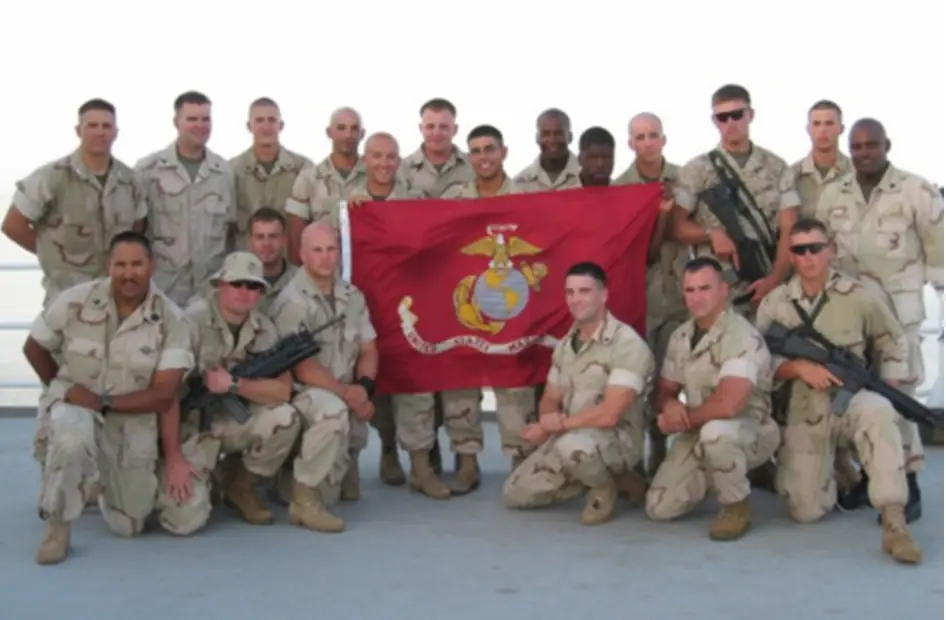
Here we are back in our youth. I’m the Marine in front of the flag trying to flex without flexing, he’s the Marine dead center behind the flag.
We dedicate this episode to Captain Brian Letendre and Corporal Jordan Peirson, and to all the other Marines, Soldiers, Sailors, and Airmen we’ve lost since September 11, 2001.

For the Itunes version: https://itunes.apple.com/us/podcast/chris-alberts-warrior-soul/id1096901382?mt=2
Show Notes:
Website: jmanuelwrites.com Twitter: @jmanuelwrites Instagram: jmanuelwrites Facebook: @jmanuelwrites
Short Bio: I am a Writer, USMC Veteran, and reformed lawyer. I am, and always have been a storyteller. I have never known a different way. One flaw, of the many that I have, is that I have told too many stories to keep them straight. So begins my endeavor to reduce them to writing. Not for my posterity but for theirs. You’re welcome. My novel, From Filth & Mud, is now available on Amazon.com. I love science, BJJ & things that make me go, huh?
Book:

Transcript
Machine-generated from the episode audio and lightly edited — may contain errors.
Chris Albert (link to this point)
Good afternoon. Welcome to Warrior Soul podcast episode 12. My name is Chris Albert, I'm the host and owner of Warrior Soul Apparel. And today we're gonna be having a very special guest on. Just to set it up for you, I want you to think about a concept in a stage of life that all of you have been through in one way or another.
And that is transition. Transition is rough for a lot of people because it entails doing something that has been very difficult for all living things throughout time. And that is adaptation. A lot of us like to think of Darwin's theory of evolution is, and we simplify it down to thinking that only the strong survive. But the fact is that it's not always the strong that survive.
In fact, being strong really has very little to do with it. I mean, we could look at the dinosaurs. We could look at Tyrannosaurus Rex. We can look at people we know who've perished. We can look at people we know who've taken themselves off of this earth.
And we can look to another factor that is more powerful than strength. That's not as unidimensional. And that's adaptation. The ability to adapt to any situation you're put into, and the ability to relearn your environment, to make yourself get smarter as it pertains to the environment you're dealing with. And when we think about everything today going on with the veteran community.
You know, I've always said, I don't believe it's because veterans are broken or because they're weak. It's just a matter of adaptation. It's a matter of understanding what we need to do to transition, what we need to learn. And in my mind, it's an understanding that we have to look at it like a process. Of were born soldiers, sailors, marines, airmen or anything else to do with the military.
Sorry. My speech is all screwed up today. You know, we had to go through training. We had to go on a journey. We had to go on a journey of transformation.
And similarly, those of us who are venturing off from our military careers and into the civilian world, we also have to go on that journey. And it's going to be a process. It's going to be a process of starting at the beginning, going through some things, having some achievements and then some fallbacks, and then eventually getting to where you wanna go. But it starts with a plan. It starts with an idea and a plan of how you're going to get there.
And while that might not be clear to you right off the bat, It'll never be clear to you unless you start searching for it. And unless you put the effort in to learn where that destination is that you wanna go to. The person I have here as a guest on the podcast, very special to me, is a marine that I served with. Name's J., and he's the author of From Filth and Mud. And this book is a fiction book, and it's based on the life of a Marine who is trying to transition and find his way in the civilian world.
And J. himself has gone through some things involving his own transition. And we both had similar experiences in that. While our brothers were being killed and shot at and off on deployments, we'd gotten out of the military. And we had to deal with the guilt of continuing on with our civilian lives, even though people we loved, people we served with were overseas and not able to, go on with their own transitions. So we're gonna talk about all that today.
We're gonna talk about J.'s book. We're gonna talk about some of his journeys. J. is a lawyer, and he's also a BJJ practitioner along with being an author. And we're gonna talk about how each of these different things that he's incorporated in his life have helped him out and helped him to find his way. So J., I want to welcome you to the Warrior Soul podcast.
Tell us where you are today.
J. Manuel (link to this point)
Hey, thanks for having me, Chris. In my home in Tampa, Florida, moved down here from Connecticut a couple of years back. And, yeah, that's where I'm at now. Working on my second novel. It's called Paper Tigers.
It's a it's not a direct sequel of From Filth and Mud, but it's it takes place with different characters in the same universe as From Filth and Mud. Yeah. Hopefully, I should be able to have that out to market in mid September. That's the time frame I'm shooting for. I'll I'm I'm a big time procrastinator, so I like giving myself Mhmm.
Deadlines and throwing them out into the universe because then they actually mean something.
Chris Albert (link to this point)
Yeah. Yeah. Absolutely.
J. Manuel (link to this point)
Yeah. That's what I'm doing now.
Chris Albert (link to this point)
So tell us about From Filth and Mud, your first book. Tell us about how you came up with the ideas and I'm going to go into it with you a little bit about your process, how you developed the characters and things like that.
J. Manuel (link to this point)
Yeah. So From Filth and Mud, the general idea is came from our deployment in 2003. We were part of the same detachment, Det three.
Chris Albert (link to this point)
Yeah.
J. Manuel (link to this point)
You you and I were going up the Euphrates River in Basra and Umm Qasr in Az Zubayr in Iraq. And it came from just from being out in the gulf at night upriver and kind of experiencing this this, like, sense of being at a loss for for for thought, for words, for what was going on. I was 20 years old at the time, so a lot of this like, I grew up in a very bible centric household, so, you know, I I knew the Euphrates, the Tigris, and those were the rivers that the Garden Of Eden was supposed to exist around. So, yeah, being in the Euphrates and looking down into that filthy, disgusting, wooded, horrifying river and just sitting there and going, really? This is it?
That's kind of where the ideas that would eventually manifest into the book came from. But really the book actually formed as a story back in 2005, two years after our deployment. And by this time I was already starting to experience the sense of like of this, that something was missing. I remember ever since I got into the Marines and thinking, oh my god, this is the biggest mistake I've ever made. I can't wait to get out of here.
That was kind of my thought process. I was always like, you know, the nerdy guy that didn't really like fit in and I didn't know my place in the Marine Corps. And I was also 18 years old. So, you know, who who knows who they are at 18. Right?
Chris Albert (link to this point)
Right.
J. Manuel (link to this point)
And so when I got out, that feeling of euphoria finally EAS ing, ending my enlistment just went away after about a year, year and a half. And then two years out, I started feeling the sense of, like, lost. The sense of, like, I'm lost. And I what am I doing in this college classroom? Just gotten the word that our unit was gonna be deployed to Fallujah and starting to get that, like, tug and pull between, okay, I've transitioned out.
Now the unit's going to Fallujah, and that's going to be dangerous, and there's gonna be bad stuff happening there. So you have this sense of like, well, my brothers are going somewhere. But I'm already out and how can I fight this dichotomy within me where at one point I couldn't wait to get out and now I'm thinking maybe I should go back in? And fighting those feelings and then know thinking like okay, what am I going to make of my life? What am I going to make career?
What am I going to make out of my career? And I was thinking of going to law school at that time because having a literature background, you know, doesn't really lead to employment, and so most English majors go to law school. And so that's actually where the first 10 pages of the book came from. And it was the scene where Jacob, the protagonist, is talking to his best friend, John, and they they were both Marine Force Recon Marines. And they're having this discussion. And in in the original work and the idea behind it was really that discussion between myself. I pictured myself sitting at a booth and kind of having this discussion when if you remember how Jacob is described in the scene where like the world the weight of the world is on his shoulders and he's slumped over.
He's just having this horrible depression and anxiety. And John is sitting there and it feels like, you know, there's no gravity around him. He's like pillared against the universe. And it was that that scene that was in my head, like, you know, the part of me that is thinking about this loss and I'm in transition out and the other part of me that's like, hey, man. Remember, you used to be in the Marine Corps and maybe you should go back.
So that's where that scene originated from, that transition feeling.
Chris Albert (link to this point)
That's interesting. You know, a couple of things you said there because, you know, that experience there on Euphrates, it had a huge impact on me as well, because I thinking the exact same thing. I mean, I'm like, we're right near the biblical city of Ur. We're right near, you know, where the supposedly Garden Of Eden is. And, You know, it looks like hell on earth.
But, you know, at the same time, you know, I also realized how lucky we were to basically be touring the the Euphrates the entire time and and not to have to deal with some of the things that our other brothers from our unit had to deal with down the line. And then that question of luck comes up and I'm like, well, who's actually lucky? And we lost some good guys over there when you and I weren't there. And I think we're all lucky for our experiences. We're all lucky for what the world has offered us and what fate has offered us.
And maybe you and I were lucky to venture off into a new adventure, even though that adventure might have started slowly. And maybe they're lucky because they got to experience some of the best of human nature in the face of some of the worst of human nature. Experience more of that brotherhood that we had in the Marine Corps. And at the same time using that brotherhood to fight against something that was evil. With the book, going through the first chapter, I was and when I read stuff like that, because I just finished reading Terminal Lance's book, The White Donkey. And a lot of times I catch a lot of feels while I'm reading. You know what I mean? Right. And I really felt for Jacob's situation.
I felt for what he was going through at the beginning of the book and that feeling of not really knowing what kind of contribution he's gonna make to the world, not knowing, you know, what his position is, what his place is on this earth. And I think a lot of guys out there are really going through that.
J. Manuel (link to this point)
Right. It's like a a lot like a a lot of a lot of the emotional content of those first few chapters, especially when it's it's Jacob's, you know, passages, and you're you're hearing his voice through the narrator, is really about that. Like, because it harkens back to like, okay, most or I would say all veterans and current and prior service military personnel, You're past young age. I mean, I enlisted when I was 17 with my mom's signature and then shipped off when I turned 18. And most most people in the military are about 18, 19 years old when they enlist and they go off. And all of a sudden, I mean, what 18 year old would you trust with like heavy weapons, explosives, a 20 ton vehicle or an Abrams tank that's worth like $50,000,000? Things Things that you would never trust an 18 year old kid to do in the civilian world. And they're thrust into that world. They're trusted to do these highly specialized, highly dangerous jobs.
And then after a four year enlistment, most guys, most girls rotate out. And that's it. And now they're 22 and they're stuck in a college classroom or they're in a cubicle somewhere. And they have this feeling of what kind of where am I? It's that feeling of, you know, I'm lost. You know, I used to do really cool stuff out there in the real world and this world is somehow not real. And so a lot of those chapters is is that feeling of that transition that really, you know, like, wow. All this cool stuff is going on that I'm missing out. I used to be part of it.
Now where's my space in the universe?
Chris Albert (link to this point)
Question for you. So so how do you find that space? What what do you do? What kind of processes do you have to go through?
J. Manuel (link to this point)
Oh, man. It's it's hard. And honestly, I I wish I had the answer because it's it's a daily grind for me.
Chris Albert (link to this point)
Yeah.
J. Manuel (link to this point)
Honestly, there are days where I feel like Jacob in the first couple of chapters and I'm sitting there like, maybe I should blow my brains out because I don't see the light.
Chris Albert (link to this point)
Yeah.
J. Manuel (link to this point)
And I think, you know, more recently as I've tried to concentrate on those thoughts and and and try to take positive steps, those days are lesser and lesser. But it's a daily struggle. Like, no matter what you do, you kinda tend to always hearken back to those days when you were in like when we were in the Euphrates. I mean
Chris Albert (link to this point)
Mhmm.
J. Manuel (link to this point)
Sometimes you don't feel more alive than that. Right. It's that weird feeling of like, well, I'm going through life, but is this really life? And I remember working in offices and thinking like, you know, I'm interning because I'm in law school and so I'm interning in different legal offices and sitting there and going, okay, I thought being a lawyer was like gonna be, you know, life and death and maybe I'll have clients that I can help out and do this. But a lot of the work is sitting in an office and you're going over contracts and at the end of the day you're like, who cares?
Chris Albert (link to this point)
Yeah. Yeah. And you know, that's a that's a thing. Because I think back on it and, you know, the thing I hated about the Marine Corps most was hurry up and wait. Just just all the freaking just sitting there and waiting for something to happen.
But and that's why, you know, there were certain places that I absolutely hated. I absolutely hated Okinawa we didn't do much there at all. I absolutely, you know
J. Manuel (link to this point)
Except for SMTG, that was fun as hell.
Chris Albert (link to this point)
Yeah, no, absolutely. But, you know, while we're out there, you know, you're, you have to be alert, you know, you're on patrol, you're going up the Euphrates and, and, and you gotta be alert. You gotta see what's going on around you. And I think that that forces you to be present. And that forces you to be here in the moment, focusing on what you're doing and actually appreciating or getting an impression of everything that's going on around you.
And And I think the lesson there is this, that if we want to accomplish something, whether that is, you know, getting a bunch of civilian contractors in and out of Iraq alive, or whether that is trying to find success in the civilian world, or even if you're just trying to be good at a job, no matter what that job is, being present and being in the moment and actually appreciating the opportunities that you have and actually focusing on what's going on around you. Because I think one of the problems with guys who are in school is the very concept of school, the concept of college is, we don't grow up to go to college. We don't grow up to sit our butts in school and listen to what somebody else says. The very concept is one that we're waiting for the future to happen we're waiting for something to happen. You know what I mean?
And have you found that have you found any way to bring yourself back to that kind of present state, that that real appreciative state of be being? Because from from what I see, I mean, you you wrote a pretty awesome book, and, you know, you've you had to take the time to sit down there. So what gets you to do that? You know what I mean? Because you go through school, you get the law degree, and you're living the civilian life.
What what gets you to sit down every day after work or after doing what you're doing to to write down, you know, a thousand, two words?
J. Manuel (link to this point)
Dude, I'm glad you asked because a lot of it I remember last January when I finally sat down because I had written those 10 pages ten years ago back in 2005. And I hadn't touched them since but the story because life got in the way. College and law school and my legal career and what am I gonna do with my life? How am I gonna make money? But every step of the way I would get those moments where like the voices would come crashing through because ever since I was little, that's what I liked to do.
I liked writing. I would have these storylines and these characters in my head. And, sometimes it felt like, you know, I'm just listening to their stories and their lives and they have names and things like that. I didn't understand up until recently that, you know, okay, guess that's what writers kind of have going on. It's not that I'm crazy.
But last year I couldn't just with dealing with everything else, you know, figuring out that the legal career isn't exactly what I wanted to do, it's not law wasn't what I thought it was gonna be. I just got to the point of desperation, really. It's that like, I'm gonna have a panic attack if I don't just start writing and start putting this stuff down. And it was one of those things where I'd always put it in a goal, like, you know, on the top of a list. I'm gonna publish a book one day.
I'm gonna write a book, and I wanna be a writer. And then last year, got to the point like, look, everything else is going so negative. Like, in terms of career and what you're gonna figure out with the world. Sit down and do this because I you have no other choice. It's almost like it was it was just, like, ripping through my consciousness that I needed to do this for for myself, emotionally, intellectually, but more than anything else, just like out of desperation.
This needs to get done. Mhmm.
Chris Albert (link to this point)
And so when you would get to the keyboard, what kind of stuff was coming out? Because I I hear from some writers they say, you know, just get the get the words out and then look over it later. Right? Right. Is that something you did too?
J. Manuel (link to this point)
Well, you know, at the beginning, I would sit there and kind of, you know, I I write stream of consciousness and hey, I had storylines and that's great and dialogue going on. But then what would get in the way of my writing was my own personal shit, my own feelings. Like, am I feeling lonely today? Do I feel like, am I stressed out? Am I gonna have a panic attack?
Do I feel anxious? Am I freaking out about life?
Chris Albert (link to this point)
Yeah.
J. Manuel (link to this point)
Those dark voices that you wake up in the morning and you say, you're such a piece of shit.
Chris Albert (link to this point)
Yeah.
J. Manuel (link to this point)
Those voices would get in the way. And I'm sitting there like, what the fuck am I doing? I'm gonna fucking write? Like, go back to your legal career.
What the fuck? Like, you know, do do that. Do all the shit that that hasn't worked out. Just go back and do it again because it's the easy way out. It's the way to just say, fuck it.
I'm conforming. I'm gonna go back to a cubicle. I don't fucking care. It's a steady paycheck. Maybe I can drink myself to sleep when I come home.
Chris Albert (link to this point)
Mhmm.
J. Manuel (link to this point)
And so those voices would stop me until one day I just kinda had a breakthrough where I just had that negative fucking voice that always comes up and says like, you're a piece of shit. You you you are a shitty marine. Like, in the voice of a drill instructor, like, you're a nasty civilian now. Yeah. You have amounted to shit.
Like, you're a shitbag lawyer. You're a shitbag dad. Like, you're shitty father. And I'm sitting there. I had that, like, moment where I was like, fuck it.
I'm gonna use this negative energy to write a really dark, horrible scene just come on comes out. So I started typing and I finished it. I left the anger on the keyboard and went jogging with my dog, Goliath, for a couple of miles. Came back and then I read what I had written. Mhmm.
And a lot of it was stream of consciousness, angry shit. And so as I started editing it down to something that could be used in the storyline, it almost felt like I was editing the emotions out of myself. So it it it helped. And so from then on, started saying, fuck it. Even if I have days where I'm feeling like shit, I have writer's block, just get to the keyboard and write whatever comes to you.
Doesn't have to be part of this book or the next book. It can be your short stories. It can be your jiu-jitsu blog. It can be anything. Maybe poetry that I write for myself or something that will never see the light of day.
Just get it out because it's a way of not only increasing your word count for the day, but also kind of like filtering out your emotions and getting them out of you.
Chris Albert (link to this point)
That's awesome. That's awesome. And so do you keep a journal as well as your written work?
J. Manuel (link to this point)
Yeah. You know, I I type out the stuff for myself as far as, you know, as far as the emotional shit that will never get published. Never seen the light of day. But it helps because you type it out, you put those words in there, and then you leave them.
Chris Albert (link to this point)
Mhmm.
J. Manuel (link to this point)
And then you come back and you read them, and you're like, oh. And what I found out is that it's like self therapy where there's a lot of negative shit that the voices inside your head the voice inside your head says about you. And you're like, oh, this is worthless. Yeah. You're so bad at this.
And then you put that down on the paper, and then you come back to it. Inevitably, at least for me, I don't know if it's some sort of bipolar thing we're going where, you know, one hour it's this and the other hour I'm feeling positive. But inevitably, when I come back to it and I read those words, I'm like, wow. That's a little harsh, man.
Chris Albert (link to this point)
Like Yeah.
J. Manuel (link to this point)
You don't actually you don't actually think that. That's kinda ridiculous. And then you think about what set it off and you're like, oh, really? Like, you know, you fucking you dropped something and you you know, two or three shitty little events in the morning piss you off that much that you're like, you're a piece of shit. So it it's kinda it kinda helps.
And that's why I keep that.
Chris Albert (link to this point)
Yeah. Yeah. You know, I go through the same thing as an entrepreneur. I wrote a blog about it a few weeks ago. And same thing happens to me.
You know, I'll have a difficult day where I'm trying to get through a project or I'm trying to get a shirt out or maybe a shirt's not selling or maybe something I'm working on just isn't working. Or maybe I'm even, I'm not following the schedule like I shouldn't should be following it.
J. Manuel (link to this point)
Tell me about it. Damn schedules.
Chris Albert (link to this point)
Absolutely.
Because sometimes the world invades and it's two or 03:00 before you actually get to do something creative. And I get hard on myself. I get hard on myself so much. And, you know, I've had nights where I couldn't get to sleep and I'd start like hyperventilating in bed because, you know, I'm like, what the fuck am I doing with my life? What am I why the fuck am I here?
I'm not fucking, you know, why is my girlfriend next to me right now? I'm not gonna be able to provide anything for her. You know what mean? She could go find somebody else, that kind of stuff. You know, that's
J. Manuel (link to this point)
I wonder that with my wife all the time. I'm like, why the fuck are you with me? I'm so fucking worthless.
Chris Albert (link to this point)
Yeah. No. Exactly. But the problem I think with it is or maybe it's healthy that we talk about it. Maybe it's healthy that we we have lit at least admit that it's there.
I think the problem comes when we actually don't acknowledge it. And when we actually don't acknowledge that it's there and we try to go on like everything's okay and everything's fine and it's not. Because you can't hide from your own subconscious. You can deny your subconscious, but you can't hide from it. And when you start to hide from it, it starts to manifest itself in one way or another.
And and it could lead to some really bad things, you know. It
J. Manuel (link to this point)
Oh, yeah. Self hate, you you just you're just sitting there like, I'm such a piece of shit, like, quickly turns into, well, if you're such a piece of shit, nothing's happening. You might as well blow your fucking brains out because, you know, who the fuck cares?
Chris Albert (link to this point)
Absolutely. And it it creeps up on you at the worst possible time. Like, when you're Yeah. When you're trying to do something like write a book that's going to help you when you're trying to start a company, when you're trying to complete a law degree, when you're trying to complete college, that kind of stuff, that's when it starts to sneak up on you. Anything you try to do to improve your life.
And so I guess the lesson for everybody at home is one, acknowledge that it's there. And then two, figure out something that you could pour it into. Whether that be writing, whether that be something like Brazilian jiu-jitsu, whether that be something like running or weight lifting. But figure out what your thing is that that you're gonna pour all that negativity into and try to try to turn it into a positive.
J. Manuel (link to this point)
Right. And you know, I found that like not only is it good to get that motion, you know, for me onto the keyboard and write and you know, that helps that little hamster wheel keep going in into in a positive way, but also as far as getting my body physically active. Because the worst times for me was that those times during law school where I'm busy just reading and doing busy work to learn the material and memorize it for exams and process that, that I was ignoring working out. I've always run. I've always, you know, at least done some light lifting, something like that. And I ignored it for a couple years in law school. And it was the worst thing I could have done because all that negativity mentally, like I used to dispel it by working out, getting that energy out. And now I had that excess energy plus negativity and then my body started reacting.
I, like, started getting ulcers or, you know, not not full blown ulcers, but, like, on my way there with horrible heartburn, H pylori was in my system. And I was, you know, not paying it, being negligent with my body and not paying attention. And so, you know, ever since I moved down here to Tampa, I was like, look, I gotta work out. I gotta find something to do. And luckily for me, one of my, you know, to bucket list items was, hey, one day I wanna do Brazilian jiu-jitsu because I've always, you know, enjoyed watching.
I like I I saw the original UFCs. I wonder what it's gonna be like. So I started doing that and one really good benefit that I found from it that, not only as far as fitness, but it helped me a lot being in the present. Finding that thing where I have to physically and mentally and emotionally be in the present when I'm doing BJJ because on the mat, if if you're not paying attention, if you let your mind slip, if or if you're caught in your mind in the cycle of, like, oh, what am I feeling like today? No.
Today's a shitty day. You're gonna get your arm arm barred. You're gonna get your foot locked. You're gonna get choked out. Yep.
So you don't have that. It it forces you to be right there in this moment, and you're battling with this other person who's your training partner and you're trying to, you know, harm each other in a non harmful way. But it forces me to just let everything go. As soon as I get into class, I know as soon as I get through those doors, I tie on my gi or if I'm doing no gi, I put in my no gi stuff. I just know everything has to be left out.
Because here I'm getting a workout but not only do I have to be present with my with like 100% of my brain because if not, it's gonna be a shitty bit time on the mats because I'm gonna get choked out every two seconds or arm barred. So yeah, I found that that's really helpful. Finding an activity where you're not only physically exhausting yourself, but it requires your full focus. Mhmm.
Chris Albert (link to this point)
What was your schedule like while you were writing the book? Like, so what would a typical day look like?
J. Manuel (link to this point)
So what I would do was last January, when I it was a Friday night where I said, fuck it. If I'm going back to work on Monday, I might as like, I'll either quit right this second or I'm going back to work on Monday. But either way, I have to start writing. So Friday night, I came back. I just started working from, like, 08:00 at night, put the boys down.
09:00, I just started typing till two in the morning. And, basically, that's what I was doing. I was going to work, coming back home, eating something, giving the boys a bath, putting them down real quick. And by 08:30, 09:00 every night, I was writing to us one, two in the morning or as far as I could without passing out. I was like, it has to get done.
I have to get this manuscript done. And so I got to about thirty, forty thousand words in and I remember when I told my wife, was like, listen, hon. I think this book is coming along really well. I hate my fucking job. And there's nothing positive about this job.
I need to leave it because I'm gonna lose my fucking mind if I don't leave this job.
Chris Albert (link to this point)
Mhmm.
J. Manuel (link to this point)
And I've gotten far enough into this book that I know that I'm gonna finish this book. And there's enough here for it to be a good book. So I'm gonna quit this stupid job and work contract jobs, find some attorney jobs, some lawyer jobs as on a contract basis and do that. And so, yeah, about summer of last year with about halfway through the book to go, I decided, okay. That's it.
I put in my two weeks, left a shitty job, and I was like, fine. I'll work on a contract basis and clear my schedule to concentrate on finishing the manuscript and then on the editing process. So what ended up happening was I got about a month free to write where I finished the manuscript, And then I started working again these contract jobs. So it got back to the cycle of, okay, around 08:00 at night, two in the morning, I'm doing my writing, my editing, things like that. Up until I remember Thanksgiving of last year, was doing my third round of editing and then right Christmas Eve, I'm sitting there till three in the morning just putting the final edits before the full manuscript, like before the final book goes to the publishers.
Chris Albert (link to this point)
Oh my god.
J. Manuel (link to this point)
Yeah. So I mean, it took a lot, but it was worth it. And it was damn worth it for me in terms of could I do this? I have to do this.
Chris Albert (link to this point)
What was that feeling like when you finally sent the book off to the publisher? Like, would you feel would you do what was there, like, any celebration? What happened?
J. Manuel (link to this point)
You know, I had bought this bottle of champagne, like, really expensive champagne. And I was like, this is it. It's gonna be it's gonna be a celebration and everything. Once I, you know for me, it was once I finished the manuscript, and that was last summer. I finished the manuscript and I was started reading over it.
I'm like, this is such a piece of shit. It's worthless. I'm gonna keep this corked until I finish the book. So Christmas Eve came and went and the book's out to the publisher and then I just felt this feeling of It wasn't euphoria. It was, oh, no.
Now it's out in the world. Now it's out to be judged.
Chris Albert (link to this point)
Yeah.
J. Manuel (link to this point)
You know? So it's like and that bottle is still there. That bottle is still there. And I, you know, I honestly, I keep moving the goalposts. I'm like, you know, I'm just not ready.
I'm not not a 100 sure on, you know, my career as a writer. It's it's weird. It's you know, I I wish I could sit back and say, open that bottle and say, I've arrived and this is great.
Chris Albert (link to this point)
What do you think is gonna get you to open that bottle?
J. Manuel (link to this point)
I don't think any single event. I think it honestly, it's my mindset. I'm gonna have to come to terms with with myself on that one and say, okay, you've you've done enough. You've earned it.
Chris Albert (link to this point)
Yeah. Yeah. And you could look at that in in a couple of different ways. I mean, the first thing is, you know, I tell people there is no endgame. The endgame is death.
Right? Right. Right. So you're never gonna really stop your pursuit of what you wanna do until you die, right? And, you know, I look at people who retire and I look at people who have stopped working and the only healthy ones I know are people who found something else.
People who've been on point with finding something else that they could do. The other way to look at it though is that at some point you're gonna have to congratulate yourself, man. And at some point you're gonna have to, you know, feel that pride and allow yourself to feel it. You know what I'm saying?
J. Manuel (link to this point)
It's weird, man. There's only been very few points in my life as an adult where I could remember I was proud of doing something like I still remember getting my EGA in front of the Iwo Jima Memorial on Parris Island, and I was in tears. And my drill instructor, staff sergeant Henderson, came up to me and he puts the EGA in my hand, salutes me, and he goes, you know, congratulations, marine. He goes, Cologne, you surprised the shit out of me. I didn't think you were gonna make it.
And I felt like, yes. I made it. But yeah, I don't know if it's if it's a marine thing or if it's just our personality type thing where it's it's hard to be self congratulatory.
Chris Albert (link to this point)
Yeah.
J. Manuel (link to this point)
It's hard.
Chris Albert (link to this point)
Yeah. It's hard to be satisfied, but I think at some point you gotta you're gonna have to do that. You're gonna have to say to yourself, you know what? I did this. This is freaking awesome.
The reason why you gotta do it is because you gotta love yourself at some point. I don't wanna talk, man. No matter what I do, I'm always looking for something else. I'm always looking for something new to do. But I think it's something we all have to try to practice because and maybe congratulations isn't opening up a bottle of champagne.
Maybe it's spending some time with your wife, spending some time with your family and the people we love, that kind of thing. And I'm sure you're doing that as well. I'm just saying at some point, I think we have to allow ourselves to be human allow ourselves to be people. BJJ talked a little bit about how you were training for that. Did that help you with writing the book?
Do you take any of the concepts of jiu-jitsu and apply them to life? And and what kind of lessons have you learned from it?
J. Manuel (link to this point)
Yeah. It helps, number one, emotionally. Getting getting all that, like, crazy physical energy out of me because that contributes to anxiety and things like that for me. I've always needed to be physically active even though, you know, I've always been the nerdy, small, skinny kid everywhere I've been. I I weigh about one fifty now.
That's my walking around weight. At the end of a jiu-jitsu class, I'm probably one forty five. Just that five pounds of sweat are in my gi. I was one forty five when I went into boot camp. I got out at one thirty because it was nothing but starvation and running.
But, yeah, I've always been a small guy and I've always but I've always needed an outlet for my energy. I've always been kind of a hyper person. So even in class and school when I was a little kid, I couldn't really concentrate because I needed to talk to people or go outside and run around in circles. So I found that jiu-jitsu helps me get rid of all that excess energy and I focus my emotions and my thoughts onto the keyboard and get the get my writing done. It's also I have a jiu-jitsu blog where I kind of take, like, science, which I'm passionate about, and jiu-jitsu, and kind of a little comedy, a little self deprecation, and involve that into a blog called On the Gentle Art.
So it's up on my website. I have a few followers, lot of BJJ people, a lot of people who are interested in science get a kick out of it too. You won't learn techniques there, but you'll kind of like follow me along my experience, my little journey so far. I've been practicing for two and a half years now. I mean, physically and emotionally it helps me do that.
It keeps me in great shape. But also it kind of gives me It kind of makes me realize like it's problem solving on the move, 100% focus required, and that helps transition to okay, what am I gonna do and how am I gonna tackle that situation? Well, you know, I could go ahead full on and just tackle it the way I've been tackling it or find a different way. And sometimes with like with jiu-jitsu, it's like, well, I'm not gonna be pin this bigger guy to the ground and force his arms apart and wrench his arms back with my tiny little body. But if I learn the technique and I apply it accurately and correctly, I'll move a side of his strength, move around, tire him out a little bit, and then maybe I can apply the technique 100% of doesn't work 100% of the time, but every now and then you go, oh shit, this works.
Chris Albert (link to this point)
Oh, wow.
J. Manuel (link to this point)
Yeah.
Chris Albert (link to this point)
That's awesome. What belt level are you right now?
J. Manuel (link to this point)
I'm a blue belt. I have one stripe on my blue belt and that's usually takes about a year, year and a half to get your blue belt. So I've been doing it two and a half years now. I go three, four times a week depending on my schedule. When I'm working contracts, it's hard to get to more than twice a week, which sucks because, you know, that's when I need to de stress.
But, yeah, it's it's awesome. Work the first class in when I'm getting choked out by a 150 group, like, woman who's, like, smiling and all happy. Two seconds later, I'm on the floor, like, as the world is closing in around me. Like, what the fuck just happened?
Chris Albert (link to this point)
That's awesome.
J. Manuel (link to this point)
And the worst thing is she was wearing a pink gi and she smelled of perfume and was like, oh, hey, maybe next time you should tap out sooner. And I'm like, oh my god.
Chris Albert (link to this point)
That's crazy. That's crazy. Boy. But we've all been there.
J. Manuel (link to this point)
Oh, yeah. It's like with anything. Anything you try, there's no such thing as being an expert at everything. Anything new that you're gonna succeed at, guess what? You're gonna suck at all the time.
Chris Albert (link to this point)
Yeah. No. Absolutely. Absolutely.
My girlfriend is a she was a collegiate track athlete.
J. Manuel (link to this point)
Oh, Jesus.
Chris Albert (link to this point)
And, you know, I running with her or doing it, she because she's a freaking stud, man. She can she could she's a girl and she could do 10 pull ups really easily. She can freaking, do it. And I could do 20 pull ups, but, actually, I did 25 last week. I'm proud of myself for that.
But, but
J. Manuel (link to this point)
Awesome. First class PFT.
Chris Albert (link to this point)
Yeah. Yeah. Yeah.
Exactly. But, we did a Spartan race like last year and it was a Spartan beast and we did, it was 12 and a half miles. And, you know, I was a power lifter. I promised myself when I got out of the Marine Corps, I would never run again. But, you know, I decided I wanted to get back into it.
She wanted to do a Spartan race, so I trained for this thing. And we're going and she's running. She's like, Oh, I'm having such a good time. This is awesome. And I'm over here, you know, my 36 year old self, and I'll because she she's ten years younger than me.
She's
J. Manuel (link to this point)
Damn.
Chris Albert (link to this point)
And I'm like I'm like, Jesus Christ. Don't ever ask me to do this again. But but, yeah, we're gonna do another Spartan race at the end of the summer. And and
J. Manuel (link to this point)
Nice.
Chris Albert (link to this point)
And I kinda got bitten by the bug and I do like training for stuff and I don't wanna do bodybuilding or power lifting anymore. So it'll be cool. It's a new challenge, a new thing for me to get better at. And I've kind of let go of that whole, I need to be the strongest person in the world, that kind of thing and that kind of stuff. I still stay strong.
I still squat. I still front squat. I still deadlift. I still do presses. But the whole ego thing, the idea that, I wanna get an Instagram shot of me dead lifting five plates.
Yeah. That's not happening anymore. That's not happening anymore. So
J. Manuel (link to this point)
But they already put them up, so they'll last forever on the Internet.
Chris Albert (link to this point)
Yeah. Maybe four plates, but but not five plates right now. Cool, man. So back to the book. Yeah.
If there's one nugget or or golden piece of advice that you want people to get or one one perspective that you want the reader to get from the book, what is that?
J. Manuel (link to this point)
Well, you know, as you read it, it's a it's a science fiction thriller. I call it science fiction, but I don't want people to think it's like, you know, galaxy far far away thousands of years in the future. It's more like a Michael Crichton type science fiction where it's like Jurassic Park where they take, you know, science stats maybe just over the horizon, but pull it to the now and see what kind of story would develop if it went haywire. So it's that kind of science fiction. So more like a techno thriller.
So even though it's a fiction and a techno thriller with a heavy science contingent in it, it's the story is really Jacob, the protagonist, who's this marine in transition, who needs he's clamoring at the beginning of the book for an adventure. Even though he's not saying it, if you read all the all the all the narration, you you're like, well, he needs an adventure to break out of this suburban life that just keeps cycling around him and he's just kind of like, vam. And so the adventure comes and he goes off on the adventure and he ends up without giving much about the book away, he ends up the story arcs back to Iraq where he kind of, you know, has lost his soul. And he has to reclaim it through this epic adventure that he's on. So really, I guess the lesson from for the book would be, you know, maybe some some of the listeners to the podcast aren't big time into science fiction or maybe aren't into thrillers or maybe aren't into fiction.
They're like, what's the story about? It's just made up. But it's more like, well, wouldn't we all like to go on this exciting quest? And some of us need this, you know, at least we we yearn for this quest like from what we used to be. And can we recapture that?
And how cool would it be? And not only how cool would it be, but in terms of like how how much of that would actually affect our lives. You know, we're sitting in the suburbia, the world is going on around you. Wow. You get this opportunity to go on this really cool quest and at the end of the quest, it's really you come to a faith you come to face yourself and your own worst enemy is yourself.
And the resolution, the redemption is through that, facing yourself at the end and breaking through that. And whatever that means to you. And then, you know, it's funny because they say that I forget. I think who
I'm trying to remember the author who who said this. It might have been Hemingway. That the writer the writer writes the words, but it's the reader who interprets them.
Chris Albert (link to this point)
Mhmm.
J. Manuel (link to this point)
And so, you know, as you read the story, you're going to get whatever it is that you you're coming to it with. You know, my and my emotions are there kind of to suck in the reader and put you in the place of Jacob at the beginning where he's just life is horrible and you're just like, oh my god. Is he gonna kill himself in the next in the next page? And then you get into that world through his viewpoint and you follow the story. But really what you get out of it is really up to you.
Chris Albert (link to this point)
Awesome. Awesome. And I always say that, you know, our our worst enemies are ourselves. Our worst enemies are are the circus that's going on in our our own head. And the key, I think, to to getting around of that around a lot of that is understanding that it is in fact a circus.
Understanding that it is in fact just stuff that we're making up. And, you know, we make ourselves into the evil ringmaster of that circus, you know.
J. Manuel (link to this point)
Oh, absolutely. And it's it's nothing but ego. I mean, to think that the world revolves around you or that you're such a piece of shit that you're ruining everybody's life or, you know, world even, like, cares.
Chris Albert (link to this point)
Yeah.
J. Manuel (link to this point)
I mean, a lot of it it's straight it's I mean, a lot of those thoughts that I deal with on a daily on a daily basis that you deal with on a daily basis, all the negativity the listeners are dealing with on a daily basis, really is just as fictitious as my book is.
Chris Albert (link to this point)
Yep. Yep.
J. Manuel (link to this point)
It's going on an adventure. All this cool stuff is happening. I could've I could've added dragons. I could've added ninjas and fairies. None of that would have been less real than the negative thoughts in my head that sometimes prevent me from sitting at the keyboard and writing or get in the way of me thinking like, am I gonna make this phone call to this publicist today?
Am I gonna make this phone call to this agent? Agents haven't gotten back to me. Oh my god. I'm such a piece of shit. This book is horrible.
All of that is as fictitious as the book that I wrote, and that's in print now.
Chris Albert (link to this point)
Absolutely. Absolutely. Yeah. Cool, man. What type of advice would you give, say, a young marine who is trying to write his own book?
What would you say to them?
J. Manuel (link to this point)
I mean, if you're in the marine corps, out of the marine corps, whatever it is that you wanna write and, you know, I'm coming at from it from my emotional standpoint, regret, self hatred, anger, all that stuff. But even if you don't have those, even if you're like, dude, my Marine Corps experience was the best ever. I love it, whatever, but I wanna write. Really is write it, sit down in front of a keyboard or if you're doing pen to pencil, know, pen and pencil on a green monster in the field, which I used to do a lot of. I used to write poems in the field on the green monster and sit there, which I still have. They're pretty ridiculous. But, yeah, if you're doing that, do it. Just keep doing it. And the second part of it, not only do it, but do it true to yourself.
Do it true to those emotions that you're feeling. If you want to write it a certain way, write it that way. Don't think that, oh, it's gonna be embarrassing if I write it this way. It's too emotional. I'm putting myself too vulnerable out there.
Or it's too angry. People are gonna think I'm crazy. Whatever it is that you actually wanna write honestly, the thoughts that are are in your head that you're saying, write those. And make sure you write them. Like, even on the worst days, make sure you write them because eventually, there the reality is there's no conspiracy against you.
Nobody's stopping you. Nobody's standing there going judging you like, that's a shitty word. Nobody cares because the reality is you can publish the book, throw it out there, and nobody reads it. So why are you worried? Why are you worried about what the vulnerabilities that you're exposing yourself to? That's the reality. Nobody's stopping you and you're at this point where you're already published, you're gonna try your damnedest to get people to pay attention to it because people are busy with their lives doing everything else. And you're like, I went from, oh, shoot. Should I put this in Jacob the character? And are people gonna read through him to me and go, oh, man.
This guy wants to kill himself and he's so vulnerable to fuck it. Somebody read my book. Anybody read my book, you know. Once you're once it's done, you're like, this is my baby. I want people to look at it.
I want people to, like, give me advice, feedback because, you know, for me, this is gonna be my career. So I want feedback. I need reviews. I want reviews. Go to amazon.com.
Leave reviews from Filth and Mud. If there are literary agents listening out there, I've pitched a bunch of you. I'm waiting for the callbacks.
Chris Albert (link to this point)
Yeah.
J. Manuel (link to this point)
But, yeah. Write it write it honestly to yourself. Just make sure you do it.
Chris Albert (link to this point)
But that's a good point too. Once once you're done with the book, kinda the real work begins where
J. Manuel (link to this point)
Oh, yeah.
Chris Albert (link to this point)
You know, you gotta get out there and market the thing.
J. Manuel (link to this point)
Oh, man. I didn't like, I was busy writing the book because I'm a writer. I finished the book and, like, a week before I'm like, oh, shoot. I gotta turn this in. I gotta get this done.
I I was thinking, oh my god. What about cover art? I don't have any idea about cover art. What's gonna what's gonna go on this stupid book? Yeah.
And I'm freaking out and then I have to figure out, oh, cover art design, gotta contact cover artist, what do I do with integration software? I mean, that's when the real work begins. When you finish your beautiful baby manuscript and then you're like, oh crap, I gotta somehow get cover art on this. I gotta get back art. I gotta get some pictures on.
I've gotta promote it. I've gotta get a social media following. I've gotta send it to literary agents. You know, big publishers, you're hoping one day a big publisher will pick it up. You know, Simon and Schuster or Harlequin Press, please give me a call.
Chris Albert (link to this point)
Yeah. Yeah.
J. Manuel (link to this point)
Yeah. You know, that kind of thing.
Chris Albert (link to this point)
Awesome. Yeah. No. Definitely, man. Cool.
Any any last pieces of advice or anything like that you wanna tell the audience out there?
J. Manuel (link to this point)
Yeah. I know a lot of the listeners. I'm one of the listeners. So I know a lot of them are people like us. That's active duty.
Maybe people who haven't been in the military but are still going through, you know, their own struggles as most people are, is basically just you gotta push through every day. You gotta find a way. Whatever it is, you gotta hang your hat on that for that day. Don't be ashamed. Just just hang your hat on it for that day.
Use it as your crutch for the day. If it's gonna if it's gonna get you through that day, use it and do it because, you know, there was a stat last last fall, last winter where guys from our unit, you know, they took their lives and they contributed to that, you know, twenty two veterans killing themselves. And I this that is 22 a day. Right?
Chris Albert (link to this point)
So What's the Right now, it's actually controversial. Yeah. And, you know, I've said before, I don't I don't like talking about it much. But and the reason I don't like talking about it is because of social proof. More people hear about suicides, the more likely they are to commit suicides.
Just like more people hear about mass shootings, the more likely they are to to do mass shootings, and and then everybody blames guns. But, you know, but but the thing is, it's actually at one a day, which is still high. Which is still really high, you know. And
J. Manuel (link to this point)
But, yes. You know, not trying to go down that rabbit hole, but really, you know, anything you can do to be a survivor, like you were saying earlier, you don't have to be the strongest person in the world and evolution doesn't require you to be, neither does survival. Some of my toughest characters in my writing are very physically weak, you would think emotionally weak characters. They're not the typical like alpha male hero where they used to be, and they've fallen apart.
Chris Albert (link to this point)
Mhmm.
J. Manuel (link to this point)
But they're surviving, and I think that's that's that's the key. You know, you could be the smiling, happy, go lucky person, like, little girl, and then you could be, like, the brooding, viking looking guy in the corner ready to kill somebody, but you're both breathing, you're both in the same room, you're both survivors. So, you know, that's kind of that's kind of like, you know, my words of wisdom is that use whatever you can to get through the day. Those days then become weeks, months. And before you know it, if you put your efforts into something, you end up with a book, you end up with a clothing line, you end up with a promotion, a job, whatever it was that was your goal at the beginning when you start first taking those steps, you'll eventually get to it.
You just gotta figure out a way to make it through each day.
Chris Albert (link to this point)
Awesome. Awesome. Very cool, man. So I wanna thank you, and I wanna acknowledge you for coming on here. I wanna acknowledge you for for remaking yourself and for fighting that fight and getting through the difficulties.
Because as I told you before we started the podcast, I've started five different books and haven't finished any of them. All of them are non fiction. And it's just, I know how difficult it is to sit alone in front of a blank screen, which in a lot of ways I think is almost even more scary than a drill instructor can be. And because the blank screen, it's like a screaming abyss where you can't ever fill it up properly. You know, you can try to put your soul into it.
You can try make magic happen. But unless certain things are right within you, it's really hard to do. And you've got to go through a lot of self analysis and self growth to do something like this. But thank you for coming on here and talking to everybody and giving us your story and telling us about your book. Where can people find your book?
J. Manuel (link to this point)
Yeah. So the book is called From Filth and Mud. And you can find it on amazon.com as an eBook. It sells for $2.99 the Kindle version. Now you don't need Kindle to have it.
You can get the Kindle app for your phone, for whatever kind of tablet, for your PC, and download the book From Filth and Mud as an ebook version. Or you can buy it on amazon.com, the print edition. Or you can go to CreateSpace, the publisher, at createspace.com and buy it there. Or you could contact me, and I will send you a autograph copy of the book, an author's edition. So I'll make sure I have a personalized autograph for you guys.
And you can get that through my website, jmanuelwrites.com. That's jmanuel,writes, writes.com. And you can find my social media links there. I'm jmanuelwrites at Twitter, on Facebook, as well as Instagram. Oh, one other thing and important thing, I'm also donating half of my royalties to St. Jude Children's Research Hospital. They deal with it's a really good cause. 85% of their donations goes directly to research and treating patients. They basically pick up every single penny of the tab for taking care of children. Their families can stay there for free as well.
It's a really good cause. It's inspired by the research that I did into my book because this is a science fiction book based on bioengineering and things like that. So once you start reading the book, you'll realize why St. Jude is a big deal. But yeah, I also the reason for the book donations is I'm going to try to do this with every single one of my books.
Basically, use half of the royalties that I make to donate to good causes like this. I kind of have a feeling like, you know, this is art. You are getting something from art. Me writing it, you and the reader reading it. But I also would like to use it to kind of benefit people and good causes.
People doing good things, good causes for me. I have two little boys, so what more what a better what a way to basically give back than to give to St. Jude. There are links to my website. So on my website to St. Jude's donation page directly. If you don't want to buy the book but want to donate, that's great. Also, I post copies of the checks that I send out from the royalties on Instagram, so you can see them there. And I'm going to add a little donation chart to my website as well.
Chris Albert (link to this point)
Awesome.
J. Manuel (link to this point)
So yeah.
Chris Albert (link to this point)
Awesome. Yeah. And we're going to put all that information in the show notes and along
J. Manuel (link to this point)
Awesome.
Chris Albert (link to this point)
Along with J.'s bio. And maybe possibly, I'll get a picture of us, back when we're younger, better looking gentlemen on the Euphrates River.
I found a picture actually, And, it's funny because you're holding up the Marine Corps flag. I'm sitting in front of you. We're we're we're in the middle of the Persian Gulf, I think, and I'm flexing. Like, I'm trying not to to look like I'm flexing, but I'm flexing. It's it's pretty damn funny.
So maybe I'll put that up there too.
J. Manuel (link to this point)
Yeah. And I probably have a my stupid grin on my face. I'm like, it's like, who's Gomer Pyle?
Chris Albert (link to this point)
Who's ruining the shot? Everyone looks like a badass except that guy. No, man. You look great. You look great.
There's certain other people that we won't talk about that I'm sure you and I both can talk about more once you get offline that don't look so great. But Yeah. Yeah. Yeah. But but, anyways, dude, it was great having you on.
It's it's great seeing one of my marines succeed so well and and, you know, and it's awesome.
J. Manuel (link to this point)
Oh, yeah. For forgot to tell the listeners, you were my fire team leader. Yeah.
Chris Albert (link to this point)
Yes, I was. I I like Corporal Albert. Yeah. Yeah. I like to think I was a good one, but I'm sure I'm
J. Manuel (link to this point)
You were a good one. Alright. I've had I've had bad ones. And I'm sure I didn't make a great one either.
Chris Albert (link to this point)
Yeah, man. No. Yeah. That that brings me back. That brings me back.
And I haven't heard corporal Albert in a long time. Yeah. I got my sergeant's warrant about, I think it was a month after my discharge. Get out. Yeah, dude.
Because they were like, dude, you stay in. You're gonna get sergeant if you stay in. I'm like, no. No. And then my my sister was actually getting married at some point.
Mhmm. And then the warrant came in the mail, I got it. And I was like, yes. Awesome.
J. Manuel (link to this point)
Yes. I mean Awesome.
Chris Albert (link to this point)
Yeah.
J. Manuel (link to this point)
Dude, first sergeant Gould, I remember when it was my time to go, he was like, no. You're gonna stay. I'm not you're not leaving. And I was like, I'm gonna leave. And he's like, you know what?
I guarantee you, I'm gonna see you here in a couple days. I was like, you will never see my face again, first sergeant. And he's like, but you'll pick up sergeant. Just stay. I'm like, no.
Oh, come on.
Chris Albert (link to this point)
Yeah. Yeah. Those those little decisions we make.
J. Manuel (link to this point)
Yeah.
Chris Albert (link to this point)
Yeah. To each and every person out there, whether you're a veteran or an active duty service member or a student, if you're writing down ideas in a notebook or a green monster or if you are doodling and making pictures and doing some form of art, you know, go with it, explore it, you know, maybe take a trip down the rabbit hole just to see where it leads you. Because at the end of the day, you might be doing something that could change your life. And for a lot of you, you might be doing something that could save your life. So I wanna thank each and every one of you today for listening to us and, you know, explore your passion, find your curiosity, and explore everything that this life has for us.
And so until next week, guys. I will talk to you all soon.
Host of the Warrior Soul Podcast and founder of Warrior Soul. Worldwide trainer and nutrition coach, contributing author at Testosterone Nation and Muscle and Strength.