Podcast episode
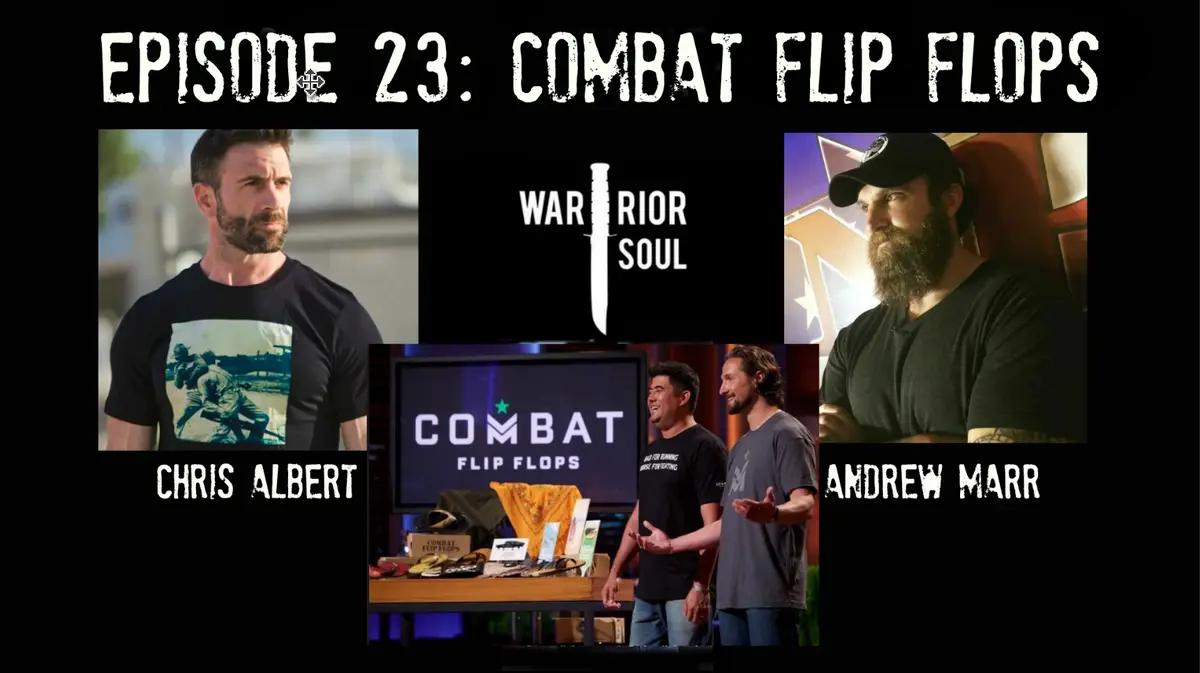
Episode 23: The Combat Flip Flops Story
Hosted by Chris Albert
The Warrior Soul Podcast
To listen on itunes: https://itunes.apple.com/us/podcast/episode-23-combat-flip-flops/id1096901382?i=1000377681729&mt=2

As US Army Rangers serving in Afghanistan, Griff and Lee saw a problem that they wanted to fix: A country torn apart by war who’s young girls had little opportunity for jobs or education.
Their solution: to build a business that helped the Afghan economy and that helped to put young Afghan girls through school.
Combat Flip Flops has grown immensely since it was a three man operation. The group recently partnered with three of the sharks on Shark Tank, and Griff has hit the stage as a TEDX presenter, but their mission is still clear. For every shemagh the company sells, a young Afghan girl gets put through school, and every flip flop is produced by factories in Colombia. Through these efforts they are helping the Afghan economy and helping Colombia to transform its once narco based economy.
The big lesson to take from this episode is that, while they might make it look easy, this is a story of pain and persistence. Things were not always easy for Griff and Lee, and they have been through a lot. But it was their purpose and vision that brought them to where they are today.
Transcript
Machine-generated from the episode audio and lightly edited — may contain errors.
Chris Albert (link to this point)
Welcome to the Warrior Soul podcast. This is Chris Albert, this is episode 23. I'm gonna start this episode off with a question. What do you want the story of your life to be like? I ask this question because it leads to another very important question.
And that is why? What is your purpose? Why do you do what you do? And it's a question you should ask yourself every time you start something new. When I started as an entrepreneur, in a lot of ways, it was the hardest thing I've ever done in my life.
You know, when when you go to bed at night and you're wondering about how you're going to pay your own bills and how are you going put the next meal on the table? These are things that entrepreneurs deal with on a regular basis. And a lot of people would ask, how do you get through that? How do you get through that period of doubt? That period of pain and suffering that you're putting in to make your dream come true.
And there's not really an easy answer for that, but there is a definitive answer. And that answer is why. Why are you doing the business in the first place? And it's important because if you don't understand your why, those hard days, those days when there is no real certainty, when you're going to bed at night and you're wondering how you're gonna pay your bills next month, and you're wondering where you're gonna get your next meal from. Those days can really have an impact if your why isn't strong enough, and they can lead you down the path to quitting.
Sometimes we look at very successful entrepreneurs and we think about them as being lucky and we only see the successful aspects of what they're doing. The two guests that Andrew and I are interviewing today are two amazing entrepreneurs. Both of them are veterans, both served as army rangers, and they started a company called Combat Flip Flops. And during this interview, they give so many gems of knowledge. And it's not your typical, hey, you know, I came, I saw, I conquered.
No. These these guys literally had to grind to get this business off the ground and they're still grinding grinding on it today to keep the business going. You're gonna hear some crazy stories about how they set up their manufacturing in Afghanistan, crazy stories about how they prepared for their appearance on Shark Tank and how Griff prepared for his, TED talk. You're gonna hear some crazy stories about the beginnings of their business where they literally had to make 4,000 pairs of flip flops by hand themselves before they could get their manufacturing set up. What I want you to do during this episode though is to think about that question at the beginning.
What do you want the story of your life to be like? Because from that idea is where you're going to get your why. And when you listen to Griff and Lee speak, you're gonna see how strong their why was and how strong their purpose is. So, without further ado, I bring you what I think is one of the best podcast episodes we've done so far. This is the story of Combat Flip Flops and all the good they're doing for this world and for the veteran community.
This is Chris Albert, and I'm here to remind you of one thing. Someday, you're going to die. Now that's not some morbid statement or scary idea. It's solid fact. Your time here on this earth is limited.
And we need to be reminded of this as much as possible for one simple reason, to live your best life while you can. This is the Warrior Soul podcast.
Andrew Marr (link to this point)
This is Andrew and Chris from the Warrior Soul podcast and today we're excited to bring you Griff and Lee from the company Combat Flip Flops and they're gonna get into that incredible mission and what that business is and we're gonna kind of dissect their lives as entrepreneurs what their life was like in the military transitioning and you know their reason behind, their why. What is what is their new mission and how are they are applying it. So And again I don't want to give away too much about them before we dive into it and so now I Griff, Lee, thanks for coming on. I think I'd like to have both of you just give a brief brief background about your how you got into the military why did you want to go into the military and then how did you two guys meet in the military?
Matthew Griffin (link to this point)
Lee you're first brother.
Donald Lee (link to this point)
I'll go first. I joined the military after nineeleven. It was pretty simple. Military was always something I wanted to do but when I got out of high school I chose the college route, I went to art school for design and after nineeleven you know just like most Americans I was pissed off but seen as I wanted it, the military was always something that I wanted to do just from outside influence, fathers, friends, things like that. There was no better time to do it.
I went in as soon as the recruiting office opened after nineeleven and I enlisted with a option 40 Ranger contract and shortly after I was at six ninety nine.
Andrew Marr (link to this point)
Nice and now you had a college degree is that right Lee? You enlisted?
Donald Lee (link to this point)
Yeah.
Andrew Marr (link to this point)
Did your parents or anybody give you any flack for not going OCS route or anything else?
Donald Lee (link to this point)
You know what like I you know I kind of did the research I knew where I wanted to go I knew what I wanted to do I wanted to be with guys that are there to win That's why I didn't I specifically went in with a Ranger contract. You know, not to knock anybody or regular army dudes, but you know the biggest fear I had was going and fighting beside guys that were in the army just for college money. So you know I went the Ranger route again I wanted to go with all the meat eaters I just wanted to win so that's really why I went that route. I didn't joined when I was 25 so that was a lot that was really interesting, a really interesting thing in my life too but when I joined it was just for that I wanted to go make a difference you know after nineeleven and that's why I did it.
Andrew Marr (link to this point)
Yeah absolutely. Griff, how about you my man?
Matthew Griffin (link to this point)
I'm fourth generation military. My great grandfather fought in World War one. My grandfather right there fought in World War two as a tail gunner in an A-20 Havoc. My dad is a retired army officer. And then so it just seemed like the logical thing to do, just raised in that kind of environment going in.
So I was fortunate enough that when I was really young, my dad was an instructor at West Point. I really liked the academy, I liked the people that were there, and I always had it in my head that I wanted to go. I went graduated the class of 2001, so the 09/11 class. Commissioned artillery just because I like if you're gonna do if you're gonna blow something up, you might as well blow it up really big. I guess it's really that was be a bear, be a grizzly.
Right? Yeah. That's right. And during my time during the military, they used to have ranger demonstrations at the academy every now and then. And I just remember one night they came in blazing on a on a Blackhawk with miniguns rolling and the RSOVs came charging out of the woods and looked like porcupines with all the machine gun barrels coming off of them and they were just raging.
I thought to myself, man, when I join the army, want go hang out with those dudes. It looked like a lot of fun. And so that's what I did is I just went through artillery basic, ranger school, my first conventional unit, and I applied to be a company fire support officer at second Ranger Battalion. And I ended up getting admitted in the summer of two thousand and three, so right as Lee was coming back from Iraq. And then we met in the team room and everybody had their combat scrolls and I didn't have anything, so that's that's how we met is all the privates giving me a hard time.
That was it. Yep.
Andrew Marr (link to this point)
Nothing like privates giving the the commissioned officer a tough time for not having the appropriate combat stripes.
Matthew Griffin (link to this point)
Correct. Yep. So that's that's how we met, and we did a short train up together, then we ended up going to Operation Winter Strike, is the winter of two thousand and three going into 2004. It was a really burly intensive mission up in the Hindu Kush, in the Kunar Province, past the Khorangal Valley, so we were way out there. Yeah, we were just living with the people off the land, hunting bad deeds down in the middle of winter, that's where we kind of built our bond and started talking business and entrepreneurship and all the other things you're doing while you're sitting around on guard, just waiting to do things.
And we'd always talked about business and through the next couple deployments we just stayed thick as thieves. Lee was always one of those guys. He was the perpetual naysayer on the team. And every team's got one, and that's Lee, and he still fills that role. But yeah, when we shit at the fan you could always trust him and so that's just how we built our bond and we stayed tight ever since.
Andrew Marr (link to this point)
And so man that that idea kind of started to spring out in those early deployments. Hey we definitely want to do a business together and it just started to develop there.
Donald Lee (link to this point)
We didn't know what kind of business we just knew we wanted to start a business right? Probably Yeah. Went through 130 ideas and I mean one was we were gonna get a little motorcycle hooked up to some kind of shack that we would pull around and sell coffee. Coffee. Right?
Matthew Griffin (link to this point)
It's like a coffee delivery service. Right? If we would have started it now for people to have an app and we'd put somebody on a moped, they go run over there and make them a Lee's special cinnamon sugar free vulte latte or whatever it is.
Andrew Marr (link to this point)
Write that write that idea down.
Chris Albert (link to this point)
Yeah.
Andrew Marr (link to this point)
Yeah.
Donald Lee (link to this point)
That was that was like one of one of a million and no but the interesting part is combat flip flops actually came in the form of like a really late night call maybe like a three in the morning call from Griff from Afghanistan and you know I was up it was three in the morning why wouldn't I be up? So I called him, Hey we're gonna do this, I'm okay sure why not let's do this and you know we buy the domain from the company and you know we're here. I mean it was one of those things where the craziest, the dumbest, craziest ideas ends up having some ray of sunshine or brightness behind the idea and this was one.
Andrew Marr (link to this point)
So, Griff, what would you say that you're calling him up at 3AM, you got the idea for the business. What is your pitch to Lee at that time?
Matthew Griffin (link to this point)
Hey, bro. I was in a factory and I saw where they're making flip flops at a combat boot factory. Let's start a company, combat flip flops. You know, GoDaddy registered their domain name. My dial up's too slow here.
Okay, man. We got this. We'll do it. Yeah. And that was it.
But I I think the the story has a little bit more background than that. You know, Lee had Lee had already done Iraq, so we'd seen some hard times. And then I come out of the come out of Iowa, out of the academy through officer basic course and all the training. I live a standard Western life. And I remember going through rope when they're doing your orientation.
They had a psychologist. You know, they'd psychologically evaluate you and everything else. And the one thing that comment that he had for me was you don't have empathy. Like, really just the word. Right?
And just big knuckle dragging, meat eating guy. And he says, you know, it's something you really need to work on is empathy. And to be honest, I I didn't know I knew what the word was, but I really didn't know what it meant. And go figure, you know, it's one of those things when the student is ready, the teacher will appear. And as soon as we rolled out of Bagram through the front gate, and I'm sure multiple people here have done that drive heading south toward Kabul, It was the Wild West back then.
When you see those kids with no shoes and water bottles and all the other things, they're just begging for whatever they have, and that hit me. It's like holy crap, these people are poor. They are destitute. They need some help. And then it went downhill from there.
You know, birth defects, polio, you know, just being oppressed by violence, addicted to drugs, all those other things that you see up in those valleys. And they're not getting to see those after school specials like we got to see when we were kids. They don't have school counselors to help them out, that nobody's gonna call their parents. You know, there's really it's it's really kind of a helpless situation. It's really where I think Lee and I both had some transformative experiences there where we developed a good sense of empathy with the culture of the Afghans.
And that just led us to always want to go back and help. And it just came in the form of a flip flop in industry. It just seemed to me like a positive sustainable change that nobody's gonna get hurt. Everybody digs it. And it's just a good way to to really put the American flag forward around the world is get through good solid sustainable business.
Chris Albert (link to this point)
That's outstanding. One question I I have, and I I ask this of entrepreneurs is, you know, I think a lot of people, see, you know, you guys on Shark Tank, and they see you on your TED Talk, and they see they see success. And as an entrepreneur, as a fellow entrepreneur, I know that there's a lot of, you know, fear and pain involved in the first stages. Can you tell us about those first stages and maybe some of the difficulties you ran into and some of the things, some of the ways you overcame them?
Matthew Griffin (link to this point)
Lee, your turn.
Donald Lee (link to this point)
We're still going through them, man. Mean, honestly, we've been doing this for like four or five years now.
Matthew Griffin (link to this point)
Four years, yeah.
Donald Lee (link to this point)
Four years now and this is really the first year that we picked up traction like we're really you know we were the scale that we were doing business on the previous three years was so small that that you know we're really getting our business learnings this year. I mean you know we were on Shark Tank and we've had some very positive media coverage you know through print and publication and online medium and we're not, man, it's still a struggle, I'm telling you, like we are still grinding because, you know, we're making decisions, you know, any forecast I have, this is one thing I've said to the guys all the time, like forecasts are just guesses, man. We could take industry standard conversion rates based on traffic and this metric and that metric and your first year of really doing business, those don't mean anything. They're just guesses. So what we're going through right now is we've been smart enough to make some very, very strong guesses and we've been very close to hitting our targets, I mean very close to hitting what we projected, but we're still going through the grind, know, we have to order inventory to keep it on the ground, that costs money, we have to figure out what's gonna sell, we have to figure out the trends before we actually get there and you know, if we make decisions based on last year's metrics, they're just not gonna hold water because we are moving at a pace that we've never moved before and at a scale we've never been at before.
So we are still learning by no means are we these guys that have millions of dollars because of But we will get there.
Yeah.
Chris Albert (link to this point)
There's this kind of idea out there that once you become an entrepreneur and you supposedly make it, know, you're sitting you're sitting down beside a pool and, you know, you got your your frozen tropical drink and your bikini girl by your side and and things are okay. But the reality is, you know, those of us in business, a lot of times, we're grinding for life. And you gotta you gotta start to learn to love the grind a bit. You gotta start to learn to to love the work involved a bit because that is your life and and when the grind's over, the business is over, really.
Donald Lee (link to this point)
There's always something there's a something I always told my wife you know early on when I really started reaching out and becoming an entrepreneur even before combat flip flops you know she's like how about we just get stable and you know get a good paying job and you know all that good stuff and I kind of looked at her and I had made a comment to her that it's always in my head if you're not moving forward you're backwards right? It doesn't matter if you're standing still you're moving backwards because everybody's moving forwards and as an entrepreneur you have to go out and you have to grind things out. Like I don't think I could, of the way I operate and GRF operates as an entrepreneur, I can never see myself working for another person again. Like I will always go out and make my own job moving from this point in my life on, right? I mean that's just a grind man.
If you need money and you need success, you have to go out and get it. I mean, it doesn't matter how bad things suck, I mean, Griff and I, you know, Griff is brother. Griff is my brother, He'll walk in front of a Mack truck for me. I have no doubt about it. And we've been through the grind together and we're going to continue to get through this.
And this is going to be so no matter what happens, right? We're going to continue to move forward.
Matthew Griffin (link to this point)
Yeah, I mean the way I explain it, entrepreneurship, is I have to give like a mental visualization. You just drive yourself back to some Native American tribe a couple hundred years ago. There's the hunters and the gatherers. There's probably like the old chiefs in the village and the merchants and the guys who are tanning all the leathers, but the entrepreneurs are those guys who strap on the lank cloth, the bag of nuts and grab the bow and arrow and disappear up into the mountains to go drag big game back. And when you're first hunting for all the hunters there, you're gonna go hungry, you're gonna be tired, you're gonna be cold, right?
But that animal doesn't change, it's still a big old nasty elk that you gotta bring down. And it's just one of those things like when you're a young entrepreneur, you're gonna fail. You're gonna make mistakes. You're not gonna be thinking about the wind. You're not gonna be thinking about the distance.
Your aim is gonna be off. All those other things that all it just takes is for you to fail multiple times to where you get hungry enough to where you learn not to fail anymore. And that's really it is the animal doesn't get any smaller, you just get better.
Chris Albert (link to this point)
What what was your most this is gonna sound counterintuitive, but bear with me. What what was your most beneficial mistake? What I mean by that, what was the mistake that taught you the most?
Matthew Griffin (link to this point)
Which one do you think it is, Lee?
Donald Lee (link to this point)
Dip the fucking container here.
Matthew Griffin (link to this point)
Yeah. That was it. So so when we started, like, you gotta understand this. Like, we've never ran a business. We don't even know how to make shoes.
Like, really, we're gonna start a flip flop company. And so we we find through Lee because he worked for some online sales and marketing for some shoe guys, and he reached out to his network. We called him like, yeah, we can make you some prototypes. So we started making shoes and that's how it started is we sold I think I sold my motorcycle and my boat and I paid for all of our tooling and for our first round of samples. We went to a show, we showed them off, people thought it was cool, they bought thousands of pair.
We went ordered up all of our materials, went to go ship them to Afghanistan, the borders closed. Okay, while we're working the workaround, our factory closes down. They lost their government contract. They go, hey, we can manufacture this first run, but we get you got to hustle the materials here quickly. So we called up our material manufacturer and said, chop chop, get going, bro.
Get it out there. June delivery turns into July, turns into August, and then mid August, my brother and I just said, screw it. Let's just fly to Afghanistan and go get our footwear. So my brother, our co founder Andy, he's not on the call today. We flew to Afghanistan with duffel bags, we were gonna get them out on our own if we had to.
We show up there. Our material supplier did a bait and switch in a hurry, and it was a 100% fail rate. We had to give them all away. We opened the doors up and gave thousands of pairs of flip flops to Afghans in need.
Andrew Marr (link to this point)
Wow.
Matthew Griffin (link to this point)
And then we we got into a car, we bounced around Kabul, we found another factory that wanted to work with us. And we told our customers what had happened and it said, hey, guys. Griff's personally gonna put 4,000 pair of flip flops on his personal credit card. We'll make this right. Just hang with us.
And then I 4,000 pair of flip flops on my credit card without telling my wife.
Surprise.
Surprise. Right? Flew back home for two months. We were doing everything. Everything was going fine.
December 6, we got a call from our our material supplier. Hey. Materials are done. Get them off our dock. Two hours later, I got a call from our our new manufacturer saying they had just lost their boot contract and they were gonna go out of business and we we couldn't manufacture with them.
So one bad run, one close factory, second close factory, and now I've got 4,000 pair of flip flops in raw material form in China.
Andrew Marr (link to this point)
Where do you go from there?
Matthew Griffin (link to this point)
Shifted in my garage. We built a guerrilla flip flop factory in our garage, and we learned how to make our footwear. And we just did. That was it. That's all we had.
We had, like, our basically time or money, and all we had was time at that point because we were out of money, and it was everybody else's. And we needed to deliver product. Otherwise, we were gonna be out double that money in returns. And yeah, we we learned like got smart on adhesives and glues and sanders and process times and ovens and everything else. We we learned our product out under the glue, which has now helped us be able to go to different manufacturers and negotiate and bargain our pricing and our construction and our quality.
And they can't argue with us because they go, oh, no. It takes a minute fifteen to sand this flip flop. And then our six foot seven wookie, that's what what's his nickname is Andy, he rolls over there, grabs a flip flop and sands one off in thirty six seconds and hands it back to him and says, no, you're gonna charge me for thirty six seconds.
You're doing it wrong.
I'm not paying for your learnings like you're doing it wrong. Right? And then like, because we've gone through that process and we know how it works, it's really helped us out as a company, drive more profitability into the business. So that way we can contribute more to our philanthropic initiatives. That was a long explanation but that was it.
Andrew Marr (link to this point)
I think it comes down to man like who dares wins right and you had to have the balls in the foresight to even win the shits hit the fan but you know what we're gonna get on a plane we're gonna go to Afghanistan we're gonna figure it out we're gonna bring stuff over here and it takes that type of tenacity to make something work you know same thing when you're operating same you know same thing in business but you know and I think it goes back to what we're talking about entrepreneurs is oftentimes they come entrepreneurs come out with a solution but they don't really fully understand what is the problem you know we have to identify what what problem are we answering are we meeting and so what was your guys' idea or design phase you know coming up with hey this is the problem that we've seen and this is how we want to offer this solution in this new and creative way?
Donald Lee (link to this point)
I the problem that we identified, I mean it's so for us what we're doing, there's a two prong attack, right? One is a short term and one is a long term solution, right? So obviously we see the problem is the lack of jobs in Afghanistan, right? And anywhere you go, lack of jobs, lack of money is, you know, you see the the primary rise, all that good stuff, right? And then then that made the local population more susceptible to radical recruitment, right?
So our two pronged attack, our short term and our long term, right? Short term employ women, right? They get paid, the money goes back into the economy, right? Lowers prime rates, okay? Everybody's taking a small piece of the pie.
Long term, educate women, they educate their kids, kids grow up to be educated adults. Now not as likely to be radicalized, right? So long term we're taking, we're literally taking away the radical recruitment base, right? Those are the two problems that we're solving with what we're doing, right? So you always have to have a long and a short term and what we're doing they both play hand in hand, right?
So you could say we're stimulating the economy and encouraging entrepreneurship and we're fighting terrorism with flip flops, right?
Andrew Marr (link to this point)
I love it man it's just my god it's beautiful. How did you have to bring that to the local populace and how difficult was it to get them to buy in you know as far as oh I'm gonna allow my wife or daughter to go work in this factory?
Matthew Griffin (link to this point)
It's not tough, man. I started traveling back to Afghanistan in like 2008 in a medical capacity. And when I was there, I wasn't in uniform. I had a briefcase. I had cash.
I was hiring local drivers. I was staying at local hotels and they're motivated to keep me happy and keep me there. The safer I am, the happier I am, the more times I come back and the more money I spend in their local economy. And you hear everybody there from the the concierge or the hotel to the driver to the security guys. Like, if you guys are bringing economy, bring it.
We love visitors. We just don't like invaders. You guys are cool. Is when you go there and you you say, hey. I'd like to buy this product from you and I wanna buy, you know, 15 of them now and if they're good, I'm gonna buy 45 of them from you next month and then four fifty of them next year.
They go, really? Nobody else does that. Yeah. And well, how are you gonna give me the money? Well, I'll Western Union it to you.
Like, nobody's gonna take that money from you. Not the bank. Nothing. Like, push your national ID. I will send you the money.
Drop the box off at DHL. Get it to me. We'll continue to do that. And they go, really?
Like, yeah.
I mean, do you imagine like us, we're kind of weird looking guys and we're standing there talking with Afghans, telling them how we're gonna send them thousands of dollars if they just send us scarves and shemaghs, right? Give Like, it out of the market. Right? And make make 500 of them in this color, and then I'll send you a couple thousand dollars. Like the average wage for an Afghan is $600 a year.
Right? It's blowing their minds and the opportunity, they love it. They wanna hire everybody and all their families and keep that going. So it's the buy in is it's not hard. Everybody wants to earn a good living.
Yep.
Chris Albert (link to this point)
My my mouth is still a little open from from from that story about, you know, having to make the flip flops in your garage. I think that's just absolutely amazing because, you know, sometimes I coach entrepreneurs, you know, give advice to entrepreneurs, and they when they run into computer trouble, their brain shuts down and they don't want to keep going. But but you guys literally figured out how to make flip flops. You you understood the process and then perfected it, and and that allowed you to perfect your manufacturing line to understand how to save money, how to find good manufacturers of the product. I mean, I mean my mouth it's lit like I'm literally shocked, like I got goosebumps.
Donald Lee (link to this point)
But I'll be honest like you really shouldn't be right, like if you look at it as an entrepreneur, right, entrepreneur you're gonna go out and make things happen on your own right? Yeah. With an entrepreneur you have you can't depend on anybody other than yourself.
At this point where we were in the at this point of the game right or the point we were at in the game it was like f this we can't rely on anybody anymore like bring the fucking materials here and we're gonna get it done, right? Like we are gonna do it. We're not gonna rely on these guys anymore, we're gonna do it. I'll be honest with you though, my idea when we talked about shipping the materials here was like just get them here and we'll find somebody here to make them, but Andy, our third partner, Andy, he was the one that said no man. Like he had this look in his eye like I got this, right?
I mean he just had that glare, eyes got beady and he's like no man, I got this. And I've never seen anybody in my entire life educate themselves that fast on glue and rubber. Mean, don't even, the things that he figured out and the things that he learned about our manufacturing process, My mind was blown, right? Like watching him go through this, you know, but the part where we decide to do it ourselves, like that's us being not dependent on a third party to do this. We're gonna get it done, just put it in our hands and we're gonna take it in the den zone for a TD, right?
Like we got this.
Matthew Griffin (link to this point)
I mean, I always go back to the missions and the mindset we learned in the military, right? You got an objective, Hey, you hit an obstacle. You got two choices. Breach or bypass. You're going through that thing.
There's one or the other. Breach or bypass. That's it. It's all you get. There's there's no way we're not getting to that objective.
Right? And there's nobody on this planet that's gonna stop you. You get enough highly motivated people behind you that are dedicated to tackling an obstacle, that obstacle will get tackled. Right? If you got a whole bunch of guys that'll give up when the going gets tough, then that's what you got.
It's just not our team. And the second thing is, I think the thing that separates when we talk about special operations is the one thing that I really found out, the differentiator being like all the different communities, is the question why. Why are we doing it this way? What's the history behind it? Why are we motivated?
Why, why, why, why, right? And people don't get insulted when you ask why, cause everybody's trying to figure out how. How can I make it better? How can I make it lighter? How can I make it faster?
And through all the learnings and the process that we had, you know, breaching those obstacles, going around certain things, asking why things were done in certain ways. We use a different adhesive system than all the other manufacturers. We use different rubbers, right? Because we ask why things were made a certain way and then we go, oh okay, how can we make it better? How can we add our value?
That's what we did. We figured out on our own. We went through the obstacle, asked why, figured out the how, and then we went down to our manufacturer who's been making high end women's boots and footwear in Colombia for years now. And we're able to go down there and look at his production line and go, hey, man, we could boost your productivity 50%. Let's show let's we're gonna show you how.
Right? And and that's what our community is supposed to do. We're supposed to figure out the problems, figure out the solutions, and then we give them away to everybody else so that way it raises the level of everybody so you can get on to figure out the next problem.
Andrew Marr (link to this point)
Chris That's it man and you know I think what it gets down to is challenging the status quo with an open mind and looking at it from new and different angles, new eyes on it. I think a lot of your strengths that you guys pulled from allowed you to see the that industry from new a new perspective that wasn't being looked at and so then you find new ways to do it and you pioneer new things like that and that's what happens when you have the right mindset and you have the right team. How much of how difficult is it to assemble the right team or how difficult was it for you guys to assemble the right team and then to get them all on the same page understanding the mission?
Matthew Griffin (link to this point)
I don't know. We've definitely ground through some people, some guys who who wanted to be entrepreneurs and start up folks who wanted to hustle us when we first started because they saw the opportunity, but when rubber hit the road, you know, their wherewithal became apparent, and they just kind of faded away while the rest of us just kept chugging along. We give a talk on values, value based leadership, and if you can articulate your values as a leadership team and your mission statement, and then hire people that have the same value system as you, your culture will form and that's what it is. And we just have a culture of candor, directness, hard work, persistence, creativity. And it took us a couple years to really figure it out, but once we said, hey these are our values, these are the type of people that we're going to hire, they kind of just gravitated toward us.
Really can't explain it any other way other than the people that said, know, I'm really hard working, I'm really creative, I'm down with this, want to go work for you guys. They became really persistent and started banging down our door and working with us.
Donald Lee (link to this point)
I mean let's take our social media girl for instance. Yeah, Mandy. She is a gangster. I mean, you know, there's no other way to put it. She's a gangster and she showed her commitment to the mission very early on, very early on and she worked for free for how long?
Matthew Griffin (link to this point)
Two and a half years.
Chris Albert (link to this point)
Wow.
Donald Lee (link to this point)
I mean, Mandy is like this girl just self starter motivated, you know, when there's no direction, just attack. Right? Just go after it and she's doing it, you know, she's helped us grow our social channels to where they are, she's you know, shape the story, the mission, all that stuff, like she's been really great. You know, we've been very fortunate to have people like her on the team, right? We have, you know, our team is small but our team is very effective.
Know, in Spanish they say, you know, small but crazy. That's exactly where are, we got a small team but we're crazy and we get shit and we're very fortunate and very blessed company to have the people we have around us around us.
Chris Albert (link to this point)
How, as far as leadership principles go, what are the similarities and what are the differences between being in the army and and leading team there versus leading your current team with Combat Flip Flops? Have you had to change anything in your personalities? Have you had to change anything in the way you direct people at all?
Donald Lee (link to this point)
If you had access to our Skype conversations. What do you think, Griff?
Matthew Griffin (link to this point)
No. I think I mean, think between us, like, we realize the way that we talk and communicate or the the way that we were trained, people just can't handle it. Right? They they just can't handle our directness and our humor and, you know, Lee will call me out on my on my shit. Like, you're being a dick.
I can't believe you're doing that. You suck. Right? And anybody else would hear that like, oh god. Yeah.
But like and I'll say the same thing to him. Like, put your lazy ass up. You didn't get that thing done yet. It's been on the calendar for two months. What's the matter with you?
Right? We could say that to one another, but we know like in five minutes we'll be back to playing grab ass and making fun of each other's like phallic size, whatever. It's just what we do. But I think just for me personally, like I learned a lot coming out of the military, and the fact that people that work for you don't have to work for you. You have all the tools to be a good leader.
You just gotta polish those edges up a little bit a little bit more and and figure out how to do things where you can, I wouldn't say internally motivate people, you know, do it in a in a manner where you don't have to be so direct, where they don't have to be externally motivated? I guess that's it.
Chris Albert (link to this point)
So Awesome. Then with you know, you guys are working with some some pretty high power people. Do you notice any difference in the way that say, like, Mark Cuban conducts business? What if there's a big difference between him and anybody else you've worked with? Can you identify those key things that he's got that you think you want to develop?
Donald Lee (link to this point)
So Mark opened the Navy Exchange for us last month and you know I'll I'll be quiet, other than email communication like that was the first time that I had seen him since Shark Tank right and you know you've been around since Shark Tank and the fact that he flew in and opened the store for us, when he got on the ground, right, we just thought it was great he was gonna come in and when he got on the ground, it was what do I need to do to make this better? What do I need to do to sell more? Everything was tell me how you need to use me and let's get it done. There was no like I'm fucking Mark Cuban, just throw money at me. It was I'm here to help my guys I got your back 100% and then some what do you need me to do put me in the game coach and it wasn't him going it wasn't Mark showing up you know trying to be big guys you know billionaire he was he was there to help us grow our business.
He was there to help grow his business right. I mean that's the one thing that I got from Mark by being around him you know just that you know the few hours we were there opening that store it was whatever I need to do to help drive that cash I'm gonna do it, I'm gonna get after it, let's get it done. All business, right? He's like you want me to walk the store? If you think it'll sell product, I'll walk the store.
You want me to take pictures with people? I'll soon take pictures and sign autographs, Tell me what to do. That's what I got out of it and I really dug that like he was all like go go go all game.
Chris Albert (link to this point)
So it wasn't like he was coming in directing you guys at all. He wanted to know what you guys needed, how you guys could best utilize him, how best you you guys could utilize the resources that we had to to sell more product and and accomplish the mission.
Matthew Griffin (link to this point)
Yeah. Yeah.
Donald Lee (link to this point)
That was exactly it. That's awesome.
Matthew Griffin (link to this point)
Yeah. I I think I think it boils down to, I think, a leadership style that the way I personally feel about it, I can't remember who taught me it, but if if if I am holding up one of my team members because I haven't done my job or gotten them the information they need, that's that's the biggest failure that I can have as a leader. Right? We should be empowering and enabling our teammates to be the best people and staff they can be. Right? So my priority when I come into work is there's something that I owe somebody else?
Is the information that I need to distribute is always somebody else to do their job? Because as a leader you need to be ensuring your team is out doing the best that they can, right? Because that's going to free you up the space to be able to plan further, plan further forward, get after bigger opportunities. And I I really think that Mark embodies that where he, you know, he really tries to get out as much information as possible. The dude answers emails at absurd hours of the evening at at at an unbelievable rate.
So he does he does communicate well and gets all the information out to his team members that need that they need to succeed.
Andrew Marr (link to this point)
Hey for the audience that hasn't seen it, the guys were on Shark Tank and I'll let them talk about it but can we kind of back up and talk about how do you guys get the idea to go on Shark Tank? What was like the tryouts or the workup for that and then you know what was it like on there and I think that'll make more sense anybody didn't it's not tracking your connection with Mark Cuban.
Donald Lee (link to this point)
You know it was a very, I don't know what I'd call it, but it started with an interview in Santa Monica that I didn't want to that I to be honest with you, we had been at four or five different places that day. It was a really long day and I was like, I don't drift. Do we really gotta do this one? He's like, yes, let's do this one. It was for and I'm sitting here like do we have to do this?
But it was for Gizmodo, right? And we did it and Wes, the gentleman who wrote it, really great guy, he wrote this awesome, awesome interview on us, He did an awesome interview with us I think it was one of, I could probably put it all along and say it was probably one of, if not the best interview in Boys and McDonald's. And it was, you know, we were very fortunate that one of the producers from Shark Tank actually saw the article and he sent an email to us and we sent an email back to each other and we responded and we said let's do this. And, Griff?
Matthew Griffin (link to this point)
Yeah, and then it was a solid train up. You know, we were we were gonna hit it like we were gonna hit an objective. Like, we were not gonna leave any stone unturned. We watched every episode, wrote down all the questions. We patterned them.
Like, we figured out their backgrounds and their stories and their motivations. We got the dimensions for the freaking hallway. We knew the pacing, the steps. We knew the timing. We did as much research as possible so that when we actually hit the ground, it was not the first time we'd seen it.
I'm sure much of other guys who are listening to this, they've hit an objective in training hundreds of times before they hit it in the ground to really make it count in that thirty seconds or two minutes. And that's the mentality that we took is the first time we went on there, those aren't gonna be the first times we heard the questions. That's not gonna be the first time we entered that room. And it was just gonna flow just like I did in an objective and it flowed. We were in there for an hour forty five, got what we needed, actually got more than we needed, and we rolled out right and that was it.
Andrew Marr (link to this point)
Was there anything that presented itself to you guys that caught you off guard that you weren't prepared for or all the preparation just you know sometimes it just comes together man and it's kind of flows seamlessly. That the case?
Matthew Griffin (link to this point)
I don't know I wasn't expecting Cuban to come in to be honest. Was.
Donald Lee (link to this point)
I was I everybody that came in I expected to come in but I don't any of the questions any of the personalities, none of that. None of that surprises. I mean, we we have we have probably hours of some really fucked up video of us rehearsing.
Matthew Griffin (link to this point)
Yeah.
Donald Lee (link to this point)
And it was it was our business partner, Andy. And you know there was some of just me and Griff, we went, we I mean Andy ran us through the ringer when we were prepping for this. I mean you know from random questions to stuff that they already had to you know, all right, pretend you're walking in, do the timing, take the steps, or you'd be a grif where in front of a camera walking back and forth like five times to, you know, simulate walking into the room or whatever and then Abby would get after us. I don't think there was any questions or anything that we wanted to know that really surprised us.
Chris Albert (link to this point)
Is that why you had the red glow stick ready? As far as was it Kevin? Is that Kevin? Yeah. The guy who always says you're dead to me.
Donald Lee (link to this point)
Yeah. Yeah.
Chris Albert (link to this point)
So you have to
Donald Lee (link to this point)
know this. So that was that was Griff's idea and we actually we actually made the decision the way we make all of our big decisions with a game of rock paper scissors. All of our big decisions are based on the results of our
Andrew Marr (link to this point)
Rolling the dice baby, you gotta go.
Chris Albert (link to this point)
What was the biggest decision you've ever made based off of the magic eight ball right now? Paper scissors?
Matthew Griffin (link to this point)
Should we give on the Warrior Soul podcast?
All side. Concentrate and ask again.
Donald Lee (link to this point)
Yeah. Do you remember do you remember the decision that we did rock paper scissors right before we went in we walked in?
Matthew Griffin (link to this point)
Oh, that's right. So the like, the the goal of producers are right in all reality TV is drama. Like, that's what it is. It's drama. And, you know, we went in and we thought a fair evaluation based on our revenue and earnings.
We were on the high side of reasonable to cause enough drama. Right? But we weren't gonna be unreasonable to where they were gonna dismiss us for being idiots in business. Right? So we were we were just riding that edge.
We asked for we put ourselves at a $1,500,000 valuation, which was five x revenue, which is it's reasonable, but it's high. And then, you know, right before we walk on, the producer's like, I really think you guys should go for, you know, a $3,000,000 valuation. Right? And and literally, they're like, the cameras are right there. They're putting makeup on me, and the producer's standing right there.
Was like, look, man. I'll rock, paper, scissors you for it. And he's like, what? I was like, no, man. You want me to do this.
Let's go. And I threw it out. Right? And I lost. I lost.
And like literally, the lady who was doing my makeup had to stop, but like her mouth was like, you're literally doing this? I was like, why not? Right? And that was just it. And so we we turn around right before we go on and Lee asked me, he's like, are we doing that?
I was like, hell no. We're not. Let's go, bro. Let's go.
Chris Albert (link to this point)
Prevail. Prevail.
Matthew Griffin (link to this point)
And we walked we walked into the tank.
Andrew Marr (link to this point)
Give them what they want, man. How many hours did you guys prepare, you think, when you look back at it?
Donald Lee (link to this point)
Easily easily, we probably probably broke a hundred to two hundred hours.
Matthew Griffin (link to this point)
No, dude. I think way more than that. I think I probably put in in May. I probably put in two hundred hours. I think collectively, we probably have about six or seven hundred hours into it as a company.
Andrew Marr (link to this point)
And then I'm interested in your visualization process. Did you guys both have your own mechanisms to run through in your mind as well in addition to the physical preparations that you went through?
Matthew Griffin (link to this point)
Go ahead, Lee. You go ahead. Go ahead.
Now my visual, my mental preparation is is when it really comes down to it, is your business viable or is it not viable? Right? And that's really determined by your profitability and your cash flow. So for me, the biggest thing was having the actual spreadsheet in my head and the big key performance indicators. And when I pulled a certain lever, what does it do over here?
So my mental visualization was just changing that spreadsheet in my head and knowing how it affected everything. That way when I was there at the show, could do the math and be able to respond back with an answer in a professional manner.
Donald Lee (link to this point)
That's the officer's answer. My answer is going in there, was like, oh man, I hope I don't screw this up. Mean, honestly, we're standing there and so we had this planned out and, you know, when we went in there, we knew that, look, Griff is the CEO of the company. He needs to be answering all these important questions. Right.
Like, if you look at a lot of these Shark Tank episodes where there's more than one guy, there's always one guy that train wrecks it for the other guy. Right. And I didn't want to be that guy on national television train wrecking it for our company. But that was my biggest concern is I was I didn't want to go, you know, that would jam up what Griff was saying when we were pitching all that good stuff so I guess it stands there for moral support. Devilishly good looks Lee.
Andrew Marr (link to this point)
What I want our audience to take away is the level of preparation it goes into separating yourself and it's not about separating yourself so to speak but it's about doing your best because you believe in what you're doing. At that point it doesn't become work that's just life you know what I mean we're talking about grinding earlier but I want to highlight to the audience the level, the degree of preparation you guys put in it into this understanding the stakes you know and understanding what you could win or you could lose this situation and again that's that is what separates the top 1% from everybody else is this degree of preparation and I think confidence is having the ability to know that you prepared to the best of your abilities and man, you guys knocked it out of the park. It was an awesome episode. If you guys haven't seen it, you need to check it out.
Matthew Griffin (link to this point)
Well, thank you very much. It means a lot. It was a chance for us to share our message and our mission with 11,000,000 people. I feel it's my life's work. This is the stoke that I want to spread.
This is the empowerment that I need to push, if we're going to make a big impact in Afghanistan and all these other areas, I need to put on the most professional presentation possible for my team and for our supporting companies, so that way people will go, hey those guys have got something. You know, they're kind of right. We should do this and make it work and fuck it works. Like it blew up. We did more business in thirty six hours than we did in our entire company history.
Wow. Yeah. It was rad. It's so much fun.
Donald Lee (link to this point)
Yeah.
Chris Albert (link to this point)
Speaking of that, you you you also did a TED Talk. Did the did the TED Talk come before Shark Tank or after?
Matthew Griffin (link to this point)
The TED Talk came before Shark Tank.
Chris Albert (link to this point)
And and so tell me about that. To you know, how was your preparation for that? Where did the idea for a temp TED Talk come from? What kind of impact do you think that that talk has had on on you, your business, and and the audience that that you're catering to?
Matthew Griffin (link to this point)
Yeah. We really try to be as as part of our mission statement is community connection and so specifically the veteran community connection. And we try to do as much as we can to be connected to the veteran community wherever we are locally. So I was at a Nike event for veterans and I just happened to meet a guy there, which is my first advice to anybody who's listening here, to all you entrepreneurs is your network is your net worth.
Exchange your network, meet as many people as possible because you never know when that's gonna pan out for you. And he said, hey, I'm putting together a TED talk. We're sponsoring it. You had a really interesting story. Would you be interested in telling one?
Yes. The answer to those opportunities is always yes. I don't care how scared you are, the answer is yes. So I said yes, and then I had no idea what I was gonna talk about. And I was out hunting in Hawaii with a bunch of my buddies, and I still had written it.
And we were just kinda sitting there one day, and I was just trying to figure out where we're going to go next. I just I had to stop and sit and I was in a beautiful side of a mountain and could see all the way down to the beach and my buddies just went off. Just sat down there and I really wrote what thought about what we were doing. And it it's really a tough thing for people to be able to to to put it out there. Right?
Because it's it's a different picture of what you see of an army ranger. Right? Being really emotionally affected by watching a little girl get beat. You know, going back to Afghanistan and then seeing all these people being creative and building a relationship that way. Right?
Looking back at other data and showing people where we've done it in history and then like, hey, like we didn't just say we were gonna do it, we did it. And it feels boastful, especially coming out of our community. Right? We just don't talk a lot about what we do and we hey, there's Jill. Yeah, we tend to marginalize those things.
And thank you very much, Jill. Appreciate it. I'm on a podcast. Wanna say hi? This is one of those awesome staff we were talking about.
Hi, Jill.
Andrew Marr (link to this point)
How you doing? This is Jill.
Matthew Griffin (link to this point)
Hi. Alright. Thank you. She had to bring by our Inc Magazine for the podcast later. So see this?
Full page article in Inc. This month. So I think for me personally, it shifted the mindset where knowing that I had to also become the chief storytelling officer, if people were really gonna people were really gonna pay attention to what we were doing. When we first started, we went down to talk to the guys at Tom's, and they said Blake went from the CEO to the CSO really quickly because it's the story, it's the idea that moves the product. And so I think that was a really pivotal moment for me realizing that I really have to take this role seriously as the chief storytelling officer to drive the company forward.
Andrew Marr (link to this point)
I can definitely relate, Griff, because being in SF for a number of years, like you said, you just don't talk about those things but you realize that, hey if I'm not glorifying combat or I'm not you know giving away secrets and this is something that is going to be to the benefit of the listeners to hear it and we have to find a way to get over ourselves and you know I tie that in with what we were doing with our with our foundation but you know the thing is if we don't get out and we don't tell these stories we don't give these lessons learned that were paid for in blood then people aren't gonna be able to take away the gyms from them you know what I mean and and again I think it goes back to Lee what you were talking about like you didn't want to do that interview but you did it anyway and then boom that gets you an email from the producer of Shark Tank. It's just it's putting yourself putting it out there and the the sheer and the hope that it's gonna impact somebody else the right way you know not not being self serving and that a lot of times a better community doesn't want to get on the mic but if you can get on the mic and say hey this is not to just serve myself but this is to make the system better then we need to be telling those stories and again I'm just grateful for Griff and Lee coming and kind of pioneering that platform and having the balls to get out there and do it and talk about these things.
Donald Lee (link to this point)
Wait what about Special Forces?
Andrew Marr (link to this point)
I was in
Matthew Griffin (link to this point)
He's he's being a dick. Don't worry about it.
Donald Lee (link to this point)
I'm joking. I'm sorry. I can That's why I'm trying to
Chris Albert (link to this point)
Oh, man. It's a whole file over here because I'm the only marine on this It could give me to get it though. Right?
Matthew Griffin (link to this point)
Yeah. So the I mean, the thing that I try to tell you know, I had a talk with another fellow ranger got out. Guy's a super dominant athlete, wingsuit flyer, he's going to school to get a history degree and going to be a teacher. And this guy is a machine, like I look up to him. Holy crap, man, you're amazing.
And he's like, well, I just don't get out, I don't talk much. He's like, that's not our role now, man. The same way that the army expects guys to be in the Ranger community or SF community go back into conventional units and to distribute knowledge and information to improve the organization as a whole. When you're a veteran and you get out of the military, it's your job to take those leadership lessons and principles of hard work and dedication and persistence and values and all those other things and improve your local communities. The greatest generation didn't become the greatest generation just out of nowhere.
It became the greatest generation because a whole bunch of teamwork oriented veterans came back and kicked ass. Right? Like that's what it is and it's our job, it's our responsibility to do it now as veterans within our country. Like we have to do it. There's no choice around it.
Our backs are to the wall now. Like we've got to get out and be community leaders and servants and really like push our values forward. Otherwise, everybody's gonna be looking to the nearest chucklehead with a social media account for direction. And that's the wrong answer for our country.
Chris Albert (link to this point)
That's the thing that gets me the most most stoked about you guys. I was gonna say giddy, but giddy sounds like a little bit girly, but stoked is the word. And and that's because, you know, I I see so many guys out there on social media. The messages are almost mixed at times. And we have some really positive stories out there, but but for some reason, I think a lot of times the negative stories, they get they get told.
And those are the stories that make it out back out to the civilian world, and those are the stories that that tend to get emphasized by the media. But when I see guys like you who have been through hell and who have still been pushing themselves to create something that helps the world, not just helping your wallets, not just in it for the money or the fame or anything like that, but getting into it to help the world and getting into it to help community and getting into it to make people's lives better. That makes me so happy and that you guys are heroes to this community. I think that that's amazing. And, you know, I'm so glad about the reception, I think, that that you guys have gotten.
I know you've gotten some negative people trying to trying to throw some slack your way and stuff. Bullshit. And and I just think that all of us have to really get behind people like you because you guys are making this world a better place.
Matthew Griffin (link to this point)
Thank you. It means a lot. I don't even know how to respond to that. So it just means a lot. Thank you very much.
Yeah.
Sorry. You're a super serious marine guy.
So, anyway, it's it's not that struggles though. You know, people again, you said it before. You know, people look at entrepreneurs like you're sitting beside the pool. They don't see the years of sitting in an uninsulated windowless garage or sitting in a tiny asshole bedroom or freaking sleeping in the back of your car in between sales meetings or you can't even afford a hotel so you sleep at the airport on the floor. You bring your little camping roll out mat because you know you can't afford a hotel.
So you're gonna go to your meeting and then you're gonna go to the airport and roll out your mat from your carry on bag because you can't even afford to check luggage, right, to do it. Like that's the hustle you gotta make. That's the sacrifice you gotta put in if you wanna go after it. I don't know. I just think everybody here, or at least the people in our community, we know how to carry heavy loads long distances with limited food and bad weather.
And we know how to win when we're doing it. Like you got to go through that again. I think that you know what we've been through for the past fifteen years is preparing us for what we're about to go through for the next fifteen.
Andrew Marr (link to this point)
Chris So in addition to that, Griff, Lee, what other advice would you give to maybe your younger self or to guys right now, girls right now who are ready to transition and are thinking about hey I want to get into the entrepreneurial field, want to start something. You know what are some advice that you usually give out to people in that situation?
Donald Lee (link to this point)
I think, I mean, you know, the common one that you know a lot of people throw around is fail fast. Fail fast, right? And don't be scared to go outside of your comfort zone. I think that was the hardest lesson for me to learn early on was to not be afraid to go outside of the comfort zone. A lot of times, you know, when you're working on specific parts of your business, you get tunnel vision.
And that's all that you see. Then pretty soon after doing it for a while you end up not wanting to go out of that, you don't want to change the way you think about a specific piece of your business because what you've been doing seems to be working or that's what you really know, right? I think for me it's get outside of your comfort zone. If you don't understand something, go out there and either learn it, try it, figure it out. That for me is the biggest takeaway I've had because of combat pitfalls, the things that we're doing and the initiatives that I've had to run and you know my areas of responsibility, it's like I have to step out and do things that I'm not comfortable doing because just because I've never done them And go out there, do them, learn them, do them well, do them good and conquer any doubts that you have.
It's just learning. Learn as much as you can.
Matthew Griffin (link to this point)
I think he can't remember the failure one, so I'll go for the other one is you can't pour from an empty cup. Right? You got to take care of yourself if you want to be providing for others. Right? And that means like providing for your family, providing for your employees or whatever.
It's like you can't pour from an empty cup, so you got to take care of yourself. I've fallen victim to it like I have drank too much, I haven't worked out, I've sat at my computer, I've done the long hours, but you need to be dedicated and disciplined to get your rituals down and like take that time out. Go meditate. Go do some yoga. Go out for a run.
Like you don't need to be working on Friday night. Stop. Take your wife out for dinner. Like it may not be a nice one because you can't afford it, but stop and take that time, put your cell phone down, get away from it. Like, you gotta fill your cup back up.
Right? So that way you can fill up others. And it just it always works around you. You don't think it's you could be making more progress working and you can't. You need to take that break and and take care of yourself too.
Chris Albert (link to this point)
We're gonna we're gonna get off in just a second, Griff. I know you have to go, but I wanna ask you guys two more questions. Number one, what is one book that you would recommend to everybody out there?
Matthew Griffin (link to this point)
I got a couple that I really liked. Lee, I'll let you hit it first.
Donald Lee (link to this point)
You know I really I'll be honest and this is gonna sound good but I don't really read business books. I don't, I stay away from them. That's just me. That's just my that's I don't want to sound really stupid because there's a lot more a lot there's people out there that are a lot smarter than me at running a business and being entrepreneurs and I'm sure they have really great stuff that they put down but I want to say that I don't want to start living somebody else's vision or living by somebody else's rules. But that's just where my mind's at.
You can say it might be a little stupid, but that's where I'm at. So I really can't recommend a book, like I can't. Griff has a million books, he's probably gonna ramble off, so.
Matthew Griffin (link to this point)
Yeah, so I would say like starting in business, if you wanna get a business degree, people going into entrepreneurship, don't go get an MBA.
Chris Albert (link to this point)
Right.
Matthew Griffin (link to this point)
Don't do it. Best MBA you can get is running your own business. There's a program called personalmba.com. It's 99 books. If you read them and understand the concepts, you'll have an Ivy League MBA for the cost of a library card.
Like, go go figure it out on your own. Don't don't sit there and listen to a teacher teach you a concept that he learned fifteen years ago and failed, he got into a teaching job. Don't don't do that. Just go get the recent book. Go read get understand the concept and go put in an application.
But the two books that I've really enjoyed that I've really read over the last year that have really made an impact is Drive by Daniel
Chris Albert (link to this point)
Pink.
Matthew Griffin (link to this point)
Yep. And he talks about the three things is that you really need to have a successful organization that you put into your team. One's autonomy, is you need to encourage and hire people that can work autonomously. Second is mastery. You need to be improving yourself and you need surround yourselves with people who are always trying to improve themselves.
And the third is purpose is you need to have a purpose and you need to be able to provide that purpose to people on your team, which I think that we we do as a company. We have a real work environment. Everybody's committed to being better. And then our purpose is to put little girls in school and and arm conflict through manufacturing and trade. Right?
That's it. And then the the second one I just read is a fantastic book. It's called the way of the tiger, gentle wisdom for turbulent times. And basically, it says the best thing you can do for an organization is just be the best you.
That's it.
Just be be the best you.
Chris Albert (link to this point)
And then what was that? I'm sorry.
Lee, somebody asked on on Instagram what your what your sign was? What your actual sign was on the query?
Matthew Griffin (link to this point)
Was that the only question?
Chris Albert (link to this point)
No. No. They the people wanna know about Shark Tank. They also wanna know about Lee's astrological sign. Well, I guess that was you, Griff.
Matthew Griffin (link to this point)
That was me.
Chris Albert (link to this point)
I wanted to know if you guys are ever planning on writing your own book.
Donald Lee (link to this point)
Griff probably has five books in the making that are going on right now.
Matthew Griffin (link to this point)
Oh, man. I I I can't even contemplate it yet. We've had so many stupid adventures. I've I've I've always been thinking about having, like, people like our nanny write it when my wife and I were both executives and the dumbass shit we did when we were executives and raising two little girls in the adventures we had and just having, like, different people in our lives, like, write the books for different years because it's it's crazy. But I'm sure it'll happen at some point in the future.
Chris Albert (link to this point)
Go ahead, Andrew.
Andrew Marr (link to this point)
Sorry. I was gonna say going back to the way of the tiger. Was that the name of it, Griff?
Matthew Griffin (link to this point)
Yeah it's called the way of the tiger the sub sub line is gentle wisdom for turbulent times.
Andrew Marr (link to this point)
Yeah but I was just gonna say you nailed it because bringing your best self your best performing to the best of your abilities what else can you ask of yourself? What else can you do but then your best? You know what I mean? And that is what's all about. You break it down right there.
All you got to do is your best.
Matthew Griffin (link to this point)
Yep. And it doesn't mean I did my best and kind of a halfway it means no you left it all out there on the field.
Andrew Marr (link to this point)
Yeah and you know there's always room for improvement you know we can always improve on our best but today my workup everything else it was my best and here's my weak points here's how I can improve but I sold out you know what I mean and that's where we start seeing these big improvements that that are happening with you guys. Chris turn it back over to you my man.
Chris Albert (link to this point)
Awesome.
I'm gonna put all these resources into the show notes and then I wanted to ask you guys where can people find you on the interweb universe? Twitter account, website, things like that.
Matthew Griffin (link to this point)
Everything is at Combat Flip Flops.
Everything is at combat flip Everything. So www.combatflipflops is the website. Facebook, combat flip flops. Instagram, combat flip flops. Twitter, combat flip flops.
My favorite is SoundCloud. So beats on combat flip flops. And then I don't know. Should we get a Snapchat? I'm asking this to everybody and nobody's even responded to Snapchat.
Donald Lee (link to this point)
I don't know.
Chris Albert (link to this point)
You you could get Snapchat. The the the the coolest thing about Snapchat is, like, all the funny stuff you guys do and, like, like, kinda quirky stuff. You could bring that out because, like, on Instagram and then, like, Facebook, you have limited space and limited attention. But when you're going through Snapchat, if you wanted to, like, do, like, a funny skit or, like, a funny thing all you know, through through the day, I know some people who who masterfully use matter of fact, if you get on Snapchat, look up man behind Metroflex. He's a good friend of mine, and I'll I'll send you guys a thing, and and he does it really well.
Matthew Griffin (link to this point)
So Oh, thank you.
Chris Albert (link to this point)
Funny, hilarious stuff. But I wanted to thank you guys for coming on here. I wanted to thank you guys for for your message. Was that a was that a Diet Coke?
Matthew Griffin (link to this point)
No, that was a Mel Melvin.
Chris Albert (link to this point)
Wow.
Matthew Griffin (link to this point)
It's a beer. It's a MPA, which I don't even know what that means. Melvin's Ale Ale. What is it? Ale. Melvin Yeah. From Alpine, Wyoming. Made by a wild use ale.
Andrew Marr (link to this point)
Nice.
Chris Albert (link to this point)
Shout out to Melvin pale ale.
Matthew Griffin (link to this point)
Yep. It's Friday, guys. Come on.
Chris Albert (link to this point)
Yeah. I wanted to thank you guys for coming on here. There's so many gems that you guys gave in this podcast. I think that that anybody who listens to this is is gonna be able to put themselves on on a a righteous path as far as business goes, as far as as life goes. And, again, I wanna thank you as a veteran because the the positive example that you guys are setting for this community and demonstrating what you can do if you start to take charge of your own circumstances, if you start to to take charge of making your own action to accomplish great things, that's that's absolutely outstanding.
And I I wish you guys both, so much success and, and anything that we can do over here to help you guys out. Anything you guys want us to post or anything like that, please let us know. Andrew, you got anything?
Andrew Marr (link to this point)
Nothing, man. You guys keep on keeping on. Thanks for the inspiration and what you mean and the mission and the work that you're doing. Like I said, it means a lot because we need guys walking the walk and talking the talk, and you're doing both. So my hats off to you.
Matthew Griffin (link to this point)
Thank you very much, Appreciate it.
Donald Lee (link to this point)
We really appreciate it. Thank you for having us.
Chris Albert (link to this point)
What's going on, guys? This is Chris again, and I got so much out of that episode and I hope you did as well. These guys have done so much and been through so much and their their story is not even over yet. It's not even begun. But the biggest thing I wanna reiterate to you guys is for you to think about that.
What do you want the story of your life to be? Who are you going to help? What are you gonna make your purpose? What is your why? Because you need to understand what your why is.
That is what's gonna help you to get through your hard times. That's what's gonna help you when you don't wanna wake up. You don't wanna keep grinding. You don't wanna keep working. Your why is gonna tell you what your purpose is, and your why is gonna keep you from failure.
Remember that failure doesn't look like the grim reaper. It's not some scary thing. It looks like your couch. It looks like your television set. It looks like that awesome ice cream cone that you see when you're trying to lose weight.
And Griff and Lee are people who live according to their why. They've got shut down. They've gotten beaten up in their process to become entrepreneurs, but they kept persisting. If we wanna succeed, we need to persist as well. So that brings this episode to an end.
I just wanna ask you guys, we don't ask for donations here. We don't we're not looking for sponsorships, but we do want reviews. We wanna know what you think about the podcast. So if you can hop on iTunes and write us a quick review, it doesn't have to be long, just two or three sentences. Let us know what we're doing right.
Let us know what we're doing wrong, and, we value that almost even more than money. So the other thing I wanna say is that I know that by the time you hear this episode, it'll probably be Veterans Day. So I just wanna say thank you to all of you out there who have served this wonderful country. And a big thank you in remembrance of the souls of the brothers and sisters we've lost in fighting for this country. On top of that, I have to throw this in there.
A happy two hundred and forty first birthday to all of you serving in the United States Marine Corps and in the Fleet Marine Force as navy corpsman. So thank you so much, all of you, and I look forward to talking to you.
Host of the Warrior Soul Podcast and founder of Warrior Soul. Worldwide trainer and nutrition coach, contributing author at Testosterone Nation and Muscle and Strength.