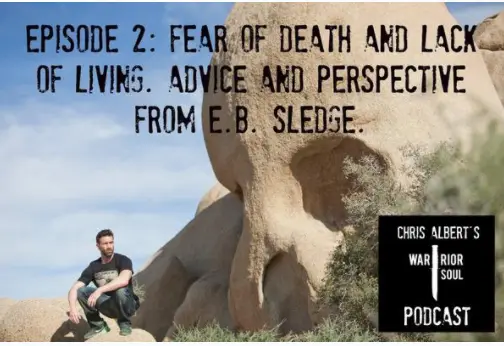
Podcast episode
Episode 2: Fear of Death and Lack of Living: Advice from E.B. Sledge
Hosted by Chris Albert
The Warrior Soul Podcast
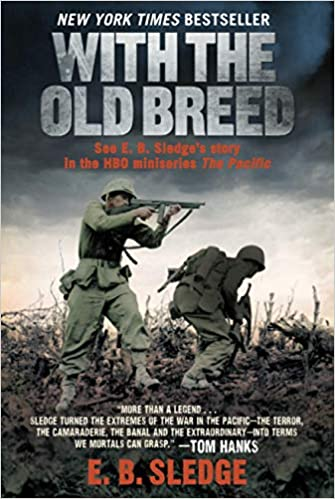
To purchase E.B. Sledge’s Book: With the Old Breed, and support the podcast, click the image below:
Transcript
Machine-generated from the episode audio and lightly edited — may contain errors.
Chris Albert (link to this point)
Good afternoon. This is Chris Albert, and this is episode two of Chris Albert's Warrior Soul. Over the next few episodes, we're going to be talking about something that controls almost every aspect of our lives. It's so pervasive that it affects the way we sleep. It affects the way we eat.
It affects what we do for a living. It can affect our love lives. It can affect the way we raise our children. It can affect what we think is possible for ourselves in our own lives. And it really shapes our reality in almost every single way.
The thing we're going to be talking about is fear. Fear is one of these things that really does affect us in every way. But many times we almost don't admit that it's there. And in other ways, we don't even know or realize that it's there. And we don't realize the full extent to which it affects us.
And this makes fear and understanding fear so important for the conduct of our life's direction. You know, when we think about it, fear can be almost paralyzing. And we're going to go through scenarios like that today. Actual historical scenarios where people have been near paralyzed with fear. Fear can also motivate, and it can motivate us to do both positive and negative things.
But we also have to separate different types of fear. Because fear comes from a lot of different sources. You know, the author Napoleon Hill, the author of Think and Grow Rich, a success book, he says that there's six major types of fear. And that is the fear of poverty, the fear of criticism, the fear of ill health, the fear of loss of love of someone, the fear of old age, and finally, the fear of death. And he says that it's really important to understand these fears and to rid them from your lives because they cloud your ability to make decision, and they cloud your ability to make any sort of judgment on your situation with a clear head.
And so not only can fear paralyze us in the moment, it can seriously affect us in preventing us from doing what we should be doing to become successful. And I could go into a lot of the complicated psychological factors here. But what I really want to do in these next few episodes, and especially this one, is to get down to that human factor. Something that we can all relate to. Not talking about these complicated functions of the brain, though I do think that's helpful.
And if you can get a hold of any sources, then I definitely recommend you do so. But really getting into recognizing our own fear, and what kind of role it's played in our own lives. And we start with the fear of death because when you think about it, all almost all of the other fears arise from it in some way. You know, the fear of poverty that arises from our classic, almost evolutionary tendency to desire an abundance of food. Our fear of old age, you know, as we're getting older and we look in the mirror and we see ourselves aging, we're constantly reminded of our own mortality.
The fear of ill health, disease, being afflicted with something that you can't recover from. Each of these fears evolves from the fear of death. And so today's subject is particularly important. Because in many ways even those of us who say that we're not scared of death are affected by fear of death in some way. And it's not only the fear of death that really affects us, it's our perspective on what death is.
Some of us see it as a final end, where everything is just gonna go blank. And so we have a very cynical view of it. Others of us believe that there's an afterlife and that it's got to be better than this particular life and that what we do here is going to affect us in our afterlives. And the perspective that I really want to get to today, and this is apart from any sort of spiritual belief, you know, you can believe what you want about the afterlife. You can believe that there is one or there's not.
But the perspective that I think we can all adopt is that fear of death, not fear of death, but death itself is a reminder. A reminder that we are all here on this earth for a very short time. When we think about the human condition, and we think about our own level of consciousness, our ability to know ourselves, and to have feelings, and to have emotions. You almost realize that there's a certain tragedy to human existence. We're all born into tragedy.
Because at some point in our youth, we realize that someday we're going to die. And we also realize that someday everybody we love is going to die. And that realization really affects us. Because since we know that death is coming, death almost follows us everywhere we go. The prospect of death almost follows us everywhere we go.
And the prospect of losing our loved ones follows us almost everywhere we go. And so we live under this shadow. And it's almost unspoken in a lot of different ways. And many people almost try to deny that it's there. But it is.
It's always there. You know, my death is sitting somewhere behind me right now. And it's somewhere in my subconscious right now as I'm speaking to all of you. Or regardless of what I'm doing, I could be working out. I could be training.
I could be working on my business. The prospect of my death is somewhere in my subconscious. Just like the prospect of your death is somewhere in yours. So that's the importance of what we're addressing here. We're addressing something that is literally always on our minds whether we know it or not.
And the big thing I really want to get at here is in looking at how your perspective on death really affects what you're going to be able to do here in this life. And analyzing the ways in which our perspectives on death allow us to do certain things in our lives, but also prevent us from doing certain things. It can be both a very limiting factor, but in a lot of ways, it can also be a really liberating factor. So while the subject matter of this podcast is on death and fear of death, what I'm really trying to get at here, and what I'm really trying to instill in you is a perspective on life, and on living, and on living rather than simply existing and waiting for that day when death takes us over. To start this podcast, what I want to do is go into the reading from an author who stared death into in the face.
And this is a reading from E. B. Sledge's book, With the Old Breed. And I'm going to start with the beginning of chapter four called Assault into Hell. Hour zero eight hundred.
Long jets of red flame mixed with thick black smoke rushed out of the muzzles of the huge battleship's 16 inch guns with a noise like a thunderclap. The giant shells tore through the air toward the island, roaring like locomotives. Boy, it must cost a fortune to fire them 16 inch babies, said a buddy near me. Screw the expense, growled the nether. Only less impressive were the cruisers firing eight inch salvos and the hosts of smaller ships firing rapid fire.
The usually clean salty air was strong with the odors of explosives and diesel extinguisher was The fire was extinguisher. Extinguisher types was of weapons through the thunderous noise. We had a to shout at each other to be heard. The big ships increased their fire and moved off to the flanks of the amtrac formations when we started in so as not to fire over us at the risk of short rounds. We waited a seeming eternity for the signal to start toward the beach.
The suspense was almost more than I could bear. Waiting is a major part of war, but I never experienced any more supremely agonizing suspense than the excruciating torture of those moments before we received the signal to begin the assault on Peleliu. I broke out in a cold sweat as the tension mounted with the intensity of the bombardment. My stomach was tied in knots. I had a lump in my throat and swallowed only with great difficulty.
My knees nearly buckled, so I clung weakly to the side of the tractor. I felt nauseated and feared that my bladder would surely empty itself and reveal me to be the coward I was. But the men around me looked just about the way I felt. Finally, with a sense of fatalistic relief mixed with a flash of anger at the Navy officer who was our wave commander, I saw him wave his flag toward the beach. Our driver revved up the engine.
The treads turned up the water and we started in the second wave ashore. We moved ahead watching the frightful spectacle. Huge geysers of water rose around the amtrac ahead of us as they approached the reef. The beach was now marked along its length by a continuous sheet of flame backed by a thick wall of smoke. It seemed as though a huge volcano had erupted from the sea, And rather than heading for an island, we were being drawn into a vortex of a flaming abyss.
For many, it was to be oblivion. The lieutenant braced himself and pulled a half pint of whiskey bottle. This is it boys, yelled. Just like they do in the movies, it seemed unreal. He held the bottle out to me, but I refused.
Just sniffing the cork under those conditions might have made me pass out. He took a long pull on the bottle and a couple of the men did the same. Suddenly a large shell exploded with a terrible concussion. A huge geyser rose up to a right front. It barely missed us.
The engine stalled. The front of the tractor lurched to the left and bumped hard against the rear of another amtrac that was either stalled or hit. I never knew which. We stalled floating in the water for some terrifying moments. We were sitting ducks for the enemy gunners.
I looked forward through the hatch behind the driver. He was wrestling frantically with the control levers. Japanese shells were screaming into the area and exploding all around us. Sergeant Johnny Marmet leaned toward the driver and yelled something. Whatever it was, it seemed to calm the driver, because he got the engine started.
We moved forward again amid the geysers of exploding shells. Our bombardment began to lift off the beach and move inland. Our dive bombers also moved inland with their strafing and bombing. The Japanese increased the volume of their fire against the waves of amtracs. Above the din, I could hear the ominous sound of shell fragments humming and growling through the air.
Stand by, someone yelled. I picked up my mortar ammo bag and slung it over my left shoulder, buckled my helmet chin strap, adjusted my carbine sling over my right shoulder, and tried to keep my balance. My heart pounded. Our amtrac came out of the water and moved a few yards up the gently sloping sand. Hit the beach!
Yelled an NCO moments before the machine lurched to a stop. The men piled over the sides as fast as they could. I followed Snafu, climbed up, and planted both feet firmly on the left side so as to leap as far away from it as possible. At that instant, a burst of machine gun fire with white hot tracers snapped through the air at eye level, almost grazing my face. I pulled my head back like a turtle, lost my balance, and fell awkwardly forward down onto the sand in the tangle of ammo bag, pack, helmet, carbine, gas mask, cartridge belt and flopping canteens.
Get off the beach, get off the beach, race through my mind. Think about that scene for a second. Sledge is getting himself ready in the amtrac, and he feels like he's literally being pulled into a flaming abyss, being pulled toward his death. And he starts to prepare. You notice he gets his carbine ready, he gets the rifle sling ready, he gets his ammo bag ready, he makes sure everything is nice and organized and he gets his balance.
And then as he gets out of the amtrac, He jumps off the side and a wave of machine gun fire comes right at him. And he falls into a tangled mess after it loses his balance with his carbine all messed up, his web gear all messed up, his ammo bag all messed up, and he lands on the beach. Doesn't land on the beach, he falls on it. And I think a lot about those marines who fought in the Pacific. Not only the marines, the soldiers, you know, we've got to give the army some due credit here.
But the marines coming in for from their amphibious landings. You gotta think about that feeling of sheer terror as you're approaching the beach. And I know there's a lot of us here who listen to this podcast who've been in combat before. But I don't think that there's any of us who have anything to compare to something like this. Where there's literally thousands of prepared enemy who are waiting and who are willing to die just to kill you.
And who've had weeks to dial their guns in on the beach. And they can drop steel on any square inch of sand that you occupy. And they have interlocking fields of fire. And your job is to run right into that. I also I just listened to Dan Carlin's Hardcore History, his Blueprint for Armageddon episodes.
And the descriptions he goes through of the Western Front during World War One. I think about that a lot too. And I wonder, you know, I'm a Marine. I served in the Marine Corps. I wonder how I would deal with these similar types of situations.
What do what I would be feeling in the lead up to something like this? And not only me, but my entire generation, whether they served in the military or not. You know, we're talking about a generation of men who did things like D Day enormity, and the hundreds of thousands of soldiers there who stormed the beaches at Normandy, and who went on to fight through France, and eventually continued on into the Battle of the Bulge and all the other battles of World War two against the Germans. And the Marines and soldiers in the Pacific who took those islands. You know, we get into the Battle of Okinawa later on and having lived on Okinawa.
I used to walk around that. It would be like to have actually fought there. You know, it was hard enough training there. With the rough terrain and the heat, and the steaminess. I can't imagine what it must have felt like to fight there, and to hunt and be hunted by other enemy.
But the big perspective I want you to get from Sledge's experience here is that utter feeling of being sucked in. That utter feeling of helplessness. Because that's the way a lot of us view our death. You know, we feel helpless in the face of our own mortality. And because we feel helpless in the face of our own mortality, we also feel helpless in our lives.
And we get this feeling that the world is against us. And we forget about everything that we can control. And we worry about everything that we can't. We forget about everything that we can control. And we worry about everything that we can't.
And this has huge implications for our behavior. And it forces us to worry about things that really have no bearing on us or on our survival. And slam these points home, I want to do some more reading from the book. And in this second reading we're still on Peleliu, and Sledge is just a few minutes into his first experience on combat. And here we go.
We started to move inland. We only had a few yards when an enemy machine gun opened up from a scrub thicket to our right. Japanese 81 millimeter and 90 millimeter mortars then opened up on us. Everyone hit the deck. I dove into a shallow crater.
The company was completely pinned down. All movement ceased. The shells fell faster until I couldn't make out individual explosions, just continuous crashing rumbles with an occasional ripping sound of shrapnel tearing low through the air overhead amid the roar. The air was murky with smoke and dust. Every muscle in my body was as tight as a piano wire.
I shuddered and shook as though I were having a mild convulsion. Sweat flowed profusely. I prayed, clenched my teeth, squeezed my carbine stock, and cursed the Japanese. Our lieutenant, a Cape Gloucester veteran who was nearby seemed to be in about the same shape. From the meager protection of my shallow crater, I pitied him or anyone out on that flat coral.
The heavy mortar barrage went on without slackening. I thought it would never stop. I was terrified by the big shells arching down all around us. One was bound to fall directly into my hole, I thought. If any orders were passed along, or if anyone yelled for a corpsman, I never heard it in all the noise.
It was as though I was out there on the battlefield all by myself, utterly forlorn and helpless in a tempest of violent explosions. All any man could do was sweat it out and pray for survival. It would have been sure suicide to stand up in that firestorm. Under my first barrage since the fast moving events of hitting the beach, I learned a new sensation, utter and absolute helplessness. The shelling lifted in about half an hour, although it seemed to me to have crashed on for hours.
Time had no meaning for me. So, this is a real description of fear. Where you are getting that same feeling, the prospect of your own death, the tragedy that we all live with for our entire lives, The fact that we're going to die at some point in the future. And that tragedy at that point is being fast forwarded and amplified millions of times compared to what anybody listening to this podcast or myself. I gotta say most people listening to this podcast because there may have been people who were in the thick of combat listening.
But for myself and for most of us listening to this podcast, this goes by and amplifies a million times that tragedy that we all feel. And the amazing thing about this is that there's a beautiful factor to it. When you go through something like that, and you experience something like which Sledge was experienced, and all the marines who were experiencing here, and all the soldiers who were there, and all the soldiers who fought in World War two and were in the invasion of Normandy, which go through is reality slapping you in the face and saying, you know what? Death, it's always right over your shoulder. And the fact is you don't even have to be there on the beach with the rounds snapping over your head.
Death is always there. It's just that those rounds snapping over your head are just reminding you that they're there. And they're bringing that part of the back of your mind that has that fear up to the front because you're being confronted with it. You're being confronted with your own mortality. And I think in a lot of ways for most of us in today's society, we're so affected by this fear of death.
Because in many ways compared to other points in history, we're also so detached from it. You know, we hide death in every single way possible. Back in, you know, as little as a century ago, we had death everywhere. Know, people used to keep dead family members in their homes for certain periods of time before they were able to bury them. Wakes and funerals were held.
First, the services were held in somebody's common room in their own home. My grandmother, you know, she told me a story about how she accidentally got locked in a room with her dead mother, my great grandmother, because my great grandmother died during a childbirth at the age of 23. And my grandmother was locked in the room with her body by accident for a little bit. And I think that damaged her for the rest of her life. But for most of us today, when a relative dies, you know, we might see them in the hospital.
And then we don't see them again until they're all dressed up at the funeral parlor and we see them in the coffin. But beyond that, our contact with the dead and dead bodies is really non existent in today's society. You know, even animal death. Most of the people listening to this podcast eat meat, but very few could actually see the animals that they're eating being slaughtered and still be able to eat a meal containing that meat right afterwards. And for a lot of people, it'd be a shock to see how the animals are killed.
And that's why a lot of vegan activists put videos out of animals being slaughtered. And they won a lot of converts that way. Because we're so detached from death, the sight of death is shocking. And I think that one of the reasons why we put it so far out of our society It's because we fear it so much. We don't want it there as a constant reminder.
We don't want it to be hanging on our shoulders like a 300 pound gorilla. Yeah. We want to get away from that lifelong tragedy that we have in our minds. The fact that we are all someday going to die. And so a lot of us live like we're never gonna die.
And we live like there is no tomorrow. And the tragedy of this is that we preoccupy ourselves with little things. We preoccupy ourselves with small pleasures that aren't going to last very long. And this is big because there's a trade off there. The trade off is that the more you occupy yourself with small pleasures, the less you occupy yourself with an overall life's purpose.
You know, the more you drink, the more you go out and party, the more you dim and dull your senses with drugs and alcohol, the less focused you are on the present. And I say this because, you know, I was talking to one of my veteran friends the other day, Cameron Delaney, I'm going to have him on this podcast, but he's from the Ronan Veterans Network. And a lot of times when we're dealing with veterans and not just veterans dealing with anybody, but know, me and him were very concerned with the state of veterans in today's society and getting veterans to live their best lives. It's really hard to get them to understand many times that some of the things they're doing aren't helping them any, you know. And I guess this is true for anybody who has an alcohol or drug problem, or who not necessarily has an alcohol or drug problem, but who's focused on the wrong things in life, you know, and I'm one to talk.
You know, when I was younger, I've lived for going out to the bar, and I lived for meeting new girls, and I lived for getting as drunk as possible. But what I realized in my older years is that you know in those years after I got out of the Marine Corps, and that I spent doing so much, spending so much money just drinking and partying, there was a real trade off there. Had I started working on my businesses, had I started, you know, working on my life, had I avoided just hiding out in school and using school as an excuse to drink and party. I could probably be about ten years ahead of where I am right now. And I probably could have avoided a lot of the hardship that came during that ten year period of my life where I wasn't really doing anything.
But again, the fact of the matter is you live and you learn. The bottom line here is that when you focus on just giving yourself momentary pleasure, You stop focusing on your ability to create a life's plan, and you stop focusing on your ability to get what you really want out of life to fulfill your purpose. And a lot of us, we look at this and we meet failure or defeat. And we meet difficulty. And we say to ourselves, well, the world is really messed up.
We say to ourselves that the politicians, the government is holding us down. This economy needs to be better. This, you know, my wife needs to be stopped spending so much money. But then we look at our lives and we think, you know, how much money do we put on credit card? What did we buy that we didn't actually need?
What did we what car do we have? I mean do we am I do I have a car payment right now where I have to put hundreds of hundreds of dollars down each month when I could have gotten a less expensive car that would just get me from point A to point B? But why do we do it? We do it to impress other people. We drink to impress other people.
We party to impress other people. And it's part of being part of a social group. You know, maybe I'm getting a little bit off the subject here and maybe I'm getting on a soapbox. But so many of us could benefit from living simpler lives. So many of us could benefit by making our lives a bit more simple, a bit more stoic.
You know, the stoic philosophers were big on this. And Epictetus says, there's two quotes I really want to read here. The first one is this, you act like mortals in all that you fear and like immortals in all that you desire. You know, and what he's saying there is so many people are not willing to take the risk of investing in their lives. So many people are not willing to start a business.
So many people are not willing to take any risk whatsoever to get out of their comfort zones. But they're willing to put flat screen TVs in their house. They're willing to buy cars that they can't afford. They're willing to take vacations that they can't afford. They're not willing to give up their two hour two hour a night TV watching habit.
But they're scared of putting two hours in a night to work on a side business, to work on a degree, to work on something that's going to improve their lives rather than wasting their time. And maybe I'm preaching there. The other thing that Seneca says here, and this is from his book on the shortness of life, says, So you must not think a man has lived long because he has white hair and wrinkles. He has not lived long, just existed long. For suppose you should think that a man had had a long voyage who had been caught in a raging store as he left harbor, and carried hither and tither and driven round and round in a circle by the rage of opposing winds.
He did not have a long voyage, just a long tossing about. What Seneca is talking about there is the idea that we willingly submit ourselves to the winds of the world. You know, this idea of you only live once YOLO, right? And nine times out of 10 when I hear somebody saying YOLO, it's so that they can conform to something to do with society. And that would be, you know, going to a party, going to Vegas, you know, drinking your face off.
But what you're doing is you're putting time into that rather than working on yourself and working on your plan. When you surrender yourself to momentary pleasures and you surrender yourself to anything that comes down the pipe that feels good, and you don't work for the long term success, What you're doing is really submitting yourself to the world's current. You're going to end up wherever the world wants you to end up. You're not going to end up where you want to end up. And so rather than living, rather than living according to a plan, all you're doing is existing.
All you're doing is existing here, taking up the world's resources, breathing, and waiting for that day when it all comes to an end, your death. And I think that this perspective on death evolves from that facet of our society that tries to put death out of our minds. That doesn't admit that it's there. You know, we'd like to say you only live once. But we don't think about death in a way that is it is a reminder.
And a reminder that our lives are short. You know, we think that we have to take these momentary pleasures to improve the drudgery of life, right? To make our everyday lives bearable. You know, when I had a an opiate addiction, one of the reasons why would take eight to twelve pills a day was because for me at the time, it was the only way I could get through my day. But it was a mask over my eyes.
It was my fear lying to me. My fear would say, you don't want to live like this. You don't want to feel like this. Why don't you just take a few pills? Why don't you have a drink?
It'll make everything better. But it was a lie because it only made me feel better for a few hours. The next morning I'd be sick. And I'd have to take more pills, and I'd have to take another drink, and I'd have to seek that next cheap thrill in order to do it. Now I know you can hear the emotion in my voice here, and that's more my anger toward myself than toward anyone else.
And I don't want you to think I'm a Puritan here. I want you to be able to have fun. I want you to enjoy the good times, but I also want you to have real and true good times. And that comes from having a lifetime of success. That comes from having a different perspective on death.
And having a healthy respect for death, so that you can truly live. And so I guess we have to define what living is, right? As I said before, when you're not living, you feel like you're being tossed about by the world. And you tend to blame the world for all your problems. Know, I'm in debt because of this economy.
I'm in debt because of my student loans. Well, I have student loans too. And I could tell you that the reason I have student loans was because I decided to go to college and I got an education. And if you have student loans it's because you made a similar decision. And that's not the world's fault, that's your fault.
If you have credit card debt, that's because you made a decision to buy something. And you made a decision to buy something not with your money, but with somebody else's money. And so that's why you have credit card debt. And this gets back to realizing something. Realizing what we can control and what we can't.
You know, we can control what we spend our money on. We can control what decisions we make, how we're going to spend our time. And we can even control the effect that bad things that happen in our lives have on us. You know, Epictetus, Marcus Aurelius, and Seneca, the great stoic authors, they all have this kind of unifying prospect or unifying perspective on tragedy and the bad things that happen in our lives. What you get from them is this, tragedy is going to happen, but it's not the event that's a bad thing.
What makes it bad is our view of it. What makes it bad is our own perspectives on this. And we covered this last time when in the last episode when we went over Eric Greitens's book Resilience. But the ability to build resilience and to overcome this kind of fear of death is to understand that in every bad event, in every tragedy, there's a lesson. And to understand that for every bad thing that happens to us, we could make something positive out of it.
If we look at our perspectives, if we change our perspective on it, if we shape our perspective on it, you can't control much of anything in this world. You can't control the economy. You can't control whether or not a disaster happens. You can't control whether or not there's a terrorist attack. You know, in many ways, you can't even control who's going to be the President of The United States.
You can vote, but you can't control what other people think. And yet we worry so much about things like that. We spend our time on Twitter, and on Facebook, constantly trying to get our preferred view put forth. And in that time, we focus on those issues rather than focusing on our lives and building our lives up. And I'm not saying that those issues aren't important.
But if we spent just as much time investing in ourselves, maybe reading, maybe researching something that we could do to improve our lives, then a lot of us would be in a lot better state. And similarly, you know, because I'm speaking to both civilians and veterans here, Because I want everybody to get something out of this. But back to veterans, when we put the events in our lives so far in perspective, those veterans who are alive today, and there may be some Vietnam veterans listening. There may be some Persian Gulf veterans listening. There may be some OIF, OEFOAF veterans listening to this right now.
But we always have to put our own experiences in perspective. We always have to put our own experiences perspective to what other veterans went through. And that's why I recommend reading books like E. B. Sledge's With the Old Breed, because it gives you some perspective on that.
And learning a little bit about the man himself will give you some perspective. You know, Sledge went on to finish a PhD and became a professor of biology and ornithology. And he was a well respected scholar for the rest of his life. And even though he went through tremendous horror, even though he went through some of the limits of human endurance, he still had a very productive life. And I think a lot of that has to do with the lessons he took from combat.
His perspective on it, Because the whole thing was horrible. It was a horrible event. He was scared out of his mind, and he had to deal with rotting bodies. Know, talks about, at one point in the book, he talks about his dismay at seeing flies flying off of feces and off of corpses, and then flying into his canteen cup full of coffee. And all he could do was flick those flies away.
But we see in this next passage that I'm gonna read, a change in Sledge from that tangled mess that he was in where we left him on the beaches of Peleliu. It's the hardened veteran he was by the time he got to Okinawa. And the reading starts. We boarded trucks and headed south over dusty roads. In this central portion of Okinawa, we first passed many bivouacs of service troops and vast ammunition and supply dumps, all covered with camouflaged netting.
Next we came to several artillery positions. From the piles of empty brass shell cases we knew they had fired a lot. And from the numerous shell craters gouged in the fields of grass we could tell that the Japanese had thrown in plenty of counter battery fire. At some unmarked spot we stopped and got off the trucks. I was filled with dread.
We took up a single file on the right side of the narrow coral road and began walking south. Ahead, we could hear the crash and thunder of enemy mortar and artillery shells, the rattle of machine guns, and the popping of rifles. Our own artillery shells whistled southbound. Keep your five paced interval came order. We did not talk.
Each man was alone with his thoughts. Shortly, a column of men approached us on the other side of the road. There were the army infantry from the one hundred sixth Regiment twenty seventh Infantry Division that we were relieving. Their tragic expressions revealed where they had been. They were deadbeat, dirty and gristly, hollowed eyed and tight faced.
I hadn't seen such faces since Peleliu. As they filed past us, one tall, lanky fellow caught my eye and said in a weary voice, It's hell up there, Marine. Nervous about what was ahead and a bit irritated that he might think I was a boot, I said with some impatience, Yeah, I know. I was at Peleliu. He looked at me blankly and moved on.
We approached a low, gently sloping ridge where Company K would go into the line. The noise grew louder. Keep your five pace interval, don't bunch up, yelled one of our officers. The mortar section was ordered off the road to the left in dispersed order. I could see shells bursting between us and the ridge.
When we left the road, we severed our umbilical connection with the peaceful valley up north and plunged once more into the abyss. We raced across an open field. Japanese shells vault types whizzed, screamed, and roared around us with increasing frequency. The crash and thunder of explosions was a nightmare. Rocks and dirt clattered around clattered down after each erupting shell blew open a crater.
We ran and dodged as fast as we could into a place on a low gentle slope of the ridge and flung ourselves panting onto the dirt. Marines were running and crawling into position as soldiers streamed past us, trying desperately to get out alive. The yells for corpsmen and stretcher barriers began to be heard. Even though I was occupied with my own safety, I couldn't help but feel sorry for the battle weary troops being relieved and trying not to get killed during those few critical minutes as they scrambled back out of their positions under fire. Japanese rifle and machine gun fire increased into a constant rattle.
Bullets snapped and popped overhead. The shelling grew heavier. The enemy gunners were trying to catch men in the open to inflict maximum casualties on our troops running into and out of position. The usual practice when one of our units was relieving another in the line. It was an appalling chaos.
I was terribly afraid. Fear was obvious on the faces of my comrades too, as we raced to the low slope and began to dig in rapidly. It was such a jolt to leave the quiet beautiful countryside that morning to plunge into a thunderous deadly storm of steel that afternoon. Going on to the beach to assault Peleliu, and attacking across the airfield there, we braced ourselves for the blows that fell, but the shocked shells of one May at Okinawa, after the reprieve of a pleasant April, caught us off balance. Fear has many facets, and I do not minimize my fear and terror during that day.
But it was different. I was a combat veteran of Peleliu. With terrorist first constriction over, I knew what to expect. I felt dreadful fear, but not near panic. Experience had taught me what to expect from the enemy guns.
More importantly, I knew I could control my fear. The terrible dread that I might panic was gone. I knew that all anyone could do under shellfire was to hug the deck and pray, and curse the Japanese. You know, one thing I want to emphasize there with that reading from Sledge's book is that at that point, Sledge was a hardened veteran of one of the most brutal campaigns that occurred in The Pacific, and that was Peleliu. You know, the Marines who were on Peleliu, they went to over a month of fighting in some of the worst terrain possible and some of the worst conditions possible.
And there in Okinawa, after going through all those days of combat, and all those days of fire, and after a month or so his arrest, Sledge was still feeling fear. He was still scared. And the thing was that he was able to admit that to himself. You know, he had a healthy relationship with his fear. Because he realized something during that process.
He realized what he can control and what he couldn't control. He couldn't control the fact that there was a wall of lead heading over him while he hugged the deck. He couldn't control the fact that the Japanese were aiming in on all the soldiers that he was trying to relieve in the lines from the army. All he could control at that point was his own ability to get as low as possible. And his own thoughts about the Japanese.
And so he wasn't induced to panic. He wasn't put in a position where he lost the faculties of his body like he did before. You remember in the first part on the assault in Peleliu, he was shaking so badly he couldn't control himself. He couldn't control his breathing. He couldn't control the tightness of his muscles, and a lot of his own actions.
You know, lot of men lose their minds in their first experience in combat, and they panic. You know, we see that in World War two. A lot of casualties happened because people panicked and ran off or didn't allow themselves to stay undercover. It happened during World War one a lot because men would go mad with the shelling and run right into enemy machine gun fire and get cut down. But we also see that in our own lives.
Right? And there's a parallel here between what Sledge was able to experience in combat, the realizations he had, and what we're able to do with our lives. The first is this. The first is that again going back to stoic philosophy, it's not the event that happens, it's our perspective on it. You know, we focus rather than worrying about and focusing on the things we can't control.
We improve our situation in life by focusing on what we can control. You know, so say you're in debt. Say your financial situation is horrible. And say, you know, you've gone through a lot of emotional drama over the last six months. Let's think about what you can control and what you can't control.
You can't control everything in the past. You can't control the events of the last six months. But you can't control how you handle them. You know, do you drown out your sorrow with partying and drinking? Do you ignore it?
Or do you focus on reducing your spending? Maybe getting a second job, maybe starting a side business? You know, do you look at your debt as something that's shackling you? Or do you look at it as an opportunity to see that maybe the way you were living wasn't helping you any? Maybe the way you were living was a little bit too complicated.
And maybe your life needs to become a little bit more simple. And maybe you need to cut some things out of it. You know, maybe focus more on what you can produce rather than what you can consume. Right? And in that way, having something like that can be a life changing thing.
I look at my student loan debt. And at first I think about it sometimes and I get bitter, you know, because I'm human just like you. And I'm subject to all these same things and I say to myself, well, didn't even use my college degree. I didn't even allow myself to really benefit from my degrees at all. But yet I have all this debt.
Even though I had veterans benefits, though I had a GI Bill, I still took all these loans out. That was so I could live comfortably at the time, when I should have just been living on a mattress, and rather than going to a gym doing burpees and swinging a kettlebell, I had to have a luxury gym. I had to have my apartment, and I had to have my TV. And so now I'm paying the price for that. And so my debt is my fault.
And the message to me was this, Chris you have to live more simply. And nowhere was that sign taken more than when I ended up living out of my car a few years ago as a homeless person in Los Angeles. And that really lets you see that too many of us live these over complicated lives with too many things. Because when you eventually go homeless, you you realize that you have nothing to lose and everything you feared about being homeless really was nothing to fear at all. At least from my perspective, some people get wrapped up into it.
Some people stay there for a while. But from my perspective, having nothing at all was liberating. It allowed me to tell myself that I can do anything from this point, because I have nothing to risk. And I think what a lot of us fail to see is that all these things that we put around us to take us away from our everyday lives, to distract us. They're taking us away from our ability to live and our ability to plan.
Because once I got rid of those things, that's when I opened my business. And whereas it takes whereas it one point it took me years to plan to open a business, it took me a month, and I got it done. And I think a lot of the material possessions put around us goes back to the subject matter for this podcast, which is death. We look for anything we can to distract us from the reality that we're going to die someday. We look for anything we can to distract us in our everyday lives.
To pull us away from that idea that someday we're going to die. And therein is the problem. Big problem for most of us is that we don't have a healthy respect for death. We don't have a healthy understanding of the fact that someday our lives are going to come to an end. We know they are.
Deep in our minds we know they are. But because we try to push it out of our minds so much. Because we try to really ignore the fact and distract ourselves from that fact that we're going to die. We forget to do something in the process. That is we forget to live.
We forget to really put ourselves out there in a way that is going to lead to lifetime success. We forget to live in the present. And we're always living for that next little bit of pleasure we can have. We're always living for that next little thrill. And so we stop focusing on our ambitions, goals, our life's journey, and we stop seeing our life as a journey.
And we start seeing our life as existence in a nest of sorts. We decorate that nest, and we make that nest as comfortable as possible, because that's where we want to be until that day when death finds us. And for those of you who want more than that, you know, because it in a lot of ways, it's okay if you're doing that. That's how most people on this earth today live. But when we talk about, you know, that generation E. B. Sledge's generation being very different from our own. I think in a lot of ways this is why. We try to separate ourselves from any prospect of tragedy, any dark thought, any dark feeling, and we forget that darkness really reminds us of the light. It really reminds us of what we can do.
I think one of the reasons why the World War II generation was able to accomplish so much was because they faced that darkness head on. They faced it and they fought it and though you can't slay the darkness. They integrated it into their lives in a way that they wanted to build something much bigger and better than what existed before. Because the darkness gave them better appreciation what they had here in The United States, and I'm sure it gave all of our allies a better appreciation of what they had too. And they built America.
And there's some of you who are going to be listening to this podcast who, love America. And I know I have some people from Europe listening who might have an ambivalent idea of what America is. I love America. I think it's an amazing country, an amazing people. But regardless of how you feel about America, you have to admit that that generation of Americans accomplished so much.
And the thing is because I love America so much, I look at our society today. And I guess one of the reasons why I'm doing this podcast is because I worry so much. You know, worry about what we've become and I worry that if there were something like World War two to happen again. I worry if our society would be up to the task. You know, I worry if we would be able to really distinguish ourselves as a generation.
You know, and I I know a lot of people from my generation and and a little bit younger than me who served bravely in Iraq and Afghanistan. But more and more, I think that one of the problems that veterans are facing is that we're such a small minority, you know, and when we see things like PTSD, right, when we see things like, you know, hyper vigilance. They're looked at as being abnormal. The reality is it's a normal reaction to a combat situation. It's a normal reaction to be having been put under stress for an extended period of time.
I mean, you look at videos of soldiers who had to endure long periods of artillery bombardment during World War one, and with these guys we're talking about months and years of dealing with constant artillery shells being poured all around you. We see a real physiological response to that. But World War one and World War two were different in that they were total wars. You know, the the wars occupied our country so much that everybody was involved. They were either involved in raising bonds.
They were involved in, you know, manufacturing arms and things like that to to push it, to push the war effort. But and when the veterans came home, there were so many of them that there's very few people today that could say that they didn't have a relative or a grandparent who served in World War two. Or who was affected by World War two today at some point today. And the only men in my family I ever knew were from the World War II generation. I used to watch them.
I used to admire the way they acted, the way they talk, the belief that they had in themselves. You know, both my grandfathers could fix anything. You know, it's hard to run into anybody these days who could actually swing a hammer. And it's rare, even rarer, to run into somebody who's had such a close contact with death. It's rare to run into somebody who's had such a close contact with killing.
One of the questions a lot of us veterans hate, that we despise, when civilians come to us and ask us if we've ever killed anyone. And it's one of the most, not only insulting things you could do to a veteran, but it's also very hurtful. Because you're really, what you're doing to the veteran there is one, you're imposing your own desire and curiosity to kill on that veteran. Two, you're really questioning that veteran's manhood and bravery. Through your own ignorance of the situation, because you you're basically asking the guy if you were brave enough to pull the trigger.
But people still ask this question, and to any sane person, a question like this is is gonna be indecent. It's gonna be not it lacks a good degree of tact. And I think one of the reasons why so many civilians were asking veterans is particularly, you know, few years ago, I think the words gotten around to a lot of them that you know they shouldn't be acting like this. Again because we're so separated from that idea of death, because we're so separated from it. And that separation from death has turned a lot of us in this society from being hard and being a people who could endure to people who have very little tolerance for anything.
Let alone a bunch of veterans who've come home and who aren't acting within the normal strictures of society. And I said this last podcast, what the hell is normal? And so they put these kinds of impositions on veterans that make them feel alienated, that make them feel as if there's something wrong with them because they're feeling what they're feeling. And it all goes back to that fear of death and that fear that somehow death is going to creep in if we start to admit that it's there. You know, a combat veteran knows it's there.
He knows that death can touch him at any moment. But then I want to go away from that and back to this idea of respect for death and a healthy fear of death. The the big thing, and this is what I think that all the different perspectives lack. And that is that you try to push death out of your mind. That's the first perspective I covered.
The idea that you're constantly worrying about death and you're trying to do anything you can to prevent death so you don't take any risks. Right? That's we all know a person like that. Somebody who has to get that secure job, who has to constantly look after the money, who's constantly watching the news, worrying about terrorist attacks, who doesn't fly in planes. That's another perspective that I don't think is healthy and that kind of restricts us from living.
But then there's this other perspective the the perspective that is more cynical. Where you don't necessarily fear death or you tell yourself that you don't fear death. But you also don't live. You kind of sit there and wait for it. And you tell yourself that I don't fear death.
I'm not worried about anything. So you stop taking care of yourself, and you stop training, you stop working out, you stop dieting. I should say dieting, following a good nutrition plan. And you stop learning, you stop reading, you keep your own perspectives, and you don't change anything, and you won't change your opinion on anything. And you lack the humility to learn because you think you already know everything.
And from that perspective, you might not fear death, or you might tell yourself you don't fear death, but you are by no means living. You're by no means getting everything that you can out of life. What you're really doing is just existing, Right? And that's what everybody here is doing. You know, from from the person who the YOLO to the person who worries all the time to this person who says they don't fear death.
But really is forgetting to live. And what we see amongst these three groups is the fact that death is eventually going to catch up with all of them. And because death is going to catch up with every one of them, they have one thing that's going to haunt them more than anything at the end of their lives. This one thing accompanies death because it accompanies finality, right? It accompanies the end.
And that is regret. You have to really understand that the first regrets that you have in your life are going to be messengers. Right? There's a lot of you who might already have regrets. You might regret that you didn't talk to that girl in high school.
Maybe you regret that you didn't take that job that you really wanted to that was across the country. It could be anything that you regret. But if you have regrets right now, you also have to realize that you're lucky. Because your regrets are trying to tell you something. They're a messenger from yourself at the end of your life.
And they've come to you like a time machine because they're telling you everything you're going to feel on your deathbed As you think about your life, and you think about all the things you didn't do. That's where the real fear of death comes in. And that's where the real fear should be throughout your life. Trying to avoid having any regrets, trying to avoid existence rather than living. Because on your deathbed, you're not gonna have your money.
You're not gonna have your car. You're not gonna have your clothes, but you're also not gonna have your worries. You're not gonna have your credit problems. You're not going to have your student loans to worry about. You're not going to have any relationship issues.
All you're going to have at the end of your life are your regrets about the things you didn't do. And the people with the most regrets are going to be those people who didn't see death for what it is. And what death is, is your greatest teacher. Death is a reminder and a teacher and it's there to remind you that someday this world, this life, this existence, this opportunity is all going to come to an end for you. Someday you're not going to be able to do what you want to do, You know, and while you might be sitting there right now and you might be 35, 40 years old wishing you were 18 again, someday you're going to be 70 years old.
Someday you're going to be 60 years old. Someday you're going to be 50 years old and you're going to be wishing you were 35 again, or 40, or 45. You're to be wishing you had more years. You're to be wishing you had more time. And above all, you are going to be wishing you had more opportunity.
That's the lesson that death has for us. And a really good reading on this comes from Carlos Castaneda in the Journey to Ixtlan. And just to set the scene for you here, Carlos is consulting with a Yaqui Indian, and he came to the Indian to learn about psychedelic plants. He wanted to learn about the peyote cactus because he was trying to study it for his courses at UCLA. And the old man said, okay, come out.
You have to talk to the plants first. And so old man was out there talking to the plants. And Carlos, the young man, he he wouldn't do it because he felt ridiculous. He felt embarrassed. And the guy, the old man Don Juan, he said, You think yourself, you think you're too important.
And what you have to realize is that you have to see your death. And he says, death is our eternal companion, Don Juan said with a most serious air. It is always to a left at an arm's length. It was watching you when you were watching the white falcon. It whispered in your ear and you felt it chill as you felt it today.
It was it has always been watching you. It was it always will until the day it taps And the reason why he's saying it was all it was always watching you is because when Don Juan, the old man was saying that, you know, you feel too important, he was he started recounting an episode from the young man Carlos Castaneda's youth where he was hunting falcons. And he went and hunted this albino white falcon, and he couldn't take the shot. And so Don Juan recounted that experience to him in detail. And then he got him to look over his shoulder.
He said, your death is staring at you right there over your shoulder. And he got him to look over his shoulder and the guy saw the shadow moving. So let me continue. He extended his arm and touched me lightly on the shoulder and at the same time he made a deep clicking sound with his tongue. The effect was devastating.
I almost got sick to my stomach. You're the boy who stalked game and waited patiently. As death waits, you know very well that death is to our left, the same way you were to the left of the white falcon. His words had the strange power to plunge me into an unwarranted terror. My only defense was my compulsion to commit to writing everything he said.
How can anyone feel so important when we know that death is stalking stalking us? You know, how can what he's saying is how can you feel ridiculous talking to plants when or trying anything new when death is always stalking you. Back to the book. I had the feel I had the feeling my answer was not really needed. I could not have said anything anyway.
A new mood had possessed me. The thing to do when you're impatient, he proceeded, is to turn to your left and ask advice from your death. An immense amount of pettiness is dropped if your death makes a gesture to you, or if you catch a glimpse of it, or if you just have the feeling that your companion is there watching you. He leaned over again and whispered in my ear that if I turned to my left suddenly upon seeing his signal, I could again see my death on the boulder. His eyes gave me the almost imperceptible signal, but I did not dare to look.
I told him that I believed him and that he did not have to press the issue any further because I was terrified. He had one of his roaring belly laughs. He replied that the issue of our death was never pressed far enough. And I argued that it would be meaningless for me to dwell upon my death since I thought since such a thought would only bring discomfort and fear. He said, you're full of crap, he explained.
Death is the only wise advisor that we have. Whenever you feel as you always do that everything is going wrong and you're going and you're going to and you're about to be annihilated. Turn to your death and ask if that is so. Your death will tell you you're wrong, that nothing really matters outside its touch. Your death will tell you, I haven't touched you yet.
So while I don't necessarily believe in the teachings laid out in this book, because this book is is very provocative. I do absolutely agree with him that death is our greatest teacher. And I'm sorry to have murdered the quotes, but death is our greatest teacher. Whenever you're worried about anything, and whenever you think you have problems, realize something. We're all just a fart in the wind.
We're here but in an instant in the millennia. Our time here on earth is short and we're only allotted a little bit of it. And if you ever want this feeling go to some ancient ruins. Go if you ever get a chance to go to Greece or if you go to Mexico, to some ancient ruins and walk around. And what you notice about those ruins is that they're rocks.
I went to the Oracle at Delphi at one time and I you know that place was like the Disneyland of the ancient world. Thousands of people had gone there to see the Oracle and to go to the Pythian Games. But what you see there is nothing but rocks today. And the people who went there, they were people. They had their own lives.
They had their own ambitions, their own worries, their own problems, own issues. And those people have been dead for thousands of years, and we know nothing about them individually except the fact that they were Greeks. We only know a few personalities from those times. The same thing's going to be for us. If you screw something up that's not going to be consigned to history for the rest of your life.
If you take a risk and it doesn't work out, that's not going to be consigned to history. You know, one hundred years from now, everything, everyone you know is going to be dead. Everything you see around you is going to be changed. The world changes. And in this world, we're only here for a moment in time.
So the way to look at your death and the perspective I really want you to get through after this, you know, nearly ninety minute discussion on the subject of death is to see death with a healthy respect and a healthy understanding that it is gonna come. And it's nothing you should want. It's nothing you should desire. But it's also nothing to fear. Because your death is a reminder of your hopes.
The thought of your death is a reminder of your dreams. Thought of your death is a reminder that whatever you're doing, whatever you're worrying about, whatever you're spending your time on right now, it could be better spent making your life's purpose come true. And it could be better spent making sure that when the time of your death comes, you don't have any regrets. So I hope you take the rest of your day, the rest of this time to really reflect on what I said. I can't say that I'm ambitious enough to change everybody's perspective on this.
And I can't say that I'm ambitious at that I I could say that maybe I'm overly ambitious in trying to change everybody's perspective on this. That's what I meant to say. But my hope is that I've at least changed some of your perspectives on this, or maybe planted the seeds too. And maybe got you to a point where at some time in some place when something bad happens to you, when you get your mortality shoved back in your face, that you realize that one, life is about more than momentary pleasure. Two, that there's a value in putting off pleasure to work for something that's going to make your life better in the long run.
And that three, that death is a constant reminder of what we need to accomplish while we're here on this earth. So I hope you enjoyed that talk. And I know some of this stuff is deep. If any of you have any questions for me, ever, and this is a part of the show that I really want to open up because I think that this needs to be more of a conversation between myself and my listeners. I really want to help you by answering your questions on this podcast.
So if you want to ask me a question, you can hit me up on Twitter, and my Twitter handle is WarriorSoulGear. That's w a r r I o r g e a r. Or you can hit me up on Instagram, which is Warrior Soul Apparel, the same spelling of the first part with apparel as the last part. Or you can hit me up on the Warrior Soul Apparel Facebook page, and ask me questions there. The best way of getting to me is probably via Twitter.
And I'll use Twitter to collect all the questions each week, and and we'll be able to really discuss them. What what am I willing to talk about? Well, I'm willing to talk about any situation that you might have. I will never use names. I will never really reveal anybody's identity.
But, you know, this can include life. It can include business. I'm somebody who's opened up multiple businesses and you know I've also gotten a bunch of different degrees. I can give you perspectives on college and you know my profession is actually as a personal trainer. And I've worked with some pretty big athletes and things like that, but that's nothing to impress you by.
But I'd love the opportunity to help you to live better lives through fitness. And if you ever want to ask me quick fitness questions, anything about muscle building, body building, getting stronger, fat loss, nutrition, ways of living healthier, and we're going to be doing some episodes on PTSD and TBI and nutrition. But but I'd love to be able to help you all with those too. And that also being said, you want to support this podcast, there's a bunch of different ways you can do so. At warriorsoulfitness.com we sell some amazing t shirts for mostly focusing on Marines in the military, but we also have some awesome civilian gear there too, in our lifestyle collection.
And so if any of you ever want to buy a shirt or anything like that, we'd be thrilled for you to wear our gear. Also on warriorsoulfitness.com you'll find, my fitness plans and ebooks, and that's connected to chrisalbertfitness.com. I have preset plans that I sell for as little as $8.99 I don't charge a whole lot. When I was a trainer, I charged as much as $400 a month for my consultation services, and I'm done doing that now. I really want to be able to spread information to people on a wide basis, and I can't do that by working with individuals and charging these exorbitant amounts of money.
So my goal is to create a community where we're focusing on fitness, we're focusing on mental performance, where we're focusing on building our best lives. And I want fitness to be part of that. So, providing information for you in as inexpensive of a format as I can. So we have my set plans, and I also have my ebooks there on the site if you want to check that out. And that's at the fitness link on warriorsoulfitness.com.
And then every book I mention here, oh, well first, because we're talking about fitness, I'll also talk about Onnit. I know a lot of you may take supplements, and in my experience as a trainer, Onnit, that's o n n I t, has some of the best products I've ever seen in my life. Whereas a lot of different companies they put a lot of crap into their products and they put the moniker proprietary blend on there. Onnit has nothing but earth grown nutrients in their products and particularly Alpha Brain, which is an Alpha GPC product. It's something I absolutely love.
I take it, while in preparation to do my work for the day, because I do a lot of writing and a lot of thinking. And so when I'm getting ready for my day, Alpha GPC is a really good way to start it, and it really helps with clarity of thought and the ability to be creative. And a lot of times I'll take that and I'll mix a little bit of some other stuff, like CBD, cannabidiol, which is a legal form of, marijuana, completely legal, that I get for therapy for my ulcerative colitis. And it really allows me to be creative. It's not a high, it's not, you know, getting stoned or anything like that, but it allows me to be very, very creative and to put things together.
So Alpha GPC from Onnit, and you could find our Onnit link off of the Warrior Soul apparel page, and if you want to support the podcast that way we do get a commission from what we sell there. And it's a real good passive way for you to support the podcast. And then finally, any of the books I mentioned here on the Warrior Soul podcast you can find at our Amazon link. You could find my whole reading list on our Amazon link which is under the link bookstore on warriorsoulfitness.com. So if any of you want to do that we'd be very appreciative of that as well.
So I really hope we got the material down for you today, and and I hope we covered fear and fear of death, and I hope we did some real honor to E. B. Sledge's book. If you ever want to get the book, it's called With the Old Breed, and to accompany the book I also highly suggest that you check out the series The Pacific. And if you ever seen the show Band of Brothers on HBO, the Pacific is like Band of Brothers, but, it's centered around the marines who invaded, Guadalcanal, Peleliu, and, Okinawa.
And there's a few different characters in that show. We have E. B. Sledge. There's Chesty Puller. There's John Basilone, and a few others. And I definitely suggest checking out this book, as well as, John, the story of John Basilone, which is, called I'm Staying With My Boys, and another one called Helmet For My Pillow.
And you'll find each of the main characters in each of those books in The Pacific. So that ends today's episode and I hope you all have a really productive day and a really awesome week, and we will get back to you next week with our next series on fear.
Host of the Warrior Soul Podcast and founder of Warrior Soul. Worldwide trainer and nutrition coach, contributing author at Testosterone Nation and Muscle and Strength.