Podcast episode
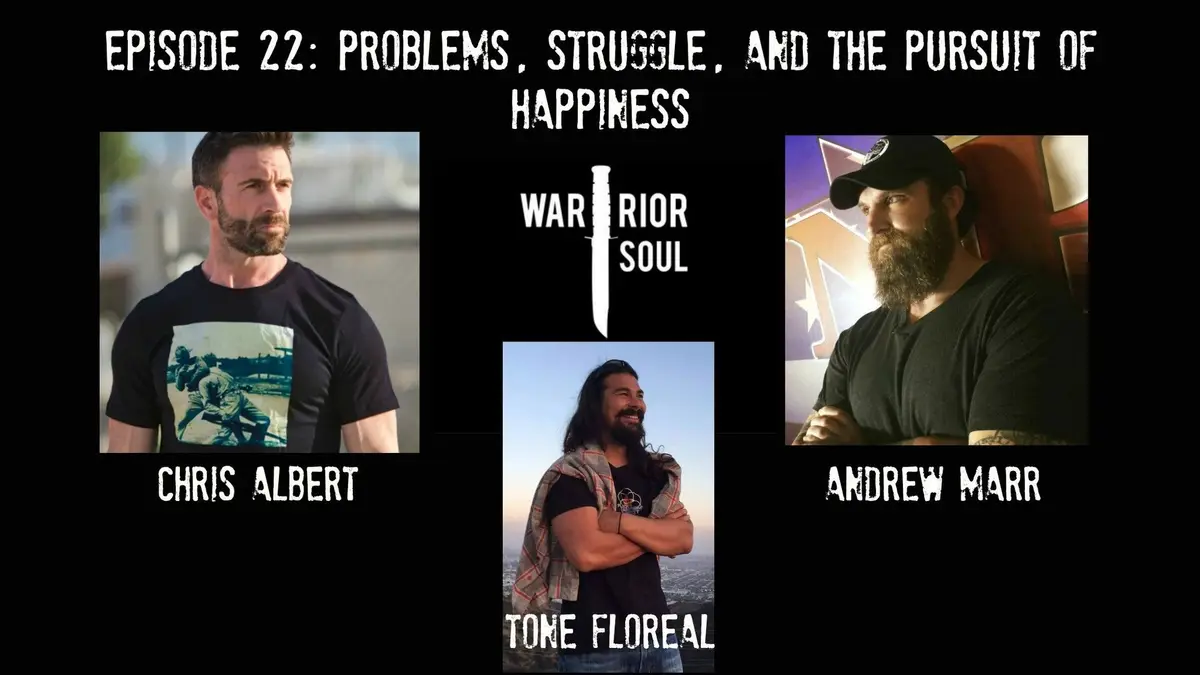
Episode 22: Problems, Struggle, and the Pursuit of Happiness

Hosted by Chris Albert
The Warrior Soul Podcast

Andrew and I got together with our friend Tone Floreal in Redondo Beach, California this past weekend and we talked about why problems and struggle seem like a necessary obstacle in the pursuit of happiness.
This is a completely informal discussion. We basically went out to dinner and started a conversation about this subject and then I thought it might be a good idea to start recording because we started getting into some really in depth conversation that can relate to everyone who listens to this show.
To Listen on Itunes: https://itunes.apple.com/us/podcast/chris-alberts-warrior-soul/id1096901382?mt=2
Transcript
Machine-generated from the episode audio and lightly edited — may contain errors.
Chris Albert (link to this point)
What's going on everybody? This is Chris from the Warrior Soul podcast. I'm over here with Andrew and our good friend, Floreal. You might remember Tone Floreal from episode 14 when we talked about flow state. We're just actually down here hanging out in Redondo Beach, California.
We took a a good walk along the beach, been talking about some some subjects. I said, you know, what a good opportunity to maybe record a show for everybody. Just, just had a good conversation and good times. And we've been talking a little bit about the problems we all face and how we build them up as problems in our minds. And, you know, what we accept is our reality and and the ways we can change our realities.
And it's a really interesting subject when actually think about it because so many of us, we build up our problems as something that's unique to us, that's unique to us as human beings. But when you consider the fact that there's so many of us here on this earth, everybody's going through their own version of reality, their own version of their own struggle, we really need to start considering the fact that our problems are often what we make them. And, Tony had been talking a good bit about some of his experiences and Andrew had been talking a good bit about some of his experiences as well. You know, guys, one question I want to pose to both of you is when is a problem a problem? And when, you know, are problems all bad? Do we do we can we live a life without problems?
And and what would a life without problems be like? And I guess I'll use that to start the conversation.
Andrew Marr (link to this point)
That's a it's a very interesting and in-depth question. I think it goes back to you can't experience the sweet without the sour, right? We need both sides of the equation. We need light and we need darkness. And not saying that either one is good or bad, they're necessary.
And so I don't think necessarily that chronic suffering is necessary, but we need to go through trials in life to come to certain understandings. And that can only be done if you're trying to look at it in the right mindset. Can I learn from this? What can I take away? How can I improve this?
Because when you break it down, I think life is just really about choices. And if you continue to make the same choices, you're going to continue to get the same opportunities to make that choice until you can get it right. And so I think we get stuck in these sets that we continue to make these choices and we can become stagnant. In short, problems are necessary for growth, but only from the point that you can use it to draw on that as a new perspective to make it turn that into something positive when that situation happens in the future.
Tone Floreal (link to this point)
Yeah, think it's all about the way I've seen it now is feedback whether it's good or bad or positive or negative. You know is it helping me move forth in my life where I feel like I'm in more control versus not being in control. So what I mean by that is like, you know, a lot of us have these experiences, especially when you're younger, it starts there where the word like teased, know, maybe a bully or something and that person is saying something to you and you had this emotional response where your feelings get hurt. And now in this sort of time in my life, I'm looking back at my history and I'm looking at like, you know, the so called like problems. In this case, it's feedback from another person that's teasing me.
And you know, what is this, this energy or what is teasing? Like my feelings are getting hurt. Like, why are my feelings getting hurt? How is it that somebody who's speaking words that are certain pitch frequency and tone, it's affecting me. Like I had this insight the other day and I've had it before, but it really like became solid for me this time around because it was like that thing about sticks and stones can break my bone but words and names can't hurt me, right?
Like it's pretty true actually. Like how is it that somebody that's like making fun of you or maybe yelling at you, like why are we getting emotionally or rioty responding? And it comes down to like, I guess evolution of the fight or flight mechanisms in our brain that we perceive a threat. But at a certain point, you start to realize that you actually have a way of controlling or being in control of this system that no longer hijacks you, and that you can actually look at it in a different way and say, Oh, that person is upset at me, but I don't really need to play that game. And I can just be cool about it.
They can express however they feel, they can be angry about it, they can tease you, make fun of you, and you can actually just kind of laugh or maybe instead of responding or reacting to it this time around, you actually have the control, the ability to be conscious in the moment and feel whatever that is coming from that other person, that energy, and then alchemize it, like convert it into something else or turn into a comedy, make that person laugh, make a face, do something different, which they call like pattern interrupting. So to me, that's like a place of empowerment where, you know, these things, these stimulus, this feedback that happens in our life is there. But at a certain point you start to see like, oh, I don't even need to like repeat or go down a repeating Groundhog Day over and over again. I actually can like change the way I react to these situations. And then when they repeat themselves, now you can like go in there and like rewrite your life or create something new.
Chris Albert (link to this point)
So, like, in the reality of of things, in a lot of ways, it's really just how we perceive things. Right? It's just it's just how we approach things. And, you know, in a lot of ways, if I look back at my life, the the main fuel for my life has been my negative experiences, has been my problems, right, or quote unquote problems. I think that if I didn't go through a lot of the hard times I've gone through, I I wouldn't be here talking.
I wouldn't have this podcast. I wouldn't, you know, be working with Andrew or yourself on a lot of different things. I wouldn't have met either of you guys. And, you know, in a lot of ways, these negative experiences have had guided me. So I think, like, one good question we could all ask ourselves is why are people in such a quest to live a quote unquote perfect life?
And why do we, why do we covet this life without problems? Why do we covet an easy life in the first place, when when in reality it's the hard life that that brings us to in many ways to where we need to be to grow, to become better people, to learn, you know, and and just knowing both your stories. I mean, Andrew, you know, in a lot of ways, you your your crucible shaped you, you know, and and who you are. And, you know, you went through some hell, but but you came out the other end, more educated and and with your life's mission in tow. So, I mean, I think in a lot of ways, kind of with the self help industry, you know, the way we see things where you're supposed to live this kind of perfect life and you're supposed to, you know, keep a gratitude journal and and, you know, meditate every day and things like that.
This is all good, but it's their tools. Right? They're not supposed to make your life perfect. They're not supposed to make make it to the point where you're not gonna experience negativity in your life. Because once negativity ceases to exist in your life, then what is it?
Are where are you? What are you gonna do? What are you gonna do to improve? You know what I mean?
Andrew Marr (link to this point)
Yeah. I think we're culturally conditioned to look for happiness and fulfillment in all the wrong places. You know? So if I could just have a bigger house or if I just had a different job or if I had this material item or that material item, then I'd be happy. You know what I mean?
But, and that's what a lot of modern society is based upon. Know, you look at all the media or commercials or this that and the other, it's putting out these fallacies of what a, you know, a man should be or a woman should be, this that and the other, and it's something that absolutely nobody could live up to. And so a person thinks they need to, achieve that level of looks or or whatever to, to to, you know, to be on par with everybody else. It's just not the case. And so what I what I what I'm saying is that, you know, when you look for fulfillment, when you look for purpose through just the material world, you know, and those things, you put your hope and your trust in that, then it's going to continue to let you down.
And I think that's a lot of what we see, you know, with the massive amounts of depression and anxiety that we have in the Western society and specifically in America.
Chris Albert (link to this point)
Absolutely, and I mean it also in a lot of ways when I I think social media in general too, we look around and everybody's kind of just showing off and pretending, you know. And maybe they aren't pretending, maybe they are pretending, But everybody tries to put their best face forward. Think there's a real deficit of vulnerability, humility and authenticity going on in today's society. And maybe that's hurting us. You know, maybe in some ways we need to see life warts and all before we can actually appreciate it and appreciate all the good things we have around us and and to truly experience gratitude, truly experience, you know, thankfulness for the simple things that are around us.
Know, like right now we're sitting in an air conditioned room in Southern California. You know, traffic sucked today, but other than that, my life is pretty awesome. You know what I mean? Like, and, you know, we had a good meal today everything. I mean, none of us are sitting here rolling around in dough with, in the Playboy Mansion in a grotto or anything like that, but but life is good. And and, you know, I I think that, in a lot of ways, what the media tries to portray is that we need to try and strive for this other thing, this this kind of fantasy lifestyle that's that's kind of being fed to us.
Tone Floreal (link to this point)
Yeah, the American dream, you know, and, I just think about, you know, people are using social media or the internet and hiding behind a screen, you know, like that's given this sort of fake sense of security. And we're losing touch with this physical reality that we live in outside of technology and the ability to communicate with each other like face to face in the flesh. And that's in some ways getting retarded like that's a skill that should be taught in school about communication. You're talking about emotional intelligence earlier with the ability to, you know, how do you respond in a situation when you're a child, you know, sometimes you're going to be like wailing and flailing and, you know, kicking and screaming. But at a certain point, like you sort of outgrow that behavior.
If you had something to give you a example of like how to go about the same situation in a mature way. So back to what we were talking about earlier with this sense of like, do we need problems in order to grow? Do we need these things in order to create solution? I think that at a certain point, like, you know, maybe we're so self centered that we're looking for the answer. We're looking for something to fulfill us.
And the American dream is teaching us to look outside of ourselves to get this perfect job, the perfect mate, the perfect house, you know, perfect car, perfect friends. And when some people actually achieve all those things, and I've seen them with my clients. They have everything materialistic, yet they're so empty inside in their soul, you know. And in my case, I had to go through that same process and it was because of those things I'm grateful for it. Like it enabled sort of like my ego nutshell to crack and I finally like discovered that nothing outside of me could fulfill me.
Had that what I call a holy shift. You know, I realized like I was whole already and that everything else was icing. I'm the cake and everything else is just icing. Bonus to that. A cherry on the top, whipped cream, you know, and that just makes a beautiful life.
And I can't imagine seeing a movie where all things is just this social media positivity, like fakeness. It's not what life is about. But at the same time, like once you reach this level where you are butting your head against the wall and you're like wondering like why there's not a door there, you know, and finally you realize, oh, I just got to go let there right in there's a door. Like, I don't think we necessarily need problems to grow at that point. At that point, I think you can like accelerate your life, like the things that you are dreaming, your purpose without like having to use problems, you know.
I think in the beginning that they're helpful to help us discover who we really are and what we're about and why we are here. But once you discover that, then you're just like free. You're free to create. You're free to like, you know, materialize your vision.
Chris Albert (link to this point)
So it's a matter of finding the mission first, finding out who you are, what's what's important in your life. Right? Because I think that's something that problems can do or hard times can do. They can really show you what to care about in life and what not to care about. And I think part of the problem we see in society is that, you know, people end up focusing on almost too many things, you know, and, in some ways we over complicate our lives with things that really in the end at the end don't matter, you know, worrying about, what kind of car we're going to drive, worrying about, you know, whether or not we have a big screen TV in our house, things like that.
And even in some ways, you know, worrying about where we stand in society as far as what other people think of us, what other people think of our occupation, our jobs, or whether or not we have jobs and things like that. In a lot of ways, I think that that can really play a role in making us more negative when we don't need to be.
Andrew Marr (link to this point)
Yeah. I think, you know, and the thing you have to look at is, you know, why am I doing what I'm doing? And is it in any way, shape, or form? Is this action being done because I'm worried about what somebody else might think about me if I don't do it this way or do it that way? You know what I mean?
And I think that that's not being true to ourselves, and we have to be able to identify that and and kind of self correct. And then it's like, you know what? It doesn't matter if so and so or whatever doesn't, you know, doesn't agree with me or we don't have this in common anymore. I'm doing the things I'm doing in my life because that's what I feel are the best things for me. And if it doesn't inhibit anybody else's well-being, you know, or your own, then who is anybody to say what you should or shouldn't be doing?
But I think, you know, worrying about so much is what somebody else is gonna think as opposed is is this the best thing for me? Is this the best thing for the for the team I'm involved with? Our overall mission or, you know, whatever you're working towards that's bigger than yourself, you know, is it falling in line with your whys for that? Then it's probably the right thing to do. If you're thinking or worried about what somebody else thinks, that's where you need to pause and reflect, you know.
And just because something you don't want to go in line with what the majority of people are doing, doesn't really make you, you know, a weirdo. It just makes you have the be recognized for having the courage to say I don't really care if everybody's swimming this way. I'm gonna go a different way because I think that's gonna be right for my life. And anytime I've done that, know, we were better for it, you know, always.
Chris Albert (link to this point)
What do you think about, so so a lot of guys out there, particularly guys who who listen to this podcast, a lot of them are still looking for their next why. Right? You know, a lot of them have left the military. A lot of them are are kind of in this transition period of this lot of their life. And they're trying to figure out their next thing to care about, I guess you could say, or or their big thing to care about.
And just to put it in context, I think that there's a lot of guys when they can't find a big thing to care about, they find a lot of little things to care about. And maybe they even listen to society a little bit more about, having society tell them what they should care about. And I think what this leads into in a lot of ways is society saying, well, if you aren't acting and coming off what you're saying Andrew, if you're not acting in certain ways then you're abnormal or you have a problem or you have a psychological problem or you need some sort of help or pill or medication or program that's going to fix you. If people are in this kind of state of purpose purgatory, guess we'll call it, then what do you think are the best ways to kind of try and find it?
Andrew Marr (link to this point)
I I think it's a it's a it's a really simple deal. You think about, hey. What would I what is one or two you know, what would I be doing if there was absolutely no possibility of failure? You know what I mean? Or no fear of failure.
If I knew with a shadow of a doubt I could do this and I wouldn't fail, I would do blank. And that's it, man. That's how you should live. You should go after your life without worrying about a fear of failure. I worry about living my life without a fear of living it to its fullest potential.
You know what I mean? So that was always an arena I was able to really pursue what I thought was my purpose at the time and that's always led to what I understood now was fulfillment. Know it wasn't necessarily that general thing be it. I you know, I was an athlete for a long time. I was an operator for a long time and you know, I thought each one was my purpose, you know, my identity.
And what I realized when you know, couldn't do either one anymore was, know what, it wasn't solely because I was an operator, it was because I, that was my purpose because that allowed me to be fulfilled because I belonged to something that was bigger, I was serving something bigger than myself and that that's always a way that you can find you know a good a good way to find what you should do you know. I remember when I was you know I was I was without purpose. After suffering the TBIs and everything else and we're going through going through that time in our life. And you know my dad, I was talking to him on the phone, said, know son, I can't understand everything that you've been through and I know that you're hurting. But if you could find a way to make your life about somebody else, look to add value to somebody else, I think you'll find that will always add value to you.
I didn't hear it at the time, but I did later and wanted to apply that to my life. It repurposed my life. And again, you know, it it led me to think, okay. Well, I can get better. And then once I got better, I can help other people get better.
And then, you know, we can take this to the next level, and things just begin to evolve. But it goes back to doing something without any fear of failure or any fear of what anybody else is gonna think about you. And we get conditioned, unfortunately, from a very young age that we start to build up this false this facade, this false self ego, and we're talking about reacting to things. You know, it's these are sensor sensory reactions. So we feel, you know, some kind of threat or insult to our ego.
We feel this emotion. We feel this feeling, and you gotta understand, like, that's all it is, is this is a feeling and it's going to pass. And so instead of involving yourself in a behavior or an action or a thought that is not going to elevate you or elevate those around you, then we don't want to react to those emotions that way. I think that's what we miss teaching our children at the fundamental levels, that hey these emotions do not define you. And I see with my two year old, my my three year old, they're dealing with these emotions and they don't know how to deal with it.
So they kick and they scream and they, you know, do all of the fits that you hear about two and three year olds doing. And but I you know I see that with grown adults but in different ways and it comes out you know as being resentful or being bullying or you know all these other down regulated emotions or attributes are, I think really when you get down to it, being conscious of where these sensations are originating from. And that's because most of the time I think is that we don't do things consciously, we do it subconsciously. And those programs have been downloaded, you know, since before birth up to age seven. And they're not serving to us because we're just a product of environment at that stage.
The child can't have the ability to be conscious, to be logical, to be analytical, so they just download all the actions and the behaviors and the environment that they're around. And then unbeknownst to them, they carry those reactions forward because it goes from the neocortex to the limbic systems to the cerebellum. And cerebellum is when it becomes an automatic process. And when you do something long enough, it becomes that automatic process. You don't have to think about it anymore.
So somebody says something to you that you perceive in a certain way, you fire back automatically. You don't even have to think about it, and you don't even you're not really even conscious of it. Why? Because again, it's a subconscious program that was downloaded for something in your environment probably between zero and seven years of age. And so the way to kind of caveat that is to become conscious of the way you deal with things, to become conscious of your emotions, and then you're no longer going to be controlled by them, you know.
But your body is supposed to be the servant to the mind, but in many cases it has become, you know, what was once the servant is now the master, and the body is running the show. And it's just reacting off the sensory perceptions that it's receiving from the outside environment. And so the real magic is, you elevate your internal state to be greater in your environment? Know, Tone, do you think we can do that?
Tone Floreal (link to this point)
Yeah, I think so. I mean, you know, had many years of this life to practice and experience. I think that's what it's all about. Because again, we talk about, you know, all these different things, but, know, we have to live life and experience things. And, you know, I think the true masters are the ones that are conscious in the moment that can self correct in the moment and not allow those past programmings to override them or hijack them.
So, you know, in my experience, I've been able to do that. I think that's what learning is. I think that's what kids do naturally. And, you know, I think back to the question about veterans and what they do during transition is like, well, what did you dream of when you were a kid? You know, like, what did you want to do before someone told you that that was impossible or that doesn't make any money or whatever the reason is, you know?
What were those things that you wanted to do when you were a kid? And, at the same time, you know, like Andrew was saying, like if there wasn't any failure, even, you know, people had the fear of success. So like sometimes you'll, get to a place where you're starting to develop momentum, you're learning quickly, you may be monetizing something, you may be growing, outgrowing your environment, and the people in your environment are like crabs in a pot, that you're climbing out of that hot pot and they're pulling you down, you know. And so you self sabotage because you're becoming successful, because you're going into a new, foreign, unknown place where, you know, it's not familiar and you're meeting new people, but you're more comfortable in your older environment. You're gonna like, you know, maybe go out and party too much or take drugs or do something you know, sabotage yourself.
And then next thing you know, you're back where you started and it's just a vicious cycle. So, these are just things to look, out for because we all do them, you know, I think that, anybody says that they're, you know, mastered that part of life. I think that they're full of shit, you know? No doubt. I think that, you know, we're That's the beauty is we are what, in our case, we're big kids, you know, like I think, but I like to say that I've matured because I'm more self aware and self conscious and I'm able to, again, self correct my course when I'm off course and my vision.
And, you know, I think that's what true maturity is to be like, I guess childlike and not childish in an adult body. Because there's plenty of adults that are adults. They look like adults, but they're really kids inside.
Andrew Marr (link to this point)
What, what tools have you used to become self more self aware and self conscious would you say?
Tone Floreal (link to this point)
The biggest tool for me or, or there been a few, but, I like, sitting by myself. You can call it mindfulness, meditation, whatever it is. I mean, these are all just terminologies, but, you know, just look at kids, look at, you know, sometimes they just want to be by themselves, you know, and what's happening when you're by yourself. You may be asking a bunch of questions. You may be, reflecting on the day, you may be thinking about a memory, you may be daydreaming, thinking about the future, but, that's always been like a tool for me is to isolate myself to, even practice closing my eyes, getting my brain into alpha theta state, doing deep breathing and being aware of my body and these feelings and emotions and learning to, be comfortable in like my skin, you know, because the sooner you can feel comfortable in your skin, that's what natural confidence is to me.
It's, yeah, sure, faking it till you make it, but really that's still fake. You know, if you really want to get in touch with who you really are, then the best way I found was to find some place to sit in silence and really just feel. And you don't have to get all esoteric and do all these mantras and chants. You can do that. You can go explore that, experiment, learn different, techniques and stuff.
But, you know, if you didn't know any of that, there weren't any holy books out there, there weren't any religious stuff, you know, what would you have done? You know, I think it's natural to have a place of isolation. Another tool I would say would be to talk, you know, it's when do we actually talk with each other and share each other our feelings, you know, and have a place, a safe place where you can like express, anger in a mature way, like to be able to raise your voice, but have the other person understand that you're just expressing yourself. There's nothing necessarily wrong. Now, if you start throwing shit or punching stuff or hurting the other person across, well, then obviously that's not the thing to do.
But talking to people helps and I also found writing. Writing my feelings down, like writing. It's also helped moving the body to help. So there's a lot of tools.
Andrew Marr (link to this point)
What what age did you start meditating? Because I know you started pretty early. Right?
Tone Floreal (link to this point)
Yeah. Pretty early, I think, because, growing up in San Francisco and in a, an Asian family, Filipino, we had a lot of sort of Buddhas around the house and you see this, this like, you know, fat, happy man. You're like, his eyes are closed and he's in a sitting position and you're like, what's that all about? So you mimic it and then you're going after a while you're like there's something to this you know? Yeah.
Chris Albert (link to this point)
Yeah.
Andrew Marr (link to this point)
And how long did it take for you to be able to acquire your mind? Know? Is that something that came naturally to you or did you have to work a while at it or you know, how long did it take for you to understand that process and how to get there, you know, for you personally?
Tone Floreal (link to this point)
It's still a process after all these years. I've gotten better at it. Gotten, I would say that I'm able to become the witness and observer of these thoughts that are just like ticker tape running through your mind, but it's running all on its own. It's got its own energy and it's it's, you know, it's like this river that's flowing, you know, and every so often you get caught up in the river and you think that you're that river, you know, and and it's turbulent. And But once you could kind of pop out of the river and like observe, you know, let's say this wrap, this boat that's floating down the river and you can sort of like take a eagle's eye view.
We're talking about getting elevation, you know, to be able to witness yourself, like what exactly is me? What is this thing called me and I, this thing called Tone Floreal, you know, and you start to ask these questions and when you sit through silence and you're able to, take on these like different perspectives. Perspectives. What would it be like if I was looking at Tone Floreal through Andrew Marr's eyes or from Chris Albert's eyes? Like what would it be like to be in their shoes? What would it be like to be in Piper's shoes?
You know, her cause, know?
Chris Albert (link to this point)
Yeah. We we got a little, four legged friend over here with us, Piper. She's just chilling. But, that's that's interesting. I've, you know, I've done a lot with meditation and trying to meditate and and, trying to go for the empty mind concept and it's I I I think it's good to, as a practice. I also think that it's a bad thing if you're coming down on yourself for not being able to have an empty mind. And so, in a lot of ways, when I when I go to meditate, it's almost not meditation anymore. I almost do more like a like a Tony Robbins style priming where I'm starting to envision kind of light and I'm starting to think of all the things that I'm grateful for in my life and really, trying to appreciate those things and spend a few moments of my own time really feeling grateful and then really envisioning that gratitude going out to those people that I love. Because I think that's like when people talk about gratitude journals, break down three things you're grateful for today, break down three things that'll make today awesome.
I think the thing they forget about that is that that's supposed to translate into energy that you're gonna use to to do things with your day and to do things with with, with your life. And so I think that if you're not thinking about it in terms of how you're gonna use that energy to to give to other people, it's almost like a waste. Know, the very act of just writing it into the notebook, think in my opinion isn't enough. You gotta really envision how your gratitude is going to infect other people or help other people or or how are you gonna use that that positive energy you have to help other people.
Tone Floreal (link to this point)
Yes. So it's like another tool that you mentioned, right? So it's, know, this concept about, meditation. I mean, modern word for it is being mindful of every moment and mindfulness. And, you know, thing about having an empty mind, I mean, it's this sort of, it's an interesting thing because I've had moments where I did have an empty mind and sometimes, you know, you have to sit for quite a long time, you know, hour, hour and a half before that even actually happens.
It is like a skill, but at the same time, like, you know, I always say like, you know, have an open mind, but not so open that your brain falls out, you know, like there's a reason why we have the prefrontal cortex, which is our part of our brain that, you know, plans for things that has a critical thinking that, you know, enables us to sort of, think, logically and, plan for stuff. So, you know, don't throw the baby out the bathwater. Like there's parts of your brain that are there for a reason. And, some of the Eastern, philosophies, I think they're more like metaphor, just like, you know, fundamental Western religions. These things are like stories that are not exactly literal, it's just something that is like Spiritual truths.
Yeah, they're giving like clues, things like empty mind, they're like pointing you in a direction. It's not the actual answer, it's that the experience is the answer, the realization. And then, and even greater because you got these people that are meditating their lives away. You know, I've fallen into that trap where I got high off my own stash, you know, my own endogenous opiates, the internal pharmacy that my body produced, you know, all these amazing feel good chemicals and I've blissed out in my mind, thinking I'm enlightened, you know, meanwhile, my marriage falling apart, you know, I was holding a job and I'm losing weight because I'm barely eating, but I'm blissed out, man. I'm high off my own shit, you know?
And I don't think that's the answer as well. The answer I find in this modern age is to integrate all these different perspectives. And based on that information and data that you learned over the years is to let that coalesce or converge into actualization, like actualizing your vision, holding strong your vision and that it, watching it materialize through the grind, through the flow, you know, finding that sweet spot where you're able to maneuver in this life and find that place where you aren't dull because you still feel, but you're not feeling so much that you're too sensitive to what other people think or these so called invisible stresses that we were talking about earlier. So, you know, finding that light and dark as we were talking about it, you know, you need both in this, this, this plane that we're living in, as far as we know, because the rest of it, we don't know. We don't know where we came from.
We don't know where we're going, but as far as we know, we're recording this. You guys are listening to this and that's what to me is the actual reality.
Andrew Marr (link to this point)
The yeah, the meditation for getting to the end state of having a clear mind, know, it's just I think a lot of times, it's not well understood and that's because of, just growing up in this culture, know, I was never exposed to meditation or as you know, well, that's not Christianity. So obviously, that's wrong. You know what I mean? Or the people who do that have are obviously lost. So just kind of being ignorant, culturally ignorant to it.
So having no understanding of it and then trying to you know, I was introduced to it first when I was at Walter Reed and started implementing it in my life over the last two years, and I understood what you said, Tone, and it's I think the end state is the is becoming self aware. And meditation is a tool that can be used, but it's not a necessary tool. It's just a tool. And there's a 101 different ways to do it. And is quieting the mind necessary?
No. Absolutely not. But could it be added benefit? Yeah. Definitely could.
Know, I was able to become more self aware, raise my level of consciousness by quieting my mind and understanding that I had the power to do that. And then being able then to say, okay, I'm now no longer being run by the system, the operating system, you know. I'm outside of it and I can now focus my consciousness and do other things, incredible things. And you start to understand that. You start to really understand, you know, what are these natural states of being?
And I can tell you, it's nothing that we've been conditioned to think they are. I think our natural state of being is one of joy and gratitude and selflessness and selfish, know, selfless behavior and all the other upregulated emotions, elevated emotions. Unless you can find a way to quiet your mind, whatever the method is, you get caught up in this rat race where you kind of forget that. And you know, you go, we're talking about you know, what should we do transition for next, and you think okay, well you know well I'm gonna make this decision on where I should go with my life on what the pension is and the insurance you know what I mean if you're making a fucking decision on what you should do with your life over insurance and insurance is a deciding factor man I mean is that what you thought that you would wanna say when you were 18? You know?
Is that what you really were going after? That that that was that was living to you? You know? So that, you know, that was never living to me, and I daresay it's not literally living to anybody. We do need certain things in our life, but, you know, we we can use these tools to become more aware of the self, to to realize that, you know, oh my god, I'm doing this because this is what my dad did and his dad did and his dad did, which was based off secondhand information, which was based off secondhand information, which is based off secondhand information, which was based off, guess what, secondhand information.
You know, I'm gonna go and find these things out and discover them for myself through experience and, you know, find out how I can live a a better life. And to me that that that's what those are some of the the attributes that that meditation affords us.
Chris Albert (link to this point)
I think, you know, one of the things when we think about things like meditation, when we think about, consciousness and and trying to to improve, our perceptions of this life and and how we're living, I think one of the fundamental questions is what are we going to allow to interrupt that flow? What are we going to allow to interrupt our states of being? And, you know, I think back to my youth for example because I I I've screwed up a lot in my life, you know, I've I've done a lot of a lot of different things, but, you know, I don't really regret the mistakes that I've made at all. I don't regret, you know, the the lessons that I've learned from them. What I regret, I think, is how much I let myself be bothered by them.
How much I allowed myself to to get pissed off at life. How much I allowed myself to get annoyed by things that didn't really matter. Know, for example, it used to be that somebody could say one of maybe my girlfriend would would say something to me or maybe my my mom would say something to me and it would ruin my day. You know, or I'd have a negative interaction with somebody it would ruin my day. Or traffic would be bad and I'd be pissed off for the rest of the day because of the traffic and things like that.
And as I've gotten older and you know, through some things and realized that that life is really a precious gift, I really have started to understand that the more I allow stuff like that to creep in, the more I'm giving up on on living day to day. You know, the more I'm I'm because I think that in a lot of ways when I was younger I had these written scripts out. If this happens, then I will lose my shit and start throwing shit around the room. If this happens, I will start beeping my horn and cursing out the window. You know, and how much is that is because you saw somebody else do that.
You know?
Right. Exactly. And you thought that was the way it was done.
Andrew Marr (link to this point)
You know what I mean? You didn't know
Chris Albert (link to this point)
any different.
Andrew Marr (link to this point)
You're like, oh, when this situation happens, we react this way.
Chris Albert (link to this point)
Yeah.
Andrew Marr (link to this point)
Okay.
Chris Albert (link to this point)
Yeah.
Andrew Marr (link to this point)
And what that too.
Chris Albert (link to this point)
And I mean, just serving in the in the Marine Corps, we we had a million scripts for that. You know what I mean? Like like, you know, if if Lance Corporal so and so does this, then I do this, you know, and then that's, we're almost we almost react right off the bat.
Tone Floreal (link to this point)
Yeah. What about genetics too? I mean, you look at little kids slugging each other, you know? Like, don't think, I think that maybe that's a primal thing that's being expressed possibly.
Chris Albert (link to this point)
Well, I think there's a difference there too between like somebody, like, I think physical altercation is actually something that happens because kids do it. You watch kids, they start playing around on mats. I don't even necessarily think that's, an inherently violent thing on the part of kids. It's just part of our survival mechanism and things we do. Yeah.
Sure. I'm thinking.
But but these other things, these these mental confrontational things, in my mind, they're almost they're they're those are the real damaging things that that when we start to attach our emotion to these types of confrontations. Because if we all I mean, we're not gonna do that right now, but if we all started wrestling in here and stuff like that, it wouldn't be like a freaking, you know Traumatic event.
Andrew Marr (link to this point)
Violent traumatic event. Yeah. Probably being pretty funny.
Chris Albert (link to this point)
Yeah. But because Andrew would would kick both our asses.
But but but, but, you know, beyond that, I think it's the emotion we attach to the event that really matters.
Tone Floreal (link to this point)
Yeah. Or something that like your parents said to you or somebody that close said to you and you like felt worse because of it. Right. And then you replay that story over and over and over.
Andrew Marr (link to this point)
I think when you see the malicious intent like in kids or, you know, maybe great great school type stuff is what we're talking about Chris is like, they're having these feelings and these emotions. They have no idea how to how to process it. Mhmm. And they're probably being talked down to or even worse at home. And so all they know to do is to transfer that energy onto something lower and an easier target.
You know what I mean? And I think a lot of times, that's what's going on. And now, you know, we want to talk and throw dirt on the bullies, you know, today with all these anti bullying campaigns and this, that and the other. But what we really need to talk about is what environments are causing that child to behave in that manner. You know what I mean?
Instead of, you know, wanting to beat the kid.
Chris Albert (link to this point)
That and and and, you know, you also have to look at the other side of it too. What what programs are keeping the kids from standing up for themselves.
Yeah.
Exactly. Speaking up. What low self esteem is keeping that kid from from speaking up. And, you know, we have situations today in in colleges and in schools across the country where, you know, like, texts are being being banned, you know, that that kind of stuff for for for being too offensive or making people feel sad or bad or things like that. We've got, you know, the safe space debate, which I don't want to get into here on this podcast, but you know, the the whole idea that people need safe spaces now because they're they they don't want to be confronted or they don't want to deal with certain things.
And there
Andrew Marr (link to this point)
It's the pussification of a generation. Yeah.
Chris Albert (link to this point)
Yeah. In a lot of ways there
Andrew Marr (link to this point)
Yeah. Yeah. It's talking
Tone Floreal (link to this point)
to each other, you know, mixing.
Andrew Marr (link to this point)
You know, it starts when every kid gets a trophy, you know? Right. You're creating a a victim mentality, you know, at the very beginning. And that we see that play out in all kinds of different cultures, but that never that never works out good. You know what I mean? There there there needs to be some some there needs to be confrontation. You know? And we need to have those things and understand what's the appropriate measures to react to that, you know Right. In in an intelligent manner. Because, you know, when it when it kinda shifted to me, there was a period that I was spanking my children when they misbehaved because that was what was done to me and you know I started to think you know about reflexive behavior and what am I subconsciously downloading into them, you know, telling them that don't do this and to learn this by physical pain through something that I'm gonna do. And what I came to understand is that anytime I did that is because in that moment I wasn't intelligent enough to solve that problem in a better manner. You know what I mean? And as soon as I thought that way, was like, I don't care if there was a holy book that said something else or my parents think this or you know, we did this growing up, I'm going to be more intelligent than the situation to have to resort to, you know, making a point with physical abuse, however it is. You know what I mean? And I think we can put, shift that thinking to any parameter, we don't want to do certain reactions or shoots, you know, shoot venom out at people, but we do it. And it's because we get in these states that we make less intelligent decisions, you know, and so that that's what happens, man. We're we're doing things that that a less intelligent person would do because we get caught up in the moment because we're not conscious of what's really going on.
You know, I think that's where that can lead to if you're not conscious of it.
Chris Albert (link to this point)
Yeah. And if you take that up to even, like relationships, like romantic relationships, we tend to sometimes put so much of our own insecurity into relationships, or I have at least in the past where, you know
Andrew Marr (link to this point)
Yeah. We're told somebody else is supposed to fulfill us or complete us or to make us whole or, you know, and that's the holy grail. If I could only meet this person, then I would be happy. And then you get married and three months later, guess what? Nobody's happy.
Chris Albert (link to this point)
Oh, yeah.
Andrew Marr (link to this point)
You know?
Chris Albert (link to this point)
No. Absolutely. And and that's one of the things like like one of the things I've learned is that no matter what relationship you get into, you're gonna you're gonna experience some conflict. Now, there's there's different ways to react to that conflict. Right?
So, like, my girlfriend, like, is absolutely wonderful. She's she's a great girl. You guys both know her and and and, you know, I I've got Definitely the better half. Yeah. Definitely the better half.
But but at the same time, I I've caught myself in situations where she'll say something to me and I'll go and I'll mope and I'll marinate in it and I will start to I won't talk to her for a little while and things like that. I'm thinking to myself, after a while, I'm like, all right, but I love her and I want a good relationship with her. You know, in the past, I've been in other relationships where things evolved to screaming, things evolved to really bad fights. And, you know, one of the things that I found is that I have to start seeing things from her perspective and because like I truly love her and I want to be in a relationship with her, I have to try and understand where she's coming from. Otherwise, it's kinda like it's kinda like operating with a blindfold.
And you know, you you don't you never know what you're walking into. You're gonna constantly get into these fights whether you try to or not. And and you're gonna feel like you're all you're gonna feel like you're always being unjustly crucified in this situation. And I see that so much with with at least male female relations.
You know, men feeling like they're they're they're being unjustly crucified or feeling like the woman's just doing things to to to make their life harder. When in fact, it's just a really big misunderstanding of miscommunication, where the guy just doesn't really wanna see things from her perspective. Yeah.
Andrew Marr (link to this point)
You know? And and I think a lot of times are you know, what's happening specifically there is you've memorized a subconscious program, and this is how I respond to a female counterpart in this situation. Now you're being conscious saying, no, I don't want to do that anymore. That's not serving. But what happens is we get addicted to our own chemicals.
Alright? We produce the same chemical pathways over and over and over, and it hits the same cell receptor sites as heroin does. And so again, unconsciously, subconsciously, you're not, but you're, how do you feel when you, when that, when that thing happens? You probably get increased sense of energy, some focus, you know, a drush of adrenaline. And what happens is we become addicted to that.
We don't even know it. And so we're trying now to replicate, the body's looking for ways to replicate that chemical cocktail at any form or fashion that it can do that, you know, and that's a downward spiral. But what you said, you know, looking at things through her perspective, you know, is key. You know, what is what is she seeing that I'm not? You know, you set to start look at it because I mean, that's that's, you know, a relationship, man.
There's gonna be give and take. And what I found in our marriage was a lot of times when when there is strife it's exactly what you said. There's miscommunication. It's not that there was malicious intent on either side. It just wasn't communicated.
Why? Why wasn't it communicated? Well, it's because I shut down, and I didn't wanna talk about And so I just thought she would understand that I felt this way, and then she would do action x, y, or z. And then she didn't do action x, y, or z, and I would get fucking pissed, and it would start to cycle. You know what I mean?
Chris Albert (link to this point)
Mhmm.
Andrew Marr (link to this point)
And it's just because, again, if I would have just taken the time to say, you know what, I don't appreciate that and here's why. And we've come to this agreement now, it's like, how long should we want to sit on a motion that has been produced between us that is not serving? And about as long as I want my two year old to sit on that emotion. What we've come up with, you know. We immediately try to, hey, if there's something going on that causes that, one, it, do your own work, but then have that common ground where we can both talk about it and that's not going to lead to World War three.
Chris Albert (link to this point)
Yeah.
Andrew Marr (link to this point)
And know and and let's stop the cycle of the same actions produce the same results. Let's make some better choices. That's been beneficial in our marriage. I'm thinking like, what about,
Tone Floreal (link to this point)
you know, managing energy systems or about health and, you know, sort of making sure that like all our fluids are topped off in our car, right? Like the same with our bodies. Like we don't really know, maybe that other person was tired and said something that triggered them and they just didn't get a good night's sleep or maybe somebody knew like died or something and just like reacted and took it out on you. You know, there's these factors I think that maybe would be mitigated if we actually took better care of ourselves, you know, like ate less sugar, got more sleep, got more sunlight, like, you know, exercise, like when you actually start feeling better, like you're less reactive. So, you know, it's almost like it's foundational across the board.
Like what if people actually started to implement these things? Like, because when I take the time and do that for myself, I'm less reactive, you know, I'm more aware of the situation and I'm able to respond accordingly.
Chris Albert (link to this point)
That's one of the things that I've been contemplating a lot as a trainer, because we look so much at fit. One of the biggest problems with fitness in today's society is that we focus so much on the aesthetic. Right? And we think, you know, abs, ass, muscles, things like that. And and the problem with that, I think, is that that it becomes a luxury in our minds.
Right? We we attach luxury to that. And if we attach luxury to that, then it's something that when we're in a deficit of something, whether it be money, time or attention, it goes out the window. The reality is that fitness really should be something that's additive to every aspect of your life. It should make you better at your relationship, it should make you better at your job, it should make you, a better, a better business person if you have a business.
It should make you a better person overall. And so in that way when you look at it from that perspective it almost becomes an essential aspect of your being. Right? And if you see it from that perspective, it will become a priority. And I think that one of the biggest mistakes I see people make when they get married or get a relationship, and I've seen it over and over again, is that they tend to take their health, their fitness, the ways they take care of themselves and kind of throw it out the window and say, alright, well this can't be a priority anymore because I've got kids or I've got a wife.
I've got people that need me around and things like that. So, I think that we have to transform that whole aesthetic aspect of it and and begin to see it not as a pursuit in and of itself, but a pursuit that's going to help us in every other pursuit in our lives. Mhmm.
Andrew Marr (link to this point)
Yeah, man. I agree. And, you know, the the research supports it. Know all of the positive benefits from leading a healthy lifestyle or specifically working out and getting cardiovascular exercise. It's going to lead to the ability to produce, know, new brain cells, the ability to have neuroplasticity, and we need these new experiences.
We need these physical exertions. Our body needs that. It craves it biologically, physiologically. We need these things in order to to operate. You know, that's how we're going to be able to secrete additional waste to work a work a certain area out because it needs to be repaired and regrown, you know, and and and that's part of the process.
And the attributes on our emotional well-being, you know, are through the roof. And again, that's that's something that's that's well known. So saying that, hey. Life is too busy to even take a twenty minute or thirty minute walk outside, you know, and there's no time for that. I don't think we're being true to ourselves, but when you look at the the cost analysis of not doing it, it just it it doesn't add up, man.
So dead on, Chris. Agree. Totally.
Tone Floreal (link to this point)
Yeah. It's interesting because I think that past paradigms and why people shy away from exercise because there's, you know, sort of Rocky mentality of, you know, grinding, you know, breaking down the muscles and breaking down the body. You know, you're sore the first few days, a couple of weeks, you know, if you operate from that. But even at the level of professional sports, man, I like work with these athletes and they're telling me like at the highest level that they're treating them like, you know, they're running these athletes to the ground and they were like, like, oh, you know, they're having non contact injuries in a contact sport, you know. And like, I think once people understand that, you know, one, don't compare yourself because that's also part of the media and aesthetics.
Chris Albert (link to this point)
Yeah. No doubt.
Tone Floreal (link to this point)
You know, magazine covers, whatnot. But also to exercise to the point where you you feel energized. Like, if you've gone to a point where you feel, like, depleted, then you've gone too far. So go to a place where you feel energized and then back away. And then every so often, push it, you know, put the metal to the pedal, go full throttle, see what, where your, your limits are.
But you can't do that day in and day out without having the proper recovery resources. Like you can't train that hard unless you're recovering that hard. And even at the highest level of professional sports, they're training insanely hard, but they're not able to recover from that. You know, only those that are drug assisted can actually get away with it, you know, but even the younger guys who are, you know, naturally producing all these wonderful, you know, goodies for, you know, regenerating the body and strength and recovery. They're the ones that are breaking down too.
So there's something that's not right there. And, I think that's what people just need to be mindful of is, you know, look at yourself, see tests, see where your limit is, and then slowly just go a little bit past, just move the needle. You know, you don't need to like climb Mount Everest on your first weekend, know, like just slowly be consistent and exercise more as like a way to energize and feel good. And then the aesthetics part seems to, in my experience, just kinda come.
Chris Albert (link to this point)
Well, I think it goes back to what is your why. Right? Why are you doing it in the first place? And and it really depends on what your vision is for your life, know. And I think that aesthetics are a really poor marker for the vision, right, in a lot of ways.
You might want abs but why do you want abs to be more attractive to the opposite sex and just in my experience as somebody who's been at sub 5% body fat before the opposite sex really doesn't like that much most of the time but you know is it to be healthy? Well then, you know think about what is actually going to make you healthy and if something's making you brain dead, if something's making you go go nuts because you missed your six ounces of chicken breast two hours ago, then then that's probably not gonna be the best thing for for your health because you're just adding more stress and anxiety in your life over something that probably really doesn't matter and actually isn't, know, isn't really scientifically sound toward getting you toward better health in the first place.
Tone Floreal (link to this point)
Like I respect people that go for it. Like they want to experience that, they want to have that kind of body, Then they have to, you know, kind of do certain things that aren't necessarily healthy to achieve it. And they may not feel great, but they achieved it.
They have a picture of it. They maybe won a contest. That's awesome. That's the human experience. Know, you got to experience it.
You did. Yeah. And after your last contest, you're like, fuck this, man. Don't wanna do this anymore, man. I feel like Yeah.
Yeah.
Chris Albert (link to this point)
No. And and that, you know, that was kind of a come to Jesus moment in my life and and and where I wanted to bring my my personal life and my health and and everything. You know, understanding that that training for that show not only, not only made me more unhealthy, but but was also kind of messing with my personal life and my relationship with with my girlfriend. Not not that I think that that's the be all end all of how you should make decisions on things, but but for me and my vision for how I wanna live, you know, it really didn't match anymore. And so that's when I decided that that I was kinda done with bodybuilding and done with with that whole thing.
But, you know, I think, back to to to kind of the whole issue of problems and happiness and and things like that. It's also the context, you know what I mean, the context of where you're putting your attention and why you want happiness in the first place. Obviously we want happiness because we all want to live good lives and we want lives of purpose, but in some aspects we have to ask ourselves what is happiness and why do we want to be happy in the first place? You know? It's it's and maybe it's just late and I'm talking in circles here, but but but I think that, you know, you take Andrew for example, you know, in in in your career as a special forces operator, there were probably things that that made you happy that that would be hellish to other people, you know, as far as training goes and and things like that. And then
Andrew Marr (link to this point)
my sick fetishes are be a different, different podcast.
Chris Albert (link to this point)
Yeah. Yeah. Yeah. Yeah. We'll talk talk about that another another podcast, but but it's all relative.
You know what I mean?
Tone Floreal (link to this point)
Yeah.
Chris Albert (link to this point)
Definitely.
Tone Floreal (link to this point)
Yeah.
Chris Albert (link to this point)
Definitely.
Tone Floreal (link to this point)
Yeah. I mean, happiness or it's a it's a another way of, because, you know, that's that can be, again, whatever is going on in life, but to actually have a sense of fulfillment, you know, it's for me, it's, you know, I've been happy, I've been sad, but, when I feel like I'm living and, you know, I'm grateful for the life that I've had and all the experiences and the things I've seen and the people I've met and the people that I've been able to help and serve. You know, this deeper thing that's, you know, I feel fulfilled. I feel satisfied. Like if this was my last day on earth, I felt I feel like I I did, like, like I feel full basically fulfilled.
So I think that, you know, searching for happiness, like that's great. But what actually like fuels your soul ultimately it's, I think that's the way to go out in my opinion.
Andrew Marr (link to this point)
Yeah, man. It's the experience, it's the road that leads to that. You know what I mean? Because what we're talking about with emotions, you know, happiness is just that, it's an emotion. And we realize that nothing is constant.
Nothing. Everything is constantly changing and evolving. Our state, our mental state, how we feel, our sensory perceptions. And so we know that that's going to change. And so happiness is knowing that I can elevate my internal state regardless of my external circumstances, external environment, external surroundings.
I can be greater than that. And, that doesn't mean I'm going to be happy twenty four seven. And I think that goes exactly what you're saying, Tony. It's fulfillment. Are we and doesn't mean we walk around twenty four seven fulfilled, but am I doing things that elevate myself and elevate everyone I come in contact with?
That's the script for my life. So then every thought, every motion, every action, every means of communication elevates every person I come across to include myself. And we have to earn it every day. Know, that's what I'm, that's about the only thing I'm certain of.
Chris Albert (link to this point)
That's very, very valuable. Think that there's so many of us out there who really can do things and and live a really good life and elevate ourselves each day in spite of whatever circumstances we're in. You know, if you're living in a blank room with just a mattress and, you know, some books and a dumbbell, You know what I mean? There's a lot of ways that that you can can improve yourself. You can work on yourself.
You can you can live within yourself to to try to become better each day. And I think what matters in a lot of ways is us being able to work together and to to push ourselves to to see beyond our own circumstances and and how we might be able to impact other people and and define those things that could bring greater meaning to our lives. And I think when we stop doing that and we start to look at the world as something that is either not giving us what we want or that's there just to give us what we want. That's when we start to get into trouble. I think we are getting and running out of steam right now because my brain is starting to turn to mush. I'm sorry if anything I said in the past ten minutes sounds like gibberish, but but, you know, we just want we're having an amazing conversation here on this, this awesome Saturday, Saturday morning now, Friday night, and, you know, wanna bring you in on these from time to time because we tend to get together and just just talk about life. And I think that that's something that more of us in this community need to do, and stop looking at life at at face value and start looking at some of the deeper things because I think you'll find if you start to look a little bit deeper, your life is pretty awesome. Regardless of how much you think it might suck right now, it is pretty awesome because you're in a place and time where you can exchange ideas, where you can exchange love for other people. That's not just romantic love, that's that's being able to do good things for other people and you can you can have an impact just by being a good person and just by conveying love to other people.
Anything else guys?
Andrew Marr (link to this point)
Nailed it, Dan.
Tone Floreal (link to this point)
That's a wrap.
Chris Albert (link to this point)
Cool. Cool. Cool. Alright, guys. We'll talk to you next time.
Alright, guys. So that was a conversation between myself, Andrew Marr, and Tone Floreal in Redondo Beach, California. And it was just basically us sitting around talking about life. And one of the things I wanna encourage all of you to do is to have similar conversations amongst yourselves. You know, we look at life these days and what we define as happiness.
And sometimes we miss the fact that we can derive happiness from some of the simplest things. A good conversation with friends, a good walk outside, you know, playing around with our dogs. And we miss that because in so many ways society really encourages us to complicate our lives. When lot of times we can discover the meaning of our own lives and things that we already have. So I hope you guys enjoyed this episode.
And if you did enjoy it, please give us a review on iTunes. Let us know what you liked. Let us know what you didn't like. It really helps us to make this podcast better. And it also helps us to spread the message.
The more reviews we get on iTunes, the the more people know about us. Second, we have so much content up at warriorsoulfitness.com, and we're building content over at warriorsoulagoge.com. So check some of that stuff out. And if you guys have any questions for us at all, please send them to us. We'd love to answer them on podcast at info@warriorsoulapparel.com.
We're gonna be doing some question and answer episodes very soon. So until next week, we will talk to then. We've got a great episode lined up for you next week with an amazing veteran owned company that I will announce toward the middle of the week. So until then, I will talk to you guys soon.
Host of the Warrior Soul Podcast and founder of Warrior Soul. Worldwide trainer and nutrition coach, contributing author at Testosterone Nation and Muscle and Strength.