Podcast episode
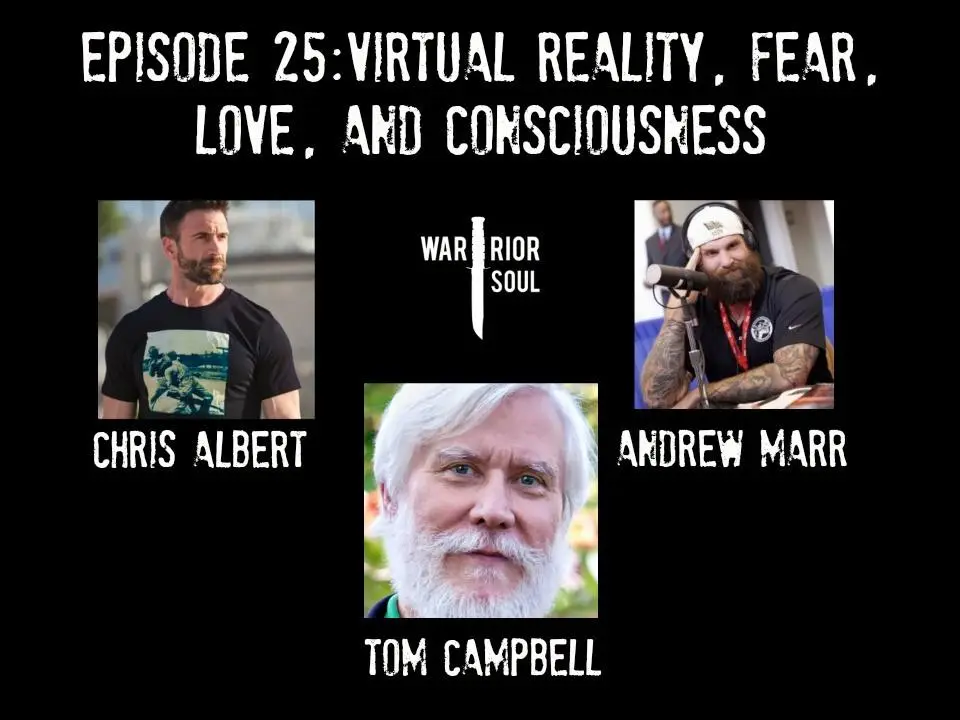
Episode 25: Virtual Reality, Fear, Love, and Consciousness, An Interview with Tom Campbell

Hosted by Chris Albert
The Warrior Soul Podcast
To listen on itunes: https://itunes.apple.com/us/podcast/episode-25-virtual-reality/id1096901382?i=1000378170114&mt=2
Tom Campbell began researching altered states of consciousness with Bob Monroe (Journeys Out Of The Body, Far Journeys, and The Ultimate Journey) at Monroe Laboratories in the early 1970s where he and a few others were instrumental in getting Monroe’s laboratory for the study of consciousness up and running. These early drug-free consciousness pioneers helped design experiments, developed the technology for creating specific altered states, and were the main subjects of study (guinea pigs) all at the same time. Campbell has been experimenting with, and exploring the subjective and objective mind ever since. For the past thirty years, Campbell has been focused on scientifically exploring the properties, boundaries, and abilities of consciousness.
During that same time period, he has excelled as a working scientist, a professional physicist dedicated to pushing back the frontiers of cutting edge technology, large-system simulation, technology development and integration, and complex system vulnerability and risk analysis. Presently, and for the past 20 years, he has been at the heart of developing US missile defense systems.
Tom is the “TC (physicist)” described in Bob Monroe’s second book Far Journeys and has been a serious explorer of the frontiers of reality, mind, consciousness, and psychic phenomena since the early 1970s. My Big TOE is a model of existence and reality that is based directly on Campbell’s scientific research and first hand experience. It represents the results and conclusions of thirty years of careful scientific exploration of the boundaries and contents of reality from both the physical and metaphysical viewpoints. The author has made every effort to approach his explorations without bias or preconceived notions. There is no belief system, dogma, creed, or unusual assumptions at the root of My Big TOE.
By demanding high quality repeatable, empirical, evidential data to separate what’s real (exists independently and externally) from what’s imaginary or illusory; Campbell has scientifically derived this general model of reality.
Transcript
Machine-generated from the episode audio and lightly edited — may contain errors.
Chris Albert (link to this point)
Welcome to episode 25 of the Warrior Soul Podcast. This is Chris Albert. We've talked about fear here on this podcast over and over again, and we have often come to the conclusion that fear is nothing but a lie. It is something generated by the circus that we play in our own heads and we force it upon ourselves to keep ourselves from doing what we're truly meant to do. Fear is what holds us back, and fear is what keeps us from being our true selves.
Today's guest is a man named Tom Campbell. Tom is a nuclear physicist who wrote the book, My Big TOE, and TOE stands for Theory of Everything. Tom works for NASA. He's worked with the Defense Department. He is one of the smartest individuals I've ever met in my life.
And Tom is one of the first scientists who attempts to explain through scientific theory, through scientific means, both the normal and the paranormal. A big part of Tom's theory is the idea of fear versus love. And in his theory, he looks at fear as something that drives us away from who we're truly meant to be. And he looks at love as something that drives us toward who we're meant to be. Tom's theory is a theory of virtual reality.
It suggests that all of us in this physical state, this physical matter world, are simply avatars in a sort of virtual reality. And our consciousness exists separate from this physical world. And because of this, Tom suggests that there are ways that we can actually extend ourselves beyond this physical reality. Tom's early experiments dealt with things like remote viewing, where people would be sitting in a room and they would view something in an entirely different location. Some of the early experiments entailed people pulling grid coordinates off of a map and the subjects of the experiments actually drawing what exist at those grid coordinates.
As we get into this episode you are going to hear a lot about Tom's story, you are going to hear about the structure of Tom's theory, but I think most importantly you're going to hear about the implications that his theory has for you as a person and for us as a community and for us as a world. One of the biggest things I think you can get out of this episode is the idea that you always have a choice. And that whenever you're making a choice, whenever you're making a decision, can ask yourself, is this going to drive me closer to my purpose or is it going to drive me further away? Am I doing this out of fear or am I doing this out of love? And one of the biggest things I think you can get out of this episode is the idea that when we put ourselves in victim mode, when we see the world is happening to us and we're playing the victim, we're truly serving no one, including ourselves.
This kind of behavior doesn't help anybody. It doesn't help to raise mass consciousness, and it keeps you right in the same spot you're always going to be, which is playing a victim. We have to get ourselves out of that mentality and toward building, toward creating, and toward serving our own higher purpose. I hope you get a lot out of this episode, and I hope that you enjoy it. If you do like it or even if you don't, write us a review on iTunes.
Let us know what you liked and what you didn't like. It really helps us to get our message out and helps us to become a better show. So without further delay, I give you episode 25, our interview with Tom Campbell, the author of My Big TOE.
Chris Albert (link to this point)
This is Chris Albert, and I'm here to remind you of one thing. Someday, you're going to die. Now that's not some morbid statement or scary idea. It's solid fact. Your time here on this earth is limited.
You need to be reminded of this as much as possible with one simple reason, to live your best life while you can. This is the Warrior Soul podcast.
Andrew Marr (link to this point)
Hey, everybody. This is Andrew and Chris with the Warrior Soul podcast, and we are extremely happy to bring you Tom Campbell today. And Tom is a physicist, a lecturer, and author. And Tom has had a long career as a scientist and a physicist. His PhD work specialized in experimental nuclear physics with a thesis in low energy nuclear collisions.
Tom spent the better part of thirty years working within The US missile defense community as a contractor in the Department of Defense. Tom most recently worked for NASA with the Ares I program assessing and solving problems of risk and vulnerability to ensure mission improves survivability and success. Tom is the author of the My Big TOE, that's theory of everything TOE trilogy, a work that claims to unify general relativity, quantum physics, quantum and metaphysics along with the origins of consciousness. Now the path that led me to Tom is is significant, so I'll mention here at the beginning. You know, a lot of the audience out there knows that, you know, I was sick for a while through traumatic brain injuries and the information and care that I was receiving from the military medical model just wasn't adding up.
So I started I started to question the beliefs I held about doctors and medicines in general, and I decided to go out and look for a way to heal myself, and I did. And after that, I started to ask myself bigger questions. Questions like, what is the purpose of life? What leads what actions lead to love, gratitude, and fulfillment? You know?
And then I started thinking, what else have I been conditioned to believe, and could there be more to life than the deeply held beliefs that I'm holding on to? And that led me to look at quantum physics, and that led me to the Monroe Institute. Then I became familiar with Tom's work and got into his book trilogy, My Big TOE, and started to, listen to some of his lectures on his YouTube channel. And then I attended a, lecture in Los Angeles last month, and his theory, is is fascinating, and we're gonna delve into it today. We're only gonna scratch the surface, but those are the main reasons I wanted to bring Tom on the show to expose, our audience to some different viewpoints and arrive at some new conclusions.
So with that long introduction, Tom, thanks for coming and talking to us today.
Tom Campbell (link to this point)
Well, thank you, Andrew. It's my pleasure to be here.
Andrew Marr (link to this point)
Well, great. Chris, you wanna start off?
Chris Albert (link to this point)
Yeah. Tom, again again, thank you so much for being here. You know, I've listened to a lot of your podcasts, your other podcast interviews. I've gone through your book. And I guess the first question that comes to mind is the book is absolutely fascinating and you know it goes through a bit of your story, how does a physicist get into a theory of everything that includes metaphysics, that includes the supernatural, that includes all this other stuff that that you get into in My Big TOE?
Tom Campbell (link to this point)
Well, it wasn't easy or obvious. I didn't start out with that as my as my goal. You know, I started out as I was I first got into, I guess, seeing a bigger picture while I was a graduate student working on my PhD, And I took the $25 introductory offer to transcendental meditation and found it was very significant. And after about three months of that, I found I could debug computer code, you know, in my mind in a in a TM state much more accurately than I could looking at the at the printouts. I could actually bring up all the the lines on the printout just like I was looking at a movie and scroll through it, and the ones that that that had errors in them would be red.
And I'd look at that. I'd know what it was because I wrote all the code. And I'd kinda make a mental note of it, I go look for them later. And sure enough, those were all the lines that had a problem. So that just blew my mind.
I thought, wow. What what is going on here? You know? That's impossible. And the more I work with it, the easier and better that got.
So at that point was my first idea that reality was more than just, as you said in the opening, the the beliefs that, you know, I had held onto up to that time. So my mind was kind of blown open with that experience. And then some years later, I don't know, not a long time, maybe three or four years later, I got a chance to work with Bob Monroe in his lab. He had just built the building, didn't really have a lab and, you know, he was looking for some scientists to work in it. So then I spent the next decade studying consciousness in a laboratory.
And as I studied it, I also was experiencing it at the same time. And that led me to to believe that I that I eventually, what, thirty five years later, that I had an understanding of how consciousness worked. So with the idea of how consciousness worked, I wrote those books. Then after about two years into the books, I realized that the exact same principles that explained consciousness and how consciousness works also explained the double slit experiment, explained why c was a constant, which is the basis of relativity. The more I looked at it, the more I could see I could explain all of the paradoxes that were sitting in physics at the time.
Paradoxes are things that physicists look at and say, I just don't know. You know? It doesn't make sense. I have no answer for that. And I had answers for it.
And then I realized that the same concepts run everything. You know? Everything is really explainable and understandable once you understand consciousness, which then leads you to understand virtual reality, which then leads you to understand how this reality works and they're all tied together. So that's how I made kind of a strange trip from your standard physics guy who doesn't you know, if you can't measure it, it either doesn't exist or it doesn't matter. You know, that's the way physicists tend to view things.
And now I think almost everything that's important is not measurable, you know, in the in the direct sense. So I changed a lot along that path with my own experience.
Andrew Marr (link to this point)
Tom, how earth shattering was that, like, the first time that you realized, you you know what? There's more to the nature of reality than I've thought my entire life. Because I remember when I came to that conclusion, I and almost felt felt like I was thinking something that I shouldn't be thinking. I was crossing the carry action across it just because of conditioned beliefs. Right. You remember that one point where you're like, my my god. This is this is there's much more to it than I know.
Tom Campbell (link to this point)
Yeah. Well, you know that I had a couple of those points. The first one, as I said, was when I I could debug my computer code in my mind. Mhmm. And, you know, that was mind blowing in the sense that she couldn't be able to do that.
It was, I mean, I had no idea what those errors were. All I knew, my computer code didn't run. And, you know, in those days, it wasn't like today where you can, you know, just try something and and you had good software to tell you where to look and where your errors were and what the line what line had a problem. It wasn't like that. But in the in the old days, I had boxes of about 4,000 cards, and these cards all went through key punch.
And sometimes key punch errors would show up, you know, the hole wouldn't be exactly where it was supposed to be. I mean, it could have been anything. It's not just that I made a mistake riding the line. There was lots of errors that really were independent of what I'd done on the software. So being able to find them and locate them just shouldn't have been possible other than very, you know, slow trial and error, you know, until you finally eliminate It's between this line and that line, and then you go and, you know, maybe repunch all those cards.
And it was a long process. So that was the first one. But that was just a mind opener. It wasn't till some years later in some of the things I did out at Monroe Laboratory, myself and another guy, electrical engineer, was working with. You know, we both we both did a, I guess, what's called an out of body together, and that got recorded.
And that was probably the second big moment. And, you know, that they hit you like a ton of bricks. I mean, your life isn't the same afterwards because you know that you know what you know. I mean, I know I was doing that computer code because I'd go find those things and change them and the computer code would run. So it's not in my imagination.
And that tape of Dennis and I that both of us were lying in beds in chambers that were isolated from, you know, acoustically and electromagnetically, there was no connection between us. And we were having conversations, answering each other, seeing the same things. And it was so obvious. It's not something you could say, well, maybe that was just luck or maybe, you know, something else happened. And when you when you have that, you've had the experience, you know it's real, you know that it can't take place under the the beliefs that you have presently.
Well, what I felt was there was a whole lot of reality that I didn't know existed. You know, I was just living in a little piece of it, and there was so much more to it that I just didn't understand or didn't know about. And being a physicist, that was that was a big deal. That's what we physicists do. We try to understand reality.
And here I found myself, you know, poking around a little corner of it called the physical universe, and there was so much more that, you know, I wanted to study that so much more. See, well, how big is it? And what can you do there? And what are the limits? What are the rules?
You know, what's the what's the physics in this larger reality? Where did it come from? You know, I had all these questions because that's the way physicists think. And, yes, it's the there's a whole series of these moments hit me, but like a ton of bricks. You know, that that second one I remember is probably spending two weeks kind of in a in a daze thinking, my god.
This stuff's real, isn't it? You know? I mean, I knew it was real. I you know, the all the data said it was real. But it's different between getting it up here where you know it's real and getting it down here when you accept it down here, it's a life changer.
When it's up here, it's just a curiosity. You know? And there's a big difference between the two. You know? And so much of the theory talks about that the intellect our intellect will only take us, you know, so far.
Andrew Marr (link to this point)
And what I've really come to appreciate, Tom, is how you challenge everybody to go and experience it by them, you know, on their own, that it needs to be a personal journey. But within that personal journey, you know, we can predict, measure, and replicate so we can be scientific about our subjective experiences. You know? Can you can you expand a little bit on that?
Tom Campbell (link to this point)
You know, know, that's exactly that's exactly right. It has to be your experience or can't be your truth. If you've never experienced it and you've just heard about it or read about it, well, then you have a choice. You can either believe it or disbelieve it. Well, neither one of those are useful.
You know? Neither one of those will help you grow or change or become anything other than what you already are. So if it's not part of your experience, then it's not really your truth. It's somebody else's truth. And you're stuck in this believe it or don't believe it, which, like I said, is useless.
So you have to make it your own truth, and the only way you can do that is by creating your own evidence. You have if you're gonna experience this, then you have to explore this larger reality like a scientist. You have to not have any preconceived ideas about what it's gonna be like, and you have to it has to be repeatable. It has to be significant, you know, testable. So you do things like remote viewing because that's evidential.
You know, you get some target and you see if you can see what's there, what's going on, and then you go to that place and see if you were right. So that's evidential. You can do using your your mind and your intent to to heal, to modify, you know, probabilities, and you can check to see if that's right. You can't do it just once. You've gotta do it a 100 times, 500 times.
And, you know, if the result is, well, 50% of the time, I'm right. Well, that's not necessarily doing anything at all. You know? Maybe you're just a good guesser. So when you get to 80, 90, 95, 98% of the times, you get things right.
Now you know something's going on. So the way you test these things is one, you get evidence, and two, that evidence has to be analyzed probabilistically so you can tell whether you're actually doing something. And, you know, a lot of science, it relies on probability. Medical science relies on probability. Now if you you make a medicine and you say this medicine will keep people from getting headaches, well, nobody will believe that.
So you give it to, you know, 10,000 people. Mhmm. And if, you know, out of that ten thousand nine hundred ninety nine of them had headaches and they all went away within an hour, well, you've got a medicine there. That's you know, you've proven that the medicine has an ability to to get rid of headaches. If half the people who had headaches got their headaches went away and the other half didn't, well, maybe their headaches would have gone away anyway, you know, without the medicine.
They haven't proven anything. So you have to use statistics and probability to sort out things that are personal. Whether or not you have your head hurts or not is personal. Mhmm. You see, there's no way to just test that.
You can't go up and stick a you know, I'm on somebody's head and say, oh, this person has a headache. It doesn't work that way. So anything that's personal has to be then tested with evidence and then usually with probability. That's the only way to do it, but an awful lot of science is done that way with probability. And it's there's a good there's a good scientific method to do that, but you have to go through that step.
And that's why I tell people, you gotta find out for yourself because you just listen to me, you know, you're stuck with believe it or not, neither one of those is useful. Go do it. It's not that hard. And if you do, then it's yours, and that makes all the difference in the world.
Chris Albert (link to this point)
Tom, one one thing I wanted to ask you because just for for some of the viewers and and listeners at home, just so they have an understanding of how your your your theory works. What I admired a lot about it was the structure. The structure is extremely elegant and I could see that as a person with a scientific mind you're trying to explain all of these things you're experiencing and listening to you describe it on other shows it really makes sense. Can you describe the structure of your theory as far as you know, what consciousness is, where it exists apart from this world that we're in now, this reality that we're in now, and and how that works together?
Tom Campbell (link to this point)
Okay. Sure. And I you know, it took me probably at least thirty five years worth of experimenting and trying to figure it out before the light bulbs went on and I I got it. So it it wasn't like I didn't understand anything, and then one day, I understood the whole thing. Science doesn't usually work that way.
So there were a lot of piecemeal, smaller ah ahs, you know, that put together, and then finally, it all kinda pulled together. Mhmm. And it all started to pull together for me when I realized that our reality, our awareness, our consciousness, or you might say, a conscious awareness, is just information. What do your senses do? Your senses gather information.
You hear, see, smell, you know, all those things that are all our senses touch is just information. So a a photon comes in and then goes through your eyeball and gets focused on on the retina. The retina produces an electric signal. Right? That's just information.
Electric signal then goes down that optic nerve until it starts doing things with neurons. It starts, you know, changing it. Well, neurons are just little discrete chunks of something. Right? It's just information, patterns, data.
So when I realized that all of our reality is information, that was one of the, you know, that was the one of the big pull it altogether things because then I could see how consciousness was really an information system. And consciousness being an information system, The next step was that consciousness is not physical because information is not physical. The information let's take a book. The information in the book is the the meaning, the significance. You know, what does this book mean to you?
You know? What do you get out of it? That's the information. The ink on the page is not the information. It's just ink on the page.
The page itself is not information. You know? The words are not information. It's the meaning. It's where the information is.
Well, how much does meaning weigh? You know? What's its volume? You know? Can two meanings, you know, be in the same place at the same time?
You see? All the characteristic tests we we have for things being physical, information doesn't pass any of those tests. You know, you know, how much information can you put in a bottle? Well, information is not physical. So that tells you that if our awareness is information and information is not physical, then our awareness is nonphysical too.
So now I see consciousness as a big information system. Well, it's a very if you want the most general system and you're trying to describe it, you know, as simply as possible, then information breaks down into bits. Well, bits in our computer experience are ones and zeros. You know? We have binary.
Now I don't mean that the larger conscious system has to be binary or has to be any particular thing. You know? Who knows what that has evolved to be? But I use binary as, like, an example of of, you know, kind of a metaphor of the lowest the smallest piece of information. So that makes it digital.
Digital just means discrete. It means it comes in little chunks like ones and zeros because that is the simplest form of information. So always try to keep whatever theory you're making as simple, you know, as possible. Because when you have complexity, you also have room for error and mistakes and other things. So keep it simple.
Keep it elegant, and you're more likely to be doing something that's that's fundamental. If it's if it's very complex, it's probably not fundamental. So that so now my my growth in this thing got to the point that consciousness is some kind of digital information system and is nonphysical. Well, then who are we? You know?
What's what's this what's this body here? You know? What's what's going on with that? Well, then that lended itself to, well, you know, this is this is consciousness having experience. Well, how does consciousness nonphysical have an experience?
And that brought me to the point of virtual reality because that's what's going on in a virtual reality. You're playing a computer game in a virtual reality, and your avatar in the virtual reality is computed digital information, and you are the consciousness. Right? And that led to the next step, which says, well, the consciousness and its avatar can't be in the same reality frame. You can't be in, say, your elf's reality frame if an elf is a character you're playing in a in a virtual reality game.
So you've got this elf avatar and it's running around and you're making all of its choices for it. You're its conscious you're its consciousness making choices, and you can't be in its frame. You have to be outside separate from its frame. And the computer that's computing that elf, that picture, that can't be in the elf's frame either. That has to be outside the elf's frame.
And you, the consciousness in the computer, have to be in the same frame because you are communicating. Really, that virtual reality is just a stream of data going back and forth between you and the computer. Right? And then the computer computes a bunch of little dots on your screen, and you interpret that as that virtual reality of World of Warcraft or whatever it is you're playing. So when I took that as fundamental nature of virtual reality, that's how virtual reality has to work.
You can't have a virtual reality without a player. There's no point. You know? It doesn't you can't have a virtual reality without a computer. Virtual reality is a computer and a player interacting with each other.
So when I put all those concepts together, it finally got clear to me how this consciousness system worked. It's a digital information system. Well, that means it's sort of like a computer, except it can have different pieces. One of those pieces is the computer that's creating our virtual reality. Why would we need a virtual reality?
Because it gives us an opportunity to have experience. We as consciousness can experience what that elf does under a rule set. So then, you see, I'm just kinda going through the steps of kinda how I, you know, how I got to that picture. And then I realized, well, why would you need to have experience? Why would consciousness need a virtual reality?
And I realized that consciousness, like any information system, has to evolve or change based on how much information it has. And that means based on a measurement of entropy. Entropy is a measurement of disorder. So you have maximum disorder if all the bits in your system are random. There is no information.
All the bits are random. Zero information. So as those bits get structure and purpose and meaning because you, you know, the cons the the structure that you have in your bits has meaning now, you've created information. So what you've done then is lowered the entropy of your system. Lower entropy lower entropy means more structure, more information.
So if you're an information system, it's clear you change or evolve or grow by lowering your entropy, creating more information, turning random bits into something useful, something that has meaning to the system. Also, it was clear that as the system evolves, it has to get more and more complex. That's the nature of evolution. As things evolve, they get more complex. They get more stable.
They get more useful. That's why evolution works that way. If they got less useful, they eventually evolve, you know, devolve and go away. So what you're left with is all the stuff that was more useful. And so, you know, so the question, well, who am I?
You know, who am I, this consciousness playing this avatar? Well, you're a piece of consciousness. Well, where did that come from? Well, if we had this larger consciousness system and it needed to evolve through choice, through more information, it would kinda die out. It would kinda get a it would have hard time evolving if it's just one big chunk of consciousness.
Break it up into pieces and let those pieces interact. Now you've got lots of possibilities. The ways that you can interact with, you know, end things, you know, goes like, you know, end factorial, you know, all the permutations and combinations that that can happen there. So consciousness breaks up into pieces, and we're one of those pieces. And we're playing this virtual reality game.
Well, why would we be doing that? What's good as experience? Well, when you think of the that that the this larger conscious system is trying to evolve. Well, how do you evolve? What does that mean when you have a lot of units of conscious?
I call those individual individuated units of consciousness. Well, that's a social system. It's a bunches of chunks of this little information that are interacting with each other. What does interaction mean? It means they share information.
It's an information system does. So they're just sharing information, and they're sharing information with free will. Otherwise, it would just be one thing talking to itself, you really wouldn't have gained anything by breaking it up. So they have to have free will. So when you get that, then how do you reduce the entropy of a social system?
Well, there's only one way to do that. A social system is interaction, interactive system. And that's if the interaction between the pieces is positive, is caring, is about other. It's it's cooperative, you know, working together, that kind of thing. Because if you have a social system where people are all working at odds with each other, who don't cooperate, don't trust, don't care, well, that system isn't going to optimize.
That system is going to be very suboptimal, and it'll probably eventually just devolve and go away. So then it became clear why we have the virtual reality. It's a place for us to grow up in. It's a place for us to lower our entropy. It's a it's an experience where we get to make choices, and we get to see the consequences of those choices.
Whereas, when before, we're just pieces of consciousness interacting with each other. Imagine you and a million other people in a big chat game just interacting but trading information. Well, there's no traction in that. What are your consequences? Well, hardly any consequences.
Say anything you want. You know? Do anything you want. Turn it off. Turn it on.
You know? Lie, cheat, steal, whatever you wanna do. There's really no consequences. But you need a tighter rule set where a game has consequences. That means the game has rules.
So you produce a virtual reality with a tight rule set that creates a virtual physical universe like ours. Let that evolve, not programmed like World of Warcraft, but let that virtual reality evolve from initial conditions and, you know, and a rule set. You have to have a rule set, then it evolves to be this physical universe. And then we evolve within this physical universe as part of that simulation. So we humans, this this body evolved, not programmed.
And we have a purpose. That's to use our choices, use our free will to make choices in such a way that we grow up. We move toward cooperation, caring, you know, productive interaction, that sort of thing, helping each other. It's about other, not just about self.
Andrew Marr (link to this point)
And, you know, Tom, that that makes you think more about the importance of every choice that we're presented with when you're thinking Yes. At the upper dime.
Tom Campbell (link to this point)
Right? Absolutely. That's the point. That's why you're here. And we make hundreds, probably thousands of choices in a day, things that we don't even know that are there are choices.
For instance, if something somebody interacts with you and it and it upsets you, makes you angry, that's a choice. You don't have to be angry. You choose to be angry. So now that tells you you need to take responsibility for who and what you are and the situation you're in. If the situation upsets you, we'll start looking about why are you upset.
Why do you choose to be upset in that situation? And you'll find out it's because of ego and fear and all these things that make your life miserable that you need to get rid of.
Chris Albert (link to this point)
Yeah.
Tom Campbell (link to this point)
That's what you that's what you find out, and then suddenly you're in charge again. It's not that you're just this pawn bouncing around in, you know, in somebody's big ocean. You actually are in charge of your life. You need to focus on what what your choices are. Choice you make, as you say, we make lots of them, and every one of them is important.
And the choices we make can fall to two sides. You know? If you, you know, break it down that way, it's you either make a choice toward love, caring, cooperation, making a difference, or you make a choice toward fear. It's all about me, self. I'm a victim.
I'm this. I'm that. I'm helpless. You know? You you you go that route, in which case, you're miserable and unhappy.
You go the other route, and eventually you grow up and and you're you live a life of joy. You're in charge. And that's really a huge difference. So the the physics came out later. And once I got this consciousness system together and I wrote the books, the books had been published for a couple of years before it even came to me that the very same logic that developed this system of virtual reality and consciousness and that understanding that the same principles applied to physics.
And all of a sudden I said, Oh, I can explain how the double slit experiments work. I can explain relativity. I can explain you know, the Zeno effect. I can explain all these things, and that was kind of an afterthought. That's not what I started out to do at all even though I'm a physicist.
As a physicist, I just wanted to understand this new weird reality I realized existed, And it ended up actually being better physics, not just better philosophy or better better metaphysics.
Andrew Marr (link to this point)
Tom, I wanna jump into the double slit experiment and see a constant sense in relativity relativity. But before that, what what is the scientific community's response to you saying that our reality, you know, is a virtual reality that's construct of consciousness? Is that something that's accepted now or growing in that direction? You know, what's your general feedback on that?
Tom Campbell (link to this point)
Yeah. Well, when I first said that, when I first did I sent out the books, it was '19 let me see. February 2003 is when I first published them. At that time, virtual reality was probably viewed by most physicists as a dumb idea, something too fantastical to possibly be true. I know between it was maybe three or four of us in the science scientific world that thought it was a good idea, but not many.
We were way out on the fringe. Now a decade later, virtual reality is probably the biggest new thing in physics. And it's not because physicists suddenly just changed their minds because they thought it was a cool idea. It's that the experiments that physicists have been doing have been probing the nature of reality at deeper and deeper levels. These experiments have drug scientists kicking and screaming into the realization that virtual reality is the only thing that produces answers.
For instance, long time ago, well, a couple of decades ago, electron was a little chunk of mass with a charge. Right? A physical particle. Well, if you if physicists represent an electron as a piece of mass with a charge, they can't get the right answer. Electrons don't behave.
You know, our calculations say, well, that little mass and a charge would do this, but that's not what it does. It does something else. So now they have realized that if they want to get the right answer and actually predict accurately what the electron's gonna do, the electron is a point with an attribute of charge and an attribute of mass, which is exactly how you would model an electron in simulation. You see? So it's things like that.
There's just been a a whole lot of them, dozens of them over the last decade. They've realized that the only thing that produces right answers, the best model for understanding how this universe works is virtual reality. Now many of them don't call it virtual reality. Most of them started out calling it our reality is information based. It's just all about information.
Well, that's that's the definition of a virtual reality. It's a computed reality. It's virtual as opposed to it's this you know, this physical reality is is is an illusion. It's a virtual reality. It's based on information.
So, yes, right now, a lot of physicists think that's not only a good idea but the best idea. But they're stuck in the sense that they don't know what to do with it. Okay. Our experiments tell us that this is an information based reality. It's computed.
Whatever that means, you know, this is a simulation. Whatever that means, they don't really know what to do with the next step. Okay. What does that mean? What's the point?
You know? Of course, the first question is, well, if it's computed, who's computing it? Where's the computer? See, that just jumps right out at you. Just a question.
And the physicist that that first got the virtual reality, his answer to that was, well, it's just in other. Because, yes, he you know, as I told you earlier, you know, the source of the virtual reality can't be inside the virtual reality. It has to be in some other reality frame, so he just called it other. That was doctor Edward Fredkin. And, that was back in nineteen ninety something when he wrote these papers, and he he, talked about being a virtual reality and that it was computed in, quote, unquote, other.
But he didn't really know a whole lot that he could say about other other than maybe how much computation, would be required to produce this reality. He said a few things about it, but other was just other. And most of the scientists that looked at that and said, yeah. That's nice, but we can't go anywhere with that. You know, we're stuck right there.
We can say it's another, but that we can't say anything else about it. So, you know, what's a scientist to do? You know, there's really no way to research it or do anything with it. So they were up against the wall not knowing what the next step was. But the steps that I had in talking about consciousness kind of showed a path that if you use this logic, if you look at the virtual reality and how it works here, how it works in consciousness, the way it works in the larger system, which I was able to explore because of my time with Bob Monroe, then you can apply that to this physical reality if it's like a glove.
So because of that, then I've been able to come up with some experiments that would be absolutely impossible to do if this was a physical reality, but would make sense if it's a virtual reality. And I hopefully will get some some physics departments interested and they'll do these experiments and that will help people see a bigger picture. So that's kinda where I am now with the with the physics thing.
Andrew Marr (link to this point)
So, Tom, you've actually I'm sorry, Chris. Go ahead, Chris.
Chris Albert (link to this point)
It's okay. I I was gonna ask, you know, you mentioned your time with Bob Monroe and and some of the experiments that that led you to this theory and and some of the experiments you're thinking about doing now. You mentioned remote viewing before. Can you can you explain for the people at home what remote viewing is and and what types of experiments you guys did with mister Monroe and and and what kind of things you came up with?
Tom Campbell (link to this point)
Sure. Remote viewing is a is a term that means you can become aware of things, and remote viewing makes it sound like you're you're seeing things that are remote to you, things that you shouldn't be able to see, things, you know, in another country, another place, somebody else's house, whatever, someplace where you are not. So it's remote from you, and you're getting information about what's there, but you're not getting in any normal means. It's not like you're calling them up or you have a camera there or anything else. You have no idea what's in these places.
You have no data coming to you through any normal means, but you're able to get data because when you understand the mechanics of how this virtual reality works, you realize there are databases. And the databases are the probable future database, things that are likely to happen or everything that could possibly happen and the probability that it might. It's just a probable database. And then you have a past database, which is all the things that could have happened and the probability they might have plus the little string through it is what actually happened. That's our our own history thread.
So you've got these databases, and those databases are necessary for the system to, you know, to create the virtual reality. You need to understand the past so that you realize so you can make sure your virtual reality is always consistent. Things have to be consistent with the past, and you can't keep them consistent. If you don't understand, you know, what they were, they still have to be consistent with that. You can't walk out of your house one day and see palm trees and walk out the next day and, know, you're on a mountaintop at a high elevation because those two things are just different.
It has to be consistent. So you need these databases as part of the the mechanics. And it turns out that with your intent, you can query the database, and that then turns into remote viewing. You can get this information. Well, remote viewers started just looking at places places here on this earth.
And the first experiments scientifically that were done were done at Stanford with Russell Targ and so the guy Targ, Puthoff. Yeah. Hal Hal Puthoff. K. Stanford, they did the first real scientific work there, and what they discovered was that it worked.
People could do it. You know? People could pretty accurately describe some place that was taken out of a out of a random number generator. You know, you get a random jump number generator that would generate the location of some place, maybe a lat long. And you just got a random thing, and then you'd say, well, goes go what tell me what's there.
And they'd say, well, I see this, and they draw pictures of it, and there it was, you know, a tennis court or a water tower or something else. And they were able to do this pretty accurately. Well, you know, you don't have to do it real accurately every time. But if somebody does it very, very accurately even once, well, that's amazing. That's telling you that something has happened.
And if they can repeat that over and over, then it's not just dumb luck. It's something's going on. So that was published in an I triple e communications journal. You know? That got peer reviewed publication because it showed communications that were by some other channel than what we what we knew about.
So the remote viewing became looking at some other place on the earth without ever going there or being there or, you know, getting any information normally.
Andrew Marr (link to this point)
And, Tom, I think that, they found the the most recent known moon to Saturn before the satellites could pick it up through remote viewing or something similar to that.
Tom Campbell (link to this point)
Well, I've I've heard that too. Yeah. They've done a lot of remote viewing. CIA had a remote viewing team, you know, back in the seventies, I guess, and eighties. Joe McMoneagle was was part of that team, and so was Russell Targ.
He he helped develop that team, and they had notable successes as well. So it's there's lots of people now doing research in remote viewing. And the research, when it's done very carefully and scientifically, says indeed remote viewing is a real thing. You know, people can remote view. And then after maybe a decade or two of just remote viewing places on Earth, they realized that they could remote view into the past.
They could remote view into the future, and they could remote view to other places other than the Earth. But the remote viewing really wasn't just looking at places on the earth like they thought. They could use their intent to gather information about all sorts of things. And they saw some interesting historical puzzles doing that where everybody wondered, well, I wonder what really happened there. And they were able to get some information that was evidential that they could then look up in the history books and see if what they saw was what happened and so on.
So then remote viewing, this was probably, like, five or ten years ago. Remote viewing suddenly blossomed into this looking at places on Earth to you get information, you know, on almost anything based on your intent. Well, that's because they were just all along just querying the database, except they never queried it for anything other than, you know, what does it look like at this, you know, place on the earth? That's all they'd ever done, so that's all they'd ever gotten. Then they started querying the database in a more general way and found out it worked just the same.
So there's nothing other going on than they are getting data out of database. Your intent is to query. And they found out that if your intent is very clear and sharp and precise, you'll get clear, sharp, and precise data back. If your intent is fuzzy, you'll get fuzzy data back, which is the way databases are. You know, you go to Google and put in love or something like that, you get million replies back, but all sorts of stuff, you know, all across the board.
If you really want a particular piece of information, you have to be very precise about what you put in, and sometimes you have to iterate to to get that. So it works just like any other database, but you have to have a clear intent. And for most of us, that's not easy to do. Our mind is constantly jumping around and and goes from thought to thought and has very little discipline. So most of us have trouble with that.
And the second thing we have trouble with is that as information comes into our mind, we immediately start to judge it and then try to second guess it. So, you know, people will say, well, okay. What's that such and such spot? And they'll say, oh, let's see. Where that that lat long?
And that should be some place over let's see. That ought to be around France. Let's see. France. France.
What's the oh, Eiffel Tower is probably what it is. You know? Their mind starts trying to figure it out based on what they know. Well, all that does is make you have a wrong answer if you try to guess. So what they did is they had a protocol where they take thousands of remote viewing targets, randomize them, and they were done by different people, randomize them, you know, put them in a in a jumble, draw one out, put it in an envelope, take the envelope into the remote viewer and say, I've got a location in here.
Tell me what you see. They'd never give the envelope to the remote viewer. He never saw, you know, any of the data. All he knows is there's some location in an envelope that he's supposed to go tell you what's there. Well, what that did, people would say, wow.
Well, that's like double and triple blind, and that makes it really hard. No. It made it easy because now he didn't have any information to second guess with. He didn't have any information to try to make up an answer or figure it out or judge it. He had to just look and say whatever it was he saw.
And suddenly, with that protocol, remote viewers got better quicker and and once you got rid of the the noise. So that was kind of a also a big jump forward for the remote viewing communities was was the double and triple blinds, so they had no information in which to mess with the answer. They just had to get it. But still, a good remote viewer has to train a pretty long time to get to the point that he doesn't make things up. You see, you you are a consciousness, so you can create information too.
And if you can't just make your mind be quiet and just see what you get, then you'll you will jumble it up yourself anyway. And that's really the skill that's required in remote viewing is a skill of just letting all that noise go in your mind to where it's just open, and you're not putting you're not filling in anything. And then you become aware of what's what you're creating versus what you're getting that you're not creating, and that takes time. That's a subtle thing that that takes a little time. So it isn't easy necessarily to be a remote viewer, but anybody can do it if they practice and if they study, if they learn to meditate and quiet the noise in their mind and and do those sorts of things, they'll have some success at it.
It's not all that hard.
Andrew Marr (link to this point)
And that that's getting to point consciousness. Right, Tom? Is what we spoke about at the conference. But that that's the I mean, that's the goal as I see it. There is a goal of meditation to get to that point where you have quieted the mind so you can differentiate.
Is this data coming in or something that I'm creating? Correct?
Tom Campbell (link to this point)
Yeah. That's, yeah, that's, like, the first thing to do. If you want to if you want to experience this larger conscious system yourself, which I encourage everyone to do, first thing you have to do is learn to quiet the noise in your mind. And the typical tool for that is meditation. And you just practice your meditation until you can shut everything off and become just a point of awareness floating in a black void.
That means you've cut off all your sense data. You stopped thinking. You stopped judging. You stopped analyzing. You're just existing.
You're just being. You kind of come to the to the Descartes point where you said, you know, I think, therefore, I am. Well, that's it. That's all that's all there is. Just that you exist.
And that's the only just open awareness with no data. That's point consciousness. And when you get there and can hold that state, you know, for more than just seconds, you can hold that state for minutes and then maybe hours afterwards, you you can then do lots of other things. So point consciousness is like the doorway. It's the portal.
Get there, and now you can use an intent. An intent because you're just there at the being level. Your intellect is disengaged. You're there at the being level, and you can think with the being level. You can then intend to, you know, remote view or heal or do this or gather this information, query the database, and your mind is clear and open and you're not putting any any noise into it.
So that's why point consciousness is a place to start. Now there's many eastern cultures that that get the point consciousness, and then that they're done. That's you know, they've reached nirvana, and there's no point going any further. My thought is that you've just finally prepared yourself, you know, to do something, to go you know, to learn some things, to go farther. That's the that getting to that place is really just the first step.
So, yes, point consciousness is a is a is an important first step to take. But, you know, anybody most anybody can get in that state more easily than they think. Think about when the last time you read a book that really captured your imagination. You were really into that book. Well, you were almost in point consciousness, except your consciousness now was involved around that book.
But you turned off the chair you were sitting in, the people walking around behind you, you know, the all that stuff, the traffic outside, all that went away. It was just you and the story in the book, and you dropped almost all your sense data. The only data you really were collecting was what you were seeing, you know, interpreting the pages on the book. So that had your full attention. Well, that's sort of like what point consciousness is except without a book.
You know? You do the same kind of thing, but you don't need a book to do it. You just you just let it all go. And everybody who reads books gets in that state, so it's just not that hard to do. It's just we we think it's a lot harder than it is.
Andrew Marr (link to this point)
And I know that's a self journey, Tom, that we all have to come to, but was that something that Bob Monroe was able to aid you in cultivating that process, or is that something that you were able to perform totally separate of your interactions with Monroe Bob Monroe and the Monroe Institute?
Tom Campbell (link to this point)
Well, I had been fairly good at that at a much younger age, just letting everything go and focusing my mind with with low noise. So it was easy for me. When I first learned to meditate, it was very easy for me. I learned to meditate very quickly. It didn't take me very long.
And after just a couple of, you know, a couple of tries, I could find point consciousness pretty clearly and hold it. So that's unusual. So I would say my experience there is probably a little unusual in this for the average person. But on the other hand, you know, that would well, what I just said would make me maybe a fast start. But on the other hand, that was a pretty slow start because being a a physicist, a scientist, I wouldn't take a step until I knew, you know, what I was doing and what was going on and test it.
And testing takes a lot of time. You have to do the same thing, go to the same altered state, you know, produce the same oh, should we say, you know, you have to hit the system exactly the same way at the same time and see if you always get the same answer. Otherwise, it's not science. You know, everything's a new experience. You can't learn anything from everything's a new experience.
You have to take a lot of time. So I was slow and that I progressed through it very slowly and very carefully to make sure that I was not leading myself down some path of, you know, self deception. That was a very important point for me. So I took more time than the average person would have to take to do it. But, yeah, I did I did come probably into this reality already kind of preprogrammed to do that more easily.
And when I got to Bob Monroe's, it didn't take me very long before, you know, I was able to do, you know, the same thing Bob did, and then I could go to this out of body state. And out of body state's just not the right words for it. You're not in your body. You know? This is just your intent, your consciousness.
Your body is some avatar. It's like you're not your elf. You don't live in your elf. You don't live in your elf's body. You know?
You are separate. And so it's not really an out of body, but that's just the words we use to describe it because you're no longer getting your body sense data. You've kinda turned that off. So I learned to do that at will probably in the first, you know, six months to year that I was there, and then I got a lot better at it by the, you know, second and third year that I was there. It takes practice.
It takes a lot of practice. There's a lot of subtle points to your consciousness and when are you feeding the data and when's the data coming to you and learning to you know, one of the big moments I had with Bob Monroe was that it doesn't have to be a long process. With Bob Monroe, we started, you know, you'd get into the booth, you'd relax, you'd get rid of all the things that were worrying and bothering you, you'd empty your mind, Then you do the you know, relax your feet and relax your legs and all this kind of thing. It was a real slow buildup that was done to try to get you to a point where you were just open and on but not processing anything. The point consciousness state.
And I was probably twenty minutes to get there. And I remember it was always this struggle to be right on the edge of consciousness, to be asleep but still aware, to be remain conscious but to let go of everything, which in most everybody's mind means, like, to fall asleep because that's what you do when you fall asleep. You let go of everything. So I had this
Andrew Marr (link to this point)
A state of a state of a brainwave state, Tom?
Tom Campbell (link to this point)
A state of state of brainwave state.
That's what it is. Yeah. About a four hertz theta. You go down to, like, two hertz delta, you're unconscious. So the idea, you're right on the edge of unconsciousness.
So I had this this false idea that it needed to be a very fuzzy, kind of cloudy, foggy state because it was just on the threshold of losing consciousness. And in my mind, that meant it was gonna be fuzzy, foggy. You know, you're you were awake, but just barely, and then you kinda ease into being more awake someplace else. And then I realized you don't need all that that, you know, that ritual. You don't have to relax everything.
You don't have to, you know, go through all that process. All you have to do is have an intent to be there and just let this go. And, you know, one half a second, you're there. You don't need twenty minutes worth of conditioning. The conditioning was a was a belief, basically.
It was a tool. And you believe if you go through this tool and you work the process, then you can get there. And, well, sure enough, that worked. Process worked. But the process wasn't fundamental at all.
It was just a tool that we learned, got accustomed to, and then kinda had to have because without the tool, well, you know, you couldn't do it then. This idea of just, okay. Now I'm someplace else. You know? It just didn't seem right.
It was just hard to swallow that that it wasn't anything but your imagination. But I worked with that for a while and found out that it was just as good a state with just as much value to it as I had when I took, you know, twenty minutes or half hour to get there. And I didn't need all that. That was another kind of big So there's learning moments all the way through it, things that I figured out, you know, as I went. And that was kind of a big one because then that's that frees you up from all the, you know, from all the props.
You don't have to meditate first. You don't have to lie in a bed. You don't have to do any of these things. It doesn't need the time. You don't have to relax.
You can do this anytime, and you can do this in parallel process. So you can be you can be in another reality system and be talking to somebody in this reality system, and you just are are time sharing. You A little bit of time here, a little bit of time there. You know? So you're, you know, maybe 50% both places or forty sixty or whatever else.
And it's just everything got easier after I I figured that one out. So it's not like it was any one big that, you know, one day everything became clear. It's it's all been a whole bunch of little steps of figuring things out to kinda get me where I am now.
Chris Albert (link to this point)
Yeah. It's fascinating to me because I could point to various points in my life where I've had something come into my head and then I would take action on it and it was just just a random thought that came into my head and I take action on on it and it would completely change the course of my life. You know I took a trip out to Greece about five six years ago while I was a PhD student and I after that trip to Greece I was sitting on the spot of the Oracle at Delphi and this thought came into my head because I was worried about my dissertation and this thought came to my head and said it doesn't matter and I came back from that trip and quit the PhD, quit the whole thing and set my life on a different course, and it led to a lot of really good things in my life, a lot of awesome things. Guess the question here is how do we have more of those moments? How does the average person reduce entropy to that point so that data becomes more clear in our head?
Tom Campbell (link to this point)
Well, we you get that message, that that little voice in your head that you suddenly had this this knowing that it didn't really matter, that that PhD thesis really wasn't, you know, the big thing in your life, that there was other things that that were coming. You can get that one of two ways. One way, that's kind of a a tipping point for you, and it could be that it came from external to you, that the larger consciousness system who has an investment in your evolution because you're a part of it, therefore, you evolve, it evolves because you're really part of the same thing. So you could have just gotten a nudge from the system that you and it wasn't like once you got it, you knew that it was something profound, something fundamental. It wasn't, oh, I just got this funny thought. Know? You you know it at the time that it's really something fundamental, and you start to see the world in a different way immediately. The other way it happens is that you're sitting there pondering, and particularly if you're at the Oracle because you think, this is the place where people had, you know, big thoughts. Mhmm.
So what's on your mind is this is this dissertation and what are you gonna do with it and where am I going with the rest of my life? And as you have these thoughts and you're open to the idea of just getting information, because after all, you're at the spot where that happens, then your own intent had these thoughts in it. What am I gonna do? What is this dissertation? Where is it leaving me?
And these questions went out to the database. You ask a question with your intent at the database, you'll get a reply. So if you ask the question, you know, what should I do? You know, what's the what's the deal here with my rest of my life? And this well, you asked the question.
In comes the information. Forget about the dissertation. Go do something else. You see? That was the answer.
So you may have been the one creating it. So what can people do to get more of those? Well, they, one, can get rid of the noise in their mind so when they get an idea that they know that they've gotten an idea, that it's not just a a random thought, therefore, they immediately just dismiss it. Oh, that's not important. Secondly, realize that if they sit still, get in a good point conscious state if they can, or even just a good relaxed state, and have an intent, and then just be quiet and listen.
Andrew Marr (link to this point)
Mhmm.
Tom Campbell (link to this point)
Don't judge it. Just listen. They would get a lot more information that way, and the average person can just do that. You just you know, if you if you think about where do the breakthroughs come from, where do the moments come from, whether it's in science or whether it's in literature or whether it's in art or anything else, it comes from when people kinda go inside themselves and open up. And suddenly, you know, they understand a bigger picture than they did before.
That's how most people have their their insights. That's because in their mind, without them knowing it, they're asking a question. They have a problem. They're at a crossroads. They've got an issue, and they're thinking about that issue, and the question goes out.
And if, you know, the answer comes back. It's just the way the systems work. You're a piece of consciousness. You have an intent. You query the database.
You'll get an answer. But mostly, we're not focused on that issue. We got all kinds of issues going on our head all the time. Some of them are really mundane, like, what are we gonna have for dinner tonight? You know, that kind of thing.
And our head's just full of that nonsense. But occasionally, at the still moment, when you're all by yourself usually, and it's quiet, and you're sitting at the at the oracle, you know, you kinda think a big thought, and you think, you know, what am I gonna do here? You know, what's the rest of my life like? Well, now that's a clear thought. And if it's not jumbled with other things because you've kinda reached a deeper point, then you'll get a clear answer back.
And anybody can do that pretty much any time. It's not like, you know, you need to be special to do that. Yeah. You everybody's a consciousness, and everybody has this ability.
Chris Albert (link to this point)
And I think that's an important point that you made there that the system wants you to succeed. Alright? The the system of consciousness wants you to succeed and and I think that one of the things that keep people from listening to those inner thoughts is is that fear that that exists out there that that fear and that, you know, I
Tom Campbell (link to this point)
Absolutely. That fear is the most debilitating thing that, you know, consciousness has is the fear. That's what keeps everything else out because when you're when you're fearful, you're no longer open. You're closed. Now when you're closed, you know, you're just a, you know, you're a closed system, then that fear starts to build.
Mhmm. That fear starts to grow. You know? It's it's just you and the fear, then the fear is just gonna take over. And pretty soon, you don't have the ability to do anything to think outside of, you know, that fear.
And most of us are walking around today making 90% of our decisions based on our fears. We just do that. We have fears, all sorts of fears we don't even know we have. You know, fears like I'm not, you know, I'm not adequate enough. I don't have it all together.
I can't, you know, I can't succeed. I don't seem to be able to beat this. You know? These are all fear that's fear talking. You know?
When you all the cannots, all the negative stuff, that's all fear talking. When you're upset, angry, anxious, all that stuff is that's your fear. You see? So all the negatives in your life are based on your fear. And most people have more negative stuff going on in their life than they have joy.
They have much more pain and much more struggle and much more, I really need to change or something needs to change or more likely they say, not me. Some you know, the rest of the world needs to change. You know, these people need to change. Everything else needs to change, and they don't see that it's inside of them. They're the ones creating this reality.
And, yeah, it's just it's the fear builds on itself. The more fear fearful you are, the easier it is to get more fear. And pretty soon, you are miserable, unhappy, struggling, and nothing seems to ever work out. That's because you create that reality.
Andrew Marr (link to this point)
And and, Tom, in your first book, I believe it was chapter 28, but it's the title was beware of the belief traps. And Mhmm. A lot of these belief traps, I'm coming to find out, are where our fear originates from because that's what we've been conditioned to think a certain way.
Tom Campbell (link to this point)
Absolutely. Those belief traps the reason you have fear is not always, but almost always because of I mean, the reason you have belief is almost always because you have a fear. Fear generates the belief. A fear of not knowing, a fear of the unknown, a fear of failure, a fear of all sorts things will create a belief. And what is the belief?
The belief is your strategy for dealing with that fear. The belief is your strategy for kinda pushing that fear under the rug so you don't notice it. And the other thing you get out of fear is ego. It's all about me. You know?
I'm, you know, number one. Take care of yourself and do against the world. You know, how much can you get and how little do you have to give for it? You know, this kind of a self centered approach, that's all based on fear. So belief and ego are both tools of fear.
And what what that ego and belief is is supposed to do is make that fear appear to go away. Of course, it doesn't go away. It's just under the rug where you can't see it anymore because you believe things that make that fear kinda disappear into that rug, but it's still there. And the worst thing is the longer it stays there, the more it stinks, just like garbage under the rug. And if it stays there longer, pretty soon it gets harder and harder to dismiss, and the beliefs and the ego just don't work as well anymore, and that fear will start to make you know, grab you and make you more and more dysfunctional the longer you have it.
So it's important to work on those things. And the sooner you get to that, the easier it is to do. So, you know, you wonder sometimes where you find some you know, I'll just give this one example. You find some old guy, and he's 65 years old. And, you know, he's caught, you know, molesting a bunch of, you know, children or something.
And you think he's 65 years old. He ought to be past that point where he's driven, you know, by his libido that much that he can't restrain himself. Well, he did restrain himself. He had these fears, and he kept it under the rug and under the rug and so on. Eventually, it gets harder and harder to keep that fear from, you know, from fighting and swallowing you whole.
Those fears just get less and less you know, you're less and less able to keep them under that rug the older you get. So that's that's the problem. You you you need to get rid of those fears or they tend to own you after a while because it it it's in this cycle. You know? Like I say, more fear makes more fear, and, eventually, you can get so winded up with that that you do crazy things.
So fear is a nasty a nasty thing that we need to let go of.
Andrew Marr (link to this point)
Tom, how did you challenge your your failed belief systems or belief systems that you saw were no longer serving? And and how did you challenge, you know, the fear in your own life to get to the point where you're at now?
Tom Campbell (link to this point)
Well, it's just a long path. You have to, you know, clean up understanding your fears is a hard thing to do because, like I say, these fears are the things we push under the rug. So you look at the rug and you say, oh, I don't see any dirt. Well, you don't see it because it's all under the rug. So when somebody says, what you need to do is clean all that dirt up, you go, what dirt?
I don't see any dirt. So we tend to deny our fears, which make them hard to find. But if you have ego, that's easy to find. If you have ego, that means you have negative things in your life. You get angry.
You get upset. You feel, you know, you're not appreciated. You're not being treated the way you deserve. You're not getting the things you want or you like. Life just isn't all that good.
It's a constant struggle. You're not just a person at peace full of joy and love and caring and, you know, just happy as you can be. You're unhappy. You're miserable. You're struggling.
Well, all of that tells you there's fear in there Because if there wasn't fear in there, you would be full of joy and peace and caring. Your life wouldn't be a struggle. It would be a pleasure. It would be fulfilling and satisfying. And if it isn't, it's not because of those other people out there making you miserable.
It's because of your own fear is what's making you miserable. So that's how you know you have fear, if you're not just really happy and full of joy. If you're not, then you do have fear, and that fear is making you feel unhappy. So I use that. And when I would find something that I'd have a negative reaction to, something that would bother me or or get me upset or that kind of thing.
I knew that there was fear in there, and you just have to work on it. You just have to say, well, what is that fear? Why does that person upset me? Why is what they said, okay. My boss didn't like the work I gave him, you know, and I knew it was really better quality, and he didn't really understand it.
Why does that make me angry? Well, it's because I fear that I won't be appreciated. It's the fear that, you know, I won't be recognized for knowing the things I know. It's the fear that, you know, I'll be left behind. It's the fear of, you know, whatever.
So you have all that fear, and you have to say, that stuff's just not productive. You know? Things are the way they are. The boss is gonna do what the boss is gonna do. You know?
Deal with it. Live with it and deal with it in a way that is positive, know, in a way that is constructive because the fear will lead you to deal with it in a way that just creates more fear. You know? That's the thing about fear. You know?
It it if you have fear, you will manifest things in your life that represent that fear. You know? If you fear that your children are gonna be drug addicts, so you never you know, you lock them up and never let them out of the house, you're gonna create drug addicts out of them because you lock them up and never let them out of the house. You see, you're gonna drive them to do extreme things. So your your fear will cause what you fear to come true.
And the way that works is your fear is an intent, and that intent will modify future probability to make that intent happen. Well, if you're afraid of certain things happening, then that's just a bigger a big issue for you. You're creating those things to happen. So that's the problem with fears. If you have positive intents, you're gonna create those positive things.
Well, so when you're happy and life is good and you're positive, you're satisfied, you're fulfilled, you're full of joy, what do you create? You create happiness and joy and the things that you need fall right in front of you when you need them. Life is good. Relationships are good, and everything works because that's what you're creating. That's a much better that's a much better role to be creating than all of that junk, you know, that you have to struggle with.
So, yeah, I know. Yep. It's a mind boggling thing. Like, what? This this everything sucks in my life, and it's because of me.
You know? That's a tough nut to get you know, tough place to get to, but it's mostly true. It's mostly true. It's mostly the way you interpret things. It's mostly the way you let things upset you.
It's the choices you make. To be upset is your choice. You don't have to be upset. You can choose not to be upset. You can accept things.
It's just the way it is. That boss that turned my stuff down, it really wasn't about me. It was about him. Mhmm. See?
He turned that down because maybe he doesn't know. Well, what can I do to help him know, to learn? You know? How can I do things? Well, you can't just go up and say, hey, boss.
You're ignorant. Let me tell you a few things. That won't work. So you have to say, well, how can I do it in a positive way that I can help him create an environment where, you know, he can see a bigger picture? Well, now you've got something that's a winning strategy rather than going off and getting angry and then thinking about how am I gonna get even and, you know, feeling like you're a victim of an ignorant boss.
That just leads to more problems with the boss. So, see, it's just a different thing. You accept what is. It's not that you you know, that by being that being positive, you're gonna control your boss. But by being positive, you're gonna optimize what happens.
What happens next now is is an optimal draw rather than a than a draw from something miserable and unpleasant is gonna happen, and it changes everything. So that's the way you have to deal with life. If your life is hard, first look inside and say, you know, who am I? What am I? Where are my fears?
What am I about? And if you don't like it, then change it. But you have to change it at the being level, not change it up here. You know? You can rationalize it away and say, oh, yeah.
I see. Okay. I have that fear because when I was three years old, a great big dog knocked me down and licked my face, and I was terrified. So now I'm afraid of dogs. Well, that's all intellectual.
Won't help you a bit. What you need to do is deal with it at the the being level, at the gut level, and that'll take courage. So you may need to walk up to a big dog and pet it. Just even though you're terrified to do that, you may just have to do it. It takes courage to do it.
And then if, you know, it works out alright, then, you know, pet another big dog. And you you just work your way out of that hole very slowly, but don't give up. It's not easy. But if you have a good, strong will to do it, you will succeed.
Andrew Marr (link to this point)
And, you know, Tom, I think that's some of the most freeing advice anybody could ever get in that that we basically manifest our intent, good or bad. You know, if you're a victim, it's because you wanna be a victim. But now, you know, having this information that we can go inside and figure out, you know what? I don't have to let the external world depict how I'm gonna be internally. Then you start taking the control back.
And that's what I love about the message is we're all in control internally if we want to be. You know? And and it's it's how you make it better.
Tom Campbell (link to this point)
And it's even better in the sense that that's that's all true. We are in control. Now there are some things that we have to deal with just because we have to deal with them. Let's say you're born short and you're only five foot two. Well, you have to deal with that.
Andrew Marr (link to this point)
Mhmm.
Tom Campbell (link to this point)
You know? You have to accept it and deal with that. Or maybe you're born with brain chemistry that, you know, makes you grouchy. Well, maybe you have you just have to deal with that. The good news is that the the consciousness leads and the body follows.
If you have these issues that seem to be organic physical issues, you can still overcome those. If you have the right intent and you keep it focused long enough, you know, it's not instant. You don't make make a wish and things come true. This is not about wishing. This is about being.
If you have that intent, that brain chemistry will change. Now you're probably not going to grow another six inches, but you might if you were only eight years old and you were short. You might grow another six or eight or 10 inches just because you had the intent, you see, to be taller. If you really wanted blonde hair and your hair was brown, you maybe and you were only, you know, 12 years old, you may end up a blonde yet just because you have the intent. You see, where there is uncertainty, where there is room to grow, then there's also room to modify things.
The mind leads. So some people feel that they're locked in. Oh, I'm locked into a situation. You know, I got this there's nothing I can do about it. There's always something you can do about it, even if it's a physical issue.
And if there isn't, because now you're 40 years old and you're only five foot two and you're probably gonna stay five foot two the rest of your life because 40 year olds don't have a lot of uncertainty about whether or how much more they're gonna grow up. You see, there's not a lot of uncertainty there to work with, Then deal with it. Accept it. Own it. You see?
And go on. That takes courage instead of being having this fear of being inadequate, at a disadvantage, you know, a victim of life circumstances, this kind of thing, that will just make your life miserable. If you own it and then deal with it in a positive way, well, it's no longer a problem. It's just life. And you go on to do good things and have, you know, have a great life.
So you don't have to have you don't have to been dealt, you know, a full house or a straight flush, you know, from the cards that you got in order to have a really great life. You can take whatever you dealt and deal with it. Some of it you can change with intent if there's some uncertainty, and the rest of it you just own it, accept it, and go on. You deal with it gracefully. That's the that's the thing.
Rather than if you sit around and wring your hands and go, oh, no, man. My life sucks. There's nothing I can do about it. I got this and I got that, and I'm too short. And I, you know, I have all these other problems.
If you're gonna get into that, then your life is gonna be miserable. Guaranteed. You're creating it that way. So there is no situation that you can't learn from. And I guess maybe that's the final thing.
You know? This is just one chapter in a very long book, this life with this avatar. Mhmm. Your consciousness. You don't die.
Your avatar dies. You know, when your elf dies, you know, you don't go cry and, you know, have a funeral service for it. When your elf dies, you go back to the graveyard. Your elf jumps up, you run back and get his stuff, and you get back in the game. Well, it actually works that way because the elf dying doesn't mean that the player dies.
The consciousness doesn't die when the elf does. Well, your consciousness doesn't either. Consciousness is immortal. That's that's stuff the system's made of, and you get back in the game. So even if you think you got a tough game, well, learn from it.
Own it. Learn from it, and then next chapter will come up soon enough. But, you know, learn as much as you can from this one. So you just have to accept things and not get into the the victim, the the woe is me. You know?
Life sucks. I've been mistreated, that kind of thing because there's just nowhere but down in that kind of an attitude. That is And then go ahead, Chris.
Chris Albert (link to this point)
Go ahead. No. I was just saying that that that's absolutely amazing advice and it's I mean, you've taken philosophy, you've taken social science, you've taken, hard sciences, and it's amalgamated all together in what literally is a theory of everything, and so I get that now. Know reading through your book it was awesome but just hearing that out of your mouth that's that's really, profound and and amazing. Do you think that, you know, these things like ontology and epistemology, do you think that that the hard sciences are going to start paying more attention to these types of things?
Do you think it's gonna be necessary at some point?
Tom Campbell (link to this point)
Yes. I think they will eventually see themselves as just a part of something bigger. See? Because once they once they once they get it and once they have the proof that they need that this is indeed a virtual reality, then they're just a small part of something a whole lot bigger instead of being, you know, the big thing in itself. There isn't this clockwork universe that is deterministic and everything's already done already and nobody has free will, and just a big machine, and that machine is gonna continue to crank however it cranks.
And if you had all the information at this point, you'd know everything that was gonna happen after that point. You see? If you have that kind of attitude as a materialist, well, that attitude just can't keep going. You can't keep that attitude once the materialism goes away and you understand it's a virtual reality. Suddenly, things about attitude, things about the way you see things, things about, you know, how you interpret reality, all become very important.
So, yes, all those metaphysical things, the ontology, the epistemology, they become more important again. So it's it's like the inner life, you know, the spiritual part, if you like. The mental part becomes a lot more significant. Right now, our science denies most of that. You know, we we we don't you know, the scientists generally turn away from anything that isn't mechanical, you know, anything that isn't physical is processed.
Even though we use it, we've got the placebo effect, where what the doctor tells you determines how well you get. Well, we know that's real. It's not just in people's imagination. That's real medicine. Everybody knows that.
It's required to beat the placebo effect before you can sell your drug. It's even in law, but nobody accepts it at the being level. It's all we we get that intellectually, but nobody accepts that mind controls matter. That's what that says. Placebo effect says mind affects matter.
Well, the mental intent affects what you do. And every athlete that's a you know, like an Olympic level athlete, they'll tell you that winning or losing at that level has more to do with your mind than it has to do with your body. You know? But everybody's trained their body. Everybody's strong.
Everybody's this. Everybody's that. But it's the mental game that determines who wins and who loses. It's that attitude is more important than anything else. You have to be very focused on what you're doing.
It has to it has to flow. You can't let your intellect get in the way when you're starting into that spin to throw your shot put or something. If you're thinking, am I doing this right? You know, did I start on the right foot or whatever? You'll never do very well.
It all has to be a part of you at the being level, all integrated into one action, one smooth thing without any of this intellect gyrating at all, or you're not gonna do very well. It's a mental game. Wow. And you need to, you know, get so everybody knows that the mind affects matter, but nobody actually admits that in the scientific circle. It's just, oh, yeah.
We got that stuff and nobody understands it. Let's go on and change the subject. So, yes, we we can do a lot. Yeah. You know?
And I think how powerful, you know, we are as consciousness, we can do a lot.
Andrew Marr (link to this point)
I think that'll resonate with a lot of our audience, our listeners, especially people in the special operations community. You know, the government spent a lot of money on trying to figure out what's the type of individual that that makes it through this training, and they haven't been able to find really any physical characteristics. That's because they haven't been able to measure heart. They haven't been able to measure measure mental strength. And those are the key components of what special operators need.
So
Tom Campbell (link to this point)
Absolutely. Yeah. It's not measurable. It's those internal unmeasurable things are what's important. So your question, are we gonna pay more attention to those things? You know, science gonna realize that all those things exist and that they're important?
Yes. I think so. And we need to, you know, we need to understand what it means to be conscious, you know, what it means to be a part of this this learning laboratory. That's our reality. And when we understand our purpose, it'll be a lot easier, I think, for people to grow up and become kinder, gentler, and and less self centered and more effective, you know, in special ops or whatever because you kinda understand how the game's played.
And if you understand how the game's played, it's not gonna be you know, it's much easier to win that game than it is if you don't understand how the game's played. So, yeah, measuring physical characteristics is just not the thing that's that's doing it. It's the mindset. It's when it's when the the people who say, oh, this is too hard. You know, I quit.
You know? Well, those people aren't gonna make it. Doesn't matter how strong their muscles are. Doesn't matter how big they are or how fast they run. They're just not gonna make it because they don't have the right mental set.
And they if if you have that right mental set and you got a bunch of people because it it adds with people. If you got a bunch of people with the right mental set, well, partly what they're doing is making the reality unfold the way they need it to. See? They've got well, first, we gotta do this, and then we gotta go there and do that. And then we have they got a lot of steps in their plan.
And whether or not they get to the third step out of six and suddenly hit a wall, a lot of that has to do with what they're thinking. If what they're thinking is there is no wall, and there won't be. If what they're thinking is, oh, shit. We're gonna hit a wall here someplace, and we'll never make it. There will be.
You see? So the effectiveness and the things they run into even have to do with what's up there. So these are things that you don't measure by, you know, seeing how fast somebody runs or how much weight they can lift. That's not the point. Mhmm.
Yep. It has to do with how clear is their mind, how much can they focus on what it is they need to do, and how it is it has to work. And you get a bunch of people all focused. That's pretty powerful. That tends to make things work, and things will succeed where maybe there was only a 20 or 30% chance they could succeed.
Well, you get the right people. Now there's a 60 or 70% chance that they might succeed. You know? They still might not, but the probability's gone up. Yeah.
Andrew Marr (link to this point)
Tom, I just get fired up listening to you talk about that and getting us all on the same page. Man, I'm ready to go outside and just take take on the world. I would I would I would hate to to miss this opportunity to talk some science to better explain some things, I think, to the audience because I know this questions I have. So can we better explain Einstein where he missed the trying to unify the field theory and explain relativity and special theory of relativity and Sure. Experiments.
Tom Campbell (link to this point)
Sure. Sure. Well, Einstein was a very smart guy, but he had this idea that everything was physical and that there had to be some physical, what do we call it, reason, you know, for everything happening that you could find a physical reason for it. So he got the quantum mechanics, and quantum mechanics does things that just aren't material. Things happen because of probability, not because there's any physical causality.
You know, those little electrons just rearrange themselves on the screen in a diffraction pattern when they shouldn't do that because they're just single particles. And why would they rearrange themselves like that? You see, there's no physical cause. So without that physical causality, he thought that there then obviously was something wrong because we need to have physical causality, and he had a hard time with that. So that was his big stumbling block when it came to quantum mechanics.
He kinda struck out there. He wanted to produce a theory that had a physical basis that would explain everything. Well, after twenty years of working on it and not being able to produce it, the reason is it doesn't work that way. Of course, he couldn't couldn't produce it. He realized that consciousness was a fundamental part of it.
And in a letter between him and and and Bohm, he, you know, admitted as much. You know, Bohm wrote him a letter, and he said, yes. He says, you know, consciousness has to be a player here. And Einstein says, I agree. It has to be, but I don't have a clue how to describe that or how to work with it, what the fundamentals are.
How do I, you know, how do I take that understanding and turn it into science, and they were just stopped. Well, part of the reason they were stopped is because the concept of a virtual reality just wasn't there yet. Computers weren't there yet. You know? There was there was nothing to support that.
This idea that you can have an an information based reality like this reality was just too strange, off the wall, you know, obviously impossible kinda idea back in the nineteen twenties when quantum mechanics was was doing its thing. It was just way too early for any of that. So they didn't have the basic concepts in which to posit a solution. So they were stuck. They were up against the wall and no way to think their way out of it because the only way out of it was through a result that was just totally absurd.
Didn't make any sense to them. You know, it's like taking a a colored TV to the, you know, to the bushman someplace that have never seen technology, you know, and expect them to figure it out. You know? It's just you can't figure that out. It's too complicated, too far outside of what you understand the world to be.
So they were all those scientists at that time were just stopped there. Now Einstein did come up with first special relativity, and he did that based on one fact, which is the speed of the light. Speed of light is constant. And there isn't any reason why speed of light ought to be a constant. There isn't anything else that has a constant velocity like that in our whole reality.
And nobody ever came up with it before because, again, it was one of those things that was impossible. So, you know, usually, if you have a you know, if you're in a car and the car is going 10 mile an hour and you reach out the your hand out the window with a ball and you throw a ball 10 miles an hour, well, the ball will end up going 20 miles an hour early to the ground because you gave it a 10 mile an hour push, the car gives it a 10 mile an hour push, so you get a 20 mile an hour speed relative to the ground. Velocities always add. But if you've got a flashlight sticking out of that car, doesn't matter how fast the car is going, if it's sticking out of a jet plane or anything else, you turn on your flashlight, it comes out at the same velocity no matter what the source velocity was. It's always the same.
It's constant. And nobody had that concept. That was like, doesn't make any sense. Of course, velocities have to add. That's just the way it is in this reality.
Well, Einstein got that intuition. One of those ideas like like you got the tame you know, he wasn't sitting at the oracle, but he got that intuition. Well, what if, like, doesn't add? You know, what if it's just a constant? And he did that, and he worked out the math, and it really wasn't even hard math math.
It was just algebra. And he worked out the math, and he said, well, if that's the case, then there's some pretty strange things that'll happen. And he did he did some algebra, and he says, well, one of the things is that the faster you go, the heavier you're gonna get, the more mass you're gonna have. And the faster you go, the slower time ticks. And the faster you go, the shorter you're going to get.
Your length is going to contract in the direction of your velocity. So those were three really weird things that were predicted to happen if light was a constant. And it turned out that all three of them are true. Oh, wow. We did the experiments, and that's the way the world worked.
You know? They put a they put an atomic clock on a satellite, and they whizz it around for a bunch of the earth going real fast. They bring it back up. It's behind time. It lost time.
Uh-oh. Yeah. And how much did it lose exactly what Einstein said it would lose. And the same with the length contraction. He put things in a cyclotron, and they have to vary the way they pulse those magnets because everything gets smaller and the masses get heavier.
So everything that he said worked out, and all of that was based on this one assumption that speed of light is constant. That was the that was the key. And though Einstein was proved right, his intuition that that would be a good good way to look at the problem, Nobody had a clue why it was like that. Why didn't light add its velocity like everything else? So right up and even now, most physicists will tell you they have no idea why c is a constant.
Well, once you understand it's a virtual reality and it's computed, well, the way you compute a dynamic reality is that you have this this program. It runs through steps, and every delta t, you recalculate everything. And then things change. You know, next delta t, you increment time and everything you recalculate everything. That's how you do simulations that are dynamic.
They're run by what's called an outer time loop that increments time digitally. Well and if you have that's the smallest increment of time you have, and there's also a smallest increment of space that you have, which is pixel. Right? On the screen that we're looking at, smallest unit of dimension is pixel. That's a little piece of area.
And you can't measure anything smaller than that. If you say, well, what's between the pixels? Well, the answer is nothing. There's nothing between the pixels. This picture we're looking at is only those pixels.
If you go between the pixels, there's nothing there. Well, if you figure it's a virtual reality, then then every delta t, the smallest time quanta, you get to move one pixel, one distance quanta, one space quanta, if you will. And that's as fast as you can ever go. Unless you're gonna skip, you know, space quanta, you're gonna jump over, and let's go teleporting, and that doesn't happen here. As fast as you can go, as every delta t, you're gonna move one delta x Mhmm.
In space. And it doesn't matter what your initial velocity is or anything else. A virtual reality computed system just can't go any faster than that. You see? That's the max velocity.
One delta x for every delta t. You go around and calculate what's happening the next time. Well, I've moved one one thing. You know? And that's that's all you can get.
So that's why c's constant. See, it's a virtual reality falls right out. I mean, that's trivial. Right? The Wow.
That's not a real big wasn't like six page of math to get there. And you just look at virtual reality, and there it is. Well, of course, c's a constant. It has to be a constant. Otherwise, we live in a squirrelly world of teleportation and other things like that.
So, yeah, it just makes sense. These things fall out. And with the with the double slit experiment, you have this this thing that they found that was the big mystery, of course, that they they had a a if you shine light at two you slit. So I got two holes, basically, and I'm a shine a laser because that's coherent light. So I'm a shine a laser at them.
They had other ways of making coherent light in the nineteen twenties other than lasers, but laser is an easy thing. It's like your laser pointer. You have two points. You have two little pinholes and a piece of cardboard, and you can shine your laser pointer at them such that it covers up both holes. And you do it in a dark room, you'll see that there'll be a whole bunch of little points of light that'll come out on the the side.
That's a diffraction pattern. K? Well, they knew that that if they put coherent light to two two holes, they would get a diffraction pattern because each hole would form its new source of light. So when you were on the other side of those holes, it looked like two little sources of light. And when you have two sources of light, light's a wave and it interferes with each other.
There's places where the wavelengths how can I do that? They kinda go together. They both go up at the same time and down at the same time, so that that means they add. And other times, one goes up, the other goes down. They're like this, and they always cancel because one's the negative of the other.
So sometimes when it cancels out, you don't get any light. And where they add, you get little light spots. That's called diffraction. Well, we knew that about about sending coherent light into a a mass with two slits in it. That's how it worked.
You got this pattern. Well, once Einstein, looking at the photoelectric effect, came up with the idea that light's a particle, Call it a photon. It comes in little chunks of of momentum. Well, that's the way particles are. Right?
So then the question was, well, what happens if we just send this light in one particle at a time? Not just the whole stream and a beam, but just one particle at a time at these two slits. Then what's gonna happen? Well, what should have happened is that the light would go through one hole or the other and pile up behind either one of those slits because that's what happens when you put one little messy you know, one little chunk of matter to a hole. It just goes in a straight line until it hits the screen right behind the hole.
So there should have been two spots of light, one behind each hole when you send these particles in. Well, what happened though is that it didn't work that way. They sent these particles one at a time at these two slits, and the particles all arranged themselves on the screen in a diffraction pattern. Little spot of light here, little spot of light there, little spot here, dark spaces in between. And it's like, what's up with that?
How did these particles decide or know that, you know, they should spread themselves in this very precise pattern? And that was a big mystery. And then what they found out that when they wanted to look at that and say, well, that just doesn't make any sense. What's going on with that slit? So they found a way to measure.
Every time a particle went through one slit or the other, they have a little detector there and say, we got one through slit one, and there's one through slit two. And when they did that and they measured what slit they went through, well, they did get a pile of a pile of particles behind each slit. Now it was working the way they thought, and now they're even more confused. So then they so then they took away the measurement, and they got a diffraction pattern again. So suddenly, their observation of what's called the which way data, which is which slit did the particle go through, their observation of that data was the difference between whether you get a diffraction pattern or just two lumps of light.
Now that was something that physics had never seen before because just whether you observe something or not shouldn't change the results of the experiment. What was that? You know, you measure it. Well, for a long time, they wanted to believe that somehow the measurement process had caused these differences. It's actually the process of the measurement somehow interfered with with that diffraction pattern and made it collapse into the the two spots.
And finally, they were able to do experiments that that the detection was touchless. It never touched the light. They could detect it without interacting with it because they one of the first ones was they broke the light, the double the light that they put to it broke into a pair of photons, k, entangled photons. One of them went straight to the detector where they were detected, never touched by anything. The other ones went in another path where they could determine which slit it went through.
So it was the second of the entangled pair they used to get the which way data, and the two that actually went to the screen never were, you know, never touched in any way. And he found it worked the same way. They also found that after those two particles after the two particles, interfered and did whatever they did on the screen, if that happened first before they actually detected the which way data, they could erase that which way data after the screen data was done, and the diffraction pattern would come back. Wow. Mhmm.
See? So that was called that's called a delayed erasure. So alright. We send the data through the slits. Some of it goes to the screen.
That's done. Some of it now continues on, and you can choose to do one or two things. You can either use it to measure what slit it went through, get the which way data, or you can erase it, not measure anything with it. And you do that after. Now the screen data is already done.
And if your decision at a later time after the screen's done is to use those two particles for which way data, then you get two spots, one behind each slit. And if you decide to use those after the fact, you know, to erase them and not get any data from them, you get a diffraction pattern. So that's called a delayed eraser experiment. And these have been done countless times by lots and lots of people, and that's the way it works. Now that is a big mind, you know, big head scratcher, big mind bender.
How does that work? And, you know, physicists were saying, well, it's like there's backward causality because we're making a change after the result's done, and that change we make afterwards affects the result. How could that possibly be? And there isn't anything like that going on. Once you see it as a virtual reality, it becomes easy to understand.
As a virtual reality, you realize that it's, you know, it's a virtual laser and it's virtual slits. Everything's virtual, so you break the whole thing down to the logic of the experiment. And that logic of the experiment is then described in terms of probability distributions. And you take random draws from probability distributions. So each piece of the experiment has a probability distribution that describes it where our measurements made.
If no measurements made, it doesn't need to be described by anything because this is a virtual reality. And the virtual reality, only you know, the data stream that defines it only gets sent to people who are players. So the player makes a measurement. The player says, I wanna see some data. Well, then the the computer has to send them some data, which they interpret as this reality.
That's why the observer is important. You see? Because without an observer, there is no virtual reality. If there's no players playing World of Warcraft, computer's not doing anything. It's not it's not doing stuff just for the fun of it.
It only makes data and sends it out when somebody logs on as a player. So if there's no observer, you see, then you don't have to compute anything. And the default answer is a diffraction pattern. The reason that's a default answer is because there's a there's this boundary condition where we know that waves produce that diffraction pattern. Now we're sending in one particle at a time.
If that doesn't form a diffraction pattern, we've got a problem. We've got a discontinuity in our reality. You see? Mhmm. We've got well, single particles, you know, don't like a diffraction pattern, but waves do.
Well, what's happening when these single particles all get together in a in a bunch and all come through lots of them? Somehow they act differently because they're now in a crowd? Hell, that doesn't make any sense. You see, for the system, in order to keep that boundary consistent, it had to make those single particles spread out in a diffraction pattern. That's the default answer because that keeps our reality consistent.
Well, it doesn't make any sense to us because there's no physical causation for it. Well, the system really doesn't give a damn about physical causation. It's not a physical reality. It's a virtual reality. So we've tricked it.
We've backed it into a corner where it has to kinda divulge some of its secrets, you know, behind behind the curtain, you know, the way that magic's done. And so we get to see that. It's a boundary value problem that that if you wanna maintain consistency, then that's why those particles have to spread out into this diffraction pattern. Otherwise, you're stuck. You got two things that just don't match up.
You know? You got a problem in your reality, and that's not a good idea.
Chris Albert (link to this point)
Are there any videos of this online or anything like that?
Tom Campbell (link to this point)
Oh, yeah. Yeah. There's lots of videos. If you go if you Google it, you'll get it, and you'll see you'll see videos of it. So this has been around a long time.
This the double slit was done in the nineteen twenties. Early actually, some in in the late nineties, and then they've got it twenties. And by '25 1925, they were mostly done, you know, with getting collecting the data. And so they knew all about this for almost a hundred years now. Not quite, but almost a hundred years.
And nobody has figured out how to do it. You know, just like Einstein couldn't quite grasp quantum mechanics because he couldn't conceive of a virtual reality, nobody's been able to understand how quantum mechanics works or why c is a constant because they haven't been able to grasp a virtual reality. But sooner or later, you know, they're going to because now virtual reality is a thing. It's something we all, you know, have played and we all know about. And we've got new virtual realities that are starting to get close to looking like ours.
You know? So it's it's now a concept that's acceptable, and we're going to we're going to see that it's working. And the first one that did that touchless experiment that showed that it has nothing to do with the detectors interfering, you know, with the particles at all, That was done in 1999, published in 2000. So, you know, that's sixteen years ago. Wow.
So it's not like these are discoveries that just happened. These are, you know, things that have been around a while. And a matter of fact, the experiments that I do that show a lot of this the same weirdness for quantum mechanics, but gives it a a description. So it's not weird if you look at it from virtual reality. These are simple experiments that could have easily been done in nineteen twenties and probably were, which is probably why we got the Copenhagen interpretation.
It's not an interpretation. It was really the Copenhagen description of, you know, how reality worked with this double slit experiment. And in their description, they got everything right. So I can't help but think that they did some of these stupid experiments then too, and they understood. Here's how it works.
They didn't understand at all. Why does it work that way? That was a mystery. But they did understand, here's how it worked. And people have been using that interpretation or that that stuff that they came up with.
It was later called an interpretation because people didn't understand it. They didn't really wanna admit that it worked that way. So, anyhow, that's that's a little bit about the you know, see this constant and the double slit experiment. It's an experiment that's been done over and over, and it so flies in the face of materialism because a material world can't act that way. You know, material world, Newton described that.
You know, if a particle is is is not acted on by an external force, it travels in a straight line. Why should those particles go distribute themselves in in a you know, in this diffraction pattern when they're just their particles going through a slit? See, impossible. It doesn't work that way. So what double slit says is this is not a material reality.
And it said that right from the first day they did it, and it's always said that. And scientists have just been squirming and twisting and turning every which way to not admit that because that undermines their whole science because their science says this is a physical reality, and it's it's all, you know, causation. And if you understood it, you could calculate everything that would happen. It's the big clockwork universe that that Newton created. We still believe that even though we're way past Newton now.
We just you know, quantum mechanics kinda trash Newton. But, basically, physicists said, yeah. But we don't understand it. We don't know why, so we're not gonna buy it. And they've just kinda been in denial ever since nineteen twenties.
Andrew Marr (link to this point)
That's What what about the multiverse theory in that every action that we do, there's a we're doing every action, you know, potentiality and and infinite universe at the exact same time.
Tom Campbell (link to this point)
Yeah. Well, what that is about is if you're a materialist and you're really stuck with explaining quantum mechanics and explaining some other things, that's your only way out. That's like the only door that's open to you. And that door is that everything that could happen does happen, and all of it happens in independent universes. K.
So you have a universe for every change. So here we have this universe of ours, and an electron flips from this way to that way. New universe. Now we have the universe where that electron didn't flip, and one word did. I scratch my head with this hand.
New universe. Because I could've scratched my head with that hand. See? So every detail in the universe, every every action, every thing, all the possibilities that could happen, even the remote possibilities, all of it happens, and there's a universe where nothing else has changed but that one thing. And so, anyway, if you add all that together, you get all the possibilities.
Okay. Now, yes, that in theory could explain, you know, a lot of things. You'd have to come up then with ideas about how all that got mashed together to a continuous experience that we have. And, of course, they have no reason they have no way to put any of that together. They just say, well, it's possible.
But this one, it's not a physical it's not a physical universe. And to do that as a calculational universe, to calculate something totally new, another universe for every change, It's just incredibly bad computer science. It's so wasteful. It produces so much so quickly. I mean, you're talking about all the changes that take place, all create more new universes.
It just is not tractable. It's a it's a very fanciful solution that is not real. You know, it's it's hugely complex. It's not elegant at all. It's it's unwieldy, unworkable, not likely that anything would ever do that because you can get the same result with a billionth of the processing.
So why would you do, you know, the big one? So I default it and say that it's I fault it and and say that it's it's, you know, very unlikely that anything like that would take place because it's just so
Andrew Marr (link to this point)
It's it's and that it takes away yeah. Our free our free will or essentially it's saying we have no free will.
Tom Campbell (link to this point)
Right. That's where the but see, the the scientists that are that are material based need to have no free will. Because if there's a free will, then you've broken their belief in the clockwork universe. You've broken their belief in the material causality is all there is. That if I knew all the velocities and the masses and all the data about every particle, then I could compute the future from there on because it's all just this machine.
And and the machine follows these rules. And once you know the state of the machine, then whatever. If you had free will, now this throws a, you know, a wrench into the into the works of that machine. This clogs up the machine because now new things can just happen because somebody just decided to do this instead of that. There's no accounting for it in their machine, and it would screw the whole thing up.
So that's why they they came up with this big outrageous you know, everything can happen. It's it's a way to maintain the old materialist view of there is no free will. There is you know, it's all deterministic because the machine has to be deterministic. So if it's a machine that we can all it's a physical machine, then it has to be deterministic. You can't have a machine that's not deterministic.
So that's the problem. It's a it's a really crazy bad idea, but it helps them maintain their beliefs. It is very impractical. You you know, in a virtual reality, nobody would ever compute all of that when there was a much simpler, more efficient way to, you know, solve the problem. It just doesn't make any sense.
So that's the way the materialist can continue to have a material reality. So that's why it's popular, and that's why people have worked on it. Physicists have made their careers, you know, in many many worlds, philosophy, because it's kind of the only game they have left, but it's just a bad idea. You know? It's not a it's not rational.
That's like saying, you know, you can I mean, if you wanna make stuff up, you can make all kinds of things up? You can say, you know, the good fairies of the universe come and, you know, do all these things. That's why reality works this way. You know? It's all about the invisible good fairies that cause everything to happen.
And you could end up with a theory that indeed could explain everything that happens because it's the good fairies do it all. It'd be you know, there's it's it's just not rational, though. Making things up that work isn't the problem. It's making things up that are reasonable that work, that are elegant that work, that are simple that work because reality is simple and elegant and efficient. And if your system has to have, you know, billion billion billion billion universes, you know, every second, you know, well, that's just not rational.
It's it's right in the same category as the fairies do it. You know? It's it's not a it's not real science. It's desperation for maintaining a material dispute point. So that's the many worlds.
It you know, in theory, you could say it's possible, but it's exceptionally unlikely. Just like the fairies are doing it. It's exceptionally unlikely. Wow.
Chris Albert (link to this point)
Well, Tom, I that was one of the most fascinating conversations I've ever had in my life, and and I really wanna thank you for coming on here. Andrew, anything else you wanted to ask, Tom?
Andrew Marr (link to this point)
I I got two questions. Tom, you've called scientists the high priests of modern time. And that before we look to the high priests and religion to tell us, you know, our what's and our what's nots, and now we look to the scientists. How how do how do you change scientists' minds to then inform the public, you know, of these truths that you're finding?
Tom Campbell (link to this point)
Well, I think that if we had tried if I had tried to offer these experiments up that are going to give a lot of experimental evidence to the virtual reality and, suddenly, I'll have a a nonmath way, a logical way of understanding quantum mechanics. But if those experiments work the way I hope they do, then, of course, I say it with an if because, you know, the it's not over till the fat lady sings. Right? You have to do the experiment before you know how it comes out. So, anyhow, once they once once they they see that today, I think they will take the next step and realize it's a virtual reality.
Now they may for a while deny the fact that it's a virtual reality created by a larger consciousness system, but that's really only logical. They'll think about it a while, and they'll see there isn't any other solution to that problem because we're here. We're conscious, and that's at the root of it. The observer has to be there, you know, otherwise, the machine doesn't create any data because there's no player. Well, that's why the observer is necessary in quantum mechanics.
So it it answers all the mail. And I think today, they will be able to say, okay. That's the way it works. So I expect them to try to stall and and slow that down and other things. But eventually, I believe it's gonna it's gonna happen that way.
And they will have to see themselves rather than than their material world at the core of everything. They'll have to see their material world fills up a subset of the space of reality where the uncertainty is small. So it doesn't it doesn't make physics go away. It just says, physics, you know, you do your realm is this realm in this virtual reality where the uncertainty is small. Okay?
As long as we know that this brick is, you know, six inches by four inches, then, okay, there's uncertainty at the tiny little places. But for the most part, well, physics can deal with that brick. It'll tell you how far it drops, how much energy it has when it lands, and all kinds of other things. So physics will still have its place, but it'll be a a smaller place rather than in charge of all reality. It'll only be in charge of a certain piece of reality.
That's what happens all the time in physics. You see, physics had to you know, when they when when, yeah, when when Newton came along, you know, suddenly, you know, physics was now the clockwork universe that we we like, then quantum mechanics comes along and says, well, Newton, you got a lot of it right, but you're only right in the places where the velocities aren't too high because relativity has to compute that, and the pieces aren't too small because quantum mechanics has to compute that. But as long as the pieces are big enough and the velocities aren't too high, Newton got it right. So Newton wasn't thrown out. It was just relegated to a piece of the physical world.
You see? And then Newton, quantum mechanics, and relativity filled in all the rest of the world. Mhmm. Now they're gonna have to find out that those three actually are just a piece of a bigger, you know, of of a bigger reality and that, you know, work on physicists. You're doing fine, but you're just a piece of the pic the picture.
And I think they will eventually accept that. I mean, that's not a that's not a bad thing to accept. That's progress. You move on. You see bigger pictures.
And now your picture was this big, and you were all of it. Now the picture's this big, and you're just a piece of it. Mhmm. You know? I think physicists are ready for that now because they've had this virtual reality kinda shoved down their throats by their own experiments.
And they really need to get an explain explanation for quantum mechanics and for c being a constant. And when all of this stuff falls into place for them, it's gonna be really hard to turn it down. I think the high priests of our modern culture, which are the scientists, they will have to step aside and not own the whole thing anymore, but be satisfied with owning a piece of it, which is really where they belong. And suddenly, we'll realize that our reality is much bigger than just the physical world, that mind and consciousness is much bigger than just the physical world, and that there's a spiritual content to us, which means there's a consciousness content to us. There's a choice making contents to us that we do have free will, and what you do does matter.
The choices you make are important. It's not just, oh, this is just a machine, and everything will happen that'll happen. You know? Nobody's responsible for anything. That's a very unfortunate worldview because it makes people feel not responsible for anything.
Okay. I can use people. I can cheat and steal their money and, you know, hey. I couldn't help it. It's deterministic.
You know? Or I'm I'm just a bigger I'm a bigger, better predator. That's alright. It's the way the world works. Big predators are okay.
You know? I'm lucky you're not. So I get up cupcake. You know, that kind of an attitude where they have no caring for anybody but themselves. You see, that kind of a philosophy materialist philosophy kind of feeds all of those attitudes which are creating all the fear and dysfunction that we've got here.
So when we break the back of that materialist worldview, then suddenly there's other things that are more important. Oh, we have a purpose. The purpose is to grow up. Oh, it's to become love. That's what you're here for to do because you're a piece of consciousness trying to lower the entropy, you know, the system.
Totally different ballgame now. You see? There's it's not a carte blanche, you know, do whatever you can get away with. You've got responsibility here. You've got a mission.
You've got a job. And I think that will change everything. And I don't think the high priests are gonna be able to hold that back. I think they're gonna have to take their their piece of it and continue to work it, and, they're gonna have to let the rest just evolve however it does. And I don't think it'll be up to them to make that decision.
I think they're basically gonna get run over. They'll have their piece left to work in, but people are gonna see a bigger picture. And when they do, I think we'll have a lot of change, and I'm hoping the change is gonna be real good. I'm hoping that people will have the bigger picture. So it could go bad.
It could have that that the scientists say, oh, yes. It is a virtual reality, and we're just a subset. It's created in other. We have no idea what other is. And now that science said that it's a virtual reality and is created in other, well, we don't wanna have a bunch of religious wars where every religion claims that their god's in charge of other.
And that could that could go the wrong way. So I'm really hopeful that the bigger picture of how reality works will come along with the understanding that it's a virtual reality, and we'll we'll get to a a nice solution more quickly and not have a lot of negative junk to have to deal with first. But, you know, time will time will tell how that works out, but I'm I'm hoping it'll that it will work well.
Andrew Marr (link to this point)
Well, I think that's the importance of delivering your message, Tom, and it's that, hey. Let's move away from fear and closer to love. And every decision that let's make the best choice we can to improve the system. I think when that takes hold in the individual, that's when one person gets better than the world gets better by one person at a time. One person at
Tom Campbell (link to this point)
a time. Everybody has to make that change. And if everybody makes that change, we don't have to worry about the institutions. They'll all make the change with us. Mhmm.
They reflect us. So if we all grow up, they'll all grow up too. So when we when we get rid of our fear, then, you know, the banks and and the other big players that tend to, like, move us around like chess pieces on the board, they'll become kinder and gentler and more fair as well just because they will reflect us. So we just have to work on us. That's the best way to change the world is to change yourself at the being level.
Not change yourself up here and what you think. Change yourself for who you are. That will change the world. And it's catching. It's, you know, if you change, it helps the people around you change.
Yeah.
Andrew Marr (link to this point)
Tom, we usually ask people to, give us some advice on what our audience can do to live their best lives, but I think this entire talk has Exactly. About that. So I'll I'll save that question because we already covered it. And we'll we'll include the book, the documentaries you've been in, the the YouTube channel, and everything in our show notes. But I just wanna tell quick story to the audience. When I was listening to Tom's lectures last month, you know, he's come up with five experiments, new experiments to challenge a double slit experiment to prove or disprove a virtual reality. And his response to it was whether I'm right or whether I'm wrong, it's good because we will progress.
We'll either know or we'll say, okay. That's not it and we'll look for something else. And I thought, you know, that's that's how you can really get behind somebody when they say, this is my life's work. And if I'm wrong, I'm happy because we're still making advances forward. Thank you for that courage, that tenacity, you know, that power to do that, Tom, and to come out and deliver this message.
When I know oftentimes probably met with some heavy resistance.
Tom Campbell (link to this point)
Yeah. Well, you know, that's just good science. I mean, that's how science that's how you grow your knowledge. And I don't know everything. There's a lot of things I don't know about how the larger conscious system might implement this virtual reality because scientists have never looked at it.
There's not been a lot of work done to, you know, to try to figure that out. Well, things could be done to figure it out, but nobody's ever done it because nobody's ever seen any reason to do it because they've never seen the bigger picture. So in my experiments, the you know, in any simulation, in any virtual reality, there's always five or six different ways that you could get to a you know, to to present in virtual reality that way. You know, there's all kinds of ways you can compute things. There's all kinds of ways you can do them.
You can do this first, then that, or you could do some other way. There's lots of paths to get to the answer. So I'm coming up with I think this is the path that they will use, and I think this is the path that they will use because it's more efficient than the other paths. Yes. I see five different ways to come up with this answer, and my experiments won't work right if they use way number five instead of the way I pick, which is way number one.
You see, then my experiments will fail. But that's okay. I'll learn something about how it's done, and that's how the whole thing works. So if indeed the system picks the most efficient way to implement, and if indeed I have found the most efficient way to implement, then I'll be right. And my experiments will work out the way I say.
But if it's for some of those other reasons, I'll be wrong, but I'll learn something. And to me, that's gold. I mean, that's what it's all about. It's learning something. That's Absolutely.
Learn something either way. So I you know, there's no there's no loss here. It just will go different different ways. You know? What's at risk is my thinking of how the larger consciousness system implements this virtual reality.
It's not at risk whether or not there is a virtual reality. It's not at risk that loves the answer. It's not at risk that we have this mission to grow up and lower our entropy and all of that all of that stays. What what's wrong is the way I think that virtual reality implements this you know, that the larger consciousness system implements this virtual reality. And I see there's five ways you can do it or more.
You know? There's lots of ways you can skin a cat when you're doing math. You know? How do you come up with a result in math? Well, you know you know that from all your math courses.
You know? There's always six ways to work a problem. You know? There's there's never just one way. There's lots of ways to approach a problem.
Well, there's lots of ways to prove to computer science problem too. And I think I've picked the most efficient, the most direct way. So I think that's the way the system will work. That's the way it works in the double slit because that's an experiment that they have done. And my explanation for that, I picked the most efficient way to do it, and that's exactly what explains it.
So I'm hoping these others are gonna be like that too. I think there's about an 80% chance they will. And I just make that up. I don't know. You know?
I would never say that that I'm right. It's a 100% chance because that's just dumb thing to say. Anybody tells you that they're right at a 100% chance, you'd right away know not to believe them. Right? That is just not rational.
Andrew Marr (link to this point)
That's just not rational.
Tom Campbell (link to this point)
You know? You you can't know everything. You can't know the stuff that you're gonna learn tomorrow. You know? Well, you don't know it yet.
So you're never a 100% sure of anything. You're always gonna live with uncertainty. So I just really feel that. It's just good science. It's not particularly laudable on my part, but I am a scientist, and I wanna learn how it works.
That's one of my goals, and these experiments will help me learn that. So I'm anxious to get to the result however they turn out. And if they turn out that they work the way I say, that'll be good because that will then you know, I'll be able to carry on this idea about virtual reality consciousness system and loves the answer because we desperately need that. If they don't work out that way, well, then I gotta I gotta look at it from a different perspective. Mhmm.
You see? That's that it's just how it works. So I I'm a winner in any in any of these cases. Science is a winner. Under knowledge is a winner no matter how it works out.
That's the way it is with experiments. It tells you what how the world works and as opposed to how it doesn't. So yay, you know, yay for whoever's doing this. You know? I I I can't do it.
It requires equipment and, you know, people that know how to use the equipment and so on, but it's not really a terrible experiment. You know, a lot of experiments are too hard to do, like the one that well, now his name's jumped out of my mind. Sometimes some of these thought these are all thought experiments. You know? I just think of what we need to do in experiment.
And if we do this, this is the result we should get. And sometimes when people do that, these thought experiments sometimes are too hard to do. Well, that's nice, but you have to have, you know, something that does this or that, and we don't have anything like that yet. But all of mine are easy and relatively cheap. They can all be done, I'm guessing, for less than, you know, $10,000 with equipment that's already in the locker somewhere, you know, in the university.
It's, they're just not that hard. So because the universities now are are very interested in virtual reality because that's where they've been pointed, I think they'll wanna do them. And I'm hoping. You know? We got some things going, so we'll see Awesome.
How that works out. So that's kinda where I am now. It's a very good time, I think. I'm I'm thrilled to finally get to the point where I could stand up and offer him out and expect people to really take him seriously. Had I done this five years ago, I could have done this five years ago, but everybody would have looked and said, is that guy nuts?
Forget it. But now, virtual reality is a thing. It's it's a serious it's serious physics where it wasn't before. Mhmm. So I'm hoping that it'll there's enough interest in it that somebody will reach out and do them just for the hell of it even though they know they couldn't possibly work and then find out that they do.
You know? That would that would be the best of all worlds for me, but I'll take whatever I get.
Chris Albert (link to this point)
Tom, I got I got one more question for you, and this might be a little bit off subject, but for for two very novice beard growers over here, what what do you do for your beard, man? That that is
Andrew Marr (link to this point)
You say speak for yourself when you're talking about novice.
Chris Albert (link to this point)
I don't know. I don't know. You're I'm looking at Tom's. I'm looking at Tom's and I'm looking at yours right now and both of ours look a little bit scraggly. You know, Tom Tom's is just epic.
It's at it's at the higher level.
Tom Campbell (link to this point)
Well, I tell you, I've had this beard since about '19 let's see. I got out of I got out of college in 1966, and I grew up a beard my first year in graduate school. So I've had this since 1967. And my children, my wife have never seen me without this beard on. I shaved it off.
I may not be able to get in my own home. You know? I've had it a long I've had it a long, long time. Sometimes it's been long, you know, and other times it's been short, but it's always been there. And that actually, it helps.
You know? When you got white hair and a white beard, people take you more seriously even if just being kind. Mhmm. So that that's the good part.
Chris Albert (link to this point)
Awesome. Well, again, I I really wanna thank you for coming on here. Do you do you hang out on social media or Twitter or anything like that, Tom?
Tom Campbell (link to this point)
I have a I have a Facebook site. Mhmm. I don't hang out there a lot because I just get really, really busy. I get so many email, and a lot of those email are really important to the people that write them. So I feel like I need to, you know, to spend the time on them.
But I do go there every once in a while, and Don and Keith who kinda make all my arrangements for trips and where I go and and are my planners and so on, they tend to keep it current. So when new things go up, like I I put a new audio up or video up, they'll make sure that the announcement goes up on Facebook. So they feed it all the time, and I look at it every once in a while. So that's that's one place that you can
Chris Albert (link to this point)
And that's under Tom Campbell?
Tom Campbell (link to this point)
I guess.
Chris Albert (link to this point)
Okay. I'll look that one up.
Tom Campbell (link to this point)
I don't know. I've got a I've got a link to it, and I just hit the link.
Chris Albert (link to this point)
You know?
Tom Campbell (link to this point)
Cool. Yeah. You can look it you can look it up. And, of course, I I don't know that YouTube is social media, whether it qualifies, but they got a lot of stuff on YouTube. Awesome.
You probably get 350 videos, you know, on YouTube. It's so much that it's it's overwhelming.
Chris Albert (link to this point)
Yeah. Okay.
Tom Campbell (link to this point)
You know, it's overwhelming if you go to some place. They got 350 videos, and a lot of them are, like, you know, three, four, five hours long. And that's a it's a tough thing to to run into and to digest. But I'm in the process of taking all the audio from all of those things, breaking it down by subject, which is, you know, oh, I'm talking about virtual reality here. I'm talking about what happens after you die or I'm talking about, you know, double slit experiment.
Take it all by subject and break all that audio up into subjects so that it'll be on an app where you can just take your your handheld device or your computer, and you get the app, which will be free. And then you can go to the subject you're interested in, whatever. Pull up that subject, and there'll be 50 or 60 audio clips available on that subject. Because after all, video isn't all that important. I mean, you got an old guy with white hair and a beard sitting here, and his mouth is moving, but that's not the point.
The point is the audio. Right? That's where the message is. So that would get all that audio out because audio is a lot smaller. People can deal with that.
And I want it to be audio so people can listen at times when they have time, like driving to work and driving back. You know, that's when you have time. When you get home, you got a family to interact with. You know? And when you're at work, you got work to do.
Mhmm. But where you really have time to listen is in between those two jobs. And so that's why audio, that's why handheld devices because they can be plugged into your car. And So that's what I'm hoping to do. That'll take a little while to categorize all that stuff, but we're gonna eventually get, I don't know, some of it done, and then we're gonna put the apps up and Mhmm.
And then we'll populate it as we have time. But Don and Keith are kinda heading up that thing for me. So that will help people find the needle in the haystack. Haystack's now so big, 350 videos. You know?
I mean, thousands you know, probably two thousand hours of video. You know? How do you find a needle in that haystack? You know? Mhmm.
That's tough. This way, it's still gonna be hard because you probably get, you know, 200 audio or a 100 audio clips that are all on that same subject, but at least that's better than, you know, two thousand hours to sift sift through.
Chris Albert (link to this point)
And then the the book is My Big TOE. And That's it. You can find it over you get a website over there at http colon backslash backslash www.my-big-toe.com.
Tom Campbell (link to this point)
Yeah. You can go there. You can go to Amazon. You can go to most bookstores and other places that sell books. And if they don't have it on the shelf, you can ask them to order it, and they can they can find a way to do that.
So it's it's pretty accessible to find the books, whatever is easiest and and cheapest. My books are probably about as cheaper on my website than anywhere, but postage cost more to me because the post office won't ship them cheaper than anywhere. Mhmm. You know? Amazon's got us all beat on that because they ship out books by the at a ton.
And, you know, they get really good rates for doing that. So I can't beat their shipping prices, but they mostly don't wanna beat my, you know, my selling prices. So we we sometimes they're cheaper, sometimes I'm cheaper. But, anyway, buy it buy it wherever you can get the best deal.
Chris Albert (link to this point)
Awesome. Cool. Andrew, any last words?
Andrew Marr (link to this point)
No, Tom. Thank you. It's been a real pleasure. And, hopefully, we can have you back on in the future to dive into some more subjects. I know dreams and some other areas that we had some of our audience might talk about.
So hopefully, that'll be something we can cross down the road. Thanks, Tom. Been amazing.
Chris Albert (link to this point)
So thank you for listening to episode 25 of the Warrior Soul podcast with mister Tom Campbell. I hope that you got a lot of lessons out of it, and I hope that it makes you look at your life in a little bit of a different way, and I hope it helps you to move toward love and away from fear. And remember that fear is a lie. Whether you like the show or you didn't, please head over to iTunes and leave us a review. It really helps us to make the show better.
I know that we are ranked amateurs when it comes to production and that our audio quality may not be the best, but we are trying to give you the best guests and some of the best information we can get you. Any review helps us in letting us know what we can do better, and it also helps us to get our message out. And if you're interested in more awesome content, head over to www.warriorsoulagoge.com. That's agoge.com. We have tons of videos up there, articles, and other podcasts that you can use to inspire yourself to live your best life.
And then beyond that, if you're interested in wearing some Warrior Soul clothing, we have plenty of it there as well. So regardless of where you are right now and what you're doing, I hope that our interaction has found you well and get out there and live your best life. This is Chris Albert with the Warrior Soul podcast out.
Host of the Warrior Soul Podcast and founder of Warrior Soul. Worldwide trainer and nutrition coach, contributing author at Testosterone Nation and Muscle and Strength.