Podcast episode
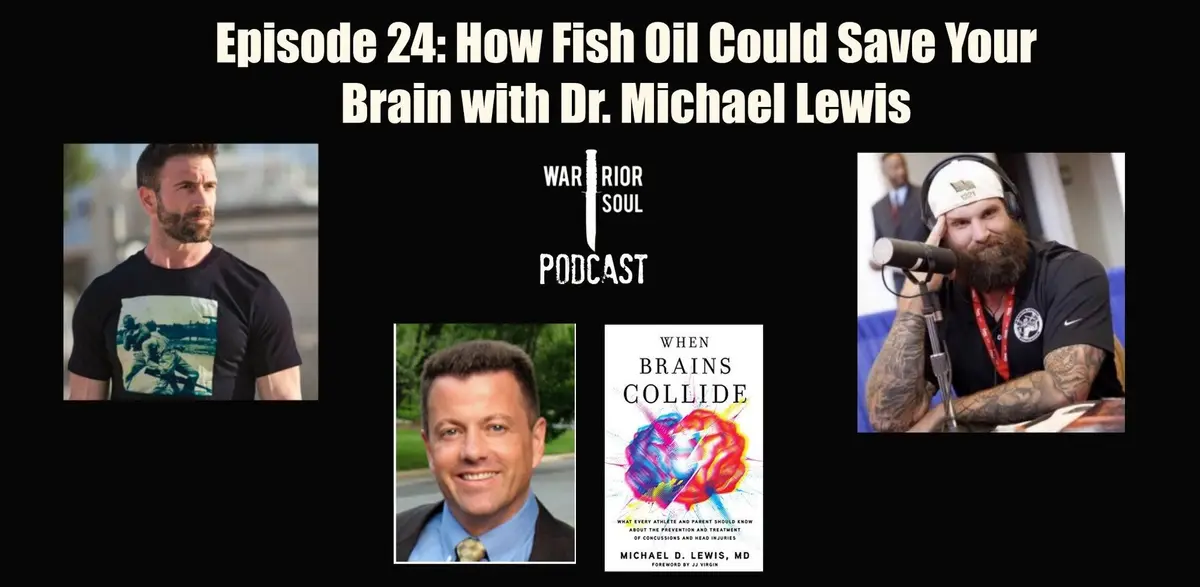
Episode 24: How Fish Oil Could Save Your Brain with Dr. Michael Lewis
Hosted by Chris Albert
The Warrior Soul Podcast
Itunes: https://itunes.apple.com/us/podcast/chris-alberts-warrior-soul/id1096901382?mt=2
Today, many people are turning to smart drugs like modafinil and adderall to make themselves smarter and to improve their brain performance. This brings up the question, why would people rely on a synthetic performance enhancing drug without first looking to more natural and less harmful food based products first?
Our guest today, Dr. Michael Lewis is at the forefront of researching how Omega 3 Fatty acids can protect, heal, and fortify the brain. Departing from the standard pharmaceutical treatment of brain injuries, Dr. Lewis has developed a protocol using high dose fish oil for patients that he outlines in his book When Brains Collide. Dr. Lewis is also a retired US Army doctor who has spent his time working with hundreds of veterans who’ve returned from the battlefield with brain injuries.

Dr. Lewis is doing amazing work and we fully support his efforts to spread his knowledge. You can purchase his book at https://www.amazon.com/When-Brains-Collide-Prevention-Concussions/dp/1619614928 , and if you write an honest review of the book on Amazon, screen shoot it and send it to us at info@warriorsoulapparel.com, we will send you a 25% discount on anything in the Warrior Soul Apparel store.
You can also find Dr. Lewis’s non profit at http://www.brainhealtheducation.org/about-us/leadership/
Here is Dr. Lewis’s full bio: Michael D. Lewis , MD, MPH, MBA, FACPM, FACN is the president and founder of the Brain Health Education and Research Institute. He is an expert on nutritional and holistic interventions for brain health, particularly the use of omega-3 fatty acids for the prevention, management, and rehabilitation of concussions and traumatic brain injury (TBI). He founded the Brain Health Education and Research Institute in late 2011 upon retiring as a Colonel after a distinguished thirty-one- year career in the US Army. His pioneering work in the military and since has helped thousands of people around the world and is regularly featured in the media, including CNN’s Sanjay Gupta, MD, show and numerous radio shows and podcasts. He is a graduate of the US Military Academy at West Point and Tulane University School of Medicine. Dr. Lewis is board-certified and a fellow of the American Colleges of Preventive Medicine and Nutrition. He completed postgraduate training at Walter Reed Army Medical Center, Johns Hopkins University, and Walter Reed Army Institute of Research. He is currently in private practice in Potomac, Maryland (BrainCARE, www.BrainCARE.center ); is a consultant to the US Army and Navy as well as several organizations, institutes, and nutrition companies around the world; and is a founding member of the Pop Warner Youth Football Medical Advisory Board.

Transcript
Machine-generated from the episode audio and lightly edited — may contain errors.
Chris Albert (link to this point)
Welcome to Episode 24 of the Warrior Soul Podcast. My name is Chris Albert. We often hear the quote from Hippocrates, Let food be thy medicine. But in modern society, we have a reliance on pharmaceuticals. We have a reliance on treatments that cost a whole lot of money.
And in many cases, they've been demonstrated to be less effective than food. One such class of cases, I guess you could say, is that of brain injury. Traumatic brain injury has affected people from all sets of society. We often hear about it in sports. We definitely hear about it in the veteran community.
It's one of the most common injuries that people face coming home from the wars in Afghanistan and Iraq. And when you get a Traumatic Brain Injury, as my co host Andrew Marr and his story demonstrate, it can radically change your life for the worse. And yet, when we look at medical practice in today's society, our treatments for traumatic brain injury have not changed. In fact, it seems as if the medical establishment has done every single thing they could in their power to maintain the status quo, to keep us on the path to not really making any progress. Now my goal here is not to bad mouth the medical industry.
My goal here is not to bad mouth doctors. But it is to point out somebody who has gone against the grain and has done a massive amount of work to show that food can truly be our medicine. Doctor Lewis has been on the forefront of looking at Omega-3s as a potential treatment for traumatic brain injury. Not only as a treatment for after the injury has occurred, but as a way of protecting us from really severe symptoms that traumatic brain injury can can exacerbate in our lives.
I'll go through a little bit of Doctor Lewis's credentials, but what I want you to get out of this podcast is the idea that whether you have a traumatic brain injury or not, the information that Doctor Lewis has put forth can not only help you if you have the injury, it can protect you. It can prevent something very bad from happening to you should such injury occur. It can also help you to preserve your brain, preserve yourself from injury, and help you to live a better life.
Doctor Lewis is the author of a book called When Brains Collide, and I highly recommend that you get this book. Goes through some case studies, that he conducted, on fixing people's brain injuries with Omega-three fish oil. He's an expert on nutritional and holistic interventions for brain health, particularly the use of omega-three fatty acids for the prevention, management, and rehabilitation of concussions and traumatic brain injury. He's also the founder of the Brain Health Education and Research Institute, and he is a veteran of the United States Army, where he had a distinguished thirty one year career, and he's a graduate of the United States Military Academy at West Point, and the Tulane University School of Medicine.
He's been on CNN and a host of other networks, and he was gracious enough to come here on the Warrior Soul podcast today to talk to us and our audience of veterans and civilians and warriors who wanna make their lives better. So without further ado, I give you episode 24 of the Warrior Soul podcast, Doctor Michael Lewis, When Brains Collide.
This is Chris Albert, and I'm here to remind you of one thing. Someday, you're going to die. Now that's not some morbid statement or scary idea. It's solid fact. Your time here on this earth is limited.
And you need to be reminded of this as much as possible with one simple reason, to live your best life while you can. This is the Warrior Soul Podcast.
Andrew Marr (link to this point)
Hey, everybody, and welcome to the Warrior Soul Podcast. Today, we are excited to bring you my personal friend, doctor Michael Lewis. Doctor Lewis is the president and founder of the Brain Health Education and Research Institute. He's an expert on nutritional and holistic interventions for brain health, particularly the use of omega three fatty acids for the prevention, management, and rehabilitation of concussions and traumatic brain injury. He started his research institute in late two thousand eleven after returning as a colonel with a distinguished thirty one year career in the US Army.
His pioneering work in the military and since has helped thousands of people around the world, and he's regularly featured in the media, including CNN's Sanjay Gupta, MD's show, and numerous radio shows and podcasts. Doctor Lewis is a graduate of the US Military Academy at West Point and Tulane University School of Medicine. He completed his postgraduate training at Walter Reed Army Medical Center, Johns Hopkins University, and Walter Reed Army Institute of Research. He is a consultant to the US Army and Navy, as well as several organizations, institutes, and nutrition companies around the world.
And doctor Lewis is also a founding member of the Pop Warner Youth Football Medical Advisory Board. His latest book is titled When Brains Collide. And I give that small introduction to let our audience know that in a nutshell, doctor Lewis knows his shit. Doctor Lewis, to the show, sir.
Michael Lewis (link to this point)
Thank you, Andrew. It's a it's a great pleasure to be with you and and be able to hopefully get word out to as many of our fellow veterans as possible.
Andrew Marr (link to this point)
Absolutely. That's why I'm so excited because something is so simple yet revolutionary as omega threes is so important, and we're gonna dive deep into it, and we have the absolute man to do it today. And so, Chris, what are you thinking, man?
Chris Albert (link to this point)
Well, just for the audience at home, and and, you know, I read your book, When Brains Collide, and it's really, really insightful. Can you explain a little bit about what omega-3s are and why they're so important and how you came across them as a potential solution for some of the issues people with brain injuries are facing?
Michael Lewis (link to this point)
These people write whole books about that. Well, in short, omega threes are most people think of omega threes from fish oil. So omega-3s are a that's what we typically find in fish, the longer chain omega-3s. But why they're important is it's basically what the brain's made of. 30 your So brain's made of fat and water, and 30% of that fat are omega-3s and DHA or your docosahexaenoic acid, DHA for short.
Is 30% of our brain. So it's throughout our brain, it's incredibly important. Takes DHA to make a brain in the first place. And so to jump back a few years, when I was in at the Walter Reed National Medical Center and teaching at the medical school there, I started hearing about the Sago mine accident, a coal mine accident in West Virginia, January 2006, and how this guy, the one guy that survived, how he was basically pretty much brain dead. And the neuro surgeon, a guy named Julian Bailes, who people might recognize from the movie Concussion, played by Alec Baldwin.
Julian Bailes and Barry Sears, the Zone Diet guy, kind of got together and said, hey, why don't we flood this guy with high doses of omega-3s, fish oil, and see if it would help. We got nothing to lose. Short of the story is he walked out of the hospital a couple months later.
Andrew Marr (link to this point)
Absolutely.
Michael Lewis (link to this point)
About a couple of years, so I started to ask questions and I eventually got connected with Julian Bailes and subsequently have become good friends with him, serve on the Pop Warner board together and I started getting asked. So basically after I got to know that, I went to the head of research at the Defense Veteran Brain Injury Center and asked the simple question, is anybody looking at omega-3s from fish oil to help soldiers recover from traumatic brain injury? And the answer was, no, why don't you? And that literally changed my career, changed my life. I put up all the arguments why I couldn't and shouldn't do it.
But I kept coming back to, you're the only one asking the question. And so they kind of carried on from there. And then I got a bit of notoriety a couple of years, two, three years later, when I got a call and basically was asked, there was a kid that an 18 year old kid in a really bad car accident locally in the DC area. And he was in a coma, did not expect to survive. What I talked to the father about the idea of maybe using omega-3s to help with traumatic brain injury.
It had never been done before and I did. The kid convinced the doctors to do high dose omega-3s because there was nothing else they could do. The kid went to his high school graduation three months later. So it got picked up by Sanjay Gupta, did a big segment on it on a show and you know, and I eventually got frustrated enough with the military and all the roadblocks that kept getting in the way of trying to do research. So I eventually retired, had enough time to retire and started the nonprofit to try to continue to educate people and hopefully influence or even fund research if I had enough funding but at least be able to influence the research and give me a platform to get this word out.
Andrew Marr (link to this point)
Doctor Lewis, what is the resistance that you're finding both in the medical community and in the army specifically because we're talking about a natural substance here that the brain's naturally made of so that always well, I say it never ceases to amaze me to hear that, but I'm interested to hear what your resistance has been.
Michael Lewis (link to this point)
Well, there's there's two areas where there's been resistance. And, you know, well, like you said, with with the medical field in general and then the military also. So one of the first things I had to do was when I started asking the questions like I said I really didn't know anything I didn't even know I didn't even remember what an Omega-three was. I had to basically go back and teach myself and learn and I'm not a neurologist, so I had to learn and kind of relearn things about the brain. Basically had forgotten long since forgotten from medical school and the idea was basically I had to teach myself so I had to go out and find the experts who knew anything about it and there weren't many.
Julian Bailes was one, Barry Sears another, but there's very few people and actually still today very few people that are looking at omega-3s and traumatic brain injury or concussions and so one of those got a network and find out who knows what and learn led me to a psychiatrist at the NIH and as we were getting to know each other he said to me one time well if we could just draw blood on people before they commit suicide, we could answer a bunch of questions. And I'm like, well, that's easy. Why didn't you say so? Of course, he looked at me like I was nuts. You know, every time we get blood drawn in the military for HIV testing, pre deployment, post deployment, all that stuff, they don't throw that blood out.
They actually send it to a huge freezer in Silver Spring, Maryland. There's 50 plus million specimens. I probably have two dozen specimens. You guys probably have a couple dozen specimens in there as well. So we're drawing blood all the time.
And so basically went to that group and asked for, we asked for a 100 documented blood from a 100 documented suicides over an eight year period starting in 2002, because we wanted to be after we had started to go into Iraq and Afghanistan. And what we found was and then we did 800 well matched controls. And what we found was low levels of omega threes and DHA in particular were very associated with suicide. In fact, was we measured it to be a sixty two percent increased risk of suicide just with low omega-three levels in the blood, something that could be changed for pennies a day And that got picked up by the press, and I ended up being called into the Pentagon and sitting in four star's desk briefing him on this and thought we were moving somewhere and and it just all of a sudden radio silence afterwards. And when he retired, I called him up on his personal cell phone because he had given me his number and said, what happened?
And he said exactly what you told me not to let happen. The medical corps got in the way they can throw in science in the the way as roadblocks of why we shouldn't do something, and they would rather do nothing than to try something that wasn't complete. There's not the studies out there that show that it's proven. And there's not studies because it's not a pharmaceutical. Who's going to pay for it? It's got the generic problem. If you spend $1,215.18, you know, $25,000,000 doing a clinical study as a company, you could go to CVS or Walgreens or Safeway and buy fish oil. So there's no financial incentive to do the studies. So the other resistance on the medical side that that kind of combined gets over to the medical side. The other resistance is again it's always there's no proof that it'll work and might do in and the other one that drives me crazy is it might do harm.
You got
Chris Albert (link to this point)
Yeah. That's insane to me, given the commonality of traumatic brain injury in the wars we've been in over the last decade, that the the military has not been willing to to take a risk and do some research there and to really try to look into this. I mean, is there I I know I'm getting into a little bit of the dark part of how we produce treatments and medications, but can't we enlist the fishermen of America or something like that where they can actually lobby for this kind of thing or anything like that?
Michael Lewis (link to this point)
You have to be able to overcome the medical establishment and nowhere is that more traditional than in the DoD and the VA. And so things like hyperbaric oxygen, you've probably seen and heard all that controversy. Fish oil omega-3s are not a whole lot different. There's no proof that it works, but yet nobody's really willing to fund the studies to be able to do it. You can't really do it in the military because there's just not enough, believe it or not there's not enough trauma in the military to be able to do that.
So, you would have to go out. So there's great studies that are starting to come out, know, with, TCU down in Texas. They did a great study with their football team and they put their entire football team on different doses including placebo of DHA and what they found was the number of concussions in the 2014 season were cut in half but two smaller numbers but they were actually able to measure all of blood markers that showed that somebody that wasn't getting the DHA, these blood markers went up over the course of the season. But any one of the groups that was on DHA, those blood markers did not go up at all. So it a proxy for exposure to head injuries or banging your head, not necessarily concussions and they found it was a huge tremendous impact on improving that. So there are studies out there being done. It's just it's slow.
Chris Albert (link to this point)
And what is the current standard of care? What are they doing right now? I mean, I think I heard you say on another podcast that you thought we were, as far as technology goes, doing the same thing we did five hundred years ago, and somebody else said, no, it's 1,000 or something like that?
Michael Lewis (link to this point)
Well if you look at what the CDC recommends and they in many ways have the sort of the go to place for advice and if you look at the three recommendations the CDC says rest, take it slow and talk to your health care provider who probably doesn't know anything anyway. And so you know and I've got a small private practice and I've tried to deal with insurance and I've just given up. I won't even deal with insurance anymore because they say, oh you're not practicing standard of care medicine for this. I'm like, great, tell me what the standard of care is. There is not. So how can you practice standard of care medicine when there is no standard of care?
It's incredibly frustrating. But, you know, it doesn't make it any less important. We've got so many of our fellow veterans out there that are suffering and there's ways to deal with it.
Andrew Marr (link to this point)
Yeah. I wanna highlight what a couple of seconds back we were talking about doctor Lewis's workings with the four star general. In the book, they go real in-depth in that story. It's really, it's a really good story. So I highly recommend, you guys out there picking up the book.
You're really gonna it's an entertaining story, with with the general that won't be named. But I wanna jump into nutrition and I wanna read a quote from doctor Lewis' book on nutrition that I think really gets to the heart of the issue. Here it goes. And I quote, the biggest reason why they have these misconceptions is basically because when we entered the era of antibiotics and vaccines after World War II, medical schools ceased teaching nutrition because pharmaceuticals seemed to have many more answers. How do I put this?
We're no longer a healthcare system. We're a disease care system. Nutrition is vital for health, but not considered important to treat disease. A large part of this mentality is because we're victims of our own successes. Though they produce important tools, the pharmaceutical, vaccine, and antibiotic industries have grown so powerful that the need to teach nutrition in middle school schools has fallen by the wayside, end quote.
You know? And with that, doctor Lewis, can you touch on the difference between omega threes and omega sixes and, you know, kind of the the all the difficulties and epidemics that Western civilization is suffering as a result of omega high omega six diet?
Michael Lewis (link to this point)
A lot of it springs from that what you just talked about.
Andrew Marr (link to this point)
The we're a victim unintended.
Michael Lewis (link to this point)
I you know, I'm not a conspiracy person at all, And so I would absolutely quantify it as unintended consequences of our actions. And while we can put a man on the moon and we can eliminate polio other infectious diseases with vaccines, we're still left with a lot of this chronic disease. And so the question that should be asked is not how do you treat these chronic diseases, but really take three steps back from there. How do you prevent them? How do you interrupt that process earlier on so that you're dealing with prevention, that you're dealing with the causes rather than waiting until it's a disease.
And that's unfortunately, that's what our healthcare system pays. The physicians, the hospitals, the insurance companies, they get paid for treating the disease process after it's already occurring. Nobody gets paid for preventing it. And so you've got to go back to what are the risk factors and why are these things happening? And this is not the only one, but it's one.
We could talk about sugars and carbohydrates and things like that. But let's focus on you brought up the idea of omega 6s and omega 3s. And so they're both fats. They're both polyunsaturated fats. And what have we been told, you know, over the last ten to twenty years is that polyunsaturated fats are all good.
Well, that's not true. Omega-six's are polyunsaturated fats. They come from vegetable oils. It's in our animal feed. It's everything.
Omega-6s are incredibly shelf stable. Omega-3s, on the other hand, are very unstable and can spoil very quickly. So which one are you gonna use to process food so it sits on a store shelf for three years is gonna be omega sixes. So it's in everything, and it's really changed a lot in the last thirty, forty years. The amount of soybean oil in particular, that's escalated skyrocketed, since around 1970.
Why is that important? Omega sixes are very pro inflammatory and omega threes are meant to balance those. They're relatively anti inflammatory and it's meant to be a balance between those sixes and threes and that's how mankind developed, over tens of thousands of years was imbalance, were meant to be imbalance. And when I did that suicide study with the NIH, we came up with a ratio, the omega six to omega three ratio in our military population, we came up, it was 25 to one in favor of the pro inflammatory thrombotic omega sixes and if you ask the question backwards a couple of times, why, why, why? It's, you know, why are we having these chronic diseases?
When we were kids, nobody had allergies and asthma and obesity was not, you know, there was a, you know, a little bit, but not like it is today. And there's a very good correlation that it has to do with our omega six intakes. And subsequently our balance of omega sixes and threes. You are what you eat and we're not eating well and the food supply is not treating us well either.
Andrew Marr (link to this point)
So 25 to one doctor Lewis, what would be an acceptable ratio or range of omega threes to omega sixes?
Michael Lewis (link to this point)
It really should be under five to one. Five to one or better.
Andrew Marr (link to this point)
Yeah.
Michael Lewis (link to this point)
And that's that's where it should be. And so well, let's cut out omega sixes. Well, great. That's really important, and everybody should try to do that as much as possible, eliminating the vegetable oils and eating a bit more vegetables and fruits and vegetables and less junk food, all this and all that. That's all great.
But remember it's fat and so the half life of fat in our bodies is measured in months or even years. So you could cut out the omega-six's as much as you want if you can, given the food supply. Again, that unintended consequences, but it's going to take years for your omega-six levels to come down. I look at it, okay, but the balance, how do we deal with the other side of the coin? How do we increase our omega-3s quickly? And if, you know, as you know, you come to see me in a clinic and, you know, you're a veteran, you're suffering with headaches and concentration issues and brain fog and you know on and on and on we can list all the concussion symptoms that a lot of our fellow veterans have. I'm not gonna wait two years for you to decrease your omega-6s if that might even help and it's something that needs to be done. I'm gonna flood you with omega-3s to get that balance back as quickly as possible And typically at the doses I use, people very often have positive beneficial responses within two to three days, even sometimes the next day. So we can really dramatically improve somebody's mental well-being very quickly, but it takes high doses.
Chris Albert (link to this point)
Yeah, and what we're talking about here really is it has a lot to do with the brain because as I read in your book, much of the brain is made up of Omega-3s, but also the entire body in performance because you raised your inflammatory levels, can also make yourself prone to injuries, the symptoms of autoimmune diseases, and things like that. But my question for you is, for that typical infantryman out there, that typical soldier marine who, you know, right now when they're out in the field, they're living off of MREs, when they're deployed they're living off of MREs, which I'm pretty certain are full of omega six and and a whole bunch of other things. What what kinds of things could they do to to protect themselves? Are there certain shelf stable omega threes they could take with them? Things that they could carry with them, or certain
Andrew Marr (link to this point)
Most products that they could
Michael Lewis (link to this point)
fish oil capsules will actually, in spite of popular belief, as long as you're not exposing those capsules to direct sunlight, they'll take a certain amount of heat and and still be okay. So you know in the book I tell a couple of stories of soldiers who had rejected the the military feed. In one case, basically was making his own MREs to take out on patrol in Iraq. And the other case was a EOD guy in Afghanistan whose mother was sending him bottles and bottles of fish oil and he was taken along on a daily basis. And so you can protect your brain, you can, before an injury, you can really improve that ratio and it's protective.
Julian Bailes and I published a study in the journal Military Medicine basically saying that every soldier and athlete should be taking essentially like five grams of fish oil a day in order to protect the brain and decrease increase the resilience, decrease the susceptibility to a brain injury. And if one occurs, then you have a better ratio of omega threes already on board to help deal with the aftermath.
Andrew Marr (link to this point)
You know, and you spoke a lot about it in the book, referring to what we call you call the neuro permissive environment. And so what I'm understanding is one, there's a preventative phase that you can do, and also keeping that brain in a neuro permissive environment if you are susceptible to a head injury or when it if and and it does happen, you can now, implement the omega protocol and, return to that neuro permissive environment at a quicker pace. Is that correct, doctor Lewis?
Michael Lewis (link to this point)
I abs absolutely correct. And interesting that you mentioned, what other benefits might an infantryman see, for example? Well, there's two places that the body concentrates actually three, but we'll leave the third one or something else.
Andrew Marr (link to this point)
I get the idea.
Michael Lewis (link to this point)
Thinking with both heads here, right? Anyway, the two most concentrated areas of DHA, omega-3s, are the brain, and even more so is the eye, the retina. And so what kind of benefits might an infantryman or a rifleman see is better night vision, calmer under pressure. So let's take that into our world. You've got a sniper set up at night, wouldn't you want to have better night vision and calm under pressure to be able to distinguish, when am I going to pull the trigger and when am I not going to pull the trigger? And so that's in addition to the mental health aspects of it.
Imagine if we had better night vision and calmer under pressure when you're out on a patrol or on the line.
Andrew Marr (link to this point)
Absolutely. You know, and Doctor Lewis, spend millions of dollars training, you know, operators. So a lot of time and energy is invested there and it it never ceases to amaze me how we're unwilling to invest more that the return is absolutely huge return on just small small amounts of preventative care. You know?
I mean, look how much we put into our preventative care of our weapons, of our vehicles, of our aircraft. The body is the same thing. Human capital is supposed to be the most important thing. I think oftentimes we're overlooking it.
Michael Lewis (link to this point)
Well, it it's it's funny. I I was before you had said that, I was kinda gonna go down that same line is you think about the culture in the Navy and it's in the Air Force and it's very equipment focused, know, ships, planes and so on. Whereas the Marines and the Army the most important tool in the entire Marine Corps or the Army is that human person. Mean you got to have boots on the ground, otherwise you're just kind of fooling yourself and or the country or whatever. So yeah, the human capital.
What it took me back to was a little bit of peek behind the curtain in your world Andrew was when I was at teaching at the medical school I was involved I was on the DOD dietary supplement committee and we were asked to come down to Fort Bragg behind the fence to work with the Delta guys and what they were having a problem with, they basically, we have an unlimited budget, any equipment, any weapon system, any body armor, anything, unlimited budget. We either buy it off the shelf or get it made, and whatever, but it absolutely was a dead solid line at the point of like, but nobody, they will not give us any budget, will not allow us to do anything that we take internally, and we neglect the most important thing, which is the inside, not just the body armor on the outside. And so what we were asked was to provide and what and their biggest thing is on their three months rotations in theater, what they were finding is the guys that were supplementing, particularly with protein, were maintaining their edge during the three months, but the people that weren't were losing weight and losing their combat edge over that time.
Because you think about when are they operating? They're operating at night. When are the mess halls open? During the day. So there's a mismatch of food and this, that and the other.
And so basically, we gave them the scientific cover to use unit funds instead of their own personal combat funds or their own personal pay to buy protein to maintain their weight and maintain their edge. And that's in our tip of our spear. That's our most elite warriors that we're not taking care of the inside.
Andrew Marr (link to this point)
Right.
Michael Lewis (link to this point)
The inner armor as it were.
Chris Albert (link to this point)
That's crazy. Doctor Lewis, what would you say to to people who claim that I'm gonna call I'll just say vegans. What would you say to vegans who claim that in human evolution we were never meant to eat animal sources of fat or protein or anything like that, and who rely on evolutionary arguments to say that we wouldn't have had these kinds of sources of fat back in the day or things like that.
Michael Lewis (link to this point)
That you just brought up, the reason why I'm chuckling is that you brought up the concept of evolution. I've gotten over the last couple of years, one of those leading experts in the world that I've gotten to know is a guy named Michael Crawford, a professor out of The UK, and when Professor Crawford was a young physician working in Africa, he came to the conclusion that the evolutionary theory has got to be wrong. There's no way mankind could have come out of the plains of Africa. And then he set out and then proved it and essentially has completely changed the evolutionary theory. And in fact, I've heard stories where he was given a lecture and the guy and I gotta look it up and who the guy is, but basically the guy that was the creationist or evolutionary theory guru was in the audience and he stood up after Michael Crawford talked and I'll tell you what he said in a second, but he said, you know what, you're absolutely right, my theory is wrong, your theory of evolution is actually correct.
And what he said was we could not have come from the plains of Africa without access to long chain omega-3s like you get from fish and so he then went out and proved that mankind developed not on the plains of Central Africa, but on the East Coast Of Africa where they had access to saltwater fish.
Andrew Marr (link to this point)
Wow.
Michael Lewis (link to this point)
I'll get one one big extreme. You know, you take a rhino, the size of a rhino. A rhino eats a ton, 2,000 pounds of grass a day. Very high in omega-3s, but they're short chained omega-3s. A rhino's brain is the size of a walnut. So Yeah. You don't get so the problem is in mammals, humans being, you know, obviously a mammal, that conversion of those leafy green vegetables and short chain omega threes has been measured as low as 1%. Even actually, I know one person that did a radio labeled tracer consume it and only 0.04% of that short chain omega-3s ended up in the brain. Less than 1%. So vegans tend to have the lowest and worst omega-three levels, of anybody measure.
You talk to anybody that runs these labs and they have the worst levels whatsoever, and my best responses have with people have been to give vegan women, middle aged vegan women, you give them omega-3s, they're like, wow, I didn't know I was supposed to think this clear and be this calm. It's amazing. It's like I'm turning on a light bulb. So one of the questions is going to be, what's the source of so what do you do?
Andrew Marr (link to this point)
Yeah.
Michael Lewis (link to this point)
Interestingly enough, somebody back in the NASA space program in the '80s asked the question, well, where do fish get their omega-3s? Well, they get it from eating algae. And they process it because they're not mammal. They can process it into the longer chain omega-3s. So this NASA space program set out to figure out what algaes around the world have the most omega-3s And then they canceled the program, but luckily the scientists went on, started a company with VC money, and they figured out how to grow these algae in million gallon stainless steel tanks and extract the oil directly from it.
So it never touches fish, so it's halal, vegan, kosher, etcetera. And that company Martek got bought out by a Dutch conglomerate DSM a few years ago but you can still find it at martek.com M A R T E K and where they really made their money is 99 to 100% of all infant formula in The United States has Martek DHA in it.
Andrew Marr (link to this point)
Wonderful, wonderful.
Michael Lewis (link to this point)
That important for the development of a brain even after you're born. So vegetarian or vegan DHA is certainly available. Horizon milk for example with DHA and there's yogurts and stuff like that. There's all kinds of foods out there that are starting to use this vegan DHA. So it is available out there.
Andrew Marr (link to this point)
Doctor Lewis, what's your recommendation as far as preventative maintenance with omega threes for children? Are is that is that safe to do? And and I'd like to talk about that because I know our audience just it's a sensitive issue.
Michael Lewis (link to this point)
There's a lot of great study a lot of great products out there, in particular for kids. There's sort of like the ketchup packet size gels or goos, sort of were really popular a few years ago for athletes on the glucose and sugar side, know, to maintain while you're out running a marathon or whatever. So there's things like that. There's good flavored liquids. Not all fish oil tastes horrible.
If it tastes bad, it's not a good fish oil. Good fish oil should taste good. Might have a slight aftertaste or whatever, but you know good fish oil should taste good. So it's really, really, really important for kids in particular. And I mean has anybody heard of ADHD or ADD out there?
Chris Albert (link to this point)
Yeah.
Michael Lewis (link to this point)
Okay, it's probably ADD is probably now I won't say you know, one to one correlation, but closely related to omega-three levels. And there's actually really good studies that show supplementing ADHD and ADD kids with higher levels of omega-3s actually is more effective than a lot of the medications, the pharmaceuticals. Same thing with depression, the kids or adults. Omega-3s are actually more effective than our SSRI antidepressants if used in the proper levels. The problem is a lot of these studies will, know, hey, here take a capsule a day or whatever, it's not enough.
So I got a, you know, I had two teenagers. I got a 16 year old starting running back on the high school football team. He doesn't leave the breakfast table without taking five capsules of a good quality fish oil every single day. And my daughter who's a high level dancer to keep the inflammatory does the same thing. That's five capsules of good fish oil every single day.
And I would say down to, depending on how big the kid is to 10 or 12 years old. If they're approaching eighty, ninety, one hundred pounds, put them on the adult dose. There's no harm in it. It's not going to hurt them. And so when you get younger, you've got to come a little bit more creative, whether it's liquids or the gels or even gummies. I have one saying that when it comes to fish oil or omega threes, some is better than none.
Andrew Marr (link to this point)
Mhmm.
Michael Lewis (link to this point)
But more is better than some. So whatever you can get at them.
Andrew Marr (link to this point)
Clearly, doctor Lewis, the benefit is there. The you know, there there is essentially no downside and all upside. So I just want that to be clear to our audience out there. This is beneficial to your life, to your children's lives, and it's relatively easy to enact.
Michael Lewis (link to this point)
Abs absolutely. And, you know, I said, I've got a 16 year old who's playing football. Know? Why why is a concussion doctor letting his kid play football? Well, because I take the because life is a team sport.
Andrew Marr (link to this point)
Absolutely.
Michael Lewis (link to this point)
Why not learn it on the field? I mean, half the military played football in high school anyway. So maybe that explains a lot. No, just You mitigate the risks and part of that is that inner armor. So how do you improve the resilience of the brain to withstand injury in the first place? And the best way is on the Omega-three side of things. I also do other things like a Kevlar insert for his helmet helps diffuse the impact, any impact and a good mouth guard that you know locks the jaw in place, you breathe through the middle, it's a dual arch mouth guard. So, you do those types of things because you want to protect your kids, but you also don't want them sitting on the couch all day playing Xbox.
You want them out on the fields playing sports. You know, I get really irritated about this concept of we need to stop football. That's great because then soccer will be next and ice hockey will be after that. And what at what point do we, you know, throw in the towel and just have our kids sit in the bubble?
Andrew Marr (link to this point)
Well, mean, I I think now to thanks to to your work, and and other pioneers in the field. You know, there's such an emphasis on concussion today, but almost as a scare tactic with no answers or results if you don't go to the right information. But what your book is all about is saying, hey. There is a neuro permissive environment. We can prevent it.
And when an acute injury happens, we can treat it to return you back to the neuro permissive environment. Don't take kids out of sports. Don't take them off the fields. That was that's what like you said, that teaches leadership. That teaches teamwork.
That teaches resilience. All all incredible traits that are amplified in the military, but these are things we wanna continue to instill in our children and not just put a bubble around them. We want to say, hey, go play. And I love it, doctor Lewis, because you say, hey, here's a recipe that you can go and still live life to your fullest potential.
Michael Lewis (link to this point)
Right. And let me let me be clear. We're talking about nutrition. We're not talking about pharmaceutical. We're not talking about a drug.
We're not talking about a cure. We're not talking about a preventative. We're talking about nutrition. So will it work for everybody in every case? Absolutely not.
But there's so no downside to doing it. And so if you have two people that look like they have the exact same injury and concussions and head injuries are like snowflakes. There are no two that are alike. So you'd have two people that collide on the soccer field and they both go down, they look like, you know, had the same impact obviously, and one might recover very quickly and one might not, respond very quickly to omega threes and one might not, but, but my experience has been overwhelmingly like eighty, ninety, ninety plus percent of people, if they do it at the levels that I'm talking about, they respond and typically respond very quickly, like within one or two or three days. Not fixed, not cured.
And again it's nutrition. So I'll tell a quick story of a football player that's now 61 years or 62 years old, three Super Bowl rings, thirteen years in the NFL, all pro, nine years, all American in college and so on, lineman. And, twenty five or so years after he stopped playing his last dawn, you know, having those problems and this should probably sound familiar. Decreased energy levels, the brain fog, the cognition not working so as well as you want and thinking and like you're stuck in molasses. All those things that come from head injuries.
And so twenty five years or more, it might have been even twenty eight years or so after his last down in football, he started on the Omega Protocol. And three days later, I got an email, be like, wow, I didn't know I was supposed to have, I forgot that I'm supposed to have this kind of energy and thinking this clearly. But interestingly enough, when I followed up with him a few months down the line, what he found was if he was traveling, because he's very active, does, he's still on one of the major sports networks and as a commentator, and when he's traveling and if he forgets to take fish oil, throw it in a bag, and thinks he can go a couple days without it, he finds that that brain fog starts to creep back in and his energy levels start to fall off. And so he is, as he says, goes out and buys another bottle of fish oil for whatever city he's in. So it is nutrition.
It's not a quick cure. It's it's nutrition for life.
Chris Albert (link to this point)
And when you're out looking for a fish oil, what what are some things you should look for on the label? Because I'm willing to bet most fish oils aren't, there's probably some really bad ones out there, right?
Michael Lewis (link to this point)
It's an unregulated industry. So that's a really, really tough one. I mean, I've got my four or five companies that I know and trust. I actually name them in the book. And I think I even left one out.
But anyway, most importantly, you want you want to concentrate, want the, so you gotta be able to read the labels. Most labels will say the serving size is two capsules. So now you gotta divide everything in half, but the most important thing is you want to look for the amount of EPA and DHA in a serving. And particularly you want to break it down really per capsule. So a thousand milligram capsule, which would be listed as like a gram or a thousand milligrams of fat, have, if you add the EPA and the DHA up, it should have roughly around six hundred or more milligrams of EPA and DHA.
Even better is if you can get it in a triglyceride form. So a lot of times out the bottom of the labeling, it'll say, what's the source? Or it'll say as ethyl esters. Well, ethyl esters are nasty, taste horrible, they're caustic, but that's kind of the standard for the industry is, and it's horrible even even the pharmaceutical Lovaza from GSK is an ethyl ester it's horrible. So one of the things I do with my patients is I'll give them if I have some samples I'll give them fish oil capsule and I'll say here chew it and you get this look like I'm not chewing this fish oil capsule you know fish oil is nasty.
So I take one and I pop it in my mouth and I chew it and like no and they do it and like oh wow that's not bad at all. That's a good fish oil. So you know if you were to there's other ways to look at it. Mean you take Lovaza for example or an ethyl ester and you pop open a pill and you put it in a styrofoam cup it'll eat through a styrofoam cup.
Andrew Marr (link to this point)
Wow.
Michael Lewis (link to this point)
So yeah that's probably not a good thing. So there are definitely some better brands out there But you have to look at it. You want to find one that's in a triglyceride form. And they should actually say that on the label because that's you squeeze a fish, that's what you get. You get triglycerides mostly.
Chris Albert (link to this point)
Yeah. I've taken, one of the brands you mentioned in your book, Nordic Naturals. The, it was a liquid liquid type form, with a lemon flavoring and it was actually really tasty. If I got it on my beard, it would stink like lemon for the rest of the day, but but it was pretty tasty. As we could see from the sign behind you, you do epic shit regularly.
So I wanted because, you know I wanted to ask you what is your own diet and routine like given what you know? How do you stay active? What do you eat on a daily basis? How do you keep yourself fit and healthy?
Michael Lewis (link to this point)
Let me preface that and my answer with I've had my share of concussions. No, I've never gone to see a doctor for them. Mean you know, high school football, you know, he just sucked it up and drove on. I played rugby at West Point. I got knocked silly more times than I can imagine.
You didn't, you know, if you even went down, they'd kind of, we go on a joke and bring out the magic sponge, and that seemed to cure everything. You know, jumping into the desert phase at Ranger School. I woke up when I hit the ground because the I must've hit the side of the plane or the air force had taken off little, I was I think the last in the stick. So when I hit the jet stream, it just literally knocked me out. I didn't suck it up and say, Oh, oh, ranger instructor, I can't go on.
You sucked it up and went on. So, additionally, my father died of Alzheimer's, as did his mother. So, it's a big concern for me personally. Brain health. And so what do I do?
In general, I eat more of a paleo type of diet. I try to decrease or eliminate sugars as much as possible, carbohydrates. That's not always easy when you have a teenage son who pulls out the ice cream and starts putting chocolate and caramel all over. It's like, Okay, I got to have some. But you decrease them as much as possible and cut that out.
In Outback Steakhouse terms, I've gone from a meat and potatoes kind of guy to a meat and vegetables guy. So if I'm at a steak house, instead of the baked potato I get the broccoli or the vegetables. So that's really important to me. I learned that a number of years ago and found that that to be really helpful. When I was doing my retirement physical, my boss, one of the best clinicians I've ever known, and he looks at my blood work and he says, do you even look at carbohydrates?
The levels were so low. Hemoglobin A1C in particular is the best measure of that. And he goes, I, and yeah, I actually, the last time I got my A1C checked at Bethesda, it was actually below measurable, limits. So I cut out carbohydrates and I take it seriously. And then I do supplementation, a good multivitamin, of course, fish oil.
And then as Andrew can tell you, I've gotten to know Doctor Mark Gordon fairly well over this past year and I've learned so much from him and the importance of balancing your hormones. So I adjust some things along for myself along the lines of what Doctor Gordon would say. That certainly helps keep your testosterone levels up and balance all the other nutritional factors that go into hormones.
So I think it's really, really important that we can measure these things that you get looked at and dealt with by somebody who's competent and that's a great bug for Andrew to deal with the Warrior Angel Foundation. Their focus is on hormones as a balance to help also with that neuro permissive environment.
Andrew Marr (link to this point)
Yeah, absolutely. But omega-3s are playing a huge role in that as well in returning that brain to the neuro permissive environment. And so it's just, it's all dead on. And, you know, all this, it's no wonder that doctor Lewis is functioning at such a high cognitive level. And, you know, that that can be attained by anybody who's willing to put in the work.
And it's gonna take some time at first to make some changes. But, I mean, we're talking about investing in your health, in yourself, and your well-being, not only yourself, but your family. And to me, it was, no pun intended, it was a no brainer. And, you know, these these things are not hard to do, and the benefits, my gosh, are just through the roof.
Michael Lewis (link to this point)
Absolutely.
Chris Albert (link to this point)
Awesome. Well, doctor Lewis, I really wanna thank you for coming on today. This has been extremely informative, and just it sounds like it would be a concept that everybody could dig, you know, if you want to be healthy and protect your brain, rely on food and rely on nutrition and nutrients rather than directly, you know, relying on pharmaceuticals or waiting until pharmaceuticals are the only possibility. But, you know, thank you for your book, thank you for your service, and thank you for bringing this information to the world, because a lot of people need this. They need to hear it.
They need to, understand how to protect themselves, and they need to learn how to steel themselves.
Michael Lewis (link to this point)
I I completely agree. And Broadcast like this is a way to reach our intended audience. It's not just the soldiers, sailors, airmen, marines, but also 44,000,000 kids play organized sports every year. Roughly as best as we know, to five million people have a concussion every single year. So it's hugely important throughout our entire society.
So I'll just make sort of three plugs here at the end, if you don't mind. One is my nonprofit is brainhealtheducation.org brainhealtheducation.org lots of information go in sign up for my newsletter I send out a newsletter almost every week either sunday night or monday morning usually and I look at what's gone on in the last week I pulled like four articles out of the news and comment a little bit on it. The other thing is make the shameless plug of when brains collide and you can you can get it on Amazon and Kindle or paperback format whenbrainscollide.com is a quick link you click on the cover of the book it'll take you to the Amazon site really easy and then the third and probably the most important shameless plug is a website called waftbi. Is it org right?
Andrew Marr (link to this point)
Yeah, yeah .org.dotorg.
Michael Lewis (link to this point)
The Warrior Angel Foundation absolutely, I think one of the two most important veteran organizations out there is Warrior Angel Foundation actually, and one more shameless plug. The other one is the one that I've been supporting over the last couple of years is Boulder Crest Retreat. Have you you guys familiar with that?
Andrew Marr (link to this point)
No. We're not. So please tell us more. And we're gonna include all this in our in our show notes for the show. So we'll have access to it, doctor Lewis.
Michael Lewis (link to this point)
The really short story on Boulder Crest retreat, which is just outside of Washington up against the Blue Ridge Mountains, was started by retired Navy SEAL EOD expert, master chief petty officer, Ken Falke. And as a way to help his fellow EOD guys who he was going into, anyway, bottom line is he has created an absolute world class retreat called Boulder Crest. So Boulder Crest retreat, I'm gonna say .org, but Boulder Crest retreat, and they have cabins there, they have stables, they have archery, kayaking, but they have cabins where families can learn to work together after an amputation or dealing with PTSD. And so, they have four three bedroom cabins, designed specifically as a retreat and they run different programs for PTSD and so on. And Ken Falke is just, guy retired at twenty or twenty one years as an E9, a Master Chief Petty Officer.
So you don't get to be an E9 in, you know, eighteen seventeen, eighteen years without having your stuff together. And he was an EOD guy for SEAL Team Six.
Andrew Marr (link to this point)
Okay. So Yeah. Well, definitely, we'll we'll get offline and, try to connect with him and and and I definitely wanna get that information out to everybody. I wanna highlight something and then I have two additional questions for Doctor Lewis, but Doctor Lewis is doing the research while he's still in the army.
He's uncovering these things. His question is, no one's doing the research. The response was, why don't you? And instead of bucking that or paying, like, oh, that's too difficult or I don't have the time or anything else, doctor Lewis dug down inside and he said, no one else is doing this. I don't like it, so I'm gonna find a way to fix it.
And you did it, doctor Lewis. I mean, it's not really accept acceptable yet, but the through your research institute, the evidence and the work you guys have put out, we now have these protocols there that we know will help regenerate and regrow the the neurons in the brain. And and so that's just phenomenal. I know thousands of lives have been touched because doctor Lewis had the tenacity. He had the courage, the the the balls to say, I'm going after it.
And I don't care what the status quo is. I don't care what the the military medical model, the conventional model thinks or says. This is the right thing to do and we're gonna further the research. And so if you're looking for some research institute to get behind, it would be Doctor Lewis's because that's the work they're doing.
So again, like a true leader, Doctor Lewis, leading by example, you know, and and I just I have the utmost respect for you and what it took to do that. So again, just wanna say thank you for that, sir. And the two questions, we call them our best life questions, but how how can the book, When Brains Collide, I love that title by the way, just phenomenal. How how can When Brains Collide help our audience to live their best lives?
Is there anything that we haven't said that that you wanna go over real quick?
Michael Lewis (link to this point)
No. I I I think we really covered most of it. I'll just sort of say that there's three areas that the book covers in general. One is what you know what type of things you know from an omega-three standpoint. How much omega-three should you take if you are suffering the after effects of a head trauma, concussion, IED blast, and so on.
So it's sort of the walking talking you know and we call it the Omega protocol. The second area that's covered is severe traumatic brain injury like unfortunately if your kid's in a coma after a car accident kind of coma you know how you know what to talk to the doctors about how like what's the research that's going on there and what most most importantly my mind is what doses to use if somebody you're having to push literally push fish oil down a feeding tube. And then the third area it gets into the whole resilience and prevention aspect and what and I very specifically say these are the doses that I have the experience using and I find that they work so I don't hold back there's no hiding the secret sauce. It's all in the book. Exactly what to do and what to take.
Andrew Marr (link to this point)
The book is absolutely phenomenal. It's a really easy read. You you don't get just bogged down with a bunch of science that's hard to understand. Doctor Lewis did just an incredible job of breaking it down to a common denominator that's easily understood.
So please go out there and get the book, leave a review. We need reviews. We need to support Doctor Lewis for all the right reasons. But the second question is, Doctor Lewis, what advice from your life would you give to someone who wants to live their best life? And this could be in any aspect of it, but some just good overall advice.
Michael Lewis (link to this point)
Well, you know, besides obviously, you know, we've talked for quite a while on nutritional aspects. But the, I just found out this morning that a good friend of mine has metastatic lung cancer and he's the healthiest guy you'd ever want to meet. So you don't know, I mean, you don't know what life is gonna throw in your way And so it's really to be present, the the most of each day. Your loved ones are, you know, there's no more nobody more important than your loved ones, except for one is yourself so you got to love yourself and take good care of yourself not just physically but mentally, emotionally, spiritually and so the one guiding thing that I think should be most important to everybody's mind is balance. Balance in all those aspects and you'll do fine.
Andrew Marr (link to this point)
That's great advice, Doctor Lewis. Well, from me and Chris, it's just been an absolute honor. So great show. Guys, you can check us out next time.
All this information will be in the show notes. And again, go out there. When brains collide, you need to buy the book just because of the title. It only gets better from there.
Michael Lewis (link to this point)
Yep.
Chris Albert (link to this point)
Buy that book and and one more thing Doctor Lewis, where do you hang out on the internet? Can people find you on Twitter or Facebook or Instagram?
Michael Lewis (link to this point)
I am a little bit more on the Facebook, not least so much on Twitter, although some things bleed over into Twitter. I'm going in so many different directions. I don't have anybody to handle my social media aspect. Facebook is kind of it for me both personally as well as Brain Health Education is the tagline for Facebook, Brain Health Ed for Twitter, and I said every time I post something on Facebook, a friend set it up so it bleeds over into Twitter. But really, you know, there's a lot of information on brainhealtheducation.org website, then sign up for the newsletter.
That's that's if you wanna hear from me every once in a while, sign up for the newsletter.
Andrew Marr (link to this point)
I I can tell you, I didn't know I didn't know about the news newsletter. I'm signing up and we're gonna yeah. We're gonna push it out on our forum to thousands, tens of thousands of people. So we're gonna get that information out, doctor Lewis.
Michael Lewis (link to this point)
That's that's awesome. It's, you know, it's it's all about, you know, why know, you like when brains collide, but how did I come up with brain health education and research? Well, brain health should be obvious. Research is fairly obvious. Research is a top down approach, right?
So we go out and you do the good science, you publish it and you try to change how the medical community practices medicine. And trust me, we need to change it dramatically. And that's a top down approach. The education side is my bottom up grassroots approach through events like this. And so it's really important, my real hope is that we can do both and meet in the middle.
I'd say I'd rather actually get published in Cosmopolitan than I would the New England Journal of Medicine. I think we'd reach a lot more people and moms can change the world. I mean moms are the ones that typically are the purchasers, the grocery, the chef and so on. Know, dads were just sort of along for the ride unfortunately. I mean, some of us do better than others, whatever, but moms can change the world.
And so the book was really written for that soccer mom out there who is worried about their kids or worried about their husband or worried about their brother and so on. So that's really important to me.
Andrew Marr (link to this point)
Great, Doctor Lewis. Well, thank you so much. Chris, any last words?
Chris Albert (link to this point)
No, that's about it. Definitely you guys need to read this book When Brains Collide, and we'll get everything up on the show notes. And Doctor Lewis, thank you again so much for everything you do and for coming on to the show today.
Michael Lewis (link to this point)
It's been a huge pleasure. And Chris, just, through Andrew, just learned about your efforts recently and I'm overwhelmed about how much good you're doing out there. I already knew how much great things Andrew and his brother are doing, but I was really impressed to see all the things that you're doing and the lives and people you're touching.
Chris Albert (link to this point)
I'm humbled by that sir. Thank you so much and, it's my pleasure and it's my pleasure to be able to talk to you and I'm deeply honored, by being able to do this. Awesome. So there you have it that was our interview with brain expert Doctor Michael Lewis, the author of When What Every Athlete and Parent Should Know About the Prevention and Treatment of concussions and head injuries.
Doctor Lewis is doing absolutely amazing work for our fellow veterans, but also for humanity, and we wanna help him out as much as possible. So if you're interested in this subject definitely get out there and grab his book. We're going to have a link for it in the show notes. And we really appreciate you and we appreciate your feedback.
If you can get on iTunes and give us a review let us know how we're doing. I will personally give you a discount code to get anything you want from the Warrior Soul store. We'll get you a 25% discount code for doing that, and we're looking forward to bringing you more awesome knowledge in the coming weeks. We've got some amazing guests lined up for you, so be on the lookout. Thank you all for listening and live your best life.
Host of the Warrior Soul Podcast and founder of Warrior Soul. Worldwide trainer and nutrition coach, contributing author at Testosterone Nation and Muscle and Strength.