Podcast episode
Episode 46: Tales from the Blast Factory, Installment 2: Battling Back from the Brink
Hosted by Chris Albert
The Warrior Soul Podcast
This series chronicles Andrew Marr’s journey from Special Forces Green Beret to brain injured veteran, and on to his current life.
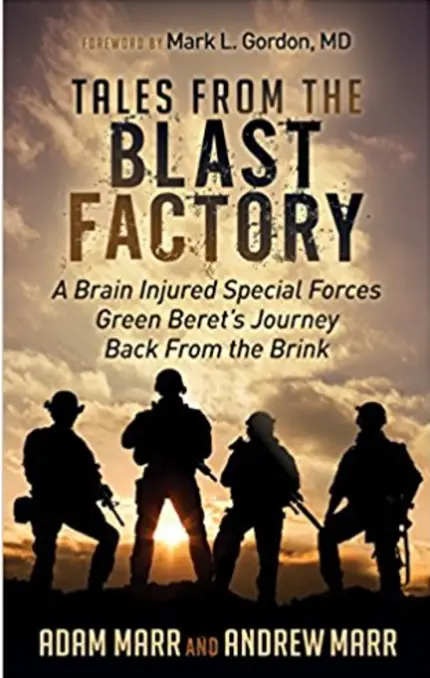
You can Pre-Order Tales from the Blast Factory: A Brain Injured Special Forces Green Beret’s Journey Back from the Brink from Amazon at: https://www.amazon.com/Tales-Blast-Factory-Injured-Special/dp/1683504941/ref=sr_1_1?ie=UTF8&qid=1498365548&sr=8-1&keywords=tales+from+the+blast+factory
Transcript
Machine-generated from the episode audio and lightly edited — may contain errors.
Chris Albert (link to this point)
Hello everybody. This podcast is brought to you by Dinotropin. Dinotropin is a human growth hormone secretagogue and it's the most effective human growth hormone secretagogue on the market. It's been demonstrated clinically to raise growth hormone levels by 50 to 200% and it's available at warriorsoulagoge.com under supplements. That's warriorsoulagoge.com under supplements.
Check out Dinotropin and optimize your human growth hormone today. This podcast is also brought to you by Warrior Soul Keto Camp. If you're interested in getting the fat burning, muscle building and mental performance building power of ketosis, check out Warrior Soul Keto Camp at www.warriorsoulketocamp.com. This is Chris Albert, welcome to episode number 46 of the Warrior Soul Podcast. This is our second installment of the Tales from the Blast Factory series.
This series is titled after the name of my cohost Andrew Marr's book, Tales From The Blast Factory, which is available on preorder from Amazon now. And I'll be including a link to that in the show notes. In the last episode, we got a bit into Andrew's story. Andrew served as a Special Forces Green Beret. And on his team, he served as the Breacher.
He was blowing doors off of buildings every single day. And he came back from multiple tours in Afghanistan without a scratch on his body. But through the process of being exposed to those low level explosions and having that low level shaking going on in his brain every single day that created inflammation. And through brain inflammation, Andrew was no longer able to produce certain hormones that were keeping him mentally balanced and functional. And what we saw and where we left off was a man who was able to perform at an extremely elite level being worn down to a nub.
Today, we're going to get a bit more into that. And we're going to get into a little bit more of the personal side of this story. You'll hear about a man who was not only worn down to a nub, but who was also extremely violent. A man who was full of rage, and he had no idea why. What I want you to think about while you're listening to this is that person out there who hasn't come across the information that Andrew was lucky enough to come across.
Or I guess you could say maybe it wasn't all luck, was also persistence. You know, Andrew didn't want to accept his state. He would not accept being where he was. And I guess the lucky part was that he was able to realize that there was a problem in the first place. And so he went out and did something about it.
But I want you to think about that person out there who who is lost, who doesn't know what's going on. You know, how many thousands of service members have come back and have struggled to find their way and didn't feel right, and they didn't know why? How many of us have come back feeling lucky because we didn't have a scratch on our bodies, but only to face mental anguish and horror? And how many more with scratches on their bodies with with wounds that also face this? And the deep root of what we're gonna get to here is that the medical model that's centered around traumatic brain injury and post traumatic stress, the model of throwing pharmaceuticals at the issue and coupling that with psychotherapy, it's not really solving the root problem of anything.
These are issues that are based in brain inflammation. What Andrew has done above everything else in his process of healing is to try to inform the general public and the United States government about the fact that we were probably wrong about post traumatic stress and the symptoms of traumatic brain injury all along. Through his book, and through this podcast, Andrew is trying to make sure that no other service member ever has to go through the horror that he had to go through. He's trying to ensure that our future war fighters don't have to deal with this. There are many more who are still suffering and there are many of them who are suffering in silence because they don't know what's going on.
So if you know somebody who's been having issues, if you know somebody who served and they have no idea why they feel the way that they feel, or maybe they've gone and sought treatment and the treatment's not helping, put them in touch with this episode. And with that, let's get into Tales from the Blast Factory installment two. This is Chris Albert, and I'm here to remind you of one thing. Someday, you're going to die. Now that's not some morbid statement or scary idea.
It's solid fact. Your time here on this earth is limited. We need to be reminded of this as much as possible for one simple reason, to live your best life while you can. This is the Warrior Soul podcast. Welcome to the Warrior Soul podcast.
This is Chris Albert, and I am here once again with my cohost, Andrew Marr, medically retired Green Beret and traumatic brain injury. I don't want to call you a victim because you're not a victim, but a person who sustained a traumatic brain injury.
Andrew Marr (link to this point)
Yeah, sounds good.
Chris Albert (link to this point)
This is installment two of Tales from the Blast Factory. And these are lessons learned and stories from Andrew's life. And if you were with us last time, you know that we went through Andrew's story. We went through his process of becoming Green Beret, what his op tempo was like, his life while he was on deployment. And we left off just as we were getting into some of the extents of his injuries and the effect on his family.
Andrew, when you think back to those days when your injuries were at their worst, the symptoms of your injuries were at their worst, What types of feelings does that bring up?
Andrew Marr (link to this point)
Well, now I'm able to, you know, I've done a lot of work in internal processing, and so it it's a good question. I think when when you're able to relive past experiences that had a high emotional quotient without reliving or experiencing those emotions, that's when it's become wisdom. So you can look back there, and you can look at it from a different perspective. You can look at it from somebody else's point of view. You can look at it from what's the what's the lesson learned?
Could I have done something different. And it took a long time to get to that place. When we wrote the book, you know, I wasn't I thought I had dealt with everything, but lots of times, man, like, you know, I would get emotional and and you know, and cry after reliving it and and writing it. But I realized that that was a way of going back in there and and working with it, you know, which they recommend for people who've had, you know, different various traumas or whatever is to go back in there and try to relive it as real as you can and look at it through the eyes of what do I want to happen differently. You know?
What are what can I do differently in the future if this happens? And so you're rewriting that script in your own mind and in your brain and your, you know, tapestry of your of your mind, so to speak. It's it's reliving it and and letting it go and and going through that process of of healing. But being able to look at those past difficult experiences without the emotional attachment, I think, is the definition of of wisdom, and that's what I've worked hard to to do. So I I don't really get emotional when I think about it.
When I when I look at pictures or anything else, I try to say, okay. I'm so thankful for the lessons that were taught.
Chris Albert (link to this point)
Yeah. I trying to put myself in your shoes back in those days and and a few things to this story that I think really matter. The fact that you came back from multiple tours in Afghanistan without a visible scratch on your body. And coming back to your family and coming back to this situation where you had two infant children, or one infant child and one on the way, and for all intents and purposes believing that you came back without a scratch and and completely healthy, but then having your body and mind start to fail out on you. Was there a feeling of helplessness there? Was there a feeling of disbelief?
Andrew Marr (link to this point)
Yeah. Both. When you're when you're experiencing, you know, those difficulties that we talked about on the last show, just an utter and complete malfunctioning, like I talked about when I was, you know, at at NICoE doing the the memory test and unable to have any recall or sitting down in the evening and and a preview for a movie comes on, and I asked my daughter if she wants to go and see it. And she's like, dad, we just saw that yesterday. And, you know, no recollection of it.
And then, you know, going in to the point, like I said, to the breaking point where it's not something that you can necessarily hide or sit on anymore and then asking for help. And initially, you know, treated as if I was making things up or was wasting people's time, you know, and just couldn't get any solid answers or understand. You know, I just wanted to understand the the parameters. I'm like, if somebody can just explain to me the the new parameters, I'll figure out how to live with it optimally, but it just wasn't the case. And I can remember when I had the the blood clots, and I'm in I'm in the ER, and and and afterwards, you know, I'm in the hospital for the the next couple of weeks.
And I can remember just waiting. I'm like, somebody's gonna come and explain to me why I had a deep vein thrombosis, which is a fancy word for blood clot, that broke off into my leg and went to both of my lungs called a bilateral bilateral pulmonary embolism. Somebody's gonna come in here, and they're gonna tell me why that happened, what to expect in the future, what to do differently, what can I what can be expected? How how can we keep, you know, these things from happening? And that answer never came.
What came was when I was ready to get discharged, you know, and I I'm on heavily medicated in there because of pain, they bring me the option of they say you're gonna have to be on a blood thinner for the rest of your life because you have a factor V Leiden, which means you have a high propensity for this to reoccur over and over and over again. And so you're gonna have to be on a blood thinner. And so here's three options for blood thinners. Pick one, and then let us know what you want, and we'll write the prescription, and then we can discharge you. And I was like, you guys gotta be fucking kidding me.
I'm like, I'm I'm high as a kite. I just came off this difficult situation where both of my other children are in difficult spots. My wife gave birth, And you're asking me why I'm doped up on morphine to make a decision about a blood thinner that's gonna have massive consequences one way or the other on how it's implemented and and the effects that has. Because those come with a lot of side effects, man. I didn't know it at
Chris Albert (link to this point)
different medications were you on at the time?
Andrew Marr (link to this point)
Let's see. When was that? September. Was on that you know, that's when I was on the high end, you know, double digits. You know, that that those push it to the 13 is at the highest.
Chris Albert (link to this point)
Opiates and things?
Andrew Marr (link to this point)
Opiate. Yeah.
Chris Albert (link to this point)
Yeah.
Andrew Marr (link to this point)
Benzos?
Chris Albert (link to this point)
Yeah. Benzodiazepines for you guys at home?
Andrew Marr (link to this point)
Yeah. Opiates, Dilaudid, stuff to Adderall, Ambien, stuff for migraine headaches, stuff for the blurry and double vision, stuff for night sweats, I mean, anxiety, anti anxiety, anti depression, and multiple, not just one for anxiety, not just one for depression. And at their max end of the dosage type deals. So I was waiting for an answer, and think but again, I'm so thankful for that because I came to this realization that, okay, nobody is gonna do this for me. You know what I mean? Nobody.
And if I wanna get better for myself, for my family, and I you know, that's what I wanted to do. I wanted to get off the all the medications, and I just wanted a return of the man of my pre injury status. Because we knew at that point, after the blood clots, being an operator was it was off the table. I mean, they had told me because you had too many head injuries, you know, you couldn't you couldn't operate anymore. Excuse me.
But I was still a hot a hot commodity at that point, and I would have found my way back to a team. I knew too many people, and too many people knew me. And by experience and and and reputation, you know, I had job offers in in in other places. So I was looking to backdoor the system and and to keep operating. But once I had the blood clots and, you know, it was in the file that I needed to be on blood thinners for for the rest of my life, so they said that takes you out of any deployable status because you can't be on a blood thinner or yeah.
And because you could get nicked and just bleed out. So, you know, that was off the table. But, yeah, it was it was through that that process that I realized that, again, nobody's gonna give me the information. Nobody's gonna do it for me. If I wanna do this, I'm gonna have to do it myself.
And even at at this incapacitated state, so what? You're either gonna get better or you're not. You don't like it? You can fix it. Or you can just cease to exist.
And that wasn't an option for me. So I went to work, man, trying to figure out, okay, what to do next.
Chris Albert (link to this point)
How long between that process of we talked about last time the day you found out that you couldn't operate anymore. And and how long was it between that date and the day you decided that that you were gonna try something else, the the day you accepted not being a Green Beret anymore.
Andrew Marr (link to this point)
I got I got back from NICoE in July. And it's funny because we went I went there thinking that that would be the tune up and the fixing that would bring me back up to being operational. And I didn't know it, but it it was the absolute antithesis of that. Whereas once I came back with all those things that they documented, that's when my command read my medical file from from everything that, you know, was noted there. And they're like, bro, there's no way that you can you can do this anymore.
So that was the end of July. Everything that went down with Jace going into emergency surgery, Becky going into labor, and then me getting put up with the blood clots was the first the first week in September. So we're talking sixty days.
Chris Albert (link to this point)
You know? And what were those sixty days like?
Andrew Marr (link to this point)
I don't I don't remember them, man. I was I was blackout drunk and medicated through throughout the entirety. But, yeah, I just I don't remember much of it.
Chris Albert (link to this point)
Wow. Then and we're we're probably gonna have to bring Becky on to talk about that, I think, at some point.
Andrew Marr (link to this point)
Probably. I mean, it was living you know, my family was living with a six foot two, two hundred and thirty muscle bound, you know, alcoholic demon. So probably why my memory system shut off. It just doesn't wanna remember those things anymore.
Chris Albert (link to this point)
Wow. You know, I think about the story, and I think about the ways that people learn. And you learn either through experience or you learn through simulation. And there are, for very good purpose, there are hundreds of books out there about military science. You know, through the ages, we can look at books and we can look at the things that other warriors have gone through, where, you know, we can learn from their mistakes. We can learn from their strategies. What worked, what didn't work. There's rarely, in my mind, there might be a few books out there, but there's very few, if any, texts that can take somebody through this process of dealing with an injury like this and coming out the other end okay. And when I think of your story, I think of a lot of guys out there who've been told that they're broken, who've been told that they're they just have to accept not being normal anymore. And, you know, at first I'm like, well, one, what the fuck is normal?
What the fuck is normal? Right? Number two, why do we accept these types of things as truth from the medical authorities? Who are they to tell anybody that they're never going to be normal again? And I guess I can ask you, what is your advice to those guys out there right now who might not know what's going on with themselves, what's going on with their brains, who might be suffering in silence?
Andrew Marr (link to this point)
Well, the the best way to look at it is what do you what do you want to happen? You know what I mean? What is what is the outcome that you desire? What is your end state? Do you have one?
What is what is your intent? Because if you're just wallowing in in self sorrow and talking about how nothing works for you or nothing, you know, ever works and, you know, you've made sacrifices and and and now you're dealing with these things, that doesn't end well. It never ends well ends ends well. So the absolute first thing that anybody must do when they're in this state is they must decide to live a life worth living again or for the first time. So if you're going through these things, you're like my story, which is so many other people's story.
You find yourself on double digit medications. You find yourself now having to supplement with alcohol. You find yourself not being able to function in the world at any capacity that that you once knew, you have to figure out, okay, is there do I have something to live for? And what is it? And so that that would be step two is to find your why, your reason for existence, your own mission, your your personal mission.
And everybody has one, but they have to find out what that is for their own life. And so that that's kind of how the process went for me deciding to live a life worth living again, saying what I'm doing now is not where I wanna be. It's it's producing the exact opposite, and it's it is an absolute detriment to everybody I come in contact with, especially the people I love. And then defining your why. And for me, that was again, I wanted to get off medication, and I knew I couldn't operate anymore, but I wanted to be the man, the father, and the husband to my family that I was pre injury.
And then after that, extending that why out to others, you know, and it was figuring out, okay. Well, how how can I fix myself? And then if we find a process to do that, how can we deliver that same information and those same opportunities to everybody else? And and that was, you know, again, extending extending that why. And then after you have the why, you can determine the how.
If you have a big enough why, you'll always figure out the how. And then that was that process, figuring out my why. The how just started to illuminate itself by knocking yourself out of that self sorrow, you know, negative line of thinking. And from there, it was dedicate, you know, dedicate my life to others with acts of selfless service because I I think, you know, at our core, you know, if you can find a way to make your life about somebody else or adding value to somebody else, that's gonna that's gonna add value to you. So if you don't know what your purpose is, you don't have a mission I said it last week, and I said it many times.
My dad gave me this advice when I was, you know, at my breaking point, and it was, son, I don't I can't understand everything that you've been through. But if you could just find a way to make your new mission in life about helping other people, that will help you. I don't think you understood the magnitude of that statement when he said it. I certainly didn't, but it stuck with me. And later on, you know, that that's what kind of continued to pull it out.
You know? How can I take this information back to the other people that I love and hopefully give them the same opportunities at at a high quality of life again?
Chris Albert (link to this point)
You you talked about that day, the the day when your wife was giving birth to your last son or or or your youngest son. You talked about the day all in the same day your your son, Jace, was affected by
Andrew Marr (link to this point)
Lymphatic malformation and essentially growth in his neck.
Chris Albert (link to this point)
Yeah. And so he had to go into surgery the same day. And then you're you end up with a deep vein thrombosis. And so you're all in the hospital at the same time.
Andrew Marr (link to this point)
Yeah. We were all in the same ER first because we went there for Jace because his neck just ballooned up. And then Becky went into labor. So and then my calf was killing me. So we're all triaged there in the same room in the ER.
Then they moved Jace to, I think, like, the 5th Floor for emergency surgery, and Becky goes to the 2nd or the 3rd Floor as she's going into labor. And I'm going back and forth between the fifth and the second, you know, and I'm and I'm just a hot mess. And at this point, I'm dragging my leg because I can't walk. And so I'm, like, just hobbling and dragging and going between the 5th Floor and the 2nd Floor to be with both of them as much as I could.
Chris Albert (link to this point)
So you realized that that was that was the day when you realized that you needed to change, right
Andrew Marr (link to this point)
Mhmm.
Chris Albert (link to this point)
In your mind. So we talked about on that abstract level, find your why. Figure out what that is. Figure out what your purpose is. We always talk about Professor Jordan Peterson.
And he talks about, start by cleaning up your room. Mhmm. Straighten yourself out. Right? What was the first action you took after coming to that point?
Where'd you start?
Andrew Marr (link to this point)
Yeah. I locked myself upstairs in our bedroom, and I started going through the literature as as good as I could to you know, again, it was like, okay. Where's the information? How to delineate fact from fiction? What I haven't been doing any of my own research.
I've just been accepting everything that I've been being told, and I'm gonna go and I'm gonna try to figure out this process. I'm gonna try to figure out why dudes are killing themselves. I'm gonna try to figure out what this is all about because they're only my symptoms are are being managed, are are tempting to be managed, and that's it. Nobody is trying to get at the underlying condition. So at that time, I had no idea what the underlying condition was, but that was my mindset.
We're gonna find it. So and I'm gonna and I'm gonna go out there. I'm gonna find every other alternative means that's providing benefit to other guys, and I'm gonna try it for myself. And so that's where my focus started. It was get off the medication, find out what is the root cause, and how to treat that.
Chris Albert (link to this point)
And so you you did this research, and then you you came off you came across doctor Gordon's work, or he he came across you, or were you out there on the Internet scouring and things like that?
Andrew Marr (link to this point)
Or So I'd already been when me and doctor Gordon when doctor Gordon first reached out to me, had already been to another a number of establishments outside of the Department of Defense's health care system. So I had we've essentially had to pay for it our own, or I had to contact other nonprofits and and get supported to go out there that way because the unit weren't wasn't gonna pay for it. And matter of fact, I had to take leave to go and and and do those things. They wouldn't even allow me to go without taking leave. And so through that process, you know, I realized that we wanted to start our finding out the, you know, the nonprofit world.
I was like, man, I wanna I wanna start a nonprofit. I wanna help other people. And so, you know, we went through the process, filled out the paperwork, got that going without really having a clear focus, you know, or something to offer, just wanting to help. But because I went to those different different therapy places, you know, some in California, some in Texas, and and and through just all throughout the country. Got some press with that, and doctor Gordon saw it.
It was an article, I think, in Forbes or Fox News, one of the two or or maybe both. I don't remember, but he saw it. He contacted me. And because at that point, he was looking at possibly developing his own five zero one c three, but he realized, like, he just didn't have the time and to to put his energy into that and also, you know, the clinical application and his practice. And so he's looking for other military nonprofits out there that he could possibly partner with.
It was just kind of a match made in heaven, I guess you could say. He he read up on that article, which is talking about a functional neurology center in Texas. And, the article had a lot of, you know, background information about me and my symptoms and and everything else. So he, he contacted me through email. You know, he said that, this is my credentials.
We've been this is how we treat TBI. And he gave some media, and I've listened to the media, Joe Rogan and and Matt Gosney and and Mark and who was the other person on there? It was the writer for the American sniper. It was on that. It was just a phenomenal episode.
And so after I heard that, you know what I mean? I was like, oh, yeah. I'm contacting Mark. So contacted him, talked to him. He was interested in in, you know, kind of forming taking it slow, but forming a partnership.
But first thing was first, and that was treating me. And so while I was out in California at a place called the Brain Treatment Center, I went up a little bit north to link up with Mark in LA and got the lab. He drew blood and gave me the provocative shot of testosterone, special blend he had to see how I would react to that. And, you know, that started our process for the protocols with him. And then that was, like, February 2015.
And I think by May 2015, we were already running we're already raising money, and we're running other people through the protocols. When May of two two thousand fifteen.
Chris Albert (link to this point)
When he took your blood, what what did your blood come back like? What what were you deficient in? What
Andrew Marr (link to this point)
I was deficient in every every major hormone and and not and not just by a little bit. You know what I mean? It was like it was a like the third lowest testosterone, or free testosterone I'd ever seen. It was all in the tank. DHEA, pregnenolone, testosterone, growth hormone.
I actually think my thyroid was okay. But, you know, cortisol was was was elevated. And it's either, you know, all the way up or it was a crash from adrenal fatigue, and then all the markers for inflammation were there as well. And so it was and then he could you know, he through all the medication I was on, he he could say, okay. Well, this is why, you know, you're having a problem with dopamine and, you know, these neurotransmitters, and this is why this is affected, and this is why that's affected, and, you know, this is low because of this.
And, you know, it all has to correlate with the head injuries. But but that that was the the initial findings.
Chris Albert (link to this point)
Yeah. Being deficient in those types of hormones, testosterone, free testosterone, when you've got low DHEA, when your cortisol crashes, you definitely end up in a hospital bed. Mhmm. It's completely
Andrew Marr (link to this point)
Yeah, you've been there.
Chris Albert (link to this point)
Yeah, I've definitely been there. It feels like absolute hell. And you lose all the water in your body, you drop weight like crazy, and your brain just doesn't work. Yeah. Testosterone is definitely, definitely something that can affect mood, it can affect violent behavior.
Mhmm. It can affect depression, all types of different things.
Andrew Marr (link to this point)
Yeah.
Chris Albert (link to this point)
Now add to that the combination of medication you're on. Now I'm not a doctor, but heard statistics that something like the benzodiazepines, a large percentage of people who either commit suicide or commit homicide are on benzos. And then we've had people on this podcast you know, presenting us with statistics about people on opiates. Yeah. Person dies from an opiate overdose every single day.
Or Yeah. Every 19 minutes. Minutes. Yeah. Every 19 minutes.
Andrew Marr (link to this point)
The benzo was crazy, man, because when when we when I came off of of that, like, we had to titrate it very carefully because people would go in and have seizures coming off of it. You can't you can't just come off of a benzo cold turkey. So I I just thought, wow. That's fucking crazy. How long of a titration was it?
A couple of months. A couple of months. And, you know, I I wouldn't recommend this, but, you know, they recommended I titrate everything else, and I didn't. I just said, fuck it. I'm I'm done with it.
And I accept the consequences. And whatever comes as a as a side effect from not having it or not being on it, well, at least it's just from my own body and not anything else coming in, you know, as an outside external source. You know, again
Chris Albert (link to this point)
do that with the opiates too?
Andrew Marr (link to this point)
Yeah. Do that with everything minus the the benzo.
Chris Albert (link to this point)
Wow. And so what were the withdrawals like?
Andrew Marr (link to this point)
It was difficult, man. It was difficult. I think being on the antidepressants and the antianxiety, it, like, it it it numbs you. I can think about it like putting a blanket over over all those negative or or difficult emotions. And it you know, you kinda you you're just kind of numb.
Nothing affects you. You're just kind of you're kind of I mean, it's like zombified. And it it it just it got to the point where I was like, you know, whatever whatever this was covering up, it's not it's not worth it. But it was difficult, man, because at that point, you know, I I became aware of all the the difficult emotions that were, you know, unbalanced. So dealing with rage, not anger, not irritability, which was there, but I'm talking rage, like burning fuel fueled by fire rage with with no cause.
And that's a difficult state to be in. And then the opposite end of that spectrum, the depressive, you know, bouts, and the bouts with with anxiety and and all this. And, again, trying to figure out, like, what the fuck, man? Like, this this this never was the case. I can't see anything.
I'm like you know? And then you worry, like, what if it's not my brain? What if my brain's okay? What if this is like I don't know, man. Like, am I just making this shit up?
You know? Like, I thought that for a while. I'm like, am I just making this shit up? Like, what the fuck is happening? And so it was difficult, man.
It was difficult, but I realized at that point, you know what, I'd never dealt with emotions. Never thought about it. And just kinda repress it or push it to the side or, you know, and and and go and and do what what I felt I needed to do. And so that was the first time in in my life I was really, you know, face to face with nowhere to go. I didn't have my teammates anymore.
You know, you get off that train, the train doesn't stop. And I definitely understood that. But I I remember thinking I think I you know, I wrote this in the book. You know, it it kind of it must feel what it's like when you die because nobody can do it for you. And and you have to own it, and you have to just fucking write it.
And that's the kind of the conclusion I came to. I was like, hey, man. Again, nobody's gonna do this for me. I have to own these things, whether they're coming from from brain damage or not, try to figure out, you know, how can I trace it back and how can I how can I overcome it to live some type of semblance of a life?
Chris Albert (link to this point)
And, you know, you talk about rage. We were talking about a specific incident incident the other day, and we might have talked about it on the last episode. But Yeah. Can you take us back to that parking lot incident that you had?
Andrew Marr (link to this point)
Yeah. Yeah. I was coming out of McDonald's for some I was going to the airport. I think I was going to get some treatment or something in a different different state again. And so we have my my my two boys.
One is just, like, a couple of months old. So Jace is, like, less than 0.5, and my daughter is, like, four. And so I I come out, man, and, you know, this kid, he might have been 18. He might have been 16. I I I don't know.
But, like, you know, he was just being a a jackass. And he took this cup, he threw it on the sidewalk, and just cursing and using all kinds of foul language and just being being difficult. And I just I don't know. I I didn't like that. And I told him to to pick up the cup and to throw it away and to clean up his language.
And, you know, there's kids and family out here, and he told me to go fuck myself. And I said, you know, hey. Pick pick this up and throw it in the trash and clean up your act. And he said it again. And I just reached back and I fucking backhanded him.
I didn't even punch him. I backhanded him and he, you know, he folded like a accordion. And then I picked him up and I threw him into a street of oncoming traffic.
Chris Albert (link to this point)
Yeah. And so for those of you who can't see Andrew, he's what are you? Six foot three? Six two, six three. Six yeah.
And at at that time, you were benching, what, 400?
Andrew Marr (link to this point)
Yeah. Yeah. I was I was I was a big dude. And, you know, it was probably some social justice warrior that, you know, is, you know, oh, you can't do that, and what are you doing? It was a chick, and she came up, and she was all yelling in my face and and everything else.
And I was like, lady, back up. You don't understand what's going down, and you don't understand what's about to go down if you dunk it out of my face. And then, like, you know, three or four guys wanted to act tough, and so I I went through that scenario last week. And and, again, I I remember I dropped that last dude, and I looked up, and there's my wife breastfeeding our youngest son, and and my two youngest children are are also looking on. And that's when I realized, like, man, like, I I don't have any control over my actions anymore.
And, again, not only am I a liability to myself, apparently, I'm a liability to everybody I come across because my thoughts and my actions aren't in alignment. And when I get pushed or triggered, it's like stop it's this local, you know, this train locomotive that gets going that I mean, get out of the way, man. Just let it run its course.
Chris Albert (link to this point)
Yeah. It's it's funny because, you know, we look at children and and how they can't control their emotions. And I guess when the brain is not at a point where where you can control those things, it's kinda like going back to to being a child where you can't control your temper.
Andrew Marr (link to this point)
No. It's a great that's a great analogy, man. I mean, I I think it's a lot like that. And so now getting on the other side of it, like, my god, man, my worldview has changed on everything, especially with doctor Gordon's education. But, again, looking at, like, the the criminal justice system, how many people are incarcerated right now that they didn't have any control over their actions.
Chris Albert (link to this point)
Mhmm.
Andrew Marr (link to this point)
You know, they got so enraged, and they most definitely are deficient or insufficient in these areas, or they have they're plagued by neuroinflammation, and they're not their their brain is not working correctly. You know what I mean? And and they're they're committing these acts that they don't really want to or they don't have any control over. You know what I mean? Because that was if I would've that would've been on tape and you know what I mean?
Or a law enforcement would've been there, like, I'd be in prison right now. You know what I mean? And so, again, that's for something that I I had no control over. It it's crazy when you think about it, but that's where it was at.
Chris Albert (link to this point)
So when you started the treatment with doctor Gordon, you had that that initial shot of testosterone. Mhmm. And then that's a tester shot?
Andrew Marr (link to this point)
Yeah, yeah. He calls it a provocative testosterone injection just to see how you respond, see if there's any benefit to it, because we didn't get the lab tests back yet and just taken it that day. So I was he gave me the shot. I'm driving south on the 405. Maybe an hour later, I'm in bumper to bumper traffic, and I I realized that I'm, like, I'm singing to the radio, and, like, I'm totally at peace, and I'm not having any problems.
And for, like, the last year, I had had this fist, like, actual feeling of a fist in my stomach, like trying to come out, and it was gone. And so I was like, oh my god. This this is this looks like I could breathe for the first time. Like, somebody took that that the X-ray guard when you go to the dentist back in the day, and they put that over your chest. Like, somebody took that off of my chest, and I could breathe fully for the first time in a long time.
And I was like, man, this is I don't know what's going on, but I feel really good. I'm not having any problems. I feel like my old self. I feel like talking. And so I called Becky, and we had a phone conversation for about an hour.
And at that up until that point, like, hadn't had a conversation in a long time other than yes, no, or or anything else. I just wasn't capable of carrying any type of conversation like that.
Chris Albert (link to this point)
It's funny because, you know, a lot of people when they think testosterone, they think roid rage. They think, you know, people going crazy. They they think, you know, the way you were acting when when you didn't have any testosterone in your body. There's been some stigma issues, I guess, surrounding bringing this kind of treatment to the military, bringing this kind of treatment to veterans. And I wanna get into those in a second.
But what other kinds of treatment did doctor Gordon have you on? He had you on some nutraceuticals as well. Right?
Andrew Marr (link to this point)
Oh, yeah. Yeah. The
Chris Albert (link to this point)
I mean, the protocol was robust.
Andrew Marr (link to this point)
Yeah. A bunch of a bunch of nutraceuticals, silver replaced, you know, everything, all the key hormones. We replaced them to their physiological levels, anti inflammatory protocol. You know, I think a lot of the stuff we've discussed prior, but, you know, that was the the root of it. The the root of every I mean, the backbone of every protocol is is this, that we've put people on, is to reduce the inflammation and to bring up their neurosteroids, their neuroactive steroids, which is a fancy word for hormones that are produced both in the brain and the body.
Bring those up to their natural physiological levels based off the individual and how they're feeling, not just a range a lab range or a test range, and then, you know, work work from there and fine tune from there. But that that that is the that that's how we do it, and that's how we've been able to have such great success.
Chris Albert (link to this point)
And that's that's important to mention because it's not gonna happen from just going out on the street and buying a a vial of testosterone or, you know, using steroids. And and it also won't happen because of the the last point you mentioned as far as to to how the person feels. There's so many in endocrinologists out there, antiaging doctors who you know, they bring it up to the range. They do it by the range. They don't do it by how the guy feels.
Andrew Marr (link to this point)
Yeah. Yeah. So they're treating numbers and not individuals. And that's the difference with what we're doing with the Millennium Warrior Angel Foundation, you know, project TBI project is it treats the individual and not the numbers.
Chris Albert (link to this point)
Now back to what you guys are doing with Warrior Angels and and everything we're doing here with this podcast. You've been trying to advocate to get this type of treatment to the military, trying to get it to people who've suffered from traumatic brain injury, and to more veterans. Now, there's been some obstacles there from the military. And let's just talk about those for a couple of minutes, and I want to pick up for the next episode on this this particular issue. But I want to I want to frame it.
And and, you know, we've got we're in a military now where people can get hormones to change their gender. Which I'm not against if somebody wants to serve their country, absolutely. But when we're denying people who fought and who have sustained these types of injuries, access to things that could potentially help them simply because of a stigma, Where have you seen that? Or or you probably can't talk about everywhere you've seen that.
Andrew Marr (link to this point)
But Well, I mean, with with the gender issue, I mean, I don't what are to each their own, man. But if you're in the military and you're you're not sure of what what gender you wanna be, then I alright. How can you how are you gonna be able to operate with with everything else? You know what I mean? If if at at your at your core, you're under you're undecided on what your gender is regardless of, you know, your biological makeup, then I think there probably is an issue with that, Chris.
You know what I mean? Like, you know, I mean, you shouldn't you shouldn't be on the front lines thinking, well, what am I? You know what I mean? Well, I think that's
Chris Albert (link to this point)
best price for it. As far as everything goes, I don't have an issue of with anybody who wants to serve or or or I don't have an issue with anybody identifying with anything. Mhmm. Right? In in my mind, I'm I'm very libertarian, you know, as far as as far as things go.
I'm very conservative on most issues, but but as far as personal freedoms and things like that, you know. But you are correct as far as saying if you're serving on the front lines and you're having an identity crisis, that's definitely not the place to be. And and I definitely agree with you 100% there. My my point is basically that I think it's a tragedy that there's kind of a double standard there.
Andrew Marr (link to this point)
Oh, it's crazy. Yeah. So, I mean, that's the government's position right now. They're they will pay for an individual to change their sex. They will pay for the surgery.
They will pay for the hormones needed, but the people that have been doing the job and have now become deficient or insufficient in these hormones as a result of inflammation, they're they're not given the benefit of the doubt. They're not given an opportunity. Matter of fact, they're told if you do put these things in your body, we will kick you out. And I know people that it's happened to, you know, and so it's real. So that that's bananas, man.
Chris Albert (link to this point)
Yeah.
Andrew Marr (link to this point)
That's bananas.
Chris Albert (link to this point)
Yeah. That boggles my mind. It boggles my mind that there's people out there right now serving in the front lines who have these injuries. Yeah. They may not know it, but but who have these injuries.
Andrew Marr (link to this point)
Yeah.
Chris Albert (link to this point)
But they would be denied access to this to this stuff. Whereas somebody who wants to train change their gender regardless of of where they're at Mhmm. They can they can get access to that. Yeah. And and that's the hard part for me to digest.
That's that's where I think the tragedy is. Because we're looking at these things as if they are in this kind of, like, box.
Andrew Marr (link to this point)
Yeah. I mean, the the problem is it it's uninformed and or ignorant or unwilling to change your viewpoint. You know what I mean? It's one of those three things. That's that's what we've come up up against.
And, you know, we're we're so gung ho about changing the government, changing the military at first. I think that's the last thing that will change. You know? I think history has shown that. Because that system doesn't serve, you know, the the the people that that need those things.
The people that aren't affected are the ones that are making decisions. Well, it doesn't bother them, so they're not gonna change anything. So how do you change it? You change it by offering a superior alternative, and you back it up with evidence. And then, you know, you take it to the the ground level, and you help to affect or or help to heal as many people as possible.
And when you get enough momentum, you get that breaking point where change is gonna happen irrelevant if the government gets on board or not. So at that point, they can either be, you know, a good guy or a bad guy. But with the way technology is advancing, way the the the laboratory technologies are advancing, where we can, you know, lower the cost of labs. It's the the protocols in of them in and of themselves are not expensive. Absolutely not expensive, especially when you, you know, compare it to the the the standard, which is, you know, medication and and and psychotherapy that that's very expensive.
And so, you know, it's it's these reasons, and it actually works. I think that we continue to do do the same track we're doing it. You know, it's grassroots. Yes. We we have some we have some footholds in some places in government and military, but we're gonna continue on the track that we're doing is putting out this information.
And so you, the listener, whether it's you, yourself, a family member, a friend, whoever, you can put them in contact with this information, and you guys can start following all the the breadcrumbs that we've left and go out there and put it together for yourself.
Chris Albert (link to this point)
You know, one of the things though is the military is going to follow the medical model as a whole, right? So when we think of the medical establishment as a whole, they for the past fifty, sixty years, since 2010 we've known that saturated fat has no association with heart disease. Right. Right? But as late as this week, the American Heart Association released a report saying that people shouldn't eat coconut oil.
Now there have been natives across the world who've eaten coconuts and coconut fat, and they had extremely low rates of coronary heart disease up until they were exposed to the Western diet.
Andrew Marr (link to this point)
Right.
Chris Albert (link to this point)
Right? What I see is the biggest obstacle here is the fact that medical establishment is not made to heal people.
Andrew Marr (link to this point)
Right.
Chris Albert (link to this point)
It's not made to to cure you. If it was made to cure you, then there wouldn't be an industry centered around it. And I have absolutely no problem with capitalism Mhmm. Making money. But doctors aren't changing anything.
They're not treating the actual disease or the root cause of the disease. They're focused on alleviating the symptoms. Right.
Andrew Marr (link to this point)
Well, know, trauma trauma medicine is fantastic. It is as good as it's ever been. And it's saying, okay, how can we allow this person to live? You know, how can we keep them alive?
Chris Albert (link to this point)
Mhmm.
Andrew Marr (link to this point)
Man, we are the best at that. We are the absolute best at that. It's everything afterwards that is is less than. You know? And so, you know, that that's one area.
But I think the average I knew this these stats better when I was on the media circuit, but I think it was like the average wait time at a doctor's office in America in 2015 was like seventy minutes, and then the actual time that you spent conversing with the doctor was seven or nine minutes. So what can anybody do in seven or nine minutes? You can write a prescription for something. You know what I mean? You can't you can't do anything else.
But it's not the doctor, so to speak. Now they, you know, they got put in this very difficult position with insurance and and and everything else, and, you know, they couldn't do anything else. And once pharmaceuticals kinda took over the medical schools and and and things like that. You know what I mean? They they don't look at nutrition.
Like, I think less than six hours of a medical degree is spent on nutrition. I I could be wrong. It's less than an hour. Okay. Well, you know, there you have it.
So no, you know, no concept of real nutrition and a heavy dosing and pharmacology, which is needed. But if that's what makes a doctor today, how can you figure out how to really get to what's causing it as opposed to just managing symptoms? You know what I mean? So if you think about it in those terms, it's pretty good business model when you can tell somebody, okay. You're gonna be on this medication for the rest of your life.
And that and, you know, the and the person says, oh, okay. Well, doctor said that. And having no idea that, you know, taking a medication like, for instance what, what's a good example here? One to lower cholesterol. Okay. A statin, for instance. A statin will rob you of every hormone that you can produce because it serves to essentially render your cholesterol as low as as possible.
Well, every hormone branches off of cholesterol. So you need cholesterol. It is well documented. Well documented and researched. But people are getting put on statins long term, and none none of those other areas are being looked at.
None of those other hormones are being looked at. And so now they're told, okay. You're on a statin for the rest of your life, and eat a low fat diet, and, you know, continue to do things this way. And we can't figure out why people are still we have more more people dying from, you know, heart heart attacks than before than when we put them on statins. And so it's obviously not not the issue.
Chris Albert (link to this point)
And lots of people dying from heart attacks with low cholesterol.
Andrew Marr (link to this point)
Exactly. Exactly.
Chris Albert (link to this point)
And that's that's documented.
Andrew Marr (link to this point)
Yeah. Mean, so I mean, getting into the medical community, I mean, that's just one aspect. Right? So it just it's it is a it's a system that is is failing, you know, for those reasons.
Chris Albert (link to this point)
It's crazy. It's crazy. And, you know, I think that's about all we've got for tonight for this episode. And, you know, stay tuned for the next episode of of Tales From The Blast Factory. We're gonna get more and more into this issue and and into where we hope that the medical establishment, the direction that the medical establishment is gonna go in terms of treating veterans, in terms of treating traumatic brain injury, in terms of understanding where post traumatic stress comes from, and what types of things could contribute or cause post traumatic stress beyond the trauma itself.
These are all things that people aren't thinking about. We're taking too many things as truth, and we're accepting that people are gonna be injured for the rest of their lives when there's still potential out there for them to heal. There's still potential out there for them to improve their lives, and there's still potential for them to take charge of everything they need to take charge of in order to live the life that they should be living. Andrew, you got anything you wanna end off on?
Andrew Marr (link to this point)
Yeah. I mean, you know, we used to think that people get old and then their hormones get depleted. We now know that hormones get depleted. And no no matter your chronological age, that person becomes old. You know what I mean?
So that's why I think we're gonna turn the corner here with this wellness revolution. Because when we realize we can can take control of that and we can live a high quality of life, when we're when we're optimized, then people once you get a sniff of what that life is like, you're never gonna wanna go back to the old way of living. And, I think I think slowly but surely, as a whole, our culture, our our society is starting to understand that. And and that's why I think, you know, important what we're doing and what so many others are doing, and this is how we're gonna be able to to take command and control of our our health again and not just give it up to the doctor, you know, or your money to the banker or your child to the school system, you know, your your spirituality to the, priest, as I read in an article the other day. And so, you know, take we're gonna take control of these areas back, and, and I think this is where it starts, the health.
I think you can take we can take care of health. We can have this massive expansion and evolution of consciousness at a global level. And I think it it can be ignited by this wellness revolution.
Chris Albert (link to this point)
Awesome. Well, thank you for telling us more of that story, Andrew, and we will be back at you next week. We've got a few different awesome guests coming on, and we'll be back at you with another episode of Tales From The Blast Factory within the next week.
Andrew Marr (link to this point)
And it's up on Amazon now for preorders. Yes. Yeah. We got talesfromtheblastfactory.com, and then Blast Tales is on Amazon now as well.
Chris Albert (link to this point)
Yes. I will definitely be putting the link for that in the show notes and along with some notes from this episode. So it's getting late, guys. And you can probably tell by the slurs in my speech that I'm getting tired. So we will talk to you guys next week.
Host of the Warrior Soul Podcast and founder of Warrior Soul. Worldwide trainer and nutrition coach, contributing author at Testosterone Nation and Muscle and Strength.