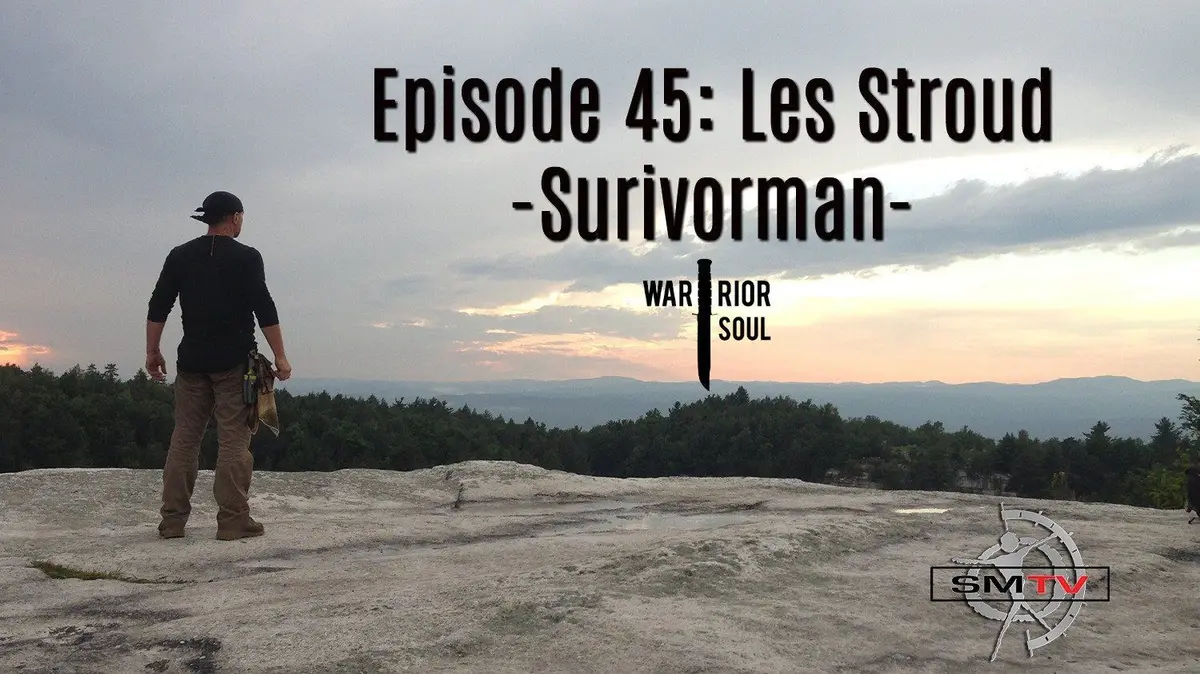
To listen on ITunes: https://itunes.apple.com/us/podcast/episode-45-les-stroud-survivorman/id1096901382?i=1000386563850&mt=2

Les Stroud has been the world’s preeminent survival expert for almost 30 years. As the star of Survivorman, a musician, filmmaker, an author and activist Les has long wanted to create a home for all his passions, teaching and experiences, which he has recently done with his new online network SMTV.
SMTVnetwork.com, is an on demand streaming network where you can learn survival from Les by following him on his adventures through his films, music, environmentalism, educational projects, and, of course, Survivorman.
This was a fantastic conversation and we look forward to having Les on again in the near future!
A quick intro to what you will find on Les’s SMTV Network:
To join SMTV Network, click on the image below:

This podcast is sponsored by Kegenix, click below and see what real ketones can do for your mental and physical performance:

Transcript
Machine-generated from the episode audio and lightly edited — may contain errors.
Chris Albert (link to this point)
What's going on everybody? This is Chris Albert with the Warrior Soul podcast. And today we have a fantastic episode for you with the Survivorman, Stroud. But first, we just have a couple of quick announcements. First things first, this podcast is sponsored by Dinotropin.
Dinotropin is a natural human growth hormone secretagogue. What is the human growth hormone secretagogue? Well, is a natural product that you take that increases your natural growth hormone production. Now, I've been in the fitness industry for a decade now, and I know that there are tons of scams out there on the market, and many of you are justifiably skeptical of any supplement that crosses your path. Dinotropin is the real deal.
Up until now, it was used only for clinical purposes and it was developed by an amazing interventional endocrinologist who wanted to come up with a inexpensive but effective way to treat human growth hormone deficiencies. Dinotropin has been shown in over one thousand clinical cases to increase growth hormone production by 50 to 200% in its users. We have every single reference ever made, as far as research goes up on the sales page if you guys want to take a look at the research. This is a fantastic supplement. I use it every single night before I go to sleep.
Helps me to sleep extremely well and it makes me feel amazing. If you're looking to optimize your growth hormone production to increase athletic performance, enhance fat loss, improve your sleep, and improve your sex life, definitely check out Dinotropin. And you can find it at www.warriorsoulagoge, that's a goge.com under supplements. That's Dinotropin at warriorsoulagoge.com under supplements. This podcast is also brought to you by Kegenix.
Kegenix is the best exogenous ketone supplement on the market. We've been hearing a lot about ketosis and it's become increasingly popular as a diet regimen. Mainly because people like Joe Rogan and Tim Ferriss have been talking about it on their shows. Well, exogenous ketone supplements help you to get to a state of ketosis instantaneously after you drink them. They contain ketone salts that have beta hydroxybutyrate.
That's the main ketone that your liver produces to help to fuel your brain while you're in a state of ketosis. Tim Ferriss and Joe Rogan have also been talking about Kegenix because they use this extensively. It's fantastic for those of you who are looking to adapt into ketosis and it can actually help you to alleviate the symptoms of the keto flu. I use this product extensively and it is the best exogenous ketone supplement on the market because it not only contains ketone salts, it also has a whole host of nootropics in it that can help extend the mental and physical benefits as far as energy goes from using this supplement. It's got Alpha GPC, which is gonna help to get the ketones across the brain blood barrier and help you to fuel your brain throughout your day.
It's also got Acetyl L Carnitine in it, and this is an amazing fat mobilizer that's going to help to mobilize fat out of the fat cells and help to use the ketones that are produced from that fat to fuel your brain and to help to get you into a natural state of ketosis. I use this product extensively. I definitely think it's the best supplement to come online in years and I definitely recommend trying this. If you want to try Kegenix today, you can go to www.realketones.com/warriorsoul. Definitely check this supplement out.
You will not regret it whatsoever. It will make you feel absolutely amazing and will definitely help you in your physical regimen and in your fat loss goals. Finally, if you like our show, if you like these episodes, head over to www.warriorsoulagoge.com. Agoge is spelled a g o g e. We've got some amazing content up there for all of you.
Stuff related to fitness, stuff related to nutrition, and tools and tactics to help you to live your best life. All of our podcast episodes are up there, videos, articles, you name it. We've got so much media up there filled with so much amazing information. We've also got some great training plans, some great nutrition programs up there, and some amazing supplements. And if you love the Warrior Soul brand, we also have our awesome clothing.
Remember we started as a clothing company for US military veterans. You can definitely get to the clothing from that site. Amazing t shirts and some awesome gear to help you through your summer. So with that, let's get into the subject matter for today's episode. If you ever get a chance to get up and go outside and breathe fresh air.
Feel the sun on your skin. You know, listen to the waves. There's a relaxing element to it. It makes you feel more human. And in many ways, it helps you to understand that you're only a small part of a greater world.
I think a lot of us lose that concept. We forget that we are actually living, breathing organisms. When you think about the fact that there are so many people out there who never get the chance to do this or hardly ever get the chance to do this, hardly ever get the chance to be outside, to witness nature, to get out into the forest or out into the desert or any other natural environment. You begin to realize why there's so much unhappiness and depression that exists. Even though we are surrounded for all intents and purposes with more modern convenience and easier living than we've ever had in our human history.
Our guest today is a gentleman named Les Stroud. Les is famous for his television series Survivorman, where he put millions of people back in touch with nature and allowed them to witness the wilderness from his perspective. Unlike a lot of the other quote unquote survival gurus that came on television over the past decade or so, Les always did it on his own. He didn't have any situations set up for him. He was out there by himself with his own cameras.
Les has gone on to create his own network, SMTV. And we'll be talking about that a bit during the show. But he's also a musician. And we talk about how his music is also kind of like a cycle. He gets to go out and witness the wilderness and through his music, people get to understand more and more of his perspective.
This was an amazing conversation. And what I want you to think about is this. While you might not be able to get out there and be in the wilderness by yourself for a long survival situation, And hopefully, you never have to be put into a real survival situation. You can get out there and appreciate this world and all of its beauty and all of its miracles. And the best part about it is, that's all free.
You don't have to spend money to do it. You just have to get to a location and begin walking, and begin witnessing. I hope you really enjoy this conversation. I know I did. Those of you who are in the military, you should definitely check out Les' network SMTV.
He's got a lot of stuff up there that can help you to understand the wilderness and to improve your field craft. So without further delay, let's get into episode number 45 with Les Stroud, the Survivorman.
This is Chris Albert, and I'm here to remind you of one thing. Someday, you're going to die. Now that's not some morbid statement or scary idea. It's solid fact. Your time here on this earth is limited.
And you need to be reminded of this as much as possible for one simple reason, to live your best life while you can. This is the Warrior Soul podcast. K. And we're now recording. What's going on, everybody?
This is Chris Albert with the Warrior Soul podcast, and I have the pleasure today of having Les Stroud on the show. Les, how you doing, man?
Chris Albert (link to this point)
I was, cruising around your your SMTV website over here. It looks pretty awesome.
Les Stroud (link to this point)
Yeah. We just launched that about three months ago. And, yeah, I mean, it is the home for everything I do. I mean, it's it's really a kind of a, I think, bit of a bold new step in in the way a content creator, myself, an artist, that sort of thing can can get, can get my stuff out and have complete and total control. It's a lot of fun. So we've we've launched it. We've got various channels on there, and we're highlighting everything from Survivorman to my music.
So, yeah, we're we're very excited about it and constantly putting up new, new material.
Chris Albert (link to this point)
Yeah. These are amazing times we live in. And and I think it's so great that create creators are able to kinda take things into their own hands now. And if you if you got anything, you you you can get it out there to the world.
Les Stroud (link to this point)
Well, yeah. I mean, if you look at the stuff that I've done, I mean, you know, basically I've got a following. Right? It's been sixteen years of doing Survivorman on television, and and many years of touring and performing and things like that. And so, you know, I'm very blessed and fortunate to have a following that I can then let know, hey, you know what?
Here's where I'm gonna be now. And the benefit is, you know, even just in the simplicity of stuff like Survivorman episodes, where you have to wait for the networks to put on a marathon or wait for them to air the show, well, it's twenty four seven VOD now just by by going on on my network. And and, you know, and then on the big special thing is that, people have direct access to me. So they can they can tell me what they want me to do. They can say, hey, man, can you do, you know, a show on this?
Or can you do And I can go out and just do it. And I don't have to, you know, get through any gatekeepers or anything like that. I'll just do as I as I please. And that's it puts the the network, so to speak, in the hands of the viewer, which is pretty awesome. And not a lot of people can do it, because most producers have gatekeepers and executives and production offices and like that that they have to go through.
But in my case, man, the buck stops at me. So.
Chris Albert (link to this point)
Yeah. It's it it is pretty awesome. I think a lot of people don't realize how much work it is too. I mean, you gotta be putting in tons and tons of work just to set this content up, you know, to to get a travel schedule going on, to to to get everything in order there. I mean, that's that's it seems like it's an insane amount of work.
Les Stroud (link to this point)
Well, And that is and that is I think people don't not everybody understands how how life works, I think. But, know, so, you know, it's, I mean, heck, it's the price of a cup of coffee per month, if you know, 2.99 a month kind of thing. And you get access to Les Stroud and everything I do. But it is a lot of work. And I mean, you you can't do these things just for free.
Plane ticket doesn't buy itself. And so, so putting a, even doing a Survivorman episode, you know, it's, it's a lot of people involved behind the scenes just because you wanna, you wanna get me and two or three people off to Madagascar to shoot a show. And of course, I do my own filming, but they are gonna go film the sunsets. That's a lot of effort to to to make that happen.
Chris Albert (link to this point)
Yeah. Now you were for you were filming yourself from the beginning, like, going out into the wilderness by yourself. And, you know, you didn't take a camera crew with you. You didn't have anything set up for you. How in the world did you pitch that to the network?
And and how did how did you get them to come up with it? Because I think it was absolutely amazing. It's just, you know, thinking back in my mind at that time, you were the only one really doing anything like that without extra drama added in.
Les Stroud (link to this point)
Well, and I, to this day, remain the only one who's never actually been able to do it authentically and do it for real. You know, every other show had to had to basically script and produce and stage, or they just wouldn't be able to pull off, you know, thirteen and twenty six episodes. What I originally did was I I I called up the network, and it was sort of shortly after the CBS Survivor series came out. And that was, you know, much much different, Mark Burnett's Survivor series. It was the beginning of reality television, and I and I I hate reality TV.
I I you know, what I do is is documentary filmmaking. And so I called them up, and I said, listen, you know, and here's my idea. And my idea was, you know, blank. It was Survivorman. I can go out and do this on my own.
And really, they were excited about it right from the start. The sale of it, the pitch of it, was was never really that difficult in the beginning, because it was so incredibly unique. Nobody else was doing it. Nobody else could do it, because I brought to the game two skill sets. I could be I was a filmmaker, and I could make films, but I was also a bona fide survival instructor of almost twenty years.
So I combined the two. And, you know, where else are you gonna find that? And that's what made it, you know, sort of an easy pitch and an easy sell was was that that fact.
Chris Albert (link to this point)
How did you get into survivalism? How did you get into to to being out in the wilderness and being out there by yourself?
Les Stroud (link to this point)
Well, it depends on on how far back you wanna go. In my young days, you know, I was a big fan of Jacques Cousteau, Mutual of Omaha's Wild Kingdom. I was a big fan of old Tarzan movies. So in my blood, you know, in my DNA, I had this love of of of outdoor adventure and and nature. And and and, you know, and actually, you know, the Tarzan movies that I watched, that was more like, you know, the jungle and survival.
And if you think about it, you know, what is Survivorman if not a hybrid between Jacques Cousteau and Tarzan? And so it was then I got into music and rock and roll. And then, you know, it was later when I was in my mid twenties where I just dove head first into every bit of outdoor adventure I could I could experience, you know? And that's what started to build the skill sets, including survival. So survival was really just it was like, you know, dog sledding, sea kayaking, canoeing, white water canoeing, wilderness emergency care, survival, you know, yada yada yada yada.
It was just it was a big part of what I did for Outdoor Adventure, but I really, really loved it a lot. It was a it was a very important part of all that that adventure.
Chris Albert (link to this point)
Awesome. Awesome. And and so how old were you when you first got out there?
Les Stroud (link to this point)
The first survival, I was a late bloomer. I was in my mid twenties, I guess. Mhmm. When I first I think I was 25 when I took my first survival course just like anybody else would. And, you know, you got your you meet every Thursday night and you learn how to do a fire bow and then you got the big weekend coming up and go out with all the other students.
I did all of that and I just I just soaked it up.
Chris Albert (link to this point)
You know, it's it seems like there's, you know, we live in this society now where everybody is so far away from nature and so far away from us being actually living, breathing animals and who who were meant to be in nature. When you take somebody out there for the first time or when you did when you were an instructor, what kinds of things did you see change in people? What what kind of changes did you see in people as they reintroduce themselves to nature?
Les Stroud (link to this point)
Well, the the the changes are profound, you know. And and you're right to notice that because, really, the baseline and the basis of everything I've ever done at Survivorman was about connecting people to nature. Here, I I showed the skills in how to build a shelter, and how to do a fire bow. But, again, the basis, though, was just connecting them to nature. And it's it's you know, I I don't want to be cliche about it, but I mean, there's there's sort of nothing that isn't profound about connecting and reconnecting with the natural world.
It's where we come from. It's it's everything, you know, all we are, all we have, and all we will ever be, is and comes from nature. And, you know, which makes me horrifyingly shudder when I think about the fact that, you know, there are children in China right now who have literally never seen the sky. And that horrifies So me. So the changes people have there's no question.
Profound is the only word I can think of. You know?
Chris Albert (link to this point)
Yeah. I think we're getting to that point down here near Los Angeles, you know, with all the all the pollution and things like that, you know, not being able to see the clear sky. But, you know, there's children out there, I think, in this country who who've never actually smelled fresh grass, you know, let let alone, seen a tree, in different urban areas. So it's it's pretty crazy, I think, to the the the point we're getting to. One thing I noticed, you know, in recent times with the the whole trend toward fitness is that there's this whole idea of, know, going beast mode on the weights or, you know, considering yourself an alpha male cause you can lift a certain amount of weight in the gym.
And I've been there. I've been that guy. I've been that guy who's who's been the meathead. But, when I joined the Marine Corps and I actually got out there, one of the things I realized is that if I kept that mentality, I wouldn't last a week out doing what you do. And and, I think people have a different concept even of fitness now.
Les Stroud (link to this point)
Yeah. You know, I mean, I've always been about keeping myself fit and in shape. But but when I discovered outdoor adventure, I was able to develop a fitness level that was so entirely different from pumping iron, you know? And it it you you end up using and manipulating all of the muscles in in these, you know, bizarre ways, because you're carrying canoes over portages and things like that. And the thing is that when you're out and doing any kind of survival, it's not about your brawn, you know, battling against the elements.
It never has been. You know, the the the joke of so many of these copycat shows that came along trying to make it like that is I mean, that that is a joke. It's that's not what it's been. It's not it's certainly nothing that Survivorman has ever been about. What I've been about has been about flowing with nature, and and going with the flow and the rhythms and the timing of nature itself.
And when you do that, you know, even when it gets to the subject matter of fitness level, you just, you just develop an all around fitness level that's much more in tuned. You know, I mean, you know, I don't want to be a hypocrite. I was, I've already done my workout this morning, you know, and that included squats and chin ups and all sorts of stuff like that. But I'm also gonna get outside. And so there's yeah.
There's an understanding there that when you when you get involved with nature, you you you have to accept that your your bicep, your guns are not going to win the day, but flowing within the natural world will.
Chris Albert (link to this point)
What types of things do you do to stay in shape? Know, lifting regimen, endurance regimen, things like that.
Les Stroud (link to this point)
Well, I've got a I mean, because of my age and all the ways I've beaten myself up, I've got a couple of I got the L five issue and that sort of stuff. I do some basic strength training around that. So I'm doing I'm actually getting into squats a lot these days. So squats and a lot of chin ups. But what I've done is a couple of things.
I've developed my own routine that combines yoga with strength training. And I'm really just gone with my own flow. So I might get up, you know, in the morning. Well, I not might, but I do. And so let's say, like, for example, an hour ago, I spent an hour training.
And so the hour was, let's see, a sun salutation followed by 20 push ups, followed by a number of yoga stretches, followed by 30 sit ups, crunchy sit ups, followed by 20 chin ups, followed by 20 dips, followed by 10 squats, followed by a couple other little hand barbell weight things. So that's one run. And I'll do that three times in the course of an hour. So there you go. There's that in house kind of fitness thing, a combination yoga and weights.
But then the other thing I'll offset on different days is, you know, I've got a a wonderful straight up two mile semi mountain hill right in behind my house. I mean, places you literally have to use your hands going up. And so I'll go and I'll do that for the cardio, you know? And I mean, I'm not running that hill. I'm I'm climbing, walking that hill, but the cardio is still intense.
So I mix and match it. But the minute somebody says, hey, you wanna go on a two week canoe trip? Oh, yeah. I'm down because now I don't have to lift another weight. I just have to go and do that canoe trip for two weeks.
And you you know, I come out svelte and and feeling much better.
Chris Albert (link to this point)
Come out jacked. Absolutely jacked from doing all the rowing. Are you putting any of this stuff up on, SMTV as well?
Les Stroud (link to this point)
I will be, as a matter of fact. Yeah. I mean, that's the beauty of SMTV network is, that I have the freedom to do a lot of instructional things. You know, when I did Survivorman, it's a forty three minute show, and I'm telling a three day, five day, seven day, ten day story. I don't have time to really teach you anything other than sort of glimpse into it a bit, even but I still did a pretty good job at that.
With smtvnetwork.com, I can now do specific instructional videos, which I have tons of them going up. And now I can also include variety where I've got people asking me about how to do documentary filmmaking. So I'm showing them filmmaking styles in the field, way that the things that I developed and the secrets I came up with to shoot my show. And that and I was actually just thinking yesterday, you know, about what I do in terms of training and and showing that as well, because these are all helpful guidance, you know, instructional things that are great to to share with people.
Chris Albert (link to this point)
Yeah. I think that that would be some awesome content. I think a lot of people, myself included, would definitely wanna see that. You know, particularly because you how old are you now? What, Les?
Les Stroud (link to this point)
I'm 55.
Chris Albert (link to this point)
Yeah, and you look great. So I think a lot of people would wanna see that.
Les Stroud (link to this point)
A lot of attitude there. I mean, my intention is to I mean, in my head, if you ask me how old I think I am, oh, I think I'm 29. And if it wasn't for a mirror, I would be 29. That's what's in my head and will always be. And my goal is to get to that place where I wanna be that 85 year old who's still spry.
You know, that's I wanna I'm gonna be that guy. I've seen them. I know those men. I envy those guys when I say, wow. Look at this guy.
He's 85, and he's like, tumping that canoe over that porch. Alright. That's gonna be me. And so that's yeah. Definitely a big part of my life.
Chris Albert (link to this point)
That's like that that guy, Dick Proenneke. Did you ever watch him? He was he was a Yeah. Old guy. Lived up in Alaska, had these massive arms where he was chopping wood.
Les Stroud (link to this point)
Yep. Oh, yeah. Life outside.
Chris Albert (link to this point)
Right? Yep. Yep. That was that was an amazing series. That was an amazing series.
You, you know, you also did a lot of work searching for Bigfoot. Can you tell us a little bit about that? Yeah.
Les Stroud (link to this point)
I mean I mean, the reality is that I've seen and heard, experienced some crazy things out there. And so, you know, the subject matter does honestly intrigue me. There's no question about it. And, you know, long story short, when I got to this place where Survivorman was kicking it and everything was doing great, and I got asked about that in some Opie and Anthony interview in New York, and I told my story of an experience I had in Alaska, and that kind of lit a little fire. And then I realized, you know what?
This could be a lot of fun, you know? So I picked it, you know, that, you know, thinking like a producer, it's like, well, let's see, Survivorman's a great brand. Bigfoot's kind of a great brand. Put them together, this can't go wrong. So, but unlike, again, unlike the other shows, now I will admit, I was not the first one to the table this time, but but unlike the other shows, I took the matter seriously.
And if I was going to go out and research it, I was gonna research it, you know, as a serious skeptic and but yet open minded to all the possibilities, and not stage and set up stupid things and try to pretend like, you know, every branch that I hear cracking must be a Bigfoot, you know? So I had all it's it's you know, we did ten ten one hours of that show, and I'll do more of that stuff for SMTV Network, for sure.
Chris Albert (link to this point)
That's cool. What wasn't there a a point where you actually saw a tree get get thrown to the side or something like that?
Les Stroud (link to this point)
Yeah, was in British Columbia in Canada, and I didn't see it. I heard it, but there was no question what it was. And I was alone in what's supposed to be quite a hot spot. And I mean, there was not a breath of air. The lake was like glass.
I was at the end of a big, or a small lake by myself. Everything was still. You could hear a pin drop sort of thing. And then all of a sudden, yeah, this big massive tree, and it it didn't fall over. I mean, it was tossed, and it was tossed and landed, you know, out of the forest and into the water.
Now you could say, well, it was just the moment of timing, the molecules of the dusky night air and the temperature change and the molecules change. It was just exact exactly that point at which the tree would decided to rot and fall over. But there wasn't an ounce of wind, like I said. And this has happened to me on repeated occasions, like at least a dozen times, where you start looking at it going, okay, know, this is getting to be way too much of a coincidence to be a coincidence.
Pretty, that one really threw me for a loop, because again, it didn't sound like it fell at all. It sounded like it was tossed.
Chris Albert (link to this point)
Wow.
Les Stroud (link to this point)
Wow.
Chris Albert (link to this point)
Now, I think when you when you put these beautiful places on TV, there there's this crazy dichotomy that exists because one, you're showing people this amazing beauty that is nature. At the same time, you're shining a light on a place that not a lot of people have gone through. When you film in these places, does it do you ever think about, maybe not talking about exactly where they are to try to keep people from actually going there? Or do you did did you ever think about that aspect of it?
Les Stroud (link to this point)
Well, I used to. I used to be more of a purist when I was an outdoor guide, thinking that, you know, we need to have places set aside where nobody can go and just allow wilderness to be wilderness. But I've learned that, you know, we are a big society. We are a global society. And I've learned that when you do that, then nobody's paying attention to those areas. And no matter what, industry moves in. And when industry moves in, they log it, they mine it, they build the roads, they fish, then people move in and they fish it out, they hunt it out. And so I realized, no, that was the wrong approach. And the right approach is actually to encourage people to go where I've been, to encourage people to get out in nature, to encourage people to get on the trails, to fish, to hunt, to canoe, to bike, to walk, to hike, to photograph, whatever. And to really encourage that strongly, you know, and and, you know, recently I was on two different trips.
One was a canoe trip and one was a backpacking. The canoe trip was in a place called Temagami, Ontario. The backpacking was in a place called the Illinois River in Oregon. And when I went into the Temagami, you used to have to go to, get to your campsite by 4PM, you know, to race to get the good campsites to see the sunset. Well now, now you take your time, because you're probably the only person on the lake.
People aren't going out there anymore, and it's the most amazing canoe country in the world, and and people just aren't doing it anymore. And in the Illinois River, I found this most incredible campsite, and we had this campsite to ourselves, and which we thought, oh, this is awesome. Like, we're right on the river. It's beautiful. It's campsite to ourselves.
And then I thought, wait a minute. We have this campsite to ourselves. How sad is that? It was an easy hike out here, and nobody's here on a gorgeous weekend with no bugs. Unbelievable.
So so no. I I, that's a long way of saying no. I do the opposite. I encourage people to to go out where I go and to experience these things. Because otherwise, you know, if they're and if they're young people.
Well, know what? A young person that's gonna grow up to be a policymaker is not gonna save a tract of land that they've never seen.
Chris Albert (link to this point)
Mhmm.
Les Stroud (link to this point)
So I want people out there.
Chris Albert (link to this point)
If you could sit down in front of the United States Congress or the Canadian Parliament today and talk to them about your concerns as far as the environment goes, what would you say to them? What would you say to to US Congress or even president Trump?
Les Stroud (link to this point)
We have to make some laws. You know, volunteerism doesn't work. Quaint approaches don't work. Tracts of land must be allocated for the aesthetic beauty that they are. And this is a problem.
Right? We can't quantify aesthetics. How do you quantify a view? Oh, yeah. And unless you're gonna build a development there, you can't quantify it.
It's very difficult to do that. And they people, you know, economists live off that. Well, what's it worth? Well, what's it worth? I don't know.
What's your soul worth? You know? And I would encourage very strong approaches to realizing that everything we have as a society, as a country, this laptop I'm speaking to you on, where I am right now, where I'm sitting, the couch, your where you're sitting, all of those things came from nature. And, you know, we can't expect that in years we will be able to grow plants in plastic and manufacture air with oxygen with machines. You know, we must have an intact natural world to continue as a species, and economically to thrive as a country.
We still must have this. Otherwise, we're gonna crash and burn.
Chris Albert (link to this point)
Wow. Yeah, that's an amazing answer. What do you think about, you know, I'm sure you've listened to like Terrence and Dennis McKenna and some of ethnopharmacologists and their their their notions about psychedelics. What do you think about this notion that that plants might be trying to tell us something or might be trying to get us to tap into a higher consciousness?
Les Stroud (link to this point)
Well, yeah. I mean, you know, the the awesome reality is that we're living in a time where science, cold hard science is now verifying stuff that would have been considered folksy remedies and metaphysical, you know, blahbitypala. And meanwhile, we're finding out that quantum physics is saying, well, no, actually, there's actually energy to a thought. You can measure the energy of a thought. So, you know, what do I think? I I think that, you know, we are now tapping electrodes into plants and assigning the energy coming off the plant to a musical, you know, synthesizer, and the plants are making sounds.
And the sounds and the plants react depending on who walks in the room. Now think about that for a second. You know, I mean, so our plants trying to speak to us, plants communicating with us, they've discovered that this incredible, almost nearly invisible connectivity of plants underneath the from plant to plant to plant to plant for miles running, exists.
It's biological. You know, it exists. Science is showing it. So, you know, the concept, science is showing that something like telepathy is not ooey phooey nonsense. It actually exists.
So I'm a very open individual. For me, it's just like a big, well, yeah, of course. You know? You can put electrodes on a plant and listen to it make it sound, and go over and do something negative, maybe cut it, and it reacts. I mean, we're getting to a point where I don't know what we're gonna eat anymore because we're gonna, you know, be worried about plants now.
But but, I mean, you see what I'm saying? I'm a meat eater, you know? So I still am going to eat meat and eat plants and and all this, but, the suggestion that plants communicate, the suggestions that they are alive and and and that they they have this existence is not a stretch for me at all. I I I don't have it. I don't have any struggle with that.
Chris Albert (link to this point)
Now you also have the this music that you do. And and a lot of your music I think almost all of your music is about nature, is it not?
Les Stroud (link to this point)
Yeah. I I just as I did with Survivorman, as I said, my baseline for Survivorman has always been about celebrating nature and connecting people to nature. And so my music you know, no one really wants to hear a 55 year old guy sing love songs. So music is, constantly directed and dedicated towards, the earth.
Chris Albert (link to this point)
Yeah. Absolutely. That's an interesting cycle because, you know, you you go out to nature, you get inspired by it, and then, you know, in a way, you're almost communicating you're almost communicating for nature with through your music, if that makes sense.
Les Stroud (link to this point)
It it makes it makes terrific sense. And that's often what I feel I'm doing. You know, you'll hear people say, you know, be a voice for those who can't who don't have voices, whether it's a human kind, whether it's animal kind, or whether it's nature. And sure. I don't wanna be pompous about it, but sure, I do have that notion, I suppose, that, you know, my understanding and my connection to nature is so strong that that, yes, when I write my music, I wanna express that.
And, you know, there's a lot of other people that connect to it. I've got two new albums coming out, and one's called Mother Earth, and Slash plays on it. Slash only agreed to play on my song because he saw what the messages were about. And Steve Vai plays on it. Same reasoning there.
So it's not just me. Many John Muir, Henry David Thoreau, Aldo Leopold, they all spoke for nature too, because they understood connectivity to nature.
You know, Roosevelt understood that connectivity. If it wasn't for him, we wouldn't have so many of the parks we have. So, you know, presidents can can you know, Trump should listen up. I mean, you want he wants his name heralded? Fine.
Make a couple amazing parks, you know, like like Roosevelt did. There's a legacy for you. You know? And so people speak for nature. Do I?
Sure. Why why not? Sure. Yeah. Absolutely.
Chris Albert (link to this point)
That's awesome. Real quick, because I I definitely wanna be respectful of your time here. What is the biggest mistake you see beginners, getting into when they try to to get into survivalism? What or or in a survival situation. What's the biggest mistake you see people making?
Les Stroud (link to this point)
They think it's a recreational activity.
The biggest mistake. You see, the reality is that you don't well, two two things I wanna two points to make here. Survival is not fun. It's not pretty. It's ugly.
It's uncomfortable. It's miserable. That's the truth about survival. That's what survival is. So you know what survival is?
Survival is you sitting there going, I wanna go home. That's what survival is. It's not a recreational activity. Bushcraft is a recreational activity. Camping, primitive earth skills, these are recreational activities to enjoy and skills to learn.
But real survival is just about going home. You know? And so, oh, I'm gonna go and build shelters all weekend. That's great. I love that in terms of the skill set.
But the truth of the matter is, if you were lost for a weekend or you thought you could get out, the last thing you're gonna wanna do is spend four and a half hours building a shelter. You just wanna go home. So they make this mistake of thinking that, and unfortunately, the television shows have not helped, because, you know, people, you don't watch, like, if if you were to watch an Olympic ski jumper on TV, you wouldn't turn around and say, okay, tomorrow, I'm gonna I've never skied, but tomorrow, I'm gonna strap on a set of skis, and I'm gonna go to the 70 meter ski jump, and I'm gonna go down it, because I watched that guy on TV do it. Well, people think that with survival, that, oh, well, can do it. I'm gonna go do it.
I'm gonna go survive this weekend alone. It took me years before I went out alone. You know? Lots of training before I went out and did those things alone. The point of Survivorman was not to be a survival guru.
It was to me to show that, hey, as a normal human being, as an everyday man, you can get through this crap. You can survive this horrible night. That was really, you know, the the skill set point of Survivorman. Not that, oh, look at me, look at me, I'm a guru and you know, know, let's go all go out and be gurus in nature. It doesn't work that way.
As I said, the main thing that you want to know about survival is how to get home more than anything else.
Chris Albert (link to this point)
Yeah, I think the biggest thing for me, because I served as a Marine Corps Infantryman, but the thing is for me, we were always in teams. I always had somebody around. I think the biggest thing for me in that situation, it would be going crazy because didn't I have anybody to talk to. I wouldn't have any kind of interaction with somebody. And just spending time, I always saw you on your TV shows, you'd be like, I have to spend, I have to do this right now mostly to keep my mind busy.
You know? That that that I think that's a big thing.
Les Stroud (link to this point)
Yeah. Well, I I mean, you can pretty much be assured that on day four of every single Survivorman I ever shot, I wanted to go home. I wanted to quit. You know? It's it's there's a word for it that is is sort of a surprising word, but it works the best, and that is boring. It's incredibly boring to be out there alone, having to survive.
No human comfort, no conversation. Boy, day three, day four, I'm just, you know, I was like, I don't wanna be here. What am I doing this for again? You know? But then I would, you know But I had I had a bigger picture.
I had a bigger baseline in terms of what I was trying to do. I was on a mission, I am on a mission. And for me, because I was making a series, my inspiration in that little round black camera eye looking at me was knowing that somewhere, someplace, there was some Boy Scout or Girl Scout watching this show and hanging off every word I'm saying. And that would motivate me to say, okay, get get a grip on it. Yep.
You're alone. You're gonna be out of this in two days. Then you're back to having a beer and a pizza. Relax.
Now Mhmm.
This next scene. Show how how to really make this shelter. Get this fire bow going. And that was my motivation. But you're right.
The challenge in being alone is is being alone. And it it could be really irksome for me to see other TV shows that are faking it that actually have scripting saying, I'm having a really tough time, you know, being alone. It's like, you're freaking not alone. You know? And and well, I've been alone and many, many times now.
And I still don't know why I do that because I'm a gregarious individual. I like people, and so it's ironic.
Chris Albert (link to this point)
Wow.
Well, Les, I gotta say that this has been an absolute pleasure to speak with you. Your website, it's smtvnetwork.com. Just, know, as a closer, let people know what they're gonna find there when they go there.
Les Stroud (link to this point)
Well, again, going back to the concept of why I started it, it puts the power of what you wanna see, like you yourself, for example, in your hands, because you can comment on the each individual channel. They've got, the Survivorman channel, which is all things Survivorman behind the scenes, never before seen footage, all of the archive of the shows, new stuff all the time, new episodes, some more Survivorman Son. You've got the Survivorman Bigfoot channel, which is all things Bigfoot, new stuff going on there. Got the instructional channel, individual instructional pieces, tailor made in detail, always adding new stuff there. That the music TV channel, which is all my stuff musically, everything I do with that, including a new series, interview series that I've been doing called Campfire Interviews.
All again, always new content. Eventually, we've got the three sixty virtual reality channel coming up where I take that little camera out with me while I'm maybe teaching a certain instruction, and you're gonna be right there. You can look around in the bush and be with me. We've got the the big one that people are loving is the director's commentary. And so for that, what you get is I literally prop up a camera pointed at me, and then I put on one of my episodes and watch it, and you watch me watching me.
And I Mhmm. I'll pause and I'll go, oh, oh, oh, you know what happened here? Well, what happened was, da da da da da da da. And so I just fill you up with all these behind the scenes stories you would have never heard. And actually, that that simple little idea for the network has been the most people are just loving it.
They're lapping that up. And then so for example, recently, you know, we were talking, I said, how about this? You know, I said, why you know, it's always the seven days, ten days, five days. What do you do if you know you're going home in twenty four hours? What if you do what do you do if you've got the word out, but you're still stuck in the cold, in the wet, in the bugs, in the heat, in the desert, on the ocean?
You're still stuck. How do you get through just this next twenty four hours? So I call it Survivorman twenty four hours. I'm producing my first episode next week. It's gonna be exclusive on smtvnetwork.com.
So this is what I've done here. I've created my own television network, but guess what? No gatekeepers, no executives, bothering me. No no gatekeepers to get through twenty four seven on air. And it's pretty, it's the way of things are going.
And I'm uniquely positioned to be able to do something like this. Why? Because I own everything to do with Survivorman, and I always have. I was never a dancing monkey. I was never a TV host.
I the buck always stopped at me. So now I can take that buck over and and put it over here on on on SMTV Network. And it's wonderful because I'm looking at the comments, and I'm actually going out probably actually this afternoon. And I'm shooting things based on the comments on the network. How cool is that?
Chris Albert (link to this point)
That's pretty awesome. And and you guys out there who who are currently serving in the Marine Corps or the army, who are looking to learn actual field craft, this is an amazing resource for them.
Les Stroud (link to this point)
And and Well, know, I'll I'll add that, you know, I I was tagged to to I taught the Canadian military. I taught them elite survival, and a lot of fans in the troops. Just tons and tons, always been hugely supportive. And that's it. When I started teaching the JTF task force, for example, you know, I recognized that there were skill sets that I had that were not available within the military instruction, and I was taking it to different levels in different ways.
So so I I love that fact. I remember there was a time when I got the call, and they said, listen, the guys in Iraq want two show they they their two top requests to have shows piped into them was The Sopranos and Survivorman. And so could they, you know and it's and and if I were to say yes to it, there's no money involved. It's for free. And I said yes immediately, of course.
So, yeah, I'm a big fan in return, as guess is I guess what I'm saying.
Chris Albert (link to this point)
Well, definitely thank you for that, Les. Anything else you wanna convey to the audience before we wrap up?
Les Stroud (link to this point)
No. I think this has been a great interview. I I you know, I'm alive and well and kicking, and and I keep I'm planning on doing more and more. And I I I recognize it's a it's a financial thing. I mean, as I said, the the cost of joining my network is for students and and for vets, that is $2.99 a month.
That's a cup of coffee. Basically, what I say is buy me one cup of coffee each month, and I'll go out and produce for you what you wanna see. And so I'm working on getting the numbers up so that the network is flowing, and it's gonna hit a tipping point where it's like, holds barred guys. Oh, you wanted me to do survival in the Himalayas because I haven't gone there yet? Okay.
Let's go. Going off to do it. And, I'm gonna do new fan episodes as well, where I take someone out with me, and some fun episodes where I take maybe some hockey players or football players and have some fun. So it's all there. And I I just you know, my my enjoyment, my emphasis, my baseline of connecting people to nature is still strong now.
And, you know, I I always feel the same way. When I said to you, look, man, I feel like I'm 29. Part of that is because I always feel like I'm just getting started, and I still feel that today.
Chris Albert (link to this point)
Well, we can we can hear it in your voice. You've got the spirit, and and, you know, I wouldn't think that I was thinking I was speaking to anybody who wasn't, who was in their fifties. You sound like a 29 year old kid. So but that's pretty awesome.
Les Stroud (link to this point)
Okay. Alright, man. Well, thank you so much for having me on today.
Chris Albert (link to this point)
Thank you so much, Les. And everybody out there, that was Les Stroud. I hope you enjoyed the episode. Now get out there and live your best life. Thank you all for listening to that episode.
I thought it was an absolutely amazing show, and we feel so privileged to have had Les on. If you guys like our show, if you really like the content that we have on here, or even if you don't like it and you want to let us know, please write us a review on iTunes. Let us know how we're doing. We want to make sure that we're getting you content that really helps you, and that's really helping you to live your best life. So, get over there, write us a review.
We don't care if it's a one star review or a five star review. We just really want to know what you think of the show, and how we can do better. Also, we have a great YouTube channel out there called The Warrior Soul Agoge. And if you are interested in getting some top notch fitness content, definitely go check that out. That's the Warrior Soul Agoge YouTube channel.
And we will be having all links to Les Stroud, SMTV, and anything we talked about on this podcast episode up on the show notes for episode number 45. And that will be at www.warriorsoulagoge.com. That's a g o g e. And it'll be under podcasts, episode number 45 with Les Stroud. Enjoy the rest of your day.
And like I said before, wherever you are, whatever you're doing, get out there and live your best life.
Host of the Warrior Soul Podcast and founder of Warrior Soul. Worldwide trainer and nutrition coach, contributing author at Testosterone Nation and Muscle and Strength.