Podcast episode
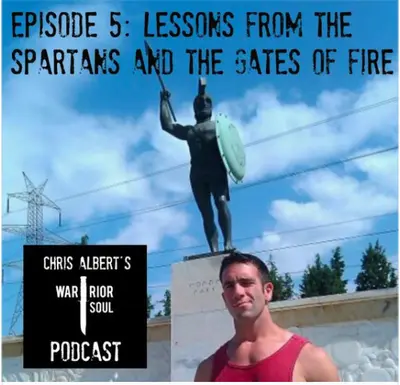
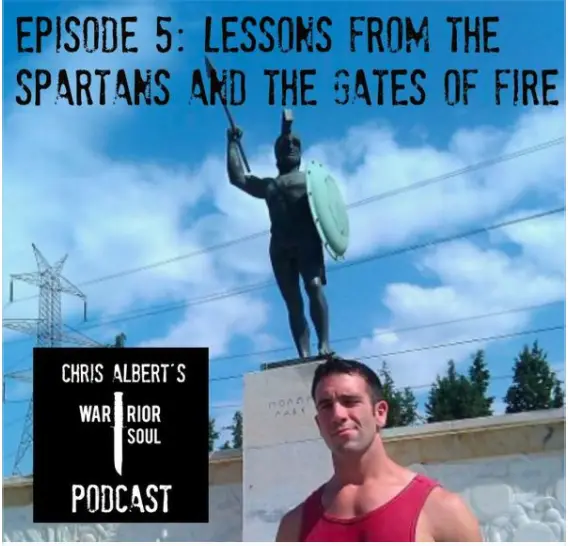
Episode 5: Lessons from the Spartans and the Gates of Fire
Hosted by Chris Albert
The Warrior Soul Podcast
Transcript
Machine-generated from the episode audio and lightly edited — may contain errors.
Chris Albert (link to this point)
Welcome to episode five of the Warrior Soul Podcast. This is Chris Albert, and I am the host and owner of Warrior Soul Apparel coming to you today from Redlands, California. Just got back from the East Coast on a trip to my hometown, and it was an awesome trip. I got to see my mom. I got to eat a lot of Italian food.
I got to take a trip down to Philadelphia, see some of the sites, where this country was created, and gave me a real appreciation for the East Coast and where I come from. During the trip, was reading a book, and that book is called Gates of Fire by Steven Pressfield. And with this book, one of the things about it is that it's a piece of fiction. And normally I don't read fiction. Normally I stay away from fiction because in a lot of ways I don't seek entertainment from what I read.
I don't want to be entertained by a book. I want to learn something from it. But this book attracted me a lot for a couple of different reasons. One the author Steven Pressfield writes about war, and he's a United States Marine Corps veteran. He's got some really good perspectives that come out in his novels, but he also writes non fiction.
He does books about internal battles as well. He has another book out there called The War of Art that really spoke to me. And it spoke about his own creative process, and how he faces this thing called resistance. And how we all face this thing called resistance that keeps us from doing what we really want to do. So I picked this book up.
And it's about a historical event that I've always been fascinated with, and that a lot of Americans are fascinated with. And that is the stand of the 300 Spartans, and a few thousand other Greeks at the pass at Thermopylae. And a few years ago, while I was a PhD candidate at UC Santa Barbara, I got the opportunity to travel to Greece. This group paid for me. It was a fraternity called Sigma Phi Epsilon, which I'm a member of, to go and to speak about philosophy, to facilitate discussions about readings that were attached to various sites we were going to going to visit.
And one of the sites we were going to visit was the pass at Thermopylae. And so we went over the Histories by Herodotus, which is the main text that talks about the stand of the 300 Spartans at Thermopylae. And visiting the site, if you ever get a chance to go to Greece and to see the memorial there, it's it's absolutely awesome. There's a plaque on the spot where the 300 Spartans fell. And it's inscribed with a message from those Spartans.
And it says, go tell the Spartans passerby that here obeying Spartan law we lie. That's part of the fascination I think that we all have those kind of laconic sayings that the the Spartans had the Molon Labe come and take it. You know those real simple brief statements. And it it was known that the Spartans spoke like that. The word Laconic, which means very brief, but to the point, comes from the word for where the Spartans come from.
Their kingdom was called Lacedaemon, and they were called the Lacedaemonians. And that's why they had the lambda on their shield because the lambda stood for Lacedaemon. But when we think about the 300 Spartans, and we think about their impact on our culture, as well as all of Greece's impact on our culture, we have some lessons that we can learn from them. And when we think about what ancient history is, you know, particularly a book like Herodotus' The Histories. The Greeks had an oral tradition of history.
So when we read a novel about the 300 Spartans, or we watch a movie like 300, which is an extreme over embellishment of what went on there at the pass. In a lot of ways, ancient history is like a novel. And the best that we could hope for is a really good story about what happened. Because over time that story changes. It gets over embellished.
You know heroes develop like Leonidas. And those heroes get characterized in a certain way based on what the historian wants you to hear. So in my mind reading a novel about the 300 Spartans also presented something that I could learn from. Because I've read the histories, I've read Herodotus, and Herodotus reads very much like a novel. He is a really great storyteller.
And that could be one of the reasons, one of the many reasons why we still hear about the 300 Spartans today, because people were able to tell really, really good stories about them. But as I was entering this book, one of the things I really wanted to think about while I was reading it was this impact that the 300 Spartans have had on American culture in recent times. Know, we see references to them everywhere, especially those of us who are into military stuff, are into military culture, who have served in the military. But we also see it in the fitness industry. And what I wanted to get out of it was a real sense of what and who the Spartans were.
Because when we see these references to them in our culture, you know, the personal trainers who post pictures of themselves in Spartan garb, and talk about themselves in a Spartan like manner. Who, you know, use the sayings like tonight we dine in hell, or you know, see Molon Labe everywhere, come and take it. Who are we referencing? What were these people really like? And how much like us were they really?
You know, how much like them are we? And my conclusion is that we're not. We're not much like them at all. You know, these personal trainers who reference themselves as being Spartans probably couldn't hack a day in Spartan life. Spartan male was taken from his family at seven years old, and brought to the Agoge, the academy, you know, where they were trained as warriors, trained to become warriors from the age of seven up till the age of 22.
And then they were committed to military service from the age of 21, 22, all the way up until the age of 60. And they weren't permitted to marry until the age of 30. And their entire purpose in Sparta was to serve Sparta itself, to serve the people, and to serve in the military. The Spartans didn't worry about things like farming, or putting clothes together, or, you know, a lot of the day to day activities you see in the rest of Greece. Know, things like art and drama that are so prominent in Athenian society.
They were outlawed in Sparta. The only form of art that was really tolerated was music. And that was because they used it to train. They trained to music, and they fought to music. They had a whistler, who would walk along with them while they were in their phalanx, their their battle formation, and they used it to keep time.
So when we think about ourselves, and we think about this very ideal culture, particularly, you know, those trainers, those people in the fitness industry who reference themselves as being Spartans. It's almost laughable. Because the idea of doing something for pleasure, like we consider fitness today because the way fitness is looked at, it's almost like pleasure. It's almost like, you know, a pastime. That would be foreign to a Spartan culture.
You know, their idea of physical prowess was part of life. Right? And when they were training, and when they were fighting, they were often training against real people and fighting against, you know, in these bloody battles that often ended with massacre, often ended with extreme violence. Unless they were fighting against fellow Greeks. And then at that point, the really the point there was just to send them a message that we want you as an ally.
We want you to work with us. And so we're gonna leave the rest of you alive. So we can make peace with you. But the battles themselves were extremely brutal, and the life was extremely brutal. You know, they didn't own a lot.
And if you go to Sparta today, and you try to do the tourist thing, and you try to see some, you know, ancient site that, you know, you can take a picture of, you're gonna be pretty disappointed. Because unlike Athens that has these amazing memorials, these, you know the Parthenon, the Agora, the Acropolis, or like Delphi where you can see the the Temple Of Apollo, and you could see the place where the Oracle spoke, and you could see the the site of the Pythian Games. In Sparta, there wasn't any architecture. They didn't spend their time on things like that. And the overall lesson, I guess, I'm going to try and get at today, is this really type of focus that they had on one thing.
I don't think any of us can be Spartans like they were, you know, it's just not possible in our society. Even if we served in the military, you know, that four years that we serve and that we commit ourselves, though extremely honorable, and gives us a whole lot. It's much different from the lifetime of service that a Spartan would have gone through. And so because in some ways that, you know, when we look at Spartan culture, particularly those of us in The United States warrior class, and maybe even the Western European warrior class. When we look at Sparta, I think in a lot of ways we are trying to work toward that ideal, but that ideal is something that we just can't grasp in our modern society.
So what we have to do is we have to take some lessons from it, and we have to think about what we can learn from it in our own And this idea of simplicity, this idea of focus because of simplicity is a huge one for us. And it's a huge one, not only for those of us who are serving in the military, but more importantly, for those of us who are in the civilian world, or even coming from the military into civilian world. Because while we're serving in the military, you know, lot of us life isn't that hard. You don't have to worry too much about bills. If you're living in the barracks, you don't have to worry about rent.
You don't have to worry about even what you're going to be wearing every day. But once you enter civilian world, things become a little bit more complicated. You know there's a lot more choices there. There's choices as to how you're going to live. There's choices as to what you're going to fill your house with, and what you're going to fill your life with.
Are you going to fill your life with material possessions? Or are you going to spend your life living a little bit more simply but pursuing something more meaningful? And to some extent, we still see that in the military world. You know, we see these kids getting out of boot camp. They go down to the local car dealer and they take the first deal they can at a giant interest rate, and they come back with a you know a Corvette or some sports car.
And you know the older guys look at them and they're like Jesus you fell for that one, you know. That was a big one when I was in, you know, the NCOs in my unit, they were good about telling us to stack our money and to avoid those types of things. Know, when I was going through school of infantry at Camp Lejeune, they they were harping on that. Know, don't go out and buy a car as soon as you can. Know, if you're gonna buy a car, go far away from the base to a place where they're not gonna try and take advantage of you, or at least take one of your leaders with you so that they can help you negotiate.
But that's besides the point. So what can we learn? What can we learn from this life of simplicity? You know, how can we get ourselves more focused? How can we pursue a more stoic life, like the ones that the Spartans had?
And I think the answer is really to focus on that one thing that we want. You know, when getting out of the military, or for those of us who didn't serve in the military or in civilian life, you need to find your one thing and you need you need to commit to it. You need to commit to it in a way that you're going to be so obsessed with it, that you're not worried about things like cars. That if you get someone in your life, who is maybe it's a girlfriend, maybe it's a friend, who is taking you away from your goals. Pushing them out of your life, so that you can stay on your path.
You know, I that's another thing. I saw so many young Marines who were involved with the wrong girl, the wrong person at the time. Who took their mind off of what their mission was. I see so many people in the civilian world who are involved with the wrong person or committed to the to a relationship that's not really doing anything for them. And they almost ruin themselves.
And I've been that guy, you know, I was involved with the wrong girl. I married the wrong girl at one point, you know, but for me, it pushed me back for years, but it was something I learned from. And I learned that when we start to over complicate our lives, to try and find some sense of comfort, when we try to fill our houses with material possessions, when we try to live in houses that we can't afford, when we try to date people who are just incongruent with our mission, that can throw us off. So let's get into this book, and let's get into this story that Steven Pressfield tells us about the 300 Spartans. The book is told from the perspective of a helot.
And the way Spartan society was put together was almost like a caste society. You had the helots, and these were basically slaves. They were people who had come from other areas of Greece and other areas of the world to live in Sparta under Spartan protection. And they were committed to working for one of the warriors who was in the Spartan army. And they were either working the land, doing the farming, they were, you know, fashioning the weapons, working the iron, working the steel, or they were serving as squires with the Spartans in battle.
And so this particular story is told through the eyes of a Helot squire, who was committed to serving one of the Spartan warriors in battle. And the squire's name was, I can't pronounce his whole name well, and I'm not going to try to, but they they use the short, the brief version of his name, and his name is Xeo. And he was committed to a warrior named Dienekes. And they start with this slave from the beginning, know he's in another city state in Greece, and his city state gets run over by another city state, and everybody gets slaughtered. His parents get slaughtered, and he's out in the woods with his cousin.
This whole time he is looking at Sparta as the answer. They're the people that are going to avenge his parents death. They're the people that are going to avenge the death of his his city state. Because in Sparta, many times the or in ancient Greece many times, the Spartans were the ones who were there almost as protectors, almost as a check on anybody that was trying to gain too much power in the Peloponnese. And they would often ally themselves with city states that were being imposed upon by others who were trying to impose too much of their will.
And we see that later, way later after the the war against the Persians in the Peloponnesian War, where Athenian power was growing, and they were starting to try to impose their will all around the Peloponnese, and the Spartans stood against them. But in this book, it's leading up to the Persian invasion, where King Xerxes is trying to finish what his father Darius had started, and to bring the Greek Peninsula under Persian control, under the control of the Persian Empire. And so we see this journey this young man makes, you know, his city gets burned to the ground, his family gets taken away. So he sends his cousin off to Athens to marry a rich person, and he himself travels to Sparta to kind of follow his dream of being a Spartan warrior, of, you know, living the Spartan lifestyle. But when he gets there, they make him a helot.
They make him a slave. And they put him in service with a young member of the Agoge. You know, I think they were 14 years old at the time. And the person he's first serving his name is Alexandros. And they talk about the Agoge.
They talk about going through the whole academy. And they talk about all the beatings that the the Spartan youth would undergo while they were in the Agoge, everything they would learn. You know, talked about how Spartan society was set up in masses. And then as as the main character Xeo grows, he's put in service to another older Spartan Warrior, in order to kind of hone his skills, but also to give the young Spartan Warrior a chance to work with an older squire. And I don't want to get too much into the main story here, because again it is a novel, It is a piece of fiction.
And there's not a lot I think we can learn from the narrative. There's specific lessons I think we can learn from things that happen in the story. And so the first quote that I really want to talk about here is from a scene where after the battle, the main character Xeo, just as all the Spartans are being slaughtered, he's mortally wounded. And the Persian King Xerxes orders that some Spartans be taken alive. So he can kind of surmise why these 300 Spartans and their Greek allies who were outnumbered by massively, massively disadvantaged numbers in the favor of the Persians.
Why these madmen were doing so much to hold the pass at Thermopylae? What made them tick? He wanted to understand this. And so he orders his men to grab Xeo, and the whole book is basically a narrative of Xeo telling his story to King Xerxes, and King Xerxes, a historian. And the first quote goes like this, and it's Xeo describing his feelings about King Leonidas.
And it kind of goes into the differences between King Leonidas and King Xerxes. He says, a king does not abide within his tent while his men bleed and die upon the field. A king does not dine while his men go hungry, nor sleep when it when they stand at watch upon the wall. A king does not command his men's loyalty through fear, nor purchase it with gold. He earns their love by the sweat of his own back and the pains he endures for their sake.
That which comprises the harshest burden, a king lifts first and sets down last. A king does not require service of those he leads, but provides it to them. A king does not expend his substance to enslaved men, but by his conduct and example, makes them free. And in that statement, I see why this book is read at places like West Point in Annapolis, and why it's on the commandant of the Marine Corps reading list. This idea of leadership as being a type of service, as being a type of commitment to the people who you're leading.
You know, when I was in the military, I remember the good NCOs would eat last. They'd be the last to go to bed and the first to wake up. They were always sacrificing themselves for the betterment of their men, Whether that be to train their men, whether that be to lead their men. But that was what we saw from the good NCOs. They led from the front, and they almost made us want to follow.
And when I became an NCO myself, that was what I tried to emulate for better or for worse on my part, but that was what I wanted to be. But the thing is, I think we forget that a lot when we get into civilian society, whether we're transitioning from the military into civilian society, or we're in civilian society itself and have never served in the military. We forget that leaders are people of sacrifice. Good leaders are people of sacrifice. Good leaders are the ones who are going to commit themselves to some sort of service to the people they're trying to lead.
And maybe you're not in charge of an organization right now. Maybe you don't have a leadership position. Maybe you're not part of any organization. Maybe you're sitting at home right now, and you're thinking to yourself, how can I make my life better? What can I do?
What knowledge can I grasp? What can I do to put myself into a better position? And I think the answer really lies in this statement. If you are looking to improve your life, one of the best ways of doing that is to seek to improve the lives of others. You know, lot of us think about reasons why we would go into business.
And the first thing we think about is money. We think about how much we're going to earn. We think about the risk involved. We think about, you know, profit to earnings or profit to loss statements and all of these things that we're gonna, you know, have to consider when we get in a business or reasons why why would get in a business in the first place. And we're taking a job, we think so much about what the salary is gonna be.
How much money are we going to earn? And when we do things, a lot of times we think about what are we gonna get out of it? And I think the focus has to be less on the material, and more on what we're gonna learn from the experience, and how that knowledge is going to allow us to provide value for those around us. You know, think about it. If you're in business today, in this world where we have things like the internet, in in this world where we have things like this podcast or, you know, social media, where people talk, right?
Opinions are out there everywhere. Right now, you could become a journalist if you want to just by opening up your computer, writing a new story, and posting it to a place like medium.com that accepts its members posts. Right? You could post any essay you want. You could post any news article you want in your own blog.
You can get your message out to thousands of people over Instagram, over Twitter. You could post something on Facebook and it might go viral. You could post a video of yourself talking about something on YouTube and that might go viral. But we see people from the business world taking advantage of this, right? We see companies putting out YouTube videos, starting up their own Facebook pages, starting their own Twitter accounts, starting their own Instagram accounts.
And that's because they know the power in these types of things. But if they were just to put out ads, right, just nothing but ads, just, you know, pictures of products. Say with my company Warrior Soul, the only thing I ever did was put out pictures of my t shirts. Where would I be? Where would my business be?
And the thing is, think that what we forget, what we need to understand is that people are attracted to things that provide value. So the reason why I do things like this podcast in the first place, and the reason why I put my YouTube videos out every day, The reason why I write blogs. The reason why I produce content is because my goal as a business owner is first and foremost to provide value. Not only to my customers, but to people who might be my customers. And a lot of people who might never buy a thing from me.
Putting value out there with no expectation of reward. And that's one of the things I think that's really driven my business. It's driving my business in Warrior Soul, and it drove my business as a personal trainer from the beginning. I think in today's society, if you're trying to live the Spartan lifestyle, the closest you can get to it aside from going into military service, is not anything like being a personal trainer. It's not getting out there and doing a Spartan Race.
The closest thing you can do to get to something like living a Spartan lifestyle is becoming an entrepreneur. Because once you commit yourself to being an entrepreneur, you are committing yourself to serving the customer base that buys your products. They provide you with your food. They provide you with your ability to survive. And they are the key to your success or failure.
And I think the more we complicate things, the more we allow other factors to get in the way of that idea that we are here for nothing more than to serve our customers. Then that is where we start to fail. Where we start to get away from who we really are, or who we should be. You know, when we think about, again, the impact that Spartan culture has had on us, I don't think we think about that. You know, we think about the ripped abs, we think about the movie 300, where these, you know, muscular giant dudes are ripping through immortals.
Think about the Laconic sayings, but we don't attach any real meaning to that. You know how many times have you at home watched this movie and you just watched it for the action? But if you dig a little bit deeper to understand what Spartan culture really was, I think the key to success really is there. And it has nothing to do with the snappy comebacks like come and take it, Molon Labe. Nothing to do with tonight we dine in hell.
And everything to do with a day to day consistent commitment to committing yourself to a single purpose. To committing yourself to whatever your goal is, whether that is being the best Marine or soldier or sailor or airman you could be. Whether that's being the best police officer you can be. Whether that's being the best teacher you can be. Whether that's being the best store clerk you could be.
But how many of us out there commit ourselves to a single purpose with that amount of dedication? And that amount of purpose? Where our lives are centered around our profession, that which we do. And maybe if you don't have a profession, maybe the way to find it is to commit yourself to that kind of service. To get out there to find what people's problems are, and to fix them.
I think in a lot of ways our society is also foreign from that of the Spartans, because we look so much at the individual personality. Spartans were not about the individual, even their method of fighting the phalanx was dependent on them interlinking shields, so that one Spartan Warrior was protecting the other. They had no real had no real sense of self preservation.
Right?
They had every sense of themselves as a unit. They had every sense of themselves as being, you know, part of this one single mass that was committed to a single purpose. And that's the way they worked on the battlefield. And that's the way their society worked. The women were there to support the Warriors.
The women were there in some ways were even tougher than the Warriors were mentally, because they had to endure. They had to endure death after death. They had to endure death of their sons, of their husbands, and you see that in the book here. You know they talk about how one Spartan woman gave up not only her son to the 300, gave up her husband to the 300. So she lost both of her, both her son and her husband.
And in this one, you know, between her and Leonidas, the king, he talks to her about why he chose her to endure. So because Leonidas was the one who nominated people for the 300 Spartans who would volunteer to go out. And Leonidas says, the reason why I chose your husband and your son, it was because of you. You are strong, and you can endure. And that's the reason why I nominated the Spartans that I did because of their women.
You know, and we have to consider that we don't live in a society like that. And a lot of times when you are, whether you're a man or a woman, when you were trying to do something new, you might have someone in your life who's not gonna let you do that. And so at that point becomes a decision on your part. Do you keep that person in your life for some measure of comfort? Or do you move on?
Do you endure? Do you push forward and maybe get someone out of your life that's preventing you from being who you should be? To pursue what you really should be pursuing. That's a hard decision. I know that I'm making this sound almost easy.
But there's those of you out there who are listening to this, who know you're in relationships that shouldn't be in. Who know that the person you're with isn't really adding anything to your life. You just haven't admitted to it yet. Some of you might be an outstanding supporting relationships too, and I don't want to make light of that. You know, there are some really awesome people who support entrepreneurs, support those who are in the military, who support each other in times of hardship.
But there's also people who are cancers. And you've got to remember that. You've got to remember that once you let someone in your life who takes you away from your purpose, it's really hard to get out of it. And the longer you stay in that relationship, the longer it's going to take for you to get out of it, get over it, and get on with your life. And I tell you that because I have been in that position, and I know how hard it is.
But in a lot of ways, once you commit yourself to making that change, both you and the other person are in better places. And in a lot of ways, I'm not saying that you should just give up on a marriage, up on a relationship, particularly if you have children. But in the sense that if your relationship is dragging you down so much that you are not in a good place a lot of the time, then that's the time to reconsider. And that's the time to think about why have you been in that relationship so long? Why have you not made the decision to move out of it?
And you have to ask yourself is, is it because this person's really adding something to my life? Or is it because I'm scared? Is because I have fear? Is it because I am worried about being alone? Yeah, that's a tough question.
It's one you're gonna have to answer. But again, when we look at ourselves in in contrast to Spartan society, we again see how different our culture really is from them. We see how our own fears, we allow our own fears to invade our paths. You know, if it's not the fear of losing somebody that we're in a relationship with, who might not be good for us. It's the fear of worrying about what other people are going to think of you.
You know, why do we buy nice cars? Why do we buy things like a $50,000 car or $30,000 car, or even, you know, some gas guzzling truck that we don't necessarily need, that we don't haul a lot of stuff with. Why do we buy that when we could get from place to place, maybe in a simpler vehicle, maybe on a bicycle, maybe on our own two feet. You know why do we do that? I think in a lot of ways it's because in our society, if you're a grown person without a car, if you don't have a way of getting around with an automobile, people almost look down on you.
You know that's, and you know if you're driving something simple, a lot of times, excuse me, had to get a drink of water, a lot of times, you know, we're worried about what the opposite sex is going to think of us. We're worried about what our friends are gonna think of us. And so we spend money that we really don't need to spend on something that's really a luxury. How much simpler would our lives be if we didn't have that car payment? If we didn't have that massive car payment that takes so much away from what we could be doing with that money?
How would we have our lives improved if we didn't live in a place that was above our means. If we didn't live in a luxury apartment, or if we didn't live in an expensive apartment that we didn't really need. You know, and maybe not all of you have this, But the lesson here is to keep life as simple as possible. To keep yourself from being dragged into the trap of living only for material possessions, and allowing your material possessions to enslave you. And keeping control over how you spend your money in order to pursue your goals.
Again, it gets back to that fear. That fear of being looked down upon. That fear of poverty. Right? In a lot of ways, we fear not only poverty, but being perceived as poor, being perceived as somebody who lives simply.
And so out of our fear, we start to act like everyone else. And we start to take everything we've learned over our lives that makes us us. And we allow our fear to conform us to the rest of society. Because you have to think about that too, right? A lot of us might look at Spartan society, and we might look at the fact that they trained from seven to 21, the fact that they were in military service from their very young age up until the age of 60, and that their lives were completely committed to the military, you might think of them as, you know, being trapped.
Leading these very, you know, almost awful lives. But then you look a little bit deeper at Spartan society and you see that the women had a lot more freedom in Spartan society than women did in Athens. You know, had a lot more say in politics, and they had a lot more power over their husbands. Even the way they dressed revealed a lot more of their bodies than what you would see in the rest of Greece at the time. And we see the fact that, you know, Spartan warriors, while they were committed to their service, it was their profession.
It was their pride. It was what they did. You know, we see a lot of Olympic champions, ancient Olympic champions that came out of Sparta. They talk about that in the book. And so while there was this complete commitment to living this kind of Spartan lifestyle, to live in this, you know, stoic lifestyle, We also see a lot more freedom there.
See people who were driven by their own passion to pursue what they wanted to pursue. And so again, we see that concept that Jocko Willink brings up in his own podcast, Discipline equals Freedom. Through discipline, we allow ourselves to pursue everything that we want to pursue in our lives. And by eliminating the complicated factors, by eliminating those things that are just dragging us down, we allow ourselves to pursue what's more important, to pursue that higher purpose. So if you get a chance to read this book or get a chance to grab a hold of this book, I suggest you do so.
It's a good story. I haven't gone over a whole lot of it again because it is a work of fiction, and I think you're gonna get less benefit from the storyline as you would from some of the specific events that occur in the book. But again, I think that the the book is very valuable. And it's not only me who thinks this, mean this book is read at West Point, it's read at Annapolis, it's on the Commandant of the Marine Corps reading list, and it's called Gates of Fire by Steven Pressfield. And if you ever get a chance to look at some of Pressfield's other stuff, like his book, The War of Art, definitely do so.
Some of his non fiction stuff. And particularly that book can really help those of you who are in a rut. Maybe those of you who are on the creative side, or who are trying to build a business, or who are trying to write a book, or who are trying to do something big, you know, that that book can really give you a kick in the butt, and get you out of whatever rut you're in, and get you moving toward toward committing yourself to some action. You know, because a lot of us, we sit and we think, and we sit and we talk, and we constantly talk about what we're gonna do when this happens or when that happens. But lot of us don't really commit ourselves to doing anything of purpose, to doing anything of action.
You know, we we keep things on the back burner until we're forced to do something. And that book, the War of Art, is a real kick in the butt to to take some action, to do something of consequence. But I also want to get into some questions today, and I got a question from a retired Gunny last week, and he says, this is a scenario question. You're a young Marine, former still active duty, and you're suffering from PTSD and severe depression. You're on the edge considering suicide.
You know there is a retired gunny out there whom you trust and you've decided to reach out to him to talk about your situation. What words from the gunny do you need to hear in order to feel better and push you to get the help that you need? This is a tough question, and it's tough not only because I'm not a psychologist or psychiatrist or anybody in the health profession. So I don't want to take my advice. I don't want you to take my advice as something that's that's a professional piece of advice, but I can tell you from my perspective, what I would want to hear if I were that Marine.
And what I would want to say that to that Marine if I was his friend, if I was his brother, which I don't know the Marine myself, but he is my brother if he's a Marine, or if he's a soldier, if he's an Airman, or a sailor. And I think it really is our responsibility to look after guys, you know, to to give our brothers calls, to be there as a supportive shoulder, you know, because if we're gonna help, if we're gonna improve ourselves as a veteran class, think that, you know, the only way we're gonna be able to do so is by helping ourselves. I think the first step you have to do with anybody in depression is to get them to accept the fact that they're depressed. Right? And sounds a little bit almost too common sense at all, but you have to get them to admit that not everything's good with them right now, that there's something they need to work on.
And you have to get them to be okay with that. You have to get them to be okay with the fact that they have to put work into themselves in order to get out of this state that they're in. Because a lot of times when we get ourselves into depressed states, when we're dealing with things like PTS, right? And PTS and depression are very different things. Don't want to confuse anybody, you know.
PTS is is a change in the amygdala. It becomes super sensitive because of some sort of stressful situation that's been induced. And from PTS you can also get depression, which is, you know, a general downstate of psychological being. But you have to get them to understand that, one, because of their experience, they might never be the same again. Right?
Then they might never be the same person again. They might not be that same, you know, smiling happy kid that they always once were. But you have to get them to understand that that's okay. That's why I hate the word disorder. That's why I hate a lot of the ways that PTS is characterized by it by in the media.
You know, if you're going to combat, if you're if you're coming back from combat, you supposed to come back and be all smiley happy, you know, hey buddy, how you doing? Or, you know, walking around whistling all the time. You know, the fact is you're not. You know, there's gonna be some work you gotta do. There's gonna be some things that you gotta deal with.
That's okay. You know, part of you might want to go back. Part of you might be glad it's over, and you have to deal with those alternate parts of yourself, you know. Part of you might be happy to, you know, be with a girlfriend or be with a person you're with. And then part of you might wish that you were alone, and that you didn't have anybody around you.
And you have to stand that's that's okay too. These are just different feelings for different times. And they're different things that are going to come up because of your experiences. You know, and if if you are out there, and you don't feel entirely secure, and you're searching the tree line, and you're scanning everywhere you go, you have to understand that's okay too. Right?
That's not something that's abnormal. That's not something that makes you crazy. That's you being extra vigilant. Something you learned while you were in combat, while you were dealing with a completely normal human experience. And I say a completely normal human experience, not because it's normal for everybody to have experienced it today, but it's things that happened to us through our evolution as a human race.
There was a time when we were in constant danger. And these instincts developed because over time we developed them in order to survive. And so the hypervigilance not just gonna go away. But you can't make your hypervigilance make you sad. You can't make your hypervigilance make you think that you're somehow abnormal, because you're not.
You're clearing your house, you're searching the tree line. For a time, that's gonna occur. And it's not the fact that you're doing it, it's the way you perceive yourself for doing it. And then over time, as things become to begin to die down, and the battles in your mind seem further and further away, if that happens, then you might stop doing it. And you might have less of a tendency to be hyper vigilant.
But again, it's going to take time. It's going to take time for you to be used to not being in danger. So that's the first thing you have to tell them. You have to say, brother, you're not crazy. There's nothing wrong with you.
You're human. You are a human being and a normal human being at that. And you're probably more normal of a human being than 99% of the people who surround you. Because you've experienced what you've experienced. The society we live in is not necessarily exactly what we should have been living in.
Right? That's why we have things like obesity. That's why we have things like diabetes. Because people overeat and people are over secure. But in this young Marine's case, he's experienced something that was completely human, and a completely normal set of behaviors evolved from that, that were normal for thousands of years before we started putting ourselves in this secure bubble that we're in today. So the other thing he's got to do, and the other thing you've got to convey to him, besides the fact that he is normal and he's not crazy is that, yeah, there's gonna be some work you've got to do here. Just like becoming a Marine, or just like becoming a soldier or a sailor or an airman. There was work involved. There's work involved in that transformation. There's gonna be work involved in getting to the next stage of your life.
And that's not going to happen instantly, you know, and it makes me almost, I don't want to say laugh, but it makes me a little bit incredulous to think that a lot of us feel like that change is going to be instant, because we think of society, civilian society, the civilian world is being soft. And we think of the civilian world as being almost a place where people don't understand us in the military. They don't understand where we're coming from. But the fact that matter is, in a lot of ways, as I said at the beginning, civilian society is harder because it's more complicated. You have more decisions to make.
You've got to make a decision about where what to wear every day. You've got to make a decision about where you're going to live. You've got to make a decision about where you're you're going to be located, you know. You have to make decisions about what you're going to spend your money on more so than you do in the military. And you gotta make decisions about what your path is gonna be in life.
So there's a transition here, and you can't expect that transition to be instant. So if you jump right out of military service, and say you commit yourself to living in a specific place, or commit yourself to pursuing a specific career, in a lot of ways you're setting yourself up for a really rough transition, because you are not going to be the same person, you know, months after you get out, versus two or three years after you get out. Right? And you're not going be the same person right after you get out as you would be six months after you get out. You know, you're going to change as a person, and you have to welcome that change.
But you also have to, in addition to welcoming that change, remember your values, and remember who you are. And you have to really think about what you want for your life. What type of person you want to be. Because you have to realize that you have that choice now. Right?
And you could make the choice to being a good person. You make the choice of being a productive person, or you can make the choice of being a completely non productive person. Someone who doesn't make anything happen. Who's no longer a leader. But above all, you have to realize that your fate is in your hands.
And it's based on that choice. And you have to realize that your past is in the past, regardless of what you did. Regardless of how much you served, regardless of where you served, whether you were in combat or not. You have to realize that there's a good chance that if you don't make the right decisions right now, and you're not willing to put the work in that your life's just gonna get worse. But you also have to realize that you can prevent it from getting worse through your own actions, and through your own choices.
And so you have to own your life. And you have to stop saying to yourself, well, this happened to me. That happened to me. So I don't really have control over my life. Do.
Right? You have to own everything that you're going through, And take the blame off of the events. Take the blame off of your service, and put it on yourself. And realize that you do have control. And that and that doesn't mean put it on yourself in a bad way.
That means that, again, you admit to yourself. Alright. This is me. I've got some things that I need to work on. It has, you know, it's not the military's fault.
It's not the world's fault. It's me. Right? And because it's me, that means I can change it. That means that I can control it.
That means that I can take actions to make my life better through learning, through learning about the world, but more importantly through learning about myself, to making a commitment to learn about what makes me tick. And I think that that's the next step. And then finally, you've got to actually put the work in. You've got to take action, and you've got to do it every day consistently. Right?
It's not just a one time thing, a one time commitment. It is you on a day to day basis pushing yourself to become better, pushing yourself to become stronger. Right? Doing the things that are going to make you a better person, picking up a book and reading it, getting out to the gym, you know, keeping yourself in shape, taking care of your health, getting rid of any excuse that you had before as to why you couldn't do that, and just doing it. And so that's my advice there.
And it's those three pieces just to break it down one more time. It's admit there's a problem. Commit to putting the work in to working on a problem. Because part of admitting that there's a problem is admitting that the problem is your problem and not the world's problem. So you got to commit to putting the work in to fix the problem.
And then you've got to actually put the work in. Those three steps. And I know that I'm making that sound very simple, and I know that there's a lot of work that people often have to do even to get to the point to admit that their problems are their own, and not the world's. And there's a lot of grief, and there's a lot of sadness, and there's a lot of loss involved in this too. But you have to realize that the grief, the sadness, the hypervigilance, none of those are things that make you crazy.
Those are all things that make you human. Those are all things that make you you. And if you're still feeling emotions, if you're still feeling anger, if you're still feeling sadness, that means you also have the potential to love. That means that you also have the potential to have hope. And all of the opposites of those negative emotions, you have the potential of feeling those too.
So stop looking at the immediate future as something that's trapping you, and understand that this is a journey that you're on to get from those negative feelings, the feelings of positivity. See if any other questions popped up here. I've been getting a lot of different fitness questions, and so one of the things I really wanna do is give you guys a weekly fitness tip. Just something to go off of. I've I've got my fitness site, chrisalbertfitness.com, and of course, I'm always open to questions from you guys about different things, but for the most part I've stopped working as a trainer to focus on building Warrior Soul as a company.
But one thing I wanted to kind of, I guess, send you home with today has to do with taking care of your body. And a lot of us as we get older, we get these kinds of aches and pains and busted knees and busted shoulders and pain in our joints. And we don't really realize why. Know, we think we're eating a proper diet, we think we're performing the exercises correctly, and we just put it up to being old. But a lot of a big reason why we get these types of aches and pains and things that keep us from training, is because of something called total body chronic inflammation.
And so when we get this type of inflammation, builds up over time. And so it starts to affect things like the joints. It starts to affect our tendency to get injuries. And so twisted ankles become more common, torn muscles become more common, you know, sore shoulders, things like that become more common. And the biggest factor here is actually your diet.
It's what you're eating. And things that can cause it are things like eating too much sugar, right? Making yourself less what they call insulin sensitive, because insulin is a hormone that brings nutrients around your body to where they should go. And so, when you secrete too much insulin, you become insulin resistant, and you secrete a lot of insulin every time you eat sugar, but also when you eat a lot of protein. And so the more insulin you secrete over time, the less sensitive your cells become to it, and the more sugar you have going around your blood, and that's how people become diabetic, but you also raise your levels of total body chronic inflammation.
So one of the things to that you could immediately eliminate from your diet that could have an immediate impact on how you feel is sugar, you know, processed sugar. I'm not talking about, fruit because fructose doesn't really elicit that much of an insulin response, but, you know, things like breads, things like lots of pastas, things like, you know, huge helpings of carbohydrates, things like candy, things like sweets, things like fruit juice or soda. Getting those out of your diet can have an immediate impact on how you feel and how you perform. And that's whether you're young and you're still in the military, or you're young and you're still an athlete, or if you're older like me and you're just trying to stay in shape. If we're going to consume carbohydrates, really good way of keeping carbohydrates in your diet so that you remain insulin sensitive is by eating them, you know, after your workout.
Eating them sometime later in the day after you've trained, after you've done your workout session, because your glucose is gonna be down, your glycogen is gonna be down in your muscle cells, and your muscle cells are going be more ready to respond to the hormone insulin. So you're going to be able to have a better ability to store those things. So keep most of your carbohydrate intake in later in the day after you've already trained and after you depleted your glycogen. And finally, also get rid of anything that has ingredients in it that you can't pronounce. You know, if it's got, polyunsaturated fats or monounsaturated fats in it, it's on the package, then it's probably something that that you shouldn't be eating because a lot of those things cause inflammation as well.
And I can get into all the science behind this as well, but these are just some simple tips that I wanna send you home with. For those of you who are still in the military, you have to understand something about your MREs, and that's that they're all loaded with this stuff. So in a lot of ways you can't get around it, but one way of allowing yourself to battle the inflammation is by taking a good krill oil or a good fish oil, raising your levels of omega-three fatty acids, and drinking a whole lot of water, and maybe substituting your MREs from time to time with things like raw nuts, or things like, you know, pemmican, you know, Onnit has this bar out right now. It's called the Warrior bar, and it's believe it's a 100% just organic grass fed meat mixed in with a few berries, and it's like an old school pemmican bar, and that might be something that you could include. And we've got links for Onnit on our website at warriorsoulapparel.com if you wanted to check those out.
But, again, these are just some tips I wanted to send home with you guys. So that's about all I have for today. Remember if you want to support the podcast in any way, can go to warriorsoulfitness.com. You can buy any of the books that we have on the podcast, from our bookstore, which is powered by amazon.com. You can get supplements from onnit.com there, or you can just send me a note of appreciation or give us a positive review on iTunes, which really helps us out a whole lot.
So any way you want to support us, you can. If you don't and you just want to listen, that's fine too. I still love you. And for those of you out there who might be going through a difficult time right now, might be dealing with some things, might be wishing you were in a better place, think about everything we talked about today and think about everything we've talked about over the last few episodes. What's gonna make you more resilient?
What is going to give you a better perspective on life? And I think the answer is, for a lot of us to live more simply, to commit ourselves to constantly seeking self improvement, to focus on our purpose in this life and what we want, to get rid of people out of our lives who aren't really contributing, but maybe taking things away from us. And to working, to committing yourself to the process, and to understand that this is a journey. And it's a journey that you're gonna have to walk in order to get to where you wanna go. Thank you guys for listening so much today.
I love you all. Peace.
Host of the Warrior Soul Podcast and founder of Warrior Soul. Worldwide trainer and nutrition coach, contributing author at Testosterone Nation and Muscle and Strength.