Podcast episode
How to Face Your Demons and Win with Mike Ergo
Hosted by Chris Albert
The Warrior Soul Podcast
How to Face Your Demons and Win with Mike Ergo from Transitions from War
In order to progress in life, you’re eventually going to need to face your demons.
Mike Ergo is a US Marine Corps Combat Veteran, Ironman Triathlete, and former alcoholic and drug addict. He is also the host of the Transitions from War Podcast. At one point, during Operation Phantom Fury, Mike lost so many friends that he accepted that he was going to die. He didn’t.
As he entered the civilian life he didn’t plan on living, he found himself ill equipped for dealing with the memories of his time in combat. Like so many, he found himself turning to drugs and alcohol to get through the pain. These proved to be false allies that simply allowed him to bury his pain deep inside. He was numbed to it, but it was still there scratching away at his insides. He found counseling, went through a 12 step program, and eventually found his peace in endurance sports.
Eventually this led him to compete in Ironman Triathlon. Today, Mike wears the names of his fallen friends on his racing gear, and connects with a local Gold Star Family in each race he runs. His podcast, Transitions from War focuses on helping other veterans to find their peace and educating others on how to train for endurance.
In this episode, you’ll learn techniques to face your demons, identify issues you need to overcome, and how Mike was able to find his own peace through intense physical exercise.
Follow Mike & Transitions from War
On Instagram: https://www.instagram.com/transitions_from_war/
On Facebook: https://www.facebook.com/transitionsfromwar/
The Transitions from War Podcast: http://transitionsfromwar.com/episode-34-chris-albert-of-warrior-soul-agoge/
Transcript
Machine-generated from the episode audio and lightly edited — may contain errors.
Chris Albert (link to this point)
This is Chris Albert, and I'm here to remind you of one thing. Someday, you're going to die. Now that's not some morbid statement or scary idea. It's solid fact. Your time here on this earth is limited.
And we need to be reminded of this as much as possible for one simple reason, to live your best life while you can. This is the Warrior Soul podcast.
You know, if you live long enough, you're probably gonna get this piece of advice at some point in your life, and that is to face your demons. And while it's good advice, it's not always easy to implement. That's because most of us don't really know how to find our demons in the first place. We keep them locked away somewhere. They're deep inside, clawing away, ripping out our insides.
But we can't access them to fight them. The only time they really come out is when we're at our most vulnerable. When we're trying to do something big to change our lives, or when we're alone, and when we feel helpless. Our guest today, Ergo, is the United States Marine Corps combat veteran. He's somebody who's faced a lot of demons, and his demons drove him toward drugs and alcohol after his service.
They nearly ripped his life apart. But one thing you'll learn from this story is that if you're gonna face your demons, you have to actively go out on a quest to find them. And that quest is gonna be a bit uncomfortable. It's gonna involve a little bit of self imposed pain. Not pain in the cutting yourself sense or anything like that.
But I'm talking about putting yourself up to a challenge, something that you have to overcome. And when you do it that way, you can make those demons come out. Mike is an Ironman triathlete. He's competed at Kona. And the first time he competed at Kona, he he wasn't even really ready for it.
And, if you're familiar with what an Ironman triathlon is, it's a two mile swim, 112 mile bike ride, and that's followed up by a full marathon. And if you're out there by yourself long enough, plotting away, experiencing the pain. At some point, those demons in the back of your mind, they're gonna come out, and they're gonna be front and center. There's a lot more to Mike's story than this, and you'll hear it in the interview. But, you know, I really enjoyed talking to him.
And the reason why I really enjoyed talking to him was because he's somebody who's been able to actualize himself through his pain, through his trauma. And he's turned that trauma into a strength. And he's turned that quest into something that could help others. He's working with Gold Star families, and he's trying to connect with them and reconnect the veteran community to those families who've lost a warrior that they loved, and who are experiencing pain and demons, probably behind beyond that which a lot of us listening to this podcast could comprehend. So before we get into this conversation with Mike, I just have a few different announcements.
And one, you're listening to the Warrior Soul podcast, and my name is Chris Albert. I started this podcast because over the past decade and a half of war, The US military veteran community has faced things like suicide, increased rates of homelessness, and massive amounts of depression and chronic disease. And while a lot of people are trying to raise awareness about these issues, talking about them, what we're trying to do here is deliver real solutions. Because in my opinion, if you're talking about something without delivering actual solutions that could help people, what you're doing is complaining, and that solves nothing. If you're not a veteran, you can still get a lot out of these episodes.
They're filled with advice and tactics to help you to live a better life. And all we ask in return is that you spread the word, that you share these episodes out with others who would be helped by them, and that you spread the word by writing us a review on iTunes, a written review on iTunes. It helps so much to spread the word about the show, and it lets people know what we're about. The other announcement I have is that this podcast is brought to you by f bomb nutrition. They're an awesome company that's done so much to help us and The US military community.
They're sending packages of their product out overseas, the troops on the front line, who need supplements for their the nutrition they get in their MREs. Their product is good healthy fats in an awesome portable packet. They make amazing macadamia nut butters. Mix them up with chocolate, with sea salt, with coconut butter, and with pecan butter. And if you wanna get yours, they're giving 20% off to our listeners.
Use the code Warrior Soul at checkout at www.dropanfbomb.com. You'll get 20% off of your first order. So with that, I'm gonna stop talking, and we'll get into this conversation with Mike Ergo from the Transitions from War podcast and Ironman Triathlete. Mike, how are doing today, brother?
Mike Ergo (link to this point)
I'm good. Thank you, man. I had a nice stationary bike for about an hour and fifteen today, so kinda feeling more awake than usual. Feeling good.
Chris Albert (link to this point)
Nice. Is that like a morning ritual for you? Are you stationary bike or do you do other types of exercises in the morning?
Mike Ergo (link to this point)
It depends. I mean if I have nothing planned, like I'm in my off season now, but if I have training schedule, that's pretty by the book. Run, bike, or swim, or a little lifting. But these days, it's pull ups, kettlebell, meditation first, and then jumping into some kind of exercise, get my body moving. Sometimes it's just been a walk, know, around the neighborhood when it's dark out.
I get up usually around five.
Chris Albert (link to this point)
Nice, nice. And I want to get into all of that, all of your morning ritual, but for the good of our audience, let's talk about you for a second. Mike, you served in the United States Marine Corps and you started podcast called Transitions from War. You're an endurance competitor. Can you can you kind of take us back to where it all began?
Mike Ergo (link to this point)
Sure. I mean in terms of like after I got out or
Chris Albert (link to this point)
Let's go all the way back. Let's go back to your birth as a young green marine.
Mike Ergo (link to this point)
Yeah, stepped on the yellow footprints in San Diego in October 2001. And the thing was in the spring, my senior year of high school, auditioned to be in the band. And I said, all right, this is going be cool. I'm going play my saxophone in service of our country. And then nineeleven happened and obviously shit got very real and I eventually ended up switching out of the band.
Failed myself out and my request to go to the infantry was granted and so I'm one of the few Marines I think who's done MCT, you know, the POG version of combat training and then a full on SOI.
Chris Albert (link to this point)
So that's great because the Marine Corps band, I mean, that's no joke, Right? To to get in there, you've gotta you gotta have certain qualifications to start. And then, I mean, I can't imagine that it's it's easy to to, you know, go through that training as a musician. Right?
Mike Ergo (link to this point)
Well, I think the weirdest thing was this. So you go through boot camp, a fully life changing experience. You get indoctrinated, enculturated, learn how to be a marine and then you go through Marine combat training. It's like a two week, three week journey out into the field and learn that part of it and then right from there go to the Armed Forces School of Music. It's such a weird transition to go from full on running, filling sandbags, shooting two zero three's and then all of a sudden you're playing an instrument in a room for a while.
So it was a weird switch. You know, I loved playing music growing up. And I played piano, saxophone, percussion instruments, did all the bands, jazz band, marching band and that. But for that time in my life, my heart just wasn't in it. And so yeah, it was spending five hours a day practicing in the classroom and afterwards playing my saxophone, it was weird because it's something that I love to do but it's just like, for whatever reason I didn't know, my heart just wasn't in it and I asked, hey, I failed one of my auditions early on and then I just kind of, I took a really passive way.
Kind of pushed out. If I'd really been able to speak and say what I needed to say I would have said, Hey, I'd like to go to the infantry instead. Can we make this happen? And instead I just let myself fail the auditions and then finally I had to go on a review board. It's like all the schools, the branch's commanders are right there and it's where most people kind of beg to stay in the school.
And I said, Actually, I'd rather go to the grunts. And I said, No problem. And so a few weeks later I got a Greyhound bus ticket down to Camp Lejeune and started learning how to be an 0311 rifleman then I was eventually,
Chris Albert (link to this point)
you went through boot camp in San Diego or did you go through in Parris Island?
Mike Ergo (link to this point)
San Diego. Yeah. I'm from California.
Chris Albert (link to this point)
Went to Camp Geiger for for for infantry training. Yeah. That is a rarity in and of itself, man. So I got a bunch of questions to ask you now, man. So number one, did you did anybody give you any shit in boot camp or after you got out of the band in ITB for having been in the band?
Mike Ergo (link to this point)
Oh yeah, heaps. Like large mounds of just shit. And so I mean, things were against me from day one in boot camp, first of all, because I showed up and even though if they shaved my head, they could still see I was chubby. I was like thirty pounds overweight. Maybe I was just like I was just almost fat enough not to show up.
I got really fat over the summer. So I was chubby, pale, and I had red hair. So it's like strike three. And then when I showed up to the My Grunt unit, they're like, Okay. So we had this guy.
I think it wasn't a normal boot drop where you have about thirty, forty guys classed up and showing up to a new unit. It was like me and a few other people. So my platoon got me, the redheaded kid from band, and this guy who seemed ancient at the time, he was 29, that's a Filipino American guy who d, I remember him.
Chris Albert (link to this point)
That's a senior citizen in the Marine Corps. That's a AARP whole
Mike Ergo (link to this point)
and everything, man. And he like, he already had like a hurt leg and so, you know, he was like, it was always me and like the broke dick. And so they're like, I fucking hate this guy. So they affectionately, asked me all these questions like, so how was Marine Corps band camp? And just every single joke you can imagine.
So I had to definitely earn my place there. Because even the boots, the young Marines, they're like, finally someone we can shit on and someone who's lower than us. And so I I got it from like, it just rolled downhill all the way.
Chris Albert (link to this point)
And so so but deep inside, were you were you a little bit happy that that was going on? Was it like Yeah. You know, I I always I kinda miss getting screwed around with sometimes. You know what I mean? Like, I don't have anybody freaking, you know, shitting on me and and and sometimes I'm like, damn, I need somebody to shit on me.
I guess that's why I have a girlfriend
Mike Ergo (link to this point)
but Well it's great because left to my own devices like there'll be things I'll hide from myself, know, there'll be things that I could be doing better that I it's, You have to be really intentional to call yourself out on your shortcomings and your weaknesses. And having that, I love that. And I think overall, the reason I joined the Marine Corps, I was all set up to go to college in Germany. I got a scholarship there, and my parents are proud. Like, wow, he's going be this international kid.
But then in my heart, it just didn't feel right. And I wanted to be able to earn something that only I could earn. And I knew I could I could go through life being kind of mediocre and never really testing myself. And so in that same way, like when I showed up my unit, was like, I have to earn like every ounce of like, you know, respect or privileges that I'm getting here. So I like that that deep down.
Chris Albert (link to this point)
So you mentioned you were chubby and did did that last throughout your your time in the Marine Corps or at what point did you fix that?
Mike Ergo (link to this point)
It went up and down. You know, I was just, I think, a strong believer in, you know, work out a lot, thrash myself, and then just treat my body like shit by just drinking lots of beer and eating pizza all the time. And so, it was funny, I was looking back at pictures. Even my second deployment, I think, I mean, we'll get in all this but I would stress eat. I do some emotional eating. So before my second deployment too, my wife and I were looking at pictures of when I got in Iraq the second time and she's like, wow, you're fat there. I was like, yeah, yeah.
I'm in better shape now than I was I'd say then. I mean, I was probably stronger then because I spent time at the gym, but like overall fitness wise, way better shape now. So I don't know, like I think I went up and down. Like it's I can't tell you exactly when and where, but it it wasn't it wasn't like I was a, you know, the picture perfect, you know, marine with washboard abs.
Chris Albert (link to this point)
It's funny how that works because, you know, everybody on the outside thinks like, you're going into the Marine Corps. You gotta be in the best shape of your life, all this stuff. But like, I mean, honestly, like, I think I came out of boot camp worse shape in worse shape than when I went in because the runs were a lot slower than what I was doing and everything like that. And you don't get the opportunity to PT whenever you want to. And so, you know, it's in the way most marines eat, I mean, beer, pizza, chow hall food, MREs, that kind of stuff.
I mean, I'm sure your digestive system, you know, my digestive system while I was in was probably completely screwed. And yeah, it's an interesting situation, you know, for most people on the outside looking in versus what the actual reality is.
Mike Ergo (link to this point)
Yeah, and I mean, all the empty calories from just all kinds of beer too. It wasn't helping anything. I came out of boot camp though, for me it was great. It was great the way I came out because I think, God, I lost 29 pounds in boot camp. Lot of that water weight at first.
But I slimmed down and I'm probably the slimmest I've been up until maybe a couple of years ago. So that part of it works, but it wasn't a sustainable model for anyone to keep up with. But yeah, you're right. I had no knowledge of nutrition, like what I should be eating or how to recover from workouts. It was just like, do this every day until your body physically can't do it and then do that again tomorrow.
Chris Albert (link to this point)
Yeah. Yeah. And it's a major weakness I think and we can get into that and we can talk a little bit about, you know, I have my own opinions on how this is affecting veterans, post service and I think you too. But you know, so you get out, you're in the fleet, you go on multiple deployments and kind of take us through that.
Mike Ergo (link to this point)
Yeah. My first deployment was in spring of two thousand and three, so we did invasion of Iraq and we didn't do too much for the invasion. And we, like I was on a MEU, Marine Expeditionary Unit and so we were on ships in in the Mediterranean Sea. And originally, we were supposed to go through Turkey from the North with some army units from Germany. That was That plan got canceled because Turkey decided we don't want people coming through our country. And so we just kind of watched the invasion on the chow hall TV on our ship.
Felt like losers. And then we went in for a few weeks into Mosul and basically just guarded an airport that Green Berets and SOCOM guys had already taken over. And then we just waited until Hunter showed up and we flew back onto our ship. And so that deployment was kinda weird. We felt like, one, we had missed Afghanistan.
Like, oh, you know, this is summer of two thousand and three, right? Okay. Afghanistan's been over for a year. That war's done. And then we missed the Iraq war because they already, you know, got to Baghdad and everything's fine.
So we missed like two big wars of our generation and like they're over now. Just thinking back to like Desert Storm when that, you know, it was what, a hundred hours of, you know, of combat. And so we're like, well, oh well, I guess we'll have to like, you know, like tell lies about war stories or like find something cool to do. And so nothing too great to report on that one. And the second one, we knew we were going back and it was supposed to be just stability and support operations.
And this is spring of two thousand and four. And we said, Okay, we're just basically going to be guarding the Reconstruction efforts and going shaking hands and talking to people and saying, hello. You get to vote for people and have democracy. Aren't you happy? And that changed when the guys from Blackwater were killed and hung from the bridges in Fallujah and burned.
And we knew, maybe things won't be going according to plan there. So we kind of got geared up for something major. We went back to Iraq in the Al Anbar province and started out in Al Asad Air Base, just basically this big Iraqi air base in the middle of nowhere. Pretty soon into it, we started experiencing just little hit and run attacks from the insurgency and a lot of IEDs. They had come into fashion by then and they were getting pretty good at them.
So less than a month into it, my best friend, another redhead guy, a kid I was really just my best friend, really good friends with. This is actually, we talk about the time, you know, like I was in the most shape, was probably on this first deployment. We had so much time on ship that this guy, we'd go down and he taught me how to work out properly. He taught me how to recover, some basics of nutrition. And so this, my buddy Todd Godwin, you know, he was just the perfect mentor for that time in my life.
But he was killed by an IED. And then it's like, okay, this real. And so I just, like within a few hours of that, was like, all well, we gotta go back on mission. And so I gotta gotta shelve all those feelings. And I said, we'll deal with that later at some point.
And so that kind of, the summer can kind of continue like that. We'd lose a few people from IEDs between, like, in the summer. This around is the city of Fallujah. And then in November 2004, then that's when things got real. There was Operation Phantom Fury where we went into, you know, the belly of the beast there and, essentially cleared, I believe it's a city of 250,000 people or so.
Most civilians were evacuated, some chose to stay. But we kicked open doors basically from the North to the South and then kind of like did sector clearing to find the remaining pockets of the insurgency. And that, for us, lasted about a month. We took some pretty heavy losses there. And so that was big that was urban combat at its highest level.
So it was everything I imagined, you know, war would be like and then a lot more too.
Chris Albert (link to this point)
Yeah.
Mike Ergo (link to this point)
In terms of no. Go ahead.
Chris Albert (link to this point)
Oh, I'm sorry. You know, it it just going through the the escalation, and and I think for a lot of people out there who who might have come in afterwards, that that should be a really interesting concept because you came in at an interesting time, right, with with nine eleven happening, meaning you were you were in the Marine Corps when nine eleven happened like I was. And I I think a lot of people forget at the time when, you know, we first went into Iraq, we thought, you know, we thought that that was the war. You know what I mean? We thought that that was the war and
Mike Ergo (link to this point)
that Yeah.
Chris Albert (link to this point)
Right. We thought a lot of times, you know, you watch Saddam statue falling and you're like, oh my god. I missed it. All these things. And I told you when I was on your show, you know, I got back from a deployment the the day that Saddam Hussein was captured and and it was like, oh, war's over.
You know, I'm I'm gonna go do something else now. But but little did we know. You know what I mean? A couple years later, you'd you'd still be there. And then years after that, you'd still be there and and it would escalate and the enemy would get smarter and they would they would become better fighters and they become more elusive and they would use different techniques and and all these different things.
And and it's just really interesting to hear it from that point of view because a lot of times I think people miss out on that and it's hard to look back with hindsight or without the hindsight.
Mike Ergo (link to this point)
Yeah, exactly. It's interesting because we have the advantage of perspective now of like, oh, are these two wars that have gone, well, off and on and mostly on since either 2001 or 2003. But back then, yeah, you look at it, you're like, Okay, the last time we were in Iraq, it didn't last that long. A lot of big buildup. And so we're like, it must not last that long.
There's no way it could. And so, yeah, the mentality going into it, they're like, oh, well, this is probably the end. Yeah, we really thought that after Fallujah that that would be mean, was expected to be like, okay, this is supposed to break the back of the insurgency. And, you know, obviously that didn't happen. Most of them moved off to the ones that stayed, you know, and fought and died.
The others who weren't captured or killed moved on to Ramadi and then they just kinda like shifted the playing field over there and, you know, marines and and the army had to deal with that, you know, 2005, 2006.
Chris Albert (link to this point)
Yeah. So you go through those deployments and then you you mentioned you'd lost you'd lost a friend, you lost some people. After that deployment, what what happened? Were you still did you decide to get out of the Marine Corps? Did you did you decide to stay in?
What what what was going on there?
Mike Ergo (link to this point)
Well, let's see. Getting well, when I got back, you know, there's this, for a lot of us, myself included, this big elation of like, oh, we're back. Holy shit, we made it back. I did not expect to come home alive at all. And so first part is that the honeymoon, seeing my girlfriend, who's now my wife and seeing my parents and being back with my friends, you know, feeling like, yeah, we did this.
We got back alive. We survived this. And then that wore off eventually and then like kind of with the idle time of just cleaning weapons and sitting around, all these things that we put off feeling and thinking about during the deployment because we're so focused on the mission started to show up like, oh, this guy died. You'll never see him again. And just for me, just all kinds of survivor guilt.
And for me, that's when I started noticing little blips of PTSD, know, like I had this feeling like something bad was about to happen, but it didn't make sense in my mind, but my body was feeling it. So it was just really confusing, you know, between that and alcohol use was just That's what my life revolved around, trying to do anything not to feel or think about those things. And then, let's see, so I got out the summer of two thousand and five And I remember I was pretty close to being deployed, just sent as an individual replacement for another unit. But I guess I just didn't have enough time. And they didn't stop-loss me, or extend me.
So I ended up getting out that summer, coming back home. And I thought, you know, I wanted at that point I was done. At that point I was like, I love the Marine Corps, but what's left to do? I did everything, you know, I thought about, you know, wanted to do in a war, you know, that second deployment. And I was like, where do you go from here?
So I was like, I was done. I was I was just, not in a good place mentally. I was like, I need to do something else. So a little burnt out. Went to school and tried to find my way there.
It was basically a very wobbly path I was walking on. I wanted to find the next step but I was so stuck in survivor guilt, anxiety, PTSD, self pity came into it and then alcoholism just like bloomed. I tried to bring that barracks lifestyle home and I was like, What do you mean you guys don't get blacked out on a Tuesday? You know?
Chris Albert (link to this point)
Yeah, I've definitely been blacked out on many Tuesdays. Yeah, exactly. So you mentioned you went to school. Where'd you go to school?
Mike Ergo (link to this point)
I started out at community college Diablo Valley College in Northern California. And then eventually I transferred to UC Berkeley. So I went I was trying to find my way, you know. I was gifted in languages, so I was like, okay, I'm gonna study Arabic and then work for the State Department or something. And then I realized, you know, maybe like the fact that I smoke weed all the time probably won't go over well.
There's no way I'm getting into that. And then, you know, I just like, so I started studying Mandarin and I was studying Japanese. But there was no, I had these goals, but I didn't have any values connected to them. No purpose. And he said, That'll be neat.
I'm good at that. That makes sense up here, but not in my heart. And then eventually working with a counselor at a vet center as part of the VA, I started to actually get a little hope and feel better. It was a weird road. Jump into therapy and jump out.
The only reason I ended up trying to get help at first was because I had a neighbor who's a Vietnam vet and he's like, Hey man, you look like I did when I came back from Nam. So why don't you go to this place and talk to these people? I do this. And I was like, Okay, well, he's a Vietnam vet. I mean, they fought it like a crazy war.
So I had a lot of respect for him and what he'd gone through. And so I was like, alright, I'll try it out just so he won't hassle me about it. So then, you know, I'm making a little improvements, kinda like gaining some insight, realizing that my life some way is untenable, but I was still trying to say, okay, hopefully I can still binge drink all the time and continue my educational path. And it was working just barely. I was barely getting by but I was getting decent grades but you know, I had missed days of work.
Like I'd lie to my girlfriend. It was just like, I could see my values just like, you know, tanking. But I knew I wanted to be able to help other vets. That was a big thing that continued service. And so my original counselor, she's like, Well, have you ever thought about being a social worker?
And I was like, Well, doesn't that just mean you go and take people's kids away? She's like, no, no. That's part of it but it's also like therapy or just helping people figure out what's going on with them so they can make changes in their own life. And I was like, that's exactly what I wanna do. So that's when I went to Berkeley, did my undergrad there and then my master's in social work there.
But by that point, I was deep enough that learning about trauma work and I did an internship at the VA Hospital in Livermore, California. And there was this moment where I was witnessing, kind of shadowing a therapist who was doing a technique called prolonged exposure where somebody just talks over a traumatic incident over and over again. And I was like, No, got this. I've moved past it. I've done these therapies.
I'm good. But something this guy was saying, it just hit me. And like, you know, I I started to feel it myself, like my heart racing and all these, like, physiological reactions in my body. I was like, oh my god. Like, this is embarrassing, but I can't control this.
And like, I was I was crying, you know, I was just like, whatever, I don't know what's happening right now, but I knew I was just overwhelmed. And so then I had to, you know, figure out that I had to do some major work on myself, which included confronting some things about myself that weren't what I was purporting to the world, that I was cheating on my wife, I was binge drinking and lying. I wasn't, what did I say? Was smoking weed, just using some coke, taking some pills. And it was just like, shit, the trains are off the track.
It wasn't working. So I came to this point where I was like, I gotta stop. And I told my wife, was like, Look, this is what's going on. You know, I just laid it all together. I'm tired.
Weight of all the lies and secret life I was living was just crushing me. I was like, I know if I continue this way, I'll probably end up killing myself. I'll probably just shoot myself in the head because I don't wanna feel these big contradictions of my life that I'm living. And I need a weight out of this. And so I said, look, this is what's going on.
I do love you. I do care about you, but I don't blame you if you want to leave. And she said, look. She left, you know, went back in with her parents and said, Here's the deal. You go get help for your drinking, and if you touch one more drop of alcohol or use one more drug, then it is over.
And so I had that choice to make. And I was like, holy shit, I can't imagine living life without these chemicals because that was the only time I felt good. Growing up, I always dealt with depression, I realize that now, and being anxious about having to please people. And so when I would drink or when I would smoke weed, was like, Ugh, I just felt this intense relief. I could just be okay.
And so for me to imagine, does that mean I'm just gonna feel like shit all the time and be sober? Was fucking terrifying. But I went to, you know, did some 12 step recovery groups for a little while and I felt this full tsunami of feelings including guilt, issues of self worth, fear, sadness of this just really crippling self pity, which is probably the worst. Like, I deserve to drink and be a piece of shit because this is what happened to me at war, you know? Yeah.
Chris Albert (link to this point)
So It's interesting to me because, you know, you mentioned you mentioned meditation is a big part of your morning ritual earlier in the earlier in the podcast. And, you know, one of the things I'm noticing here is like, everything you're talking about with with the use of drugs, with with the the cheating, with the the the drinking, all of that stuff, you know, that wasn't you, but that was fear. Right? That was fear that Completely. Yeah.
You. That was that was all these feelings. And and how did you start to separate that out? Like saying, okay, wait a minute. I I'm struggling with this.
I'm struggling with drugs. I'm struggling with all these things. I don't see how I could get through my life without these things. How did you begin to separate out that idea that that wasn't you, that was something else that invaded your mind?
Mike Ergo (link to this point)
You know, almost ironically or paradoxically, was during the middle of some very deep trips I was having on edibles. When you consume cannabis, I don't know if it's true, I just know that Joe Rogan says that it changes the chemical compound and it becomes more hallucinogenic. That's been my experience. And so I'd eat too much of an edible, probably just enough to where it wasn't fun, where all of a sudden all the things in my unconscious mind came into view and I could see, oh, this is something that I'm doing. Like I couldn't hide from myself basically.
I could keep all those walls up but in these deep trips I was like, oh this is kind of a shitty thing, this is a real thing, you can't hide from this. And I'd contemplate my own death, I'd contemplate just seeing through the veil of what I was doing versus what was on my part, what was right And, you know, seeing like who I used to be as a kid, you know, like the things I used to love to do, you know, playing music, just being kind to people, really being in touch with animals, being outside, working out. There are all these parts of my life that I just blocked out. I was like, that's not good enough. I can't be that person.
So and then also, you know, hiding from, you know, some sexual trauma that happened early on in my life. Like, I didn't wanna deal with that shit. Was like, fucking bury that forever. So that came out and little by little I just realized like and this is like 2012 when I stopped using any kind of drugs or alcohol besides coffee. Had But get in these states just enough throughout these last few months of like wreckage and debauchery that I was like, okay, I have a choice to make.
It's either this until I die or I just like jump out and fucking embrace whatever's gonna come of trusting that at least I can be honest and not hide from myself anymore. So cannabis got me to the point, like I'm always grateful for it, it got me to the point where I didn't need it anymore. It like it would even though I wasn't trying to use it like that, that's how it works for me.
Chris Albert (link to this point)
Yeah. I mean, I've had the same exact experience with edibles and with cannabis. I mean, I have ulcerative colitis, so I'll use therapeutic cannabis in small doses with with like, through a vaporizer. But anytime I've ever done an edible, I mean, it's hard to explain this, but they're not fun. Yeah, party drug.
It's something that that it will take that fear, that thing that's in back of your mind, and it will bring it right in front of your face, and it's gonna hold it there and press it into your forehead.
Mike Ergo (link to this point)
Yeah, it makes you look at it right there.
Chris Albert (link to this point)
Yeah, it's like you you gotta deal with it right then and there. And that, you know, I tell people if you're gonna do it like that, make sure you're around people who can calm you down a little bit because Yeah. It will freak you out. You know, I've also had that experience, not exactly the same experience, but but with psychedelics, with mushrooms and and with DMT. And DMT was actually a highly ritualized use and psilocybin mushrooms were were more by accident like the edibles were.
But but, yeah, it's it's interesting how if you approach drugs from a certain perspective, they can actually keep you from using drugs and they can actually bring that truth to the front of your mind.
Mike Ergo (link to this point)
Right. And there's this class I took when I was at Berkeley and it was drugs and the brain. And one of the big things I took away from it is that everything is a medicine and everything is a poison. It really depends on the dosage. And so once I learned that, was like, Okay, yeah.
I'm not one of those sober people that says, Oh, alcohol is bad or cannabis is bad or anything like that. It's like, I just fucking sucked at using it, you know?
Chris Albert (link to this point)
Well, it's also the set and setting too. The set and setting the whole lot, you know? If you're gonna do an edible at like at like a death metal concert
Mike Ergo (link to this point)
God, good luck.
Chris Albert (link to this point)
Bad experience, you know.
Mike Ergo (link to this point)
Yeah. You're you're a Jedi Warrior if you can do something like that because unless you're just too completely ignorant going into it.
Chris Albert (link to this point)
Yeah. Yeah. Exactly. So, so at Berkeley, right, and a lot of people are probably here in UC Berkeley and they're like, oh my god, like, how did he get through that, let alone the Marine Corps? You know, what was that experience like for you as a veteran being on a liberal California college campus?
Mike Ergo (link to this point)
I was pretty apprehensive going into it. But when I showed up, there was such a huge veteran population there that I I hung out with Marines everywhere there. Yeah, was really cool. And what I realized too was that there was a big distinction between students and faculty at UC Berkeley and then the people who lived in the city of Berkeley. So whereas the people who lived in the city were definitely trended way more fringe left wing and anti war, anti military, the people at UC Berkeley were more inclined to be open and say, Okay, well tell me what you're about.
Let's you know, like in pursuit of knowledge, in pursuit of truth a little more. And these are generalizations but one experience I had going I think it was my first semester was I took a class called War Culture and Society and it was in the Peace and Conflict Studies department. And at one point, you know, I told my professor, I said, you know, here's some things you're talking about. Here's my perspective on them. Here's where I I definitely, you know, I I definitely can back up what you're saying.
Yes, this is happening. Here's where it differs based on my own experience. He's like, you wanna give a lecture? And I was like, Yeah, I'd love to. So he gave me the floor for an entire lecture and basically I got to just talk about my experience at going to war, being a Marine, coming back dealing with PTSD.
And it surprised me because everybody listened. Some people were horrified but they listened. They genuinely listened and then at the end, the entire class gave me a standing ovation. So, yeah, so it was like the difference between what our Vietnam vets faced coming back where they just got shit on by everyone and blamed for the war. Where people who were very against the Iraq war said, You know what?
We're not gonna pin this on you. And so we got to be, like, see each other human to human, which is really nice. And that that There were still, you know, people there, maybe outwardly who wouldn't say anything, but inwardly maybe, like, were pretty judgmental. But that wasn't the majority of my experience, which really surprised me.
Chris Albert (link to this point)
That's interesting because I I I guess the media perception of everything goes both ways. Like, you Yeah. Think UC Berkeley and you think, oh my god, like, you know, you can't you can't have a free thought up there or anything like that.
Mike Ergo (link to this point)
Yeah. Well, culture was still kind of there. I mean, it got weird because, like, I had these interactions, and this was before the big protest of right wing speakers coming to Berkeley. But I remember being there and I was in one of the smaller sections that the graduate student was leading and I was like, oh, we were taking notes on something. Was like, you want me to write that up on the blackboard?
They're like, it's a chalkboard. I was like, the blackboard? It's a chalkboard. And like, I didn't know what was going on. Was like, what's happening here?
And then I said, and then I think it was at the same class. I think it was the same day, but I was like, okay, let's put the, you want someone to write this up on the whiteboard? They're like, it's a dry erase board. And then I was like, what the hell is going on here? Did I do something to piss them off?
And then afterwards I realized, was like, is this a racial thing? And so that was really weird because I'd ask people, I'd ask some my black friends, was like, is that a thing? They're like, I've never heard of that, you know? So it became this, like, was very selective language you had to use at Berkeley and I don't think it's unique there. But there's also really selective, like people would preface, you know, like a question.
You probably saw this when you were in school where someone would, before they ask a question, would have this like fucking ten minute preface about how they were the least racist, most tolerant, most enlightened person ever and then like their question was dog shit and you're like, I fucking wasted ten minutes of a lecture listening to this.
Chris Albert (link to this point)
Yeah. Yeah. Grew up in so and so and I was this and I protested for this and blah blah blah, and I wanted to ask you blah blah blah.
Mike Ergo (link to this point)
Yeah. That yeah.
Chris Albert (link to this point)
I I used to teach at UC Santa Barbara, and it was an interesting situation. I think it's probably far more worse now than it was
Mike Ergo (link to this point)
Yeah.
Chris Albert (link to this point)
Uh-huh. You know? So you are now you're a triathlete, and you you were doing endurance. And how did that come about?
Mike Ergo (link to this point)
I think, so I bridged the gap of all my addictions and coming into sobriety. CrossFit was thing I was doing that I continue to do because I work out and it was, you know, something my wife and I were doing. It was like one of the few things we could do together at that time when I was rebuilding trust with her. And it was one of the few healthy activities I had, so was like, let's keep this going. And then I got into running again because I had a friend from my thirtieth, I think it was my thirtieth birthday, he gave me a registration to a half marathon.
And I was like, I just looked at him I was like, this is a this is a shitty present. Like what? Like what is this?
Chris Albert (link to this point)
You want me to run 12 miles? What?
Mike Ergo (link to this point)
This is not a present. Yeah. This is not a present. This is in December. It's gonna be cold.
But I started, you know, training up for it, you know, maybe like two months before the race. Just couldn't start running. And beyond like the first two weeks where I just felt like shit because my body was like flushing out a bunch of stagnant bullshit that was in it. I think I remember just I just remember having this run. And I I remember I was I was running in the neighborhood and I just like had this like feeling.
It wasn't a thought, a feeling of like, this feels good. And I felt good and I realized that I can feel good. Like the feeling I was after with drugs and alcohol, I could have that in a better way, you know, exercise and I can have that. And it like, it was like a familiar feeling. I was like, I remember how good this felt because I remember running distance as a kid and I remember the runs I had in the Marine Corps that felt good when I wasn't completely hungover and drunk still.
And then, so I did that half marathon. At the same time, I had a Vietnam vet who was starting an open water swim challenge and this was like swimming from Alcatraz to San Francisco. And it was a little over a mile, about a mile and a third. And so he said, Okay, well I wanna get a bunch of vets to do this swim. Boats will drop us off at Alcatraz and we'll swim all the way back to the city.
We'll have this training program where we train them up to learn how to swim in the cold water and how to swim with a wetsuit and all that. And he pitched it to me and I was like, nah, that sounds like shit. I don't wanna that sounds horrible. It's cold. I don't like swimming.
And, know, there's I was like, there's fucking sharks in the water. Like, this all around horrible idea. But the greatest thing about him is being a Vietnam vet, he knew how to call that no balls challenge. And so he's like, oh, that's cool. Well, I I did it with Boy Scouts.
They had fun but look, it might not be for you, I get it. And I was like, this motherfucker's just calling me out right here. And so I was like so then I signed up, of course, to do it and I thought I'd hate it. But the thing about the cold water and so sometimes I swim with wetsuits, sometimes I just get in skins with bathing suit. Like, I felt so good.
Like, it was the best body high, you know? And I could just get into a rhythm swimming too. And I could get into a rhythm where I just heard the water and heard my breath and especially underwater, the thoughts would just go away and I could just be still. And it was one of my first experiences before I got into meditation with just stillness of the mind and stillness and being right there. Especially afterwards, the body high was awesome.
I was like, there's something to this. I really like it. And so that was the beginning of all that.
Chris Albert (link to this point)
Interesting.
Interesting.
And so, know, what you mentioned there about the cold water, I've heard that quite a bit from a few different people. I have a lot of friends who do the Wim Hof method and
Mike Ergo (link to this point)
Yeah.
Chris Albert (link to this point)
They go out and they do ice baths and things like that. And I take a cold shower every morning when I wake up just to kind of reduce the inflammation and put myself in a good mindset. They say that's also a really good treatment for depression. Yes.
Mike Ergo (link to this point)
Oh, and that was the first thing, like even if I was depressed, I'd jump in. Just the like literal shock to your system, like there's no fucking time to be depressed. You can't. Yeah. It's just like, walk in the cold water and that's all you can think about.
And so it just like shocks you out of that.
Chris Albert (link to this point)
Yeah, absolutely. So with your training and everything like that, when would you say you became like hardcore into training for these types of events?
Mike Ergo (link to this point)
Well, it started so I was in Hawaii for vacation and it just happened to be the same week that the Ironman World Championships were happening And so that's where my big journey with fear really took a big turn. So I'd face my fears with sobriety and telling my wife about my infidelity and feeling specific feelings, doing trauma work. And I learned to kind of lean into fear and not to run away from it. And then, so I saw the Ironman World Championships happening and it fucking terrified me. I don't know why but I was just watching these people do this.
Was like, this isn't normal. Why would you do this? And like, I remember that I was getting mad and I was like, why am I getting mad? And so I I knew enough about my feelings at that point to know that the anger was just covering up fear right there. And I was like, well, why am I afraid?
And just not in my mind. It didn't make sense in my mind, but in my heart, on this intuitive level, just knew this is something this is part of my path. And so when we got back from that vacation, I signed up for my first half Ironman. It was a 70.3 miles, 1.2 miles swim, 56 mile bike, and then a half marathon, 13.1 mile run. And I started training, so that was, I signed up for that in November 2014 and started training for that race all the way, followed a very regimented training plan to the race was in July 2015.
That's when I got that back, that kind of regimentation that I really needed that helped me balance the other things in my life. So where I needed to be as spontaneous as I could because I had like a solid base. And that, I was like, oh I feel good. I get up at the same time. I feel good.
I'm eating right. I actually want to eat food that's good for me. You know, the food, the junk food and all that bullshit. I was just eating that to feel better for that small little window of that sugar rush and that the dopamine hit. But I was like, oh, I'm I'm feeling good now.
I don't need that. I actually wanna eat healthy.
Chris Albert (link to this point)
That's awesome. And so you've been doing these events and and, you know, you're you're of you're people, but you you've started this podcast Transitions from War. And how long have you been doing that? And and why did you start the podcast?
Mike Ergo (link to this point)
Well, I started the podcast after I started the blog because writing, I think, was just an easier way for me to explore my own unconscious mind and try to process my experiences of going into combat, coming back, trying to find meaning in life. And I mean, a big hang up for me was I got back from Iraq and I was like, what's the point? I mean, like, how do you go from, like, intense urban combat and to, like, I'm working at a law firm as a clerk, you know, and the secretaries get, like, upset if I stapled something the wrong way, like, vertically instead of diagonally. And I was like, I don't relate to anyone. And I realized, you know, okay, I need to find something.
So when I started the blog, was because, I guess backing up a little bit, this first half Ironman I was like, I don't know why I'm training, I feel good, but I need some kind of purpose. And then I watched a YouTube clip about this woman, Lisa Hallett, started a movement called Wear Blue, Run to Remember. And she lost her husband in Afghanistan, John Hallett. And then she just started running. She's like, I'm stuck in my grief and just for whatever reason she knew on a body level, need to just go run, just do something, move forward.
And so she ran to honor him. And I was watching that and I cried so hard watching that because there was the purpose right there. It's like, oh, she can grieve and she can mourn her husband and honor him by taking care of herself and by doing something like that. And I was like, I can do that. And so I put all the names, I put 29 names of the guys who had died that deployment in 2004 in my unit, as well as some guys who committed suicide and died subsequent deployments later on my jersey.
I was like, I'm gonna race to honor them. I'm gonna race to let their families know they haven't been forgotten. And once I did that, then I was like, perfect. This is purpose. Know, have mind.
I'm getting my mind right. I'm getting my body right. And now I'm getting my spirit right. And for me, that completed this circle. And so I started writing about that just to see like, I didn't know.
I figured out that people were doing it and, you know, that it was no big deal. And so I started writing about it, you know, that I was doing this and it made me feel good and that, you know, I was hoping to inspire other people to try it out too so they could kind of make that transition. And then Ironman picked up on this when I registered for my first full Ironman, and it was a couple years ago. And they had this section that says, like, you know, the paraphrasing, this shit is, like, pretty crazy. Why do you do this?
Like what's your deal? And then I just wrote that. Was like, I'll take a chance. Usually I just blow through those things and don't really fill out surveys. But I was like, I'll take a chance.
And I wrote my reason. I do this because here's where I came from and here's how I want to honor my friends who were killed by becoming the best version of myself possible. I run with their names on my jersey and bring them with me. And they picked it up and Ironman surprised me on on another podcast, Zero Blog 30, and they told me, hey. They interviewed me about my story and they said, wow.
Well, that's that's kinda cool. I mean, I I, I bet you wish you could tell the story. You had a bigger platform where you can do this on a bigger stage. And I was like, well, Ironman is a pretty big stage. I don't know.
The only thing bigger than this in the sport would be, know, the world's championships in Kona. But, like, where I am and where the elite athletes that go there, there's there's, like, a two or three hour difference in times. And I'm like, yeah, well, I bet it'd be hard to get there. But I'm here to tell you, you know, actually, it's kinda weird because Ironman's inviting you to go to Kona. And I was like, holy shit.
Wow. Like like, biggest shock of my life. I was like, I'm I'm new to this sport. And like, I didn't think really anyone gave a shit about like why I was doing this outside of the families, know, the Gold Star families.
Chris Albert (link to this point)
Wow.
Mike Ergo (link to this point)
But they wanted to hear it. And so I was like, oh, I have the chance to represent, you know, generation of vets coming back. And this is more about like, this is more about that than just Mike Ergo. This is, I have a chance to represent that. So I was like, I'll honor that.
So And I went there to to Kona. It's my second full Ironman. Fucking bizarre to to be on the world stage there. And I raced there. And and after after that, I decided, well, I love I love writing, but I love, you know, the audio format of things.
And and it's it's like like we're doing now, having a conversation. That's more my style. That's that's
Chris Albert (link to this point)
I I wanna get back to that Kona the experience at Kona. When when they told you you were gonna be able to go there and you were gonna be able to to run there and and do that triathlon, like, what what went on went through your head and and were you, like, immediately jumping into training? Did you change your training up or anything like that?
Mike Ergo (link to this point)
Yeah. This was They told me the beginning of July and so the race is in October. And you know, I was like three and a half weeks out, I think, for my first full Ironman. So I hadn't even completed an Ironman yet. And I was like, well, better not fucking fail, you know?
That jumped in my head. I was also on my way to a big open water relay swim up in Portland. We're swimming, you know, it's a 14 mile relay in the river. And so I was just thinking, okay, well, one, holy shit, this is awesome. You know, I get to go to Hawaii and race and and, like, the Super Bowl of triathlon.
And two, holy shit, do I have what it takes to cross the finish line? You know, like, I had like, I can't fuck this up. And so this there's the fear was right there. But also more than that, there was the so the fear and excitement were there intertwined and then the purpose was there. I was like, this is the purpose.
Like I knew because I had found my why. I was like, nothing's gonna stop me no matter what, no matter how hard it gets, nothing's gonna stop me. And so if I didn't have my why, my purpose, I probably, I would've spun out into some kind of panic attack probably. But I had the purpose and I was like, there's nothing that can stop me. And so after I finished my first full Ironman, I did pretty well by my standards.
It was just under twelve hours I finished and I was shooting for thirteen hours so bonus. So I felt good. I was like, okay, I know I have what it takes to finish the race in Kona time wise. I'm not gonna get cut off there. My training changed, so I took a few weeks to recover.
Really light stuff, just walking, easy spins, you know, some time in the pool. And then I started doing training with just wearing extra layers. And then after training sessions, spending twenty minutes in the steam room. And so really getting used to the heat and getting used, my body used to those kind of like humid conditions. And so that was probably the biggest change I did, you know.
Chris Albert (link to this point)
What kind of distances are we talking about with a full Ironman?
Mike Ergo (link to this point)
Full Ironman is a 2.4 mile swim and Kona's in the ocean with no wetsuit because the other swims you get the wetsuit and you get the benefit of the buoyancy there. So 2.4 mile swim with no wetsuit and then 112 mile bike ride and then a full marathon. So 26.2 miles. And so for the bike ride though, I mean, they time it perfectly. It's on October when the trade winds come out and so you're getting this really shitty crosswind on the Queen K Highway there in Hawaii and it it just it it feels like there's always a headwind.
And so I remember, like, know, like pedaling downhill and just kinda getting this weird, almost like a vertigo experience because it's like, I'm I think I'm pedaling downhill, but I'm like, I feel like I'm getting blown back up the hill at one point. And so, yeah, it's a long day, you know? You start just after sunup. And, you know, in the tropics, sun goes down a lot earlier. So for me, I'm finishing in the dark.
Yeah. The thing about an Ironman too is like you, like when you're around the crowds, like the transition zones and stuff, it is awesome. And you know, first part of the bike, everybody's lining the streets to watch. It's almost, closest thing I could think of there was Tour de France where people are just watching and all piled on, cheering, cowbells, everything. But then you have lots and lots of time just hearing just the wind and yourself breathing.
And it's like all the time for the doubts and all the fears and the stuff you're hiding from yourself that really come out.
Chris Albert (link to this point)
Well, that's one of the things I was just thinking about. I mean, that's almost exactly like the experience that we were talking about with cannabis.
Mike Ergo (link to this point)
Yes. Exactly.
Chris Albert (link to this point)
You're doing that thing and it brings that fear, that doubt, that voice inside your head to the front of front of your face and it's pressing it there. But in this case, it's trying to make you give up and you've got to find your own voice in there that says, okay, I'm not going to die right now. I'm going to be okay and I can keep going.
Mike Ergo (link to this point)
Exactly, exactly. You know, takes a little longer than an edible to get there, but it's something that I kind of crave in a soul level. And so before Kona, I read about, you know, the greatest triathlete of all time, Mark Allen, kind of the shift he made in his career. One, he hooked up with Phil Maffetone and got into, you know, the Maffetone method of training. And then not totally a keto diet, but higher fat, no junk carbohydrates, no fucking cookies and stuff.
But another part of his practice was working with a shaman and really a deeply spiritual practice to find purpose. And so one of the things he did when he was in the islands, he went to the ancient, one of the, like, it's like the ruins of a Hawaiian temple. And he gave an offering of something that was important to him. He left that there and just asked the island spirits for a safe passage during the day. And so I said, Okay, I wanna make sure I'm being respectful of the place I'm racing, placing a lot of intention in what I'm doing and just, you know, having my mindset right, a mindset at heart of gratitude and not fear based or not like ego based.
And so I went there and I brought, there's this small rock of this place that is, for whatever reason, it became this really invigorating kind of spiritual place for me in the Yuba River up in Northern California in the
Chris Albert (link to this point)
Sierras.
Mike Ergo (link to this point)
It's just kind of a restorative place for me. And that's why I left that there and I was just kind of, you know, sitting there meditating and just asking the island spirits just for permission to be on their lands. And I just got this weird message that came to me and said, you know, your heart will be tested. And I said, okay. Like, it was weird.
It was I didn't hear it audibly, but it's this message that I just felt. You know, something I can only explain to someone who's like, you know, done psychedelic drugs or had like deep spiritual experiences. And so during the race, it was definitely tested, not just in an aerobic, you know, cardiovascular way, but during the run, you know, the sun starts to go down, you know, you run out in basically the middle of nowhere and it's still fucking hot. Like my body was hurting. My body was hurting a lot and my legs were hurting and when it got dark my mind went dark too because there was a lot of remaining shit that my mind hadn't processed and I kind of just kept out kept out of of my mind, my psyche or whatever.
Had blocked it out. And so like all, I was replaying the way I saw people die. I was replaying the way that, you know, I felt stuck and trapped in certain situations and just this horrible shit, it just kept playing in my mind and I said, instead of like resisting that, like no, I don't wanna feel that, I just let that be there. Whatever remaining pockets of just like shit that was there that I didn't wanna face, I faced it like during a marathon at night and I said, okay, just let it be there. Stop resisting, you know?
It's almost like that scene in Fight Club where he pours the acid on his hand. He's like, just stop resisting. Just stop resisting. And then I let it be there and then I let it be there and just let it be there and it was there. Was like, okay, I don't have to run from this discomfort.
Now liberated. I'm free. I can be here as long as I accept the discomfort.
Chris Albert (link to this point)
The parallels to psychedelic experience, I mean, the that's huge. I mean, like, if you're gonna if you're gonna do any of those substances and you're gonna get anything out of them, you kinda have to you have to submit. You have to let go.
Mike Ergo (link to this point)
Completely. Yeah.
Chris Albert (link to this point)
It's it's crazy. I wanna ask you this. So so you've you've been doing these and, you know, you you mentioned a couple times meditation. When did you start learning how to meditate and and how does it work into your daily routine? Do you do it once a day, twice a day?
Mike Ergo (link to this point)
Yeah. I I meditate once a day in the morning and then if I have time during the day or I have some time just to breathe, I'll do it then. But I make sure I have it almost first thing. So routine is usually, it's been thrown off a little bit since I moved, But it's cold shower for three minutes, solid, you know, and then just meditating and then whatever exercise I'm doing. Sometimes there's some journaling in there.
But the way I got started is I was working at my other job. So I'm a full time licensed clinical social worker at part of the VA vet centers. And at my old place I was working at, Concord, California, I got a email, a connection from a guy who is a at one point, he was a Buddhist monk and he's also a psychologist. He worked at some of the hospitals doing mindfulness based stress reduction for people just in a hospital setting. And so he said, You know, it's been on my heart to just offer this to veterans.
What do you think? I was like, Yeah. So we put together a workshop and I started meditating more and more often and just kind of like, for me, there's tons of ways to do it. But it was simply just like allowing whatever's there to show up, you know, insight meditation or Vipassana. And it's just breathing, staying with my breath, and just watching or allowing, acknowledging whatever thoughts or feelings come by.
And just usually the idea is like, kind of like leaves floating by in a stream or clouds passing overhead. You don't have to speed them up. You don't have to try to stop them. You just let them be and then come back to your breath. And things will arise and just being okay with that.
And so doing that, he eventually brought me to a five day silent retreat. And God, I loved it. I didn't know how it was gonna go, but, you know, we spent five days going between walking meditation for an hour, sitting meditation for an hour, and no talking. At one point during the day, they do this, you know, this dharma talk or the the the basically a teaching of, like, finding out about meditation about the kind of the Buddhist traditions and learn about how to incorporate more of that in our life, what we felt was right. And that helped me just completely be still and just be okay with being still.
And I could not have done this early on for an extended period of time. I mean, maybe two minutes just observing my thoughts would have been enough and more would just been counterproductive. But now I can go deeper and deeper and deeper and spend an hour, sometimes two, sometimes even three hours meditating and just trying to be still and let whatever needed to show up to show up, whether it's inspiration or fears or whatever else just kind of bubble up to the surface.
Chris Albert (link to this point)
Wow. Wow. That's that idea of letting things bubble up to the surface rather than forcing them to come out. That's that's huge, I think, as far as things go because
Mike Ergo (link to this point)
Takes a lot of trust.
Chris Albert (link to this point)
Yeah.
Mike Ergo (link to this point)
It does.
Chris Albert (link to this point)
It It takes takes trust trust in yourself and it takes trust in in the universe, really. I mean, like
Mike Ergo (link to this point)
It does. Yeah. I mean, if it it kinda goes back to a core belief of, I mean, if like everything's just chaos, then why would you trust something like that? I've had enough situations in my life to where I feel purpose and I feel an order and I don't know what it is. I don't have any kind of official religion but I just, I put myself in situations where I can act in accordance with my values and hopefully I get called out when I'm not. And then just trust that wherever I need to be, I will be. I'll feel it, you know, and I'll feel it. And that that's happened enough times to where I I can trust that now.
Chris Albert (link to this point)
Wow. So we gotta we gotta wrap this up in a second, but you you're currently doing your gold star initiative right now. And Yeah. And can you tell us what that is exactly?
Mike Ergo (link to this point)
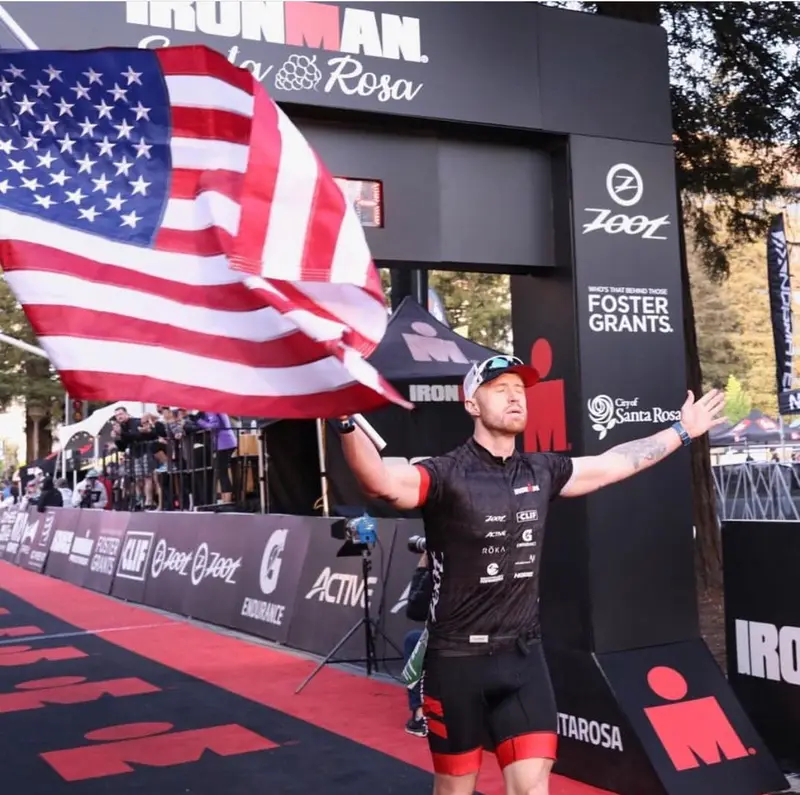
So this year at Ironman Santa Rosa this past May, it was They chose me to be an ambassador for the race because this is Ironman's fortieth anniversary and they wanted to have people who were part of the history along the way of Ironman to be ambassadors for these races. And they said, Okay, what kind of special thing do you want to do for that? I was like, Well, could lead a guided meditation. I don't know, like what kind of special thing I could offer? I said, you know what?
I want to honor a local gold star family. You know, I want to, like, who's the lost son or daughter. So I found a woman, Linda Kainok, who lost her son, and Joshua in Iraq. And I asked her, know, and this was like, kind of felt it. And I was like, I want to carry a flag for him during this race.
I mean, run with a flag a little bit but not for a marathon. I was like, I want to carry a flag. Like I just, you know, that fear again showed up. I was like, let's do it. So I said, would you allow me to honor your son by carrying a flag in memory and honor of him along the marathon for this race and present it to you at the finish line and bring you in?
Because with Gold Star families, what I've heard from them and some of the people who work with them is that there's a big separation between them and the public and even vets because they have a son or daughter who's killed. And then people will rally around them for the funeral and people will rally around them right then in the moment of crisis. But afterwards, people's own discomfort lets them or kind of keeps them away. And so not only do they lose their son or daughter, but they lose the community. And then on top of that, all the vets maybe who served with that person, like myself, if they're dealing with survivor guilt, also don't approach the family.
So then they're just completely cut off. And I was like, this is bullshit, you know? Just like we got vets coming back who are taking their lives because they don't have purpose or it's hard to deal, this is bullshit and this needs to stop. And I was like, we need each other for our healing. So I was like, This is a way we can bring the community, veterans, and Gold Star families together.
And so I carried a flag for her and this veteran's daughter. So the vet's mom and the vet's daughter were both there and I presented it to them and it felt really, really good. It felt good. And I'm like, I don't know if I can run another race without carrying a flag for a Gold Star family. And so I did it again for half Ironman this summer.
And I asked the people I know at Ironman, it's like, so this is cool that I'm doing it. This is I love it, but let's make this a thing. Let's let's can we do this on a bigger stage throughout the country? And they said, Yeah. Yeah, let's do it.
Let's call it the Gold Star Initiative. And so that's what we're doing. And we're gonna officially announce it this November. But next year, there'll be at least six races around the country where a veteran will be able to carry a flag for a local Gold Star family. And it's just gonna be fun, you know, bringing, you know, endurance and sport and things we love to do and connecting with a bigger purpose.
And so, like, we're gonna make this happen and vets are gonna be carrying flags next year and we'll see where it goes. But the cool thing is I've already got a lot of people contacting me like, hey, what's the next step? How do we do this? You know, we're working on the details but the short story is, you know, it's it's gonna be awesome and people's lives are gonna be changed and and people are gonna be reengaged with the community. So it's it is exciting.
Chris Albert (link to this point)
That's amazing, man. That's amazing. You know, it's I really enjoyed this conversation and and there's so much here for for anybody who who's listening, particularly veterans who are trying to get their lives back together. And, you know, really anybody who's trying to get out of a bad situation, not just if you're a veteran, but but but anybody who's trying to get out of a bad situation, who's trying to make change in their lives. You know, you I listened to your podcast a good bit, Transitions from War, and I think it's a it's a fantastic show.
Mike Ergo (link to this point)
Thank you.
Chris Albert (link to this point)
And I really love what you're doing. For people to get in touch with you, transitionsfromwar.com, is that the best place or
Mike Ergo (link to this point)
Yeah. It's probably the best place in there. Instagram, I'm probably the most active of all the social media things. One thing I have for everybody too is just it's a free e book. And I made it I tried to break it down really in style so three eleven's and grunts like me could understand it.
And it's just called Mind, Body and Spirit, Reconnecting to Purpose. And it's just ways to reconnect your mind in a healthy way, reconnect your body through sleep, nutrition, and working out. And then spirit, which means purpose or community. And so it's free to download. And eventually, I'll turn it into a bigger book.
But if anyone's looking for anything to get started right now, it's probably the best way to do it. So transitionsfromwar.com, and then it says, I think download the ebook. It's a tab there. They can check it out.
Chris Albert (link to this point)
We'll put a we'll put a link up on the show notes for people to easily access that from the show too. Awesome.
Mike Ergo (link to this point)
Awesome.
Chris Albert (link to this point)
Awesome. Well, Mike, I want to thank you so much for coming on. Any last words?
Mike Ergo (link to this point)
I'd say that we covered most of it. And I think that the biggest thing that I'm learning right now is that just trusting and developing a sense of intuition and trusting my heart. And if, you know, sometimes that doesn't make sense with my mind, but I have to trust now that that's a deeper knowledge going on. And so if anyone's looking for that, spending some time in silence, spending some time reflecting and writing down their values and what's important to them, you know, that is the key right there. But I think other than that, my relationship with fear and I think everyone's relationship for fear, instead of running away from it, can almost use that as kind of like the direction to move towards because it's something that's always revealed something about me that I can do better at or my next step.
But, you know, facing that fear, it's always intertwined with the excitement. There's a part of us that always wants to go through that because there's something exciting in the other end. If you can see that part of it, it makes it a little easier to deal with.
Chris Albert (link to this point)
Awesome. Awesome. Mike, thank you so much, man. And and everybody out there, you know, take what you learned in this episode, start to apply it, get over there to transitionsfromwar.com, check out that ebook, and get out there and start. Live your best lives while you can.
Rah.
Hey, guys. I just wanna take a moment to thank you for listening to this episode of the Warrior Soul podcast. And, again, I wanna encourage you to share these episodes out with friends, with people who could use this information. Our goal is to awaken the veteran community, and we think that it's the sleeping giant in this country. There's a lot of veterans out there who are imbued with a lot of natural leadership, lot of talent, a lot of skills that could be useful for this society.
And what we're trying to do is we're trying to bring this country to its greatness by empowering them. And so, if you can share this episode out, and please, please write us a written review up on iTunes. Additionally, if you want to connect more with us, you can find us on Instagram, on Facebook, on Twitter. On Instagram, we are WarriorSoulAgoge. On Twitter, we are WarriorSoulGear.
On Facebook, we are the WarriorSoulAgoge on our page. And if you want to join our private fitness group, you can join the Warrior Soul Fitness Academy. Thank you guys so much for listening, and we'll be back at you very soon with another episode.
Host of the Warrior Soul Podcast and founder of Warrior Soul. Worldwide trainer and nutrition coach, contributing author at Testosterone Nation and Muscle and Strength.