Podcast episode
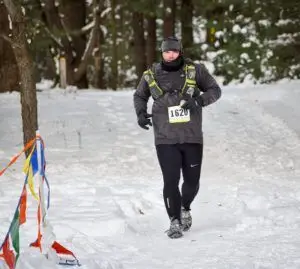
One Ultra Marathon a Month with Ben Davis
Hosted by Chris Albert
The Warrior Soul Podcast
Human beings are fascinated by pushing themselves to the extreme. Whether it be lifting superhuman amounts of weight, or running as fast as possible, feats of physical prowess inspire us to be greater than ourselves.
A growing segment in extreme sports is ultra-marathon- races where runners run 50 miles or more. Normally, when we hear about these races, we think of light and sleek runners.
Ben Davis Is a US Army Veteran, Ultra-Marathon Runner, Coach, and Engineer
Ben Davis defies the norm. At 6’2 and 230 pounds, Ben is far bigger than his compatriots. This adds to the physical challenge, but it used to be much harder for Ben.
After leaving the US Army, Ben settled into a sedentary job and life as a veteran. There his weight rose to over 400 lbs. He was held back from training properly due to physical injury and lack of motivation due to depression and PTS.
One Ultra-Marathon a Month
Ben used to ketogenic diet to overcome both. On his quest, he dropped 120 lbs and committed to running an ultra-marathon a month.
Ben is using his story to motivate other veterans to achieve their own extreme physical feats, and he’s created Arsenal of Hope as a free coaching platform to enable them to do so.
Transcript
Machine-generated from the episode audio and lightly edited — may contain errors.
Chris Albert (link to this point)
This is Chris Albert, and I'm here to remind you of one thing. Someday, you're going to die. Now that's not some morbid statement or scary idea. It's solid fact. Your time here on this earth is limited.
We need to be reminded of this as much as possible for one simple reason, to live your best life while you can. This is the Warrior Soul Podcast.
Chris Albert (link to this point)
What's going on everybody here in the Warrior Soul universe? Warrior Soul universe. I don't know where I get these things sometimes. Anyways, my name is Chris Albert. Welcome to Warrior Soul podcast. This week on the podcast, we've got Ben Davis. Ben is a US army veteran, and he is an ultra marathon runner.
Now, guys who do this sport absolutely fascinate me as it is. They they they run, you know, 50 to 100 miles or or sometimes more than that, And it is absolutely brutal, and they've just just got this remarkable ability to endure. But, Ben isn't your typical runner. You know, he is six foot two. Right now he's about two and thirty pounds.
He used to be four hundred pounds and he lost a bunch of weight, that he had gained, in his own, fights after he got out of the military. And today he's running these marathons, he's got a full time job, works as an engineer, and he started something called the Arsenal of Hope. So in addition to being an engineer, he's also got a bunch of certifications in training and in understanding human performance. And so basically the arsenal of hope is a free coaching system for veterans who want to do something that's pretty much physically crazy, like going out and running a 100 miles. So Ben's a really interesting and smart individual.
I absolutely love speaking with him, had a great fantastic conversation. And Ben was introduced to me by the good people at F Bomb Nutrition, the remarkable sponsors of this podcast, really awesome individuals. They make awesome delicious packets of fats. They're they're really awesome and they make their macadamia nut butters, they mix them up with chocolate, mix them up with sea salt, them up with pecan butter. So delicious.
You can get 20% off of your first order by heading over to www.dropanfbomb.com and use the code Warrior Soul at checkout. These guys are amazing. That's why they're sponsors of the show. They're they're great people. They're sending box of the boxes of this stuff overseas to the troops of the front lines so they can supplement their MREs.
Really great. You know, and beyond that, I hope you guys are doing well out there. I'm recording this on Valentine's Day. By the time you get it, it'll be the Monday after. But I love you all.
Let's get into the interview. What's going on, Ben? How are doing today, man?
Ben Davis (link to this point)
I'm good. How are doing, Chris?
Chris Albert (link to this point)
Doing awesome. Doing awesome. You are out in Detroit area. Right?
Ben Davis (link to this point)
That's correct.
Chris Albert (link to this point)
What is the temperature like out there? I hate talking about the weather or the first first thing, but what is the temperature out like that out there right now?
Ben Davis (link to this point)
Well, it's it's a bit of a mixed bag. Yesterday was, I think, 18, but today, it's in the mid forties.
Chris Albert (link to this point)
Okay. So That's a little bit warm. That's a little bit warm. Right? And and the reason the the big reason why I'm getting into the temperature here is because Ben is an ultra endurance guy, and he's out there plugging away a lot of times in below zero temperatures and that's it's pretty crazy, man.
Ben Davis (link to this point)
Yeah, it's guys are what you get used to it, guess. So we were negative 40 last week with wind chill. So that was that was a good day to not go out. But yeah, we we get out. It gets pretty cold here at the time.
Chris Albert (link to this point)
So awesome. Awesome. So tell us a little bit about your story and and Arsenal of Hope. You you started out in the military, and then and then now you're you're doing this. Tell us a little bit about it.
Ben Davis (link to this point)
Well, Arsenal of Hope came came about in kind of a, I don't know, by accident, because I've always wanted to do something to give back to the veteran community. And obviously, I've been in the Army for six years and with deployments under my belt, and you see going through the VA system you see how people are treated but you don't know what you can do to make a difference. And so my background when I got out I went back to school and I went through and did my undergrad and graduate school in kinesiology and I don't know if I was going to go to medical school or PT or whatever. I didn't really have a direction. I just wanted to help and I saw that you could do some really cool things in kinesiology.
So the big driver behind that was, do you remember that show Sports Science? Yeah. Was on Fox and then it was on ESPN now. Well, the person who oversaw that she actually was a professor at the school I chose to go to and so that's why I went there because well, can we do these things to measure and what can we do to make it better and prior to my time in the military, was actually a professional soccer player. So I lived in I played in Europe and Romania.
And so I left that career after 9/11 to join the Army. And so I'd always been an athlete my whole life and working in those environments. It's always been fascinating about how we can make the body do what it shouldn't be able to do. And so went back to school and, you know, I started in grad school, was going through and doing a lot of work with dealing with training protocols for PTSD and TBI. How can we use a holistic approach to do that as opposed to you know pharmaceuticals and medications because I lost 13 friends to suicide and really in the course of about three years from 2008 to 2011 and they all the same thing all combat arms guys all lots of deployments and on the same cocktail of pills And I think there's got to be a better way to do this and we're feeling better.
So I went through and that's what I was working on. And the foundation I was working with doing my research, we lost funding and I kind of had to find a regular job. And at the time I was also coaching in like performance training, strength conditioning, and I was coaching soccer as well collegiately. And so once I lost, it's funny I kind of get a normal job, and so I got into engineering. And so I kind of put everything on the back burner because I have a family and I needed to make money.
And so I got into engineering. And myself, someone who has like a fake hip and a whole laundry list of injuries that you just accumulate, you know, I just got to let things go. Really, after I had my surgery, was told I'd never actually be able to run again. That's one thing I guess I probably should have mentioned is when I got out, I had to have a hip surgery. And the doctor said, You're never going to run again.
You're always going be in pain. Your life is going to be chronic pain. Here's some meds. Here's whatever. And so and then I was led off into the real world.
So I never wanted to to I guess, live that life. And so I figured there's got to be a better way. So that was again another driver into understanding, you know, studying kinesiology. And so at that time, was never really when I got out, I was was not like I was physically when I was in. I was not in shape.
I was so strong. It can it can move. But over the next course, the next nine years or so, I guess two thousand and nine to twenty seventeen, I started to gain weight, gain weight and gain weight. And no matter what I tried, you know, made some progress and had backslide. Make some progress, hasn't backslide.
And it got to the point where I was almost four hundred pounds. So, and it was December 2016, so going into January 2017, I was just at a really low point. And so even though I had this background and wealth of knowledge and I didn't even help people recover and help themselves. I never helped myself, and so for a variety of factors. And so anyway, so flash forward.
So I got into I started getting into podcasts through whole different things. And so I started listening to some I came across the ketogenic diet.
Chris Albert (link to this point)
And so hold on one second. I wanna I do want to get into that. But but I want to ask you a little bit more about this time period. Right? So so number one, what did you do in the army?
Ben Davis (link to this point)
I was a I was a grunt. So that was the infantry stuff and then some offshoots from there as well. So some other specialized training and other other things. And so did some high speed stuff, did a lot of low speed stuff. And I wasn't I like to say I was remarkable, but I'm not I I was never really remarkable in in terms like that.
I I had a had a good career, and I had a lot of fun, and and and I had a lot of friends, and I spent a lot of time away from home. And so
Chris Albert (link to this point)
well, less than less than less than a very small percentage of the military is actually runs actually infantry. And so that does mean Yeah. As a fellow infantryman, I'd like to say that. So absolutely, man.
Ben Davis (link to this point)
So I mean, it was a I said it was what it was. It was the it was it was the best worst job I think you can have. And so where you get you get to do a lot of cool things, and when you get out into the regular world, you have no transitional or applicable skills. And so but you get you have a good you have a good ride while you're there.
Chris Albert (link to this point)
So well, you do you get you get leadership skills, people skills, and I think that that's extremely translatable. You also get the ability to think about problems in ways that most people won't. So that's something I think you carried over to, right?
Ben Davis (link to this point)
Oh, I mean, for sure. Like, I've I've spoke with, you know, with executives at companies and advocating for veterans. And listen, you know, like, they might not have an MBA. They might not have some might not even have degrees. And I actually had a with a really high level person where I currently work.
I had a conversation with them, and they're like, yeah, you know, do great in our factories and manufacturing. I said, well, if you only if you marginalize a veteran too, that's what they can do, make widgets and, you know, and push a button. I said, then you're missing out because we do have all these crazy leadership skills working under pressure, understanding, you know, commitment to get the job done without, you know, letting things come in the way. And so, you know, for me with what I do, talk it down, but for what a veteran brings to the table, one of the reasons I'm successful at my day job is not because I know what I'm doing and truth be told I don't really know what I'm doing most of the time. But what I do is I don't let little things get in the way like oh, this person never emailed me back or this person didn't call me.
I will physically go to that place to talk to that person or to a supplier to make sure that parts are ready and I do those things. If I get locked out of a building, there's been times where I've just climbed the fence and which, you know, is last blow in hindsight. But, you know, I've worked thirty six hours straight in a white collar job. That's crazy because most people are like, ah, if I'm not getting overtime, I'm going home. Or if I'm not getting paid for it.
And to me, it's about getting the job done. And those are those great soft skills that vets do have. Right. And so a lot of vets, say, I mean, I I guess I can't speak for everyone, but
Chris Albert (link to this point)
Exactly. Exactly.
Ben Davis (link to this point)
I know.
Chris Albert (link to this point)
That's huge, man. I mean, those those those soft skills, being able to to adapt, being able to overcome, being able to to to outwork people, but also having that ability to speak to people in a way that I think is influencing. Right. A lot of people think of veterans as as being these hard edged people who who who, you know, people in the military that just yell to get things done. But it's really the art of influence and it's really the art of knowing people and starting relationships with people.
And that's amazing. Now, you said you had to have hip surgery. What happened with your hip? What was going on there?
Ben Davis (link to this point)
Well, a whole lot of things, but there were incidents that did happen. Cumulatively, you do things like you run five days a week on top of all the calisthenics and then the weight training. With where I was at, doing PT twice a day or exercise physical training twice a day was commonplace. Sometimes you get three times, and then your whole job is physical, right? So a lot of that was just not taking care of the things because the new modified PT wasn't there.
Was just, all right, we're going get in formation, you know, right face forward march, you know, and then you're going to pick up and run.
Chris Albert (link to this point)
Right.
Ben Davis (link to this point)
And so those you know, the proper way to do things isn't as much there. It was just doing it because that's how it always been done. With that being said, there's some great things you can take away from that, and that thoughtless thing is that you're just going to do it and just do it and do it and do it. Unfortunately, you're going to break down at some point. Specifically for me, was getting ready for a selection process.
And so I was kind of was decided, I'm like, okay, going to try to go to this unit. And so I was you know, we were doing like 40 mile ruck marches. The terrain was like 40 miles over land, you know, ruck marches. And, you know, I ended up if you're in, like, I don't know the training area at Fort Campbell, you're in the back 40 there, and and there's a lot of just sinkhole potholes that you don't see. Yeah.
And one of those ones, I just stepped right in and it went down and kind of a Bambi splits type thing and carrying, you know, 75 pounds. So that was kind of the straw that broke the camel's back. So Yeah. And that was the one that they it's pretty much tore everything. And they're like, yeah.
You have to have a complete, you know, reconstruction, and it was it was pretty gnarly, but, I mean, it is it is it is what it is. Yeah. Lot of people had a lot worse than I did.
Chris Albert (link to this point)
So Yeah. And and this is the thing. And and what years was this, Ben?
Ben Davis (link to this point)
2003 to 2009.
Chris Albert (link to this point)
Yeah. A lot of people don't I I was I went into the Marine Corps in the nineties. I had 1999. I was there '9 '99 through o five. And a lot of people don't realize this, but but the training we did back then just and I'm not just talking about like, you know, the field training, but everything we did back then, our mentality toward PT, our mentality toward toward exercise, our mentality toward nutrition.
I think that aged a lot of us prematurely because oh, yeah, you know, you're doing all this this this steady state work. And then on top of that, got your physical job. And then you're putting a lot of inflammatory nutrients into your body. You know, and I remember looking at guys back then I was 19. I would see like a first sergeant who was, you know, maybe 35, but he looked like he was 65, you know?
Ben Davis (link to this point)
Yeah. Yeah. That's for sure. It's my understanding. Things have gotten a lot better, at least in the Army.
I can't speak for marines or or anyone else, but I know that they've brought in they've begun to modify a lot of those standards. They they they've done it in the Marine Corps too. Yeah. I mean, you I mean, you get beat up, and it's just it's just a job that you love and and they don't love you back, or or you you hate it, but you you hate it so much you love it, or, you know, one of those kind of things that that the the the power of adversity in the the relationship you have with the adverse circumstances. And so Exactly.
Exactly.
Chris Albert (link to this point)
So so you're so you get this hip surgery, and and and they're telling you you'll never be able to run again. Right? And and Yeah. What is what what what's going through your head at that point?
Ben Davis (link to this point)
Well, I mean, I don't know if the with the I don't know if they is there a rating on this in terms of, like, you have to keep it at a certain level or I I I said I I said f u, sir. It was a they did an app with curse at the table. Was whatever. Curse it. Yeah.
He's like, okay. I wasn't I wanna be respectful. I just I I said f you. You know? And I said, you're I said, sir, you're full of shit.
And I said, that's not happened. And he just laughed at me and he's like, Okay. He's like, what do I know? I'm only a doctor. I guess he was like one of the top orthopedic surgeons in the Navy.
And so unfortunately for him, I actually I didn't go through them because he's like, all right, it's going take nine months. And it was through a serendipitous kind of thing that I was able to see a civilian doctor who was the team doctor for the Tennessee Titans and the Nashville Predators. And he'd done stuff for the Olympics, and invented a surgery that was made possible to not have the same things as you would have like from a traditional hip replacement, all that same time. And so I was really able to see one of the cool things was, and this has really influenced me, was how much time that not only he, but the PTs and all the people there spent with me going through the process. And so and I don't know if that was because I was a soldier or because you know, full disclosure, like I'm if you've ever seen, I'm a big guy.
You know, right now, I'm at about two thirty five. I'm six two, two thirty five. I look like the linebacker. So I'm pretty sure at the time, I think people thought that I was like a player for the Titans. Maybe that's why they helped.
They worked so much with me or not. I'm not sure. But that really showed that just the amount of time that people would invest in you. It it made it more feasible to know that. Okay.
Well, gonna be fine. I can recover from all this and and I can go. And so That's awesome. Gave me hope. That's good relationships.
Chris Albert (link to this point)
So that's awesome. And so so how long in the recovery was it from that from the surgery? Were you? How many how many months?
Ben Davis (link to this point)
I mean, I had it in February of and by June, I could actually I could actually kind of jog and by August they wanted to redeploy me. Wow. And so I had more of a how do I say this? For me, I was at the time like I was a had overextended my my I was extended like medically. And so they were like, you know, so they didn't think I was going to recover.
I recovered and by the time I said recovered, was like, yeah, I'm ready to go. I want to get out, you know, because I didn't want to be in the Army. You know, I was I had served my time. I'd done my stuff. And so but because of the the shortages of of just the MOS and, you know, the shortage of NCOs, they were like, okay, well, guess what?
You'd have something that we can use. So you're going to go to Afghanistan again or Iraq again. And I'm like, that's not how it's gonna work. And so to me, I felt like I could I could go and I I was I felt recovered in August. And when I say recovered, that's army. It's like military recovered, you know, like really at a it's probably like 60%, if I really am honest with how I felt I was performing. But, you know, a 60% for someone who has that mindset of, you know, go, go, go, that's generally about 85%, 90% of a normal person that doesn't put themselves in those situations. And so I really felt like I was, you know, and I was extra motivated to get out and either I was going to start contracting or I was going to that was kind of the goal was to start contracting. That's the friends that did that.
And so I was like, that's what I was going to do. And so and then I didn't. That's another story.
Chris Albert (link to this point)
So Wow. So you're there. You you know, you're at 60%. And then so you continue on with your military career. Did you you went on another deployment?
Ben Davis (link to this point)
No. No. I I got out. I'd already
Chris Albert (link to this point)
You got out.
Ben Davis (link to this point)
Right? Well, took some so it took some time and some nuance and finesse in understanding how that how understanding the Army regulations and what you can and can't say and what you can and can't do. And so to me, I'd already served my time.
Chris Albert (link to this point)
Right.
Ben Davis (link to this point)
You know, and when I was pursuing them, like, I'm right now I'm medically extended. And you know, with so many deployments that I've you know, in just that five years leading up to that, I was, you know, I had already had so many deployments. I was gone for almost three years of that time. And so I was like, and then I was having people tell me that I was, you know, like, you know, the shitbag and I was, you know, trying to sham and go out things like, woah, woah, woah, I've done my time, you know. Yeah. I've done my share, you know, and I don't mind going, but this is like, this is the like Yeah, that's you're so fucked up, the only thing you don't realize is that the chronic stress of everything as well. And so that was something that was the PTSD and the inability to clear think clearly and regulate emotion as well. But I mean, it was a it was a it was an adventure getting out and but I got out and I mean, kind of evolutions of things happened since then.
Chris Albert (link to this point)
That's a that's a funny thing about the time too because I think, you know, a lot of times there was different periods. Like like, I got out I came back from my my my my last deployment on the day Saddam Hussein got captured. Right? And so I'm looking at the news, and I'm like, oh, great. War's over.
Right? So so left. I'm like, and then I went, I had to have my ankle reconstructed. Right? My right ankle reconstructed.
And so I go and I do that. And then before I know it, you know, I'm looking at the news and everything's reamped, you know, everything happened in Fallujah and then everything's getting intensified again. And a lot of my guys are going back. And, you know, it's I think I think the thing is this, a lot of us, we try to get out, get down on ourselves for when we get out. But you did your time, You know, you did your time.
You did your duty. And and, you know, timing is all is a big thing in this war that we just been through. Right? And so people have different experiences in different periods. And and, you know, I hate when anybody tries to denigrate anybody else's service just just because of that, you know?
Ben Davis (link to this point)
Oh, yeah. Yeah, for sure. Yeah, I was I had to force it. I was 23 when I mean, I kind of I've been to school for a little bit, left school and had a, know, I'd say career, quote unquote. And then I I, you know, I was 23 when I joined.
So I wasn't young. I mean, had I wasn't a typical 18 year old that that gets in. And so some of these things I'm like, I didn't feel, yeah, I wanted to deploy. I wanted to do some things, but I also knew that I was so spun up that, you know, there was something not right, and I needed to be done. I needed to move on and get out.
And so, you know, you always miss your guys, but you always But want to be part of with some of the things I was doing, know, I was, you know, if it was in an advisory capacity or whatever, it did make it a little, you know, it's a little easier. But again, like I I done my I done my time, and it was really one of those things where it was kind of unethical what they were trying to do, like guilt me or just talk, you know, the way they were talking. It just I don't know. Like I said, you know, I look back, and when you're dealing with PTS and TBI and things like that, you can't you were never the same person. You know, like when I come back now and the changes I've made in my life, know, but you're a completely different person, you know, especially when you're all those such you live such a temporary life when you're in, especially when you're deploying and, you know, and
Chris Albert (link to this point)
so No. I I get that, man. Absolutely. How'd you get into ultramarathon? Because, you know, it's somebody six foot two, you know, mid two hundreds in pounds.
It it seems like it wouldn't be the easiest sport to get into, right?
Ben Davis (link to this point)
Yeah. No, you know, the big motivator for me with a lot of things is people telling me I can't do something. Right. So I think back to those doctors that you'll never run again. And I can be semi active, but it's always going to hurt.
Like, it always did hurt. And so getting up to about four hundred pounds. You know, for me, when changed my diet, and just through dietary changes, I lost so much weight. And not only that, but I actually felt good. And you know, the anti inflammatory properties that come that are sequelae of a low carb diet, obviously, you know, forward because of that.
And so when I started exercising again, and you know, some of the psychological factors of it is that, you know, for me, like, a few years, you know, post military, it's like, yeah, I'm not running because it hurts, but I can lift because I'm I'm strong. I'm a big, guy. And so, okay, well, just gonna lift heavy things because I can at least that that will go with how I look, and and that's a psychological component. Well, that's all I can be. That's all I can do, and, you know, it makes sense.
And and, you know, then when you yo yo, you you lose 20 pounds, you gain 40 pounds. You lose 30, you gain 60, and you play those games. And for me, like I said, I was at a low point. I have four kids, you know, fairly successful professional in terms of, you know, having a stable job or a multi stable job, I guess. And I was miserable.
I wasn't achieving things like it would take me forty five minutes to get out of bed. I'd lose my breath, you know, just putting on my shoes and that kind of thing. It was like it wasn't wasn't the kind of example I wanted to be for my kids. Right. It wasn't in, know, I don't think you know better, but nothing really ever worked for me.
And so once I had lost all that weight, I felt good from a cognitively, you know, emotionally, psychologically, physically, you know, again, I've lost a 100 pounds and I'm like, so I'm still running around, you know, 300. I'm like, yeah, I'm going to start jogging again, you know, I'm like, this is great. And so I was able to start jogging and running. I put together 10 mile run. And I was like, why are we still in a VA appointment randomly enough and dealing with, you know, you know, PTS and TBI and you see people, get other vets, and you interact and you talk.
And I'm like, why don't more people know about this? Why does this guy have nine prescriptions for things that are a toxic cocktail? And who knows what's going to happen? He's never going to get ahead. And so, like, I've lost friends.
I'm sure you have. We all know people. And we don't need this stuff. If we kind of change those things, how can we can bring hope to people? Know, for me, like, I could do things I hadn't been able to do for years, you know, for decades.
And so I was like, got to spread I got to spread the word. What can I do? I was like, and a few years ago, I told the one of the counselors of VAs, yeah, want to I want to think I want to run a half marathon try it out. They laughed at me and told me I'm stupid. You know, try something like that.
I'm like, everyone's telling me I can't run because I'm too big or I can't because I whatever. I'm like, you know, I'm gonna run and I'm like, well, maybe do a marathon. I'm like, well, you know, every year 100,000 people 20,000 do the marathon. I'm like, I'll do an ultra marathon. That's even bigger.
Like, you know, people do those. I'm like, why don't I do one a month? And so that should help raise awareness, spread attention and say, you know, this person who's not a runner clearly is, you know, can do it. And so and I did it using, you know, using fat based like a ketogenic style fueling plan, which in all honesty is probably a hack, which, you know, in terms of making it easier for longevity and recovery and all these other things and performance if I was a 100 left. And so
Chris Albert (link to this point)
So so you started this journey came into it.
You started this journey out at four hundred pounds, right?
Ben Davis (link to this point)
At three nine, like three ninety five, three forty, you know, just under four hundred pounds.
Chris Albert (link to this point)
Yeah. And and so wow, that's the I mean, that's that that's insane, you know, and and and you know, you're talking about the power of essentially low carb ketogenic diet, right? And and I you know, I suffered from I was a bodybuilder and power lifter and, you know, I had a lot of the same kind of things as you going on, but I'm much smaller than you. I'm a little short guy, but I got myself up to about two hundred and thirty pounds, five foot eight. And, know, I was having some of the same things, low energy.
The only time I ever had energy was when I was lifting weights in the gym and I started suffering from ulcerative colitis and an autoimmune disease. And it nearly killed me a couple of times. And so I kept asking the doctor, is there any nutritional changes that I can make? And they said the nutrition doesn't matter. Just take your medication.
And I did my own research. I found out more and more about the ketogenic diet and the power of fatty acids like butyrate to rebuild your intestinal tract. And, you know, it did wonders for me. And not only did it do wonders for me, it also helped me increase my performance as a power lifter. I got stronger than I ever was.
And I had more energy to do other things like jiu-jitsu and and, you know, doing more and more high intensity training. So I was healthier and I got I was more capable. So I definitely am with you on this. The power of this diet to reduce inflammatory processes in the body and not only to help you feel better physically, but also to feel better mentally. Because my mental energy skyrocketed, helped me with my business, helped me with my mood, helped my relationships, helped everything.
But a lot of times I would tell people this and and I tell, you know, I I was on YouTube and told people a lot about this. But but people would call me a fool. Right?
Ben Davis (link to this point)
Yeah. Oh, yeah. And that's it's hard to because you're always going to have people and then unfortunately, now keto is getting very mainstream. So I try not to that's not my cross to die on. Right?
Right. You know, but the would say carb reduction, low carb. I try to avoid that word for that for that purpose. And once you can establish kind of a framework of trust, then you can get to know you know, then you can start to explain why with PP and Oikido. But you're not going to give an elevator pitch. The other thing is that like I have like you name the health and fitness organization, like I have their certifications. Have over 50 different ones from, you know, NSCA, ACSM, NASM, you know, CrossFit, USA Weightlifting.
I have all these, you know, like everything under the sun. But are you going to take advice from someone who is, you know, three fifty four pounds? Know, that doesn't you look know, and I've done some kind of consulting, you know, education work for a big box, you know, gym company. And the best trainers they had were actually the worst, the best being most profitable, actually the worst trainers. Right.
You know, in terms of like, know, clients at risk and things like that. But and the best trainers were generally the lower selling ones in terms of revenue probably because they don't push things and they don't miss, but they have they might have, you know, bachelor's degrees and exercise science and they have multiple certifications. But the people who are the most successful ones are they they look they aesthetically look like they're fit. And so people see that. And so to me, it's one of those that I have to get I have to get myself in a place where I can convince people because you got to pass the eye test.
And so for a long time, it was like I always wanted to do some things, whether it be with RWB or Wounded Warrior, but I can't be an advocate for health and if I don't look that part. Right. And so people don't care how many pieces of paper and acronyms you have after your name. It's you got to pass the eyeball test. And so, you know, so to me, that was one of the things where I kind of given up on that because I tried, you know, everything, you know, leading up to to to this.
And I was like, well, it's gonna be, you know, I'm just gonna be a big guy and maybe I, you know, drop twenty, thirty pounds and get a little better. And, yeah, I didn't have a lot of hope for that. You know?
Chris Albert (link to this point)
So That's one thing that they always drive me insane because, you know, people would keep training with these these these kind of fitness model types who had because I used to I used to own a very, very popular gym called Metroflex Gym in Long Beach. And I I would be training my clients. I'd be looking around and, know, we we'd have certain people in there who had very, very, you know, well defined physiques, great great musculature, who are trainers, but they were crappy trainers. And they'd be sitting there looking at their phone, not paying attention to the client, having the client do these risky ass moves without, you know, paying attention to the form or anything like that. And and they continue to to work with this trainer even though they weren't paying attention. You know, it was just, you know, and I used to I used to rip a bunch of people, new assholes because of that. But, you know, it's it's kind of the state of the fitness industry in the social media world where, you know, yeah, the aesthetic is everything, but not only the aesthetic, it's that it's that image of being a baller and, like, you know, trying to trying to carry that million dollar image, and a lot of people are faking it until they make it. And and, you know, it's it's kind of a scary thing because you're playing around with people's health.
Ben Davis (link to this point)
Yeah. Yeah, I know. I feel the same way in ultra running by the way. Yeah. You know, but no, I know exactly what you're talking about and you're missing, you know, those things that you'll never truly be fit.
And a six pack won't give you that or whatever it is, you know, whatever you're looking for, those aren't going make you happy. Know, like fitness is there's so many different facets to it. And so, you know, yeah, there's a fitness component and exercise, you know, there's a nutritional component. There's also that psychological component and that emotional component to it. And if that avoids not being met, you can try as hard as you want, you know, and a six pack isn't going to make you happy again.
You know, it's not going to get those things that you really need. And so that's one of those things where, you know, again, working with people, and it's about changing lives. It's, you know, and if they hey, if that's your goal, if you want that kind of thing, yeah, well, I guess we can you know, there's things that we can do to help you, you know, like as a trainer, like, yeah, I get you, we can do that. But, you know, realistically, if your genetics don't allow you, you're probably not going to have a, you know, an aesthetically pleasing six pack. You know, I'm like that kind of guy where mine don't, you know, when I when my abs are showing, they don't look great.
Know, like my brother has that surf, you know, like he's long and lean. He's six'four, you know, like one hundred eighty five, and he's just always has that model build. I don't have that. I'm, know, I look like a, you know, a power lifter. I look like a linebacker, you know, and so and I and I and I don't really care.
I'm happy with that, you know, so look like a man.
Chris Albert (link to this point)
You look like a man.
Ben Davis (link to this point)
That's awesome. But then that's yeah.
Chris Albert (link to this point)
Yeah.
Ben Davis (link to this point)
Exactly. And, you know, to me, it's about, at this juncture in my life, is one helping even a lot of people that I see and deal with in terms of the veteran community, they're not looking to get six packs. They're looking to figure out how to, you know, unfuck their life. Right. You know?
Because they got to be, you know, like, they they don't have those components. They have no hope because, you know, their injuries limit them, you know, and really, in all honesty, it's that space between their ears that limits them, but they don't know that. Because one thing we're good as veterans is in our previous life, we're taking orders. So we're always kind of we do what we're told. So if we're told, hey, you're going to be in pain, take these pills, you're going to do it.
Chris Albert (link to this point)
Right.
Ben Davis (link to this point)
Because that's what you're told to do. There's that level of respect. And so until we can break the cycle, know, then it's not going to change. And so the hope is to kind of, you know, at least put a dent in it. Right.
And start making a difference. And whether that's getting people out, and there's lots of organizations that get people out. Like, I've been more involved with Team Red White Blue, and some of the stuff they do is great, but if you can't if you can hardly walk, do you really wanna get out and run? Right. No.
You know? So we wanna get to the where they can get involved with those things.
Chris Albert (link to this point)
No. That's awesome, man. I I wanna know about your so your first Ultra. Right? Because that's gotta be that's gotta be, like, the the the the most painful race you ever run there.
I'm sure there's more painful ones, but but it's the most mentally destabilizing race. Right? So so tell me about your first ultra, and and how did it go and what did you do to get through it?
Ben Davis (link to this point)
So this is a this is a not like a caveat thing, but I decided to do these ultras in November. And so, again, now I'm still losing weight. I'm not I've only been running for, you know, again for, by that point, maybe a month or two. And so it wasn't a well thought out plan. And so to do that, probably in hindsight, I probably should have waited, you know, but that being said, you know, I decided with these ultras, that I think was around November. So this January 1 or January 6, I ran that first one.
Now it was on the West side of the state Michigan, which is just gorgeous in terms of view if you're in the outdoors. And we just hit this it's called a bomb cyclone, which I don't know if you get you probably get those out and where you're at. But it's a massive drop in temperature like polar vortex kind of thing. So the actual temperature was in the negative negative 10 negative. I've heard conflicting reports, you know, people said it's cold negative 20 and it's a couple feet of snow.
Now to make matters worse, for whatever reason, this very specific layering system that I prepared for this, I didn't it wasn't where it was supposed to be in my bag, and I must have forgot it because, again, all the nerves of packing the first one. And and so I didn't have the actual cold weather gear that I I needed to end up running in a, know, like a I had a sweatshirt. Was it cotton? Was like cotton. This is actually So I had a merino I had a merino wool t shirt and a merino layer under it and then a cotton sweatshirt.
Chris Albert (link to this point)
Oh my god. And then for those of you who don't know that when it comes to cold weather where there's a there's a saying, it's called cotton kills. Right?
Ben Davis (link to this point)
Yep. So the savior was was the merino wool, which is great. But all that being said, not that there's any savior. So I had the water I was carrying because I'm like, that point, I'm like, I need to carry as much water and fuel as I can, which for me I used f bombs and pickles and some walnuts and then the water. So I had like two, like the 100 milliliter soft flasks and then a CamelBak, a three liter CamelBak, which in my work up to that, I was like, yeah, that's fine.
You know, that's enough in my training. I timed it out. Well, I knew nothing. I didn't factor in insulating water bottles or any of that stuff. So that's all that water froze.
It froze. And so it was just carrying around like solid weight. Like when say froze, mean, it was a rock. Like, it was frozen solid. And so the only thing I had was some, like, the pickle juice.
So getting to those eight stations, I think it was rough. And then to make matters worse, I if you've run an ultra, like, race director is like, oh, yeah. The course is really well marked. And they say that because that's, like, their home course. They know how to run it.
Chris Albert (link to this point)
Right.
Ben Davis (link to this point)
If you're not from there, it's not well marked. And with all the trampoline and the snow and every you know, it got I had taken a slight detour and followed like a snowshoe path because it all looked the same to me. And because everything, again, there was like, you know, foot foot and a half snow or whatever. And so, I mean, imagine it's just it's like being on just like a frozen forest, something you'd see in a Disney movie or something like that. It was really awesome, actually, very, very cathartic.
But so with that loss and everything, I ended up doing it was a two, supposed to be two twenty five Ks Loop. And I ended up doing 25 miles on the first loop. Then it was a pretty technical course, which didn't make things better. So I ended up finishing with like I ended doing, like, 27 miles. But because it was so cold and we had lost light, I didn't have a mat like a headlamp, and they had the the race director the race people were like, you know, we don't wanna be here till, ten at night.
I had a dropping from the race, but I had in essence, I had run an ultra. So I'd run the distance. I just didn't finish the race just based on for me, what I felt like was safety, like a safety concern. I'm like, I don't wanna I don't wanna fucking die out here. Right.
So I technically did run an ultra for the first one, and I felt actually amazing. And it was so cold, in all honesty, that I didn't feel anything. So when you say painful, it wasn't painful. It was even psychologically, it wasn't painful because, you know, when you do extreme land nav, like when you're in, like, know that you always doubt yourself, you know, especially when you first learn land nav, and I'd done so much land navigation that I knew I'm like, these these waypoints and these flags are gonna come up. They're gonna come up.
They're gonna come up. And, you know, so I just kept going and kept going and kept going and just trusting myself. And, yeah, so I trusted myself too much, and I probably should have doubled back. But so I didn't really have a lot of anxiety when I was out there. And truth be told, I wanted to come home to my kids and not die.
So I didn't feel bad about again, it's technically a DNS even though I covered in ultra distance. But but that was my first ultra experience. It was it was I learned a lot to say the least. Yeah. And so when I finished, I think it was in the I was in the positive temperatures.
I think when I, you know, when I finished, I think it was, like, up to, like, four degrees. The actual temperature, I'm not sure what wind chill was. So
Chris Albert (link to this point)
Wow. Wow. Now you have really, really put a lot of thought into footwear. Right? As far as Oh, for sure. Types of shoes you're in, I'm sure you have to because because you're you're a large gentleman, and and you need to make sure that that, your feet are standing up to the pressure. What's your take on footwear?
Ben Davis (link to this point)
So for me, with anyone, you need to be wearing like a shoe with zero offset or as little offset from heel to toe as possible. That doesn't mean a minimalist shoe. Obviously we'd like to work that way but something with a zero offset and even just a few millimeters what that does that changes again when we run and we do things that offset that shortens our Achilles
Chris Albert (link to this point)
that's what do you mean by an offset? What do you mean by an offset?
Ben Davis (link to this point)
Just so from the heel to toe, but a lot of times it's called a zero drop shoe, right? And so there's a lot of brands out there. You want a very minimal offset A lot of the popular ones you have like I know Salomon sent me shoes and there's companies that sent me shoes, but it's like a ten, twelve, sometimes 18 mil offset, which again if you think about that distance on a ruler, it doesn't look like that much. But again, those patterns it can really affect over time, if you know runners are that's all they do is run. So when you get all that repetitive motion stress and those adaptations that happen throughout the kinetic chain, that's going to lead to imbalances and aberrant patterns forming which lead to injuries.
And so for me, went with a zero offset. And so I wear a brand called Altra. Now it's not a minimal shoe, but there's no offset from heel to toe. It's also a wider toe box so your feet can splay, which makes sense. But there's a lot of other companies out there.
But having that zero offset, it creates a more biomechanically efficient stride. And for me, it's one of the big things that I credit with being injury free now through that time. You get little bumps and bruises and, you know, things like that, which that happen. But most times, I would say, I remember, it's like seventy percent of runners will go through a season with some kind of injury that will cause them to miss things. And so the footwear that we choose, and that's even with casualties as well, it's always creating patterns.
And so we want to put ourselves in the best way possible. And so for me, like I said, I'm a huge proponent of that. And even though there's lots of brands out there that I love that have more of an offset, I haven't worn shoes with an offset for almost two years now, maybe a little less than two years. And so, yeah, so that's again, it's huge. And I have the five finger shoes as well.
But again, minimalist and zero off set or zero drop are two different things. The minimalist is you really have to be careful and work yourself into because if the muscles and ligaments and tendons in your feet aren't used to that, it's going to mess them up. Ideally, you'd like to get to that point because that's going to make you a stronger athlete overall or more resilient to injuries overall. But it's working to that point. I would have some minimal issues as well.
Chris Albert (link to this point)
What's the best buy? The best buy for a a for a zero offset shoe out there? Because I I know you you mentioned a couple, but would are there are there any, like, for somebody who's just getting started and and who who might not want to spend like like a lot of money. What would be the best one?
Ben Davis (link to this point)
You know, honestly, so the problem is is that like with everything else that they get the label and becomes popular or mainstream like people are going to go for it. And so for with I get I get a lot get a lot of scripts and and discounts and things sent to me, but the best thing to do really is, like, go to, a like a TJ Maxx or Marshall. They have, a Sierra Trading Post or you can find anywhere online and get, like, last season's models of things like Altras. Like, can get them for like 40, 50 bucks, which in essence, it's the same shoe. It's just a different color, you know, depends on what you're looking for and and just, you know, shop bargains like that online and deals.
And so that's really probably the best way. Or you can go through like an expert voices. So if you're a veteran, you should have an expert voice or experticity account. If you don't know if it is, just Google experticity or expert voice. And what that does is like you can get discounts to thousands of companies.
And Altra is on there. There's Innovate. There's a lot of companies on there that you can actually get like forty, fifty, 60% discounts.
Chris Albert (link to this point)
Oh, wow.
Ben Davis (link to this point)
You know, wholesale, retail, you know, like, yeah. So if you're a veteran, all you need is your 214, you black out the thing and you apply, you know, for they have an army specific one or a marine one, a navy one. Yeah, I guess that's probably the first place to go because that way you can get all the newest stuff and do that. You can I mean, there's everything from hunting, shooting, athletics, I mean, pet care, you know, baby stuff, you name it? It's expert voice.
X
Chris Albert (link to this point)
it's x and it's xexperticity.com. Experticity.com? Yeah. Awesome.
Ben Davis (link to this point)
Yeah. I think so.
Chris Albert (link to this point)
Yeah. I'll I'll get that
Ben Davis (link to this point)
the best place to go.
Chris Albert (link to this point)
Very cool. Very cool. I'm actually gonna write that down. Yeah. I'm gonna I'm gonna get that up in the show notes for everybody.
Now we've gotta gotta sign off in a second, but, you know, a couple more questions here about Arsenal of Hope itself. So Yeah. Yeah. Where are you taking Arsenal of Hope? What what's your main goal with it?
Ben Davis (link to this point)
All right, perfect. So there's a lot of great organizations that do veterans like, hey, get them out in community and you get them active. The problem is, is we got to get to the point where we are. And so for me with Arsenal of Hope and for one of my strengths and my background is working with that transitional period from your discharge from rehab or you have a recurring thing, but you don't have PT visits, but almost like corrective exercise or, you know, it's not quite, in essence, like a physical therapy without actually going to a physical therapist, if you will. So corrective exercise or force training.
So for me, the big pillars of of Arsenals of Hope are, one, providing free health coaching to veterans. And so, you know, whether that's the diet, lifestyle, nutrition, habits, it's all free of charge. And so, you know, and you don't have to be Detroit here. We can do a lot this through, you know, Webex, Telemedicine, things like that. I have a pretty wide network across the country as well, people that are getting on board with it.
The second is to provide post rehab training and mobility work to bridge that gap. Okay, yeah, I say, all right, you had reconstructive surgery, you know, ten years ago and you want to get active, but you're not really sure. And okay, well now we can we can get you there to a point where your body's in line, your balance and you have a foundation to build on to go from there. So now you're ready to, hey, I can do this run, or I can do this Tough Mudder, I can, Hey, I can do an Ultra. And so we're going to provide that training for you for free and then that work for free.
And I find that the difference between myself and the people that we do and physical therapists and doctors is that they get a very small time to work with you. When I work clinically, I could spend three hours with a person and those relationships and bonds that help empower people to know what to do to help themselves, you know, recover, be the best version of themselves, go beyond what they thought was possible. Whether that's teaching people how to walk again or, you know, people who want to take their sports to the next level. So that post rehab training, part is a big proponent. And then adaptive sports coaching as well.
If people need that, we'd more than help to put programming and things. And then if you're here in the Metro Detroit area, we can work with you. And then we're also there's another offshoot. We're working what we call green team, which is people who want to try to exceed their expectations of themselves physically, psychologically. Want I was able to run these ultras at virtually no cost to me because I had sponsors.
Well, a lot of these events, know, ultras, ironmans, strongmans, whatever you want to do, whatever it doesn't just have to be running related or endurance related. They're very cost prohibitive. And so the whole point is to get those people that want to do something like that and help figure out a way to offset those costs and mitigate those costs. And so we call it green team. And in doing so, want to inspire other people to go beyond what their limits are.
And so, so yeah. And then, I guess lastly, is things that we're doing now is we're actually doing education seminars, mobility and health summits, getting you know, going out to facilities and working with groups of veterans on a small or large group basis, presenting them with information, ideas, training, whatever it is that they need to help get them over the hump and help them not just over the hump, help them find hope. Because to me, if I was if I could have dropped 50 pounds last year, would have been happy. But the fact that I'm running ultra marathon, now I have the whole world is is a possibility, which has opened up doors for me to be on, you know, various media outlets or interviews or meeting with high level people or whatever it is, getting sponsors, that's opened the door to a whole bunch of things that we've talked about previously. And so that's the whole hope is to give hope where there is none.
Chris Albert (link to this point)
That's awesome. That's awesome. And and where can people find you and and and get on to work with you? Where are you? I know you have your Arsenal of Hope website.
Are you also on social media?
Ben Davis (link to this point)
Yeah. So we have websites, arsenalofhope.org. I'm doing my best to become a better webmaster. And so we do have a lot of times there that, you know, there's a blog on there we follow, do some reviews of things as well. If veterans are interested in things, have a veterans resource tab where fill out your info what you need and we're going to get you started.
Or if you just want more information, we can work that out. And then social media, everything's arsenalofhope. So Instagram, Twitter, there's a Facebook as well, I think. I'm not good with Facebook. I should be.
That's what I got to figure out how to do. A lot on Instagram and Twitter are pretty much the same thing. It's just pictures of whatever it is we're doing, whether it's training, motivational stuff, know, you're looking for food ideas, whatever it is, just random things you see on social media. So so that's what we have on our Instagram. That's at our soulful.
Then we have a podcast also, our soulful podcast on Google Play, iTunes, Twitter or Twitter, Stitcher, and all the other ones.
Chris Albert (link to this point)
So Awesome. We'll get all that linked up on the show notes along with the experticity and and some of the other resources you have up there. You know, Ben, I want to thank you so much for coming on. I want to thank you for the work you're doing. And and, you know, I want to acknowledge you, man.
All the stuff that you've accomplished is not easy at all. And it it takes a a good amount of mental strength and fortitude to be able to do these things. So so, you know, awesome work. And and again, thank you so much for coming on to speak to our crew.
Ben Davis (link to this point)
And I appreciate to have you, Chris. Thank you so much.
Chris Albert (link to this point)
Awesome, guys. And for everybody out there, the show notes will be up for this episode. Make sure you go and check them out. Take advantage of some of these resources that that Ben talked about. And, you know, get out there, move, push yourselves, and live your best lives while you can.
Host of the Warrior Soul Podcast and founder of Warrior Soul. Worldwide trainer and nutrition coach, contributing author at Testosterone Nation and Muscle and Strength.