Article
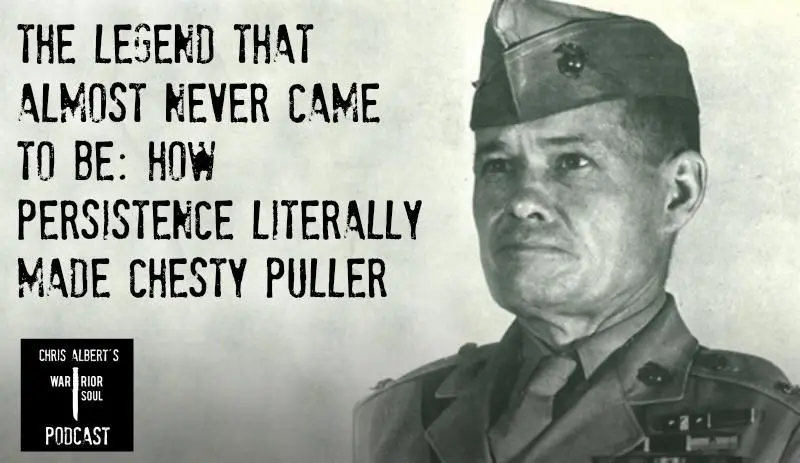
Podcast Episode 3: The Legend that Almost Never Happened – How Persistence Literally Made Chesty Puller
By Chris Albert
1 min read
FIND US ON ITUNES AT: https://itunes.apple.com/us/podcast/chris-alberts-warrior-soul/id1096901382?mt=2
Transcript
Machine-generated from the episode audio and lightly edited — may contain errors.
Chris Albert (link to this point)
What's going on everyone? This is Chris Albert, and welcome to Warrior Soul podcast episode three. The last episode was a pretty heavy episode, and we explored death. We explored the fear of death through the eyes of E. B. Sledge in his book, With the Old Breed, which described his combat experience on Peleliu and on Okinawa during the Second World War. And we discussed perspectives on death, and how our perspective on death forms life. And how if we don't have a healthy perspective on death, we can really be wasting life. And if you haven't listened to that episode, I definitely suggest going back and checking that episode out. Today we're going to be talking and starting to have a conversation about perspectives on life, and ways of living your life to get the most out of it.
And today's subject is on something that we call persistence. It's a real characteristic that we don't appreciate as much in our heroes as we should. Because when we hear about our heroes and the people we look up to a lot of times, we just hear about their success. We hear about all the things that they did when they were at the top of their game. But many times we don't hear about the backstory.
We don't hear about the suffering. We don't hear about the years they waited in order to get to where they got, and how they got to the epitome of their fields. And today we're going to be deconstructing one of my heroes. In fact, this is not just one of my heroes. This is somebody who if you were in the United States Marine Corps, and the Marine Corps if you compare the Marine Corps to a religion of sorts, then this person could probably be considered its Messiah.
If you're not in the Marine Corps, or you're a civilian, and you don't know who Lewis B. Puller is, also known as Chesty Puller, I suggest you pause the podcast, and you go and Google him right now and just look up a few things about him for about five minutes and then come back to us. Because I can't emphasize enough how important this man is to the United States Marine Corps and Marines around the world. This is a guy who won five Navy Crosses, which is the second highest award that Navy or Marine personnel could win next to the Medal of Honor. He fought in Haiti.
He fought in Nicaragua. He fought in World War II through four campaigns, and he fought in Korea. He was surrounded by multiple Chinese divisions in Korea, and he fought out of being surrounded. And he got his division out alive, and that's how he won his last Navy Cross. This guy is probably the most important Marine who ever lived.
When Marine recruits go to bed at night at Parris Island or in San Diego, the drill instructors often have them say before they go to bed, Good night Chesty Puller wherever you are. That's who this man is. And the thing is his Marine Corps career almost never happened. And I don't think that most human beings who exist on this planet today could have endured what he did just to get into the positions that he got into. This man spent almost fifteen years in an entry level position in the United States Marine Corps.
And we're going to go into that backstory today. And we're also going to be relating it to us, and our quest for success in this life. And the bottom line here is that, what we're trying to get to is that life is not an event, it's a journey. It's a road that you have to travel. And in order to travel that road properly to get to where you want to go, you have to have a goal.
You have to have direction, but you also have to be tough as nails, and you have to have thick skin. And the book we're going to be looking at today is a biography about Chesty Puller. It's called, Chesty, The Story of Lieutenant General Lewis B. Puller USMC, and it's by Colonel Jon T. Hoffman.
And what I like about this book, there's two biographies about Chesty. There's one called Marine, and that was basically Chesty's memoirs co written with somebody else. And I've read that book, and I like that it has the first hand sources from Chesty. Generally I like to read the word straight from the horse's mouth. But that book didn't go enough into his backstory for me.
Was mostly a memoir of his time in battle. It talks a little bit about, you know, what he did to become a second lieutenant in the first place, but it didn't have enough detail for me. What Colonel Hoffman did in this was he actually went back into Chesty's military records, and he looked at all of his fitness reports. He looked at all of his evaluations from his instructors, and he saw the ups and the downs, and he gives us a really great story that we can work with, and that we can translate into a message for all of us in how we should all be persistent in trying to get to where we're trying to go. So let me start with the first passage here, and I'm going to set the scene for you.
It's June 1919. The greatest and biggest and most awful war that the world has ever seen, just came to an end about seven months earlier. And Chesty Puller is about to graduate from OCS for the first time. And starts, The two thirty one handpicked enlisted men marched into the gymnasium at the Marine Corps Base Quantico, Virginia for the last muster as a unit. It was 06/16/1919, graduation day for the third officer's training camp.
After five months of strenuous effort, each man had earned commission as a second lieutenant in the Marine Corps Reserve. The post band opened of ceremonies with a medley of martial tunes capped by John Philip Sousa's March Semper Fidelis. The music turned out to be the most stirring portion of the program, which otherwise consisted of short speeches and presentation of commissions. A reporter noted that the striking feature of the proceedings was their solemnity and simplicity in comparison with graduations at West Point and Annapolis. Although the writer ascribed this difference to that precision and lack of fuss so characteristic of the doings of Marines, in truth, there was little to celebrate at the moment.
Seven months earlier, there had been rejoicing when an armistice ended the war to end all wars. Now The United States was rapidly demobilizing its forces. The commandant of the Marine Corps, Major General George Barnett, pointedly noted in his speech that this placed the class in a peculiar position. This commissioning ceremony would not launch the lieutenants on a grand and glorious new career. Rather, for most of them, it marked the end of their service as Marines.
With the exception of a few pre war NCOs, the vast majority of the men had joined the corps with patriotic fervor to fight the Germans. Few of these wartime volunteers had seen action, and they now had to return to civilian pursuits with the exhortations of the speakers as their only reward. Barnett told them, Whatever after this you do in life, your service will have left its traces in your hearts. Once a Marine, always a Marine. Major General Littleton W. T. Waller echoed that theme. You've come in and absorbed our traditions and beliefs, and I tell you, you can't go wrong if you live up to their principles. Now, basically these guys had just gotten through OCS, and they were told, thank you for trying out, now go back to your civilian lives. And to give you a little bit of backstory as to how Chesty Puller ended up in OCS at that point, he started this quest back when he was a teenager.
You know growing up he heard tales of his ancestors who fought with the Confederacy in the Civil War, and he came from the same family that General George S. Patton, the famous US Army General from World War two came from. Except Chesty's side of the family wasn't as rich as Patton's. They weren't wealthy, you know, his father was very working class, they just basically got behind down there in the South. But they had pride in their family heritage, they had pride in, you know, the legacy that their relatives had provided for them.
And so Chesty wanted to become an officer in the military. At first he was going to try out for the US Army. So he went, he spent a year at the Virginia Military Institute, which is a very strict military institution that's still located in Lexington, Virginia. And during that time he learned a lot about drill, he learned a lot about how to keep his uniform, and he kind of performed middle of the road in his class. He wasn't like the best academically, but he also wasn't the worst.
While he was going in, while he was doing that first year at the Virginia Military Institute, The United States had just gotten into World War One. So World War One started in 1914, and it was a European war. At the time The United States really didn't want much to do with it, except to, you know, be able to sell different supplies to different countries that were involved in the war. And so it really avoided jumping in, and it wasn't until the German submarines started taking down American ships, that The United States decided it was going to get into the war. And in June 1918, The United States saw its first combat, and that first battle was known as the Battle of Belleau Wood.
If you're a United States Marine, you know the legacy of Belleau Belleau Wood very well. Both the United States Army and the United States Marine Corps fought there. But the United States Marine Corps ended up getting a lot of the press for that battle. Now that's not to take away from any of the bravery of the US Army soldiers who fought and died there. But it's to say that when the Germans fought the Marines, they basically saw them as shock troops.
And they called them Teufelhunden, which means Devil Dog. And that's how we got the name Devil Dog. And there was another famous scene there where Gunnery Sergeant Dan Daly, who had already won two Medals of honor, was in the battle. And he saw his Marines getting held up, and so he started walking at the German lines, firing his machine gun from the hip. And he screamed, come on you sons of bitches, do you want to live forever?
Trying to get his Marines to move forward from the line. And it's likely that while Chesty was at VMI, he read a lot of this press. And the Marines had adopted this slogan from the Battle of Belleau Wood, because they were the first to engage the Germans in World War One. The slogan is First to Fight. And so Chesty, being somebody who wanted to gain experience as fast as possible, decided that he was going to leave VMI, and he was going to pursue a career in the United States Marine Corps.
And so Chesty went to Parris Island. He went through the Enlisted Boot Camp. While he was there, there was a real shortage of NCOs. So they were running an NCO Academy there. After he graduated from the Enlisted Boot Camp, he went to the NCO school immediately because they needed NCOs to fill the lines.
And so he got through that school. And then he applied to Officers Candidate School, and he got in, and he got through OCS. Now a couple of things about Chesty through his training. He really wasn't the best recruit. He qualified marksman on the rifle range, which is the lowest qualification score you can get with a rifle in the Marine Corps.
You know, his he got some below average marks in different aspects of military life. He got above average marks in his bearing and his drill. All things that he probably learned previously at VMI. He was also a really average person. He was about five foot eight, one hundred and forty five pounds, pretty skinny, not very athletic.
So there was nothing really naturally remarkable about the guy. But they liked the way he did his drill, and so they took him to the NCO skill NCO school, and then from there they accepted him into OCS. And after passing OCS, as you just heard, he was told, well thank you very much for coming and trying out. Now it's time for you to go back and to become a civilian. So imagine that you go through Marine Corps boot camp.
You did a year at VMI previously, which is no picnic, a very strict military school. You get through NCO school, and then you get through OCS, and you get through all this training, and then you're told the Marine Corps doesn't need you anymore. Go home. What do you do? What do you do at that point?
And I like to think about what I would do in these types of situations, and honestly at this point you know World War One has just ended. It's, you know, information's coming back from the front lines at this point in time, because there wasn't a lot of information coming back during the war. And you hear about how awful that war was. I mean, we think of battle today, and we think of all the things that our troops go through. But we're talking about people who were on the front lines for months and years at a time, with constant artillery barrages, living amongst the corpses of their comrades, because they couldn't take them out for burial, because the machine guns were so trained on their positions.
If they tried to bury their men, they were going to get cut down themselves. You have feces everywhere. It's said that at some of the battlefields, you could smell the battlefields from five miles away. And people are dying from diseases, getting things like Immersion Foot Syndrome, having to have their limbs hacked off, not from rifle wounds or anything like that, but because of the conditions. And at that point you're hearing all this information, and you're just told that you don't have to serve.
And I'm sure that some of the people in Chesty's class probably had a buttload of relief. They're probably really happy to go back to their civilian lives. And they were probably really happy to say that they at least tried, and they got the title Marine, but they got to live their lives out without ever have to well, ever having to experience something like that. You know, I'd like to think that I would be brave in that position. I'd like to think that I would do my duty, and I'd like to think that I would have been amongst the disappointed.
But I also know that there would have been a sigh of relief on my part. I know that had I known what World War One was like at the time, I probably wouldn't have really wanted to go out there. But Chesty was disappointed. Chesty wanted a military career above anything, And so he had to figure something out. And he considered a bit about going out to Poland and becoming part of the Polish resistance to fight the Soviets.
Because the Soviets had just pretty much taken over Eastern Europe. They annexed Poland, and they were basically, you know, solidifying their rule out there. And and Chesty wanted to be able to do that. He wanted some war to participate in. But somebody came to him and they said, you could still be in the Marine Corps, because The United States has small engagements around the world still.
I mean, it's got engagements throughout Latin America. It's got engagements in The Caribbean. He said, they said to him, you know, why don't you go down to Haiti? The only thing is you're gonna have to resign your commission and become an enlisted Marine again. And so Chesty decided that all the work he put into becoming an officer in OCS, he was going to put that to the side for now.
And he was going to pin on a private rank and head down to Haiti. So he resigned his commission, became a private again, and got on a boat to Port-au-Prince, Haiti. Now the situation in Haiti at the time was a lot like what we see with Iraq today. There was a government there that was being fought by insurgents. They hadn't a really not a strong insurgency there, but it was strong enough to disrupt the very weak government that was in existence at the time. And even today Haiti is not the most it it's not a developed country at all. I had a squad leader while I was in the Marine Corps who had gone down in the 1990s when The United States had one of its interventions down there, and he said that it was pretty much the worst place he'd ever been on earth. He said there were people trying to bring their dead babies up to the line to see if they could be revived. He saw people starving and the amount of suffering that was going on down there as recently as the 1990s and probably still today is really significant. And at Chesty's time, the country was going through much of the same thing, except it didn't have a lot of the modern conveniences of a sewage system.
And so when Chesty first arrived there, you've got to think that this was not exactly the best place to be spending the next few years of his life. And we are talking about years here. You know, Chesty wasn't going to spend six months there. He wasn't going to spend just a year there. He was going to spend least two years on the island before he got a break, and he'd be on the island for a total of five years.
And he would have known that coming up to the island, because deployments back then were a lot longer than they are today. And in the book talks about pulling up to the island and smelling the smell of burning shit from people burning the material that was coming out of the of the latrines. And for those of us who've done latrine duty from our experience on deployment, we all know it's not a very pleasant smell. And on top of that he's basically seeing that the people there are living in poverty. Again, much different from deployments that many of us who are listening to this podcast have done.
But he's going to be experiencing this for a very long time, continuous time without break. And he's going to experience a lot of isolation, because at many posts in the island he was the only United States Marine there. He was basically leading forces made up of the native Haitian police force, And he was searching for this group known as the Cacos. Basically the Cacos were bandits, and they were trying to overthrow their government down there. And they were kind of ragtag groups that carried around a mixture of firearms and machetes.
And they terrorized the countryside, they would rob people, they would rob supply lines, they would seriously disrupt the government in Haiti. And Chesty made a bit of a name for himself down there. He got himself in, I think up to 14 engagements with the enemy. Set up, you know, types of ambushes, searched them out, killed the enemy, raided their camps, got information, got more information to search out more enemy, and then killed more enemy. So basically this was a lot of search and destroy, but the other part of the job was as an administrator.
So in addition to doing all this, he was going around and he was collecting taxes, he was taking note of things that needed to be fixed in the villages, and he was basically operating as a government official for the Haitian government, and trying to bring some sense of normality to the citizenry down there. And again, the parallels to what a lot of us experienced in Iraq are significant. I mean this is very much like the counterinsurgency that many of us who fought in later deployments in The Middle East had experienced ourselves. So we see a lot of parallels to our own lives in modern day, from what Chesty was going through in the early part of his career. But again, you have to remember that this guy was a private in the United States Marine Corps.
He did not have a commission yet. He made a few mistakes, but for the most part he performed very well. He was known for being really organized, for carrying out orders to the satisfaction of the commander. And after a couple of years down there in Haiti, he decided he was going to apply for OCS again because he heard the United States Marine Corps was trying to take on more officers. So he applied, and the first time he applied, he got denied.
Regardless of his combat experience, regardless of what he'd been through, they weren't gonna take him. They were basically he either didn't have somebody on the board that could help him out, or for whatever reason he got denied. A couple of months later he heard that they were taking on more officers and they were doing another OCS class, so he applied again, and this time with a few recommendations from his commanders he got accepted. And he went up to OCS, and this is two years after he got on the island of Haiti, He went up to Marine Barracks Washington DC, and went through the OCS class there. And at the beginning of the OCS class he was doing really well, but toward the middle he started to slip off.
And toward the end, he really started to slip off. He came back from Liberty about two hours late. He got a summary court martial for that, and got himself in a lot of trouble. And though the command could have thrown him out right then and there, they didn't. But Chesty ended up failing out because he couldn't really handle the academic classes that they were giving.
And reason for this, I mean during World War One when he went through his first OCS class, were probably a lot less stringent in who they were letting through. In peacetime the military tends to be a lot more selective as to who they make their officers, and Chesty just wasn't cutting it academically. And so he failed out. Now imagine that, he gets through boot camp, He gets through NCO school. He gets through his first OCS class.
He earns his second lieutenant bars. He has to resign his commission if he wants to stay a marine. He goes through two years in Haiti. He applies to OCS one time, doesn't get in. He applies a second time, gets in, but then fails out.
And again, we see the persistence. Again, we see how Chesty was so obsessed with his goal that he would do anything he could to get there, and he didn't quit. So he goes down to Haiti to fill out the rest of his enlistment, and again he performs performs really, really well down there. About halfway through his second time down there, they basically wipe out the insurgency. They've killed everybody, they've captured the leadership, they have set up things so that Haitian Haiti can function as a government.
And he goes into administrative duty, and he's still down there just basically training the police force, handling all administrative tasks that I talked about before, and he finally hears about another OCS class. So he decides to give it another shot, And so this time he goes back up to Marine Barracks Washington DC, he takes the OCS class for a third time, and he passes. He gets his Lieutenant Bars, and now he's a United States Marine Corps officer. And here's the good and the bad about Chesty becoming a second Lt. While Chesty was serving as an enlisted man and an officer in the Haitian Gendarme, he was making double pay.
And so as United States Marine Corps Sergeant, which was the rank he got it got to in his enlisted rank, he was actually making more pay than he would as a second lieutenant. As a second lieutenant, he'd make about a $125 a month, which for even for that time wasn't very much. But he was also making more than that because he was also getting paid as a gendarme officer. So to become a second lieutenant, Chesty had to take a pay cut that was more than 50% of a pay cut from what he was making. So this is an enormous financial decision.
He was going to lose a lot by doing this, but he still decided that this was what he was going to do. And what we see here is an example of stoicism. So he was putting off the immediate desire for money in order to continue on his path toward what he wanted to do. He was getting combat experience in Haiti, but his real desire was to lead Marines. He wanted to be a Marine Corps officer, and so he took a 50% plus pay cut in order to do that.
I don't know how many of us today could do that, but I tell young people all the time, when you're at the beginning of your career, and you are trying to map out your path in life, never take a job for a salary. Because when you do that, what happens is you trap yourself. You trap yourself into that job because when you get more money, you buy more stuff, you take on more credit, you have more bills to pay. And the more bills you pay, the more bills you have to pay, the more you're trapped into needing that salary, into needing that wage. Take a job for what it can teach you.
Take a job for the information it can provide for you that is going to carry you on your journey toward your long term goal. And that's again the basis of Stoicism. Putting off the immediate pleasure for the overall experience. Allowing yourself to see the bigger picture, and not being subject to the whim of your own immediate desires. But this isn't the end of the story for Chesty.
He was in for a lot more difficulty, you know, when he became a second lieutenant, he got pushed into jobs that, for lack of a better word, were really boring. He was a Mess Officer for a while, put in charge of cooks. He was a Supply Officer for a while. That's right, Chesty Puller was a Supply Marine, basically handing out material to other troops. He was put in charge of a range, he was a Range Safety Officer, and he used that time wisely.
He got his Expert Badge, went up from being a Marksman expert with the rifle. But the most excitement he got out of the beginning time that he was a second lieutenant was when he finally got attached to an artillery company, and they had to do a live fire shoot. And so, you know, he got to put on this huge show for some senior leadership, and after that though, I mean we're in times of peace right now. This is the 1920s, there wasn't much going on, So he basically didn't have much to do. He wasn't put in a position where he could be in charge of Combat Marines.
And he kept doing this for years, and he was so bored that he decided he needed to do something else, and so he applied to become an Aviation Officer. He got into Aviation School down in Pensacola, Florida, and he goes to flight school and he is awful. He can't get the plane off the ground. He fails all of the classes, and the flight school says if we let you advance in this course you're gonna get some people killed, so we're gonna send you back to whatever you were doing before. We just don't want you around here.
And being the guy he is, even after hearing that, he still applies to get back into flight school three more times. One, because he's so bored with the other stuff he's doing, but two, because he's just that guy. He doesn't give up. So he spends the remainder of his time as a second lieutenant in various admin billets, and you know again living a very boring life in obscurity in the United States Marine Corps. Not really doing what he wanted to do, but also learning a lot about leading Marines along the way.
I mean he's being put in charge of various leadership positions, he learns a lot about paperwork, you know, in this in addition to a lot of his combat experience from Haiti, really I think set him up for greater things in the future. But still, after three attempts at OCS, after being denied several times to become an officer, after failing out of flight school, this guy is still going. And finally in 1928, nearly ten years after he began his quest to become a combat leader, he's finally sent down to Nicaragua. And this is an actual no bullshit deployment. But he wasn't on the original list of officers that was to be sent down there.
He actually had to get one of his former commanding officers from Haiti to request that he be part of the officer corps that was gonna be sent down there to fight the Sandinistas. Which was very similar to the situation in Haiti where the Sandinistas were a an insurgency group that was trying to overthrow the Nicaraguan government. And so he was going to be doing counter insurgency down there. The problem was that when he gets down there, he finally gets promoted to First Lieutenant after being a Second Lieutenant for five years, but he gets put in charge of supply. He's made the Quartermaster.
And so after several months of working in supply, after handing out, you know, supplies to the Marines who are going out on combat patrols, Chesty asks his commanding officer if he can go out on a few patrols with the Marines. His commanding officer says yes and he goes out on his first patrol. And he and his patrol run into an ambush. Chesty puts down the ambush. They kill one of the rebels.
They retrieve some weapons, and he performs very, very well. And the commanders were so impressed that they finally assigned him to a combat billet, and they put him in charge of infantry Marines. And this is where Chesty begins to find his date with destiny. You know, he'll go on in Nicaragua to win two of his five Navy Crosses, and again that's the second highest award that Marines or naval personnel can win next to the Medal of Honor. He'll get in multiple engagements in Nicaragua, he will perform in an exemplary manner, and he'll go on from there to lead Marines in the Pacific, And he'll lead Marines in four campaigns in World War two.
He'll win two Navy Crosses there, and then he'll go on from there to lead Marines in Korea. And during his time in Korea, his division gets surrounded by multiple Chinese divisions, and he and his Marines fight their way out of it. And he's quoted as saying at the time, we're surrounded? Simplifies the problem. Another quote he gave says, we're surrounded?
Great. We could fire in any direction and still hit the enemy. Those aren't the exact quotes, but that's the gist of what he said and that's who this Marine was. And he's an inspiration and a legend to all those who he led, but also to Marines today. Like I said, Marine recruits at Parris Island and San Diego, every night before they go to bed they say, Goodnight Chesty Puller wherever you are.
This is a legend, but his career almost never happened. And he had to fight tooth and nail to get that career in the first place. So for the rest of us who hear this, what do we take from this story? What do we get from it? And what we have to do is really examine how this journey played into Chesty becoming the legend that he did.
You know, during this time we think of him as being constantly held back. We think of him as constantly facing obstacles, and a lot of us might think that had he been given the opportunity to lead Marines earlier, that maybe his date with Destiny would have come sooner. But maybe it wouldn't have. Maybe Chesty needed to go through that. You know Chesty was known for his respect for the enlisted man, for his ability to listen to his NCOs, and for his ability to really understand the mind of an enlisted man.
And a lot of people think that's what made him the leader that he was. And maybe Chesty had to go through this period of time in experiencing immense difficulty in getting to his goals to gain that understanding. You know most of the campaigns he fought in were in jungle, apart from Korea, where he was really fighting almost in a frozen tundra. Most of his campaigns, they were in really dense terrain. You know, think about Guadalcanal or Peleliu.
What the Marines faced on those islands was absolutely insane and maybe Chesty had to go through the experience of fighting in Haiti for five years to understand jungle warfare in a way that most Marines never could have. You know, and I'm just speculating here but these are things that definitely could have played into his success as an officer later in life. But you also have to think of that other factor, the subject of today's podcast, that persistence. The idea that he got himself into multiple difficult situations throughout his career and he did not give up. He did not lose sight of where he wanted to go.
He kept his eye on the ball the entire time. And I think that's the real example for the rest of us who are listening to this. You know, you might, there might never be another world war. There could be. There might never be another opportunity for combat in our lifetime.
And most of us who are listening to this podcast are out of the military or never have served in military. Some of you might still be in the military and you could use this as an example for all those hard times where, you know, being in the Marine Corps, it's not the most exciting thing in the world all the time. There's a lot of times where you have to eat a shit sandwich and you have to just spend your time doing what can widely be considered mindless activity. But there's a lesson to be learned from all those activities, and there's a lesson to be learned from experiencing those times when things just aren't going right. And we have to take those experiences and incorporate integrate them into our being.
Just like when we talked about resilience. You know life isn't going to be a constant upward arc towards success. There's going to be times where we're pushed back. Just like Chesty was pushed back from being a Lieutenant to being a Private. There's going be times where we have to claw ourselves back up.
But the biggest thing we have to do when we're put in those situations is understand that it's not the end of the world. It's to understand that if we keep going, if we keep pushing, we can still get to where we want to go. And the worst thing for us to do is to say to ourselves, you know what, this just isn't working. I'm gonna give up. I'm gonna go back and just go back to my comfortable place.
And I'm gonna sit there. I'm just gonna stay there for the for the rest of the time that I'm here. If more people exhibited the kind of persistence that Chesty did in just trying to become an officer, there'd be more successful people in the world. You know, so many times we talk about talent and we talk about genetics and genetic ability. And yeah, he was innately aggressive.
You know, they talk about when he was on his first patrol in Haiti, he instinctively charged the bandits that they accidentally ran into. You know, he didn't even hesitate. But just to be in that position in the first place, didn't require talent. It required will. It required the desire to be there.
It required living in the present and understanding the paths that laid before you rather than feeling sorry for yourself and thinking that the world is against you and that it's never gonna allow you to get to where you wanna go. When we think about his academic prowess and his stature, you know, wasn't the most athletic person in the world, and he definitely wasn't the smartest person in the world. But he committed himself to learning his craft. He committed himself to learning everything he could about being an officer of Marines, about being a combat leader. And it was that humility that he had, that understanding that he didn't know everything that he needed to know, and that he had to spend some time learning it.
That really played into his success as well, I think. Know, and in, and humility in another sense, in understanding that the Marine Corps didn't need him to be a combat leader all the time. What it needed him to be sometimes was a Supply Marine. What it needed him to be sometimes was an Admin Marine. And so he did those jobs without complaining.
He kept trying to advance himself into a combat billet, but he didn't say no, I'm not going to do this. He said, I'm going to take these jobs and I'm going do the best I can at them. Then, you know, hopefully I'll be able to do these jobs well enough that they'll have the confidence that they need to have in me in order to put me in charge of Marines in combat. So what are the lessons that we could derive from this? What what can we understand from Chesty's long path from the beginning of when he tried to get in the Marine Corps to going through those years of obscurity to finally getting put in charge of a combat billet and leading Marines.
I think the biggest thing, like we said, is persistence, but we have to think about what plays into that. And I think that right there, there's an understanding that wherever you are today in your path to whatever you're trying to accomplish, you have to be okay with the fact that you haven't gotten there yet. You have to be impatient, and by impatience I mean you have to constantly be in a forward motion. You need to constantly be putting yourself through the tests that you need to get through in order to get there. You have to constantly be trying to advance yourself, but at the same time you can't get frustrated with the fact that you're not there yet.
You can't get frustrated with the fact that there's obstacles in front of you to get you to where you need to go. You know, to think about a few instances that might play into some of the things that you guys are facing right now, maybe something like a promotion. Maybe you've gotten passed over for promotion a few times. And you might be a bit frustrated with that. You might be thinking that your boss has it in for you, or that people around you are just trying to prevent you from advancing yourself.
But what does that do for us? What do we gain from thinking that everyone around us is against us? Maybe the better option is to use that time that you're still in your old position to learn more. Maybe the better option is to take some classes that'll make you a better leader when you get into that leadership position. Maybe the better option is to learn more about the company during that time.
Or maybe the better option is to look at different paths you can take to get to another position. You know, there's a there's a lot of different things you can do rather than just blaming the world around you, and rather than just thinking that the world is against you and getting you to where you wanna go. You know, I think about my time as an entrepreneur, and in a lot of the situations I've been in, I've had so many obstacles pop up in front of me. And I have to say that I haven't always had the best perspective on this. You know, I've constantly questioned why I haven't, I didn't get much attention in the fitness industry.
I had a decent following on the YouTube channel, but I didn't have as much as a lot of my friends did. But maybe if I wasn't blaming the industry, or maybe if I wasn't blaming other people for what I was going through at the time, maybe I could have learned things and put myself in a situation where I could learn things to make my YouTube channel better, to produce better content, to make my service better, or maybe to gain an understanding of marketing so that I can market myself better. And right there, you know, we see how important humility is. The understanding that you need to learn certain things in order to advance yourself. Understanding that you're not the most important person in the world.
And that because you're not the most important person in the world, the world's really not trying to hold you down. The world is just being the world. The world is just doing what it does. And it's not the world's job to open things up and make things easier for you. It's your job to figure out the world and to put yourself in a position where you can move past those obstacles.
And again, using those obstacles as lessons, learning from everything and everyone around you. And then for those of you who might be trying to improve your physical fitness, who maybe lost a bit of weight and then gained it back. Or maybe you're just trying to improve your strength. We see the importance of persistence here, in that you constantly have to put the work in. A lot of people, you know, from my time as a trainer, they would ask me for different types of secrets.
They would ask me for little you know, tricks that you can do in your diet to get leaner. And the thing is, is no re there isn't really one diet that's better than the other. There isn't really one workout program that's better than the other. Most workout programs work and most diets work. That's why they get marketed, and that's why they get accepted as products in the first place.
The key is consistency. The key is in doing something every day that's gonna help you to get to your goal. Whether that's eating properly, whether that's training, you know, it's the only thing that really matters is that it's a regular part of your life, and that you're transforming your lifestyle. There are no secrets. But the fact is people want secrets.
They want the shortcuts, and that's why these exist in the first place. You know, they work, but the way in which they're marketed is such that the marketers make them look like they are shortcuts. The reality is the only thing that's really necessary is your will, and your desire to get to where you want to go. And finally, you know, think I a lot about the vets out there. Those guys who aren't in a good place right now.
Those guys who are constantly struggling with the fact that they might be a little bit hyper vigilant. The fact that they're lonely. The fact that they feel like they can't get back what they once were before they got into combat. And I think about these guys every day. But I also think that if they looked at stories like these about a combat leader who showed immense persistence, they can learn a lesson here too.
And that lesson is that if you're not feeling entirely right about your life, if you're not feeling like you're safe in public, if you're not feeling like you're safe in your house, if you're double checking everything, if you are in a situation where you feel like you've lost control, that's okay. Right? It's alright that you're feeling these feelings right now. Because life is a journey, it's not an event. We can go from one state in life to another, but we have to walk the path.
And so over time, rather than chastising yourself, or rather than torturing yourself because you don't feel entirely like everyone else, or you don't feel like you can mix with everyone else, what you can do is spend time learning a little bit more about yourself. Studying yourself, understanding yourself, understanding what brings on these feelings. And maybe incorporating a little bit of humility here, and opening up a few books, and learning about life, learning about what the meaning of life is, and then forming your own understanding about your meaning of life. Because I think one of the major problems that veterans face when they come back here is they got a certain sense of life imposed on them. You know, they're supposed to go from being a combat veteran, from being in the thick of the fight, to just meshing into society back here. And that transition in and of itself can be extremely stressful. It can be extremely lonely.
But you also have to see that transition as a journey. And rather than having it imposed on you, I think the better path is to learn a way that you're going to be comfortable comfortable in in fitting fitting yourself yourself in. In. Just because you're having these feelings, it doesn't mean that you're some psycho who can't ever mix with the civilian world. All that it means is that you're just not going to be like everyone else and that's okay.
Who the hell wants to be like everyone else and what the hell is normal? You know, are you supposed to be like your neighbor? Are you supposed to be like every other douchebag around here? Are you supposed to want the house with suggestion is that you should only really want these things is if they're what you really want. Otherwise you have to walk your own path, and you have to find the path that speaks to you.
But the only way you can do that is by putting some time into learning about yourself, learning about why you're feeling these feelings, accepting that you're feeling these feelings and that they're okay, and in committing yourself to a time period where you're going to be walking the path. It's a lot easier said than done. But again, when we think of guys like Chesty Puller, who went through all those combat experiences, who kept going, who kept pushing, despite being kept in obscurity for a long time, despite the fact that he faced a lot of different types of defeats. In the long haul, he got to where he wanted to be, and he got to serve in battle, and lead Marines, and then to come home, and live his life in peace. And that's what I wish for all of you. I gotta say that this podcast was really not easy for me to put together. I've done, I think three or four different takes, and each take took about an hour and a half, two hours, and I was constantly thinking about what I would want to say in this podcast. And I think that there is another example of persistence, because the first couple of times it happened I basically wanted to throw my computer through the window. And I was, you know, frustrated to a point where I was like, maybe I'm not going to be good at this podcasting thing. Maybe I'm not going to be good at this conversation.
Maybe this is something I should leave for another person. But I took a step back, and I thought about it. And I said that was the weak way out. And I wasn't gonna be able to rest until this episode was done. And it might not be the best episode, but even if it's not the best episode, I'm gonna learn from doing it.
I'm gonna learn the feedback. So I'm gonna get it done, and I'm gonna put it out there. And I had to think about what the alternative was. You know, what was I gonna do? Just sit here and tell myself that I couldn't do podcasts anymore?
Was I gonna gonna sit here and not do another episode? And I think the real difference comes down here. The real dichotomy that we're talking about is between just existing and living. Right? When we're just existing, we're thinking about doing things, but we're not really doing anything.
We're occupying our time with things that aren't really gonna move us forward. We're occupying our time with things like watching TV or playing Xbox. You know, eating, drinking, doing things that are just gonna keep us right where we are. And that's existing, but that's not really life. Life is when you take the risk.
Life is when you walk the path. Life is when you face an obstacle. Life is when you seek obstacles out. And a lot of times in order to advance ourselves, we have to seek defeat. We have to seek the opportunity to fail.
Because that's how we learn. That's how we learn our lessons. That's how we learn everything we need in order to move forward. And when we think about Chesty during those years when he was trying to become an officer, we think about a man who's actually living. We think about a man who was walking his path.
The idea here is that you have a choice. Your choice is to stay exactly where you are, and accept the comfort, and accept the fact that you don't have to change. Changing is your choice. Or you can choose to continue to grow in whatever fashion that is to you. You know, it doesn't mean that you need to be on a path to become a millionaire.
It doesn't mean that you to be on a path to become an executive in your field. It doesn't mean that you have to become some sort of fitness model or some professional athlete. But what it does mean is that a year from now, you're going to be a better person than you were today. That you're going to know more, that you're going to have a better knowledge about life, and a better knowledge about yourself. And that you've put yourself through some difficult times.
And that means that a year from now, you will have lived those three hundred and sixty five days rather than just existed. And if you're not happy with your life right now, that's the question you have to ask yourself. Am I living or am I just existing? And the choice to live is a simple one. It's not hard to accomplish.
It just means you have to step out your front door and realize that even if you get smacked in the face or get knocked on the ground, that you can pick yourself up, dust yourself off, and move forward. Clench your fists, grit your teeth, and keep going. That's about it for that segment of the podcast. I want to give you guys a couple of announcements. I hope you got a lot out of this.
If you want to get the book, Chesty, The Story of Lieutenant General Lewis B. Puller, USMC, or any other book that I mentioned in this podcast, can always go to www.warriorsoulfitness.com and head to the link that says Reading List. Any money that you put into that, we do get a commission off of that and that goes into putting this podcast out there. So if you like the podcast and you want to support it in any way, you can do that. Slide Additionally another way of supporting podcast is by purchasing Onnit supplements from our website.
We have the link there on warriorsoulfitness.com. Basically, I love Onnit as a company, and the reason why I love Onnit as a company is because I know the fitness industry, and I know there's a lot of crap out there. This is a company that puts nothing but earth grown nutrients into its products. I'm a huge fan of their Alpha Brain. I take it every day before I'm getting to work.
It gives me a really good state of focus. They also have Alpha Brain Instant right now, which you could put into a bottle of water, just like a drink, or like a pre workout. But unlike a pre workout, it's not going to make you super hyper. It's gonna give you a solid state of focus that you can use to focus on your next set, to focus on that project you're trying to complete, to focus on that work you're trying to do. And it also does keep you up at night.
If you take it before bed, it'll give you some lucid dreams. Onnit just doesn't just have supplements, it's also got a lot of great training equipment up there. They have zombie bells. They have maces. They have all kinds of awesome medieval type things that are gonna give you an awesome range of things that you can do for your workout without having to spend a lot of money.
I always tell people the most versatile thing you can do, or that you can keep in your house rather than getting a home gym is a kettlebell. You can do swings with it, you can do strength movements with it, you can do squats with it, you can carry it around for a couple of miles. That'll really give you a great endurance workout. And that's something I keep in my office right next to my desk. I do a kettlebell walk several times a week, and the kettlebell has truly transformed my own regimen and allows me to work out at any time.
So if you're looking for a home gym, that's a really good cheap option. And the third way you can help the podcast is of course by buying Warrior Soul Apparel. We make shirts for Marines and members of the military and veterans and patriots and anybody who just loves America and loves our brand. So go ahead and check out our clothing if you want to. Also this podcast I wanted to open myself up for questions and I got a couple of different questions about different things.
If you want to ask me a question you can always hit me up on Twitter and my Twitter name is Warrior Soul Gear. That's Warrior W A R R I o r, Soul, s o s o u l, Gear, g e a r. Sorry for messing that up. I'm a stupid grunt. But I wanted to open up myself questions, and I've got a few here right now.
And the first question was this, what in your opinion is the primary quality you need in order to become an entrepreneur? And as I said and alluded to during this podcast, think that the best quality you can have in order to become an entrepreneur is humility. You have to understand that becoming an entrepreneur much like life in the military is a life of service. And a lot of people don't think about it like that. They think that entrepreneurs are people who are just out for money, out to really get what they can out of life, and they just want to work for themselves.
And yeah, that's part of it. Of course there's a monetary reward at the end of the day. But when you were getting into business, you are really committing yourself to a life of service to a specific segment of people who are going to buy your product. Those are the people you work for. And so you have to understand that one, you're not the most important person in the story here.
The most important person in the story here is your next customer. The most important person in the story here is anybody who decides to buy your product. And so you have to spend a lot of your time getting to know and understand them. Understanding what they want, understanding what they read, understanding the things that they pay attention to, to, and to committing yourself to serving them and learning about them so that you could serve them to the best of your ability. And you can't do that unless you're humble.
You can't do that unless you understand that there's a lot of things in this world that you're gonna have to learn in order to understand your customer. You can't just put a product out there and shove it in people's faces. You can't just say, you know what, this is the best product in the world so you should buy it. You know, enough said, give me your money. What you really have to do is figure out ways that you could provide value for your customer.
And if you take Warrior Soul for example, you know the reason why I do things like this podcast, the reason why I write blogs, the reason why I put videos out there is to give something to my customers, and to serve them better, to provide value for their lives. If I were to just sit here and put out t shirt ads and watch the sales come in, I wouldn't be giving much value and there wouldn't be a whole lot of longevity to this brand because people could buy a t shirt from anywhere. They could buy a t shirt from any one of the military companies out there, or they could get a blank t shirt and go to a printing factory and get something they want printed on it for themselves. A t shirt's pretty much a t shirt. But what a brand does, a brand provides a bit of context for the t shirt.
It couches it in a specific type of lifestyle. And for us, what we're really trying to do is to get veterans, Patriots and anybody else who loves our brand to live their best lives. You know, there's other companies out there that do an outstanding job of giving humor. You know, I absolutely love Grunt Style and Ranger Up. I think they're amazing companies and they have an amazing product.
And a lot of their content is extremely helpful, and a lot of their comp content has really helped veterans, but they also have an awesome comedic tinge to them. Myself I tried that, but I don't think I'm a very funny person. So I can't sit here and just crack jokes all the time. I have to get a bit serious, And I have to really try to incorporate some of the things I've learned from myself and use those lessons that I've learned to help other people. And if I wasn't doing that, I don't think that I'd have the passion for this business that I have.
And I don't think that I would be doing this for very long. But as it is now, I absolutely love it. And so if you're thinking about getting into business, I think what you really have to do is know and understand everything that you need to do in order to give value to your customers. And again that takes humility. Get into the second question here.
Second question goes to Fitness, and if you didn't know I'm a trainer and I run another channel on YouTube called Chris Albert Fitness, and I have a fitness site called chrisalbertfitness.com. But the question is that, I heard that you are an advocate for the ketogenic diet. Would you recommend this diet to athletes? So for those of you who don't know what a ketogenic diet is, basically it, the basis of a ketogenic diet is getting you into ketosis. And ketosis is a state where rather than burning sugar, you're burning fat as fuel. You're using your fat stores as fuel for your own endurance. Now the here is that with glycogen or sugar as fuel, you have really limited stores as to what you can use, right? You have a limited number of calories that you can store in your muscle cells or your liver cells.
But with fat, even relatively lean human beings have a massive store of energy in their fat cells. And so they can use that energy for lots of endurance. When And you begin to use fat as fuel, when you begin to use fat as a fuel source for all of your activities, to fuel your brain, to fuel your muscles while you're doing a workout, what you do is you tap into that source. And so it puts you in a state where you're gonna consistently get lean or keep yourself in and at a healthy body fat percentage. But it also allows you to fuel yourself without having constant fluctuations in insulin.
And insulin is the hormone that takes sugar from a bloodstream and brings it to your muscle cells, your liver cells, or your fat cells, or your brain. Not to your brain. Your bloodstream brings sugar to your brain, but it brings it to your muscle cells, your liver cells, or your fat cells. And the more insulin we produce, the more insulin secrete, the more we're adding fuel to store in our fat cells. And the more insulin we secrete, the more our blood sugar fluctuates, which means that our brains don't get a constant state of fuel.
And when that happens, you know, sometimes after you eat you'll get a huge energy dip. I don't know if you ever experienced this, but anytime I eat something sugary, I end up getting really, really sleepy. So one of the tools I've used throughout my time in fitness is a ketogenic diet. And basically the diet consists of 70% calories from fat, and the fat sources I'd use were sources like coconut oil or MCT oil that are very quick sources of energy from fat. Where you know MCT oils triglycerides bypass the liver and they go directly into the bloodstream into the brain where you can get fuel.
And you get about 20% of your calories from protein sources and 10% of your calories from carbohydrate sources. So my typical daily diet in a ketogenic diet would be about 200 grams of fat plus maybe a 20 or 30 grams, and then maybe 80 gs of protein a day, which is a lot less than you hear about most bodybuilders taking in. You know, says that you need one gram of protein per pound of body weight, which I think is absurd. And then, you know, less than 50 gs of carbs, which again a lot of bodybuilders think, you need carbs in order to get through the gym. With ketosis on the other hand, you don't need to eat all the time because you're constantly fueling yourself with fat, and you're using your own fat stores, you get a constant source of fuel to the brain from your fat stores, and you're not getting those insulin fluctuations.
So the benefit to me here is that as somebody who works, you know, twelve to fifteen hours a day, plus finds time to get in the gym, plus finds time to do some more endurance work every day, I have a constant state of energy when I'm in a ketogenic diet. So I am constantly in a time when I can create, I can work on my t shirt designs, I can work on my products, I can work on writing blogs, and I could live a very active lifestyle, and I don't have to worry about eating every two hours. If you're interested in learning more about Ketosis, you can actually check out my website, chrisalbertfitness.com. That's linked off of Warrior Soul on the Fitness tab at the top of the page, and I just wrote a small pamphlet on Ketosis. It's about sixty-seventy pages of information.
It's not small, but it's kind of an electronic book that will teach you all the background information you need to know, because I know that me talking about this so far is extremely boring and scientific. May maybe not all of you get it. And I priced that very cheap. I priced it at $5.99, because I'm not one of these guys who thinks that, you know, my stuff is worth $40. It's general information that you can get from other places.
Just aggregated it and put together a couple of plans for people, example plans. If you want to check that out you can. But would I recommend Ketosis for athletes? Absolutely! I think that it is a fantastic tool that athletes can use.
Is it the only diet that somebody can achieve performance through? No, I don't think so. There's a lot of really great different diet protocols out there that can help you burn fat and perform optimally. But ketosis is a great option, for those of us who are extremely busy, who don't want to eat all the time, who don't want to have to eat tons of protein all the time, but who, you know, still want to be really athletic and want to be strong, and who want to perform to the utmost of their ability. So if you want to check that stuff out.
And the last question is, what is your supplement regime like? And I'm not a person who takes a whole lot of supplements. I take what I need. And, you know, to understand what I need, I've gotten blood work that shows where my deficiencies are. And I am vitamin D deficient a lot of the time.
I take thirty five IU per pound of body weight per day of vitamin D. I combine that with vitamin K2 because if you're taking a lot of vitamin D and you're not taking K2, vitamin D can actually become calcified in the bloodstream, and that can lead to different types of inflammation that can lead to heart disease down the line. I take fish oil every day, about two thousand milligrams. I take vitamin C about a thousand milligrams every day, and I take a Alpha Brain every day, that's from Onnit, and I take Onnit Earth Grown Nutrients, which is, it's like a green supplement where you can get all of your daily requirements of fruits and vegetables in a single drink. And I take that every day.
And then the last thing I take is something called ShroomTech, which I use as a pre workout. It's got Cordyceps mushrooms in it, which really aids in respiratory health. Because I'm training for a Spartan Race coming up, I really want that in my regime. So that's my basic supplement regimen. And I think that's about it.
I'd love to answer more of your guys questions. If you want, again, you can hit me up on Twitter at Warrior Soul Gear. You can hit me up on Instagram at Warrior Soul Apparel. And that's about it. Now back to today's lesson.
I really hope that for those of you who are in a bad state in life right now, who are in an uncomfortable state in life right now, that you understand that there is a benefit to that discomfort, and that is traveling the path and learning what you can. So keep going, keep pushing forward, and until the next episode, I hope that you keep walking the path. Thank you very much for listening to me. And wherever you are, have an awesome day.
Host of the Warrior Soul Podcast and founder of Warrior Soul. Worldwide trainer and nutrition coach, contributing author at Testosterone Nation and Muscle and Strength.