Podcast episode
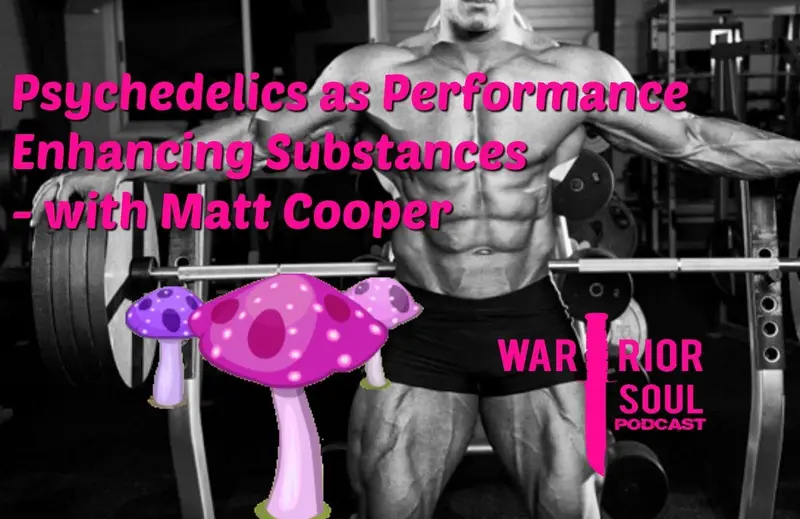
Psychedelics as Performance Enhancing Substances – with Matt Cooper of 12AM Labs
Hosted by Chris Albert
The Warrior Soul Podcast
In recent years we’ve been hearing more and more about the potential benefits of psychedelic substances for the brain. Now some are beginning to look to these substances for potential improvement in athletics. We brought on our resident biohacker, Matt Cooper of 12AM Labs to talk about his cutting edge work in this area.
For more on Matt: http://www.12amlabs.com
Sponsored by FBOMB nutrition. Get 20% off of your first order of FBOMBS at www.dropanfbomb.com when you use code WARRIORSOUL at checkout.
Transcript
Machine-generated from the episode audio and lightly edited — may contain errors.
Chris Albert (link to this point)
What is going on everybody? Welcome to the Warrior Soul podcast this week, and today we have a really interesting discussion. We we are going to be talking about is the use of psychedelics as a performance enhancing substance. Now we've all heard about, psychedelics in in the hippie era, you know, the LSD and the mushrooms, and we've heard of their use as a kind of like party drug. You know, MDMA is out there, and it's being used, not real psychedelic, but it's largely considered to be within the psychedelic realm.
We're hearing more and more about medical cannabis. But my friend Matt Cooper, a good friend of mine and co author on Warrior Soul Keto Camp, He's kind of been on the cutting edge of looking at these substances for their performance enhancing attributes amongst athletes. Now recently, we've been hearing about Silicon Valley executives microdosing LSD and microdosing psilocybin and that helping them with their work, they're kind of using it as a nootropic to help to enhance their brain. Matt's been kind of on this pan of research, I guess you could say, and he's been looking at it for developing neuroplasticity in the brains of athletes. And, you know, my opinion on all of this stuff is that I'm open to it.
I, you know, I tend to be very conservative politically, but at at the same time, I believe in personal freedom, and I believe in the individual's right to choose what is best for them. And I've always been on that realm as far as guns go, as far as, you know, one's personal preferences, as far as sexuality goes, and as far as one's own freedom to use things like cannabis and other substances that might be helpful for medical treatments and things like that. I'm also, you know, kind of of the opinion where I'm not one to judge anybody for doing these things if they're just trying to use them to feel good. You know, we have some serious problems with opiate addiction in this country using legal pills that have been given out by the medical establishment and the Veterans Administration. And, you know, these are legal drugs that have been given out, and and psychedelics have actually been shown to be able to help people to overcome those serious addictions through the use of Ibogaine and things like that.
So, again, this is something I'm very open on. I wanted to not necessarily advocate for it here on this podcast, but to kind of enlighten the crowd and let them know what some of the uses of these substances can do as far as developing the brain and developing those neurological pathways that are important for athletes. And I think it's important that we maintain a very investigative approach on this. So it's gonna be a really interesting conversation. Like I said, Matt is on the cutting edge of some of these things.
But before we get into that conversation, I just wanna keep you a note from our sponsor. F Bomb Nutrition, they make delicious, awesome packets of nutritious fats, and the their their best product, in my opinion, are these macadamia nut butters that they make. They they mix up macadamia nut butter with coconut butter, with chocolate, with sea salt, and they taste great. There's no sugar in them. And if you're looking for a good healthy snack that's well within the realms of paleo and keto and all these other kind of new and awesome diets we're seeing come around the pan that doesn't contain a lot of sugar, then you should check them out.
And you can get 20% off of your first order if you go to www.dropanfbomb.com, and you use the code Warrior Soul at checkout. So with that, let's get into this episode with myself and Matt Cooper from 12AM Labs speaking about psychedelics and their implications for athletes.
This is Chris Albert, and I'm here to remind you of one thing. Someday, you're going to die. Now that's not some morbid statement or scary idea. It's solid fact. Your time here on this earth is limited.
You need to be reminded of this as much as possible for one simple reason, to live your best life while you can. This is the Warrior Soul Podcast.
What's going on, Matt? How you doing, man?
Matt Cooper (link to this point)
Good, dude. How are you?
Chris Albert (link to this point)
I'm doing awesome. I'm doing awesome. What are you working on these days, man?
Matt Cooper (link to this point)
So, still mainly doing strength and conditioning and nutrition in different spheres in that realm, biohacking, you know, just leveraging all the disciplines, turning over new stones, the latest of which has been, as you know, psychedelics for a while, specifically their impact on health, creating change, right, lasting change, and then athletic performance.
Chris Albert (link to this point)
Nice. So when it comes to psychedelics, so we're thinking about drug, what classifies a psychedelic? Like what is a psychedelic? Like, you know, if I'm taking a bunch of fish oil and it's making me feel super alert, really good, is that a psychedelic? What is that?
Matt Cooper (link to this point)
Yeah. So I guess classically they were originally called psychomimetics and that would be things like mushrooms, LSD, MDMA, it's looped in that category, but not a lot of people actually consider it a psychedelic. So it's interesting too, because you can't just say plant medicine, also have to look at them as chemicals as well. But those are the main ones you have to loop in DMT, Ayahuasca, things like that.
Chris Albert (link to this point)
Okay. And so like what kind I mean, as far as their purpose and why why people should be doing them and what reasons should they have for trying these out?
Matt Cooper (link to this point)
Yeah, so I should say first, you know, I'm not an advocate or anything like that. I just, I think that there is, where there's smoke, there's fire, and then there's definite benefits that can be had here, and I'm hardly the first person to say that. But I think that it transcends beyond the psychotherapy uses. So we know a lot about that already based on research and how, for example, anti anxiety antidepressants are about 2% better than placebo, whereas psychedelics have proven to have been about 60% above placebo. You need to be about 20% or higher to be considered clinically valid, right?
So there's definitely something there. So if you are somebody who's suffering from any number of mental illnesses, they could be something you consider for that. My work, however, has been a little bit more on the side of seeing what they can do for your health, seeing what they can do for fitness, seeing what they can do for athletic performance. So we're transitioning now a little bit less away from, or excuse me, a little bit more away from need, and then a little bit more into accessory items, you know, just like you would any other biohacking tool.
Chris Albert (link to this point)
So, like, with USADA and everything like that, is is their use do you think that's gonna be governed? Is there any any are there any regulations against their use right now as far as athletic performance or organized athletics goes?
Matt Cooper (link to this point)
They might try to step in, but it's a lot of these are really hard to test for because they're out of your system in such a finite amount of time. Athletes have known this for a long time, especially in Major League Baseball. Some of the greatest pitching performances ever have actually been done under the influence of LSD or mushrooms.
Chris Albert (link to this point)
Really? Who?
Matt Cooper (link to this point)
Yeah. I don't the names escape me just purely because I'm not an MLB fan, but I could send you the references. There's a great article by James Oroc, actually, which sort of kick started this in a lot of ways, and he's a cool guy. So I have to credit him for kicking me down this spiral, but there's some references I can send you with the MLB players specifically. I can tell you that it's huge in the extreme sports community.
Then, you know, as far as NBA, NBA, MMA, those are more of my sports. So, you know, Joe Schilling is a famous kickboxer who's openly talked about it. I can't really expose a lot of my athletes who use this, but I do have some baseball guys. I do have some, know, again, basketball guys, some just general fitness folks as well. I think it's gonna become bigger in CrossFit pretty soon too, so those are a few ones just to throw out some disciplines.
Chris Albert (link to this point)
Now, far as compounds that we're talking about, we're not talking about heavy mushroom trips here where they're off in the distance or doing anything like that. We're talking about moderate doses, right?
Matt Cooper (link to this point)
Yeah, so a couple of the baseball stories are actually of heavier doses, and that's kind of interesting to see people perform under those kind of circumstances. However, generally what we're doing here is looking at the work of Doctor. James Fadiman and using micro doses. And these are sub perceptual doses of these substances that can actually induce certain states and in my case, in my work, attenuate certain qualities that can heighten athletic performance, fitness, and potentially health as well. So these are things that you would take on a schedule just like you would a supplement, but you're usually doing it on average about twice a week, and because of that, in effect, what happens is you're not having any sort of psychoactive effect on a trip level.
However, over time, you'll find a cumulative effect on things like anti anxiety, flow, creativity, energy. And then on the athletic side, things like reaction time, movement quality, motor skill acquisition, those are things that rev up pretty close to right away. I don't know if I've ever told you, but that's actually how I like relearned how to dribble a basketball.
Chris Albert (link to this point)
Really?
Matt Cooper (link to this point)
Yeah, so I used to play basketball, never at a high level or anything, but I did play it for a long time. I almost entirely abandoned that, even playing pickup games when I started getting into martial arts, jiu-jitsu, basketball, or excuse me, boxing, Muay Thai. And then from there, I got really into fitness and weight lifting, as you know, and went so far down that pipeline that when I re picked up a basketball again, it felt sort of foreign to me, and I had to relearn everything, you know? And so this has actually, in a way, helped me create new neural pathways and attain new motor skills that have translated to better performance, even in my own realm as a, you know, just sort of a pickup artist as far as basketball goes.
Chris Albert (link to this point)
So when you're talking about new neural pathways, describe exactly what you mean by that physiologically.
Matt Cooper (link to this point)
Yeah, so what's really cool is actually some of this, some of what I learned in strength and conditioning made me think polymathematically over here, and I have to credit one of my mentors, Nick Curson from Speed of Sport, and then he's one of the descendants of the Marv Marinovich training lineage, and he also does a lot of his own stuff. So in my studying of training, I realized how much of a role the brain and nervous system play in that, and that very much is the bedrock of what I do for training. And then a key element of that is something called myelination, And that's, let's just say that you shot free throws underhanded your whole life. If you do it enough times, it creates a myelin pathway. And that's actually a certain neural pathway that has a sheath around it of fatty tissue.
And it's almost like permanently When they say I'm going to pattern something into my brain and nervous system, that's essentially what they're talking about, is just enhancing that dialogue between brain and musculoskeletal system. And that's essentially what I'm talking about. There's also something called a motor engrams, which Doctor. Yuri Verkhoshansky talked about a lot. And that's like when you go to throw a baseball or do any number of things, how you do it is essentially the instructions that your brain grabs when you send that master sort of signal out to say, Hey, I want to throw a baseball.
Motor engrams are the instructions that tell your brain, Hey, throw it like this, or shoot your free throw like this. Right? And so what I found in my own research, and also if you look online, there's not a ton of published studies on this yet. It's very much some research that's in its anecdotal phase, but I think in the next five to ten years, we're gonna see how much myelination and psychedelics, or at least certain psychedelics, are yoked together.
Chris Albert (link to this point)
So basically your brain has these scripts that it runs off of. And if you are trying to learn something, it needs to create a new script,
Matt Cooper (link to this point)
Exactly.
Chris Albert (link to this point)
Basically what's happening is you're allowing your brain the ability to reprogram past scripts and and create new scripts to learn a new technique, a new a new a new skill, and allow yourself to to perform better at that skill. Right?
Matt Cooper (link to this point)
Exactly, exactly.
Chris Albert (link to this point)
So when Keep you going, sorry about that.
Matt Cooper (link to this point)
It's alright. So what I found too is just like with that, sometimes it just affects muscle activation as well. Sometimes it's not even that athletes are the ones who are only benefiting from this on a health and fitness level. I find that every day, people who maybe, let's just say if you have a hip wink and you're squat, or you don't have too much biomechanical elegance on a deadlift. It can help you be a little bit more, well, the bodybuilders used to call it mind muscle connection, but that dialogue between your brain and musculoskeletal system is just enhanced a little bit, and it's almost like you can kind of have a bit of a neurological reset, if you will, and you can correct bad habits pretty easily.
I think that for everyday folks and for veterans too, some of the most exciting benefits might be out of the realm of athletic performance and actually transcend a little bit more into health, believe it or not.
Chris Albert (link to this point)
So if we're talking about myelin sheaths and we're talking about neurological performance, For those who might not have the ability to get ahold of psilocybin or some of these other products that are out there, What are some other things they could be doing? I mean, in my mind, DHA and lots and lots of sleep as far as rebuilding those my and repairing those myelin sheaths every night. Allowing your brain to reprogram in that dream state. What are some other things that they can be doing out there as far as getting some of these benefits even though these products are illegal?
Matt Cooper (link to this point)
Right, so a lot of it comes down to other things that enhance neurogenesis, and also looking at the fact that our there's a lot of this work, actually, some of the most exciting in this field, I think, being done by Huberman Labs and those folks, but essentially, it comes down to doing things on a dietary level that will enhance your neurogenesis and your neuroplasticity, and almost make the nervous system a little bit more pliable and receptive to the inputs, if you will. So that can mean doing a, like you said, DHA is one of my favorite ones. And so sometimes what I'll have people do, I mean, ideally with both, but especially in younger folks where I'm not recommending this, or in people who just don't have access to it or don't want to for one reason or another, I'll recommend they do a mega dose biohack of fish oil, and that was something that was taught to me originally by Ryan Freisinger. You might have seen him at PaleoFX, but at any rate, you're taking about upwards of eight grams of fat sourced from a high DHA fish oil, and you're doing that for about a month.
And this is something that Doctor. Mauro Di Pasquale, somebody I know that you're definitely aware of, talked about. Charles Poliquin talks about it as well. And this is another thing where there is definitely a lot of research out there about this in terms of high dose fish oil, but not in terms of doing it this high and for sort of an acute period of time. However, there is a ton of anecdotal data out there to suggest that it does help with motor learning, it does help with skill acquisition, and it does help tune your nervous system.
And I think that is something that a lot of people should look at. I also think that avoiding certain things that can overexcite your nerves, like excitotoxins and food, MSG being the premier of them, and in addition to that, too, also food colorings, food dyes, things like that as well. So avoiding excitotoxins, loading in on DHA. There's some cool stuff you can do. Again, not everybody will have access to it, but it's delicate nature.
Neurofeedback can help. Halo Neuroscience headsets are great. It's like transcranial direct stimulation. In a nutshell, it's a headset that opens up your neuroplasticity. In addition to that, one device I like using a lot, which a lot of people are gonna be able to start finding in their cities close to them pretty soon is a NeuFit device or a Neubie, that's N E U Fit, and that's a direct current electrical stimulation device. And so what that does is it can actually reprogram your nervous system in such a way that you can feel pain regularly, resequence muscle firing patterns, do muscle activation, basically rate of force development or fast twitch development like we do here at the gym, fast twitch in effect. So those are just a few things. Another thing right now that I've had people get a lot of success with is pulsed electromagnetic frequency or PEMF. Yep.
Pulse Centers is actually the main company for running, bringing this technology to just the general population right now, and I think that there's a lot of promise in that cell voltage.
Chris Albert (link to this point)
Yeah, so back to some of the stuff you're talking about there, I mean, I've had on Doctor. Michael Lewis, who wrote the book When Brains Collide and he's worked with a lot of veterans with a traumatic brain injury. And you know, one of the simplest things, especially for the guys out there with TBI, is getting that that high DHA fish oil in. He actually recommends going as high as fifteen thousand milligrams a day for a bit as far as if you've been affected by a traumatic brain injury, you know, getting a really, really like crazy dose into you. And then for average everyday people going between five and eight thousand milligrams, I think.
Yeah, him and then we've had a few experts come on and talk about neurogenesis is that is DHA being so important for that. With some of these other tools, far as creating neuroplasticity and and and repairing the brain. Do you think that the way things are going right now, that we're at a point where we're gonna be focusing on the brain first before looking at all these other things like, you know, trying to max your squat or anything like that? Do you think that's the logical next step?
Matt Cooper (link to this point)
I really think so. And I think those in the athletic and fitness realm, they need to pay even more attention to the brain and the nervous system. And then I think a lot of people in our realm that are more on the biohacking side, they're so heady and focused on cognitive enhancement. Some of those people will continue to focus on this as well, and for good reason, but I also think that doing things that enhance that mind body connection are gonna be bigger in that biohacking realm too, because a lot of those folks, I think they earn the things like meditation and psychedelics, things like that, but they're not very good at looking at their nervous system from an objective point of view and realizing that processing these things in the body is part of this. And Stanislav Grof, famous researcher in the psychotherapy realm who also supervised over 5,000 psychedelic assisted therapy sessions, he was big on basically somatic experiencing.
These are things that you might find right now in emotional freedom techniques. EMDR, something again that my friend Ryan pricing here had taught me about, TRE or tremor exercises, trauma release exercises, originally invented by Doctor. David Berceli, things that actually help us process the effects of trauma that's stored in the nervous system and essentially tattoos our nervous system. And so a lot of us are guilty of logically wrapping our head around these things, and I promise I will loop back to health and fitness in a sec here, but a lot of us are very guilty of spiritually bypassing these things, or logic or thinking our way through these things, but not actually processing them in our body. And so what we know now from the research of some of these psychotherapies, especially psychedelic assisted, is that in terms of trauma, our body can actually cauterize and block off certain parts of our body or brain that make us feel and relive the trauma in a certain way.
But it's always there, and oftentimes it's shoving us into a low level of fight or flight, or what's known as the sympathetic branch of the nervous system. And so some of these somatic experiencing exercises, especially when combined with some of the dietary tweaks we talked about, certain types of psychedelics, these things actually can, in effect, have us discharge our nervous system and discharge the biological effects of trauma, which only then I feel, and I've found, and research shows, that you can get true freedom from a lot of the effects of anxiety, trauma, stress. Then again, it doesn't have to be a PTSD level trauma like veterans would experience, but it could just be getting picked last on the playground, a misunderstanding of sorts.
Chris Albert (link to this point)
Yeah, I think going back to all that, it's definitely one of those things we try to do. We try to we try to rationalize as human beings. I think, know, particularly in this modern world, if you talk to us, you know, five hundred years ago, it'd be a very different scenario. We'd be blaming a whole lot of different things or or looking at a whole lot of different things. And I think there's a happy medium we have to come to in in today's society.
What I worry about with a lot of this stuff though, is because like a lot of our listeners here, these are guys who who've been trying to do the best, you know, I mean, they're they're they're they're doing what the VA tells them. EMDR is actually one of the therapies that the VA provides. But, you know, what I worry about is, you know, when we hear like Aubrey Aubrey Marcus coming on and talking about, you know, getting intravenous, you know, ketamine to to help him detach from himself and things like that. Or, you know, Ben Greenfield coming on and talking about injecting, you know, stem cells into his own penis and things like that. What I worry about with those of us who are concerned with these advancements is that we're alienating the masses to some extent and, know, keeping them from from finding more, I guess you should say tangible therapies, tangible things they can do.
You know what I mean? Because if I come on here and I try to say, hey, guys, you know, if you really want to increase your sexual performance, I want you to get some stem cells, get them removed from your ass, and then I want you to just inject those into your penis. A lot of guys are gonna come back to me and be like, Chris, what the fuck are you talking about? You know what mean?
Matt Cooper (link to this point)
Yeah, I hear you. Well, I will, after this, let's go back to the previous loop, and I'll tie it a little bit more properly into health and fitness, but I agree with you there, and for a couple of reasons. Number one, I think that these are a tool, and I think that they're just that. You can't put methods over principles, and if you're not doing the right basic work that anyone can do, whether it's some sort of mindfulness practice, meditation, proper diet, exercise, things like that, you really shouldn't even be barking at this tree in the first place.
I think it's awesome that EMDR is offered and covered by the VA. That's huge, and that's something that I would look at even before doing any of these biohacks. And this is something that our mutual friend Andrew and you and I talked about at PaleoFX, and in some of these circles is that seems like you have to be very well off to have access to these things, put So it that's something that I've really had an honest conversation with myself about in the last year. And I've been able to do my best to capture a certain threshold of clientele in that sphere, and then use that to free up more of my time to get more free content, free research out there that anyone has access to, and then I also, you know, I train some inner city kids for free too, and try to get them access to, you know, high end information, whether it's consulting with me, sports science, things like that. Because I really think that those are the people who need this kind of stuff the most, and it shouldn't be privileged information.
Otherwise, I think we're going to see this sort of divergence in evolution in our species, where you have people who are sort of prisoners of their own health, and we know how that affects the brain and your life experience already, not to mention decision making, and then we'll have this other higher primate kind of branch. And now, the other thing I'll say is that these things are kind of getting bastardized, these plant medicines, psychedelics, in that many people are using them to escape from their lives, just the same way they previously were with drugs, alcohol, sugar behavior. It's like, you know, that's why I like some of these somatic therapies like EMDR are things that are like more A, they're outcome based and you can get good outcomes in a short amount of time, thus they're more cost effective, and B, they are more cost effective. You can find the therapist in any state. And so I just think with those kind of things, again, you're treating the problem a little bit more at the source and you're treating the biological root of it.
And if you're doing the previously mentioned fundamentals work, then you can create some real change. We're in agreement there.
Chris Albert (link to this point)
Absolutely. I think that, you know, for all the stuff it for all the weird stuff that we see at like biohacking conferences or like, you know, that we see see some of these companies putting out there. I mean, are some really cost effective things that people can do, to change their health. Now, you mentioned something earlier that I want to touch on and that is that there's kind of a divergence in the species or there could be a divergence in the species as far as, people who are in control of their health and getting in touch with these things versus people who are kind of trapped in their own bodies. I think we're already seeing that a whole lot.
I mean, if you look at the statistics for the vast majority of Americans, I mean, one in four or or or yeah, no, I think it's one in four veterans who are admitted to the VA system has diabetes. I think one third of our population here in The US 18 and over is pre diabetic and we're seeing a whole crazy, I guess you'd say dip in our overall health. We're living longer, but the quality of our lives isn't improving. And one of the things I think that's good about coming that are coming out from the biohacking community, things like knowing that apple cider vinegar can help to lower your blood sugar. Knowing that if you consume some insoluble fiber like celery or maybe have a little bit of black beans that can help you with your blood sugar.
I've been experimenting with UCAN SuperStarch. Somebody sent me a whole bunch of it and man, you know, I took some of that prior to my workout yesterday. Had the workout of my life, like ridiculous. And I think, you know, that's another cost effective thing people can start messing around with. I think it's cool that we have all this stuff.
I just want to continue to make sure that a lot of this stuff keeps getting to everybody. You know what I mean? Including psychedelics, you know, including the benefits of psychedelics. And I think the problem is what you mentioned, is that in certain communities, the use gets bastardized and it turns into an escape. And a lot of people are going into these things without being guided, you know what I mean?
And having experiences that either turn them off or not getting what they should be out of the experience too, you know?
Matt Cooper (link to this point)
Right, because they haven't done the inroad experience, and then also started the integration process that way, and then followed it up with the integration process, things like the diet movement, again, free things like sunlight, and then ground contact or earthing outside, things like that that are free, and some of these trauma exercises, which I'm gonna be putting out a video pretty soon of myself doing them so that other people can actually have access to them and don't have to spend a ton of money to go to a certain practitioner. So some of those things for sure, and then I also, again, I just see how much everybody has, to some extent, some high period of stress they've gone through, some misunderstanding or full on trauma as a child. And what we don't realize as a population, at least in the mainstream, but that science has proven is that there are biological consequences when it comes to stress and trauma. And when your nervous system, and this is where I'm looping back previously, when your nervous system is in that low level of fight or flight long term, it's very depleting energetically. It's depleting on the mitochondria, and then because of that, from there, you'll see that manifest as various symptoms, whether it's adrenal fatigue, whether it is other hormonal deficits and testosterone, things like that.
We've also seen some dysregulation of estrogen, too. In addition to that, too, digestion and the gut health normally gets thrown off. Immune system can get overactive, excuse me. And then from there, even in the functional medicine community, let alone Western doctors, there's this propensity to over diagnose and say, All right, well, it's just adrenal fatigue, so you have to go down that pipeline. And it's like, Wait a minute, that's like the same reductionist thinking that Western medicine gave us.
Just because it's a healthier, more holistic solution doesn't mean you're really helping somebody. And so what I see is really a need to look at medicine like as it originally was created, health optimization, or fitness, or athletic performance, and that's tying in your quality of life, who you are, your identity, your ability to author your own story in this life through your help and tying those things together instead of compartmentalizing it and fragmenting it. And the reality is you're gonna get better health outcomes that way.
Chris Albert (link to this point)
Yeah, I completely agree with that. And one of the places I'm seeing a lot of that kind of, you know, fix the symptom, don't go for the root cause kind of thing right now is in a lot of these anti aging testosterone replacement therapy clinics because what's happening is we are seeing lower and lower levels, lots and lots of deficiencies out there. But if you're injecting exogenous testosterone into yourself, that can definitely alleviate a lot of these symptoms, but it's not going to fix the root cause. I mean, is there Leydig cell failure there? Do you have a problem in your gut microbiome that's causing high levels of inflammation?
Do you have a problem in your hypothalamus that's keeping you from producing precursors? Are you producing high levels of cortisol that's producing a pregnenolone steal? I mean, there's a whole host of different things that doctors should be looking at before just putting somebody on exogenous testosterone. And I keep hearing guys telling me they're starting to use it. They're starting to go for these therapies.
Yeah, of course they should because it's going to help them to get rid of that depression and all that stuff. But unless that root cause is being addressed, they're not fixing the real issue and they're gonna end up with potentially really bad health problems in the long run because that root cause, that breakdown in your biological chain was never fixed.
Matt Cooper (link to this point)
Yeah, absolutely. It's just all about getting to the origin and that, like you just put pretty eloquently on a tactile X's and O's level, it's about just considering the source and then at the same time, to speak to what I spoke of before, I think the more you tie in the person as a whole, the more you're going to reach these outcomes one way or another, rather than trying to have an itchy trigger finger with over diagnosing something and then also partnering that with reductionist thinking that's for failure no matter what kind of practitioner you are, you know?
Chris Albert (link to this point)
Yeah, absolutely. And I think that, know, we as one thing that we have the benefit of doing, I think, as trainers and as health and fitness practitioners, rather than being, you know, medical practitioners, is that we can can delve into a lot of these root causes and our knowledge allows us to do that. And I think that's really what our place is going to be in the future. With a lot of the stuff you're doing, you're working on as far as building neuroplasticity and helping athletes to focus on the brain first and then, and then to focus on the physicality. But also in general, you know, when we're dealing with, with, normal everyday people, getting them to get outside, get out in the sun, getting them to be out in nature, getting them to take care of their happiness, you know, when they're eating a meal, getting them to sit down and actually chew their food because, you know, that's that's gonna be how you digest your food is gonna be even more important than than what's actually in your food, you know, those types of things.
Matt Cooper (link to this point)
Yeah, that's actually a good point. I never would have expected when I first started doing strength and conditioning or doing nutrition, especially more on the fitness side, that I would be getting consulted by a lot of people to kind of be a jack of all trades for them to help them with somatic experiencing therapies, to help them kind of look at labs, to tie in these other domains. Again, I'm not claiming to be a doctor or a therapist or anything like that. I'm upfront about that. But I do think that the idea of open source medicine and open source information is something that's growing right now.
And I think that in our culture now more than ever, where you know what you know, what you know culture, it's definitely a results over credential society, and you're either, you know your shit or you don't, honestly. And I think that in our realm, exciting it's because we get to branch out in these other disciplines and then tie it together. And believe it or not, back in the day, the old Stovich training conditioning coaches, to re reference Doctor. Yuri Verkhoshansky and Bondarchuk, guys like that, They used to hire people from other fields in finance and business and creative works and artists and people with literary backgrounds because they thought about things in different ways and they were able to make different connections that people who are highly specialized in the mainstream way of thinking, they may not have been able to make before because they were too focused on doing things the same way they've always been done for years. And you really see that right now in fitness.
I don't know a single certification that I cosign on entirely, at least in the formal realm. And so because of that, it's focused me to become better, honestly. Because of that, I went and I learned from the best of the best in that field or got these more cutting edge certifications. At some level right now, taking my CSCS, I feel like it's a little bit of a sellout because it's sort of trying to fit what I know, which again, I don't think I know shit at the end of the day, fitting what I know into their box, and so I've had to kind of wrap my head around that. But, you know, it sort of is this gateway drug into talking to certain organizations and teams that would make my life easier, so.
Chris Albert (link to this point)
Yeah, I felt the same way with every certification I've ever gotten. NASM, NSCA, they they it's it's just a matter of, you know, kind of checking the box as far as certain things go and then fitting what you know into their template. Right? So, you know, NASM has their OPT model, and, and you start with balance and you start with this and then, and then you move up to all the way up to, to, to strength and power and things like that. But, you know, when you look at the human body and, and all of the different things that, that it does and can do, and you start to actually look at the human body as a whole and you start to realize that everything emanates from certain things, right?
It emanates from our brain, it emanates from our digestive tract, it emanates from, you know, a whole host of different scripts that have been built into our neurological foundations, you realize that there's a whole lot more work to be done besides just making somebody, you know, balance on a physio ball for five minutes at a time or, you know, try to do a single leg squat. There's a whole lot of deep work that needs to be done in order to retrain them and in order to get their body in working order. And, you know, when I think that only comes really from being out there and working with people for a while and, from a desire to keep your brain open or keep your mind open and learn as much as you can.
Matt Cooper (link to this point)
Yeah, it's really about if you're passionate about it, you're gonna do the work and you're gonna find yourself those experiences, those mentorships, those coaches or certifications that you're they're going to be parallel with what you believe in and you're going to really feel like they help you. And I'm not saying some of those certs don't have some nuggets of gold in them, but it takes ten to twenty years to update a textbook, A, and B, it's like this reductionist thinking model. It parallels kind of the issues that a lot of people have with Western medicine, too. And it really just highlights the fact that, again, if you kind of always, always just try to get people to fit into your model without expanding your model or questioning it critically, there's no good in that. And I'll tell people this too.
I let them know upfront, hey, some of the things I'm telling you today probably are going to be totally different in five years, and if they're not, then they're definitely going be different in ten years. And that's just part of being on the edge of science, is critically looking at your model and trying to draw out new paradigms from that, and objectively looking at other paradigms as well that you can either fit in your model that maybe destroy your model as scary as that is, or maybe just accessories.
Chris Albert (link to this point)
Absolutely. I think that, you know, it's like you said, you have to get you have to get that base education, and then from there, you move up and and you keep going. Now back taking it back to psychedelics and and and plant medicines and and, whatever you want to call them for now. Where can people learn more about this stuff so that it's not so scary and so that they can, if they decide to have their own free will, explore these things in a systematic and educated manner?
Matt Cooper (link to this point)
Yeah, so what I would do is I would check out MAPS, that's the Multidisciplinary Association for Psychedelic Studies. I would also check out the Third Wave. I'm affiliated with this organization, but they're the, in my opinion, the thought leaders on microdosing specifically, although they educate for the broad brush stroke on the realm of psychedelics and personal development. As far as psychedelics tie into health and fitness, I'm actually gonna be the one probably for running most of that research and putting it out. We're actually hosting a seminar here at Fast Twitch, which is in the same cohabitats with Black House MMA, and we're doing that this weekend on the twenty third.
So between the seminar work and we're trying to make it a seminar series, also certain podcasts and on my site, 12amlabs.com, I'm posting a lot of these findings and a lot of this research as well. And that's probably where I would start. If some people want to find the ways in which traumas, things that psychedelics can help with and how these things can actually have consequences downstream on health and fitness, I would read a book called The Body Keeps the Score. That's one that I found from Doctor. Mike T. Nelson. I have to give him credit there. So those are some places that I would start. And again, I'd get the book by Doctor. James Fadiman as well, The Psychedelic Explorer's Guide.
Chris Albert (link to this point)
Psychedelic Explorer's Guide? Awesome.
Matt Cooper (link to this point)
Yeah, it's just a nice objective framework to look at, or Michael Pollan's new book, How to Change Your Mind.
Chris Albert (link to this point)
Yeah, yeah, I'm hearing a lot about that book all over the place, as far as, you know, people who are exploring these things and trying them out. Yeah, I, you know, my own experience is an interesting one as far as it goes and, and, one of the things I would say to people out there is that if you're going to do this, as Matt's been saying, and as I've been saying, definitely do it in a responsible manner. I mean, I have no problem with anybody, you know, taking a little bit of mushrooms and going out and having some fun or anything like that. But if you're going to take like a serious dose of these things, I definitely do think that there's some deep work you gotta do before, trying these out or just saying, hey, I'm gonna take, you know, five grams of mushrooms and go out and have some fun because it's it's not gonna be fun. Might run into some bad things when you do that.
Matt Cooper (link to this point)
Yeah, definitely. And I think it also kind of sets back the research in a way, the more people use this, like it was being done in the 60s. There was some genuine research being done there, but I don't cosign on people using it as an escape safety valve as much as it can be used and you might have some fun on it. That's fine, but I think that this third wave of psychedelics is poised to have a phase shift like what just happened with cannabis, and the more that people are dumb, the more it sets us back.
Chris Albert (link to this point)
Yeah. Yeah. And it's just like cannabis too. I mean, you can have a really great experience with cannabis if you use it wisely. You have a really crappy experience with cannabis too.
If you take too much of it and you don't realize, what you just took. I've been in those holes before. It's pretty, pretty rough. So it's, you know, keeping everybody cautious on everything and all that stuff. But, so Matt, this is gonna be down at Fast Twitch in Los Angeles.
It's gonna be this coming week. I'm gonna try and get this episode out beforehand so people know about it. But what can they expect at one of these events and are you gonna be running other events in the future?
Matt Cooper (link to this point)
Yeah, absolutely. That's the plan. This is the first one of its kind to combine these different integrated domains of strength and conditioning, flow states, or cognitive fitness, if you will, which includes psychedelics, overall health, trauma release, and then we're also having a ton of fun demos as well from the Pulse Electromagnetic Frequency guys are going to be here as well from Pulse Centers. We're going to have Athletic CBD here as well. Our mutual friend Tone Floreal is going be there to speak on flow states.
Kegenix, our friends at Kegenix are actually providing some nutritional supplement handouts as well. So it's going to be, and it's just sort of a mixer as well. So we're having people from different backgrounds at the event. We're having some pro athletes, people from creative disciplines, art, film, music industries, everyday folks looking to better themselves as well. So it should be a ton of fun, and I think that the more we can bring these domains together, the better off we'll all be, because, you know, again, I'm not coming to you or speaking to anybody now as an expert, I'm very much still just the student.
And like Galileo said, dare to be wrong and use data as your compass. So that's what we're doing here is just trying to light a fuse and try to start a conversation to hopefully facilitate more formal research from that.
Chris Albert (link to this point)
Yeah, I think that's important to mention too. Nobody's really an expert in these things. These are things we're just coming into contact with, right?
Matt Cooper (link to this point)
Honestly, beyond the 5-HT2A receptor for serotonin, we don't really know exactly what happens with psychedelics in the body anyways. We don't even know where consciousness comes from in the first place.
Chris Albert (link to this point)
I just had a Tom Campbell on coming on. He's he thinks consciousness exists somewhere else, not in this dimension. I mean, like, it's a theory. Right?
And and all of this stuff happens with theory. And and what's cool about this stuff is that we're on the edge of exploring new things when it comes to the human mind, potentially allowing us to grow as human beings, but also allowing us, to grow not only our minds, but our physiology and allowing us to do new things and and to see what we can do in this reality that we're in right now and and and to make our lives better. So so that's the cool part about it. You know, and for all you guys out there who are kind of weary of this stuff, you know, I I feel you. I completely empathize with you because the marine in me, when I got out and I started seeing people using mushrooms and LSD and all these types of things, was like, the fuck are people using that crap for?
But it wasn't until I started to kind of educate myself about this stuff and and, you know, started to see the benefit and and, you know, had actually tried some of it to my benefit, I that's when I I started to change my mind on it. And so for you guys out there who are like, you know, what the fuck are these hippies talking about? Completely understand what you're talking about out there. I you know, all we ask is that you see what these things are currently doing for the veteran community through the work that MAPS is doing and and their potential to help a whole lot of brothers out who are going through some really hard times right now. So also to help people to make their lives even better.
That's where we're coming from on this, ladies and gents. We are not drug dealers. We are not drug advocates. We're just people spreading information. So that's Matt Cooper, 12amlabs.com, and when you get to his website, he spells it out in Roman numerals because Roman numerals are badass.
So that's we'll get the links up to to his his website on the show notes for this. Anything you wanna end off with, Matt?
Matt Cooper (link to this point)
I think just reminding people that as much as these things might be tools to alter consciousness, whatever you believe, this is the reality that we ultimately have to live in. So my goal is to help people help themselves, better help themselves and self author their own journey in this reality. And I'm not promoting escapism at all. And then I also think that just the open mindedness helps and just getting people to think in terms of panoramic action. When you go to improve yourself, it's not like you can just be disciplined in one area and say, I'm not going to eat cookies for a week and then expect a change.
You might have to bite it off in bite sized chunks, but don't forget to be on top of your sleep, your nutrition, your training, your life exposure, your bio magnetism, bio electricity, and your mindfulness practice as well.
Chris Albert (link to this point)
Awesome, awesome. All right, Matt. Well, thank you so much for coming on today. I would love to be at the event this weekend. I'm not gonna be able to make it, but I am definitely going to try to make the next one.
Think it's really interesting stuff. So to everybody out there, thank you for listening and, regardless of what you end up doing, just try to get out there and live your best lives, guys. Get out there, enjoy nature, be active, have lots of sex, get as strong as possible, get as smart as possible, and enjoy this life while we've got it.
Host of the Warrior Soul Podcast and founder of Warrior Soul. Worldwide trainer and nutrition coach, contributing author at Testosterone Nation and Muscle and Strength.