Podcast episode
Three Keys to Resilience: Lessons Learned from Andrew Marr
Hosted by Chris Albert
The Warrior Soul Podcast
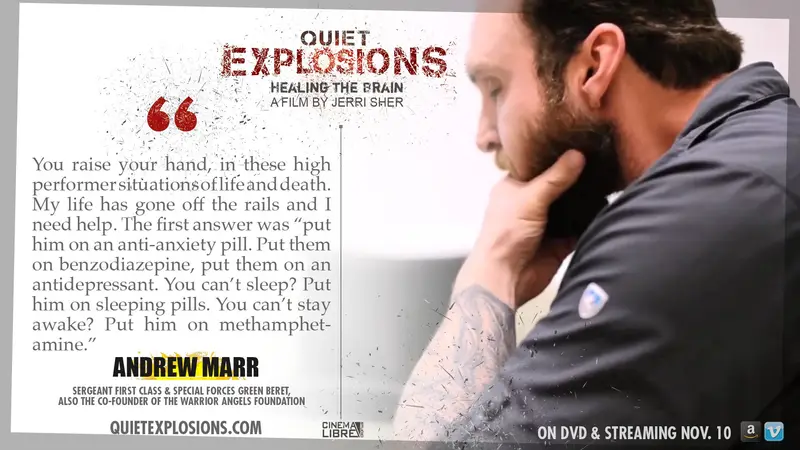
This is a follow-up episode to our discussion with Andrew Marr about the documentary Quiet Explosions, which follows his life and mission as a medically retired Green Beret seeking to educate and empower others suffering from Traumatic Brain Injury.
In this episode, I discuss three lessons I've learned from knowing him as a friend and as someone, I look up to in this world. I highly recommend listening to his interview HERE and watching the film prior to listening to this show.
Transcript
Machine-generated from the episode audio and lightly edited — may contain errors.
Chris Albert (link to this point)
What is going on, ladies and gentlemen? And welcome to the Warrior Soul podcast. My name is Chris Albert, and this is where we deliver tools, tactics, strategies, and ideas to help The US military veteran community and anybody else willing to listen to live their absolute best lives. Now I wanna follow-up this week on the episode we did with Andrew Marr. And I wanna talk to you about some of the tools he he talks about and that he's bringing to the table.
Because Andrew's a guy that I really, really admire because and it's not because he's, like, superhuman. It's not because he was, like, super, super special forces. It's because of the very human aspects of him. Right? He's somebody like, if you look at his life, he's somebody who was, like, way down in the depths who was able to pull himself back up.
And that, to me, is the epitome of what we're trying to do here. Right? And so I wanna talk to you about some of the stuff that I learned from him in that show and and some of the stuff I've learned from him just knowing him throughout the years and seeing if we could apply that to to to what you guys are doing out there. Right? And, you know, I'm gonna try and do more of this following up off of these interviews that we get.
Before we get started, I just wanna say this. We have a new sponsor, and that sponsor is the Citadel, the Military College of South Carolina. And a lot of you out there, you served in the military, you are veterans, or you're active duty. And you're probably seeing yourself, well, Chris, I've already been through the military. I I'm serving on an active duty.
I'm a veteran. Why would I want to go and go to a military college? And here's the deal, guys. The Citadel is a lot more than that. They have their corps of cadets, which is a very, very awesome, awesome institution.
Alright? I went down there and visited one time, and I was so impressed with the school, so impressed what they're able to do with young men and women. But at the same time, they have so many programs that can benefit veterans in active duty military. They have programs where you can go to school there while you're on active duty. They have programs that veterans can go to school there.
They can go to school during the day. You can get your bachelor's degree there. You can get your master's degree there. And we're gonna be talking specifically about a lot of the programs they offer because it seriously is one of the best programs in this country for active duty and for veterans. So we're gonna get more and more into that.
I'm going to actually bring some students on to the show so that you guys get to hear more about everything they offer there. I just think it's it's a really, really awesome institution. I've been impressed with them for since I heard about the place, honestly, and, you know, definitely wanna check them out. If you wanna learn more right now, head over to www.citadel.edu. And we're again, we're gonna be having more and more information on this as the weeks go on.
Actually, our official relationship hasn't even started yet. I'm just talking about it because I'm so enthused about working with them and bringing all their awesome programs to the table for you guys. So with that, let's get into this conversation, guys. So the things about Andrew. How does Andrew go from, you know, being down in the depths of hell, right, dealing with all the things he was dealing with with severe TBI, and then turning himself around and, you know, really bringing himself back online and back to his elite status as a as a high thinker, as somebody as a critical thinker to what he was when he was a special forces operator.
And, you know, as a friend of his, what I could say is this. I think the primary thing that it starts with is his ability to take a step back and really analyze his own situation. Right? Take a step back and really analyze his own situation. So when I look at him, I I see somebody who analyzes absolutely everything.
He analyzes himself. He analyzes his efficiency. He analyzes whether or not he's being productive or not. He he analyzes he thinks about the other person involved in everything. When you get an email from this guy, he'll tell you how much time it's gonna take for you to read that email.
Right? He's always considering the other person. He's always considering what other people are seeing in him. Right? And I think that that is so valuable so valuable in figuring out whether you're not whether or not you're on the right path.
So the question is like, well, how do you do that? How do you do that? And it comes down to something we talked about again and again on this show, which is mindfulness. Right? Now what's mindfulness?
Yeah.
Meditation is involved here, but it's a little bit deeper than that. It's about taking some time every day to kinda check-in with yourself. Right? Are you where you wanna be? Are your are your thoughts where you want them to be?
Right? And and actually coming to a realization that you're not your thoughts. Right? You might think you're you're you are your thoughts. Right?
That that little story that's going on in your head. But if you actually take a a minute or or ten minutes to sit back, close your eyes, like turn your cell phone off, turn your computer off, turn the music off, put yourself in a quiet room, sit there alone with your thoughts, and and you sit there and you think and you analyze the feelings, the emotions, the the the thoughts that kind of pop up into your head, that's a good way of of getting to that point to where you could start to recognize things in yourself. That's a practice I've implemented in my life, and and honestly, I'm not nearly as good at this stuff as Andrew is. But, like, it's it's definitely something that I think we all need to do is check-in with ourselves every day. Because, you know, the truth of the matter is we lie to ourselves.
We lie to ourselves all the time. Right? We lie to ourselves about why we can't do shit. We lie to ourselves about why we're in shitty moods. We lie to ourselves about why our lives have gone the way they've gone.
We lie to ourselves about, you know, whether or not we're we're ever gonna be able to get ahead. And the way what we start placing the blame on is we start placing the blame on the world around us. Right? When the reality is we have far more control than we think we do over our circumstances. Right?
Think about your life so far. Every choice you've made has put you into the position you're in right now. Right? Whether that's good or bad, every choice you've made has put you into the position you're in right now. And chances are you probably didn't think about a lot of those choices.
You probably just made them. Right? You probably acted on some whim or what some people call instinct or or what some people call, you know, reaction. You know? A lot of different words for this stuff, but but a lot of times, we don't think about ourselves.
We don't think about our thoughts. We we just kind of play along with this story that we have in our head, you know? Hey. I can't catch a break. Hey.
I can't do this. Hey. I have the worst luck in the world. Andrew is somebody who doesn't think like that. He's somebody who sits back and he analyzes absolutely everything.
He analyzes things about himself. He analyzes, you know, his thoughts. He analyzes the impact he's having on others. Right? And that, I think, even when he was in the darkest depths of his situation that he was in, he was able to recognize the ruin he was bringing on himself and on those around him.
The the the next thing about Andrew is this. He's not afraid to be humble. Right? Andrew realized that he didn't know everything he needed to know to go out there and and and fix himself. He he recognized that.
And because he recognized that, he was willing to listen to other people who might have the answer for him. Right? He was willing to listen to other people who might have the answer for him. And in doing that, that's what allowed him to get in touch with Doctor Mark Gordon.
That's what allowed him to honestly network to the point where he was able to get onto the Joe Rogan podcast. That's what allowed him to, today, being able to produce a book and and a documentary. He was able to listen to other people about what he should be doing. Alright? And that's something more of us need to do as well.
So so many of us are so afraid to listen to others. So many of us are so afraid to to go back and and think about what others have to say. Right? So many of us are are are so afraid to to let other people in. Truth is we gotta be humble.
You are not going to be able to produce all the answers in life for yourself. You are not gonna be able to do that. You are not superhuman. Right? It it takes a a humble mind to be able to realize that you don't have all the information you need to succeed right now and to go out there and do everything you can to find that information.
Alright? The third thing about Andrew is this. In every relationship he has, he finds a way to bring value to the table. Alright? He finds a way to bring value to the table.
Right? So for example, his relationship with doctor Mark Gordon, that's been a two way street. It wasn't just, you know, doctor Mark Gordon reaching out to him and doing all this stuff, although doctor Mark Gordon has been very gracious to him. But Andrew's brought a lot of value in return. He started a foundation, right, where he could help other veterans, and that helps doctor Mark Gordon to to spread the word about what he does.
Right? Andrew figured out a way to help others because of the situation he was in. He was able to figure out a way to turn his suffering into something that could help other people. That's another big lesson for you. Everything you're going through right now, everything you've been through, there's value in the lessons you've learned from that.
And the epitome of bringing yourself back up to where you should be is when you could bring value to the world. When you could figure out how to bring value to the world through the things that you've gone through the things things that you know, through the things that you've gone through, that's where you are gonna be in position to do some absolutely amazing things. I'm always talking about this community. We're the sleeping giant in this country. And the reason why I think we're the sleeping giant is because we have so many lessons, so many lessons that we could impart on others.
Alright? So I wanted to talk about those three things. They're they're quick lessons that you can get from the last podcast that we brought up, and, you know, kinda wanted to put my commentary on the situation. Andrew is somebody who I love dearly as a friend. He is a great person.
And, you know, I think there's so much value in paying attention to him and paying attention to his story. And so I highly recommend that you go out there and that you check out both his book, Tales From The Blast Factory, and you also check out his new documentary coming out November 10. It's gonna be up on Amazon and a couple other channels. We'll get the links up on the show notes here, and and they'll also be on the show notes for the last interview. And I highly recommend you go back and listen to the last interview I did with him.
Just an an outstanding individual and somebody who we should all look to as an example of what to do to turn yourself around. Alright? You guys have any questions for me, please feel to reach out feel free to reach out, and we're gonna be back at you later on with some more awesome content. This is Chris Albert with the Warrior Soul podcast, and I am out.
Host of the Warrior Soul Podcast and founder of Warrior Soul. Worldwide trainer and nutrition coach, contributing author at Testosterone Nation and Muscle and Strength.