Podcast episode
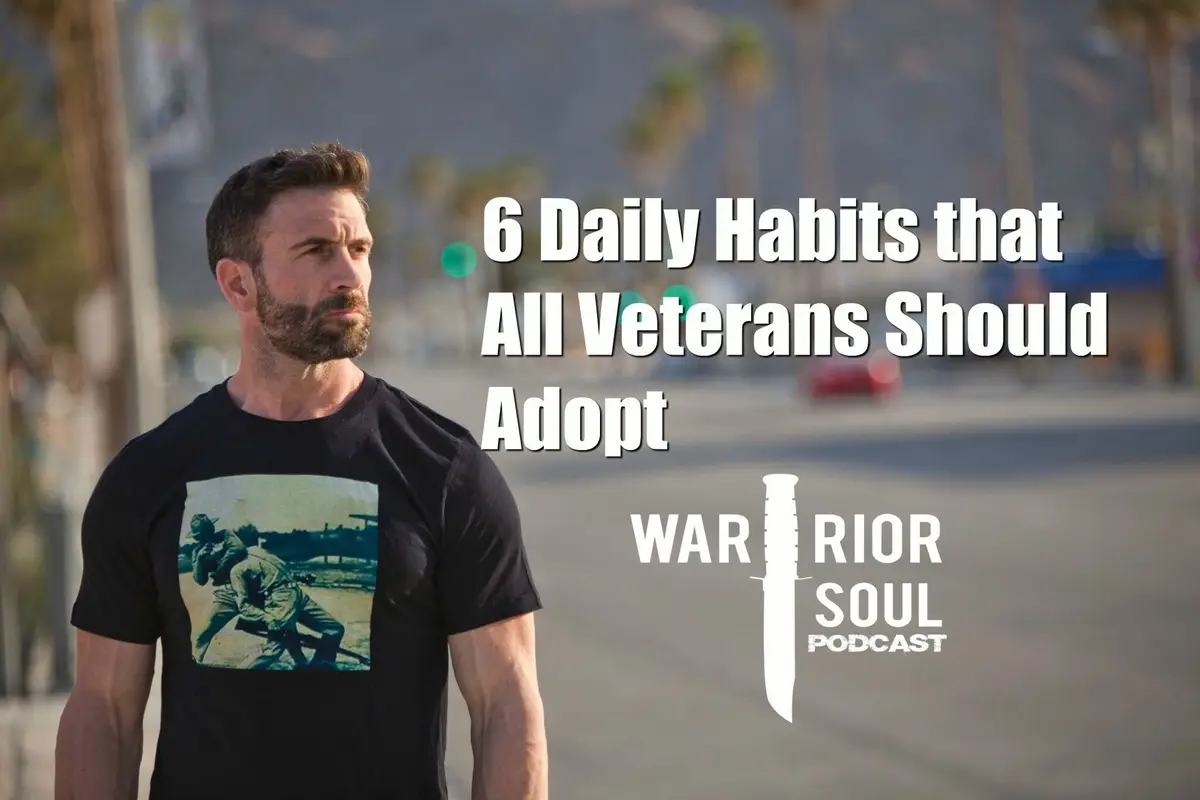
6 Daily Habits that all Veterans Should Adopt
Hosted by Chris Albert
The Warrior Soul Podcast
In this episode, Chris goes into 6 daily habits that have helped him through the dark times. Of course these habits aren’t just for veterans, but they’ll be particularly helpful to any veteran out there who’s looking to get his or her life on track.
They Include:
Gratitude
Physical Exercise and Active Meditation
Good Nutrition
Daily Learning
Adequate Sleep
Giving Back

Transcript
Machine-generated from the episode audio and lightly edited — may contain errors.
Chris Albert (link to this point)
What's going on everybody? Welcome to the Warrior Soul podcast. This is Chris Albert, and this is another solo episode. These are episodes where I deliver tools, tactics, and ideas that I've used in my life to help me get out of some dark places, and that I want to deliver to you, the veteran community and the other people who are good enough to listen to this podcast. And, you know, when I do this, it's not because I think I know it all, because I don't.
I definitely don't have everything figured out and my life is pretty screwed up at times. There's definitely things I need to work on And I am on a journey just like you. But the original idea behind this podcast and and everything we do here at Warrior Soul was to get back to something that I had in the Marine Corps. We used to run these hip pocket classes where NCOs would come in and they would just talk about things that we could use. Fieldcraft, they would talk about their lives, they would talk about, you know, specific weapon systems, They would talk about exercise.
They would talk about things that they were doing that that was helping them and things that they learned in their experience that could help the younger lance corporals and privates and PFCs. And by no means, I I know there's plenty of people out there who probably done more than I have, who know more than I do. But there's also a lot of people out there who are stuck. And so that's what this podcast is about. It's it's about us helping each other out.
And every expert that I brought on here that was in an effort to help all of you out. And I I hope you guys have gotten a lot out of the Warrior Soul podcast so far, and we've got a lot more to cover. Today, what we're gonna be doing is I'm gonna be talking about six habits that I think could help all veterans and anybody else who's listening to this in their daily lives. And, these are things that I've used that have helped me to to push forward, to get out of some really dark places, and to keep myself from really becoming complacent, and also to keep myself from falling into victimhood. Because life can be hard.
Life can be brutal, especially when you're running your own business and and you're trying to figure out a way forward. Life can be really, really brutal and disappointing, and none of us are immune to it. So a lot of times we need to do things in order to keep ourselves on the path toward our goal. First, before I get into these six habits, I just want to give a note from our awesome sponsors, F Bomb Nutrition. Really great people who make a really great product.
Always talking about the benefits of a ketogenic diet. One of the big problems is that it's really hard to get portable sources of good healthy fats. And they've solved this issue with their fuel packets and their fat packets. Their fuel packets are absolutely amazing. They all have a macadamia nut butter base.
Absolutely delicious. They have a macadamia nut butter mixed with coconut butter, macadamia nut butter mixed with sea salt, and a whole bunch of other flavorings. So so they've got pecan, they've got some some chocolate, really, really good stuff. For our listeners, you get 20% off if you go to www.dropanfbomb.com and use the code Warrior Soul. You'll get 20% off of your first order.
So go check them out. Now let's get into it.
This is Chris Albert, and I'm here to remind you of one thing. Someday, you're going to die. Now that's not some morbid statement or scary idea. It's solid fact. Your time here on this earth is limited.
And we need to be reminded of this as much as possible for one simple reason, to live your best life while you can. This is the Warrior Soul podcast.
So when I'm talking about six daily habits that you can use, this is obviously going to be part of a routine. And a routine is something that's really personal to a person. You know, I'm a I'm a morning person and so I like to get a lot of the stuff that I do done in the morning. Other people might be night owls and and night might be their more reflective time. For me, when I wake up really early, that's generally the time when nobody's bothering me.
Nobody's trying to get ahold of me. Nobody's trying to interrupt me or anything like that. So that's generally my reflective time. But you can take each of these and you can adapt them to what you want them to be. You can include them where you want them in your day.
They're just things that I've found really, really helpful. The first one is gratitude. And I've talked about this a bit before. I've talked about it in interviews. I've talked about it in other solo podcasts.
But gratitude is one of the most powerful tools that I found to get myself out of a dark place. And you might be asking, why is it so powerful? You're just being thankful for what you have, and and that's the real point of it. As I said before, life can get really difficult. It can it can knock you in the head.
You can be in positions where you really have a massive temptation to feel sorry for yourself, and you have a massive temptation to feel like all the bad things in the world just happened to you. And so sometimes what you need to do is you need to take stock of all the good things you have in your life. Right? And so I'm definitely so grateful that I'm living in The United States Of America, that I've reached adulthood, and that I have an opportunity to do so much, but I have to really search to find gratitude for the different things in my life. And sometimes I forget to be grateful for for my girlfriend who's been so wonderful to me through really, really dark times.
Sometimes I forget to be grateful for the fact that I'm just alive, well, breathing, and I have all my limbs and appendages. When I'm out on a run and I'm I'm tired and I wanna stop, One of the things that helps to help me helps me to get through my runs is realizing that I have the luxury of running in in a beautiful place like California, but I'm able to run. I've got my legs. I've got lungs that work. I've got a body that works.
And so my big advice to you is to to really search for things to be grateful for. And when you get good at this, you start to be grateful for some of the bad things that happen to you because you start to realize that those bad things often contain lessons that are gonna make you better. You know, one of the worst things that's ever happened to me in my life was developing ulcerative colitis. You know, and because when I was a kid, I always dreamed of being a bodybuilder. I always dreamed of being this massive muscular guy.
And I got pretty big and I was able to compete bodybuilding, which I'm extremely grateful for. But it hit me at a time when I think I was at my peak and I lost a lot of that muscle mass that I worked really hard for. But what ulcerative colitis taught me was that the things I was doing as far as my nutrition goes, they probably weren't very good for me in the first place. And some of the things that I was doing in order to be a bodybuilder probably weren't very good for me in the first place either. And so I've been able to adapt and develop nutrition program for myself that's made me a better person, that's allowed me to think better, that's allowed me to perform better, that's allowed me to continue to train really hard, up in into my late thirties and now going into my early forties.
And so I've found a way to be grateful for the fact that I have ulcerative colitis. And and my big challenge to you is to think about the worst thing that's happened to you in your life and figure out a way to be grateful for it. And when you do that, you start to understand that it isn't what happens to you in life. It's your mindset about what happens to you in life and it's how you respond to it and whether or not you give up or whether you choose to move forward. And so my my daily gratitude practice is it's actually really simple.
I just write the three things down that I'm most grateful for for that day. And, sometimes it takes a little bit of thinking. Sometimes I'll spend a half hour on it. Sometimes I'll spend five minutes on it. But that little part of my day helps me to train my brain to understand that anything that comes in my path is an opportunity.
Number two, I put these two together and it's gonna sound weird at first, but exercise and meditation. Now we're talking to the veteran community here. So some people are gonna get meditation and some people just aren't. And I'm one of these guys who I have a real problem just sitting still and meditating and focusing on my breathing. And even if I'm using something like the Headspace app or or trying to use other tools that exist out there to help me meditate, I'm just not very good at it.
And I find that, you know, the more I practice, the more I try to put effort into it, I wasn't getting a lot out of it for the for the time I was putting in. But one thing I realized about me and exercise, particularly intense physical exercise, is that it's kind of my meditation. Right? So when I'm exercising, I'm really focusing on just the task at hand. I'm very, very present.
I'm focused on my breathing. I'm focused on my body and I'm not focused on the outside world. I don't take my phone with me. I don't put anything. I don't pay attention to anything else.
I'm not gonna check my messages. I'm just focused at the task at on the task at hand. And that for me is a form of meditation. You know, I I lift weights, four to five times a week, and I try to get outside and do some form of physical exercise every day, whether that's running, whether that's carrying kettlebell around with me for a few miles, whether that's, you know, going outside and doing a circuit of burpees and things like that. But I find that that really, really helps me to focus, to be present, and to understand the the crazy thoughts that happened in my head.
I was telling this to my to my buddy Tony the other day. We went on a six mile run. And when you do one of those things and you're really hurting, you start to hear those voices going off in your head saying, oh, you should stop now. Or, oh, I'm I'm really real. I'm about to vomit.
And then, you know, you hear the other side of your head that's like, no, don't stop. And no, you're not about to vomit. And it's kinda like your goal during one of those runs is to make those voices go as crazy as possible, but for you to remain calm. And that's what you're really going for when you're doing these types of, you know, extremely hard physical physical physical exercise sessions. Know, You whether it's like a CrossFit WOD, whether it's running, whether you're doing jiu-jitsu, the key is to keep yourself calm while all that crazy stuff is going on in your head, and that's a tool.
Because I also find that while I'm doing work, sometimes I get stressed out about something in my life. Right? You you hear that insane part of you that wants to really stress you out, that really wants to push you over the edge. But if you can listen to that, and you can bear it, and then all of a sudden you say, you know what? That's just a voice going off in my head.
It's it's it's make believe. And then you remain calm, then you can do so much. And, that's one of the the tricks of boot camp, think, is that they put you in these extremely stressful situations, But you've got to act and you've got to make a decision and what they're training training you to do is to endure that stress. And for those of you who've been through something like that, this is just gonna bring you back there and it's going to put you back into that place where you're training your mind to be calm despite all the chaos going on around you and despite all those crazy voices that are going off in your head. So definitely daily physical exercise. If you are more of a meditator, definitely incorporate a meditation practice. But I definitely recommend getting your heart rate up at some point in the day. And the other added benefit of that is that you have your own internal pharmacy, right? All those antidepressant drugs that the VA has given out, that doctors have given out, even a lot of those opiates that they're giving out, a lot of those can be manifested in your own body through intense physical exercise. When you get done with a session like that, you feel absolutely amazing.
So the third thing is good nutrition. And this is something that I'm talking about all the time on my new on my, YouTube channel. In fact, my YouTube channel is mostly focused on nutrition, but one of the reasons why it's so focused on nutrition is because I've realized that nutrition affects everything about you. It's gonna affect your mood. It's gonna affect your ability to think.
It's gonna affect your ability to perform. It's going to affect your your looks, the way you look. It's going to affect your future as far as your health goes. It's going to affect your desire to have sex. There's so many things about nutrition that matter so much.
And if you're not putting the right kind of nutrition in your body, it can definitely affect your life in a really, really bad way. So what do I mean by really good nutrition? Well, I mean eating good, healthy food, making sure that you're getting enough micronutrients into your daily diet. Now, micronutrients that are going to be really important for veterans, omega threes, so important. Why are they so important?
If you've been around explosives, around small arms fire, around anything that explodes, if you've been in a helicopter and had your head shaking around or a tank and had your head shaking around. We had on guests like Andrew Marr, who used to be my cohost and Doctor Mark Gordon, who talked about how these things can give you a low level traumatic brain injury and how that can also shut down hormonal production. Omega-three's, docahexasetoic acid, I think that's how you pronounce it, also called DHA, is it makes up about a third of the dry weight of your brain. Right?
And if your brain is really, really inflamed, you need DHA to help to heal that. Another one that, and that's something that Doctor Michael Lewis brings up in his book, When Brains Collide. Another But one that Doctor Gordon brings up is making sure that you are taking N acetylcysteine, which is a supplement, it is a precursor to glutathione that helps with cellular turnover, so N acetylcysteine.
But on top of that, make sure that you're getting really good food, making sure that you're taking care of your gut microbiome, making sure that you are eating enough green leafy vegetables, getting enough grass fed meats, getting enough nutrients from what you're doing, going outside, getting in the sun, making sure that you're getting enough vitamin D. All these things can play a role in ensuring that you don't fall into depression and ensuring that you don't run into health problems down the line. A lot of people don't think about this, but one in four veterans in the VA system has diabetes. You know, we talk a lot about the veteran suicide rate and that's horrible. But to think that we've gone through so much and then in our older age for so many of us to be affected by diabetes and heart disease and cancer, that's a horrible thing.
And in order to lead, in order to continue to contribute to society, in order to raise your family, in order to be the best person that you can be, you've got to be taking care of yourself. You've got to be taking care of your body and you've got to be eating right. And if you ever want more knowledge about nutrition, just come on over to my YouTube channel. I give so much of that stuff away from for free as far as knowledge. I've got, I think I'm up to a thousand videos now as far as things go.
So definitely come check that out. And there there's also a world of knowledge out there as far as other people on YouTube who are talking about nutrition and giving some really great information out. Definitely check that out. Fourth habit, learning. You gotta learn something new every day.
And it could be something new about your job, it could be something new about something that's gonna help you push forward, it could be something new about fitness, something new about health, but try to learn something new every single day. The more you educate yourself, the more you build your mind, the better you're gonna be able to make your life. And if you're thinking about getting into a new career, if you have a particular career, read up on what other people have done in that space. You know, General Mattis is an avid reader and and that's he says that's because he doesn't like to be surprised. And he says he'll never be surprised on the battlefield or he said he never was surprised on the battlefield throughout his career because he read so much history.
And make no no no mistakes about it. Life is war. Whether you're in business, whether you're a teacher, whether you're a police officer, whether you're a nurse, every day you were fighting some sort of battle, whether that battle is to help people learn, whether that battle is to help people become healthier, whether that battle is to protect the citizens of your city or your county. That is a battle. And so you've got to learn everything you can about fighting that battle and about building your life.
And another subject that I think everybody should read up on is most certainly finance. I mean, so many of us, we get caught, you know, out in the water without a paddle so many different times because the economy changes. Because we didn't save enough for our taxes, those of us who are business owners. Definitely make sure you are reading up on finance, make sure you are educating yourself as much as you can about how to run your financial life and where to build how to build your life as far as your career goes. Learn what you got to do. So that's a big thing. So the fourth habit, again, is learn something new every single day. Number five, this is one I've neglected a lot myself, and it's sleep. Sleep, I'm learning is so important. And, you know, it comes down to us repairing our brain each night when we go to sleep and when we get into that super restorative dream state.
And you know, if you're not getting at least seven and a half hours of sleep at night, you're definitely underselling yourself. And we had Doctor Kirk Parsley, former Navy SEAL, and a medical doctor come on and talk about this when, I forgot which number episode is on there, but if you check out the Warrior Soul podcast page, you can definitely find it. He talks about how important sleep is. And you are decreasing your performance levels, even if you're missing out on a half an hour of sleep and you're just getting six and a half hours of sleep.
You are missing out on so much because of that. And the damage that's done to our brains in not repairing that the myelin sheaths in our brains and not helping with cellular repair, that can lead to a whole host of issues ranging from increased depression to serious neurological problems down the line as we get older. Alzheimer's disease. And I don't know about you, but I'm not going to go through this whole lifetime to go out like that. I want to have my wits about me.
I don't want to lose myself as I get older. And I don't want to lose memories of my loved ones and that kind of thing. And I've had relatives with Alzheimer's disease and dementia. And it's been a horrible thing to see and a horrible thing to witness. And I would not want to do that to my loved ones.
So make sure you're getting your sleep. I understand you work hard. I understand you're getting up. Don't wear it like a red, like a badge of courage. You know, it's about more than just what you're doing in the next few days or the next, the next twenty four hours.
It's it's about your life and about your ability to continue to take care of your loved ones and to continue to provide and to continue to contribute to to society into your older years. And, you know, Get the most out of this life while you are here. Every moment counts. Even if you are 80, you are still 80 and breathing. Be an 80 year old who can still do everything.
The last thing is this. And I think it's important for all of us to start doing this in the veteran community because as a group, you know, we have so many talents and so many abilities, but, you know, you take groups like people who graduated from Harvard or people who graduated from from from Yale or some of these elite societies. They they get to where they get because they help each other out. And because they they give value back to to their respective communities. And I think one of the things we all need to start doing here in this community, and I think a lot of us already are, is giving back to the veteran community and teaching others and educating people about what you've learned in life.
And so, you know, whether that is a phone call to one of your friends, whether you start your own podcast, whether you start your own YouTube channel, whether you start just putting information out there on Facebook to your friends and people who might be following you. Whatever it is, take that experience and turn it into knowledge that you could pass on to the younger generation, or pass on to your friends, or pass on to your peers. And, you know, again, I'm gonna go back to those hip pocket classes. I think I learned so so much more from those hip pocket classes than I than I ever had, you know, with anything before because I had really good NCOs. So I'm asking all of you to step up and and to be the NCOs and officers of of the veteran community, I guess, that's what I'm saying.
So that's my take on six things you should be doing every single day to make your life better. And, you know, we're gonna get into some of these other tools moving forward. We'll have a few more guests in a series, but this is something I definitely want to incorporate more of in the Warrior Soul podcast, and in our content in general at Warrior Soul. So with that guys, I wanna thank you for listening. And, if you've got a topic you want me to cover, if you are looking to get information about anything, don't be don't be afraid to email us over at info@warriorsoulapparel.com.
I'm happy always to, you know, take any suggestions for the podcast. If you got a guest in mind or anything like that, I'm happy to happy to consider them as well. And, know, beyond that, I always forget what I'm gonna say. Beyond that, you know, if it one thing I I wanna ask everybody to do if if you can, something that would help us out a lot is to write a review for the show on iTunes. We've got some good reviews up there.
We definitely need more in order to let more people know about the show. So if you're on iTunes, head over to that little review section and just leave us a review. Costs nothing. Let me know how I'm doing. I definitely always want to look for ways to improve the show.
So thank you all for listening. I will talk to you all very soon.
Host of the Warrior Soul Podcast and founder of Warrior Soul. Worldwide trainer and nutrition coach, contributing author at Testosterone Nation and Muscle and Strength.