Podcast episode
Call Sign Chaos: A Review of Lessons Learned

Hosted by Chris Albert
The Warrior Soul Podcast
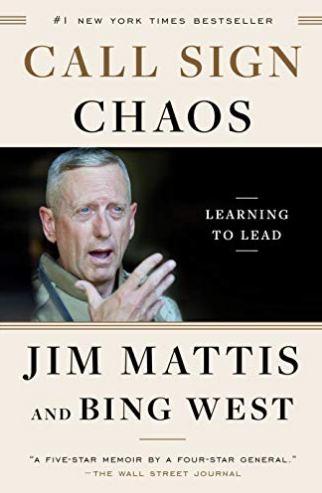
Call Sign Chaos, General Jim Mattis’s autobiography, should be considered one of the most important memoirs published in the 21st Century…
but you wouldn’t know it from the media response. In fact, most of the major news outlets seemed disappointed that General Mattis didn’t give a “tell all” of his time as Secretary of Defense in the Trump Administration.

Despite the flat media response, Call Sign Chaos by General Jim Mattis and Bing West delivers on a much more important purpose: to provide a chronicle of the life of one of the United States’ most important military leaders in history, along with the lessons he learned over his long career.
In a few weeks, we’ll be bringing co-author Bing West onto the show to discuss the book. In preparation for that event, I thought it appropriate to cover six leadership lessons I learned from General Mattis in my first reading of it in this episode:
- seeing your mistakes as tuition payments
- leading isn’t about you, it’s about your impact on others
- becoming an opportunistic learner
- the importance of understanding history
- the vital importance of stepping back to see the big picture
- defining the problem and your desired outcome as clearly as possible
If you’ve read the book, be sure to let me know what you think of the episode on the Facebook post for this page.
If you haven’t then be sure to get your copy at the link below:
Transcript
Machine-generated from the episode audio and lightly edited — may contain errors.
Chris Albert (link to this point)
The Warrior Soul podcast is written, produced, and edited by me, Albert. Our mission is to provide tools, tactics, strategies, and ideas to US military veterans and anybody else willing to listen to help them to navigate toward living their absolute best lives. If you find these episodes helpful, please share them out with somebody that you know of that can use them. And if you really like the podcast, please also head over to iTunes and write us a written rating and review. It really helps us to spread word about the show, and it really helps to get these tools in the hands of others who really need them.
This podcast is sponsored by f bomb nutrition. They make awesome delicious packets of macadamia nut butters. They mix them up with chocolate, with sea salt, with pecan butter. They're absolutely delicious, and they also have a number of other fat fueled snacks, like their meat sticks and their cheese crisps. They're amazing people who are sending boxes of this stuff out to the troops on the front lines, and they're offering 20% off to our listeners on their first orders.
If you head over to www.dropanfbomb.com and use the code Warrior Soul at checkout, you'll get 20% off of that first order. And I'm gonna keep the announcements short and sweet today. You can stick around to the end. I got a really special announcement about a brotherhood that we're creating here at Warrior Soul. So hope you enjoy this episode.
I hope you get a lot out of it. And without delay, let's get into it.
This is Chris Albert, and I'm here to remind you of one thing. Someday, you're going to die. That's not some morbid statement or scary idea. It's solid fact. Your time here on this earth is limited.
We need to be reminded of this as much as possible with one simple reason, to live your best life while you can. This is the Warrior Soul podcast.
Dear Bill, the problem with being too busy to read is that you learn by experience or by your men's experiences, I e, the hard way. By reading, you learn through others' experiences. Generally, a better way to do business, especially in our line of work where the consequences of incompetence are so final for young men. Thanks to my reading, I have never been caught flat footed by any situation, never at a loss for how any problem has been addressed successfully or unsuccessfully before. It doesn't give me all the answers, but it lights what is often a dark path ahead.
And that is an excerpt from a letter that general Mattis wrote expressing his love and his use of reading to do his work. And that letter is in appendix b of general Mattis' and Bing West's book, Call Sign Chaos, which is a memoir of General Mattis' life as a United States Marine Corps officer. I got to read this book a couple of weeks ago, and in a few weeks, I am going to be hosting mister Bing West on this show, General Mattis' co author on the book. And what I wanna do before we get to that interview, because I want to encourage all of you to read that book. I think it's one of the most important books of our time.
I want to go through a few of the biggest lessons that I took from it in my first reading. A lot of what you'll get from this book is simply going to remind you, if you have served in the military, of a lot of the lessons you were taught when you were young. And I think the problem is that a lot of us, as we venture out of the military, we fail to apply those lessons to our own lives in a way that is going to serve us as we move forward with our next missions. I think it's imperative for us to study this guide, just as a guide for being an officer or being an enlisted leader, but as a guide for carrying ourselves through this life. Because the lessons of leadership that are in this book could help you in so many different situations.
I also want to say that what I'm going go through here on this episode is by far just a fraction of what you'll get from reading this book. When you go through this book, I think that every single page, every single chapter in it is valuable. There are so many books out there right now where you just read the introduction and you just read the conclusion and you skim through the center and you'll get the whole book. This is not one of those books. This goes through General Mattis' entire history from being a 21 year old Marine Corps officer all the way up through commanding a quarter of a million people and leading up to his service as secretary of defense.
So when you do get this book, don't try to take the easy way out. Don't try to skim through it. I suggest that you spend some time with it and that you digest it. So with that, let's get into some of these lessons that I took from it. The first one is this.
Over and over again in the book, General Mattis refers to his mistakes and most of his experience as tuition payments. He regards his career as a world class education. And one of the things he says at the very beginning of the book is that he made a lot of mistakes. But every time he made a mistake, the Marine Corps promoted him. You know, a lot of us, whenever we make a mistake or when we screw something up or where we don't show up as our best, we dwell on it.
We sit there. We dissect the situation. We think about it over and over and over again, and it keeps us from ever stepping up again, or we hesitate when it comes time for us to step up once again. As a leader, you can't afford to do that, And in your own life, you can't really afford to do that. You're gonna be afforded a lot of different opportunities throughout your life.
And because of that, you're gonna step into a lot of new situations. And when you're new at something, there's a required time for you to really master that new position or that new situation that you're in. And so your job is really to observe, and it's also to apply what you've learned in the past to the situation you're in right now. Now that's not always gonna work out for the best. And so when you do make new mistakes, that means that you need to take chalk them up as lessons.
They're tuition payments to your overall education. Now one thing that general Mattis says over and over again, and it goes back to that initial passage that I went through at the beginning of this episode, is that there are ways of keeping yourself from stepping into mistakes because you lack experience. And the primary one is by reading. Reading is one of the most important facets of General Mattis' recommendations for anybody who's trying to navigate themselves through a military career or through life. As he says in that passage that I read, the problem with learning by experience, especially in the military, is that you're playing with lives and limbs.
And if you're not gonna take the time to learn about what people went through in the past in similar situations, how they reacted, and what they did to get themselves out of those situations or what they did to potentially make those situations worse, then you're really putting yourself into a situation of greater risk. So the biggest lesson you need to take from this is that you need to take time to study. You need to take time to learn. And before you step into a new situation, you need to take the time in order to learn the advice of those who came before you. Because if you don't, you could be stepping into a potential minefield.
One thing I do every day right now is I dedicate myself an hour in my day to reading. Whenever I'm going to the bathroom, I keep a book with me by my side. And for that ten minutes that I'm gonna be in the bathroom sitting there doing nothing, well, having the book there, you know, a few times a day, ten minutes, you know, you can get through a lot of reading that way. Now, know that's kinda gross, but that's a helpful tip for getting through a book if you if you can't find the time to read. And it's a lot more valuable than cruising around on social media or cruising around on your phone.
I run into a lot of people through my work as a coach and as a consultant that don't know what they want to do in life, particularly young people and particularly guys who get out of the military. That big mission is over and they don't know what's supposed to come next. What I would say to you is that if you're in that position, you definitely should dedicate yourself to doing some reading. One book that I'd recommend to those of you in that situation actually, I'll give you two books here. One of them is Mastery by Robert Greene.
Robert was a guest on the Warrior Soul podcast just a couple of weeks ago, and I think it's one of the best interviews we ever did. But knowing a bit about his story, he didn't know what he was gonna do with his life up until he was in his late thirties. He knew he wanted to be a writer, but people kept telling him that he wasn't a good writer. And so he took over 80 jobs throughout his life, and then eventually ran in this opportunity to write the 48 laws of power, which is the book he became known for. And in this book, Robert goes through the history of a lot of the world's great masters, from like Einstein to Madame Curie to a whole host of others.
And it's it's just a fantastic book for understanding how to find what you're meant to do, and then putting everything into learning how to do that thing so that you're one of the best in the world at it. The other book I'll mention is by Steven Pressfield. A lot of you know him by his work, The Gates of Fire, which is a book that's passed around in military circles about the 300 Spartans. But he's got another book out there. It's called The War of Art.
And just like Robert Greene, Steven Pressfield actually didn't find success as an author until he was up into his fifties, I think. And he was living in a van. He kept his typewriter back there, and he really didn't know what he was doing. And it wasn't until he began applying himself and and began really doing the work. He call he says this unseen force called resistance kept him from doing it.
Well, that's when he started to find success, and that book, The War of Art, is a guide for getting through your own resistance. It's meant for artists, but I think it applies for people as well. So that's two big lessons to take from the book. Your mistakes as tuition payments and then making sure that you are learning from the past, learning what others went through. The third one follows from these two, and it is be an opportunistic learner.
Now what does that mean? That means that you need to humble yourself enough to learn from others. General Mattis was lucky enough to be guided at the beginning of his career by a lot of Vietnam veterans. He had a lot of NCOs that were working with him who were Vietnam veterans that guided him. And, you know, though they were under him in terms of rank, they were more experienced.
And general Mattis humbled himself like any good officer should, and he learned from his most experienced NCOs. Similarly, as he moved forward in his career, he learned from officers and senior NCOs who had been around the block a few times. And so your job in the civilian world is to seek those people out because they're not so readily presented to you. You need to get out there and you need to find people who are more successful than you. And I know you hear that over and over again.
It's become kind of like a self help cliche to try to find a mentor, but it's the truth. Too many of us try to isolate ourselves in our own lives, and we try to do this Rambo thing where we're going to try and fight the world by ourselves. And that's just not how it works. Now, what I'm not recommending, I'm not recommending that you go out there and you sign up for one of these courses where you're paying somebody to mentor you or anything like that. I think that there's far too much of that going on.
What you need to do is you need to get out there and you need to be clear about what you want to know, where you want to go. You need to find people, and you need to do what you can in order to learn from them. That might mean you go in and you apprentice with them for a while, maybe taking a free internship for a little bit. And a lot of you are probably smacking your heads and saying, no, I can't do that. But listen, if you're young and let's say you're going to college after the military, well, guess what?
You have energy and you have time on your side. And so why not, when you're not in class, head over to a local businessman's office and say, listen, I wanna work for you for free for a little bit. Just to learn what you do, learn about how you carry yourself, learn about how you do your business. That could be a great way of learning. It could be a great way of trying to figure things out as to what you want to do, what career path you want to follow, and also understanding what steps you need to take in your own life in order to get success.
If you're a bit older and you need to keep a steady job, well, here's my advice for you. Don't take a job for how much it's gonna pay you. Take a job for what you're going to learn from it. I'll give you an example from my own life. About four years ago, I was offered a chance to work with London Real.
London Real is a really big podcast out of The UK, and I wanted to learn how to start my own media company. I didn't just jump into this and say one day that, hey, I'm gonna start Warrior Soul, and I'm gonna start a media company. I knew that there was a whole lot that I didn't know about because I'd never done this before. I'd never run a podcast before. But Brian Rose, the founder and host of London Real, he had started his show from scratch.
Before that, he was an investment banker, but he knew what had to be done in order to create a very successful podcast that was also an entity that was making money. Right? Because a lot of podcasters get into this, but they don't quite understand how to monetize it. You So get a lot of podcasters who are absolutely broke. So when I heard that he was putting a course out there teaching people how to start online businesses, number one, I went and I took the course.
And after I got through the course, he and I became friends. I'd invested a bit into London Real, and that raised my trust with him, and he got to know and like me. Remember that, know, like, and trust. And he saw that I was able to bring some value to the table because I'd had some experience in online business by running a clothing company and by being an online trainer. So he asked me to come on board as an instructor.
And over that three years, I got to learn a whole lot. I worked really hard. I eventually became the lead instructor of the London Real Academy, and I led a team of nine instructors, and I helped build his courses out from, you know, 10 students per course to a 150 students per per course. But what I was able to learn over that time was a lot about how Brian found success in his business. I learned a lot about how he promoted his show, and I was able to take that and put it all into producing the Warrior Soul podcast.
And so where you see me coming out of nowhere where I'm getting guests like Robert Greene, I'm getting guests like Nick Koumalatsos. I'm getting guests like Ryan Michler, and a whole host of other really, really awesome and important guests. Well, that's because I was able to learn from him how to do that. And I'd highly suggest getting yourself into a position to where you're not taking the jobs just for the money. You're taking them because you have something to learn from them.
So that's a really important lesson to take from this book. Be an opportunistic learner. Learn as much as you can from others. The next one I wanna talk about is how we define what we're going to do. One of the things you'll see from general Mattis' life is that he was constantly trying to define the intent in no uncertain terms.
And that was a big thing in the marine corps while I was in. Everybody had to know the commander's intent. And you see why from this reading of call sign chaos. If you don't know the intent, you don't know what the problem is that needs to be solved. And if you don't know that, then your subordinate leaders and the rest of your subordinates, well, they aren't able to use their initiative and their innovation to try to solve the problem.
And you'll see that General Mattis had so much confidence in his marines. He had so much confidence that they would get the mission done. And it's because it all starts with him clearly defining the mission and clearly defining the intent. You see, if your intent is defined and you've defined the problem that needs to be solved, then what happens is you can clearly map out the steps that you need to take to get there. But more importantly, if you're working with other people, and that's another big lesson from the book is that you can't get anywhere without other people, and we'll talk about that in a second.
If you've got subordinates, if they know the intent, they can figure out different ways to get there. Because you're not the be all end all as a leader. The reason why you have people working with you and working under you isn't because you're better than them. It's because they're the ones who know how to get the job done. If a commander has a clearly defined intent in a military operation, then the marines, the soldiers, they can take initiative.
And one of the things that general Mattis says is that he was constantly amazed at the amount of initiative and the amount of innovation that his marines were able to come up with. The only way that can happen in any organization is if the intent is defined. And that brings us to the next lesson. Leadership isn't about you. It's about your subordinates.
It's about guiding your subordinates properly. It's about allowing them the greatest possible chance for success. One of the things that though the media constantly talks about General Mattis in terms of the Mad Dog moniker, and I think there's a lot of us in the veteran community who, you know, screw with that as well, thinking that he's he's kind of a hard ass. Well, yeah, he is a hard ass. But what you'll also find is that in his book, he says you can't be a tyrant.
If you're a tyrant, you're not going to get your marines, you're not going to get your soldiers, you're not going to get your subordinate workers to want to accomplish the mission on their own initiative. And without that initiative, you're not going to get that amazing innovation that allows for mission accomplishment a lot of the time. So you can't be a tyrant, and you got to remember that leadership is not about you. You need to put your subordinates first, You need to be communicating with them clearly, and you need to give them every chance that you can for success. The final thing that I got out of this book, the final lesson that I got out of this book is this.
You need to constantly step back and take a look at the big picture. That's because momentary success may not be leading to overall success. One of the big examples I think of this is in the way that this book was meant by the media. When a lot of initial reviewers read the book, they were expecting some sort of takedown of the Trump administration. And sure, that might have sold a whole lot of books, and it might have put him into position to get a lot more interviews and a lot more media and a lot more press.
But at the end of the day, it wasn't his intent in writing the book. His intent in writing the book was to add to the multitude of lessons that have been written down by Warrior scholars over the history of mankind, from Xenophon all the way up to this book here with general Mattis writing out his memoirs. He wanted to convey those lessons that he'd learned over his career to the marines, the soldiers, and the leaders who were going to read it. And that was far more important to him and his life's mission than writing some tabloid piece about his interactions in the Trump administration. And though he faced a bit of criticism for that initially, and maybe he's not gonna sell as many books as he would, I believe that this book, over the term of its history, is going to be one of the most read books in military circles, in leadership circles, and by those who are truly looking to do big things in their lives.
And this book, in turn, could be responsible for so many great things happening. And because of that, General Mattis also maintains his reputation as a fantastic leader and as somebody who's dedicated to his duty. And I have to say that I don't think that his stint as secretary of defense is gonna be the last we see of him in public service, and it's because of the path he took with this book. I also wanna say this. When you look at your life, it's easy to see the three feet in front of you.
It's easy to get bogged down in the minutiae of things, but you constantly have to take a step back and look at the big picture. If you look at the foreign policy mistakes, the mistakes we made in Afghanistan and Iraq, it's because the politicians at the top of the pyramid were not necessarily looking at the big picture. They were looking at short term political outcomes. And that, in turn, probably deteriorated the security of The United States. And if there's any criticisms that General Mattis has in this book, it's for those policies that led to that that were just based on shortsightedness.
So, again, I wanna emphasize, when you read this book, I think every page of it is important. Every chapter is important. There's a lot you're gonna take from it, but only if you do the hard work and you read through it. So take the time, gain this wisdom. That's why General Mattis took the time to write this book, and you should be taking advantage of it.
And again, in a few weeks, we'll have the honor and the privilege of bringing on General Mattis' coauthor, Bing West. I did make the attempt to bring General Mattis onto the podcast himself. He's a very busy man, and I did not expect that he would have the time to come on here. But I am definitely honored to have his co author, Bing West, is an outstanding leader in his own right, another Marine Corps officer, and a past Undersecretary of Defense who's written volumes of pages on leadership, on war, on combat. And with that, guys, that's all I've got.
I will link to the Amazon page for this book on the show notes. And when you do make your own reading, let me know what you get out of it. Hit me up on social media. I wanna I wanna hear from you guys about what you found most valuable about reading this book. I also want to mention this.
We've got something going on here at Warrior Soul. It's a group called the Warrior's Obituary Society. And essentially, what it is is a group of men who are pushing each other to be their best. When you join the Warrior's Obituary Society, the goal is to empower you to live an epic life worthy of an epic obituary. And all of our members go through an eight week development program.
And in that development program, you're focused on finding your vision, defining your purpose, defining your goals. We focus on fitness, on personal finance, on relationships, on learning the basics of living an awesome life. And once you get through the development program, it's not over. We're here every week on a live call, defining our goals, telling each other how what we're working on that week to get closer to our goals, and holding each other accountable. There's challenges each week, and we are constantly finding new books and discussing those books on the calls.
So if that sounds like it's something you'd be interested in, just hit me up. You can DM me at warriorsoulagoge on Instagram or email me over at chris@warriorsoulagoge.com. A lot of these types of programs cost thousands of dollars. This one does not. I purposely kept the price manageable so that we can get as many brothers who need this help into the group.
So again, if you're interested, hit me up, and we'll be back at you later on this week with some more awesome content. Get out there and live your best lives while you can. Learn as much as possible, and I am out.
Host of the Warrior Soul Podcast and founder of Warrior Soul. Worldwide trainer and nutrition coach, contributing author at Testosterone Nation and Muscle and Strength.