Podcast episode
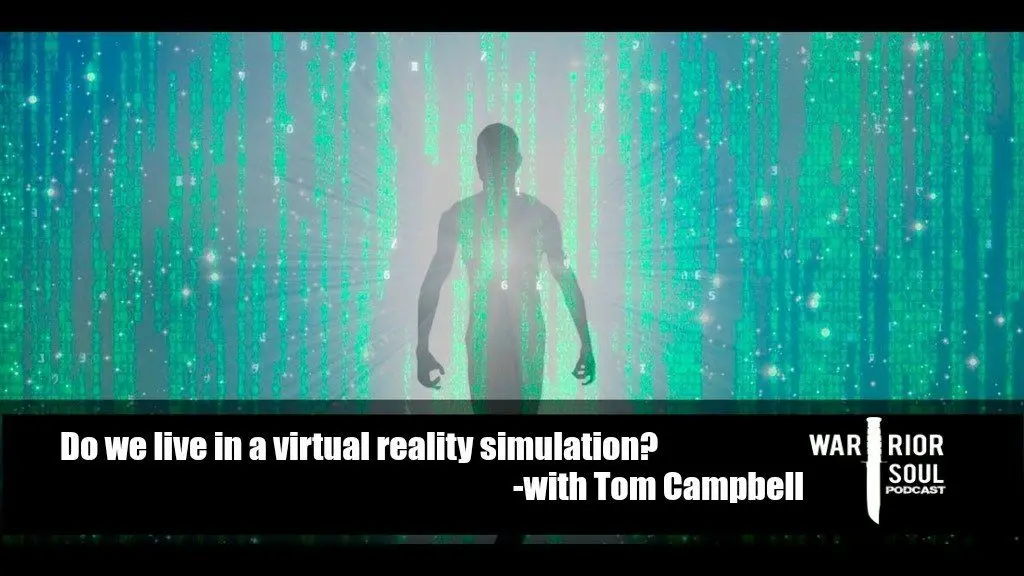
Do we live in a virtual reality simulation? | Tom Campbell

Hosted by Chris Albert
The Warrior Soul Podcast



Tom Campbell is a Physicist and the author of the book My Big TOE. He is a leading proponent of the theory that we currently live in a virtual reality simulation and seeks to prove this through scientific methods. His recent Kickstarter campaign is currently raising money to conduct experiments to solve this interesting question.
For Tom’s Kickstarter: https://www.kickstarter.com/projects/simulation/do-we-live-in-a-virtual-reality
Video footage courtesy of My Big Toe and created by:
Scott ElnesMobile Age Mediawww.facebook.com/mobileagemedia
Transcript
Machine-generated from the episode audio and lightly edited — may contain errors.
Chris Albert (link to this point)
This week on the Warrior Soul podcast.
Narrator (link to this point)
Are we living in a virtual universe? Is our reality being created by the information processing power of consciousness? It may sound far fetched, but actually it isn't.
Chris Albert (link to this point)
Are we living in simulation?
Tom Campbell (link to this point)
I find it hard to argue against that possibility. Now you can see a video game that's photorealistic, then eventually those games will be indistinguishable from reality. How do we know that that didn't happen in the past, and that we're not in one of those games ourselves?
Narrator (link to this point)
For over one hundred years, materialism has failed to adequately explain quantum mechanics' experimental results. However, virtual reality not only provides a logical explanation for quantum physics, but explains many of the most perplexing problems facing scientists and non scientists today.
Tom Campbell (link to this point)
I'm Tom Campbell, a physicist and consciousness researcher who has worked at the leading edge of science and technology for NASA, missile defense, and Monroe Laboratories. In June 2017, my scientist colleagues and I wrote and published a peer reviewed quantum physics paper that describes how we can test the simulation hypothesis with physical experiments that are unique variations of the classic double slit experiment.
Narrator (link to this point)
Scientists like Tom Campbell have been quietly working for years developing a solid scientific theoretical foundation to explain the attributes and logical consequences of virtual reality.
Chris Albert (link to this point)
What's going on everybody? Chris Albert here with the Warrior Soul podcast and yep, you've heard that trailer correctly. We have mister Tom Campbell on the podcast today. He's one of our more popular past guests that we've had on. And Tom believes that we live in a virtual reality.
That these trees, all this stuff around me are bits of data that's being sent to my avatar and my consciousness actually in your consciousness, it exists somewhere else. So in some other dimension, some other universe and that we're simply avatars or like what you would consider an elf in a World of Warcraft game. Our consciousness is controlling our every move. And the thing about this is because I know it sounds really really far fetched but you got to remember that Tom is a physicist. And he wrote a book called My Big TOE, My Big Theory of Everything where he lays down the logical underpinnings for why he believes we live in a virtual reality simulation.
He just completed a kickstarter campaign where he reached his goal. He's gonna be conducting experiments to try to prove we live in this virtual reality simulation and it's one of the more interesting subjects I've ever covered. So I wanted to bring him back on, talk about these experiments, to talk about what he's gonna be doing and then talk about the what he thinks the implications are for all of us. What does it mean for all of you if we do live in a virtual reality simulation? And it's one of the more interesting conversations I've had this year.
Before we get into that conversation, I want to give you a note from our sponsors. Our awesome sponsors, F Bomb Nutrition. They make delicious portable packets of fat. Now, they've got packets of olive oil, MCT oil, coconut oil. These are always hard to get when you're out and about and you're trying to get a good source of fat in your diet, but they also have these amazing nut butter packets and all of them have a macadamia nut butter base and they mix it up with chocolate, they make it mix it up with pecan butter, absolutely delicious.
And you can carry them around and you know have them whenever you'd like. They're also really great people. They've been sending packages of their product out the troops on the front lines and I've been getting notes back about how hope how helpful these things are and giving these guys energy while they're trying to do their jobs. So if you want to get yourself some f bombs, you can get 20% off for being a Warrior Soul listener if you use the code Warrior Soul at www.dropanfbomb.com. That's code WarriorSoul at www.dropanfbomb.com.
You'll get 20% off of your first order. So with that, I'm gonna go enjoy the sun. You guys enjoy the episode.
This is Chris Albert and I'm here to remind you of one thing. Someday, you're going to die. Now that's not some morbid statement or scary idea. It's solid fact. Your time here on this earth is limited.
We need to be reminded of this as much as possible for one simple reason, to live your best life while you can. This is the Warrior Soul Podcast.
Tom Campbell, welcome back to the Warrior Soul Podcast. How are doing out there today?
Tom Campbell (link to this point)
I'm doing great, Chris. Thank you for the invitation. Always enjoy coming here and having a talk with you.
Chris Albert (link to this point)
Absolutely. First things first, you've got this Kickstarter out there. Do we currently live in a virtual reality and you just made your goal? What was this Kickstarter about? What are you trying to do as far as raising money for this project?
Tom Campbell (link to this point)
Okay. Well, there's a couple of answers to that, sort of the little picture in the big picture answer to that. And the smallest picture of that, it's about doing some physics experiments that I have made up, quantum mechanics experiments that will, help us understand how virtual reality, informs or makes up this world. In other words, if these experiments work the way I hope they will, then it will be very strong evidence that our reality is a virtual reality. In other words, a computed reality, one based on information.
Now science has been moving in that direction over the last decade anyway, because that's what experiments have been telling them. But the experiments are never at all that conclusive. It's like they, they hint and they lead people to think that that is the right answer. But we would like to get something a little more dramatic, little more definitive that would help us solidify that. So it's to raise the money to pay for getting these experiments done, which means we have to hire some competent experimental physicists who are familiar with all the equipment that needs to be used.
We'd have to get lab space. We'd have to buy equipment. So that's what the money is really going for is to produce these experiments. But now in the bigger picture, it's like, so what? This is physics and most people don't really care a whole lot about how the physics works out in their daily life.
But the idea is that once the scientists, who I call the high priests of Western culture because it's the high priests, you know, of any culture who tell us what to believe, what's right and what's wrong, you know, what is, you know, what's phony and what's real. So for our culture, Western culture, which is pretty much world culture these days, the Western culture is kind of spread everywhere. The high priests are the scientists. They're the ones that tell us, you know, truth from falsehood. That's sort of their job.
So when they get to the point that they say, this is a virtual reality, then that has some very important philosophical consequences that will actually reach down and touch everybody. And those are that in order for this to be a virtual reality, that means that our reality is computed. It's a simulation, it's computed somewhere. And where it's computed and by whom it's computed, if you will, have to be non physical to us. In other words, know, the virtual reality can't compute itself.
Your elf in World of Warcraft will never find the server that's creating the World of Warcraft inside of the World of Warcraft. You see, that's basically the way it works. So for the elf, the server that's creating World of Warcraft has to be non physical from the elf's perspective. Well, it's the same way here. If this is a virtual reality, that means that there is something that is a superset and we're a subset, you know, and that's something that's the superset, the creator, if you will, of this virtual reality has to be nonphysical to us. Now that also says that in a virtual reality, you have avatars.
The avatars are just eye candy. They're just there for the players to look at, to kind of show them what's going on. You know, there there's not a lot of depth to it. It's just just what you can see, just what the senses take in. So that elf running around doesn't have to have a liver and a heart, you know, and lungs and air to breathe and all that sort of stuff.
All it has to do is you see what's on the outside. It's just simply, eye candy. Well, that's the way avatars are. Avatars are always that way. So what's, you know, what is this player that's playing the avatar?
Well, that's the consciousness. So consciousness is playing the avatar. The consciousness makes all the choices for the avatar. So then the second big thing is that we are not our physical bodies. We are consciousness.
Consciousness is also nonphysical to us, to the avatar. Okay? And that's just logic of the virtual reality. It's the same thing. The the elf is not going to be conscious.
The elf is just eye candy. It's just a superficial, picture of of basically what the sense data that the elf would collect when it's there. There's nothing else inside. And that's the way all avatars are. So the consciousness is the player that plays the avatar.
And that also has to be non physical and it has to be in the same reality frame as the computer. You know, we said the computer had to be non physical. Well, the consciousness is really just in a dialogue with the computer. That's how virtual reality is played. You have a player and you have a computer and those two are communicating with each other.
The player says, I want my elf to, you know, to jump up in the air. And that is a data that's sent to the computer. Then the computer draws a picture of the elf jumping up in the air and sends that picture back to the player who now sees his elf jumping up in the air. Plus the computer computes all the consequences of himself jumping up in the air because it's a multiplayer game. So that's the way it works.
So what we have, if we get science to, to, kind of grab hold of this virtual reality idea, which they've been kind of sneaking up on little by little over the past decade, do it something a little more dramatic. Then we will have this idea that there's something more fundamental than we are as far as we, the physical world, and that physical thing is consciousness. You know, it's that thing that's more fundamental than we are is consciousness. Consciousness is fundamental, the physical world is not. Well, that's going to create a whole lot of changes in the world.
It may not be obvious, but that's science basically now telling people, and we have an internet, so a billion or so people find out about these sorts of things very quickly. So we have science telling people that there's something else more fundamental than us, it's non physical and it's basically consciousness. Consciousness is the computer. And there's this larger consciousness system that is the source because the next two things that are the next thing that drops out of that, if that's the case, because science, I mean, consciousness is a social system. In other words, we have lots of individuated units of consciousness interacting with each other.
Logic, deductive logic will show you that the optimum interaction for a social system is caring, is not self centeredness, is cooperation. That sort of
Chris Albert (link to this point)
Let me backtrack just a second because some of our viewers who might not have ever heard of you or who might not have listened to the first podcast, just going back into your history because there's a lot of people who pay lip service to consciousness, who talk about consciousness, who talk about the fact that we might be living in a virtual reality. And there's a lot of lot of people out there who describe it maybe for the shock value, maybe for having for for to attract people to their view, but you are your background is as a physicist. You are a scientist.
Tom Campbell (link to this point)
And Right.
Chris Albert (link to this point)
Your book, My Big TOE, actually lays out the the logical premises for this theory. And it's a it's a very, very well and elegantly laid out theory that that goes into the depths of everything that you're describing. And so right now, what you're doing is you're taking that from theory and now moving that into the experimental phase, where you're actually testing out these hypotheses that you've laid out in My Big TOE. Is that correct?
Tom Campbell (link to this point)
That's right. You see, if consciousness is the fundamental thing, then everything else will be a derivative of consciousness. So then, you know, like in physics, physics we know is not complete because we have two theories, quantum mechanics and relativity that are at odds with each other. Philosophically, each one of them makes a premise that the other one denies exists. So there has to be something bigger that each of those can be derived from.
And that's the TOE that Einstein and other people have been searching for. The string theorists have been searching for this overarching understanding that explains both relativity and quantum mechanics. And as it turns out, consciousness is that overarching thing. So consciousness needs to describe relativity and quantum mechanics. And I've already described, you know, the fundamental unknown in relativity with consciousness.
And that's why C is a constant. That just comes out of virtual reality being virtual. C is a constant because it has to do with the pixels, if you will, the smallest pixels, the resolution of virtual reality. Every virtual reality has a speed limit. Even the World of Warcraft has a speed limit.
It has to do with the pixel size. You can only move one delta x for every delta t, and that delta x over delta t in our virtual reality is the speed of light. In the World of Warcraft, that's something else because their resolution isn't as fine as our resolution. You see, so that's as fast as anything can move contiguously through space is one pixel of distance for one pixel at a time. So that's why speed of light is constant.
So that kind of solves the relativity because once you understand that, the rest of the relativity is just math. It just works out. That's the big unknown in relativity. In quantum mechanics, it's why our particles best describe as probability distributions. And that makes perfect sense also from the consciousness viewpoint and the virtuality viewpoint.
But in science, nobody really listens to you until you've done an experiment. See, everything, what's right and what's wrong is defined by experiments, which is a little difficult when you're working with consciousness that's basically non physical to the physical reality, because now you have to do a physical experiment that verifies non physical consciousness. And you can imagine that's, you know, logically that's a little hard to do because you've got apples and oranges there that you're mixing. So we've come up with some quantum mechanics experiments that look like they will point a finger at the virtual reality that they will say, there's really no other way to explain this experiment other than this is a virtual reality. So that's sort of what we're trying to do.
But our big picture end goal is to try to help people understand that they're here for a purpose. And that purpose is to grow up, become love, be cooperative, care about other people. And that comes back to the evolution of consciousness. I know that's a little hard for your readers to maybe tuck all that in and it sounds like I'm making it all up, this stuff is logical. It really does have a logical scientific basis.
It's just hard to describe all that in few minutes.
Chris Albert (link to this point)
Well, absolutely, and I want to break a bit of this down and I definitely want to move into lessons for life that we have from this theory and from from what could come out of these experiments. But when we're talking about the experiments themselves, so the most famous of these is probably the the double slit experiment. And Yes. You'd mentioned that consciousness is reality is probably more likely a probability distribution. Mhmm.
And this was an experiment where they shot, I believe it's photons, forgive me because I'm not a physicist, but through these two slits, and rather than getting two direct beams, they got a spread, a probability spread. And and so why does that matter, and and what other ways are you looking at as far as experimenting to find these kind of blips in the matrix, so to speak?
Tom Campbell (link to this point)
Okay. Well, that double slit experiment was done in the early 1900s, like 1914, up through nineteen twenty, twenty five. And they did, that's what I would call, they did a thing that we call a miracle, which means something that, is impossible. Something that has no physical cause happens anyway, and it happens routinely. So what they did, as you say, they took single particles and shot them, you can think of it with a particle gun through slits, two slits that were separated by some distance.
And what you would expect if you throw particles through slits is you'd get a pile of particles behind each slit, right? If you're throwing baseballs at two holes in a board, baseballs that go through are gonna hit the background right behind the slits, right behind each slit. So you'd have a bunch of baseballs that would hit behind each slit. That's the way particles act. That's what Newton said about particles.
They'll travel in a straight line unless interacted with some other force. Well, are no other forces, but what these particles did is that they distributed themselves on the background in what we call a diffraction pattern. So some of them hit right in the middle between the slits and some of them, you know, then there was a little blank space where none of them hit and then a bunch more hit off to the right and left of that. And then a bunch more of them hit off to the right and left of that. So there was this pattern of what's called a diffraction pattern. It's what waves do. If you put waves through two slits, you get a diffraction pattern.
So these particles arranged themselves on the backdrop in the same way that waves would have arranged their energy on backdrop. And that was just impossible. So as they studied this a little more to see why that worked that way, They found out that if they looked at every time that a particle went through a slit, measured it. And they said, all right, particle just went through slit A. Now particles going through slit B.
Okay, now two more go through slit A. If they did that and kept track of each particle going through a slit, it's called the which way information. Which slit did the particle go through? If they collect that which way information, then all the particles pile up behind the slits just like they expected. They look just like particles.
But if they don't collect that which way information, if they just let the balls go through the holes, then they distribute themselves in a diffraction pattern. So that's the mystery of the double slit experiment. And the way that science eventually solved that or learned to work with it is they just assumed, they didn't know exactly why this should be the case, but they realized that if they treated the particles, not as particles, but as probability distributions, they had some probability of being somewhere. And if they treated them that way, then they could compute the right answer. They could get their probabilities, would be that diffraction pattern.
So they were able to compute the right answer. So that's the big mystery in quantum physics is why should particles be best modeled as probability distributions? And of course, in my consciousness theory, the way consciousness computes this virtual reality is as a probability model. That's the nature of consciousness. So the whole virtual reality we see is a probabilistic virtual reality.
And that I didn't make up in order to match what physics found out about the double slit. That comes out of just the nature of how this reality works. It has to be a probability model. That's not an assumption. That is a necessary logical fact in the process of developing this consciousness model.
So any other model doesn't work. So the only model of consciousness that works that actually can get the right answers is a probability model. And that's the only one that's efficient enough that it would evolve to be that way. So I know that consciousness is the fundamental thing that is informing quantum mechanics. So I know that's true.
But now the challenge is to try to get some experiments that will show hard evidence of it being this way. And like I say, that's a difficult thing because you're trying to show something that is non physical with a physical experiment. So you're not actually ever going to do that directly, but you're going to be able to at least point a finger at it. You're going be able to build evidence for it. And that's what the experiments are trying to accomplish.
And you're right, we did hit our goal, kind of our minimum goal. And just a couple of days ago, maybe even just yesterday, I'm not sure. I think it was just yesterday afternoon we hit that goal, but that's just the beginning. In this game with Kickstarter, it's an all or nothing kind of game. You either make your goal.
If you don't make your goal, you get nothing at all. All the money gets put back, you don't get anything at all. So you start with a goal that is kind of your minimum for getting something done, you know, because you want to at least get there. You don't want to set it all the money you'd like because chances are you won't make that and you'll end up So giving it all we got the $150,000 but that's just enough to get us started. We really would like to have at least twice that much, but you always set your goal to kickstarter at the minimum amount.
So even though we made our goal, I encourage people to still, if you want to, if this is something you want to do, well, please go out and join in and make a contribution there. I think if this does work the way I hope, then it will have a major effect on society Because this theory of mine isn't just about physics and science and consciousness and models. It's about everyday people and their lives and choices. You see, that's the thing. And that's kind of why you and I connect on this because you're about everyday people and their problems and their pain and their choices.
And so is my model really about the same thing. Because once you understand consciousness, well, that's very individual. That gets us right down to you and I and all the rest of the people in the world. And this model then tells us how it is we have to be and what it is we have to do in order to be productive here, in order to be happy, in order to be full of joy and satisfaction rather than struggle and pain. And that's really the side that's most important.
It's not the philosophy, the physics. All right, that's nice for people who study those things, but it doesn't really affect the people that much. But in this case, this philosophy does because it's a philosophy about you and who you are and how you exist, your consciousness. And that means it's about your happiness, your pain, your fear, all of those things is really what it's about. So that's the bottom line.
Chris Albert (link to this point)
What I wanna mention here is so, and there's a big reason why I'm attracted to this stuff because it is that idea of everything being a probability distribution. Right? And so if we look at, you know, there's somebody who's never heard of this before, you know, to say that that we are an avatar and that this avatar that that that we're dealing where we are consciousness and that this avatar that we're experiencing here in in in this world or this dimension is being controlled by some other consciousness or or a piece of consciousness that somewhere else. To say that to somebody, sometimes it might seem like personal responsibility is taken away, but with the way you have things described here, it's not at all. Personal responsibility is everything here.
Right?
Tom Campbell (link to this point)
Everything. Yes, everything. I mean, you have to take responsibility for all your choices. And your choices aren't just whether to buy a Chevrolet or a Ford. Your choices are basically that we're talking about are your choices of how you react to things.
If somebody insults you or says something belittling about you, you have a choice about how you react to that. You can react to it with anger and that's a poor choice. Or you can react to it out of caring and cooperation. Now, if you do the caring and cooperation, you actually have a chance of solving that problem, of fixing that problem so that it doesn't happen again. But if you react to it out of anger, all you do is throw fire on something that's already burning, you see, and you make it worse.
So it's the same with our fears. It's about getting rid of your fear, getting rid of your beliefs and always being skeptical. And I guess that's an important thing. Want everyone to be skeptical because if this is not your experience, it's not your truth. But if you actually experience this responsibility where your responsibility for everything in your life, where you realize that most of your pain is self inflicted and that you can make yourself over, you can make yourself into a person that has a life with good relationships and full of joy and caring and that sort of thing.
It's possible. So we're here in this virtual reality as consciousness playing these virtual realities in order to make choices. This virtual reality gives us choices to make. And whether we make those choices with love and caring or make them with fear and belief is the difference between whether we're happy and have good relationships or whether we don't. So it really is a very personal thing when you get down to the end of it.
It's not an academic discussion at all. It's a very personal discussion. So, yes, as you say, it's all about responsibility. You have to take responsibility for all of your choices, all of your reactions, all of your feelings, you have to take responsibility for them.
Chris Albert (link to this point)
Why do you think so many people are attracted to fear? Why do you think so many people are attracted to fear as a choice base?
Tom Campbell (link to this point)
Well, see, as consciousness, we have potential. We have potential to evolve toward a positive side of love and caring and no belief, no fear. And we have potential to go the other way. It's always easier to go the other way. Now, why is that?
Well, if you think about any situation, let's say again, a person is talking about you and they may say things that aren't too complimentary and so on. Now, there's probably a dozen wrong ways to react to that. There's a lot of ways that you can do it wrong. You can get angry, you can punch them out, you can get angry but still grit your teeth and smile, even though you're angry inside, you can suppress it. You can get even.
You can plot your revenge. You've got all sorts of choices that you can do. But what about good choices? What are the good choices you have to do? Well, your good choice is to react with that just honestly and straightforwardly without anger, you know, without any negative feelings and just investigate that and say, well, you know, why do you feel that way?
Or why is that attitude? Or maybe if that person is just not somebody you can approach, then you might see how you can help get to know them a little better so they know you a little better so they don't say those things about you that true. So you find ways to fix the problem rather than throw gasoline on a fire that's already burning. That's what we're going here for is good choices.
Chris Albert (link to this point)
So so that's really what's at stake here as far as as conducting these experiments is is not just this this whole understanding of quantum quantum mechanics and quantum physics, but but a real understanding of why we're here, what we're supposed to be doing here on earth, and and how we're supposed to be managing our lives. Right?
Tom Campbell (link to this point)
Exactly. You know, if you look at the the basic philosophy that's undergirding science, it's materialism, which basically says, you know, there is no bigger purpose. You know, we're just here, you know, and stuff happens and we just struggle with it. Life is a struggle, right? Life is always going to be a series of pains.
You kind of get an existentialist viewpoint of there is no purpose, there is no point. You're here, you're just going to suffer, get used to it and stop complaining. You know, that's kind of where you go with materialism. There really isn't a positive place. If anything, it's a negative place and ours is to suffer through it sort of an attitude.
Well, when you have that attitude, you're trapped. That's like being a victim. When you're a victim, you give away all your choices. You give away your free will. You give away your power, if you will.
You can't heal yourself. You can't grow if you're a victim because a victim is somebody who is overcome by everything else. It's just so weeny and there's all these other powers in the world and they just somehow have to try to get along, but there's no way they can ever really succeed because they're just this victim. Well, that's just being self defeated. And if you're self defeated, you're defeated.
You'll never get beyond that place. So the philosophy of materialism kind of feeds being self defeated, not important. And the only way to get it ahead is to run over other people, get their stuff. Well, okay, you don't want to go to jail, you find some legal way to run over people and get their stuff. Well, that's just a slicker way of not being a very nice person.
It's maybe not illegal, but it's still not nice. It's immoral. Whereas if we can shift that view to the fact that this is consciousness and that we have this virtual reality here for us to make choices to grow up, and that's our purpose in life, then that gives a very positive thing. There is a point to life. There is a purpose.
We are consciousness playing these virtual characters and our job is to evolve ourselves. We evolve ourselves by becoming love, by making better choices. That's how we evolve as consciousness. And again, I just don't make that up because it sounds good. That's really a part of a deductive logical theory that works out that way.
So once we have that idea that there's something bigger, more fundamental than we are, Okay. Now it's well, okay, then why are we here? You know, what are we doing and what's our purpose? Well, that's it. It's to make good choices here.
That's why this virtual reality is created. So that gives us a positive reason, a way we can level up, a way we can grow, a way we can, be successful. And it doesn't matter how much money we have or how much power we have to push other people around. That's not the point. That's not how you get points in this game.
In this game, you get points by caring, by being a part of the solution and not part of the problem, by helping. That's how you get points. So changes the game from one of the bully wins, the big guy with all this stuff gets to push other people around, to a game where people who are kind, people who are gentle, people who care, they win. And the people who are bullies and can push everybody around, they lose. So it changes the nature of the game we're playing and gives everybody an equal opportunity to win, if you will.
And what winning means is you end up happy, you end up living a life of joy, you end up with great relationships, and your life is fun. That's kind of the reward as you as you play this game.
Chris Albert (link to this point)
That sounds awesome. This also isn't an argument for pure pacifism either or being allowing yourself to be pushed around. Right?
Tom Campbell (link to this point)
No. No. No. This philosophy is not a pacifist philosophy. There's a time to turn the other cheek and there's a time to fight back.
That's just the nature of things. And as you grow up, you're more able to tell which time it is. Is it the time to turn the cheek or is it the time to fight back? And it depends on a term I haven't mentioned yet because it's kind of a physics term and that's entropy. And entropy is basically order.
So as consciousness evolves, it evolves toward lower entropy. And that is in a social system, that's cooperation and caring within the social system. So that's why consciousness is evolving in that way. So you look at a situation and you decide what's the low entropy solution in the long term for this situation. And most of the time that's probably turn the other cheek, but some of the time it's fight back.
So there are times when you need to protect yourself and others who are less able to protect themselves, were to stand up and say no more to people who would be raising entropy, then that's the right thing to do. So no, not a pacifist philosophy at all. But many people don't have the ability to really know whether they should fight back or turn the other cheek. They get confused on that issue. Well, that's just the way it is.
As you grow up and learn and level up in this game, that becomes more and more obvious. But until you level up in this game, the way the game works is making mistakes is not a problem as long as you learn from them. You see, it's not like you have to get it right all the time. Well, we can't get it right all the time. We're going to make a lot of mistakes.
But the idea is you just learn from them. The only thing that's bad about making a mistake is if you don't learn from it and you keep making the same mistake over and over and over again. Now that's failure. But just making a mistake is not failure. And if you learn from it, it's a success.
So you do your best you can to have the low entropy solution, the caring solution, the skeptical solution, and then see how that works out. Does it work out that it's good for everybody? Not just you, but good for everybody that you interact with. And if it is, good, do more of that. If it isn't, grow up and change, do less of that.
So that's kind of the fundamental stuff. Stuff happens, we get to deal with it, and how we deal with it is where the rubber meets the road. That's what's important, not what happens, but how we deal with it. And if we deal with it with kindness and caring, we'll optimize the result. If we deal with it with ego and it's all about us and with a fear, then it'll just create more trouble.
So that's how it works.
Chris Albert (link to this point)
Well, let me ask you this because I know you put so much time and so much effort in creating this theory and to to to and you travel all around. You're giving seminars. You've you've developed a good bit of a following here. And there there's a whole lot at stake riding on these experiments as far as as far as the philosophy, as far as everything goes. How do you feel about actually having these things tested?
I know you're excited about it, but is there a part of you that's nervous at all?
Tom Campbell (link to this point)
Well, really not so much. And that's because it's not just about these experiments. Okay. What we really want to do is set up a, well, we have an organization that we're setting up. It's going to be about, you know, unifying science and consciousness.
It's called the Center for the Unication for the Unification of Science and Consciousness. It's gonna be a nonprofit. So with people making these donations, we'll be able to get no taxes on that donation as long as the IRS approves our nonprofit. It's in process now. We don't actually have the nonprofit yet, but the IRS is evaluating it.
And there's no reason why we shouldn't get it, but whether we get it in time or not, don't know for sure because we don't know how fast the IRS is going to process it. But anyway, so we're going to have this and the idea is that we're going to start the scientific dialogue of looking at virtual reality and how it can be applied to the real world and how that can show in physics experiments. So we're going to get that ball rolling. And I don't expect every one of these experiments to work just the way I say. That wouldn't fit into the way science generally works.
It doesn't work like that. Maybe in Hollywood it works like that, but in the real world it doesn't work like that. You do a bunch of experiments, some of them will work the way you think, some of them probably won't, but all of them, you'll learn something. So the ones that don't work provide valuable information. They say, well, the system doesn't work that way, it works some other way.
Well, that eliminates one of your variables, one of your paths. So now you have to look at alternate paths. So whether they work or not isn't as important as how much you learn from each one of them, however it works. And I don't expect this just as one off on these experiments. These experiments will suggest other experiments and those experiments will then suggest other experiments and hopefully we'll get other physicists involved in trying to go down this path of doing the experiments to make the connection between virtual reality and quantum mechanics.
So that's really what I'm trying to do. So if some of them don't work, well, that's okay, I'll learn something. I'll have to adjust my theory and whatever, but I'll learn something. If they do work, then that means I got it right on the first guess, which would be nice, But science often doesn't work that way. If you look at real science and the breakthroughs that have been done, it's not like some guy one day woke up and decided to do an experiment and everything he did was perfect and the world changed the next day.
It doesn't work like that. It's usually a process that takes time and the work of many scientists. Others are going to have to get involved and I'm hoping my experiments will get others involved and we'll start kind of a group of people working toward showing that this is a virtual reality. I'm very convinced that it is a virtual reality. I'm not as convinced that it's going to be easy to show that with experiments, but we're going to try and we're going to do what we can and we'll learn a lot. So it's that sort of a thing. So yeah, maybe a little nervous, but not really because I want to learn from these. I'm not necessarily want to, you know, get them all right. And then, you know, put myself up on a pedestal and say, yay, yay, I did it and do a little, Dora the Explorer, you know, I did it dance or something like that. That's not, That's not my point. I want to learn from these experiments. I want other people to learn from them and they'll suggest others.
And so I'm starting something bigger than just these experiments, but these are the experiments of the things we're leading off with. So however they work out will be good because they'll either demonstrate what I want or they'll lead to a better understanding of how to demonstrate what I want.
Chris Albert (link to this point)
So you're looking at putting together a team of investigators right now? And and when you're aiming that, are you looking for both, you know, potentially people who would be extremely skeptical? I know all scientists are supposed to be skeptical, but are you looking at at maybe putting together kind of a council of rivals or anything like that? Or are you looking at putting together particular technicians or
Tom Campbell (link to this point)
All of the above. All the scientists that I would hire to work on this will be very skeptical. Science tend to be skeptical in the first place. Particularly, they're going to be skeptical about virtual reality because that's kind of an outsider, if you will. And I'm an outsider, so they'll be doubly skeptical about me bringing in experiments to them.
My world is not the academic world. I've worked as a physicist all my life, but not in universities. I've worked in what I call the real world physics, applied physics, not theoretical physics in universities. So I'm a bit outsider to them. So I expect not only skeptical, but double skeptical about the people who will be doing them.
And of course, if they do them and if they work out well, then other universities will want to repeat them. Science doesn't believe anything because one experiment did something. As soon as one experiment shows something that's unusual, 10 other people and 10 other universities have to verify it to see know, is it really like that or did those experimenters make a mistake of some sort? So before it's accepted, it will have to be repeated by many different physicists in many different places. And then if everybody gets the same result everywhere, then it will become a fact.
But that's the only way. So yeah, science is a very precise game and skepticism is the way you have to go into it. So there be a lot of that.
Chris Albert (link to this point)
So have you thought about so I know that the bigger picture here is trying to instill love as as kind of the answer and and reducing entropy and and it's kind of societal implications of this. Have you thought about what other implications there might be as far as other types of things as far as maybe connecting to that database or that pool of consciousness that's out there? Have you thought about what the next step might be on other levels?
Tom Campbell (link to this point)
Yes, it will change everything. Not only if these work out, they will completely rewrite science. No science, chemistry, biology, physics, all of it will change its fundamental belief structure. It'll change how it views the world and how it views its science. So it's going make a huge change through all the science.
It's going to make a huge change through all of our social fabric, the way we treat each other, the way we see each other, the way we understand our purpose and point that it's a positive thing, we're not just left stranded in an uncaring world. You know, it seems that way, but that's not at all. We take responsibility now we're in charge. We're not stranded in an uncaring world. So it'll do those things, but it'll also, put the idea that consciousness, that we are consciousness, we're not bodies.
And that has a whole bunch of ramifications, of logical ramifications. Once we understand that we are consciousness, a whole lot of things come into play. For one, most of the things that we call paranormal will just become normal. They're no longer para. So the idea of things like remote viewing, precognitive dreams, things have been studied for a hundred years.
There's tons of science that says these things exist, they're there. But materialism as a model can't explain them. Therefore materialism rejects them. So science tends to reject them and not give them much credence. But there's been a lot of good science done on these things.
We know they're real things. This will provide a theoretical foundation under those things. Well, once they have a theoretical foundation, the science in those areas will start to blossom. We'll learn a whole lot more about those things, which again will affect everybody. Suddenly our whole world will become a bigger place with more opportunities and more choices, things to do, ways to be than we thought were possible before.
So just us as consciousness is an amazing step forward. Just, you know, we are consciousness and we have the ability to explore and interact with all of consciousness. Yes, consciousness is outside this virtual reality, but this virtual reality is just a little piece of reality. There's so much more to reality than just this physical universe. And as consciousness, we get to explore all that and interact with it and use it.
And some of it interacts with this reality. So yes, it'll change everything in a very dramatic way. So we will develop as beings in a way that right now only some people do. You know, they kind of are on the freak side of our society because they are good at precognition or they're good at understanding what people are feeling or thinking. Now they're empaths or they're other things that are basically paranormal where you get information that's not physically transmitted.
That sort of thing will become a normal thing. People will start to pick up these abilities to work in that world once they understand their consciousness. That will change a lot.
Chris Albert (link to this point)
It's important to note here that also, you know, Hollywood, you know, with the Netflix series Stranger Things, the movie Men Who Stare at Goats, The Matrix, Hollywood's been talking about these types of things for a while. But the CIA actually had a remote viewing program. Right? And and Right. Series of other things devoted to these types of and I think The Men Who Stare at Goats was another program that actually existed, right?
Tom Campbell (link to this point)
Yeah, all of these things existed and they existed for only one reason, and that's because they worked. They were very effective. And the matter of fact, I would say that they were so effective that they were overcome a very strong resistance against it. Something like this is so kind of out there in that it's not supported by science. So it's hard to get people to even pay attention to it or even think about it.
You go in and talk to people, Oh, we could set up a group that used remote viewing and you'd be thrown out of their office. But it was able to demonstrate its value and it worked very well, which is why they kept it for a very long time. Had it not worked at all, it would have just been thrown out. It would have been there for two or three years and then dumped because DOD doesn't spend a lot of money on programs that don't produce anything. It may give them a chance, but it doesn't carry them along for decade after decade unless they're productive.
So yeah, it worked very well. And you can take classes, anybody can learn how to remote view. It's not something that's a gift you're born with. It's not like that at all. It's something we can do because we are consciousness.
You just have to learn really how to stop blocking it. It's not really that you have to learn new things, new techniques. You have to learn to stop blocking it, get out of the way. It's your ego and your fear that are the problem and your beliefs. Once you get rid of your ego, your fear and your beliefs, these things become much easier, much more natural and normal.
They're really a part of being conscious.
Chris Albert (link to this point)
A lot of people these days are also talking about psychedelic drugs and talking about things like Ayahuasca, DMT, Psilocybin as maybe keys to consciousness. What's your take on this and do you think that these plants are giving us clues as to what's going on out there?
Tom Campbell (link to this point)
Well, if you take one of those drugs like ayahuasca for example, or the DMT, they will indeed put you into another reality frame. You're no longer here. Dorothy's no longer in Kansas. You know, just wake up or you don't wake up, but you open your eyes, you open your mind, you start seeing things and you're no longer in this reality. And the reality that you're in is not just a fantasy.
It's not just a hallucination that you make up. You actually do get put into an alternate reality. Okay. So in that sense, yes, they work to put you into an alternate reality, not just to give you a hallucination. And there is information that you can get there.
But all in all, it's not a good way to explore consciousness. And the reason for that is that there's a big difference to exploring. Let's say you're down on the ground, you're a reconnaissance team and you're exploring and you're exploring all the rocks and the cover and the woods and the open plains and the deserts. You're just going around all the land there just to see what's there, what you might use, what could be to your advantage, what could be to your disadvantage. Or you could be put in a rocket and fly over it for ten seconds and get a look and then land, well, crash usually if you're on drugs, you crash afterwards.
And yes, you did see something of that, but there's a really big difference of getting a fleeting view and exploring it in-depth and in detail. So that's the problem. You really, You can't really explore much because you don't know what you're doing. You don't know how you got there. You took a drug, the drug blasts you into interspace, and now you have an experience.
And after your experience over, you crash and come back, throw up for a couple of days, feel bad, and that's it. Well, your point of being here is to grow up, is to become more cooperative and caring, become part of the solution and not so much part of the problem. And having an experience doesn't do that for you. It may make you feel like you understand things better. Oh, I saw, I was one with everything that is, and it was this great peak experience in my life.
Well, okay, but what are you going to do with that? You see?
Now, if you were the one that walked up to that experience on your own and then dealt with it with a clear objective mind, that's different. But if you're blasted through that experience and come out the other side, then you haven't grown up, you haven't learned from it. It's like getting on a roller coaster. You can get on a roller coaster and you can do stuff that's really wow, gee whiz, that was fantastic. Five loops and it's faster than the speed of sound.
You know, we do all this marvelous stuff, but we get off it and all we have is an experience. It doesn't change us. It doesn't help us grow up. But the very process of doing this on your own helps you grow up because you can't get there on your own until you learn to let go of fear, until you learn to get rid of a lot of your beliefs. So the process of getting there really is a growing up process.
Being launched there by a drug is not a growing process. That's the difference. Although the drug will get you to a similar version of the same kind of reality as you get to otherwise. So it's not a hallucination. It's not useless as far as an experience.
And I've known people who have gotten a lot out of the drug experience when they use it just once or twice to get the idea of a bigger reality. And then they let go of it and don't do drugs anymore, but start working toward that bigger reality. In other words, they use the drug as like a wake up. Okay, I see it now. Now I need to go explore it on my own.
So in that case, yes, drugs have been a valuable step along the way. But if you keep using those drugs because it's easy, otherwise you have to grow up. You've to do a lot of hard work. You've to get rid of your fear. Well, you don't have to do any of that to take a drug.
You don't have to grow up. You don't have to get rid of your fear. You don't have to do anything actually useful. All you do is take a drug and have a different experience. You see, one's really on your path to being functional and growing, the other is just doesn't take you any place, puts you at risk because you're doing something and in many places illegal, and it will make you sick for a while, at least if you're doing ayahuasca, as I understand that that's something that is a very sickening experience.
So you go through all of that, take that risk, and at the end you haven't gained anything except some amazing experience.
Chris Albert (link to this point)
It's really interesting that you say that because my own experience with DMT tried it once and ended up somewhere else, but the beings that were where I was, and I know that sounds crazy, they basically said to me, get out here, get out of here, go back to the other dimension, don't come back here until you're ready and and and learn things on your own. That was pretty much the message you just gave that they gave me at that particular moment in time. And I was like, I'm not doing this again. Thank you very much.
Tom Campbell (link to this point)
Yeah. Not a lot of people listen though. Know, I guess that a lot of them get that sort of message, but they don't listen to it because they figure, Oh wow, that was an interesting trip. But they don't really have a sense of the reality of it. Yes, it is a real place.
Those were real beings. Yes, that was a real thing. It wasn't just something that was a hallucination in your mind. But they kind of think, well, I'll take them again and maybe that won't happen. Maybe I won't run into any grumpy people.
Maybe I'll just run into happy people. So that's not, you know, so I say with drugs, if drugs were very carefully controlled and used kind of precisely, you know, if this was done under a more, better protocols and so on, it could have some usefulness, but it's no replacement for actually doing the work. Like everything else, you kind of get what you pay for, right? And in this case, you have to pay for it with a lot of hard work and effort. If it's easy, it really isn't worth much.
Life is like that. You're going to be an athlete and what you want to do is run faster than anybody else, and you say, Well, I want to take the easy way. Well, there are easy ways to do things like that. You take a lot of steroids, you get a lot of muscle, but you pay the price for that when your kidneys fail, when you're 40 years old and you're a cripple or other kinds of things. It's the same way.
The easy way and the quick way, kind of cheating the hard work doesn't pay off in the end. It's a bad way to go about it. And in the end, you end up with a price to pay that wasn't worth it. And that's the way it is with drugs. It's the same thing.
Yeah, it's the quick and easy way to get into the non physical reality frames, but you'll pay a price. The people who do that are less able to actually do it on their own for doing it because now they've done it the easy way enough times that the hard way just seems too hard. Whereas if you do it the hard way, then that just becomes the way it is and you have the gumption to keep doing that until you start to get there and do it on your own. But if you're used to the easy way, it's hard to go back from the easy way to the hard way. So I say a lot of these people do themselves damage in the sense that they're even less likely now to get there in a way that they're going to grow up from it as opposed to just have a lot of peak experiences.
Chris Albert (link to this point)
Gotcha. Tom, I wanna ask you, you've met the goal now, you're still going, you've got about, I think it's thirteen days or fourteen days you have left on the Kickstarter. Now that you met the goal, when are you thinking about starting the experiments? And are these gonna be publicized anywhere or published anywhere? Are you gonna be doing videos or anything about them?
Tom Campbell (link to this point)
Yes, we're gonna start on them just immediately. We'll be going out to try to find people who will do them, to find the space for them. All of that will take a little time, but we're working on it already. We're not even waiting for the kickstart thing to stop. We're going to start working on that, although that's a little premature because like I say, things can go bad, I guess, in a way might not end up with it all.
But that's probably a long shot at this point. It looks like we're going to get at least the 150 ks and hopefully some more than that. But we'll start working on it immediately. And we have several ideas about how we're going to publicize it. We'd like to do documentaries as we go.
Another idea that I like a lot is to put, cams up actually in the laboratory, real time cams, so that anybody from anywhere on the internet can look in and see exactly what's going on in that laboratory and what we're doing. And as we're performing experiments, we'll tell you the times and the days and I'll probably get up and give a little talk about what this particular experiment is supposed to do and how it is to come out. You can just watch it right on the cam and see how it comes out. And as we get our data, we'll show the people on the cam. So I think that's a good idea.
Now there may be some issues with that. If it's done in a university, the university may have laws against that. They may not want that sort of thing. Who knows? I don't know.
So we're not in control yet enough to say that we can do that. But that's something I would like to do to, you know, if we have our own lab someplace where we can then we can do whatever we want. We're not, you know, on somebody else's turf, but I'd like to do some of a live cam. We're gonna have four or five other video teams just come in to do documentary work. We're going to be open to others doing that, not just ourselves.
And when we get done with it, we should have our own documentary that we'll make as we go about the whole process and what worked and what didn't and why and what we're going to do next. So we want to be as open as possible about this. So the good, the bad and the ugly will all come out and we'll all be public as we do these experiments. And I'd like to do it with cams so the world can watch as we do it and as we see. So like you mentioned earlier, am I nervous about it?
Not really because again, I'm in it for the knowledge, not so much for the glory. So if they don't work out the way I say, then I'm still going to get a lot of knowledge and I'll learn things and that'll be part of the process and we'll discuss that as we go. So it's more about learning than it is about trying to reap glory for having gotten the right answer. That's kind of a fool's way of going about science. Science mostly doesn't work that way.
Science is usually a hard slog through a whole lot of trial and error. That's just the way science works. It's not somebody drops into a lab, does an amazing experiment and wins the game. Just science isn't done that way. It usually takes longer and is more difficult than that.
Everything should be as open as possible.
Chris Albert (link to this point)
Yeah, and you know, Tom, I think what you're doing is amazing because like I said and talked about earlier, there's a lot of people who talk about this stuff. There's a lot of people who think about this stuff. There's a lot of people who pay lip service to it. But I wanna acknowledge you here because like a true scientist, you are literally putting this together. You're testing it out.
And by doing so, you're kinda standing up in front of the crowd in your underpants and and letting everybody see what's going on. And I think that it takes true strength to do that. It takes real gumption. And, know, thank you for doing this work. Thank you for putting yourself and your your your beliefs and your writings on the line.
And and, thank you for being frank about it.
Tom Campbell (link to this point)
You're quite welcome. It's all actually pretty simple when you get down to it. We're just trying to better understand the nature of the reality we live in. And that's what it's all about. And I think that as we understand the nature of the reality we live in, we will turn out to be a kinder, gentler, more profitable place to be.
I think an awful lot of our dysfunction is because we don't understand the nature of the reality we live in. We don't realize that we are not doing well here. We're not playing the game right. We're not leveling up. In many cases, we're sinking deeper into a hole.
So understanding what the game is and how to play it, think will change almost everything for almost everybody over the next, say, two decades. It won't be quick. It'll be at least two decades, maybe three before what I'm doing actually works its way out to a dramatic effect to the common person. But things can move fast these days. This is the era of the internet and it's not like it used to be.
We get the scientists to buy into this, then that will bring us into the mainstream. These ideas have always existed out on the margins, always existed out on the margins. Two thousand four hundred years ago, the Buddha said this reality was an illusion. Well, it's like saying it's a virtual reality. And at the point was love and caring and getting rid of fear and all the things that I'm saying.
Well, it was two thousand four hundred years ago, and that's still around, but it's in the margins. It's not mainstream. Science goes with it. It becomes fact rather than philosophy and becomes mainstream. So that's why I'm trying to connect to the scientists with experiments, because they're kind of key, being the high priests of our culture, to bringing the mainstream on board.
So I'd like to get something started here. Whether I'm the one that crosses the finish line or whether I crash and burn, but somebody else picks it up, I couldn't care less. I just want to get it started, get it moving and show that there is something here worth looking at, worth studying. And if I can get science on board with that, then I'll feel like I've been successful and I've done everything I really want to do. Whether any glory comes to me or not is really irrelevant.
Matter of fact, I'd like to avoid that if possible because that to me is more annoying than is helpful. I'd just like to bypass all of that if I could slip out the back. But anyway, I think it's exciting times and hopefully we're onto something that'll make a big difference in everybody's life here.
Chris Albert (link to this point)
Absolutely. And if you guys want to donate to Tom's Kickstarter campaign or if you wanna learn more about these experiments, we're gonna be including a link to the Kickstarter page on the show notes for this episode. We'll also include a link to some of some of Tom's other stuff. He's got world of awesome content out there. I actually had the privilege of attending one of his seminars out in Brooklyn, New York last year.
Really, really great stuff. Learned about things like remote viewing, like healing, and and a whole lot to do more as far as the the theory of everything goes. So again, Tom Campbell, I wanna thank you so much for coming on to the show and for everybody out there, really think about this. You know, what could this mean for you? What could this mean for our world?
And what could this mean for your ability to live your best life? Till next time, guys. I will talk to you very soon.
Host of the Warrior Soul Podcast and founder of Warrior Soul. Worldwide trainer and nutrition coach, contributing author at Testosterone Nation and Muscle and Strength.