Podcast episode
Episode 49: Tales from the Blast Factory, Installment 3 with Adam Marr
Hosted by Chris Albert
The Warrior Soul Podcast
This episode delves into Andrew’s brother’s perspective on Andrew’s bout with Traumatic Brain Injury and PTSD. We discuss what to look for in someone affected by these diseases and how veterans can look out for each other. We also discuss the state of the military medical model, obstacles for better treatment, and solutions to better the treatment of veterans affected by these diseases.
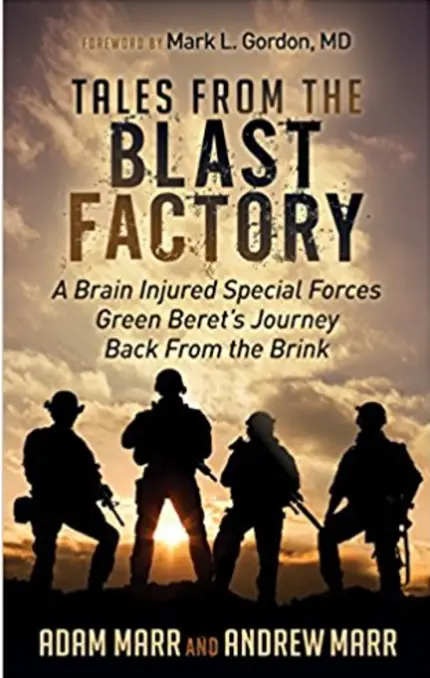
You can preorder Andrew’s book, Tales from the Blast Factory at: https://www.amazon.com/Tales-Blast-Factory-Injured-Special/dp/1683504941/ref=sr_1_1?ie=UTF8&qid=1498365548&sr=8-1&keywords=tales+from+the+blast+factory
Transcript
Machine-generated from the episode audio and lightly edited — may contain errors.
Andrew Marr (link to this point)
Warriors, this is Andrew Marr. And today, I wanted to talk to you guys about the book that we have coming out later this fall called Tales From The Blast Factory. And it's about my trial, my family's trial and experiences with the symptoms of traumatic brain injury and then what it takes to pull yourself out of that and live a life of purpose and fulfillment. And why do TBIs matter? Well, they matter because close to four hundred thousand individuals have been diagnosed with a traumatic brain injury in the military since two thousand to twenty fifteen.
Of that, up to fifty percent of those will develop a major mental disorder after diagnosis. And the conventional model has been psychotherapy and medication, which in most cases further exacerbates the problem. And it does that because it doesn't treat the underlying condition. And that's the basis of the book. We wanted to show what that life looks like, the life of an operator.
What happens when disaster strikes and you step into the unknown, and everything that you once knew is not the way it is anymore. And then we wanted to talk about and show the process of that healing process and talk about the Warrior Angels Foundation. And since then, we brought that same level of healing that I've received to hundreds of others while delivering our message of hope and a viable solution to millions. And it was thinking, visualizing, and believing it in our minds first brought it into existence. And we wrote this book, my brother and I, Adam, so others could do the same thing.
The name of the book is Tales From The Blast Factory. You can sign up to get on the prelaunch list. They'll get you all kinds of cool Warrior Soul vinnies at www.talesfromtheblastfactory.com. And you can also preorder on amazon.com. That's Tales From The Blast Factory.
Can You pre order on amazon.com and talesfromtheblastfactory.com.
Chris Albert (link to this point)
We talk about veteran depression, PTS amongst veterans and traumatic brain injury amongst veterans a lot in the veteran community. And we talk about looking out for your brother, looking out for your friend, checking on them, making sure that they're okay. And this is so important. So important because there's so many of us who are scattered about sitting in dark rooms, locking ourselves away, keeping ourselves from being in contact with others, and being left alone with our deep and dark thoughts. But what we wanted to do in this third installment of the Tales from the Blast Factory series is to bring on Andrew's actual brother.
We brought on Adam Marr. Adam is also Andrew's cohost or not cohost, co author on the book Tales from the Blast Factory, which has just been pre released and is up for pre order right now. And as we've covered in this series, Andrew is a medically retired special forces Green Beret, and the book actually chronicles his journey from being a brain injured special forces operator to his deep dark places, to a point where he was locking himself in his room, isolating himself from his family. And at a time where, you know, he doesn't remember months of his life. And we wanted to bring his brother on to discuss what somebody should do if they think that there's a problem.
What do you do if you believe that your brother, your friend, your comrade is in a deep, dark place? It's a difficult situation, and a lot of us pay lip service to it. But we wanted to bring you some solid advice from a person who's been through it. This is a pretty cool conversation. It's it goes to a bunch of different places.
There's, you know, information in here about Adam's own career as an army officer and army aviation officer. It goes back into their childhood a bit. We talk about various issues related to veterans and and serving in the active duty military. But above all, I think we should have paid attention to Adam's words as he discusses dealing with Andrew when Andrew was at his worst. And so with that, let's get into episode number 49 of the Warrior Soul podcast.
The third installment of Tales From The Blast Factory right now. This is Chris Albert, and I'm here to remind you of one thing. Someday, you're going to die. Now that's not some morbid statement or scary idea. It's a solid fact.
Your time here on this earth is limited, and we need to be reminded of this as much as possible for one simple reason, to live your best life while you can. This is the Warrior Soul podcast. Welcome to the Warrior Soul podcast. This is Chris Albert, and I am joined today along with Andrew Marr by Adam Marr. Adam is the co author to a new book that they've both turned out.
It's called Tales from the Blast Factory. And this book chronicles Andrew's story and his brother's journey through their service in the United States Army, Andrew's service as a special forces operator, and his battle with traumatic brain injury. Now, Adam, dude, we've been working out quite a bit, right?
Adam Marr (link to this point)
Yeah, yeah. To say the least.
Chris Albert (link to this point)
We just did a little driveway workout up here at the studio. We're working with some kettlebells, doing some squats and things like that. And Adam's out here now because he's attending the Ignite program up at Stanford. And Adam, you came along with Andrew on this journey as his brother, as a family member, as somebody who loves him. Can you tell us a little bit about your own perspective on what he was going through at the time?
What types of things were happening?
Adam Marr (link to this point)
Yeah, certainly. First and foremost, I mean, it just basically kinda came out of nowhere. So I'm Andrew's younger brother by two years, and I can remember pretty much looking up to him throughout the entirety of my life. Always, you know, big, strong, forward thinking, and and really just kinda like a a man's man. So that parlayed into his military career and and ultimately special forces career where he's operating at at an elite level.
And then after his last appointment, to see him come back and see the wheels kinda slowly but surely start to fall off, it it was very troublesome. There's a a lot of different different adjectives I could use to describe it from my perspective, and then that's not even looking at the perspective that he himself is going through. But, you know, starting off with just calling me very emotional and and, like, crying. And this is a guy who I haven't seen cry since, you know, we were in elementary school.
Andrew Marr (link to this point)
What about your military background too?
Adam Marr (link to this point)
So yeah. I mean, my military background was just over nine years as Apache helicopter pilot and commander. Had positions as a platoon leader through all the different s shops to include s one, s three assistant, s four times, and then company commander, which was by far my most favorite job in the military. I'm gonna go back and do it in a heartbeat if you could. The the problem is they only let you do it one time or two if you're lucky, but, you know, once that ship sailed.
And then I culminated my time in the military as a OC from JRTC. So working directly with the Apache attack companies that were coming through as a part of their larger battalion or brigade exercise, and then go over a lot of the TTPs, doctrine, operational planning, as well as evaluating their actual flying capabilities. And that exercise is predominantly before a large scale deployment or something of that magnitude. As kinda like the last final check the block. So all that's going on.
I'm actually at JRTC when Andrew gets the when everything just kinda starts to unravel. And, you know, again, man, I have my own obligations and and family and stuff, but always being so close to Andrew, just realizing, hey, that something is not right. And that was kinda like the the little first indicator. Hey. Here's a guy calling me, you know, crying, breaking down, not knowing why.
Like, there's something definitely wrong here.
Chris Albert (link to this point)
So let's take it back a step. What was it like growing up in the Marr household? I know you guys have another younger brother. I know I know you have an older brother too. What was it like growing up with Andrew?
Adam Marr (link to this point)
Yeah. Nothing but incredible fond memories. Two older brothers for me, one younger. I'm kinda somewhere in the middle. As I reflect back on our childhood and our youth and my relationship with Andrew, was a great childhood.
Just very family oriented, always laughing, oftentimes laughing at one another, at another brother's expense. But again, it was just, we didn't have a lot of adversity or or difficulties as far as I can remember. You know, I'm sure they were there and and they were prevalent, but nothing that, you know, I feel just, you know, scarred me for the rest of my life going forward. Very, you know, very, very great childhood. And Andrew
Andrew Marr (link to this point)
We were all into athletics. You know, sports sports was the was the ruler of the day, I would say, hon.
Adam Marr (link to this point)
Yeah. I mean, it was indeed. And, you know, we grew up predominantly in Texas. So football is a akin to religion in those parts. And so Andrew, you know, to that was you know, kinda blazed the trail and, you know, picked football first, and and the younger brothers just kinda followed suit.
But Andrew had a very successful high school career, multiple state championships, and then led that into, you know, college football and then ultimately special forces. Similarly, and my younger brother, you know, participated in sports, exposed to it as well. And then that kinda led to a natural transition into the military as well.
Chris Albert (link to this point)
So how many years are you guys separated from?
Adam Marr (link to this point)
Just two years. He's two years older than me.
Chris Albert (link to this point)
So he's two years older than you. And you ended up going into the military as an army officer afterwards.
Adam Marr (link to this point)
Yeah, that's correct. So out of high school, got accepted into TCU, Texas Christian University. Great private school and was able to get a ROTC scholarship. And then through ROTC, put aviation as my first choice. Was lucky enough to get it.
Went out to to Fort Rucker where I went through flight school out there. Met my wife, which we're still married coming up on anniversary number eight with three kids later. And yeah.
Andrew Marr (link to this point)
Fort Rucker is referred to in the army as Mother Rucker. Mother Rucker. Why why do you guys refer to it? Because it rhymes with motherfucker. Oh.
Adam Marr (link to this point)
It's also known as LA, Lower Alabama.
Andrew Marr (link to this point)
Yeah.
Chris Albert (link to this point)
That's one thing I appreciated about being in the Marine Corps. Some of the bases might suck, like Twenty Nine Palms and Okinawa, but for the most part, they're they're they're they're not in really, really super rural areas aside from Twenty Nine Palms. Jacksonville actually is pretty redneck too. I had the the mispleasure of being out there.
Adam Marr (link to this point)
Well, listen. I I mean, I love Alabama now, and it's it's one of those things. And it's it's pretty much at every duty station. People are like, you either love it or you hate it. And, you know, I ended up marrying my wife from there.
So her family's still there, so we have to go back there all the time.
Andrew Marr (link to this point)
You get to go back there all the time.
Adam Marr (link to this point)
Oh, yeah. I get to.
Andrew Marr (link to this point)
It's a pleasure.
Adam Marr (link to this point)
But it's commonly called the the Wiregrass. And I did SERE School out at Fort Rucker too. And you don't really get a appreciation for why they call it the wire grass until you're doing your, you know, land navigation at night. And every vine and branch is it just seems like it's reaching out there and grabbing onto your foot so that you cannot proceed forward. And you're like, the fucking wire grass, I get it now.
Chris Albert (link to this point)
No, that's pretty funny. My girlfriend, Shauna, is from Twenty Nine Palms. And I didn't know she was from twenty nine Palms until I started dating her. And now, after a career of avoiding 29 Palms as much as possible, I now go there every holiday. And it's phenomenal.
It's phenomenal being out there.
Andrew Marr (link to this point)
It's great. My life. I love it.
Chris Albert (link to this point)
So you're in you go into the army. You follow you follow Andrew into the army.
Andrew Marr (link to this point)
Well, I'll say Adam, he decided to go to ROTC first way before I ever thought about going into the army. So he commissioned the same time I graduated college and then enlisted.
Chris Albert (link to this point)
Okay. So you guys both went into military.
Andrew Marr (link to this point)
Same summer. He graduated, commissioned summer of o six. I graduated college summer of o six and enlisted in October of o six, months to much to my parents' chagrin.
Chris Albert (link to this point)
Were you so so did your parent your parents were were against both of you going in, or or they were okay with you going in because you were an officer?
Adam Marr (link to this point)
You know, there wasn't actually a lot of talk about it, military in general, until, like, we started to, like, cross those bridges that that might be, you know, our future employment. Mhmm. And, you know, it seemed like mom was mom had college degree, and she was pretty big on us getting a college degree as well, because that has been what was preached to her is, hey, you wanna get a good job, you go to college, go to college, get that education, you get that good salary. We know that that model can be turned on its head now, but that's not to scoff at education. So for me, I kinda knew education was gonna be the next step.
And then nine eleven happened my senior year of high school, and I know we all have our personal stories to tell, but it was also a way to prepare myself, get the education, and then make that next step into the military so I could get back and do my duty and obligation as well.
Chris Albert (link to this point)
Yeah, it's kind of a common story. We hear about the parents want you to get that education, and something inside you wants to live out that male archetype a little bit, which is awesome, I think. I think it's an essential part of being a young man if you're not able to live out your archetype and few people get the opportunity to in today's society. But it's kind of a common story there. Parents think that college is going to be the end all be all of everything.
And for our generation, least it really was.
Andrew Marr (link to this point)
Well, we've lost our initiation rights, whether into male hood or whatever. There's really we lack a process to say, hey, now you've gone through the training. You know, you're now blessed with, you know, this title that that that doesn't exist. And that that does exist, however, for the military, community. That is initiation and rites of passage.
Adam Marr (link to this point)
Well, and I have, like, I have three small children, only one of which is, like, grade school age, but coming up. And so he kinda turned that on his head and say, well, hey. What do I want for my children? Do I want to be this authoritarian figure that is going to methodically line out everything that they need to do to be successful? Or do I want to just be able to provide them the opportunities to excel at the things that they want to pursue, but then also kind of give them this well rounded, kind of broadened ability that if they want to go into college, then they're prepared to go and excel at the highest institutions.
But if they feel like that's not for them, then in no way, shape, or feel like they're any less than somebody who went to school, but equally prepared and enabled to go forward and do the things that they want. And I think that's, looking back, that's the same thing our parents wanted for us too. Just maybe only being able to articulate it in a certain way.
Andrew Marr (link to this point)
I think the process of its resilience is what you're talking about, you know, being able to bounce back from something unexpected to possibly even stronger than before. Do you think that resilience was embedded in who we are at at a early age, you know, or or as a kind of individual along, you know, every mom and dad's kids, you know, at different levels of resiliency?
Adam Marr (link to this point)
I I think, you know, the individual does have different levels. You look at the three of us, us brothers who grew up closely together, in our adult lives there's many similarities and things that remain the same. And then there's many things about us that are wildly different. And you say, well, hey, that's the same mother and father, the same disciplinary track, the same general principles and guidance. Maybe one of us got a little something more or less here or there.
But ultimately, it was the same, and yet each one of us turns out somewhat different. So I do feel like a large part of that is on the individual. But I also it's environmental.
Chris Albert (link to this point)
Yeah. Just for everybody at home, when we're talking about resilience, we're talking about the ability to bounce back from a bad situation. Or if you're looking at the definition Eric Greitens puts forth, it's kind of integrating that bad situation into your being and allowing it to make you stronger. And I think that in many ways, there's a temptation to be negative. There's a strong evolutionary temptation to be negative.
Back when we were cavemen, there was an evolutionary benefit to that. If you were out in the woods and you saw something that looked like a snake, then it was beneficial to point it out and tell everybody that's a fucking snake right there. It might bite our fucking
Andrew Marr (link to this point)
Be face on guard for
Chris Albert (link to this point)
a snake. Yeah. You know what I mean? Ready to kill it. Yeah, exactly.
Andrew Marr (link to this point)
And any given moment, have to be prepared to defend yourself and your past life to the death.
Chris Albert (link to this point)
Right.
Andrew Marr (link to this point)
So, yeah, we absolutely see what evolutionary biology and psychology evolved. It's just that today, I don't know that that's necessarily the best trait.
Chris Albert (link to this point)
I it's not. And I think the the the thing is, as far as social circles go, you know, our social circles have expanded like crazy. And so we can go around the Internet, and we can find people complaining about different things. Complaining about how much their lives suck. We can see SJWs on there talking about
Andrew Marr (link to this point)
Social justice warriors.
Chris Albert (link to this point)
Social justice warriors trying to figure out what the next thing to complain about is. You know, even the veteran community, we can we can find so many people who are willing to just complain and not really find any good information
Andrew Marr (link to this point)
Misery loves company. Right? And so that's what I was looking for, somebody to identify with and validate your level of suffering, I
Adam Marr (link to this point)
And I'll tell you what, being out at at Stanford for the Ignite program, being able to be surrounded by some incredible veterans that are doing awesome things. And that was one one of our points of discussion the other day, you know, kinda outside of class, is that a lot of us are tired of that. The veteran pound their chest. I served. I have all these things that are, you know, going wrong towards me because people don't understand that I'm a veteran.
And we just feel like that is not indicative of the entire veteran population, that so many of us are out there doing great, incredible things, doing and starting foundations that are answering problems that other people aren't addressing. And we wanna kind of rewrite that narrative. Whereas like one of the examples was if you bring up like a veteran in The UK, then it's very much like an executive in a business suit, a high operating professional or something like that. That is the perception of a veteran in The UK. And then you do that same thing here in The US, and it's it's very much, hey, you know, we have to go out and and let people know that they're not doing enough and we're hurt.
And we're while all those things are true, and we don't wanna discredit that, that's that's not the narrative for our generation for the veterans.
Chris Albert (link to this point)
Or you live out the whole narrative as far as, you know, drinking whiskey and and, you know, sitting sitting there looking up dark shit on the Internet Mhmm. And and sitting in a room by yourself. At the end of the day, it's choice. And you get to choose what you want your narrative to be. And and it's either war broke me or it's I'm pissed off because I'm here and I served and freaking, you know, some things didn't go my way.
Or maybe it's some things didn't go my way, but I'm gonna work through them and I'll be damned before I let anything defeat me. That's that there's a bunch of narratives you can live out. At the end of the day, think it's your choice. It's your choice to to let something make you angry. It's your choice to to view the world in a positive state or a negative state, and it's your choice to to be able to to to move through that.
I think the thing is though, you young guys out there, the problem is seeing those alternative perspectives and understanding that they're out there and understanding that there are veterans out there who are making a difference. So tell us a little bit about this IGNITE program that you're in and you're getting out of that and how you got into it.
Adam Marr (link to this point)
Yeah, so the Stanford IGNITE program, it's a global program and a global initiative. And it's really a a program to help accelerate the people. It's more of a a people accelerator than anything. And that's it's it's target audiences, professionals, and or individuals that are, you know, in some kind of transitionary or want to move, you know, to another level. And so what happens is they'll go into this program, and it's designed for individuals that have not gotten there or attained their MBA yet.
So it's a lot of foundational principles of business, everything from accounting to design thinking, finance, business models, but it's very much centered around innovation and entrepreneurship. And then this program specifically is a post nine eleven veterans program. So they launched this in 2014. So this will be the fourth year that they have it. Very competitive, only 35 or 36 accepted into the program each year.
And then they'll have this program replicated on campus to other professionals that are not military, just a regular Stanford Ignite. And then they they'll also offer this program about nine weeks. It is normally all throughout the world. And then they've consolidated the post nine eleven one into four weeks on campus at Stanford.
Chris Albert (link to this point)
Andrew, you went through this program as well. Right?
Andrew Marr (link to this point)
Mhmm. Absolutely. I went through it last year. And so now me and Adam are the first brothers or siblings to go through the Stanford Ignite Veterans Program.
Chris Albert (link to this point)
What kind of stuff did you get out of it?
Andrew Marr (link to this point)
Just the design process. So I mean, they've looked very hard at the science or applied science of how do people, organizations create ideas and turn that into businesses that change the world? What's the process behind that? Know? And they brought in first of all, you're taught by all the Stanford Graduate School of Businesses professors, and then they bring in
Adam Marr (link to this point)
But it's not just the professors. It's it's their senior professors.
Andrew Marr (link to this point)
Yeah.
Adam Marr (link to this point)
And so the the faculty that they're bringing in is the best and proven faculty in the world. And that's important because the faculty decides the content and what to focus on and how to deliver it. Mhmm. So that's what sets, like, a Harvard Business School or a Stanford Graduate School of Business program because you not only have the senior faculty, but oftentimes these guys, you know, in their introductions, it's, hey. He wrote the book on this.
Well, no. He literally wrote the book on it that everybody uses, you know, nationally or internationally on, you know, say, legal patents or design thinking or whatever. And so to be able to be a veteran, go in there and be among like minded veteran individuals operating on a high level and then receiving that instruction from the world's premier professors. It's it's an incredibly exciting time. And like I said, it's an innovation and entrepreneurship class.
And so just like Andrew was saying, they're gonna break the entrepreneurship process down into a science because that's exactly what they've done. The message the methods that they're teaching are what the Sand Hill venture capitalists are looking for in their pitches because their products are Stanford too being taught the process that's been innovated and developed out there over the last fifty years.
Andrew Marr (link to this point)
And you're partnered up with two mentors in Silicon Valley that have already been proven successful. And they're bringing in daily guest lecturers, both from the Silicon Valley and the startup world and the VC world, that's venture capitalism, and then past military that are on staff here at Stanford as well. So for instance, last year, like we heard from former Secretary Condoleezza Rice, former current Secretary of Defense Mattis, former Secretary Shultz, and then just all the big names in Silicon Valley. So really cool process. You really get to get in there and network with some of the more brighter and intelligent minds in the world on business design and innovation, and it gives you a great foundation to move forward.
Adam for Warrior Soul is doing a whole special on this. So he's covering in a blog all of the key takeaways, what somebody can do to prepare to get in next year, and all those processes processes. Those will that'll come out the end of this month. We might do a I'm not sure what all we'll do with it, but Adam's got a sweet blog coming out for more information on that, because we highly recommend that program. And we'll have some of those Stanford professors on here as well to talk about it at a future date.
Chris Albert (link to this point)
That's cool. We'll definitely get that out there. So back to growing up and coming out and getting into the military. So you joined ROTC. You joined
Andrew Marr (link to this point)
I enlisted.
Chris Albert (link to this point)
You enlisted. And he's like, I'm gonna be a pilot. Were you doing the whole Joe Rogan, Texas, all out, do you thing? Like, fuck him. I'm gonna get into the special forces.
I'm just messing with you guys.
Andrew Marr (link to this point)
What was I don't know the Joe Rogan thing, but I never remember. Was a national news
Chris Albert (link to this point)
Joe Rogan routine is like the guys in Texas who they have the most tigers, I guess. Oh. Tigers in
Andrew Marr (link to this point)
They definitely do. He ain't gonna out tiger me. Yeah. Yeah. I think we're just we're just playing towards our talents.
You know what I mean? And that's what Adam wanted to do. He wanted to fly helicopters and ask where the men were at, and I wanted to be on the ground doing the job. Yeah.
Adam Marr (link to this point)
No. I mean, it it really it it was jokes like that that we would go back and forth with. But it was very supportive and just understanding the other brothers, you know, their their reality because he was living a different life than I was and and vice versa. You know, I told him what it's like to have to command and be in charge of flying warrant officers. And the analogies were were wild and extravagant, but very much like herding cats and laying out some of my initial stories as a platoon leader, you know, trying to
Chris Albert (link to this point)
Give give us one of those stories.
Adam Marr (link to this point)
Is she handcuffed to the chair?
Chris Albert (link to this point)
Yeah. Yeah. Yeah. Alright. Wanna hear this story.
Andrew Marr (link to this point)
Unhandcuff her. Talk.
Chris Albert (link to this point)
Talk. No.
Adam Marr (link to this point)
Well, this one was when I was a company commander, and I was just going over to the Planning Room just down the hall where the warrant officers and everybody else is getting ready to go out and, you know, prepare for flights and missions.
Andrew Marr (link to this point)
This was this is Iraq.
Adam Marr (link to this point)
Right? No. No. This is in Fort Riley, Kansas, stateside. Yeah.
My whole company command was garrison. So, I mean, you want you want some real fun stories. You do two years of a garrison command where everybody's just itching to go back to war. So anyway, this story kind of play case to that. And that is I walked down the hall to just go check-in on my company and see see what they're doing.
And I walk in and I find our only female warrant officer handcuffed to one of the desk chairs visibly frustrated. And four or five of let's just say the the culprits that I thought would be most obvious as to is anybody in my company ever gonna handcuff somebody? These would be the guys. And so I just walked in there, and I was like, is she handcuffed to the chair? You gotta be kidding me.
I was like, I don't care who has it. I'm handcuffed right now. And I swear to God, if anybody ever handcuffs anybody in this company again, I'm gonna have some asses.
So I want so I I want and I, you know, I was like, Laura, are you okay? And, you know, she was visibly frustrated, but she had a very, like, brother sister relationship with the other pilots. And so she was good. And once I realized, like, there was gonna be, like, no EO infractions or, like like, my command was in jeopardy, You know, I I left them to it and then I walked outside and just started laughing. And then I think I like immediately called Andrew and I was like, you're not gonna believe what's going on over here.
Andrew Marr (link to this point)
How the hell did she end up handcuffed to a chair?
Adam Marr (link to this point)
Yeah, I don't know. She probably had it coming.
Andrew Marr (link to this point)
Oh my god. No. I don't know. They're just messing around, man.
Adam Marr (link to this point)
And and, know, that's the kind of mentality.
Andrew Marr (link to this point)
A bunch of tomfoolery, warrant officers handcuffing others to the chair before preflight.
Chris Albert (link to this point)
Yeah. I I mean, if we wanna get in this stupid, I was in the Marine Corps infantry, and we had a lot of a lot of 17 year old kids who who did some pretty dumb things. But, anyways, so that we don't get any SJW protesters coming after you or your former unit.
Andrew Marr (link to this point)
What was that like for you, Adam, at the initial stages, getting the phone call and then, you know, thinking like, duh, something is something's not right here, man. And then by going into, like, serious health concerns, what's that like for the family member being on that side of the house and almost defenseless or feeling helpless? Because before we came across this journey, and he talked about the brain, like, it was just so frightening to hear. Like, what do you mean there's a problem with the brain? Like, what the fuck does that mean?
Adam Marr (link to this point)
We're gonna need somebody in here who's been studying it for the last twelve years to tell us because but but no. I mean, you touched on a lot of the feelings. I mean, it it's it's helplessness because, you know, there's there's nothing that I can do.
Chris Albert (link to this point)
So real quick before before we get into this, you know, just to rehash the story. We're in part three of this series. And Andrew, at this point, has served several tours in Afghanistan. He served as a breacher and was blowing doors off buildings every day, working with working with explosives. And through that process, his brain was shaking back and forth in his head every single day.
And that created some brain inflammation, which led to some hormonal deficits and traumatic brain injury. And this, without knowing it, he was going into a spiral, a psychological and psychotic spiral. And after his last appointment, we left off last time on the last episode of this. He was literally locked up in a room, not showering, not doing anything, drinking all day long. He doesn't remember, think a good three months of his life.
And his wife was pregnant, about to have the baby, and she had to request that he didn't drink that day so that in case they had to rush to the hospital to deliver the baby. And so at this point, they know something's wrong, but they don't quite know what's wrong. And so you're going through these things in your head. Is this just post traumatic stress? Am I just shook up?
Am I dealing with some sort of emotional thing? Am I just some sort of psychological case? And this was before you did some of your research and discovered some things about the brain. So at this point, before you knew anything about the brain, before you knew anything about permissive environment, a neuro permissive environment, what was going through your head, Adam?
Adam Marr (link to this point)
Yeah, I mean, it's pretty simple, man. You're scared because you don't know what's going on. The person that you know is like an ulterior personality. You know, there's there's traits and there are aspects that you define as normal to that person, but the the rest of the behavior is abnormal. And then, you know, there's the element of being geographically separated and not being able to be there.
And then additionally, like, just not knowing enough about the space and what to do to make it better. It's, you know, it's very hard. And and the end result is in your own mind, you think about how this plays out. And if we don't have these answers, then how can we get help? And if he's having these kind of things, what's going on when he's not on the phone with me?
And then is the end result, you know, gonna be some kind of tragic 05:00 news story about, you know, my brother, and he just gets encapsulated into this little five minute segment where it talks about, you know, the
Chris Albert (link to this point)
The crazy Green Beret.
Adam Marr (link to this point)
Yeah. The crazy Green Beret that, you know, suffered and was exposed to too much and saw too much and come home and couldn't handle it. And I feel like that's just such an overgeneralization of everything that that individual goes through. And so, yeah, it's it's all that's going on. Right?
And and this unfolds, like, not in a podcast where we can cover everything, but this is over, like, a year, year and a half. The answers are still coming. Right? And it's like just as soon as we're in the labyrinth and we make one corner, we realize we got several more corners to traverse.
Chris Albert (link to this point)
Well, is the thing. And the reason why we're doing this series is because we've looked at this issue of post traumatic stress often. And that headline's been played out in the media, I think, a little bit too often. A veteran does something bad, immediately we're talking about post traumatic stress. Immediately we're talking about the psychological impact of war.
And for a lot of guys who listen to this podcast who have served, who have brothers out there who are suffering, and they're watching them suffering, they don't know what to do, You're thinking to yourself, well, do we have to get this guy to a doctor? Do we have to get this guy to some psychiatric help? We've done rehab three times and it still doesn't work. So why does he wanna get better? You know, those types of questions.
Exactly. And try
Adam Marr (link to this point)
And, of course, from my perspective too, I'm thinking, okay, do we need to get him in ASAP? You know, I'm thinking about all the the tools of, like, a company commander that, you know, maybe, like, his command is overlooking. And I'm trying to think about all these resources. And again, like once those have been exhausted, and the problem is getting worse, then what? Then what's the next step?
Chris Albert (link to this point)
Right, right. And that's the thing, like, you're trying to figure this stuff out. And guys are going to the hospital as they're getting pharmaceuticals thrown at them. And in many ways, the pharmaceuticals are making things worse. And so why is that?
Why is that happening? Why aren't the pharmaceuticals working, Andrew?
Andrew Marr (link to this point)
Well, doesn't it doesn't work because they're only served to treat symptoms. It doesn't treat the underlying condition. And so this is for anything. If you don't identify what is causing the underlying conditions, and then from that underlying condition, you're going to have different symptoms that manifest. But if you don't find out where that initial problem is, and you just treat symptoms, and you never solve the problem.
And as the research has widely shown, these pharmaceuticals, certain pharmaceuticals used as symptom management makes life exacerbates the problems the individual was having prior to. I'm not saying that modern medicine is bad or should be shunned away from or anything else. I Think our trauma medicine is top tier, best it's ever been, always getting better. We can keep somebody alive better than we ever could. But that quality of life from that point is what the question is.
And if you think about it or you look at it from a from a business model, if you have somebody in and you tell them that they're gonna need blood thinners for the rest of their life, then that's a pretty good business model than solving the problem and getting the person healthy and needing to be on whatever said medication in the first place. But, and don't think it's, you know, the doctors, it's a conspiracy or anything else. It's just, it's a unfortunate product of our success that I think history will show our society and culture is working right now on fixing. And I think we'll have this talked about before, this evolution or this raising of consciousness through our ability to promote a healthy lifestyle, a wellness, a life that's predicated on wellness and not sickness. And that's the current model.
It says, Okay, you're sick, now let's put you on medicine. And if that medicine doesn't work, we'll give you another medicine. We'll up the dosage, and we'll continue this until you're on thirteen, seventeen, 20 medications. And you look far different from the person who first came in there with that problem.
Chris Albert (link to this point)
Right, so the bottom line is that when eventually you got help from Doctor Gordon, it was reducing the brain inflammation that eventually helped you. That helped you to create the hormones necessary to balance your mental state, to put you into a state where you could achieve neurogenesis once again. When I say neurogenesis, guys, I mean cellular brain growth, right? And healing of the brain. And here's the thing, this stuff he got put on. Yeah, he was doing a little bit of testosterone therapy, but it was vitamins and nutrients that actually did the job of shutting down the inflammation.
Without those things, the brain inflammation would have still been there and he wouldn't have been able to recreate his hormonal production. And so the thing is, guys, we just had Keith Norris on the podcast. We talked about the medical system and opting out of the medical system. And I don't want to sit here and tell you that your doctor's out to get you. And I'm not going to sit here and tell you that there's some deep, dark, black medical conspiracy to chemically neuter veterans or anything like that.
But at the end of the day, we're in a system right now where ninety nine percent of the treatments for chronic disease just don't work. And we're seeing people suffering from things like diabetes, like heart disease, like cancer, and like mental illness without any real effect from the treatments. And it's been clinically demonstrated, for instance, in depression that things like regular cardio exercise can actually alleviate depression more effectively than most antidepressants. It's been clinically demonstrated that most antidepressants only work part of the time. And we have this situation where veterans are committing suicide and the numbers are debatable about it. But we know that there's a good number of veterans out there committing suicide who are not living in a good state.
And they continue to get pharmaceuticals thrown at them. So what's the solution? What do we do? How do we get over this?
Adam Marr (link to this point)
Yeah, I mean, I think podcasts like this, blogs, the information that we're putting out, like the the book in and of itself. There has to be enough of a body that is raising the alternative answers or solutions to that. And until that's out there, until individuals start looking inward and really quit blaming everybody else for their problems and take ownership and identify what is making me so angry, so depressed, so disgruntled. So why am I peeking and vowing with like manic and depressive states? Could it be from a hormone imbalance?
Could it be that I need my blood tested and to check into that kind of stuff? So really, I mean, I do think that it falls on collectively all of us to put out good information to really make individuals ask those questions and look inward. Because unless you have the desire to do so, and unless you have the motivation to go out, it doesn't matter what incredible information this podcast is putting out because it's gonna fall on deaf ears. And I think and I don't know, this might just be because of our own personal journey, but I do feel like there is more of an awakening going on, that people are waking up to this, that these groups that are concerned about the pharmaceuticals, about sugar and everything, are expanding exponentially. And a lot of that comes from documentary.
I'm a huge documentary advocate and almost watch those on Netflix and Amazon more than I do any recreational movies just because I find the documentary format is so compelling when done the right way because you can get incredible information that's scientifically backed, and then you can get it visually appealing, and then you throw in a solid soundtrack to that. I mean, it's gonna be very moving. And I think documentaries are a huge way.
Andrew Marr (link to this point)
Yeah.
I mean, I think going back to your social sciences background, Chris, looking like how do how historically has, you know, a new topic, new information, new idea, something that challenged the status quo, how did that come into fruition, you know, following that process? And that's that's what we looked at. And it came down to if you want to change something culturally, a status quo, you have to look at, okay, well, what is the problem? You have to really understand the problem. We felt like we really did that with as far as the people going undiagnosed with their traumatic brain injury problems, and then how to treat it.
And so we identified the problem really well. And then we looked at, okay, so what is the solution? And you have to offer up a solution that is superior to the status quo. And then you back it up by evidence, mountains and mountains of evidence. And then at that point, once you have those things working for you, you go and you find the echelon or the people in the society that that's they're on the wrong side of that.
They're being affected by it. And then you say, how can I bring this group of people, this information, so then they can make the decision to enact, enact it or not enact it? But at that point, they have the ability to say, I can weigh the pros and cons. And at that point, that's when you're building up to this tipping point of enough people saying, enough is enough. There's an answer out there.
I want access to it. At that point, when the numbers are big enough, then the government or other, you know, institutions take notice, but not before that. Why? Because the people that are making those decisions aren't affected. They're not the ones being affected by it.
So they're not looking to change it necessarily. So we're going through this way, you can call it a bottom up approach to bring this information. Like
Chris Albert (link to this point)
Well, Andrew, let me interrupt you real quick. Amongst people with post traumatic stress, how ubiquitous do you think is traumatic brain injury?
Andrew Marr (link to this point)
Well, I don't think it can be ruled out. You know what I mean? I don't think it can be ruled out. Here's the problem. The problem is a person goes in, says I'm having psychological issues.
I think they're due from experiences in combat or some type of traumatic situation. Or maybe they don't know why they're having them. But what happens from that, at least in the military model, is psychotherapy, medication. And again, if the root of the problem is neuroinflammation that then is causing a downregulation, a dysregulation in your hormonal balance, so that means your hormones are now not operating efficiently, then that causes unbalance, dis ease in the whole body. So it only makes sense that we should look for that first, and we can do it objectively through a lab analysis.
Right? And so we're saying, hey, before we put somebody on an antipsychotic, antidepressant, antianxiety, or any other thing, wouldn't it be a smart idea to measure to see how the central nervous system is affected if their cortisol is through the roof? Or are their adrenals shut off? Are they complete hormonal shutdown? Are they riddled with inflammation?
If we're not looking at that, then again, we're not getting to the root of the issue. And that's about our message, man, to provide this information on multiple platforms where people can now know where to go and what to do. And I can honestly say we have that.
Chris Albert (link to this point)
So what are some of the obstacles for the military to be adopting this stuff as a medical model? What are some of the obstacles to it? Why are they so skeptical of it?
Andrew Marr (link to this point)
Well, again, they're skeptical of anything that's new, different, and not mainstream. And now while checking hormones and looking for biomarkers, this is this is not new. So we're just we're fifteen or twenty years behind the latest science on this. And and that's somewhat normal. And so there's tons of scientific literature to now support what the clinical application is proving.
But we have the scientific literature proving it, the clinical application proving it. And if you just think about it, these hormones are the body inflamed is going to mess up every system in the body. Dysregulation in hormones, again, is going to cause for different parts of the brain and body to not be able to communicate with each other. And these things then manifest as all these problems. So it's going back and identifying that.
The biggest hurdles, again, is people wanna say, well, where's your peer reviewed articles? Well, it just so happens we're working on them. We've got about a half a dozen in the hopper right now. So we're pioneering new science. We're validating everything that we've been said.
Doctor Gordon is extremely scientific. And so we've been able to follow-up and follow on with all of our participants. And it's statistically significant, the results that we've been able to produce and produce and produce again. So again, it's just showing, getting this information into the public's hands, and continuing to turn that upswing.
But we're not going sit around and wait for the government to do it. So that's why we're to push out this information. That's why we want to do a bottom up approach. And that's why we want to have all these alternative ways to get access to this type of treatment outside of the military and the government. The way technology is advancing, this will be so affordable that it will be ubiquitous, where it can be afforded by everybody.
And at that point, it doesn't matter if the military wants to get on board or not. Everybody will have access to their own lab results and what they want to do with it.
Chris Albert (link to this point)
So when we're talking about hormonal deficiencies, we're talking about hormonal hormonal replenishment. How low does your testosterone have to be in order for the military to really step in and say, Okay, we're going to do something to help you?
Andrew Marr (link to this point)
Yeah, it's a good question. And so the problem is, as I've been told it and I've lived it, is that they seek to treat a reference range. Okay? So let's just take free testosterone for instance. And we'll say that the highest in this range could be nine, and the lowest on the range could be one.
And you add those two together, nine and one, and you get 10 divided by two, and the median of that is five. Well, the range might be between three and eight. And so if a person comes in, their free testosterone is a three, and they have they're complaining about all these symptoms or things that are bothering them that haven't been there before, then a doctor in the mainstream model will say, your level is at a three, you're in range, and you're fine. So therefore it's not testosterone.
What Doctor Gordon is working to pioneer is to treat the individual and not the reference range. I know it's a crazy idea, but basically that's saying, look at this person, look at what they're saying their issues are, their problems are, and then triangulate that with their lab results, and then classify that range as high average, average, low average, low, below range. And then at that point, you can start to work on an individual and bring their levels back up to the median range. That's how we try to work it.
Chris Albert (link to this point)
But if you go to an outside lab and you try to get your testosterone levels up, what happens to you then?
Andrew Marr (link to this point)
If you try to go to an outside lab, if you're in the military? Well, in in this in spec ops world right now, that's outlawed. You cannot you cannot look for third parties to replace or replenish what now is no longer there due to your military service. So you're between a rock and a hard place if you wanna take control of your health as opposed to what the current command is putting out.
Chris Albert (link to this point)
But if I am a man who or a woman who wants to, you know, reformulate my gender as a man, what can I do then?
Andrew Marr (link to this point)
Right. The government then will pay for you to remain in the military receiving your paycheck, and they'll pay for the hormones to complete your gender transsexual transformation.
Chris Albert (link to this point)
So right now we've got guys out there who are suffering from traumatic brain injury, who could benefit from hormonal therapy, who are not able to access hormonal therapy because of the law. But at the same time, we've got service members out there who if they want to transition their gender, can do so via using the same hormonal therapy.
Andrew Marr (link to this point)
Chris, that is 100% correct and accurate.
Adam Marr (link to this point)
Yeah, and I mean just to build off that, it's not like we're saying, hey, gender reassignment, and we're trying to get into that label at all. We're really just comparing, hey, why is it okay for this hormonal treatment for one and not the other?
Chris Albert (link to this point)
Right.
Adam Marr (link to this point)
Especially when you can look at the numbers statistically and it's over like three hundred thousand diagnosed with a TBI since the onset of this war.
Chris Albert (link to this point)
Exactly. I mean, that's kind of what I'm saying. I'm not saying that I don't believe that transgender people should serve in the military, though, you know, people might debate me on that. You know, I personally don't care about
Andrew Marr (link to this point)
No, strictly from a, hey, if it's good enough If for
Chris Albert (link to this point)
they have a mental condition, they're saying that could benefit from hormonal therapy, why is it okay for one mental condition and it's not okay for the other? Right. Amongst cis males who want to who want to, you know, be optimized and be able to do their jobs, and to live in a sound mind and sound body state.
Andrew Marr (link to this point)
Yeah. And and again, we're talking about bringing up levels to physiological levels. No more. You know what I mean? So where you physiologically should be and and not anything else, which will maximize and optimize what you're looking to do as far as cognitively, physically, and and and other areas.
And so, again, that's important why it's it's good to have these conversations because, you know, look look at what happened with congress and baseball and steroids. How many freaking congressional hearings did they have on that? Stupidest thing ever. Yeah. No good information got brought out.
You know? No solutions. And all of America is like, okay. All we know about performance enhancing drugs is it's cheating and it's bad and most likely from what we're told, it's unhealthy. And now it just turns out, just like cannabis, those things couldn't be further from the truth.
Chris Albert (link to this point)
Right.
Andrew Marr (link to this point)
You know? Right.
Chris Albert (link to this point)
No. And and that's the thing. I mean, I'm I'm not gonna lie. I have I have a pretty good background with performance enhancements just from the profession that I've done, which I've trained professional athletes. I've trained professional bodybuilders.
I've worked in that area for a while. I have a pretty extensive knowledge. Nobody's ever overdosed from them. And and the times when we've seen them in the media as the product of, you know, these kind of violent crimes, that's been way overblown. And and, you know, we've had Chris Bell who did the documentary on this Bigger, Stronger, Faster.
You know, it's it's it's it's amazing to me the stigma that's surrounding this. But I think the bigger issue here is that there's people out there. We have technologies that can help people out there who are suffering and they're not being utilized. And that's what pisses me off about it. What I want to get into real quick before we sign off. We got this book. It's up for pre order on Amazon right now. But I want to get into why when did you guys decide to write the book? What was your process in putting the book together?
And what can people get out of Tales from the Blast Factory?
Andrew Marr (link to this point)
Well, real quick, it was such we spoke about it a little bit last week. But the hospital scenario that that we lived through was so unique that I thought, my god, this story, you know, needs to come out. I don't know how. I don't know why. So when I got home from the hospital, I just started writing.
And it was kind of therapeutic just to get everything that happened out because I was like, this is so crazy. No one's gonna believe that this shit actually happened. You know what I mean? So I wanted to write that down and then continuing the process to look for you know, I just wanted to get better. And we're having to go to alternative models and then started getting treated in ways that we didn't think was necessarily conducive to healing.
And I remember then telling, you know, Adam, like, hey, man, like, we have got to highlight what's going on. Because where I was coming at, the e seven Green Beret, respected, experienced, you know, in that field, I'm like, if I'm catching shit, then what hope does a 17 or 18 year old have? They have no hope. And so I feel like we've got to find a way to handle this. And at first, it was that's why we set up the foundation, Warrior Angels Foundation.
And then, like, know, the story just continued to evolve, and we continued to see results and everything else. And we thought it was just a positive evolution to bring out the information where people could get in and just have another means to access it. But what do you wanna add on to that?
Adam Marr (link to this point)
Yeah. I think the only couple things I'll highlight is, again, it was just it was an unknown injury, and it was an unknown process to us. And through the evolution of that from not knowing to understanding, And then also additionally from having an idea to want to help other people to an up and operational foundation. It was kind of taking those two things and saying, hey, how can we package this, tell this compelling story in a way that it's interesting for readers? But then also really outline the things that we had to do to be successful, the blueprint, the standard operating procedure for your individual life.
And then what were the really the key takeaways that allowed us to get through that? Not only that, let's throw in some evidence based scientific understanding that's not being widely thrown around in the TBI community. So then we kind of package all that together. It was, hey, here's a compelling, interesting story for you to read. You can read it in one day.
It's gonna have a blueprint and an in-depth look at the TBI medical military landscape like you haven't seen. And guess what? It's a feel good story. You know, we win in the end. We come out on the other side, and we leave you with the tools and resources to do that in your own life for a life of a friend or a family member or anybody that's traversing some trouble waters.
And so that's why we're so excited about the book. Yeah. That was kind of our our our reasoning going into it.
Andrew Marr (link to this point)
That's it, man. And now listening to my man Jordan B. Peterson a lot. It's, you know, a story very much where you go in and things become chaotic. And you have to go and face the unknown and go and have your date with the dragon. Slay the dragon, get the gold, which is information and bring that information back to the rest of the community community and then disperse it.
And, you know, I feel like that's what we're doing.
Adam Marr (link to this point)
That's cool. Plus who doesn't wanna slay some dragons?
Andrew Marr (link to this point)
Right. Right now. Let's do it. Adam, what are some real quick. What are some things that you think that other that you can help other people to look for that will help them notice, like, okay.
Maybe I I need to look into this. Like, I'm seeing some things similar in my loved ones. What are some things there that they can look for you think?
Adam Marr (link to this point)
Yeah. I think initially, it was just characteristics, behavior, or traits that were seemingly foreign to that individual. So, like, in in Andrew's case scenario, like, calling me up crying and just not being able to get it together. Like, that's never ever happened before. So, I mean, that's, like, red flag number one.
But then, obviously, you know, it depends on your relationship with that person. Oftentimes, if we can and it does it does just go back to relationships. And can you communicate interpersonally with another person And ask them thoughtful questions about themselves, about their life. I mean, that's part of the problem is if a veteran goes off and isolates himself, doesn't call communicate with friends, family members, then they go through a dark time. Nobody's there checking on them.
You know, for Andrew and me, we had a very close relationship and it was always, hey, at least once a week or so, I'm gonna call and touch base. Just tell me the things that are going on in your life. And again, if anything seems out of line with that or there's problems or issues, then that's a pretty good indicator that that things are leading, you know, in a bad direction. And I and I would say that would be, like, the first steps I would just kind of recommend to somebody.
Andrew Marr (link to this point)
And then check out our our foundation website, which is waftbi.org. That's waftbi.org. And then also you can get to that through our warriorsoulagoge.com. But through there, we have mini documentaries, excuse me, short four or five minute professionally done videos. We have testimonials.
We have us, you know, speaking on on various news platforms and podcasts. And so we've just created in a short amount of time through Warrior Angels Foundation and Warrior Soul Agoge, an amount of information and a viable solution that previously did not exist. And you want more information, you wanna dive in deep, you wanna find the video or something that's sent to a loved one, then both of those forms in addition to our social media platform.
Adam Marr (link to this point)
Yeah. And I just I wanna give a quick example of that because I was in Alabama with my family. And I had this alert on my iPhone for USA Today article, and it was talking about the different kinds of fats and why coconut oil is got a bad misconception. It's really it's really bad for you. And I was like, oh, man.
I and I tried to read the article, but it, like, disappeared in my alerts. So I went back into USA Today, I tried to find the article. Finally found it. And I I read all this, and I'm like, man, this is just goes against everything that I'm finding to be true. And I started Googling, trying to find more information that I could reference and combat this article.
And finally, it just occurred to me. Was like, well, I'm just gonna go to Warrior Soul Fitness, and I'm gonna look up in the blog post. And sure enough, there was about five or six articles that Chris had specifically addressed that, bullet for bullet, like, gave the, like, the true answer with evidence to back it up why it was such. And I was like, this is is what Warrior Soul Fitness and Warrior Angels is. It's information that when you're confronted with the contrary or you're looking to know more, you can go in and from the the bevy of different resources and content, you can go in and find what you're looking for.
Andrew Marr (link to this point)
Well, and that's like
Chris Albert (link to this point)
That's that's a big example there, right? Because we've at we've heard over the last sixty years that fat is bad for you. But now we're studying the brain. And we know that fat is certain kinds of fat, specifically omega-3s. Fat is a neuroprotectant.
And we also know from scientific research since 2010 that saturated fat has nothing to do with heart disease. It's actually inflammation. So we're looking at inflammation as a base cause for a lot of these issues, including cancer, including diabetes, and including traumatic brain
Andrew Marr (link to this point)
Almost every chronic disease that we know of, it's like you go back to there.
Chris Albert (link to this point)
Exactly. And so we go into this and then you start to discover that the same people who have set these nutritional standards and who have demonized fat are also the creators of things like the C Ration and the K Ration. Right? The K Ration stands for Keys.
And Ancel Keys was the primary scientist who who came up with the hypothesis that fat was causing heart disease.
Andrew Marr (link to this point)
Yeah, listen to our interview with Gary if you're interested in that. Because Gary, the author of what was the what was the name of that incredible book?
Chris Albert (link to this point)
The it he had a couple of them. Good Calories, Bad Calories. That gets into the
Andrew Marr (link to this point)
end of the case. About sugar. You know? And they talk about Case Against Sugar. Yes.
Case Against Sugar. Yeah.
Adam Marr (link to this point)
That's that's one of my favorite podcasts that you guys have done.
Andrew Marr (link to this point)
Yeah. Yeah.
Adam Marr (link to this point)
It was It's incredibly insightful into the world of sugar.
Chris Albert (link to this point)
He's a great guy. He's caught a lot of abuse for questioning the scientific norms and and for going against the grain and for for speaking truth. And we had to point back to that Keith Norris episode we just did. That's why a lot of people are pissed off, because the establishment is not taking into account the actual science. They're doing everything they can to protect themselves, to keep themselves in a position of power.
And like I said, I'm not gonna get into conspiracy theories. But at the end of the day, we're all figuring things out. And we're all understanding things because of the power of this thing called the Internet and by communicating with each other. The media, the the the full blown media, you know, CNN, MSNBC, even Fox News, they're, you know, they're they're they're they're losing their their viewership on mass and people
Andrew Marr (link to this point)
are doing to sell marketing ads. Right? And so they're you know, it's it's well documented now. They're playing off fear. They're playing off the amygdala.
Adam Marr (link to this point)
Well and it's and it's so biased. I I can't help but feel, okay. Why is it leaning this way in order to get me to believe this? So I'll go out and buy or purchase this or align with this politician that wants to do this. And I just rather go to a Warrior Soul Fitness or, you know, your unique individual content provider in that respective field that is so close to the material that you can just get the unbiased one
Andrew Marr (link to this point)
And that's how media is changing. Right? You don't have to go to the big conglomerates anymore. You can you can go out and find what you think is relevant for your life and find the source to give you that information. But, you know, I think our central thesis at Warrior Soul is, you know, you have to earn your own truth.
And you can only earn it by going out there and experiencing it in your own life and then saying, hey, was this profitable? Did this help me? Did this help other people? Did it help everybody I came across? And if it didn't, then it's time to reflect and analyze and maybe look at some different decision sets.
But if anybody ever tells you that this is the information in its totality and you can experience it for yourself, you just have to take the other person's word, then that is the definition of fucked up in my world. So we give you actionable information and strategies that you can take out and apply and experience and make up your own mind. And I think that's what more could you ask for?
Chris Albert (link to this point)
Yeah. Yeah. Exactly. And it's it's that and it's community. I mean, the the best classes we've gotten the military, the best classes I got in the Marine Corps were hip pocket classes given to me by NCOs.
And that's the real philosophy we go by by by putting our content together is I think of myself putting together a hip pocket class. Every time I do a video, every time I write a blog, every time we sit down for one of these podcasts, we're really just trying to to spread information that we've come across that's helped us out. I think that's where we're going, what we're doing, what we're living here. And and it's what put Andrew and I together. It's it's it's what, you know, strengthened your relationship together as brothers, and it's what all of us should be doing.
If you're out there and you're coming across some good shit, you're not fucking telling me about them, I'm being pissed off at you.
Andrew Marr (link to this point)
Yeah. That that's the model, man. Like, that's that's our responsibility as men just as individuals is to we need to talk about what's working in our lives, and and also what's not working. And then how do we continue to go to what we identify as what we want for our lives as long as it's not impending on someone else's well-being. You know what I mean?
We need to be sharing these these stories and this information.
Adam Marr (link to this point)
Yeah.
Chris Albert (link to this point)
Absolutely. So we're gonna head in there. I wanna thank you all for listening to this. This was the third installment of Tales from the Blast Factory. Wanna thank Adam for coming on today.
Adam Marr (link to this point)
Yeah. Great to be here.
Chris Albert (link to this point)
These guys are about to The Innovation Lab. Yeah. They're about to make the long drive up to Stanford after we kicked our own asses out in the driveway with a bunch of kettlebells and dumbbells and burpees and things like that.
Andrew Marr (link to this point)
Do you know about when it got hot, I just looked up there and I said, my gosh, we're in paradise and Chris' shirt's off, so I'm apt extra happy.
Chris Albert (link to this point)
Oh, yeah. Totally. Totally. You know, I'm everybody in a three mile radius had to wear sunglasses because I'm so white. But but it's cool, man.
It's cool. I aim to please. I aim to please, especially tall bearded Texas, man. There we go. So just kidding.
Next installment.
Andrew Marr (link to this point)
Yeah. Coming soon. We're thinking either my wife, Becky, or my mom and dad also have two very good opinions and and can really, I think, help further and expand this conversation that we're having.
Chris Albert (link to this point)
And we've got some great podcasts coming up. We've got Walt Gragg, the novelist, I think coming up in a couple of weeks. We've got we're we're trying to get Robb Wolf, the very famous nutrition expert out onto the podcast. So if you know Rob, we've we've been talking to his people. We're trying to get to tell him to get a schedule in order and get the hell on the podcast.
And then, you know, if you haven't listened to to a lot of episodes before, definitely check out the the Keith Norris podcast number one and two. Definitely check out Gary Taubes. It's an amazing interview. You know, go all the way back. Check check them all out.
Andrew Marr (link to this point)
Yeah. Honestly, I mean, I'm so happy with our our body of work. It's just putting out such good, you know, intriguing and informative conversations with people who know what they're talking about. You know? So I'm just it's just a wealth of of good information in there that's very entertaining as well.
Chris Albert (link to this point)
And while you're at that, go over and check out the videos too. Warriorsoulagoge.com. We've got videos. We've got articles that can help you to to live your best life. And the you know what the best part of all that is?
It's fucking free.
Andrew Marr (link to this point)
Yeah.
Chris Albert (link to this point)
You don't have to pay a fucking dime for it. You don't have to you don't have to pay anything for it. Just come on over, check this stuff out. We're putting this information out for you guys out there. And if you wanna know about something that we haven't talked about, just ask.
Ask. We're happy to put some stuff together. We're always looking at what our viewers think and our listeners think. And if you like us and you wanna check that stuff out, you wanna check out some of our products too, that's fine, but we don't necessarily care about that. All we care about is getting good information out to you.
So with that, get out there and live your fucking best life. I like the word fuck. Fuck. Fuck. Fuck.
Fuck. Fuck. And we will be back at you very soon with some more awesome content. This is Chris, Adam, and Andrew out. Hope you enjoyed this episode of the Warrior Soul podcast, third installment of Tales from the Blast Factory.
We hope you're getting a lot of information from this series and our other shows. If you can, get over to iTunes and leave us a review. It really helps the show out. It lets people know what we're about, what we're doing. And honestly, we want honest reviews.
We don't want just people who are gonna give us five star reviews. And if there's things that we can do to improve, please let us know. We really appreciate it if you could do that. Just head right over to iTunes and leave us a review. And while you're at it, get over to warriorsoulagoge.com.
That's a g o g e. This website is so filled with helpful information. Information about fitness, information about better living, information about leadership. We've got some amazing podcasts up there like our show with Gary Taubes and our show with Les Stroud, the Survivorman, and with Chris Bell, the filmmaker responsible for Prescription Thugs and Bigger Stronger Faster. We've strives to create a website that is gonna be your go to source for living your best life.
And we're always adding to it and coming up with new things and new ways to help you out. So if you can get over there and check that out and until next time. This is Chris Albert with the Warrior Soul podcast. Get out there and live your best lives. Talk to you soon.
Host of the Warrior Soul Podcast and founder of Warrior Soul. Worldwide trainer and nutrition coach, contributing author at Testosterone Nation and Muscle and Strength.