Podcast episode
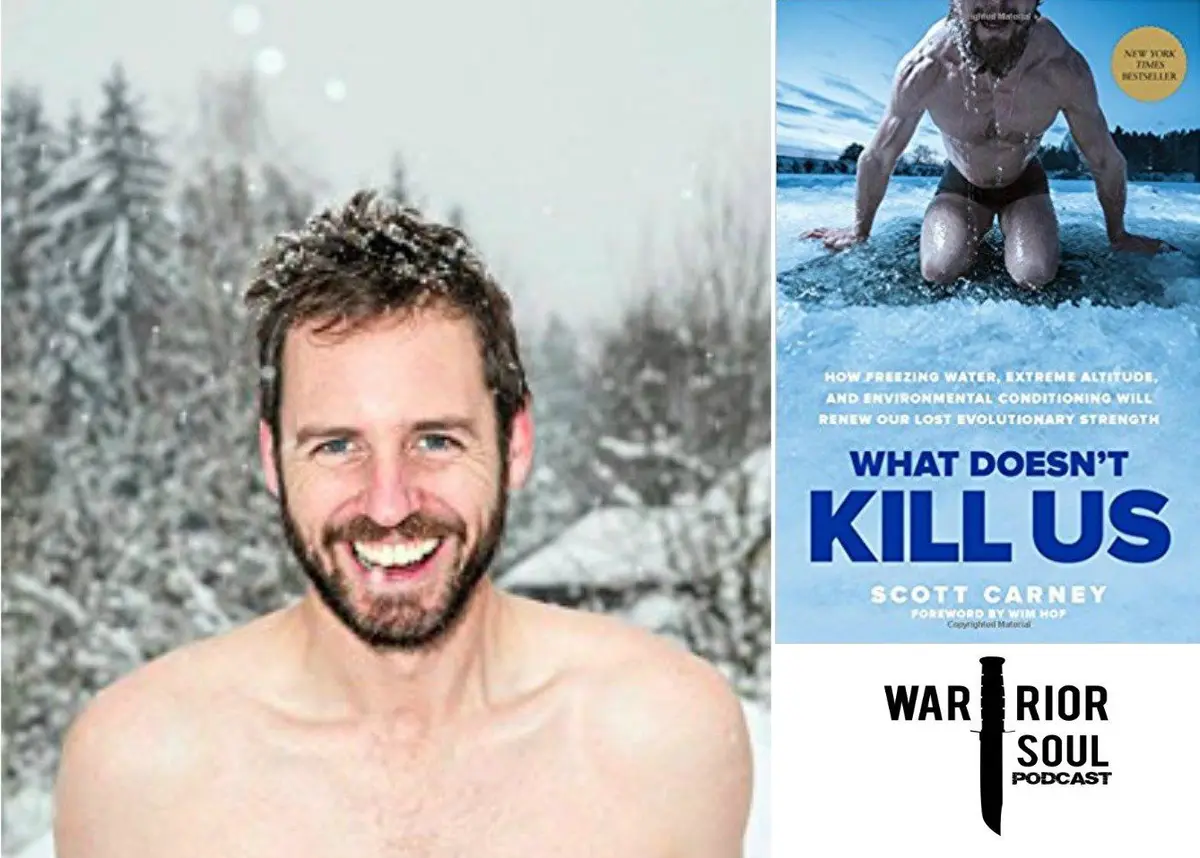
Episode 58: What Doesn’t Kill Us – with Author, Scott Carney
Hosted by Chris Albert
The Warrior Soul Podcast
Imagine this. It’s March, 1621, and you’re a pilgrim at the Plymouth Colony. You just emigrated from England a few months before and you’ve spent a bitter first winter on this new land freezing your your unholy parts off. The only thing that you think got you through it was your fellow pilgrims and prayer. It’s still cold in March, as it always has been in New England, but something catches your eye. Out of no where, a dude comes walking into your village wearing nothing but a loin cloth. He says “welcome Englishmen! Do you have any beer?”
Yup, this happened, and that dude’s name was Samoset, a member of the Abenaki Sagamore tribe and the first Native American to ever interact with the Plymouth Colony. He’d learned English from English fishermen up in Maine.

We all think about the first Thanksgiving and the Pilgrims landing at Plymouth Rock, but fewer of us remember how hard it was for them to survive during that long first winter. Even fewer of us remember that Native Americans had been surviving there for thousands of years before wearing next to nothing compared to their English counterparts.
How?
Well they had something that the pilgrims didn’t. It was something that the Pilgrims’ ancestors had begun to lose many years before and something that most of us still lack today: exposure to the elements and a resulting buildup of brown adipose tissue.
In his book, What Doesn’t Kill Us, Scott Carney discusses how we can all get back to our own evolutionary greatness, highlighting his own journey in training with Wim Hof the Ice Man, and top athletes like endurance expert Brian Mackenzie (a past guest on this show) and big wave surfer Laird Hamilton.
This is an amazing conversation and Scott is an awesome individual with many awesome insights.
To purchase Scott’s Book, click on the image below:

To learn more about Scott and all of his writings: www.scottcarney.com
Transcript
Machine-generated from the episode audio and lightly edited — may contain errors.
Chris Albert (link to this point)
You know, one of the questions people bring up to me a lot about the ketogenic diet is where you can find good portable sources of healthy fats. And that's understandable. That's a big thing that keeps people from trying the ketogenic diet. They don't know where they're going to be able to get great sources of fats when they're at work, when they're on the road, maybe you're in the military and you're out in the field. Back when I was in the Marine Corps, I wouldn't have been able to try a ketogenic diet because who the heck is gonna get coconut oil out in the field?
Well, there's a great company out there called F Bomb Nutrition and they've come out come out with a remarkable solution. And these are packets, portable packets filled with some of the best fats in the world. They've got avocado oil, olive oil, coconut oil, MCT oil, and they've got this awesome series of nut butters, macadamia nut butter, coconut butter, and they're absolutely delicious. And we're not just talking about, you know, nut butters and and oils that are that have been crammed into packets. These are top quality fats made out of the best natural ingredients.
So if you're looking for a solution to make your ketogenic diet easier, definitely go over and check out FBOMB Nutrition, and they are at www.fatismartfuel.com.
Chris Albert (link to this point)
Speaking of fuel and energy, one of the new products we're carrying at warriorsoulagoge.com is Clear Mind and Energy. This is a fantastic product that was developed by Dr. Mark Gordon, renowned interventional endocrinologist who's been treating hundreds of veterans around the country for traumatic brain injury and bringing them back to normal. And he developed this product to help them to fight fatigue. Now, I absolutely love this stuff.
You take a little bit underneath the tongue and you get lasting non jittery energy for about six to eight hours. I I and and this isn't like caffeine where you're gonna be jittery or anything like that. You're super calm, super focused on what you're doing. So if you get a chance, head over to warriorsoulagoge.com. Check it out under supplements.
We've got all the science to back it and some amazing reviews of the product. If you've heard about that guy, Wim Hof or Wim Hof, he's a guru, and he's got a lot of followers from around the world. And he's known for being able to control his body and his response to his environment. And he does so through some simple breathing exercise. Now, we don't have Wim on today.
We've got a very special gentleman named Scott Carney. And Scott is the author of the book, What Doesn't Kill Us. And what Scott writes in this book is basically a story about human beings and what they're capable of when they're faced against the elements. Now, one thing to remember here is that though we're all constantly surrounded by warmth and comfort right now, at one point in human history, we had to be cold. We had to deal with the cold.
And in fact, and we talked about this in the podcast, when the pilgrims landed at Plymouth Rock, they were encountered by Indians who were in loincloths. And if you've ever been to Massachusetts, you know how cold it is up there in November. So when we talk about human capability and when we think of our own capability, sometimes we forget that our ancestors were doing superhuman feats for a very, very long time. And I use superhuman in quotes. Because as we get into in this conversation with Scott, Scott's writing actually brings this back down to the human level.
A lot of people look at Wim Hof as some sort of Superman or some sort of God. But as we hear from Scott, he's not. He's a human being. And the real beauty in this is that those same superhuman feats fighting the cold, facing against the elements, and doing anything else that we hear about these other guys doing. We're all capable of it because we have the same DNA and we have the same evolutionary background.
So I don't wanna get too further too much further into this in the intro. Let's get into this discussion in episode number 58 with Scott Carney, the author of What Doesn't Kill Us. Hey, guys. It's Chris again. Just before we get into this episode, I want to warn you about something.
At about the twelve minute mark, I think it's gonna be about the fifteen minute mark for you guys. We end up cutting off. And that's because Scott was up there in Colorado. We had a little bit of a bad connection, but we recover. So I just wanna let you know that that occurs in the episode.
And I come back on just to narrate you through the audio that you missed, and it's just a couple of seconds that I do that. So with that, let's finally get into this episode. Sorry for the delay.
Chris Albert (link to this point)
This is Chris Albert, and I'm here to remind you of one thing. Someday, you're going to die. Now that's not some morbid statement or scary idea. It's solid fact. Your time here on this earth is limited.
And we need to be reminded of this as much as possible with one simple reason, to live your best life while you can. This is the Warrior Soul Podcast. Hello, everybody. Welcome to the Warrior Soul podcast. And we're here today with mister Scott Carney, and he's the author of What Doesn't Kill Us.
He's an investigative freelance journalist, and he's a badass who lived in Long Beach, California. I wanna start this up with a little bit of a story from your life, Scott, if you if you'll give me some leeway here. And the reason why I wanna start this is because it kinda hit me because at one time, I was a bright eyed young PhD candidate who was studying the social sciences, and I'm picturing this with you, you were on a trip to India and you were leading people on this meditation retreat, and you had a student and she was the brightest amongst your students, she was beautiful, and she was dedicated to what she was doing there. And you did this meditation retreat, and I'm sorry if I'm not getting the whole story correct, at the end of the I but feel it so far. Yep.
At the end of the meditation retreat, she decided that she'd found enlightenment, and she proceeded to commit suicide. Yeah. And
Scott Carney (link to this point)
Yeah. So so it was a it was a, you know, 10 silent meditation retreat in the in the Tibetan Buddhist tradition. And, you know, the crazy thing about it is that it was silent, right? You know, none of us could talk. Those are the rules of the program.
And, no. We were talking about all the I don't know how many of you guys know about, you know, Tibetan Buddhism, but one of the things you do other than sort of mindful meditation is contemplate the moment of your death. And these sort of intense meditations are thought about our own mortality, considered what it means to have only one life. So what are you gonna do with that life? And and we also talked about nirvana and bliss and enlightenment and these really sort of big spiritual questions.
And on the last day of the retreat, she had, you know, had some sort of pretty intensive meditative experiences and and realizations, and she climbed up to the roof of the retreat center and, and jumped off at about three in the morning. And there I was, the director of the program, you know, seeing what my student, you know, this this really just vibrant, you know, person, you know, bleeding and and dead on the ground. And and that the, you know, that experience of dealing with, you know, the death of somebody who was, you know, fairly close to as a teacher, can be close to a to a student, has been the sort of pivotal, you know, experience that has informed all of the work that I do. And the the the the the craziest thing about her experience, and, you know, I read in her journal that she had been keeping at the time, was that she believed that she had attained enlightenment and that she called herself a bodhisattva, which in sort of Tibetan Buddhist parlance, it means somebody who is is on the cusp of this sort of almost superpower state, someone who can sort of usher all of humanity towards enlightenment, together.
And she thought that she had essentially become an angel and that all she the only thing that was keeping her from sort of fully realizing that power was her body and her life, so that's why she took it. And so this sent me down, you know, a lot of very strange quotes. You know, the the the first book I wrote about was really about my experience being with her corpse. And I was with her corpse for three days as we sort of bought off 100 and some odd degree heat and, you know, brushing her through autopsy and sort of really dealing with the physicality of her flesh. And so I finally brought her out of Bodh Gaya and then to Delhi and then off into, you know, back to her home in The United States.
Chris Albert (link to this point)
I gotta ask you
Scott Carney (link to this point)
that book yeah.
Chris Albert (link to this point)
Go on. I gotta ask you, what this moment you've talked about before is, like, the moment that changed your path. You know, prior to that, you were gonna be an anthropologist. And at that very moment, you decided that there was gonna be a different course for you. What was it about that that drove you onto the course that you're on now?
Scott Carney (link to this point)
I mean, there are a lot of things. I mean, it's such a complex moment. And one of them is was was sort of me copping out. It was me saying that I don't wanna be responsible for some of the lives and decisions of three year olds on on these programs. Right? That I didn't want to and and sort of being a teacher puts you in this in this role as custodian, of of other people's decisions. So that was sort of the, you know, one of the the sort of less honorful and, you know, central things about the moment. The other thing is that it was really startling that that that somebody who, in pursuit of bliss, in pursuit of these very noble spiritual ideals, would end up doing something that took their their own life. And and I I sort of realized that to to sort of delve into these questions, I could do it in one of two ways. I could do it as an academic who examines, you know, all of the, you know, her journey in in sort of, you know, the the the multisyllabic words of academic writing that, you know, no one would really read. Or I could try to do this in a popular format. I could try to go out there and reach, you know, you. You know? And reach reach, you know, people all around the world by telling the story in a way that that is that that that makes sense and that's emotionally bound.
And and I wanted the the tools of the the tools of social science couldn't really do that as well as the tools of a a journalist. Now And so so yeah.
Andrew Marr (link to this point)
I was gonna say, Scott, as you're making that switch and you're saying I want to convey these things in a in a different platform, how difficult was it for you to work on your writing to convey it to reach a a lay audience, not a scientific audience?
Scott Carney (link to this point)
Well, writing is one of those things that is, you know, it it it can be very easy or very difficult. And and I happen to be not a terrible writer. I I happen to be an okay guy with words. And, the the thing that was difficult for me was more learning the way to get your writing into the right outlets that then would be read by a large number of people. Because, you know, anyone can start a blog.
Right? But not anyone can end up writing at the top magazines in America. So I spent a a stint with Wired, Mother Jones, National Public Radio, with Playboy, Details, you know, all these sort of really big magazines. And learning how to convey it at that level was certainly a very difficult sort of professionalization process, you know, and realize that I'm, like, 27 years old when happens.
Andrew Marr (link to this point)
How are you how are you selling yourself to those top magazines having not experienced yet in that field?
Scott Carney (link to this point)
Well, if you have a good story to tell, I think they'll listen. You know, it it it it is essentially what it comes down to is that is that they're looking for stories that that are meaningful and that, you know, from a cinema level, they can put an advertisement next to it and and sell. And I you know, the first things I wrote about weren't Emily's death. Right? The first things I wrote about, were was about organ trafficking.
And and the less the first lesson I took from her death was that the body has its own social life after death. You know, you know, I think we have this the body that we inhabit right now, this living body has this, you know, this animation, and you could call it a soul. It's a value all of its own. But whatever it is, is you're in control of it. The person in the body controls the body.
But in death, society takes over and sort of defines what that body is worth, how it moves, how it gets to the funeral home, but insurance companies arguing over its parts. You know, the mortuary, all of the the graveyard, all of these people have a stake. And, you know, living in India at that time, and I I had moved to India, I I was right you know, just the the the village right next door to where I live, every woman in the in that village sold their kidney. And so then I ended up looking at organ trafficking. I was actually the only American reporter within a, you know, at least a thousand miles.
And, you know, the my career started by looking at these very hard hitting stories of around buying something like kidneys, buying something like human skeletons, teeth, hair, you know, all sorts of body parts. And that was really where I made, if you will, made my bones as a a as a reporter. And I didn't start really looking at this other side of her death, more in in the way, the more emotionally difficult side of her death, which is the reason she took her life until until later, until I had sort of established myself. And that took about six years to start really looking at, the the mistakes people can get to, whether whether trying to become enlightened or trying to find spiritual transcendence.
Chris Albert (link to this point)
Seems like there's almost like an intellectual duality there because as a social scientist, you have to remain objective. And a lot of times you see these deep and dark things, but you have to approach things in as an objective manner as possible. As a journalist, you're kind of seeing these things firsthand, these deep, dark, awful places where human beings can end up and that human beings do to each other in life and in death. Have you been able to remain non cynical? And if so, how have you done it?
And if you've become cynical, how do you keep that from invading your own personal happiness and your own personal quest for happiness?
Scott Carney (link to this point)
Well, I mean, so there's three questions there. And the first question is, it was built up objectivity. And, you know, and you sort of said that that social science am I still connected?
Andrew Marr (link to this point)
Yes. You are, sir.
Scott Carney (link to this point)
Yeah. Science is objective, and journalism is not it is is less so. And my my feeling is that there's no such thing as objectivity. Right? We we we can try, we can attempt to attain objectivity and and get rid of our biases, but they're always gonna be there because we're people.
And everyone comes from a a from a business.
Chris Albert (link to this point)
So guys, this is about where our audio cut off with Scott. We started recording on another platform, and Andrew and Scott picked up with a conversation about what to do when you're faced with adversity. It's a fascinating conversation, and from here, there are no other audio cutouts.
Andrew Marr (link to this point)
I think once you hit rock bottom and you really truly take responsibility or accountability for your life, you realize that the decisions have possibly led you to the place that you're at. So not only will you have to improve on how you perceive the world via your mindset, but you're going to have to harmonize your outer and your inner environments. And so that means you can't continue to do the same things that you've done and expect to get a different result. So if you have a chronic disease or you can put that really to anything, you're gonna have to say if I want a different result, I'm gonna have to produce different actions and I think a lot of society on a whole right now just wants to take a pill for it but they have to realize, hey, decisions I made in my life has produced this outcome. If I don't change those decisions or the environment that, elicits this reaction, then nothing is going to change.
Scott Carney (link to this point)
Yeah, absolutely. Like, a pill's not gonna change a lifetime of sitting in your desk chair eating sugar, right? You know, a pill might touch that physical substrate and do something for it. Like, you know, the sailors running around the world, they can take some vitamin c pills and their scurvy would go away. But but not everything is just physical.
There's also mental. There's also your relationship with your environment and how you view that. And, you know, when when we talk about the book that I just wrote, which is what doesn't kill us, you know, I did some things that that I wasn't sure I was gonna live through. Like, you know, I I I gave myself a pretty good chance of living, but not a 100% chance of living. And one of those was climbing up Mount Kilimanjaro in a bathing suit and and shoes, basically.
So, basically, naked on this really freaking tall mountain. And it was really cold. It hit down to negative 30. But I had this technique that had showed me how to control my body temperature. So I had a little tool in my tool belt when I went up there.
And it was the in in some ways, was the the faith that I that I couldn't do it, which which which allowed me even to take those steps up the mountain and then realizing every step that that there were possibilities ahead of me. And it got to be a really magical experience, and where I felt sort of at one with the environment around me and grateful that the mountain and nature or whatever the anchor meaning that connects us all together sort of let me get there.
Chris Albert (link to this point)
There's this theme throughout the book where we talk about the desire amongst most people to protect themselves from the environment, to shield themselves from the harshness. And you talk about Samoset and meeting the pilgrims and meeting them in this frigid cold in nothing but a loincloth. And can you go into what you think we've lost by having all this modern convenience around us and all this comfort?
Scott Carney (link to this point)
Right. Yeah. So the story of Samoset is just amazing, right, which is and this is the founding myth for for listeners who are, you know, so familiar with that name. This is the founding myth of America, you know, when the pilgrims landed on Plymouth Rock in sixteen hundreds, '16 say 1692. That wasn't 1654.
Anyway, sixteen hundreds. The pilgrims land on Plymouth Rock, and they're they they build their little huts, they have their little boats, and they have their big hats and wool coats. And it's in the middle of winter, and it's freezing because Cape Cod is freezing. And they don't see anybody for the first, let's see. They land in, like, November. They they don't see anyone for, three or four months. So So in the middle of winter, middle of March, the first, you know, local, if you will, walks up into their camp, and his name is Samoset.
And he is wearing only a loincloth in the middle of this sort of harsh winter. And and he also, instantly, and through sort of inexplicable weirdness of the world, knows a few words of English and says to them, welcome. Welcome to Englishmen. And the the
Andrew Marr (link to this point)
Didn't he ask if they had beer?
Scott Carney (link to this point)
Yeah. And the second thing he says, do have any beer? And, yeah, which are good questions. Right? Which are good questions.
Andrew Marr (link to this point)
Yes. Priorities.
Scott Carney (link to this point)
And yeah. You have to have your priorities. And this guy was obviously a cool dude. And and, you know, too bad he asked pilgrims if they had beer because I'm sure they had none. Right? Anyway, so he he's walked he he he walks into their camp. He's wearing just a loincloth. And the pilgrims are like, oh my god.
This guy is who is this dude? And they they offer him a coat. First thing they do, no beer. Here's a coat. And he's like, okay.
Thanks for the coat. Where's the beer? And the the thing about this moment, which is just so fascinating, is that that this environment which the pilgrims are shivering away in and and and, you know, probably on their way to starving, right, because they're they're not weren't very well prepared for surviving a a New England winter, is that Samoset is just totally at ease with his environment. And he was an Algonquin Indian. He was living with a local Wampanoag and I forgot the other tribe.
That's actually Narragansett. And he what what they did in the middle of the winter, the the sort of the the native Americans of the the Northeast United States, would take their children as babies and put them in the snow for fifteen minutes a day and then bring them back into their warm sort of shelters afterwards. But that exposure to the extreme cold as an infant gave these children incredible resilience, incredible lifelong resilience to the cold weather. They built up a a tissue in their bodies called brown fat, brown adipose tissue, whose role is to suck white fat from the system and burn it as if it's in a stove directly for heat energy. And and so, actually, you see stories similar to this all over the world.
We see that we see this Darwin going around the Tierra Del Fuego. Meet you know, this is the southern tip of of South America. Meet guys just in wine glass down there, and they're burning up. He's like, why the hell are they doing this? Like, it's just like frigid, snowy, wet weather.
But they are in tune with their environment. And aren't you know, and and it comes down to two things: one is a psychological thing, is that we in the West don't want to expose ourselves to cold because that looks uncomfortable. And the other thing is that there's this evolutionary power that we have and indigenous people of the world expressed this power which is that our species has always had variations in the environment. We've always had extreme hot days and extreme cold days and in order to pass on our genes to get from there, the dustbin of history, to now, only the strong genes would survive, the people who could adapt quickly to their environments would survive. And so we're given this baseline incredibly strong capability to adapt to the world around us.
The thing is though, we go past the pilgrims because the pilgrims were like badasses compared to what we are today. Today we have modern air conditioning and centralized heating and we can stay in this perpetual 72 degree perfect late summer weather all year round regardless of what the weather is like outside because we've gotten so strong with technology. But in doing that, what we've done is we've undermined our body's ability to adapt to the world around it. So we've trodden comfort for resilience. You know, and we've taken an easy way out and that's what we keep on doing.
And so one of the things that I am pushing for in my book is to say, Hey, get right with the environment. Get right with the world around you. Go out there and experience some things that make you uncomfortable. And you'll find that it's not so bad. That something as terrifying as rolling in the snow I know you guys are in Southern Like California but there's got to be snow around somewhere, right?
Or going swimming in the Pacific for an hour with no wetsuit or jumping into an ice bath for fifteen minutes, that's not going to kill you. What it's gonna do is invigorate your body to say, Hey, your body's not just gonna give up and die. It's gonna be like, I'm gonna fight back. And you give your body something to fight against, which makes you stronger.
Chris Albert (link to this point)
It's interesting because we see so many things coming out now regarding this process of hormesis, where the body encounters a stressor and then is able to respond. And cold is definitely one of them. The other thing is bacteria, gut bacteria. The fact that we live these ultra clean lifestyles where we're using antibacterial soap and keeping ourselves away from any microbes, that's ripping people's gut health apart. And so many people have digestive and intestinal problems now. When you first went out and you met Wim Hof, you're coming from this place where you've been trying to bust charlatans. You talk about in your book how there was another guru out there who caused somebody to die after I think they were sitting in a heat hut or something like that.
Scott Carney (link to this point)
Yeah, something like that.
Chris Albert (link to this point)
Yeah, yeah. And the guy eventually died. So you made a career out of busting charlatans. What were you thinking in your head when you first encountered this crazy Dutchman with a beard who was sitting on an ice shelf?
Scott Carney (link to this point)
Yeah, well, you know, when I first heard about Wim Hof, he was making these claims that he could teach anybody to withstand extreme environments, whether it's arctic weather or flaming hot Sahara deserts. He said he could also control the immune system consciously. And so I took a commission with a magazine to go out there and sort of debunk him. And I was just sure that he was just another guy offering you superpowers in exchange for a couple thousand bucks because there's lots of people out there who are willing to do that and that he wasn't going to follow through. Or, and even worse than taking money, I figured he was going get people killed because, hey, sitting on ice shelves and you're under it doesn't sound like a safe thing to do.
And I get out there, I fly to his training center in Poland, 2011 I believe, and at first blush Wim Hof is not a super impressive looking guy. I mean he's not super tall, he's got a big bulbous nose from years of alcoholism, he's pockmarked, he's got scars all over his body from the stunts he's done that have not gone right and he smells bad! Sort of like a homeless guy. He's also wearing a green pointy hat like a garden gnome at that day. So I was like, Who the hell is this dude today?
And if you've ever heard Wim Hof speak, and there's all sorts of videos and stuff, podcasts and stuff of him talking, Wim talks in sort of this self aggrandizing, know, patois where he's like, I am the greatest, I deserve a Nobel Prize for all the things I've learned and I will win the war on bacteria and you know we're gonna win with heart and it's like it's just like spiritual mumbo jumbo nonsense I am the greatest person on earth which is not it doesn't inspire confidence when you hear that stuff. And so I was pretty sure that he was gonna be easy to debunk but I get out to his compound which is in the Przesieka, Przesieka, it's a village called Przesieka in the sort of the mountains on the West Side Of Poland. And the first thing that happens is we get out the car, I go upstairs and I look out the back window and there's this dude standing in the snow, probably a young guy, he's probably like 25 or so, and he's in his underwear, his black underwear, and that's it. And he's throwing snow on him and there's steam coming up off of his body.
And I'm like, what the hell is going on? Why are you in the snow? Like, what the what the fuck?
Andrew Marr (link to this point)
Yeah.
Scott Carney (link to this point)
Right? And the guy there were three people who came with me or two other people came with me on this trip from the airport. And one of them is this Latvia guy, a Krav Maga sort of, fighter, know, pretty burly, pretty awesome guy actually. And he looks outside and says, Oh my god, have to go outside! He runs out and goes standing with the dude in the snow.
And I'm like, What the fuck? And I have no desire to do that but I am sort of interested that people are doing it. Right? They actually have the desire to try to do this. And I'm coming from Southern California, I was living in Long Beach before this.
I did not want to be in the middle of the winter that stopped the Nazi army, right? This is January. I did not want to be in this frigid, horrible place. But I hang out with Wim Hof that night, you know, where I think we're sipping some whiskey and we're playing chess and I see that underneath that self aggrandizing sort of crazy disorganized talk, there's something that's really sincere that he emotes and that he believes. And I have a really good nose for liars. That's, you know, as an investigative reporter I have a pretty good bullshit detector.
And he wasn't exhibiting that stuff, he really believed the things that he was saying. He may be crazy but there was something there and I said, Okay, I'm gonna give the training a chance. And the next day, it starts actually not with cold exposure, you start with this breathing protocol where you learn to hold your breath for exceedingly long periods of time And what you essentially do is you hyperventilate and then you hold your breath on an exhale. And you just let it all out. You do like 30 breaths and you exhale.
And after two or three rounds I was holding my breath for like two and a half minutes and I knew before that I could only if I just took a deep breath of air in I would hold the breath for maybe forty five seconds, maybe a minute. But here I was holding my breath for like two, two and a half minutes with empty lungs and I thought that was pretty cool. And then he had this other technique that he showed where you do the same thing, you do the hyperventilation and breath and exhale and they said, 'Now you do push ups. Just do as many push ups as you can without breathing.' And I'm like, 'That's going to be fun.' And I knew and I am you guys are all like sort of muscle masters and sort of in super fit shape so I'm embarrassed to say all I could do at the time was about 20 push ups Hey, I'm a journalist, what do you want? And so I did this breathing and I exhale, I do 30 breaths and I exhale and I start doing push ups.
And I do 40 push ups right then and there. Just doubling my output and I was like, Oh crap, this is really interesting. This is cool. If he can do that with breathing, what else can he do? And at that moment I sort of give him permission, I give myself permission to take some chances with him.
And then we could go in the snow a little bit later, we're standing in the snow and it hurts. To make a long story short because it is a book which you should read or listen to, I end up standing in the snow for an hour at a time, I end up climbing up this mountain in Poland in just a bathing suit and I learned that I can freaking heat my body up at will and I can go out in these really intense environments and I can do it. And that thing that terrified me before going out in the snow, the major obstacle wasn't really the snow, it was my sense of terror. It was the sense of opposition. And once I got over that, once I put myself to it once the first time was hard, right?
The second time was easier. The third time was like a cakewalk. And I just sort of built up this resilience and I am so grateful that that Wim was able to show me this breathing and the cold as a mirror to my own sort of weakness and then a way that I can sort of grow as a person by doing these physical challenges.
Andrew Marr (link to this point)
What was that like, Scott, the first times you're doing the cold water immersion and you can really tune into your body and feel that physiological shift and then working with the training and realizing what you just said, man, I can turn things on and off at will. Kind of confidence or what kind of feelings did that bring up when you realized that you had that power?
Scott Carney (link to this point)
Well, the first time I jumped into like really cold ice where he's got this waterfall behind his house, he's like, You will stay in this cold water for a minute. And I've been doing some training. Was like, Okay, sort of okay. It's piercing me a little bit. I jumped in the ice water and I kid you not, I just started crying.
Andrew Marr (link to this point)
That's cold. That's cold.
Scott Carney (link to this point)
It's horrible. It's not lasting, I'm going sell a a total loose hair early. Okay? So that's the first time.
Andrew Marr (link to this point)
Let's talk about later. Yes.
Scott Carney (link to this point)
And it's interesting. Get out, cried a little bit and I got it out. And part of those tears weren't the pain, right? Part of those tears were the feeling that I could have done more but I didn't. And the feeling that I could have done, I could have found something deeper myself and I knew it was there but I didn't sort of trust myself to find it. And so in a way that was part of what that emotional reaction was. And the other part was pain. And later, you know, when I've done these other things, what I find is I get into these cold environments you know, whether dunking in ice water or the snow stuff I do, it doesn't really matter which one. And I feel this sense of euphoria. I feel this sense that I'm in this really intense environment.
I can feel the cold, it's not like I don't feel it. But instead of interpreting that message as pain pain is psychological a lot of it, right? These are neural signals that go to your brain. Instead of interpreting it as pain, what I do is I interpret it as joy. I interpret it as this is fun and this is actually great and through that joy I feel heat.
I feel resilience coming. And it's not just psychological resilience, it's actual physical stamina in that event. And one of the things I write about in the book is running the coldest obstacle course race in the world, supposedly called Tough Guy in England. And it's held in the coldest week traditionally in England, I forgot that was like third week in January or something like that. And we get there and this is like your normal obstacle course race.
There's things you jump over and things you crawl under, there's water you jump into and there's barbed wire and electrical shocks all that stuff that we love in a Spartan race and Tough Mudder and those things. It's maybe a little harder than those but it's of a piece. The real thing about Tough Guy is that you're fighting the cold as well as those obstacles. And people are dressing like neoprene, you know, Vaughan Betsy that's running this thing. It is a brisk, brisk day.
And here I am, I'm lining up at the start line in just a pair of shorts and shoes and I think I had an orange hat on. And I get through it and I'm running down that course and I'm not a great athlete, like I'm not the, you know, I'm the guy who did 20 push ups and thought that was pretty cool and, you know, I'm a guy who's able to do this stuff and in okay shape but I have a smile on my face that whole time. And the photographers and I know some people on the sidelines are like, Wow, you're the only guy who seemed to love this every moment of this. And I could feel this hole and I knew A) it wasn't going to kill me B) that I could handle it. There's something about that sense of joy, that release of cortisol and adrenaline that I had sort of conditioned myself to handle that just made it a blast.
And I find that the best part of this book and the best part of this experience is that it's fun. It's fun to do something that terrifies you and then realize that that terror is just a joke.
Chris Albert (link to this point)
You know what I love about you, Scott? Is that, you know, out of all the people I've ever heard talk about Wim Hof and this method, you're the first person that I think is not getting high off of their own shit. And and what I mean by that and and, of course, Tony is well our good friend here. But you actually describe William as a human being and you describe the process in this manner in which you're just beginning to learn about things. And there's this awesome fascination with it, but you're never blowing it up with anything else or or or any any other kind of fluff or anything like that.
I think that's amazing. And if anything, I think you're you're probably the greatest spokesman for the method because of that.
Scott Carney (link to this point)
Yeah, I think that the only way I can do this is if I've seen all the bullshit. I've seen people die doing spiritual stuff and I also saw really early. And there's something about and I'm not going be a little cynical here that since Wim has grown, sort of blown up, he's now this international man of mystery, right? He's this big time health and fitness guy is that the people around him who are running that business are really seeing the financial upsides to this and they're trying to build them up as a Superman because they think that there's money in Superman. And it's really disheartening, actually.
Because Wim the guy is best when he's Wim the madman, in a way. Right? He's best when you understand that he's just another guy who's trying to make it in the world just like you, just like me, and that he's got these failings, but he's also got something really beautiful that he could take out to the world. And that dichotomy is really what has allowed me to embrace him and love the guy and love his message. And I feel like there is so much Superman bullshit around him that is mean, it's frankly just terrible.
I think it ruins the message and I think it actually makes people do stupid things because they lose the fact that this is a challenge to yourself, Right? You're not competing against the iceman Wim Hof. You're not competing against that dude who can, like, stay in the ice bath for thirty minutes when you can only do ten or whatever. You're it should be about you and your own experience and your own joy and your own challenges that you're overcoming. And that is not, sadly, what is happening now that it has blown up into sort of a multi million dollar a month business.
Andrew Marr (link to this point)
You know, and you talk in the book trying to get on the Kilimanjaro trip and all of a sudden it would turn out that, you know, oh, it's full and and you can't get on it. And I think you spoke of his his son. I forget his name. Is he kind of being a gatekeeper and that that's kind of producing some of these negative outcomes as you see it?
Scott Carney (link to this point)
Well, I mean, yeah, I find Enahm to be a very difficult person to deal with. I find him no. He's the guy who he's Wim's son. He's in some ways, he's responsible for the fact that anyone knows about Wim because he really had Wim is not a marketing guy, he's not a guy who's great at social media or anything like that. But Enahm was able to build this company called Innerfire into something which is packageable and that really anyone access.
In that sense, Enahm is a really great person. The downside is that there's a cynicism behind it. He's the son of Wim Hof and he sort of feels like that makes him better in some ways. And he, like, owns the intellectual property behind the Wim Hof method and the trademarks behind it. He does not do the cold showers or the breathing, at least not when I was meeting him, when I hung out with him for, like, several weeks.
Wow. He's in it, you know, he talks again, he talks about how this can help people with arthritis and help people with immune disease which is true, but I don't feel like his heart's in it. And so then he's sort of cut off people from the community who are really accentuating the better parts of the Wim Hof Method and he's sort of really just looking for that brand Hof. And so you know it's really sad that I have to say this but and because I really wanted to sort of help also build wind, really wanted to sort of make that also a thing that came into the world but I didn't feel like it was an honest place where Innerfire came from. And so it never really happened.
On the other hand, the nice thing is that anyone can learn the Hof Method by just looking at all of the writings on the internet and the YouTube videos and, you know, the knowledge is out there because the Wim Hof Method is super easy. It's super easy to get into. You don't need to go through Innerfire to get all the upside.
Andrew Marr (link to this point)
I agree because I took the ten week course early on too, I forget maybe 2014, 2015. We even discussed it with Joe Rogan on the show. But I was like ten weeks, like I got the breath in two minutes. And then, know, I understand cold water immersion. So like I didn't understand the process of doing it for ten weeks, but it did make it super easy if you couldn't just grasp it in that amount of time.
But speaking about the book, how do you, when you're coming up with the idea to formulate it into a book, how do you merge all these additional stories that you spoke or wrote about so eloquently? How you get all these different storylines, merge them together in a process that makes coherent sense and that helps to articulate your end state because I thought that was just fabulously done in the what doesn't kill us.
Scott Carney (link to this point)
I'm so glad you thought it was coherent. You know, I don't know. I have a knack for thinking about structures of books. I think it's part of it, is a really boring answer. But I have a sense for how narrative works, I think it's just from being a writer for a long period of time.
And, you know, the beauty of this method is that there's just like principles that underline it. Right? There's principles of how you interact with the environment. In a stressful environment, you have to relax. Very easy breathing methods.
And I found all these interesting characters around the sides of Wim Hof. Wim takes up maybe a third of what doesn't kill us. And the rest are other people who are using similar ideas and similar techniques. Maybe, you know, I think all of them had at least heard of Wim Hof, but, you know, they weren't him, right? They were doing other things.
Like I met Laird Hamilton up in, you know, the epic famous surfer who uses ice baths and cold water and breathing to make himself a sort of high performance athlete, which is not really what Wim's about. Brian Mackenzie, one of the founders of CrossFit Endurance, just like sort of this amazing trainer of high intensity interval training and a lot more, and I met him and saw him use these techniques and sort take them in his own direction. And the Army has its own perspective. They want to make soldiers that can survive extreme environments and thrive in extreme environments. So I interview them.
And really, it's just like my curiosity takes me to different places and I go into them and I just see what people have to say and I come back and luckily it all fits together and I'm glad you say that because sometimes I worry.
Andrew Marr (link to this point)
How long was that process of actually doing the work, going and gathering this information and stories and then putting it together? How many years did it take you to write this book?
Scott Carney (link to this point)
So I met Wim in 2011, I think end of or maybe beginning of twenty twelve, and that's when in many ways the kernel of the idea germinated and came forward. And then, but I didn't do much with it until 2015 when I started writing the book. And then and then I would, you know, then I it takes me about a year to write a book, you know, it's not I have sort of a method for how I do it. And and so it depends on how you calculate this, it either took me six years to write it or took me one year to write it, I don't know.
Andrew Marr (link to this point)
Yeah. How do you fund that? How do you fund that? Did you get the publisher to front you money and or do you, you know, have an agent or it's just kinda give us the life of a of a freestyle journalist freelance journalist. What what is that like financially?
Scott Carney (link to this point)
Oh, it's fine. You go to a publisher and you say, Hey, I got this great idea and it's gonna make you a bajillion dollars and give me some money, some portion of that upfront, and then we'll work it out. So I'm funded because I'm a journalist and because I understand that business model but in general the way books work is you go to a publisher, they give you some money upfront and they don't give you any more money until you've what they call earned out in advance, which is, in general, you've got about 10% of the cover price of a book, doing 1015% of the cover price of a book as an author, that's what goes into your pocket, but they give you advance up front and they won't give you another check up until you've earned out the advance. Publishers are sort of like venture capitalists. They come across an idea and they're like, Great, we're gonna screw you on the percentages but we're gonna give you some money up front so you can do your thing.
And in the end, hey, it's worked out for me. I think my publisher Rodale has been fantastic and I'm super psyched to have worked with them and I'm gonna work with them on the next book which is also sort of taking these concepts further, it's called The Wedge which is sort of my central concept in What Doesn't Kill Us. And then I'm gonna apply it to things outside of the cold. I'm gonna look at breathing again, I'm look at cold again but in sort of a different way. Then I'm look at heat, sound, light, I'm gonna hang out with your friend Tony who's I think right next to you right now in the gym and he's gonna electrocute my brain, I can't wait.
Chris Albert (link to this point)
I've had my brain electrocuted by Tony many times and it's amazing.
Scott Carney (link to this point)
And I don't even know what that's about yet. So if anyone's listening to this podcast now and it's the future and I've written my book, I hope my book was good because I haven't met Tony yet, I don't know how my fried brain's gonna come out at the other end. If it's a terrible book, it's Tony's fault.
Chris Albert (link to this point)
Scott, we've had another journalist on here, Gary Taubes, who covers some pretty pretty interesting and sometimes controversial subjects. One of the things we got into with him was the immense amount of hate that he gets on a daily basis from people questioning his writings, questioning what he's putting out there into the world. Do you get this kind of hate? And if so, how do you deal with it?
Scott Carney (link to this point)
Yeah. I've gotten hate. From my very first articles. The stuff on organ trafficking, I got tons of hate for and I've gotten hate all the way from then till now. Number And one, I think the most important thing is on the Internet people are assholes.
That is just like the general You say things on the Internet that you would never say in real life. So in a way that I don't necessarily take it personally, weirdly enough. The stuff that I take personally is when I get stalkers or people trying to kill me and that's only happened like two or three times. And that's a different sort of situation. But, you know, if you look at my Reddit AMA, when this book came out I did a Reddit AMA.
And so this was right when the book came out. So no one had read the book, no one had any clue what was in the book. But tenor was like half people were like 'hey this is really cool, you're doing some interesting stuff, I'd love to know more' and so there's a ton of people like that. There were also a ton of people being like, You're selling snake oil, you're a charlatan, you're trying to get people killed, you know, all the stuff that I was criticizing Wim for initially. And they hadn't read the book either, you know, and they sort of just called me a sham in the show up front.
And in a way I understood where they were coming from because I make some pretty big claims in the book and they hadn't seen them substantiated so they hadn't read it. They probably still haven't read it, they probably still think I'm a scam. But you know, people are so knee jerk in the world and they don't really go into depth because we're so entrenched in our beliefs already that we don't in general go very deep. And I think that's just a problem with the world right now. But if I get like a scree of comments calling me a bad person in any of the colorful ways that people can do that on the internet, it really doesn't faze me anymore.
I think I just have a thick skin at this point and I figure if we had hung out as real people at some point it probably would be fine because very few people who are like Nazis on the internet, when you get them in a room, actually turn out to be Nazis. Right? It's sort of like this duality. And maybe I learned that from hanging out with the worst people in the world, when I was eating organ traffickers or mafia dons or child soldiers. They all had good in them and bad at the same time.
We're all like that.
Chris Albert (link to this point)
Getting back to that kind of dichotomy between academia and journalism that we were talking about earlier. In academia, have the double blind process or the double review process for journals. And you basically have somebody from your academic area reviewing your work and then if they both agree, it gets published and it gets put out there into the world. Right. When dealing with that process, a lot of times you have to give mind to different academic paradigms and and whether or not the the people are gonna actually accept what you're saying.
There a higher degree of freedom as an investigative journalist there? Or is there something you miss about that old process of dealing with journals?
Scott Carney (link to this point)
Oh, I find that the journal process is also replete with bullshit, honestly. I I think that idea, the peer review process is actually very good because it keeps you honest and that's the way to keep people honest. But there's also stuff that goes into it beforehand like IRB, Institutional Review Board, which is before you can even start writing that journal article, before you can do your research, there's a review panel that sort of listens to your project and decides whether or not you can proceed. And when I was in grad school, one of my research projects was on Indian cinema, Bollywood film. And, you know, whatever, it was sort of now I look at it and think it's sort of laughable that I wanted to spend a year studying Indian cinema.
But I did at that point. But the institutional review board was like, well how can you possibly interview actors of these cinemas because then they're not going be anonymous and then someone can like, I don't know, blackmail them or something like that. And so then you can't interview any actors and reveal their identifying details which is like crazy, right? Like there's some sort of weird ethics that they had that they just sort of put forward that didn't make any sort of rational sense because all of these actors in India and anywhere, everyone knows who these people are. They don't have privacy a sense and to say that you can't even talk to people is sort of a really common problem with institutional review boards in the social sciences.
They make a lot more sense if I was going to inject them with syphilis or something, right? Then they'd be like, That does not sound ethical. So there were some problems with IRB. In terms of freedom of what you can write, you certainly have more freedom as a journalist than as an academic. I will say that there's one problem in journalism in the last maybe ten years that is really sad is that we used to have a really great tradition of fact checking in American journalism where literally another person would go call every source you talked to and sort of confirm that the information you gathered was accurate. And they basically reverse report your pieces and by doing that you could be sure that your work has less confirmation bias, you're not horribly misquoting people, you know, they're checking your facts, you're making up you know, some journal article or just misremembering a journal article or something like that. And that was a beautiful tradition that is now almost dead and certainly does not exist in the publishing world, in the book publishing world just because there's no money for that anymore.
And this is a systemic nationwide problem where standards in journals have gone down. And I benefited from fact checking a lot in my early career because there still were fact checkers. Now there's less of that. So in my book, on what version you get, there's some mistakes. Like the first edition has some mistakes in it and the only way I fix them because I try to fact check as I go through but some stuff sort of slips through the cracks because I don't you don't always have a perfect view as a writer of your own work.
Like you're like, Oh yeah, that's right, I totally remember that! And then it turns out it was wrong. So what happens now is that books sort of get fact checked first by sort of maybe there's a copy editor who looks at some stuff and then, you know, readers will write into me like, Hey, that was a little wrong in your book. And it's funny, some people readers will write like very violent, mean emails. You are a complete sham because you didn't know that ribodoacolic acid binded this way to, you know, myosin, whatever, right?
But I feel like super grateful when that stuff comes in because I'm like, oh nice, now when the book releases that and the e book I can just like fix that. And so it's sort of funny. It it it the situation is certainly changing partially because of of publishing paradigms.
Andrew Marr (link to this point)
And that's a great attitude to have, you know, instead of just saying, getting down yourself, what can I learn from this and how can we make the process, the book better? I want to speak a little bit about the business aspect of it because you can write the best piece of literature ever, but if you don't get it in front of people's hands, it doesn't the message doesn't get out. How have you been successful at marketing your books and what are some of the lessons you've learned there from early on in your career until now?
Scott Carney (link to this point)
Well, one of the things I've always been very a very strong advocate for authors retaining their rights to their work as much as possible. You know, when you sell a book, a book is a piece of paper that people buy at bookstores, like a bunch of pieces of paper that people buy at bookstores and that can sell for a certain amount of money but there's other ways those books can travel, right? There can be e books, there can be audio books, there can be it can become a TV show, it can become, I don't know, a theme park ride or a t shirt, I don't know. It can have all these other ways. And so, not giving up all of the ancillary rights or as few ancillary rights as possible is a very important thing for writers to do.
And what I have done professionally in my books, especially with What Doesn't Kill Us and the ones going forward, is I've always retained the audio rights. Which has been one of these really smart things because the paper book is what I wrote down, it's a great book, and the audio book is all mine. Well, half mine, half the distributors because that's what happens. But, you know, so I make money, you know I said you could earn out your advance and they don't pay you until you've earned out your advance? That's true with the paper book because I don't own it.
But I do own the audiobook. So I sort of make a living doing that. And I probably make more doing the audiobook than I do the paper book, which has been totally weird and awesome. But the other question is like how do you get the word out? Well, man, publicity is a hard thing because I've written my previous book, A Death on a Diamond Mountain, where I looked at sort of these charlatan gurus, didn't do very well because it didn't have a great publicity campaign behind it.
And that was mostly because I trusted the publisher, which was Penguin, to be able to do a big publicity campaign and it turns out for various reasons they weren't very good at it. So with What Doesn't Kill Us I did it all myself. I contacted every podcast I could and went out there and it has worked out really well because I took responsibility for my own publicity campaign. I didn't give that power away and in a way that's a lesson from the book as well. I decided that I had to do it, I had to be the one in charge of that.
And now I'm talking to cool people around and I find podcasts really nice because they're intimate. I'm talking to just like you guys, you don't work for CNN or anything, right? You do your own thing and we can just talk like people. And I found that to be a wonderful way to get the message out. And then since I'm a journalist I also understand how to pitch the mainstream media.
And so I send lots and lots of emails to journalists trying to get coverage for the book.
Andrew Marr (link to this point)
That's pretty awesome.
Chris Albert (link to this point)
I think for the people at home who are trying to start their own things up and you always kind of have to remember is that in this day and age, you've got to be going these multiple routes to try to promote yourself. And you've got to be going these multiple routes to try to promote any business you have or anything like that. I want to ask you, Scott, it seems like writing this book has most certainly changed your life. You talk about the weight loss and you talk about being able to be fitter. We have a lot of veterans listening to this podcast.
Scott Carney (link to this point)
Awesome.
Chris Albert (link to this point)
And that will listen to this podcast over the coming years. So your voice is kind of going into immortality right now. And I don't want to build up the pressure too much on you. But what I want to ask you is, what would you do as far as changing your life? What's the first step that you would take if you were in a bad place right now toward changing your life for the better?
Scott Carney (link to this point)
Well, I think it's what you said earlier. You have to take responsibility for your life, right? And you have to say, we're humans, right? We're and I'm somewhat Buddhist, I'm not all the way Buddhist but I take a lot of Buddhist and Hindu ideas from just how I grew up. And the way I think of it is that we're born with one life.
Whether or not there's anything that happens after heaven, hell, reincarnation, whatever, we don't know what that's going to be. But we do know that we have a right here and right now and this is a temporary thing, right? We're born, we go through joys and traumas and goods and bads and all that stuff until eventually life ends in tragedy because that's what's gonna happen. Death sorta sucks. And so given that limited time that we have on earth, you know, we can let ourselves coast and do the way and live the way we think society tells us to live, you know, we get a nine to five job and waste all of our time, you know, working for, you know, under fluorescent lights in a cubicle and whittle our way until we get to retirement and then we have saved up enough money that we can die comfortably in the old folks and we give all our money to the healthcare system.
Like that is like one path that we put forward as like a model to live in the world. And I think that's bullshit. I think that you are here, right here, right now and you have opportunity. Every waking moment is an opportunity to live to your fullest and to live the best you can. And the interesting thing about that statement is that there's no what is right for you is not necessarily right for another person as long as you're not actively harming people. You can't be hurting other people but if living in this world and you realize that we all are stuck in the same sort of one life system and we all want to live the best we can, we have to be part of that. And so if you're in a shitty position, you know, if you're dealing with post traumatic stress and either guilt or suffering or whatever you know human experience you've gone through, you still have tomorrow. And if you're an American you can just reinvent yourself because we have this really nice ability in America to reinvent ourselves but you have to take responsibility, to take emotional responsibility, you have to take physical responsibility because you can't let yourself fall apart physically, you have to think critically, you have to take financial responsibility, you have to just be the best person you can be and you also have to realize that you're gonna fuck up, you know?
You have to give yourself the space to say, you know, I tried something and it didn't work out and now I'm gonna try something else or do that other thing better. And, you know, I look back at my life and I have a tremendous amount of success in things, right? Got three or four books out, I've got, you know, speaking engagements, people talk to me, people think I'm sort of cool and that's awesome. But like half of my life is fucking up. Half of my life is all the stories that never made it.
All the books that failed. All of the hopes and dreams I had that didn't work out. The divorce I had. Like I had, you know, just like everyone, I have good things and bad things that have happened and you just sort of get up and you learn from those mistakes, you inhabit those mistakes, you accept responsibility for those mistakes and then you also say Look, I got tomorrow. And you just go for it.
And eventually, don't worry, you know, eventually we're all gonna die. Eventually we're gonna fuck up. Eventually it's not gonna work out. So if you know that in the end, the very last scene is not gonna be a great scene, that gives you sort of some freedom in those scenes that come before it. Because it's never going be as bad as that.
Andrew Marr (link to this point)
Wow. Yeah. And I think you're summing it up. The central theme there is it's temporary defeat. And it's only failure if you said that I'm not going to go out and try anything else.
But if you can learn from those fuck ups, as you say, then that's not a fuck up. That's something that propelled you to a place that you wanted to go if you have the right mindset. And that's what doesn't kill us. And I think you more as a person, that's what you exude. I want to get into a little bit more of because guys out there are gonna wanna know this.
You doubled your push ups from 20 to 40 after just doing a few rounds of breathing. What is the mechanism behind that, Scott? Because that is incredible, and I've also seen that those same those same performances.
Scott Carney (link to this point)
Yeah. So this is gonna be I have one explanation for this that I put in what doesn't kill us, and I'm working on another one, which is gonna be totally different in the next book because there's actually several mechanisms that are going on. But the the basic one, you're breathing, right? And respiration is a gas exchange which means you inhale oxygen, there's other stuff in there too, but you bring in oxygen and that travels on hemoglobin around your body and the hemoglobin does it pick up CO2? Think it picks up CO2 and then you exhale that, it comes back to the lungs and you exhale. So you're exchanging O2 for CO2. CO2 is acidic and oxygen is not CO2 is the waste product of respiration. Now, interestingly, the body, when you're holding your breath and then you get to that gas point like Oh no, you have to breathe!
Right? That sort of shaking Oh shit, I have to breathe moment. That is not because your body is lacking oxygen. Your body has no ability to detect oxygen. What it does is it detects the build up of CO2 in your bloodstream.
So if you get to that moment, let's say you took a full breath of lungs just in and then you held it for as long as you could and then you get to a shaky point, if you exhale, you can actually hold your breath longer because you've exhaled the CO2 and your detection mechanism is off. So what you're doing in this hyperventilating is exhaling as much CO2 as you can, you have CO2 deficit so it's well below what the normal levels would be. And then you're jumping into this push up routine which sort of stresses yourself and sort of builds up lactic acid and other waste products. But because your waste products are so empty that it takes up longer to build up that waste product so essentially you're tricking your brain into saying, to not realizing how much endurance it has used up. And so that's the mechanism that's going on, that's why I can hold my breath longer after hyperventilating and why I can do this anaerobic exercise and double it because I haven't hit that brain point, that governor point that says I have to give up.
Now, one of the interesting things about this is that when you give up, that's a mental moment. That's your mind saying I've hit my threshold and I have to give up but your muscles still had power in them. So you're tricking your brain, you're telling it you could do that you're moving that gas point or that give up point further and then you're doing more push ups and then your brain's like, oh wait, I can actually do a little bit more. So it has this reverse impact too and teaches your overall muscles how to get more energy out of the muscles that you already have.
Andrew Marr (link to this point)
Is that the same technique you used going up Kilimanjaro? You breathe you your breathing pattern was like that the entire ascent and descent? Can you speak a little bit about that?
Scott Carney (link to this point)
Sure. So the problem with Kilimanjaro is that as you oh, and I have to say, I do need to go pretty soon. There's something coming up in about half an hour. But as you go up Mount Kilimanjaro, it's not a difficult hike. This is not Everest, is not K2 or anything like that. This is a hike. There's no ropes or anything like that.
However, it's really high. It's like 19,000 feet at the top. And of the people who attempt Mount Kilimanjaro, forty percent don't ever make it. And it's not because they don't have the muscles to put one foot in front of another, it's because as you go higher, the oxygen saturation decreases and you can get this altitude sickness where you're not allowed to transport enough oxygen into your lungs and your body starts to shut down. Your organs start to shut down, your lungs will fill up with fluid and then you die unless you descend.
Altitude sickness is a really dangerous thing. And this is why most people don't make it uphillie. It's not the cold. The bathing suits in some of it's just me and flashy. The real obstacle was O2 saturation.
And so what we did is instead of just hiking up, you know, breathing when we needed to breathe on the way up, front loaded that. We just breathed like this the whole time. The entire twenty eight hours off the mountain. And by doing that, we compensated for the lower O2 saturation with the power of our lungs and the additional movement of air through ourselves and that proved to be an effective way to combat altitude sickness, which is something that I have to say that the Army is getting super interested in this too because when we drop soldiers into Afghanistan or the high mountains up there, we lose a lot of soldiers to altitude sickness because of lack of acclimation. But if you learn that you can just breathe your way through that, you know, and breathe harder and breathe consciously, you can actually gain resilience in those environments, which is pretty cool.
Chris Albert (link to this point)
Well, Scott, you know, I I think we've gotta have you on again at some point because this this has been an amazing conversation. And I think that there's so much more here, you know, definitely probably when you're when you're working on your next book or when your next book comes out. But, dude, we're almost brothers, man. You lived in Long Beach or a PhD dropout like me. And seriously, I'm super enthused that you came on here and you gave some really frank talk today, which I definitely appreciate and I think the audience definitely appreciates. Where can people find you on the internet, Scott?
Scott Carney (link to this point)
Oh, Google. Just Google me up. If you want me on Twitter, you can find me on Twitter. You want me on Instagram, I'm there. If you want me on Facebook, I'm there.
I am sort of a social media stretching my myself out. You can get my book. Know, people say buy the book at the local bookstores. If you want, you can totally do that. That's great.
But also buy it on Amazon because it's quicker and cheaper. I'm fine with that. I've got an audiobook if you like listening to me. I can read you to bed every night. Don't tell me that you're doing that. That'd be creepy.
And, you know, there's some ways to connect. You know, I have a website, scottcarney.com and, you know, super easy to find and connect. You can find me on Facebook. Don't friend me because I will not accept you even if you're a very cool dude. I just get too many friend requests.
Just like my author pitch. Maybe we'll have a beer sometime, then you can friend me.
Chris Albert (link to this point)
Well, we already have your book up on the website under our guest books collection. If you want to check that out, and that links directly to Amazon. So you guys should definitely check that out. And again, Scott, I just want to say thank you. Thank you for what Thank you for what you're doing, which is shining a light on the world for the rest of us. And I think that that's a beautiful thing, and it's a beautiful mission to have in life.
Scott Carney (link to this point)
So Well, absolutely. I didn't even get to interview you, so we'll have to do that because I wanted to talk about what you're doing with Tony and how he's electrocuting your brain and why the hell you would let him do that to you and if it's made you better because that's gonna be part of my next book. So let's let's set up another time to do that.
Chris Albert (link to this point)
Absolutely. Absolutely.
Scott Carney (link to this point)
Alright, guys.
Chris Albert (link to this point)
Alright. To everybody out there, thank you for listening. Now get out there and live your best life.
Host of the Warrior Soul Podcast and founder of Warrior Soul. Worldwide trainer and nutrition coach, contributing author at Testosterone Nation and Muscle and Strength.