Podcast episode
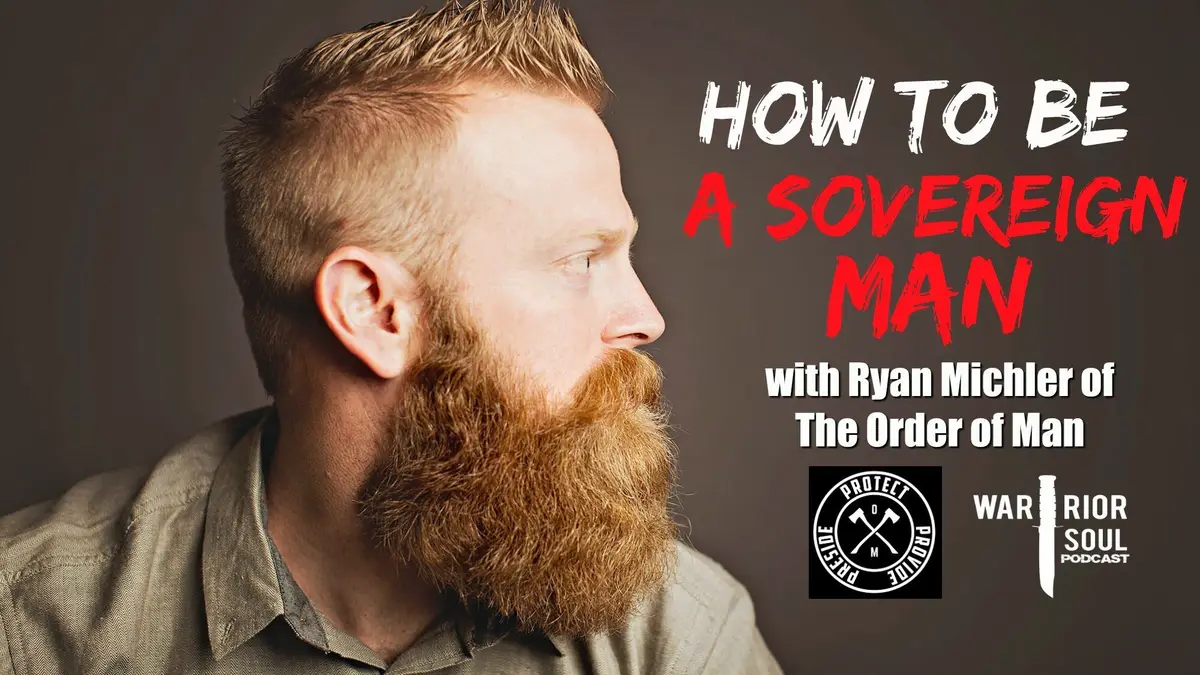
How to Be a Sovereign Man with Ryan Michler of The Order of Man
Hosted by Chris Albert
The Warrior Soul Podcast
Ryan Michler is a US Army veteran, father, coach, financial advisor, and the founder of The Order of Man. Through his podcast, Ryan helps men step more fully into their roles as protectors, providers, and presiders over themselves, their families, their businesses and their communities.
To learn more about Ryan: http://www.orderofman.com
Powered by FBOMB Nutrition. Click below and use the code WarriorSoul to get 20% off of your first order!

Transcript
Machine-generated from the episode audio and lightly edited — may contain errors.
Chris Albert (link to this point)
You know, if you look around at our world today, it seems like more and more men are afraid to be men. They're afraid to fully step into their roles as protectors, providers, and leaders in this society. We find more and more men giving up control of their own lives, not maintaining what today's guest calls sovereignty. And because of that, we're seeing what could be a really strong societal downfall of masculinity. We're seeing more and more men who are falling into depression, falling into risky behavior.
And we're seeing suicide rates amongst men skyrocketing. And that's something that we've dealt with heavily on this podcast in discussing issues in The US military veteran community. And it's also why I think that today's guest, Michler from the Order of Man podcast, is doing some of the most important work in the world today in teaching and motivating men to fully step into their roles as masculine role models for the world, to fully step into their roles as protectors, providers, and presiders, and to really take charge of their own lives and set their own course. Here on The Warrior Soul podcast, we focus on teaching you to live your best life and to give you the tools, tactics, ideas, and to talk about the issues that matter for you in pursuing that best life. And we make effort to bring on awesome experts like Ryan Michler, who enlightened me on a whole heck of a lot to do with masculinity today.
This is a fantastic conversation and I think you guys are going to get a whole heck of a lot out of it. And before we get into that conversation, I want to give you a quick note from our sponsors. F Bomb Nutrition, they make delicious portable packets of fats. I'm always talking about the value of including a good source of fat in your diet, whether you're on a ketogenic diet or not. But one of the problems is that when you're out and about, it's really hard to get a hold of those fats.
It's really hard to get a hold of some good healthy fats. Well, F Bomb solves that problem with their delicious packets of awesome fat. They've got packets of macadamia nut butter and it's macadamia nut butter mixed with coconut butter, which is absolutely my favorite in the world. They've also got macadamia nut butter mixed with sea salt and macadamia nut butter mixed with chocolate. And this stuff is absolutely delicious.
There's no sugar inside of it or anything like that. And you can take it with you wherever you want to go. And for our listeners, all Warrior Soul listeners get 20% off of their first order when they go to www.dropanfbomb.com and use the code Warrior Soul at checkout. With that, let's get into today's awesome conversation with Ryan Michler of The Order of Man podcast.
Chris Albert (link to this point)
This is Chris Albert, and I'm here to remind you of one thing. Someday, you're going to die. Now that's not some morbid statement or scary idea. It's solid fact. Your time here on this earth is limited.
And we need to be reminded of this as much as possible for one simple reason, to live your best life while you can. This is the Warrior Soul podcast.
Chris Albert (link to this point)
Ryan, how are doing today, buddy?
Ryan Michler (link to this point)
I'm good, man. How about you?
Chris Albert (link to this point)
Absolutely awesome. You know, it's funny because I was looking on Fox News earlier and and across all the news channels, they have the story on today about a 30 year old man who had to be evicted from his house and his parents actually had to take a court case up against him. And I thought thought it spoke well to a lot of things we're seeing in this day and age and a lot of the help that you're trying to give to men around the world right now.
Ryan Michler (link to this point)
Yeah, that's true. I actually saw that as well. Made a Twitter post or something about that same article like an hour and a half ago. So I saw that as well. But yeah, think it's pretty pathetic.
You know, I don't know the gentleman's full story. He there might be some extenuating circumstances I'm not aware of. But I do think it's pretty telling when we have guys who are fighting so hard to remain at home and and and shirk their manly responsibilities. I call it Peter Pan syndrome, you know, where where people are like, I don't wanna grow up. And it's unfortunate and it's sad.
And so you see these people, these grown adults who are shirking responsibility, have no accountability over themselves, wanna lead other people, and frankly, don't wanna be the type of people that they have the potential to become if they just learn to step into it a little bit more.
Chris Albert (link to this point)
Absolutely. You know, I really, really wanted to have you on here because I I absolutely love your message. As I as I told you before the the show, kind of have similar stories. My I never knew my dad. Never, never even seen a picture of him.
I know his name. But I grew up just with a mother without really a permanent male figure in my life.
Ryan Michler (link to this point)
Yeah.
Chris Albert (link to this point)
And I know that you had the same thing going on. How has that shaped your experience and who you've wanted to become as a man and and the work you're doing today?
Ryan Michler (link to this point)
Man, it's been it's actually been an amazing experience. And I know when people hear that, they're like, what you, what are you talking about? Because I know when I was a kid and there's plenty of men who are in the same circumstances you and I were, that I was confused. I was upset. I was frustrated.
I was mad. I had a lot of anger and rage pent up inside of me. I didn't know what was going on or why I was pissed. And it was rough, man. And I look back now and I think, you know, if I would've had a permanent father figure in my life, what would life have looked like?
How would it have been different? I think growing up, I would've had a lot more confidence. I definitely would have learned how to interact with other men and boys better than I did. I always felt awkward and out of place because I didn't have that. But I look back at it now and I actually think it's a good thing.
You know, I think a lot of the experiences that we have in life, positive and negative, can shape and define us, and we get to choose, right? We get to choose. Is this experience going to be something that's going to define me in a negative way? And I'm gonna use that experience as an opportunity to become bitter and angry and resentful and let it just fester in my body and in my soul and who I am. Or am I going to use that experience as an opportunity to grow and expand and be enlightened and think about a new way of doing things?
And fortunately for me, and we can talk more about this during the show, but I look at that as a pivotal moment in my life, a pivotal experience. I've got four kids now. And one of my greatest fears, frankly, is dying prematurely before my kids grow up and move out of the house because I know firsthand what it's like. So that also presents me with opportunities to be fully present. I coached my two oldest boys football team, baseball team, and basketball team.
So I'm coaching six teams per year. I'm hyper involved with my kids. I'm helping them with homework. I'm being there physically, emotionally, mentally present for them. There's opportunities that I have to grow the business and speak outside of my hometown that I I turn down because I'd rather be at home and I'd rather be present.
And so a lot of what I grew up with in in my life has shaped me in a positive way who I am today. I didn't always feel like that, but fortunately, I've been able to grow and expand and learn how that can serve me rather than hinder me.
Chris Albert (link to this point)
Yeah. You say you didn't always feel like that. I know so many people fall into that trap, you know, and they don't realize that tragedy and bad things they happen to so many people around the world and that in and of itself doesn't make you special. How you respond to it. But what was it that made the switch in your mind that said, you know what?
This isn't this isn't a handicap. It's an opportunity. What what was it?
Ryan Michler (link to this point)
I you know, don't I don't know that it was one experience necessarily with with regards to the the father thing. I do remember a particular instance where my wife and I, we had been married for, oh gosh, maybe three or four years at the time. We had a one year old son. And I remember getting into an argument with my wife. And I said to her, and I hate the fact that I said this, but I said this, I said I don't even wanna be married anymore.
And she said the next she said the same thing. And the next day she was gone. And we went through a long separation. And for a long time, man, I blamed her. Like, how could she do this?
Why was she disloyal? Why wasn't she doing the things that a quote unquote good woman should do? Why didn't she appreciate the business and the sacrifice I was making to bring income into the house and doing the best I knew I could? And I used a lot of the experiences that I had when I was a kid as an opportunity to self destruct. And so I blamed her.
I don't know why necessarily it changed for me. I do remember the road I was on. I remember the cross street I was on. And I remember thinking to myself, you know, Ryan, this marriage is probably over. This was probably about three or four months into our separation.
I remember thinking this marriage is probably over. And as hard as that was to wrestle with, it was very liberating for me because for the first time in my life, I decided that at least in our marriage, if not my life, I decided that I'm not gonna focus on her. And I'm not gonna try to manipulate or coerce or strong-arm her or do any of this stuff that I was having a tendency of doing. I'm gonna stop focusing on that, and I'm just gonna be focused on myself. Because if this marriage is over, then I'm gonna be a great catch for the next woman come into my life because I was young at the time.
And what was really fascinating is as I shifted responsibility and burden and blame from her over to myself, it was like flipping a switch on the wall. And she began to respond to that because she saw that there was actual changes being made. And so a lot of people, people would argue with me argue about this all the time with me. They'll say things like, well, it takes two to tango and your wife had something to do too, and you're just subservient to her now. No.
It has nothing to do with that. If she were down here on this interview with us right now, she would say the same thing. That she had things to work on. She had things to improve. She was in a bad place herself, but you know what?
There's nothing that I can do about that. There's nothing I can influence that, but there's not a dang thing I can do to change her. So why do we focus so hard and so heavily on getting other people to do things when if we can just focus on ourselves to the degree that we can and it's our responsibility, life changes. It's incredible. And so as I began to take responsibility for my part in the ultimate demise of our relationship up to that point, it was enlightening.
Inspiring. It was amazing. And I recognize that if I could do that in my marriage, I could do it in other avenues of my life. I could do it when it came to being a father. I could do it when it came to managing my health.
I could do it when it came to managing my finances. In 2008, 2009, I was just getting started in the financial planning industry. And that's a bad time. If if you're not aware, that's a bad time to be starting in the financial planning industry because what was the market doing? It was tanking.
And I remember thinking to myself, oh, the economy's bad and this is wrong and this is off and this is why I'm not succeeding and this is why I'm not thriving. Yeah. Okay. There's some truth to that. Sure.
You know, people are losing thirty, forty percent of their market value. There's some there's some truth to that. But then again, where does the responsibility lie? Well, it lies upon my shoulders because if there's one person out there who's thriving in 2008, 2009 in his or her financial planning practice, then it really doesn't have anything to do with the market. It has to do with the individual.
And I recognize that, okay, it had to do with me. And so I went out and I connected with some other advisors who were having success in the same market that I was trying to work in. And they shared some insights and some ideas and some strategies, and I began to accept responsibility for my own position. And my financial planning practice turned around. I did it with my health, and I lost 50 pounds.
Pick an area of life. The more you take responsibility and ownership of it, stop blaming your dad who wasn't around, stop blaming the economy and your wife who's not treating you the way you think you should, or your boss who's, you know, playing office politics and put the burden of responsibility on your own shoulders, you change your life around. It's incredible. It truly is.
Chris Albert (link to this point)
Yeah. You know, one of the things that I've gotten from listening to you is is looking at the state of men in modern society, you know, men are more likely to die early from from natural causes, just from diabetes, heart disease, chronic illness, we're more likely to get murdered, we're more likely to undertake risky behavior, and we're more likely to commit suicide. Mhmm. And you and I both come from the veteran community that's been wracked by suicide over the past decade and a half. But in looking at these in separate issues in my as separate separate issues in my mind, I think it's almost reductionist after listening to your work and reading your book, because I see them all as almost being interrelated.
And a lot of these really bad things are are happening because of a lack of ownership, lack of taking control of what you're putting in your body, taking care of yourself, a lack of managing your your your ability to control your drinking issues, a lack of managing your ability to control your life. And I really see I'm starting to see these as more connected entities because of the work you're doing.
Ryan Michler (link to this point)
Yeah. You know, I I wholeheartedly agree. I I think we see it that way. And I also think it's a culture of victimhood as well. You're you're a victim, so you can feel sorry for yourself.
And look. Let's talk about PTSD for a minute. Both of us come both of us are are are previous military members, and I I don't have PTSD. I wanted to get that out there because I don't fully understand someone who is experiencing what I believe to be a real condition. Don't know.
I don't know what that's like. But I will tell you that I know people who have been in that situation and who have come out of it to the degree they have who have said that I felt like I was a victim of battle or a victim of those experiences or a victim of war. You look at people, There's movements where men are completely distancing themselves from women and not engaging in relationships with women. These are men who are who are damaged, and they think that women have done something to them. So rather than having a healthy relationship, they've positioned themselves as the victim, and I've gotta protect my I've gotta disengage because I'm the victim. So I've gotta disengage from this so it doesn't happen to me again.
Did you look at your own behavior? Oh, no. No. No. No.
Didn't have anything to do with me. It was her. Or people, again, go to the boss thing. My boss is playing politics. Great.
Well, if you recognize that, why not play politics then? And why not play the game? You know? Don't don't don't say that this is how it is. You recognize how it is and then do nothing about it.
Or I hear people say, well, I'm big boned. That that's why I can't lose weight. You know, you know, big boned. You're boned like everybody else.
Chris Albert (link to this point)
Yeah.
Ryan Michler (link to this point)
You just you just eat too many Cheetos. And I know people hear that and like, well, Ryan, And I hear this all the You don't know my situation. You're right. I don't know your situation. But I know everybody else's situation that I've talked with.
I know everybody else who who who used to come up with these excuses. I know I used to come up with those excuses, and I know that's all they were, excuses. So maybe you represent the point 01% of population who who is truly a victim of whatever you're telling yourself you're a victim of. But I'd be willing to bet more often than not, you're a victim of your own thoughts and putting yourself in that in in that category when you really don't belong there at all.
Chris Albert (link to this point)
Yeah. It's funny because, you know, I I can think back to when I was in some of my bad places. I mean, I had I had severe problems with alcoholism. I had severe problems financially. I I was living out of my car at one point, and I was dealing with an autoimmune disease called ulcerative colitis.
And my life was a living hell. And what I kept telling myself was that, you know, when I went to Iraq, I had a relatively easy time there. You know, I didn't I didn't deal with anything. Didn't deal with with with a lot of the the trauma and and people that issues that people who went on later deployments than I did that they experienced. And so when I came back and and my unit got sent back over, they lost people and I felt guilty about it.
So I would make up stories in my head that said, you know, was supposed to be on that second deployment. And so the reason why my life is a living hell right now is because I didn't die on that deployment. And so now, you know, my life is hell because because of that. And was completely externalizing it when the fact of the matter was was I was choosing to drink. I was choosing to abuse alcohol.
I was choosing to be a womanizer and I was choosing to isolate myself. And I see a lot of that these days. A lot of people experience this type of guilt and whether you're blaming somebody else or you're blaming some phantasmic entity out there that you think is causing your problems, it's still externalizing it. Right?
Ryan Michler (link to this point)
Yeah. I mean, I I love hearing that story because you don't you don't hear it too often. You know? You don't hear somebody who's an alcoholic and somebody who is isolating themselves and somebody who had that baggage then learned to let go of it. So I commend you.
You know, I commend you for recognizing that although there are some outside circumstances that certainly have an impact on the way we live our life, you know, we're not we're not immune to those things. We're not living in a vacuum. You know, people are gonna screw you over. You're gonna be dealt a shitty hand. You're you're gonna have a medical condition that you've gotta deal with.
And some of that stuff is is brought upon ourselves, and some of it, it isn't.
Chris Albert (link to this point)
Mhmm.
Ryan Michler (link to this point)
But that doesn't mean anything. What matters is how you decide to respond to it, how you decide to react to it, and how you live your life moving forward. You know, I see people with with with, you know, paraplegics, for example, who were just living these incredible lives. I can't even imagine what that would be like. I can't even imagine how I would respond to that.
Like, if I got into an auto accident today and I lost the ability to walk or use my arms or move a a bloke my neck, I can't imagine my attitude, my negative attitude. The fact that, oh, man. Like, look at this hand I was dealt. And yet I see people every day who have that hand And we're living these incredible lives and doing wonderful things and have decided to use it as an opportunity to expand and grow and influence people in a positive way around them. It's pretty inspiring to see when you take ownership of your life and stop being a victim.
Chris Albert (link to this point)
Absolutely. And one thing I wanted to ask you here too is, do you think that creating Order of Man and and and beginning to help other men to be better men, is is that part of your own healing process? Because I think there's really so much benefit in giving value to other people and I see you doing that. Is that also for helping you to heal as a man?
Ryan Michler (link to this point)
Oh, 100%. A 100%. I mean, we've all heard the adage that if you want to learn something, you teach it. Right? And that's certainly been true for me.
But when I started Order of Man, is in March 2015, so a little over three years ago now, I had started with the goal of creating a brotherhood, a fraternity, an organization of men standing shoulder to shoulder helping lift each other up. And I've never once positioned myself as I'm the guru. I'm the know it all. I have it all figured out. I have some things figured out, I'm learning some other things, I've always positioned myself as, hey, I wanna stand shoulder to shoulder with you.
So as much as I can say I'm the quote unquote leader of the movement, I'm an active participant. I'm a soldier in the movement. You know, I'm somebody who's learning from thousands and thousands of men who are learning from other men. I'm somebody who's growing. I'm somebody who loses his patience at times and somebody who eats a few too many Oreos and doesn't go who doesn't get out of bed every morning and go work out.
Like, that that's me. You know? And and I think there's this really interesting world we live in where we just wanna show the highlight reel. And I found the more that I'm willing to share my faults and my flaws as much as I'm willing to share the things that I do well, the more people resonate with that, the more they connect with that, but the more that I'm able to improve myself. You know, I went and did a Spartan Agoge.
And if you're not familiar with that, I did this in 2000 the end of twenty sixteen. So, it's like a year and a half or so ago. It's a sixty hour endurance event and it's grueling. Spartan's like pinnacle endurance event. It's grueling.
It's it's brutal. I went and did this thing with with seven other guys, and I remember wanting to quit so bad. I remember how how hard it was, and and I was telling myself I couldn't do it and I couldn't finish it. And I was feeling sorry for myself. And there's a lot of reasons why I didn't.
A lot of reasons why I ended up finishing that that endurance event. But one of the reasons was is because I told 10,000 people, and that was how many men we had in our Facebook group at the time. I told 10,000 men that I was gonna finish it. And if I didn't finish it, like, how could I ever go back to the guys that I'm I'm wanting to inspire and say, sorry, guys. I can only get 35 out of the sixty hours or forty hour, whatever it was. No way in hell was I gonna do that. So as much as I hope to inspire and lift men up, I'm inspired and lifted up by the men who are in this movement with me.
Chris Albert (link to this point)
Yeah. My my good friend Brian Rose from London Real, he just finished an event called the the he he did a series called Iron Mind, and it was his training up to a a Ironman triathlon after ninety days of training. And, you know, he he dealt with some demons during that. But but one of the things he gets into is the monkey brain. And and what I find is that if I'm here and I'm struggling, one of the things I've got to do is I've got to go out and I got to put myself through some physical pain.
Because what you realize when you do that, you know, going for a really, really hard run or doing a really hard lifting session or doing something physical that's hard is that you have these multiple voices going in your head and it's your monkey brain playing around with you. And it's literally, you know, you have a voice saying, alright, you know what, you've run enough today or you know what, you need to stop, you're gonna pass out
Ryan Michler (link to this point)
or then You've hurt yourself or yeah.
Chris Albert (link to this point)
Yep. Or then you're going downhill and it's saying, you're not going fast enough, bitch. Keep going. You know, it's you realize that you have all these crazy voices going on in your head all the time. And and one of the things about doing something hard like that is it allows you to be the ringmaster in that circus that's going on in your own head.
Ryan Michler (link to this point)
Yeah. Yeah. I def you know, it's funny. One if we do quite a few of events and one of the in the event, in the early stages of the event, we always have guys do what what we call a plank challenge. And and the only instructions that we give the participants of the event is we say, just hold the plank as long as you can.
And so these guys get down. They get on their hands or they get on their plank or on their elbows and they do the plank. And eventually, they start falling off, you know, one by one. They start stopping and eventually, the last one stops. And it's always fascinating because he thinks he's won.
He's like, I won. I was the last one. I'm like, well, hold on. Let's stop for a second. What were the instructions?
And the instructions were not to beat everybody else. The instructions were to hold the plank as long as you can. If your life was on the line, could you hold that plank for another five seconds, another ten seconds, another thirty seconds, another minute? And the answer is always yes, of course. So did you win or did you fail the exercise?
And they see the light bulb. Yeah, I guess I did fail the exercise. The question then is why? Why did you fail the exercise? And to your point that you just made, the reason is is because I hear this.
These are the most common ones. Well, I wasn't the first one to go. Right? Somebody else somebody else went down, so it gave me permission to go down. I thought this was stupid or irrelevant to me actually being a better man, so I gave up.
I have this nagging shoulder injury, so I didn't want to inflame it and hurt it even worse, So I went down. The winner always says, well, I just thought I won. I outlasted everybody else, so I just stopped. So we're measuring against what other people are doing rather than ourselves and what we're capable of. All these excuses as to why they failed the exercise.
It's a really enlightening experience because they begin to see that we're more powerful than we give ourselves credit for, but we're also more destructive than we give ourselves credit for as well. We sabotage our own efforts.
Chris Albert (link to this point)
That's some amazing insight. That's absolutely ingenious for to put on an event like that, you know, that that really tests that that ability to hang on. But also that that test that group mentality, you know, so many of us, we blend right into the pack. We don't want to sprint ahead. We don't want to do more than what's necessary.
And that shows it right there.
Ryan Michler (link to this point)
Yep. Absolutely. Absolutely. It's pretty enlightening. And I've done it too.
I mean, it's said the same things. I'm not gonna say I'm above that. You you would have done the same thing too. We all do. 100%.
Failed. So it's just an interesting and telling experience.
Chris Albert (link to this point)
Absolutely. You know, one of the big things that I love about podcasting and and about about interviewing people like you is because it allows me to put on my white belt, you know, and and and really learn. And, you know, I you know, you've mentioned that you don't consider yourself a guru. You don't consider yourself an expert. What's the biggest thing you've learned from interviewing people?
What's the biggest thing you've learned from from running your podcast?
Ryan Michler (link to this point)
Oh, man. I've gosh. I've learned so much. One of the things that I I was just talking to a group earlier, which is why we had to get on the call, you and I, a little later than we had initially planned, is I was talking about the power of consistency. And and for me, I think consistency trumps just about any other skill set or gift or blessing or whatever you wanna call it that you might have.
You know, some people are well connected. Other people are smart. Other people are good looking. Other people are intelligent. Other people can communicate well and articulate ideas.
All of those things are wonderful. Of course, I wanna develop in all of those areas. But I think if there's one virtue that anyone could possess, it's the ability to be consistent. It's discipline or grit or resilience. It's driving on when you don't want to.
It's continuing to put forth the effort long after the feeling of excitement is gone. I see that in podcasting all the time. People get hyped up and they get excited and they think, well, I listen to podcasts, so I wanna be a podcaster. And they do three, four, five, twenty episodes and then they quit. You know, they didn't see the results that they wanted or had these false sense of expectations and they don't reach them and they think, oh, I guess this just wasn't for me.
It's not my thing. How do you know? You did it for a month. Like like, anybody can do something for a month. Do it for a year.
Do it for two years. Do it for five years. And then you tell me if it's not for you. I I'd be willing to bet more often than not, you'll find out that anything's for you if you just give it enough effort. You do it long enough.
You learn. You grow. You expand. You get better. You try to become a master that we can, as human beings, become masters of anything that we try.
It's pretty incredible.
Chris Albert (link to this point)
Are you think we're losing the quest for mastery as far as getting our ten thousand hours in and and really trying to become a a true master at something?
Ryan Michler (link to this point)
Well, and I think even I mean, even that ten thousand hour thing is it to me is a trap. Because what it's arrival. Right? It's like, oh, once I get my ten thousand hours, then I'm good. No.
Who who said you're good? By whose whose definition are you good? I don't want ten thousand hours of anything. I want an infinite number of hours. So to answer your question, are we losing the sense of mastery?
Yeah. Absolutely. Because we're defining it as ten thousand hours or or we're defining it by somebody else's expectation or somebody else's metric. I mean, we've all heard the story of Roger Bannister, you know, broke the four minute mile. Well, nobody thought they could do it.
He thought he could do it. So he went out and did it. And then guess what? Within a matter of what? A year, three, four, five other people broke that.
Well, it wasn't that they weren't physically capable. Maybe they trained a little bit differently, but they were physically capable of doing it. It was right here. And once one person did it, they're like, oh, okay. It is possible.
So I just have to push a little bit harder. And we use other people's expectations and what other people have done before as self imposed barriers and limitations. So, yeah, I think you couple that with with our level of focus. Oh, man. It's brutal.
Right? Like, like, even even sitting down with somebody on a podcast interview for an hour, it's difficult for a lot of people to do. Like, I can't sit here for an hour and listen to this. We have this bright shiny object syndrome where it's like, oh, okay. Well, I'll be on Facebook. And oh, now let's go over to Instagram. And oh, now, okay. I'm done on Instagram.
Let me go back to Facebook. And here's a project I need to work on, but this one's more. And and then you have this idea, and you're like, oh, I need to do that. And then two minutes later, you forget about it because you're onto something else. I do it too.
Everybody does it. But our ability to focus is greatly diminished, which hinders our ability to perform over long periods of time and truly become masters of the craft that we're after.
Chris Albert (link to this point)
Yeah, it's I'm seeing more and more people and social media and in the Internet space. Yeah. But but but there's so many people out there coming on so called experts or so called people who want to start a business and they'll go after it for a few months. They'll go after it for a little bit, but when success doesn't immediately come their way, they quit and they they they just they give up.
Ryan Michler (link to this point)
Right.
Chris Albert (link to this point)
And the thing that I find about that is, you know, I find it funny because I've been grinding away at this for a decade. I've been in the training space for a decade and and at times, you know, barely enough to scrape by and at times having wonderful feast of of of money and everything that I wanted. The ups and downs and and everything in between, but it took a lot of work and a lot of learning. And I just I feel like so many people are losing that because they want gratification, that instant success.
Ryan Michler (link to this point)
I think they want external validation. Right? Like, if you ask people why they want it, what are they going to say? Well, I want notoriety. Well, I want to be famous.
Well, I want 200,000 Instagram followers or well, I wanna make $300,000 and well, I wanna be influential. There's nothing wrong with that. I think all of that stuff's great. But if that's your primary motivation, you're giving control. And this is the subject of the book that I wrote.
You're giving control to outside factors and other people. We have ultimate control over our own lives. And yet, we voluntarily give up that control when we say it's somebody else's fault or I want this external validation. Like, if you can't find it in here, if you can't find it yourself, you're never going to achieve that external validation. Internal validation is significantly more valuable than external.
Not only is it more rewarding, but you can also control it, right? You put the power back where it belongs, which is in your hands, on your shoulders, as opposed to, man, I really hope Chris calls me up for a podcast interview and really validates me and tells me how wonderful I am. Well, that that feels good, no doubt. But if I'm waiting for that to happen, that may or may not happen. And I can't be happy in the meantime.
That's what I'm telling myself. I can't be happy and satisfied and fulfilled until you call me and invite me on your podcast or I have this podcast guest, or I get this many downloads, or I make this much money, or I connect with this person. Man, that's a crappy way to live. I've been there. It's a crappy, crappy way to live.
Chris Albert (link to this point)
Yeah. And it's I I think pulling people the wool off people's eyes and making them realize that it's a big thing. That's definitely one of the things your book does, I wanted to mention that right now. Talked about this earlier. I've been reading this book.
It's called Sovereignty, the battle for the hearts and minds of men. And you make a differentiation between this concept of sovereignty, and I think you alluded to this earlier, but the men going their own way movement. What's the difference there? What what's the difference between your concept of male sovereignty versus versus that men going their own way, no fucks given type movement?
Ryan Michler (link to this point)
It's it's the answer to a question that one of my friends used to ask me all the time, and it drove me nuts. And the question was, therefore, what? And what I mean by that is I would tell him something or share an idea, and he'd say, therefore, what? I'm like, what the hell are you talking about? Why do you keep saying that?
And I had a hard time wrapping my head around what he meant. What what what he was meaning is, why are you telling me this? What are you gonna do about it? How is that going to serve you? And the differentiating factor between, I think, what what I'm trying to accomplish and what the book is about between the men going their own way movement and things like that is that I think there's a lot of people out there who just wanna disengage entirely because again, they're the victim.
Right? So they wanna disengage. That's selfish. Alright? And there's times to be selfish.
No doubt. But if you disengage because you're afraid or you're upset or you're hurt and you can't go back out into the world and provide and be a man of value, then that's a selfish attitude to have. The differentiating factor between what that's talking about and what we talk about is that I need to learn to take care of myself. I need to learn to wrestle control over my own life so that I can go out and more effectively serve other people. And if you look at what what the the core responsibilities of a man are, it's to protect, it's to provide, and it's to preside.
It's those three things. And each one of those, protect, provide, preside, which is synonymous with leadership, have an element. The underlying tenet of each of those is service. To be a man is to serve. And if we're using outside experiences and horrible situations as an opportunity to withdraw from society and our responsibilities, then we're not fulfilling our obligation as men, which is to go out into the world and serve our families, serve our communities, serve our neighbors, our businesses, our country.
That is what it means to be a man, and that's what differentiates us.
Chris Albert (link to this point)
Yeah. A a good friend of mine named Kameron Delany, he started a veterans organization a few years ago called the Ronin Veterans Network. And he used the Ronin concept from the Japanese Samurai. And if you really think about that, a Ronin was a Samurai who had either lost his master or had had been disowned by his master. And in in in the Bushido code, if you were a ronin, it was a shameful thing, and and you were obligated to commit suicide or live the rest of your life in shame.
And reading your book, reading everything, it seems like we're in a case where almost every man out there is a modern day Ronin. Unless they find their purpose, unless they find that ability, those three P's that you talked about protect, provide and preside. And in such circumstance, you know, if you were not serving, if you were serving no one except for yourself or you're serving nothing, you tend to live your life in shame. You tend to live your life by doing all the things we talked about at the beginning of this of this show that lead to self destruction and lead to disease and lead to a life of depression.
Ryan Michler (link to this point)
Yeah. You know, you talk about Bushido and and Samurai code, and and it reminds me of the movie The Last Samurai. Mhmm. Have you seen that show? Yep.
It's a good it's a good movie. And the samurai's code is that if you're defeated, right, then you then you take your life in shame. Right? And and I'm I'm not familiar enough with it to to know if that's entirely accurate or how that all works out. So I'm I'm not speaking from knowing all of this stuff.
But Tom Cruise's character says, no, man. If we're defeated, we keep fighting. We find a new way to fight. We find a new reason to live. And he convinces this samurai master that that is actually probably the better way to do it.
But he he helps him take his own life in the end. And it's just a really interesting thought for me. When I when I experienced that, I'm like, man, do you quit? Like, do you give up? Do you do you finish your life or end your life in shame?
Or do you just find that new purpose to your point? And I think the only time that we can lose our purpose in life is when we voluntarily stop fighting. Right? Like, we voluntarily say, it's done. I'm done.
I have nothing else to fight for. And I think a lot of veterans deal with this. I work with an organization called American Dream U. I'm not sure if you're familiar with them or not, but it's very telling. A lot of these guys feel like when the and gals as well, when they leave the military that they have lost their purpose.
Well, the the ones that transition successfully into the civilian sector are the ones who find a new purpose. You found a new purpose in what you're doing here. I found a new purpose in what I'm doing here. I I think it's I I just I can't overstate how important it is to find some sort of purpose for the way that you live your life and something worthwhile in your own eyes to pursue.
Chris Albert (link to this point)
Yeah. You gotta find that next mission. You gotta you gotta dedicate yourself to something out there that's greater than yourself. You know, and I'd also mentioned about your book. One of the things I love about it is that it's almost it's written almost in the style of, like, one of the old FM manuals, the the the the the military manuals.
And the reason why I think that's significant is because Order of Man obviously extends beyond the book. And so you have some amazing things going on. You have your Iron Council. You have have the work you're doing with men. You have the podcast, obviously.
But what you've created for your your followers and for the people who subscribe to Order of Man is a real path toward creating a battle plan for themselves and a real way of working with other men to do this. Could you talk a little bit about that?
Ryan Michler (link to this point)
The battle plan itself?
Chris Albert (link to this point)
Yeah. The battle plan in the Iron Council and everything you guys are doing over there.
Ryan Michler (link to this point)
Yeah. Yeah. Absolutely. I mean, we hear a lot about finding your purpose. We're talking about it right now.
Finding a new direction. Finding significance and meaning in your life. And I think that's wonderful. You have to find that stuff. But unless you have a roadmap to do it, it's pretty difficult to do, right?
Something catastrophic is going to have to happen. And you're gonna have to figure it out along the way if you want to continue to thrive and succeed. And I think a lot of people don't because they don't have this roadmap or don't know where to turn. And so that's what I did when I set out to create the Iron Council, which is our brotherhood or mastermind, and also write this book. I wanted to lay the foundation and the framework for people finding their purpose and finding direction and creating that new mission and having objectives and all the things that I think are important.
The things that I found in my own life to work. It's just really interesting that we, as men, I think more than women tend to withdraw. Right? Like the lone wolf type thing where we just withdraw and we go away and we reengage with other people. Yet you look at what we've been doing as a human species for tens and tens of thousands of years is operating in packs and tribes because it's better for the collective good of the people involved.
So the book is really the framework for creating, like you said, a battle plan in your life. And a battle plan is a ninety day plan to achieve measurable results in four specific areas of your life. So what we do first and foremost is start to articulate a vision. You know, what do I want my future to look like? What what is the ideal relationship with a spouse look like?
What is my ideal level of fitness look like? How will that feel? What will I be doing? I know for me, when I was fifty pounds overweight, I I I was really upset that I couldn't balance on the trampoline with my kids after work. That was that was not a cool experience.
That was not fun. And I could see the look of disappointment in their eyes when they asked if I jump, and I said, can't. I literally can't. I don't wanna live like that. And I envision this moment where I could jump on the trampoline with them and outlast them, and they're like, dad, I'm tired.
Let's go inside. And it wasn't me the one who was saying it. And and I'm to that point because I articulate that vision. And then what we do is we work backwards into this plan. So we have objectives, and there there there are four objectives in four key areas of your life.
So number one is calibration, and that's getting right with yourself, your mind, your soul, living in integrity, knowing about your own well-being and how you want to live and how you want to show up and the type of man or woman you want. Number two is connection. So that's the relationships that you have with other people, Spouse, friend, colleague, brother, dad, coworker, whoever it may be. The third component of this is condition. So that's your physical health, right?
How's your sleep? How's your recovery? How's your conditioning? How's your strength? And then number four is contribution.
And contribution is the way that you give back. The way that you can be a person of value. So you might be compensated that through work, for example. Or there might be charitable services or things like that that you're involved in. Maybe you're coaching your kids to sports teams and you're giving back in in that capacity.
So those the four areas that we work with people to create objectives on. And then we go deeper than that. And, of course, we can get into that. But that's that's where we're at.
Chris Albert (link to this point)
Yeah. You know, one of the things I really appreciate about that is because a lot of men out there when they begin providing and they are out there, they're working there, they have kids, right? And their time becomes more and more constrained. They they think to themselves, I have no more time for fitness. I have no more time to to to hit the gym, to take care of my body.
I need to focus on earning money so that I can provide for the family. Or what a lot of them don't realize is that if you don't take care of your body, the only two big assets you have in your life are your mind, your your body and your mind. And if either of those go, you're not gonna be able to provide. You're not gonna be able to provide to the best of your ability. You're not gonna be able to be present to the best of your ability as a parent.
And I like how you're fitting this in because that's all part of it. Right? Lifting weights isn't something or working out in general and being in shape isn't something that's apart from being a good parent or a good provider. It's part of it.
Ryan Michler (link to this point)
And it helps you be those other things as well. I mean, look, here's let's let's be real. And and this is gonna tick people off. I know. But this is the truth.
If you're a 100, you're not gonna be as good a father as you can be.
Chris Albert (link to this point)
Right.
Ryan Michler (link to this point)
You can't. Oh, but I'm a I'm a good father. I love my kids. You might, but you're not as effective as you could be if you were a 100 pounds lighter, if you could run two miles without stopping, If you can lift a reasonable amount of weight. You're just gonna be a better person, and that doesn't speak about your your worth, certainly.
Alright? I'm not talking about that, but I'm talking about your effectiveness in the roles that you live. Father, husband, your woman, wife, mother, sister, brother, employee, coworker, boss, neighbor, friend. You're gonna be more effective if you get your body right, if you get your mind right, if you know how to communicate and articulate and have relationships with people. You're going to be more effective.
If you if you're not willing to take care of those things, then just understand that you're not as effective as you could be. And you might be okay with that. And if you are, great. But I'd be willing to bet that most people aren't, which means that you need to find a way to take care of yourself. There's the adage, and I think it's attributed to Abraham Lincoln, whether it's true or not.
He says, if you give me six hours to chop down a tree, I'll spend the first four sharpening my axe.
Chris Albert (link to this point)
Yeah.
Ryan Michler (link to this point)
And I I think there's a lot of truth to that. You know? Can you take an extra hour out of your day and carve that out somewhere to spend some time in the gym? Yeah. Will there be a sacrifice?
Sure. Of course. But that sacrifice is well worth it when it comes to how much more effective you can be when you get back into your life.
Chris Albert (link to this point)
Absolutely. And you have this other event. It's called Legacy. And that's a father and son get together. Correct?
Ryan Michler (link to this point)
Yeah. So we started doing events a couple, excuse me, a couple of years ago. Our first event was called Uprising, and we brought 20 guys in from all over the country. And my goal was to make them bleed, sweat, and cry. That's what I tell them.
If I can make you bleed, sweat, and cry, I feel like we've a successful event. Well, there's been a lot of stuff in the news lately about anywhere from Boy Scouts, for example, allowing allowing girls and being more open about that, transgender people as well. And I and I truly believe that there needs to be some space and organization for boys to learn how to be men. The fact of the matter is is that masculinity is bestowed. It's earned.
You don't just get to have it. You can that's why we have 30 year old guys like we started this conversation who are still living in mommy and daddy's basement. Because they're of manly age and yet they're still behaving like children. And I think there needs to be a place where boys can learn from men how to be men. So it's the reason that we have, like we started this conversation, men who are 30 years old and they're still living in mommy and daddy's basement.
Right? They've never fully learned and developed in how to be a man. And so we've created an event called Legacy. It's a father son event where we have men come with their sons, whether it's biological or stepchildren, stepsons, or maybe you're an uncle or have a fatherly duty with a neighborhood boy, whatever it may look like, where we bring you in 20 guys and we give you the skills and the tools and the resources and the conversations geared towards helping you be a better father figure and helping your son become more a man. It's a rite of passage.
It's really exciting that we're doing this stuff.
Chris Albert (link to this point)
That's absolutely awesome. And, you know, it's funny because I I mean, I was in the Marine Corps, I went I went to college, I went through, bachelor's degree, master's degree, and then almost all the way up through PhD. And of the things I learned by spending so much time at college is that it's it's definitely decreasing its value as far as what it can provide you with in society as a human being who is trying to actually make it in the world. And I think events like this, extra education like this, and and, you know, everything you're doing over there at Order of Man, I think that's what's that's gonna be the cutting edge as far as the future goes, as far as what's going to separate men out from everybody else.
Ryan Michler (link to this point)
Yeah, well, I agree with that. I think it's more practical. I think it's more applicable. And as much as college is valuable for certain professions in certain areas, I think the more that we can create opportunities, movements, courses, programs, events geared towards helping people in a practical and effective way, I think the better off that we're gonna be. I know I've never been to an event where I didn't learn one, at least one new thing that I can implement in my life and make make me a better person.
Chris Albert (link to this point)
Absolutely. Now, I want just to to wrap this up because we are we are speaking to our our brothers in arms here on this on this show. And and I wanted to mention that you also, in fact, are are a combat veteran and served in the United States Army. Coming from the the military, what what did that teach you? And and what do you have in your life now because you did that?
Ryan Michler (link to this point)
Man, there's so there's so much that's come from that. I actually joined the National Guard, in fact, when I was a senior in high school and did the National Guard thing for a while and had a couple little minor deployments. One was to the Salt Lake City Olympics. Another one, we went to Fort Lewis and trained ROTC cadets for the summer. We're supposed to go to Iraq in 2003 for that.
A week before we left, they said, no, you're going to train these ROTC cadets, which was a really good duty up there by Seattle. And then in 2005, we got activated again. This time we went to Iraq. We were in Ramadi in 2005, 2006. And it was a hard, you know, was a hard experience.
Anybody who's listening to this who's been in in combat and been in that arena understands how difficult and challenging that can be. Fortunately, you know, I wasn't in a position where I had to necessarily engage in a bunch of combat and things like that. I know that there was guys that did. And it was it was a hard deal. And we lost a couple of guys, and it was it was tough.
It was tough. Everybody understands that. But that being said, you know, joining the military at such an early age without having a father figure in my life was was pretty enlightening for me because I learned a lot about what it meant to be a man. I learned how to interact with other men. I think one of the biggest things I took away from it was number one, discipline.
And the level of discipline that it takes to be successful in any mission, whether it's on the battlefield or whether it's in the classroom or the boardroom or wherever it may be, discipline is critical. I also learned what it means, and I think this is my biggest takeaway, especially with my service in Iraq, is that we we play for keeps. You know? If anybody who's listening to this has been in a life or death situation, you you understand. You you know what it's like to worry if you're gonna make it at home, that that you worry if things are gonna work out.
And that was certainly life every day while we were over there. And then you get back and people are worried about that the guy at Starbucks didn't put the right mocha frappuccino or whatever in in his coffee. I'm like, this is the stuff that you worry about. Mhmm. And I think that attitude of playing for keeps and playing real and the significance of that has certainly permeated every element of my life from the business I have to the relationship with my wife and my kids to this conversation to everything I do.
I realize the significance and importance of it because I respect life and I know how fragile it can actually be.
Chris Albert (link to this point)
Absolutely. You know, one of the biggest things that I got from from my experience in in in Iraq was, you know, being there and wanting to come home, but looking around at the kids who are over there who couldn't come home, who who had to live there for the rest of their lives.
Ryan Michler (link to this point)
And we're home.
Chris Albert (link to this point)
Yeah. Gives you some real perspective. We none of us really have too much to worry about over here. Lives and limbs are not on the line most of the time.
Ryan Michler (link to this point)
Well, that's the thing. I mean, it's it's crazy. The things that people are worried about, I'm like, man, I can't. That was that was one of my hardest that was one of the hardest things to deal with. I'm like, what?
Anyways, you you understand. People who are listening understand. If they've been in that situation, it's like, can't believe the the trivial nonsense that people are worried about.
Chris Albert (link to this point)
Absolutely. And and your your interview, I think it was with Braxton, a gentleman from your unit who who who had hit an IED.
Ryan Michler (link to this point)
Yeah.
Chris Albert (link to this point)
That was that was an intense Yeah.
Ryan Michler (link to this point)
Was it was a suicide bomber, essentially. A suicide bomber. Yeah. Came up and detonated his vest full filled with ball bearings. So, yeah, it's pretty pretty crazy story.
He's an inspiring man for sure.
Chris Albert (link to this point)
Absolutely. Well, Ryan, number one, I wanna thank you so much for coming on. And number two, I really want to acknowledge you for the work you're doing. I think that that this is some of the most important work that anybody could be doing in in today's society where we have threats to masculinity around every corner, where we have masculinity continuing to be called into question as a virtue. And where we have a lot of men out there who are confused about how they should move forward in life.
And so I want to thank you for that. And I want to thank you for your service. And, you know, where where where can people listen to your podcast and find out more about Order of Man?
Ryan Michler (link to this point)
Yeah. So if you're you're listening to podcast right now, so if you like podcasts, Order of Man podcast. Outside of that is our headquarters, which is orderofman.com. We've got everything over there. And then on Twitter, Facebook, Instagram, I mean, name it, you'll find us all at order of man.
You can track us down pretty easily.
Chris Albert (link to this point)
Absolutely. And for everybody out there, definitely check Ryan out. And wherever you are, whatever you're doing, get out there and live your best life while you can.
Host of the Warrior Soul Podcast and founder of Warrior Soul. Worldwide trainer and nutrition coach, contributing author at Testosterone Nation and Muscle and Strength.