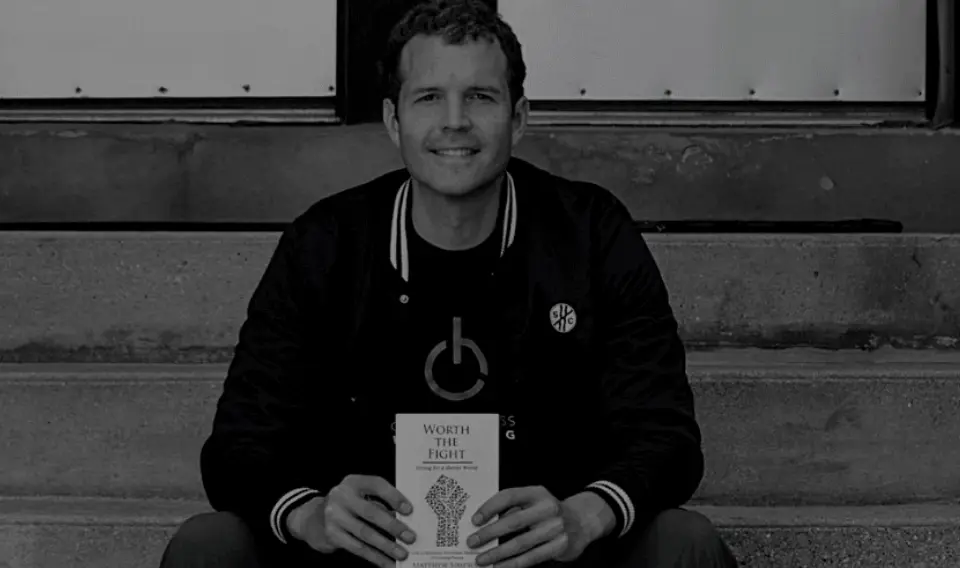
Matt Simpson is the author of Worth The Fight and the host of the Worth the Fight Podcast
Matt Simpson is the author of Worth the Fight, a book that details how he overcame his battles with trauma and the resultant self-destructive behavior that comes with trauma.
Matt thrives on showing people what’s possible when they finally come to grips with the traumatic events that have happened in their lives.
This is not easy. It involves searching deep within one’s soul, a journey that often involves confronting uncomfortable truths along the way. Yet through that discomfort, you can find forgiveness, compassion, kindness, and fulfillment through service to others.
Matt found help on his journey through the healing power of psychedelic plant medicines and has spent much of his time advocating for the study, de-stigmatization, and introduction of these therapies to communities in need, like the veteran community.
Matt and I had an excellent conversation about life, healing, trauma, and psychedelics.
To learn more about Matt and to access his excellent book visit: https://www.nltrans.org/
Transcript
Machine-generated from the episode audio and lightly edited — may contain errors.
Chris Albert (link to this point)
The Warrior Soul podcast is written, edited, and produced by me, Albert. Our mission is to provide tools, tactics, strategies, and ideas that help The US military veteran community to show up as the wisest, strongest, most capable versions of themselves in the civilian world. If you're not a veteran, stick around because anything we talk about will most certainly apply to you as well. This podcast is made possible with the help of f bomb nutrition. They make delicious packets of fats that you can carry around anywhere with you in little portable packets.
They make macadamia nut butters. They mix them up with chocolate. They mix them up with sea salt. They mix them up with coconut butter. They're absolutely delicious, and they're really good for you.
They don't have any sugar. They also make a lot of cheese snacks. They make meat sticks, and it's just a great company. These guys send packages of this stuff to the troops who are on the front lines overseas to supplement their MREs, and we didn't ask them to do that. They just did that on their own initiative.
Really great company. If you wanna get 20% off your first order of f bombs, head over to www.dropanfbomb.com and use the code Warrior Soul at checkout. This podcast is also brought to you with the help of Save the Brave. Savethebrave.org is a five zero one c three charity for veterans. They run camaraderie events that include fishing, golfing.
They also do a lot of work with gold star families. And unlike a lot of other organizations, their board doesn't take a salary. Really great organization that is doing amazing work. So go and check them out at savethebrave.org. With that, thank you guys so much.
Let's get into today's programming.
This is Chris Albert, and I'm here to remind you of one thing. Someday, you're going to die. Now that's not some morbid statement or scary idea. It's solid fact. Your time here on this earth is limited.
And we need to be reminded of this as much as possible for one simple reason, to live your best life while you can. This is the Warrior Soul podcast.
What is going on, ladies and gentlemen? Welcome to the Warrior Soul podcast. My name is Chris Albert, and this is where we deliver tools, tactics, strategies, and ideas each week to The US military veteran community to help them to live their absolute best lives. And, man, I absolutely love doing this podcast. And one of the reasons why I love doing this podcast is because of conversations like the one I'm about to present to you.
This conversation is with mister Matt Simpson. He's the author of a book called Worth the Fight, and he is somebody who's experienced quite a bit of trauma in his life. He's not a veteran, but like a lot of people, he's dealt with some pretty crappy circumstances, and he has been able to work through them with the help of psychedelic plant medicines. I had him on a few years ago, actually. It was a conversation with him and another gentleman from Veterans for Entheogenic Therapy.
And I'm glad I got that word right. I always get it wrong. And we were talking about the power of psychedelics to help the veteran community. And Matt has written a book about his experiences, about his travels, both physical and mental, and we had a really great conversation here. We talked quite a bit about trauma.
We talked quite a bit about things you can do to start working on yourself, to start dealing with that trauma, and to start bettering yourself, and we talk quite a bit about psychedelics. This is a subject that I am quite passionate about, and it's not because I'm somebody who's extremely enthusiastic about doing drugs or anything like that. I am somebody who rarely even takes a sip of alcohol. But I believe in the power of psychedelics to help explore the mind and as a therapeutic tool for this community to explore trauma, to overcome a lot of the obstacles, the mental blocks that you have in your life, and to help you to heal. Matt's story is based around this, and I highly suggest you guys check out his book, Worth the Fight.
I've been listening to it on audio, and it is absolutely excellent. And I think Matt is somebody here that we can all relate to. So I'm not gonna keep yapping my gums here. Just a couple of announcements. Number one, I am, like I've been talking about over the past few weeks, in the process of moving.
I am trying to keep my content production as regular as possible. I'm trying to stay to that three times a week schedule that I've committed to. But, you know, in the process, sometimes the editing quality might go down. I'm trying to keep it as high as possible, but please bear with me over this time period of transition as I'm working with less equipment in my studio. I'm kind of on the road right now, and, you know, we're we're trying to give you the absolute best.
The other thing I just wanna say is that I absolutely love this community. The support you guys have been giving this podcast, the support you give me, it's why I get up in the morning. It's it's why I keep doing this. You know, this... You don't get rich off of podcasting.
I'm not doing this for money. I'm doing this for you guys. And the only thing I ask of you in return is to get the word out there, to tell people that the podcast exists, to write us a review up on iTunes. I can't tell you how much that helps to spread word about the show, to let people in this community know that we exist. Because we're not just creating a podcast here, we're creating a revolution.
And in my opinion, there's never been a more important time than for members of the veteran community to step up and become leaders in their communities. With all the chaos going on out there right now, we are a community that is made up of every race, that is made up of all political beliefs, and we're a community that knows what it's like to work with people who are different from you. And that's why I think we all really need to step up here and be leaders in our communities and and to be people who people turn to in times of trouble. So we're trying to help you to do that with this podcast, and I hope you do leave us a review and tell your friends about it. So with that, I'm gonna stop talking.
We're gonna get into this outstanding conversation with mister Matt Simpson, who who is the author of Worth the Fight. Matt Simpson, welcome to the Warrior Soul podcast.
Matt Simpson (link to this point)
Thank you so much, Chris, for having me. It's an honor to be here with you.
Chris Albert (link to this point)
Yeah. You know, I I mean, going through your audiobook, I really, really, really liked it. I got I got the chance to come on your show last week, I think it was. And then I think that's gonna be released sometime soon. But I wanted to bring you...
Give you the chance to come on here and and tell your story to to our audience here because I think it's pretty compelling.
Matt Simpson (link to this point)
Thank you. Thank you. Absolutely. Yeah. It's been wonderful to connect with you, you know, last week or the week before and and very much looking forward to sharing your high vibe insights with with my audience on the Worth the Fight podcast.
And, yes, absolutely. There... You know, as we talked about on the pre call, there's a lot of synergy with with our respective, you know, projects and missions. And thank you for the kind words about the book, the Worth the Fight audiobook that you've been engaging. And, yeah, I'm really excited to share what we're up to.
Chris Albert (link to this point)
Definitely. So just for our audience, to get a little background on you, how how did this journey start for you?
Matt Simpson (link to this point)
You know, it was back in 2014. I was, on my 30 birthday, October 16, 2014, I sold a business that I've been working on for seven years in Chicago. I did the whole corporate America rat race thing. And immediately after... I mean, the night that I was supposed to be out hoot and hollering with the the the new company that bought us, you know, my heart was on this path that I'm on right now.
This path of service, this path of, you know, helping people work through some of the challenges that that I've been fortunate enough to work through. Two months later, I was... I had a... There was a critical juncture where I just felt intuitively like, Matt, you got one week here before you're gonna get sucked into the game, and and there's gonna be no return. And and the money and the responsibility and accountability would have been very, very high.
And so I had a week, and I went down to Costa Rica to explore Ayahuasca. And I'd had some success with psilocybin and, you know, the years prior. And, you know, I had a really profound healing journey with with Ayahuasca, really a breakthrough experience for me to feel this this beyond love that I talk about in Worth the Fight. For the first time in my life as a 35 year old man feeling love, you know, having been raised by wonderful parents and a loving home and and, you know, good friends and family, support system growing up, you know, immediately, it was like, shit, man. This this has gotta be shared.
This has gotta be talked about. And ultimately, that Ayahuasca journey allowed me to confront the childhood sexual trauma that had my nervous system garbled up and really kept me at arm's reach from authentic connection.
Chris Albert (link to this point)
Yeah. You know, we're hearing a lot about plant medicines these days and and and other other medicines and other resources that I think, you know, this planet has provided to us for long before modern society ever ever really took hold. What was it that kinda led you down that path? I... Because, you know, going through your book, it brought me back, I think, to to my own youth, right, to to...
When I when I was engaged in my twenties. You know, when I got out of the Marine Corps, I had some significant problems with alcohol. I had some significant problems with with drinking and and, you know, doing a lot of other things that a lot of young men do to destroy themselves. You know? And I see that in your book.
I see that in your story. You know, where were you prior to that mentally? What was going on in your head?
Matt Simpson (link to this point)
I was stuck. I was I was really stuck. And I I think a few years prior, I I had found meditation and that was the first thing that like actually gave me measurable results of of an elevated increase in well-being and peace of mind. And and that really started this path. You know, the...
And what you're saying really resonates, and that was my twenties. I I was a... You know, I'd followed all the rules that society had set forth. And and the more obedient I was, the sicker I became. And, you know, I had the job, I had the the home, I had the the, you know, the Jeep, the the young lovers.
I I... You know, all those things that that that were were that were just... They weren't satiating. I was still miserable, and I was still drinking a lot. And and and I couldn't connect.
I think that that was a that was a big... Like, Matt, you know, I I remember having these these kind of conversations with myself. Like, Matt, you know, you you you can't connect on on that deeper level, that deeper soul, heart level with intimate partners. It was... You know, I I I couldn't I just suspected there was something more and and that that that sex and connection was more about the physical aspect.
And and I felt like, you know, whatever it was intuitively that I was seeking was worth risking everything that I'd worked for to that point.
Chris Albert (link to this point)
Yeah. And and, you know, I think trauma is such... Everybody has some degree of trauma in their lives. Say, I've talked to a lot of people, and there's so many people who have some degree of trauma going on in their childhood, something something going on in their past, you know, to to more or less severe extents. And a lot of times, I think what our culture tells us to do is to to to try to push that down, to to get rid of it somewhere, to hide it somewhere because it's embarrassing, you know, for the person.
It's embarrassing for the family. It's embarrassing for for everybody involved. And, you know, when that happens, when you're pushing it down, there is a psychological weight that occurs. And, you know, you can't give yourself entirely to somebody else. You can't give yourself entirely to the moment.
Your your... Part of your mind is always back there. And I think that fewer and fewer... Or or very few people realize that the amount of weight they're carrying around with them, after something like this occurs.
Matt Simpson (link to this point)
Absolutely. Yeah. I I agree with you a 100% the idea that that that, yeah, we are all carrying around varying degrees of trauma. And the... It it keeps us from connecting with others.
It it keeps us from connecting with ourself. And there's that, you know, cheesy slogan or or or cliche that we've heard... We've all heard since we were little kids. You know, you can't love someone else unless you love yourself. And and it's...
But it's it's so true. And I think that we're waking up to what trauma is and that's really what the Worth the Fight podcast is all about is we're redefining what psychedelic medicines are, what trauma is, and and ultimately what our war veterans mean to our collective human family if we indeed seek peace in this lifetime. And I think that there's a a a big retelling of the story around trauma And, you know, it's it's... You know, I I maybe had referenced this on our last podcast or or a recent podcast. The idea in in your great state of California, the surgeon general, Nadine Harris Burke, she had a had a prolific TED Talk three, four years ago.
And and they're talking of... They're they're identifying this at an earlier age, and there's this whole concept of ACEs, adverse childhood experiences. That, the more ACEs, the more of the the things that we're trying to eliminate in our society, the depression, the incarceration, the, you know, substance abuse, all of these these aspects that there's a a high correlation between the the childhood trauma and adverse experiences in in adult life.
Chris Albert (link to this point)
Absolutely. And, you know, I think there's also this concept of of ritual, right, where, you know, in in a lot of a lot of human cultures, there was there was a ritual to adulthood. Right? And and those rituals would come up, and the the entire, you know, society there, many society would participate in those rituals. And I think we're we're seeing a lot of people coming to adulthood on their own without any any type of guidance, any type of, you know, hey. This is what's going on in your body.
This is what's going on in your mind. This is how you deal with it. In in in our community, the veteran community, there used to be rituals associated with coming back from war, you know, where where the veterans would be able to to tell their stories. The warriors would be able to tell their stories, and they would have a time... A period of time where they were doing that before they were fully integrated back into society, into their village.
And we've lost so much of that. You know? It's it's... There's so many of us that have to go through these crazy experiences, frankly, alone and and apart from the world.
Matt Simpson (link to this point)
Absolutely. Yeah. The right rites of passion... Passage. And, know, Sebastian Junger, he writes a ton about this and that notion that, yeah, we don't have the the rites of passage in our in our society into adulthood that satiate our evolutionary driver of of, this is something that we've always had.
You know, the the the very few of us that go into the military, I think it's, what is it, less than 1% or something really very, very low. I mean, that is a profound rite of passage, but it's a rite of passage that very few p b e... You know, that it's not relatable to the rest of society because so very few people do serve. You know, there was a... Sebastian Junger on, I think he was talking with Joe Rogan about this aspect of what could be a remedy for this is some sort of mandatory service. It doesn't have to be... You know, you don't have to have to fight or or or be in the armed services, but some sort of service to our country that...
Something that that that brings everyone together, and there's a common thread of, you know, hey, everybody's gotta spend at least a year of of of doing something even if it's, you know you know, doing something in a peaceful peaceful manner, but but but still contributing to the greater collective good as opposed to just having the the military folks that that serve our... That bravely serve our country.
Chris Albert (link to this point)
Yeah. I put a lot of thought into that. I think that's a... It's a great idea. I also think, you know, to some extent, because we have such an entrepreneurial culture, and and, you know, culture centered around business, and this is something that's that's becoming more and more apparent in in recent recent years.
But I think that, to some extent, even having, you know, some sort of situation where everybody's got to to create a business that benefits somebody or or attempt to create a business or things like that. Because I think there's a disconnect in our society and not to get too far off the subject matter, but like, there's a disconnect in our society between, you know, people who go off and try to do different things and try to create things versus people who try to to stick within the system and who who, you know, kind of venture the single path. And I think that if we were all put into each other's shoes, we might make a little bit more sense out of of the the the classical debates going on that have been so divisive here in this country.
Matt Simpson (link to this point)
Absolutely. Yeah. That... Really, what I'm I'm hearing is this this aspect of of emphasizing service and service to others and and and shifting the model, shifting the game. And it's something, you know, I think that we're in unprecedented times of people struggling right now and, you know, keeping an eye out for.
And and that that that resonates as as a a a strategy to create meaning. And I think there's so much apathy in... Because we've gotten away from the the the most rudimentary basics of of humanity, which is is loving our brothers and sisters.
Chris Albert (link to this point)
Yeah. No. Absolutely. Absolutely. You know, I wanna I wanna take it back to this concept of of Ayahuasca and and and plant medicines and and discussing those for a second here or or, you know, a little bit more in-depth.
You know, one of the things with this notion of ritual is that these were all at one time ritualized parts of society, things that people did. And I think one of the things that we've done in our culture as well is is we've taken the ritual out of that experience on a a level. So for example, a lot of the times people will come in contact with these things in a party context or in a a concert or or something like that. Right? And and that's not what we're talking about here.
What we're talking about here is work. It's definitely not a pleasant experience. It's definitely not something you should go into unprepared. Should be a a guide there. You should be doing the mental work prior to doing this and and, you know, set and setting and and all these different things.
How did you first come in contact with this? And and did you seek it out? Was it something that was placed before you? Where where did you... Where were you able to do this?
Matt Simpson (link to this point)
It was in Costa Rica. And, you know, I had had some some success with with, with psilocybin on a recreational setting. And I agree with with with the... You know, you completely agree with your stance in in terms of the the importance of of ritual. And I think that's what makes ayahuasca different is that it's not, done in a recreational setting.
It is work. It's extremely challenging work. I think it is the work. It's... There's there's no work more challenging than than confronting our truth and confronting our humanity and and what that requires.
And, you know, it was it was something that I I had no no clue what I was getting myself into. How could you? You know, I I had... Again, I had had success with psilocybin, and then I found out like, oh, wait. There's something stronger than psilocybin?
It's like, dude, put put put me in the game. I I want to go there. And and, you know, I had... Again, I had this this this week off, and I didn't tell my family because I knew there was gonna be immense judgment. I told two friends.
And and and they, of course, you know, gave me some cautionary words. And... But but this was something that I had to do. This was something that resonated with with a part of me that that I never had this calling before where it was like, Matt, you have to do this. This is something that is, and and so I I I listened to that.
I took a chance. I I I jumped in the deep end. And, you know, as as Terence McKenna would say, you know, you jump into the abyss only to realize it's a feather bed. And... But getting to that feather bed was was an immense amount of gut wrenching work, and, it's not a pleasant experience.
And, you know, to be confronted with with, you know, hard truths, You know, it's a visionary experience, so you have this safe setting. And this is really what makes it different than these social recreational setting is is that you're in a ritualized setting where you have the space to fully feel and feel everything and you're supported. There's a group there. There's there's a container that's set of like, hey, these are the rules. These are the expectations.
And and and it's powerful. It's profound. It's it's it's really an ineffable experience. But but again, you to go back to those traumatic memories to to to revisit them in a safe setting, to reprocess them, to recontextualize them, ultimately to cry those tears and and let them go.
Chris Albert (link to this point)
And and what did you find? You know, and and you can get into the specifics that you're comfortable with, but but what what was the main message that you got from that?
Matt Simpson (link to this point)
Well, in in in 2014, that first weekend, you know, the the realization, the heavy realizations were, Matt, you've only just scratched the surface on your healing journey. You know, I'd I'd addressed the the childhood sexual trauma with my family years prior, you know, basically saying, hey, you know, this happened. It's ugly. But I I don't want to have this this this memory that our childhood was some some perfect deal. So I confronted my family, started therapy, started talking about things, started to getting, you know, then then the spiritual path started with meditation and and some of the work with with with psilocybin.
And then, you know, having that realization of, hey, for the year of 2015, I took a I took a full year to untangle myself from the mess that I'd created in corporate America. You know, I I got up an hour and a half before sunrise every school day, on the the year of of of 2015 to meditate and and to do yoga. And, and really, it was... It goes back to kinda what you had said on on my podcast. The big message was humility and and and service and doing whatever it takes to to get this work done correctly.
And I had to pull back a lot on on some relationships that weren't weren't healthy. And and, you know, I really really took that year to go within and and to prepare for, ultimately for an 18 travel journey, which I traveled the world with a backpack. And and in month 17 of month 18, I came across this, veteran organization, Veterans for Entheogenic Therapy. Years back, you were you were generous, to to have Ryan and I on the podcast.
Chris Albert (link to this point)
Yeah.
Matt Simpson (link to this point)
And and and that was that was something that was very clear to me that that, hey, our warriors are dropping like flies to suicide. This isn't getting talked about. I know these medicines work. I'm gonna raise my hand and stand with them because it felt like a, you know, moral duty and obligation.
Chris Albert (link to this point)
Yeah. And, you know, I mean, this concept of you... Because this is one of the parts of the book that kinda hit me pretty hard. You confronting your family, letting them know this happened. This is not okay.
Not everything was was... I love you all, but this was... This is what happened in our life. You know, that in and of itself, when you you gain the power to do something like that, that changes your brain a little bit in in my mind. Right?
Because you're there. You're you're you're you're putting that monster out of your brain. It's out there in front of everybody so that they can see it. And, you know, what was that experience like for you when you did that?
Matt Simpson (link to this point)
It was powerful. It was the most courageous thing that I've ever done in my life to... And and and this was that knowing that I talked about with Ayahuasca, this knowing that I had to go down to the to to the jungles of Costa Rica. The first time I've experienced that knowing was that feeling when I was working with Cheryl, my therapist, and I just had an... Had a a knowing that this is something that I have to confront confront my family.
And, there was a loads of fear and the unknown of how are they going to receive me, are they gonna disown me? Are they gonna freak out? And and it was just one of those moments where, you know, I got my my family together, I got my parents together after twenty years of my mom and dad not being in the same room. I I called them together and and, you know, it was a working up to the moment, you know, extremely nervous, extremely challenging. And then, you know, when it came came to that moment, it was just like, hey, this is my truth.
I love you guys. This is this is this is the experience. This is what happened. It's ugly. It's messy.
And it's this it's this childhood sexual trauma, which I believe is is at root for the war and conflict that we see here on earth. One in five of us are subjected to this childhood sexual trauma. And, you know, it's something that that because of our our... Really our sick society, there's... It doesn't get talked about.
So it can't... If it's not talked about, it can't it can't heal. We can't heal this. But but, yeah, I don't wanna get too far off base to your to your original question.
Chris Albert (link to this point)
No. I I think that's that's on base. And and the reason I say this is because, you know, I... Just from my own experiences, I know there's so many things we... Again, that we carry around with us.
And even our... The people closest to us in our lives, we don't talk about it with them. Right? And and there's gotta be this thing because if I wrote about this once, and it's it's like there's this demon that's there. And the more you don't talk about it, the more you ignore it, it gains more power.
Right? The more you don't don't bring it out to the light, it gains more power because it's living off of your internal fear. It's living off of your... Those negative thoughts. It's living off of your negative self beliefs.
It's living off of all the negative things in your body. And then what happens is when you're able to identify it and then when you're able to put it out there for other people to see, it's almost like that demon, it it goes from being seven or eight feet tall to to to shrinking a little bit. It's still there. It's still severe. It still hurts, but you're able to deal with it.
You're able to to to to to put it out there into the open to talk about it more openly, and and you're able to confront it. And when it does come up, it's it's like something that that, you know, you're able to handle a little bit better once you're you're you're once you're able to talk about it. You You talked a bit about the Catholic church in your in in your book. And, you know, I grew up Catholic and and and Catholicism, I mean, the priesthood is supposed to be this class that's above all of us, that that's closer to God somehow, you know, that that we're all we're all supposed to listen to, to go to for advice, to go to for therapy. And in some instances, in in...
You know, I... I'm I'm still practicing Catholic. I I I actually enjoy the the concept of of going for confession because it's like free therapy at times. But but, you know, I think that that at the same time, that separation, that power that they have has led... And the and the repressed sexual, you know, repressed sexual desires of the priests, that's led to a lot of really awful things, you know, and and that's something that that we as a church, we need to come to grips with, we need to tell the truth about, and we need to stop covering up.
Matt Simpson (link to this point)
Absolutely. Yeah. Yeah. So much to unpack there. You know, I want to to address the...
Your metaphor or analogy with the the demon. Yeah, absolutely. And and these sacred medicines, they they force you to confront your demons. And that's why it's it's work. It's challenging.
It's scary. But in doing so, there's you neutralize them. Know, I still have trauma in my nervous system, but I look at that trauma differently now. I've friended my demons. My demons work for me now I can channel that energy in the direction of serving humanity and can channel that that there's loads and loads and loads of energy in our trauma.
And when we transmute that energy towards service, you know, I think that we can we can use that to to really shift the winds so the winds are behind us as opposed to, you know, it always felt like I was, you know, walking into a a three or a four club win. It's a golf reference for for, you know, anybody that that might play golf. But but this idea of now that that, you know, I feel like the wind's at my back. And, you know, having that... Those energies neutralized and...
But but... Yeah. And in terms of what you'd... What you were saying about the Catholic church, you know, and I I really love your outlook, and I think that's the the institution would be very, very different if if a a majority of the parishioners had that outlook. I think that that these these issues wouldn't be stood for.
And and and, yeah, you know, I take bold... A bold stance on my podcast and in, you know, the Worth the Fight book. This this notion that I I I truly believe that that that the Catholic church is at the root of of a a high percentage of the war and conflict that we see it at... On Earth here. And, you know, there's there's some troubling statistics that that I I reference and talk about often is this notion...
We'll bring up Sebastian Junger again, is that he had some troubling research in his book Tribe. We all know Tribe is the foremost... You know, Sebastian Junger is the foremost expert in PTSD, homecoming, and belonging. He's the one who really blew the whistle on this whole, you know, p s t... PTSD and and and, you know, our warriors and and veterans having a mental health crisis.
But he he cites that that the modern day veterans that fought in Iraq and Afghanistan were two times more likely to report childhood sexual trauma in the early years of childhood development than those that fought at random in Vietnam. Mind you, I said report. Anybody that knows anything about sexual shame, really fucking tough to to talk about. It's just really tough to talk about. And and and I suspect...
From my work with the... With Veterans for Entheogenic Therapy from, you know, with with Jesse Gould and the Heroic Hearts Project, we're seeing a crazy high disproportionate amount of the warriors that are healing with these psychedelic medicines. It's it's not the the arm that's missing. It's not losing anybody in war. Those things are are are tragic and traumatic.
But time and time again, it's the childhood sexual trauma or it is is some sort of abuse in the early years of childhood development that appears to be driving, you know, our our warriors to to fight in in wars to begin with.
Chris Albert (link to this point)
Yeah.
Matt Simpson (link to this point)
That's a lot.
Chris Albert (link to this point)
Yeah. I I see that a lot. I I mean, I think... I'll think back to when I got into the Marine Corps. And and, you know, I was 19 years old.
I had a strong desire to serve, a strong desire to... I mean, to be honest with you, I think as a 19 year old, I had this kind of rage inside me that I wanted to get out, and I thought that, you know, being an infantryman would allow me to do that. One of the things the Marine Corps and I think the Army as well is very good at, though, is allowing people to harness that in a way that's almost positive. Right? And so what do I mean by that?
You begin to see yourself as a protector, rather than a monster. Right? And there's a difference there. There's a difference between a protector and a monster. A protector is going to turn into a monster when they're confronted with evil.
A a monster is is just a monster. They're they're out there doing things just for the sake of of doing things. What I'd see is that, of course, you know, there are statistics. Right? If you have a group of 100 people, at least one of them is gonna be a sociopath or have sociopathic tendencies.
Right? And and, of course, you know, we go back to Vietnam and look at what happened with Lieutenant Calley and and the My Lai massacre to to see that if things go awry and that energy doesn't get harnessed and there's no leadership there, there... There's some horrible things that can happen. What I would say, though, is that that, you know, I think the Marine Corps is in... And the army, they're they're very good at allowing us to harness that that kind of crazy energy that a lot of young guys have in them.
And then they're not so good at helping them deal with that when they get out. Because let's be honest, when you get out and you're 22 years old, that's still there. Right? You're you're still young. You...
We... Our brains aren't even fully developed really till we're, like, 25, 26, maybe even 30. So it's like, you know, I think that that a lot of guys who get out, they're still in that kinda adolescent brain phase. And they're trying to figure out how to harness that energy in the civilian world. And it's very difficult.
Matt Simpson (link to this point)
Absolutely. Yeah. Yeah. Thank you for for sharing. You know, everything you're you're saying is is is is resonant.
And I think that the big the big challenge that we have is is integrating our warriors back from this this flow lifestyle of being in the service. There's a a PhD locally here in Milwaukee, Katinka Hooyer, who's... Who did some work. She's she's fascinated with our warriors, and she's an anthropologist and and psychedelic medicine, specifically Ayahuasca and how it relates to, you know, some of these things that we're talking about. But this idea of war itself as an altered state of consciousness.
And and when we're bringing people back into the, you know, the the the nine to five workday, there's a massive freaking gap there. And and, you know, this this, these medicines could could be a, certainly a tool that that... It's my hope and prayer that in time, you know, the work of, you know, Jesse, you know, doing brave work, The Veterans Exploring Treatment Solutions, Amber and Marcus Capone, you know, our our our Navy SEALs came out of the psychedelic closet on my podcast, I think it was episode number 16. There's an upswell of veteran organizations that are raising their hands saying, hey, you know, we're we're drawing a line in the sand. We're tired of losing our brothers and sisters.
Something has to be done. We all know the VA is... This, you know, Akshay, you know, he he... You know, another former guest of yours, you know, my mentor, he talks about the VA working with a really outdated bad playbook and kinda looking at that in in a manner that they're doing the best they can. And...
But this is something that that I envision the private sector stepping up and, you know, again, this upswell of of veterans saying, hey, this isn't cool. This isn't right. Our our our most prestigious institutions are green lighting these psychedelic therapies for those that are earnestly seeking, you know, to heal from trauma, we gotta do something about it.
Chris Albert (link to this point)
Yeah. Yeah. I think I think Akshay Nanavati is doing some great work. You know, you guys do... Did did some great work over at Veterans for Entheogenic Therapy and Jesse Gould is doing great work too.
And I think these are all things that they definitely need to be explored. They are definitely things that the VA needs to be putting on the front burner rather than on the back burner. And I appreciate that work. I think, you know, when we talk about altered states of consciousness too, one of the things you started to realize about society in general or the way society is today, that's an altered state of consciousness as well. I mean, like, you know, here we are, we're talking we're talking to each other on a screen, into plastic boxes, you know, about a thousand miles away from each other.
That's a completely altered state state of consciousness, you know. We're we're getting used to having these kind of types of conversations. Right? I think that, you know, it's it's amazing to me how much information's come to the fore just through the value of the Internet. Right?
So if you talk... Most people didn't know what Ayahuasca was three, four years ago. Right? And and today, if you listen to podcasts, if you're you're you're in this realm of communication, then you're hearing about it. You're hearing about this and and all types of alternative therapies.
And I think one of the things that's happening here is that we're all communicating a lot more. This information is getting out there into the world. It's becoming part and parcel of our culture. And the more that that happens, the more we're gonna see things change on that front. Right?
And and, you know, I think that the stigma has gotta go away. It's gotta get away from, okay, these are a bunch of really, really dangerous things that should never be used, which is what the current government policy is. And and switch to, okay, let's explore these for their value. Let's let's see how these can help people, and and let's recognize that they've been used for thousands of years for these purposes.
Matt Simpson (link to this point)
Absolutely. Yeah. That... That's a a... An extremely mature outlook of of...
A sane outlook of integrating these into our society and and holding them with deep reverence and respect and, not not repeating the mistakes of yesteryear. We're in a time where, like you've been, you know, talking about that we're interconnected and there's proper education is out there. There's a lot of people that are raising their hand and sharing their experiences. And, the experience... I was just talking about this yesterday on a podcast.
The the experience that a war veteran will have with the healing in 2020 is very different than the experience that... My first experience that I had in 2015 because there's loads of these signals that are are... That we're we're we're tearing down a lot of this erroneous programming, this bullshit programming from the sixties and seventies, and and and and calling a spade a spade when it comes to our drug laws. And and, you know, with with the decrim movement in, last year, big big movements in in in both Denver and Oakland. Denver decriminalizing psilocybin, magic mushrooms, and and Oakland decriminalizing all plants, all nature, any psychedelic, you know, medicines, whether it be Ayahuasca, Boga, Psilocybin, cannabis, you know, this idea that that a metropolis in our great country, does not look at these psychedelic medicines as a, it's not a criminal issue.
It's a health issue. It's hey, what what what are you doing? What can we do to to nurture your health as opposed to, hey, let's put some, handcuffs on you and throw you in the slammer and have you be more traumatized.
Chris Albert (link to this point)
Yeah. I just don't get that. I don't get the idea of of putting handcuffs on on an open person, you know, even if even if they're they're, you know, just trying to feel better. You know what I mean? Like, I I I never got that.
And I I mean, honestly, I come from a very conservative political background and and political thought. And, you know, one of the things that's that's been refreshing to me, I think, over the past few years is, you know, was to hear the Trump administration say, okay. We're gonna try to explore these things. If there's a use for them, we're gonna try and try and, get the VA to look into that. I think far more needs to be done.
Far, far more needs to be done here. And I think that, you know, the the libertarian sections of both parties need to need to really, you know, step up here and and really try to try to, you know, promote decriminalize... Treat decriminalization and and to try to get these things promoted into more more use.
Matt Simpson (link to this point)
Absolutely. Yeah. It... It's it's happening slowly. And and and that's that's that's awesome that that we're in a position where...
I I I think about the... And and and specifically, the veteran population really leading this charge. And, you know, I've been beating this this love revolution drum for the last three and a half, four years since I wrote the book. But this idea that our our our war veterans, they they transcend the the... A lot of the dualistic nature of our society.
They they transcend the left. They transcend the right. They they... They're they're male. They're female.
They're, you know, all different colors, all different races, all different, religions. They're they're us. They're America. And, they're in all of our communities. And and this idea of what do we need more than anything right now.
We need community resilience. And this idea of letting our warriors lead this charge into the unknown, it's scary. We don't know. We're going into unchartered territory. But with the mental health crisis that the veteran population is in, with twenty two war veterans dying by their own hand each day, that number's likely far greater.
I heard that Secretary Jeffries in Illinois, she made a very candid comment, she's saying, we all know that number's a lot higher. You know, the masses that are are are stuck in self abuse, the opioid crisis and mess, and, you know, it's it's it's a big problem. And and it... But it's also a a problem in our our collective culture, outside of the veteran community. And and that notion of...
And and I really love Jesse's outlook because... Jesse Gould, former guest of yours, because he's fully in touch with the sacred duty and responsibility that our warriors have to lead this charge, not only for the... For our war veterans amid mental health crisis and suicide epidemic, but for our whole nation that are that are... People are curious. People are wondering like, hey, what is going on?
Everybody's talking about Ayahuasca. Everybody's talking about this healing. Know, Johns Hopkins is is is saying, psilocybin is is, you know, NYU, Imperial College of London, all of these these, UW Madison, all these universities are are doing these these ultra compelling studies. People are curious because they're hurting. I am sure there is that yearning for that healing and finding something that actually works to confront the trauma as opposed to let us just mask it and band aid it with another pill.
Chris Albert (link to this point)
Yeah. No. Absolutely. Absolutely. And that that I think is is so important.
And, you know, I mean, it it's like we're all wearing masks, right? It's like we're all wearing masks. And and we put these masks on for different purposes. You have a mask you wear with your family, a mask you wear with your job, a mask that you wear when you're walking out in the mall. And, you know, it's there there there is so much repression involved.
And and, you know, it's it's it's gonna lead to some awful things if it if it doesn't get fixed. Right? It's gonna... We're seeing that now. We're seeing that everywhere.
And, you know, I think that that this work is so important. And we we... I think it it involves all of us. And, you know, one thing I say about the veteran community, you know, is that that we all need to step up as leaders. Right?
And I think one of the things that we had been seeing for a long time, and the thing that I try to steer this community away from is is the idea of seeing ourselves as victims. We're not victims at all. Right? We have experiences that most people never had. Right?
We've been places that most people have never had. We've explored corners of our mind, even though it's not a pleasant experience that that most people never tend to venture down to. And when you think about that, every single aspect of that is an asset if you treat it like an asset. Right? Every single aspect of that could be an asset.
It just requires some training, and it requires some ability to see it from what it is and to admit the truth of what you've been through in your life.
Matt Simpson (link to this point)
Absolutely. Yeah. That's a that's a very powerful, you know, summation of of... And and really the... This this notion of...
There's a Thich Nhat Hanh quote, you know, that veterans are the light at the tip of the spear or the... At the tip of the candle, illuminating the way for the whole nation. If veterans can achieve transformation, peace, and well-being, they can share with the rest of society the reality of war. And and so we can never have conflict again. And that was from Thich Nhat Hanh.
I butchered it, but it... But you you get the essence of it. But but yes, you guys have... You guys and gals have lessons and have these experiences that are profound, that that the civilian community could couldn't dream up with a doobie and a and a pot of black coffee. And there's there's there's something extremely powerful in that.
And and there's a... And I think there's a responsibility as well. And, you know, Sebastian Junger, he talks about that in in terms of, you know, the a lot of the, the the tribal communities, would would revere their warriors as as the, the most spiritually enlightened because they have that... These experiences that that you just can't again, you can't dream up. You guys have lived that.
You've been through the the... You've seen the the the greatest beauty in humanity, but you've also seen the ugliest parts of humanity. And I think that the the degree to which we we know and understand and face our darkness is the very same degree to which we can stand and love and share our light. And that is why I've, for the last three and a half, four years now, have made it my life's mission to share this work around our warriors, to raise my hand and to say, hey, if we want peace in this lifetime, let's rally around our war veterans. It's something that we can all agree on.
It's a love based solution. Let's let them guide us into the unknown. Amber said something very... Amber Capone, Marcus Capone's wife said something very poignant on the Worth the Fight podcast. She had said something to the fact that our Navy SEALs, I'm sure this holds true for all of the war veterans that are healing with psychedelic medicines, are waking up to the reality that their most important mission is forthcoming.
And that is properly, safely integrating these psychedelic healing modalities, these medicines into our culture in a responsible, safe manner.
Chris Albert (link to this point)
Absolutely. Absolutely. Well, Matt, where where can people get access to your book? Where can people learn more about you and the work that you're doing?
Matt Simpson (link to this point)
Absolutely. Thank you. You can find the book, Worth the Fight on Amazon. It's also on Audible. I recorded a eight hour audio book and, you can find out more about what we're up to on the worththefightbook.org on my website.
And, you know, I'm on social media worththefightbook on Instagram and Facebook, and I love to connect with people. And and, you know, it's... And I've pledged all of the proceeds Worth the Fight of the book to psychedelic healing in our warriors amid a mental health crisis. So it's my hope and prayer that I can keep getting on podcasts and keep getting this word out there and we could start selling a boatload of books and the psychedelic research and psychedelic funding is dry with everybody hurting right now. We're in these precarious times.
It's it's it's tough to to to get the funding. And so, you know, I I think that the Worth the Fight message has become very relevant right now with what's going on in the world. And, you know, I'm really grateful for a platform to share. And it's been amazing to connect with you these these these past many weeks to reconnect with you. And I...
I'm continually impressed with your high vibe insights and and very responsible outlook and sane outlook as to as to where we're heading and the work that you're doing for the veteran community is is... It's God's work. And and, you know, for you to raise your hand and and say, hey, you know, these are my experiences, and and these are the things that can help empower my tribe is a transcendent solution that's... That I that I truly admire.
Chris Albert (link to this point)
I appreciate that. We try here, you know, and and just trying to keep the message going and trying to get great look... Great work like yours out to this community because I think that's that's so important right now. We're in the building phase of massive transformation. And, you know, the more that this information gets out there to this community, I think the more we're gonna have an impact on this country and the more of an...
The more we're gonna have an impact on the world. So thank you for all the work that you're doing. And thank you for this awesome message that you put out there in the world.
Matt Simpson (link to this point)
Absolutely. Thank you so much again. It's been an honor to have this this opportunity with you, Chris.
Chris Albert (link to this point)
Absolutely. Absolutely. And and to everybody out there, listen. You know, this... We put a lot of information out there today.
I I I can't emphasize this enough. Start exploring. Right? There's options out there for you. You know, take a look at Matt's book, Worth the Fight.
You know, it's out there on audiobook. I've been listening to it and and, you know, really taking the words that he puts out there in and and trying to do this stuff slowly, and and trying to work it into my brain. This is not something that happens overnight. You don't get automatic change just by hitting a button or anything like that. This is work.
We brought a number of different thinkers on here. We talked about Akshay Nanavati. Excuse me, guys. I got got a little bit of hay fever going on. We talked about Akshay, you know, we talked about Jesse Gould, we talked about veterans for for ethnogenic...
Ethnogenic... I always have a problem with that word. Ethnogenic therapy, you know, and and and and the work that that med student would hear worth the fight. I I can't emphasize this stuff enough. Explore, learn, and, you know, and then take action.
So And I
Matt Simpson (link to this point)
I just wanna say real quick, the the Veterans for Entheogenic Therapy, they ran into we ran into a buzz saw in 2018 and and, you know, ran out of funding and and, you know, had really stopped this this work. But but... Yeah. The Heroic Hearts Project with Jesse Gould and Veterans Exploring Treatment Solutions, VETS, which is, Marcus and Amber Capone, raising their hand for, the Navy SEALs community and special forces. But, yeah, all sorts of really hopeful, exciting things going on in the world.
And, you know?
Chris Albert (link to this point)
Well, podcasts don't die, so definitely go back and listen to all those.
Matt Simpson (link to this point)
Absolutely. A lot of evergreen podcasts, and and you, my friend, have have a ton of those. And and, yeah, good things are happening.
Chris Albert (link to this point)
Absolutely. Absolutely. Well, thank you again, Matt. To everybody out there, listen. Get out there.
Live your best lives while you can. Times are hard, but that doesn't mean you gotta stop less... Stop living. So keep doing it. Keep putting the work in, and things will get better.
We'll be talking to you soon. I'll be back to you later on this week with some more awesome content. And this is Chris and Matt, and we are out.
Matt Simpson (link to this point)
Peace.
Chris Albert (link to this point)
Alright, guys. I hope that you got a lot out of that interview. Matt is just such a great person who really wants to help this world, and I have really enjoyed the multiple conversations that I've had with him. We've been talking both on air and off air about different things that he's doing, different things that I'm doing, and, you know, I just have a lot of admiration for what he's doing. I hope you do go out and check out his book, Worth the Fight.
He is putting a 100% of the proceeds into this research, understanding the power of psychedelic plant medicines. And this is research that is going to directly help our community, put more people in touch with this. And once again, I just wanna emphasize this. We're not talking about going out there and grabbing a bunch of drugs and just doing them. This is stuff that requires work.
This is stuff that's not not pleasant if you're not doing the work necessary. You need to to do the work on yourself in order to get something from this. I just wanna emphasize that for you guys. And we brought to light a lot of different resources that you could take advantage of. We've had Jesse Gould here who was...
Who's the head of... Sorry. I'm getting a cord stuck around my foot. He's the head of the Heroic Hearts Project, and we've been talking about this subject quite a bit here for a few years. So I hope you guys go out and actually explore this stuff, put it into action, and at a minimum, do the work on yourself to begin to open yourself up to this world.
I wanna thank you all for listening. As always, please let us know if you have any questions. And again, the only thing I ask of you for... In exchange for me putting out this show is for you to tell other people about it. So please tell your friends, share these episodes out with people who need them, and be sure to raise a review up on iTunes.
Thank you guys so much. I'll be back at you later on this week with some more awesome content. This is Chris Albert, and I am out.
Host of the Warrior Soul Podcast and founder of Warrior Soul. Worldwide trainer and nutrition coach, contributing author at Testosterone Nation and Muscle and Strength.