Podcast episode
The Strong Do As They Can, While The Weak Suffer As Must
Hosted by Chris Albert
The Warrior Soul Podcast
The Strong Do As They Can, While The Weak Suffer As They Must
Throughout history, people have regarded strength as an admirable trait. That’s because it’s always been important for survival, security, and in seeking out the means for life.
Yet, in today’s society, where life is much more convenient than it once was, we often find people neglecting the pursuit of strength. Some even characterize the pursuit of strength as a form of oppression.
In this episode, Chris discusses strength in the context of Thucydides’ History of the Peloponnesian War through three different theoretical lenses: realism, neoliberalism, and post-modernism. From there, he takes it back to the individual level and discusses why strength should be the focus of our pursuits here on this Earth.
He delivers three pieces of advice for keeping yourself strong in an environment and a society that seems to be encouraging weakness.
Transcript
Machine-generated from the episode audio and lightly edited — may contain errors.
Chris Albert (link to this point)
This is Chris Albert, and I'm here to remind you of one thing. Someday, you're going to die. Now that's not some morbid statement or scary idea. It's solid fact. Your time here on this earth is limited.
We need to be reminded of this as much as possible for one simple reason, to live your best life while you can. This is the Warrior Soul Podcast. You know, for a good portion of my life, I have been focused on strength, the study of strength. By profession, I'm a strength coach. I've worked with hundreds of athletes from around the world in helping them to become stronger.
In my academic training, I was a doctoral candidate in international politics. So what that means is I basically studied war, and I studied the use of strength between nation states. And now, I'm doing what I do now and promoting these podcasts and creating these podcasts and these videos that I do, I am often talking about mental strength and being the strongest version of yourself. But as I look out at society, I am seeing more and more that people are a little bit confused about strength. And a lot of people don't think that pursuing strength is a valid pursuit anymore.
And it's interesting. And I bring this up because today, I went over to the barbershop, and the barber who's a friend of mine was telling me about some of the old timers who come in. And I'm talking about guys who are really old, like 80 years plus. And some of these guys are World War two and Korea vets, And they'll sit down in the chair in the chair, and they'll talk about the old days. And they'll lament the fact that things don't seem as good now as they were back then.
People were nicer. And regardless of what they were doing, most people seem to be living with some sort of purpose. And it's funny because if you look at it on paper, our society today should be much better than it was back then. You know, right now is probably the easiest time for human beings, at least in the Western world, to be alive. And I'm talking about from the dawn of history.
You know, if you look at history, human history is filled with wars, plagues, you know, slavery, all types of horrible things that we've done to each other. And yet, today, in this time of relative prosperity, where we all have these supercomputers that sit in our pockets called iPhones and Androids, where we can learn about anything, you know, just by by pulling out one of those contraptions or opening up a computer, where most of us are able to get a full meal at least every day, where we don't have to worry about, you know, an enemy like the Nazis or or the Japanese coming on our shores and and trying to invade our country, where we also don't have to worry about institutionalized racial segregation. We should all be pretty happy right now. But we're not. So many people are talking about the world as if it's a horrible place to be right now.
That's interesting. And I think, you know, at least in my opinion, it's because so many of us are no longer living really with a purpose anymore. We're living without direction. And I think that lack of direction comes from a lack of challenge, a lack of desire even to pursue challenges. And I think that that lack of desire comes because in many ways our society today encourages weakness.
So today's podcast is going to be focused on why all of us should be pursuing strength all the way up till the day we die. For those of you who haven't listened to the Warrior Soul podcast before, my name is Chris Albert. And as I said, this is the Warrior Soul podcast. This podcast is focused on helping The US military veteran community to live their best lives. And the reason why we do it is because, you know, over the past decade and a half of war, the veteran community has faced things like a really high veteran suicide rate, a really high rate of homelessness, and a really high rate of chronic disease.
And while there's been a lot of awareness, raising awareness about these issues, there hasn't been a lot of talking about solutions. And I think that if we're gonna raise awareness without talking about solutions, we're putting ourselves into a position where we're doing nothing but complaining. And that's not to talk crap about anybody who is trying to wear raise awareness about these issues. It's just to deliver a bunch of solutions to people who can really use them. If you're not a veteran, then this is still a show that you should be listening to.
We deliver a lot of tools, tactics, ideas, and talk about issues and we introduce you to experts who can help anybody to live their best lives. It's just that we focus on that population, because my brothers and sisters and the veteran community really need to hear this stuff. This podcast is sponsored by F bomb nutrition. And, they've been with us for a while now, and they're such an awesome company. Been very good to us.
They make awesome delicious packets of fats, and I'm a huge fan of their macadamia nut butters. And, they mix them up with chocolate, they mix them up with sea salt, they mix them up with pecan butter and coconut butter, and they're so good. I eat a couple of them every single day. And they're really portable, you can take them anywhere. And, you can get 20% off of your first order of f bombs by heading over to www.dropanfbomb.com, and use the war the code Warrior Soul at checkout.
You'll get 20% off that first order. They've been awesome. They are sending packages of this stuff overseas to the troops on the front lines. And, you know, I love these guys to death. So with that, let's get back into the subject at hand.
Why is it important to pursue strength? Well, I'm gonna take you back to ancient Greece, to the history of the Peloponnesian War, as written by a man named Thucydides. Now, Thucydides was a general, and he's known as one of the first historians. He was trained by Herodotus. And Thucydides' book, The History of the Peloponnesian War, well, and Sparta had been the dominant power for quite a while.
Right? And, you know, it's interesting when we talk about Athens because a lot of us, we have a lot of preconceived notions about Athens. We think of it as the birthplace of democracy, and if you watch the movie 300, you know, the the the Spartans, they refer to other ancient Greeks as as boy lovers. Right? And so a lot of us have that perception of Athenians in our mind.
But at this point in time, they were actually a a rising power, and they were actually, quite vociferous in their pursuit of power. And there was a Spartan colony. It was an island called Milos. And Milos depended on Sparta for its security. And as Athens was rising in power, it was looking for allies and it went to Milos and sent its army there and it said, and the leaders of that that troop went up to the Melian leaders and they said, join us or we are going to overtake this island.
We're going to burn down all of your buildings. We're gonna kill all of your men, and we are going to enslave your women and children. And you will no longer have a colony here, we'll install our own colony. And the Melians laughed at them and they said, well, we're friends with those guys up there in Sparta. You know, the the those jacked guys up there with the lambdas on their shields and the and the red capes.
Yeah. If you you try anything with us, they're gonna come down here and they're gonna help us. And so the Athenians ended their negotiations, and then shortly after, they invaded the Island Of Milos. They burned down all the buildings. They killed all the men.
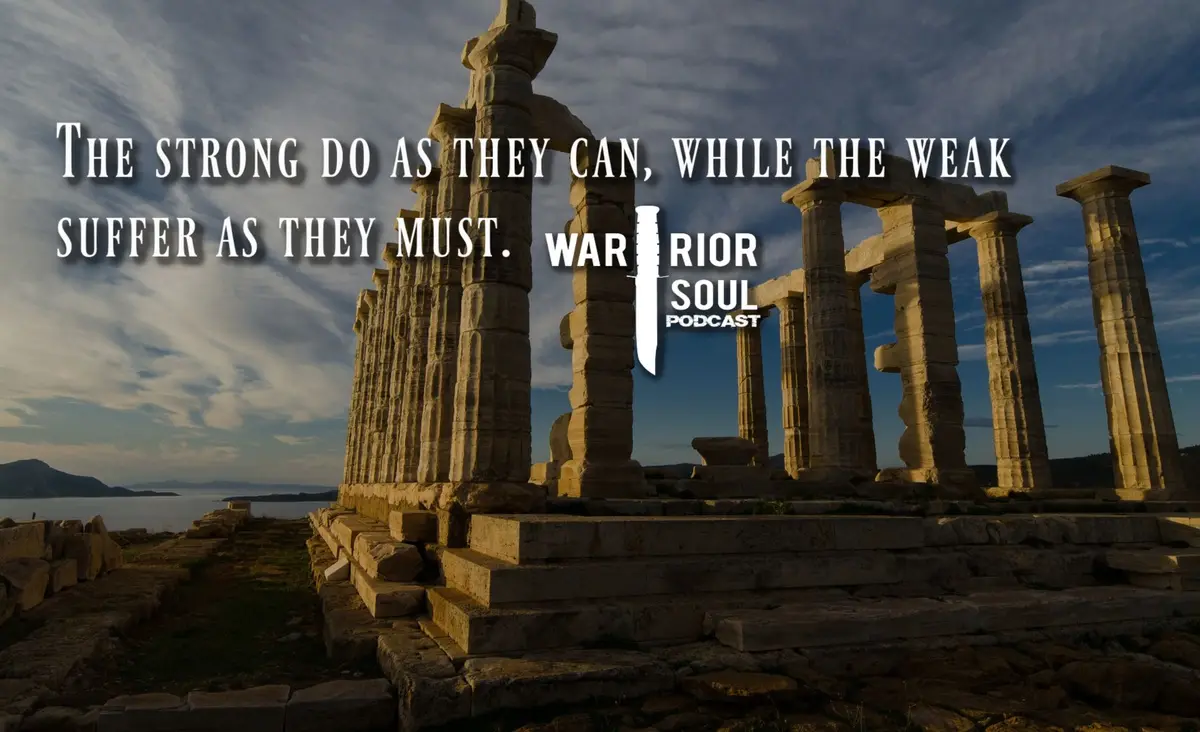
They enslaved the women and the children, and they installed an Athenian colony on the island. And there's a really famous line from the negotiation, the dialogue between the Athenians and the Melians. And the Athenian general basically says to the Melians, you know as well as I do that the strong do as they can, while the weak suffer as they must. Think about that for a second. What does that mean?
It means that if you're strong, you can do whatever you want. You can be however you want. But if you're weak, you are doomed to suffer at the hands of others. You're doomed to have others will imposed upon you. And there's a lot of eerie truth to that.
Right? And the whole thing that Thucydides is trying to get across there is that, you know, in this time period, the Melians, they were relying on a false sense of security. They were relying on an alliance with another power for their security. And in doing so, they didn't see to their own security. They didn't build up their own army.
They allowed themselves to become weak. And because they allowed themselves to become weak, they also allowed themselves to become annihilated. And when you look at it from this point of view, strength is a moral imperative. It's a moral imperative to protect that what you believe in. It's a moral imperative to keep yourself out of danger and to keep those who you identify with, those you love, those whom you want to protect out of danger, and to not rely on anybody else for your own security.
Now, there's a lot of debate about whether that is true or not. The if you look at international relations theory, which is what I worked on my PhD in, there's a lot of people who question the the veracity of this. There's the neoliberal line of thinking, which which shouldn't be confused with, what we consider a liberal in the, political realm, in The US political realm. It's it's an academic line of thinking that talks about institutions. And so the neoliberal argument is that if we develop international institutions, and these institutions are made up of norms and and, rules that states follow, that these norms and rules can become legitimized, and then it can in turn become impossible for a nation state to invade another nation state and and do something like the Athenians did to the Melians.
And if you look at history, you know, we have things like the UN. And and during the Korean War, the UN had had stopped the invasion of South Korea by North Korea. Right? It was a UN effort. But then, you know, you would have the realists and the neorealists would argue back and say that, well, the UN relied upon The United States and a few other powers in order to put its army together.
The UN doesn't have a real army. And so what you really had was a very powerful nation state acting in its own interests under the rule of anarchy in the international system. The realists, they believe that anarchy is the rule of the international realm and that that's that's why strength matters. Because under anarchy, there is no other language except for strength. And I don't wanna delve too far into international political theory.
I think that I would put a lot of you to sleep. But it's worth mentioning here that there is another line of thinking that has become more and more popular over the past few years. And the reason why I'm mentioning it mentioning it is because this is how we're gonna translate this down to the individual level and what is going on in society today. And that is the postmodern line of thinking. And I'm sure a lot of you are well aware of professor Jordan Peterson and his critiques of the postmodern movement in today's society and how he believes it's a malevolent force that's infecting our college campuses.
But what I wanna do here is I wanna give you a little bit of a comparison between the realist, the neoliberal, and the postmodern line of thinking when it comes to our conversation about strength and our conversation about Thucydides and and the Peloponnesian War. So while the realist would come in and they'd look at the the facts relating to the Athenians and the Melians, and they'd look at the mistakes the Melians made, and they would use that as a prescriptive element to give advice to nation states for their survival under anarchy, and the prescription would probably be something like, you know, build up your strength to survive in anarchy. That'd be a basic summary, a very simple summary. The neoliberal would say, okay, so we had this situation here. Now what institutions do we have in place that could prevent something like this from happening?
Right? So both the the realist and the neoliberal view would would be very prescriptive. They they would try to garner some advice for, you know, a nation state or in our case, eventually, this will get down to the individual level, I promise. The the postmodern would take a very different approach to this. What they would do and what they have done, if you want to check this out online, you could check out a 1988 article called the dialectical logic of Thucydides' Melian Dialogue.
And what you'll find is that the postmodernists, what they're gonna do is they're gonna go in and they're going to actually analyze the language that Thucydides used. They'll analyze the language in terms of the relationship between the Athenians and the Melians. And they'll look at how Thucydides legitimized the Athenian practices through his own language. Right? So basically, what Thucydides is doing is by speaking and using certain words, he's legitimizing the use of power to oppress or destroy the Melians.
And this happens over and over again through postmodern thought. So it's a line of thinking. Right? There's always an oppressor and the oppressed. And what they focus on is really trying to highlight how the oppressor is legitimizing his oppression of the oppressed.
So now that I've summarized those three views, what I want to do is I want to take this back to the individual level. And I want to talk about what these mean for us, these lines of thinking mean for us, as far as the pursuit of strength, the value of the pursuit of strength. And what should we do if we want to pursue strength? Now, if you think about the postmodern line of thinking, right, that idea of oppressed versus oppressor, that everything in history and everything going all the way from the individual level all the way up to the state level and the international level involves oppressed versus oppressor. According to the postmodern line of thought, you don't want to be the oppressor.
Right? That's that's everything that that they're against. And so what that leads to is a line of thought that that the pursuit of strength itself, right, just trying to become strong, just trying to live up to certain ideals, just trying to live up and uphold certain truths, that that in and of itself is an evil of a sort. Right? They they would say that me talking to veterans, talking to them about living their best lives, that I'm conducting a form of oppression right now.
Because I'm encouraging a group of people to live up to a certain standard, and that I'm imposing their truth on others when there is the the actual truth of the oppressed, right? And we should all be focusing on, you know, kind of shedding our identity to to, enlighten others on on the oppression going on in the world. And that's a, you know, there's a lot of young people who are really attracted to this line of thinking. And that's because it's kind of intoxicating. You know, if you're a young person who's not done much in your life, and you are on a university campus, it it really feels good to categorize yourself as someone who's oppressed, because then you can be the victim and then you can have the light shown on you.
And that's why I think that we're seeing more and more of this, right? We're seeing more and more of people who rather than choosing to to improve themselves, to become stronger versions of themselves to deal with the environment out there. What they want to do is they they want to tear the whole environment down. They want to tear the whole thing down and throw it out. And through that effort, something new with new identities, new reasoning, and they want to live in a world where, you know, things are turned upside down.
Right? For example, strength becomes a form of weakness or strength as we know it, as we would categorize strength, that becomes a form of weakness. And and that's really what they're trying to do here. But the reality here is this, regardless of what label you try to put on things, regardless of what types of language you choose to use, Regardless of, you know, your attempt to try to turn the world upside upside down, the world is the world. Right?
This environment that we live in has been testing human things or living things since the dawn of time. Right? Bacteria came onto this earth and they started invading each other, and then microscopic organisms started trying to kill each other. And then some of those organisms they developed into multicellular organisms in an effort to get away from the single cell organisms that were trying to kill them and then, you know, those organisms existed in the ocean and things adapted and evolved to find new ways of destroying others and to survive in that environment. And and eventually, some living things in order to get away from that terror, they moved out of the ocean and onto the land.
And then once they got on the land, the the whole cycle continued and they continued to adapt and evolve in an effort to kill each other to survive. And so, you know, we in our modern society, where we do have things so easy, where we can walk down to the corner store if we're hungry and get some food, or we could walk to our refrigerator and and get some perfectly preserved meat or eggs and and cook them up right here. You know, we who no longer have to hunt, who no longer have to kill for food, who who no longer have to search, who no longer have to move long distances in order to survive. It's easy for us to forget that we still live in that same environment. The same one that has been testing living things since the dawn of time.
It's easy for us to forget that overcoming challenges and problems was the thing that made human beings the top of the food chain here on earth. And it's easy for us to forget the value of being strong. You know, I think that if you are someone who is not facing a challenge, if you're not continually trying to pursue betterment in some way, you know, trying to make yourself better throughout your life, then we lose something as a society and we lose something as individuals. We lose that aspect of our personality that's attractive to others. We lose that aspect of our personality that seeks cooperation with others.
Right? That and and that is something we're seeing more and more now than we ever did. People are losing their sense of cooperation rather than seeking to help each other out and to better each other. A lot of us are just lobbing shit at each other over the Internet. So for me, that postmodern line of thought, that idea that we need to sit here and and and question reality and question our language at every turn and to highlight that continually highlight it that relationship between oppressed and oppressor.
For me, that line of thinking is empty. And it leads to the idea that we really shouldn't be believing in anything, and we should just be seeking out all the problems in the world so we can highlight those. You know, and that's been one of the themes of of this podcast because even in the veteran community, I was noticing this line of thought starting. I was seeing more and more people talking about veterans as an oppressed class. People who were oppressed by the system, oppressed by the government, oppressed by everyone around them.
And I was seeing them as as turning themselves into victims. Alright. As I said before, you know, being the victim is a very attractive thing. It's very attractive thing to see yourself that way because what happens is you develop a sense of other. And then the only way that that we are cooperating these days, and I'm talking about society in general, is is when we see another and when we see oppression.
Right? That's that's really the only way we start to cooperate. And so a lot of us, we thrive in victimhood because it brings us just a little bit back to to what it's like to be a human. But it's not a productive way of going about things. And those of us who try to go down that path of of becoming victims, well, what you're not doing during that time is is you're not actively finding solutions to anything.
You're not trying to make yourself better. You're just trying to highlight the unfairness of the situation. So I always try to talk about these things, and I try to highlight the problem, but I also try to deliver some solutions. And, you know, this is not something that's that's easy to talk about solution wise. And I am not so cocky to think that I have the ability to fix all the problems here on this earth or with today's society.
But I think that these are things that we can do as individuals to try to keep up our own pursuit of strength and our own pursuit of living our best lives in a society that's continually trying to make us weak, and in a place and time where weakness is becoming more and more attractive to people. These are things we can do to make ourselves stronger both physically and mentally. The first one is this, expose your weaknesses in a controlled environment as often as you can. What am I talking about there? I'm talking about training, real training.
And I say real training because, you know, I'm an avid gym goer. Right? I've been a power lifter for for a long time, like I said at the beginning of the show. And every day I walk into the gym, and I see guys who who are muscular, they're strong in a sense, and they're performing the same exercises over and over again, right? So I'll I'll see guys going in and they'll they'll do the same squat every week, or they'll do the same bench press, and they'll load the bar up with as much weight as they can can try to load it up with, and and they'll try to test themselves.
Right? And that's awesome. I'm glad more people are training, and and and pursuing physical strength. But here's the thing, and I know this because I fell into the same trap. If you're continually only doing those exercises that you're strong at, you're not exposing those holes in your strength that need to be filled.
Right? So rather than doing a squat, why don't you try doing an overhead squat or front squat? Rather than doing a bench press, why don't you try doing a ring dip? Hell, rather than just lifting weights, why don't you try to go and expose yourself to jiu-jitsu? Right?
And there's a lot of guys I see who carry this macho, you know, male aura about them, you know, who who try to pose themselves as the alpha male because they lift weights, but they get their teeth their their face wept into the mat if they rolled in jiu-jitsu. And I was one of those guys too. I mean, I walked into a jiu-jitsu gym the first time, you know, a couple of years ago I was able to deadlift 600 pounds, and I got broken in half by a guy who was a hundred and thirty pounds, like literally destroyed me. Right? But I'm not just talking about physically here.
Right? You need to expose yourself to knowledge that you're not comfortable with either. Right? You need to try to new learn new things. You need to try to if you're if you're weak in business, or you're weak in a certain area of business, maybe your leadership skills are weak.
You got to try to train to become a better leader and you you do that through learning. And it's easier now than it ever has been on earth. Right? Just like we can walk up and go to the refrigerator right now to grab a snack if or hungry instead of going out and hunting, you can just pull out your phone, and you can start reading, you could start listening to podcasts, you could start, you know, exposing yourself to knowledge that that you haven't been exposed to before. Right?
So expose your weaknesses at every turn. Right? The number two thing is this, and this relates to exposing your weaknesses, but do things that scare you. Right? Do things that scare you.
This is where you put number one in the practice. Actually, go out there and do something that you are uncomfortable with. Right? Now, I'm not just talking about again, I'm not talking about going up and fighting somebody, or hitting somebody in the face, or trying to get into a barber and brawl, or anything like that. I'm also not talking about, you know, doing things like cliff diving or anything like that, though that might be something that you might want to try.
But if you're lacking self confidence and you're scared of public speaking, then go and try to find a way to do some public speaking. Right? If you're afraid of talking to females, right? And I know there's a lot of younger guys who listen to this podcast, commit yourself to having a full conversation with some girls. Right?
Just a conversation. No, you know, not trying to hit on them or anything like that. Just just expose yourself to them. Right? And I get this from when we had Kevin Ashworth here, the expert on anxiety.
And he said that one of the biggest problems with people with anxiety is they try to avoid the thing that's trying to make them anxious. Right? And he said the best way of overcoming that is by exposing yourself to it. I had somebody, I was talking to on Facebook the other day, and he said he's afraid of going to the gym because he lacks self confidence. And I was thinking about he's like, how can I raise my self confidence so I can go to the gym more often and work on my fitness?
And, you know, what I said to him was the only way of raising your self confidence in that situation is by going to the gym and training. Right? Exposing yourself to that fear. The more you do it, the more you'll be more comfortable with it. Right?
And and if you lack self confidence, the only way to solve an issue with self confidence is to do the thing you're not confident in. Right? I wasn't confident in jiu-jitsu the first day I walked in. I got my face rubbed into the mat, but I kept going. And I still get tapped out a lot, but I'm able to hold my own and it's not such a big deal to go anymore.
Right? When I was a kid and my mom brought me to the gym the first time, because I was a weak little kid, she's she handed me a $20 bill, she told me to go get a gym membership, She dropped me off, and, I walked in there and there were monsters in there. And, you know, I was uncomfortable, but I started lifting weights and some of those guys came over and showed me what was right. And pretty soon I raised my self confidence and, you know, twenty five years later, I've made a career out of being a strength coach. That's basically how it works.
If you're not confident in something, you gotta expose yourself to it. Number three, don't just expose yourself to uncomfortable situations. Expose yourself to views that you don't agree with. Alright? And and this is really important.
And the reason why it's important is because in today's world of social media, everybody hangs out and clicks online. And you notice this if you go through Twitter, All the liberals, they talk to each other, and they agree with each other stuff. All the conservatives, they talk to each other, and they agree with each other stuff. And what you have is this massive echo chamber, where you're constantly just having your views reaffirmed by people who you agree with. But you're not strengthening yourself that way.
The only way to really be able to strengthen your views and to really be able to strengthen your logic is to find out what the other side thinks. And find out why they think it. That's more important than finding out what they think. Find out why they think that way. And then go over that calculus in your mind.
And sometimes your views will change, many times they won't. Maybe you'll many many times you'll find the fault in their view. But I don't think that we are strengthening our democracy, our country, we're not strengthening ourselves, if we're not finding or or or exposing ourselves to views that we don't agree with. And that goes back to something that a lot of people don't want to do to in today's day and age, and that's cooperate. In order to cooperate as a society, and I think it's necessary for any society to survive that that we cooperate with each other.
In order to cooperate, you've got to be able to work with people who you do not like, and who you don't agree with. Now, why is that important? Well, it's important because if you're not able to work with people who you don't agree with, you're never gonna be able to become a leader. Right? When you're you're leading people, you're not just leading a bunch of people who are just automatically going to agree with you.
You've got to lead people who are gonna disagree with you from time from time to time. You got to be able to lead people who might not even like you on upon first impression. And if you can't do that, then anything you do on this planet, in this life, you're gonna fail at. Because if you're gonna build something, if you're gonna be a part of a team, if you are going to to create things here on this planet, you're gonna need other people. And everything that I've described here revolves around one single theme.
And I don't know if any of you picked it up picked up on it or not, but the only way to be strong in an environment that is constructed to test you. Right? Because we all think that our current environment, and as I said, current environment is probably easier than it's ever been, but the overall environment here on this earth was always constructed to test you as a living thing. To to see your ability to survive despite what gets thrown at you. In order to be a strong person, you need to be able to expose yourself to all those things that make you uncomfortable.
Right? I said expose yourself, expose your weaknesses whenever you can get a chance. Right? That that that's uncomfortable. Do things that scare you.
That's uncomfortable. Expose yourself to views that you don't agree with. That's uncomfortable. Right? But through that discomfort, that's how you become strong.
And I wanna wrap this up by going back to what Thucydides said, or what he wrote, that famous line, strong do as they will, while the weak suffer as they must. I think we can say that anybody who describes that line as legitimizing oppression, I think we could say that they're wrong. That's not an oppressive line. That's a line that talks about liberation. You know that the world is a certain way.
You know that this world was constructed to test you. And so if you wanna be free, free to make your own decisions, free to be the person you want to be, regardless of of who you are, whether you're a veteran, whether you're a teacher, whether you're a transgendered person, right? I'll say that because those are those are that's a group of people who some would say that I'm I'm legitimizing oppression of. But regardless of who you are, that pursuit of strength, that can give you the freedom to be who you want to be, to be the person you want to be, To accomplish what you want to accomplish here on this earth. And if you're neglecting that, you're selling yourself short.
I wanna thank you guys for listening to this episode. And if you got helped by it, if you found value in what you're listening to today, then please share this episode out. And in addition to that, you know, what really really helps us is when people do written reviews for us up on iTunes. When people actually go and they put their thoughts down about what they got from the podcast, up on an iTunes review. That lets us know we're on the right track, but it also lets other people know because the more reviews we get, the more iTunes promotes the show.
So again, I want to thank you all for listening, and I will be back at you next week with another awesome interview.
Host of the Warrior Soul Podcast and founder of Warrior Soul. Worldwide trainer and nutrition coach, contributing author at Testosterone Nation and Muscle and Strength.