Podcast episode
Rob Jones: A Life of Service and Sacrifice
Hosted by Chris Albert
The Warrior Soul Podcast
Rob Jones is a US Marine Corps Veteran. He’s ridden across country in the dead of winter on a bicycle. He’s also run 31 marathons in 31 days.
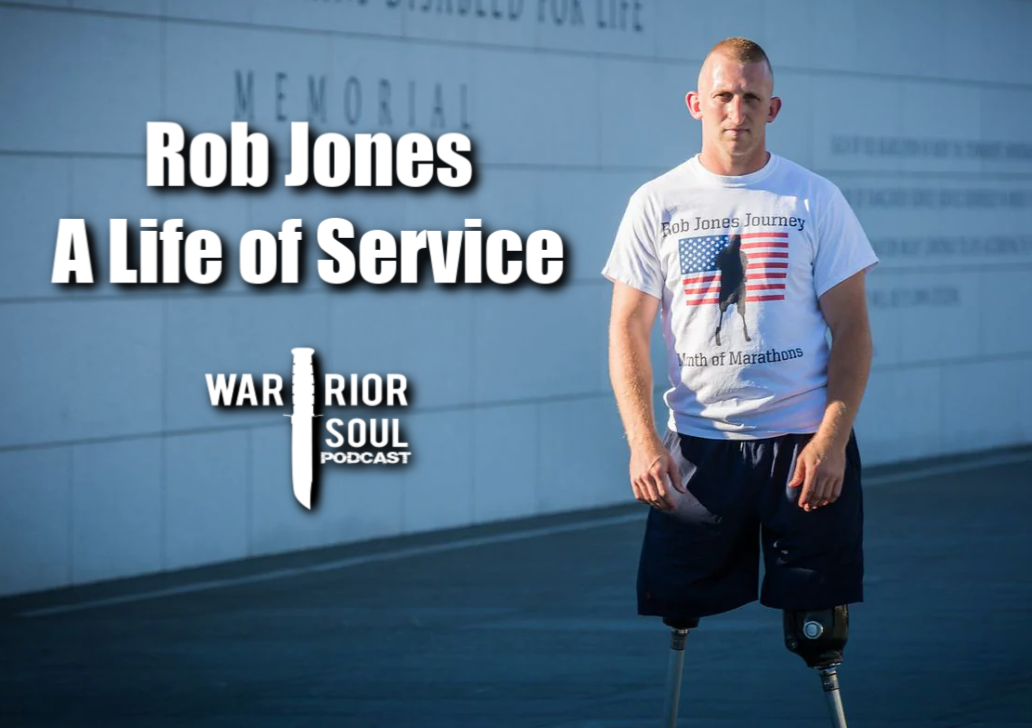
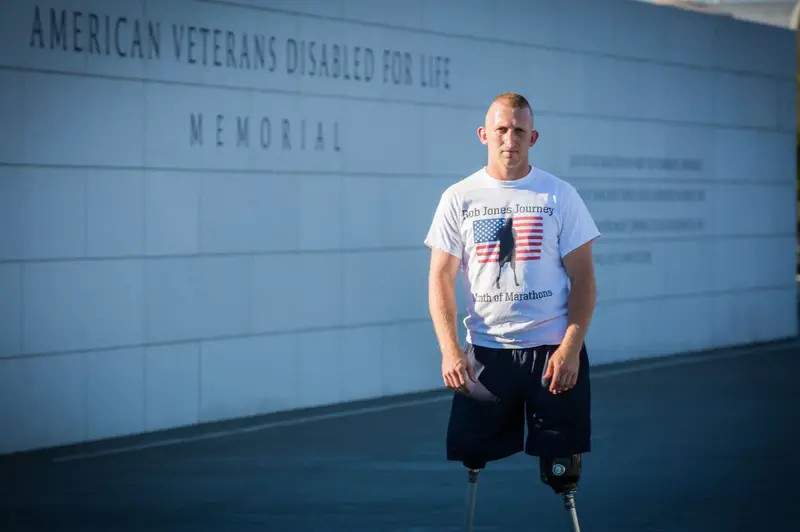
Rob is a double above the knee amputee who lost both of his legs while serving in Afghanistan. In addition to the accomplishments listed above, Rob also earned the bronze medal in rowing for the US Paralympic Team.
Now Rob is running for a congressional seat to represent Virginia’s 10th district in the US House of Representatives. We brought Rob on for the second time to speak about his life, his campaign, and where he sees this country going.

You can learn more about Rob Jones and his journey at www.robjonesjourney.com
Donate to Rob Jones Campaign at https://robjonesforcongress.com/
Transcript
Machine-generated from the episode audio and lightly edited — may contain errors.
Chris Albert (link to this point)
The Warrior Soul podcast is written, produced, and edited by me, Albert. Our mission is to provide tools, tactics, strategies, and ideas to US military veterans and anybody else willing to listen to help them to navigate toward living their absolute best lives. If you find these episodes helpful, please share them out with somebody that you know of that can use them. And if you really like the podcast, please also head over to iTunes and write us a written rating and a review. It really helps us to spread word about the show, and it really helps to get these tools in the hands of others who really need them.
This podcast is sponsored by f bomb nutrition. They make awesome delicious packets of macadamia nut butters. They mix them up with chocolate, with sea salt, with pecan butter. They're absolutely delicious, and they also have a number of other fat fueled snacks, like their meat sticks and their cheese crisps. They're amazing people who are sending boxes of this stuff out to the troops on the front lines, and they're offering 20% off to our listeners on their first orders.
If you head over to www.dropanfbomb.com and use the code Warrior Soul at checkout, you'll get 20% off of that first order. And I'm gonna keep the announcements short and sweet today. You can stick around to the end. I got a really special announcement about a brotherhood that we're creating here at Warrior Soul. So hope you enjoy this episode.
I hope you get a lot out of it. And without delay, let's get into it.
Chris Albert (link to this point)
This is Chris Albert, and I'm here to remind you of one thing. Someday, you're going to die. That's not some morbid statement or scary idea. It's solid fact. Your time here on this earth is limited.
We need to be reminded of this as much as possible for one simple reason, to live your best life while you can. This is the Warrior Soul podcast.
Chris Albert (link to this point)
Alright, ladies and gents. I've got an outstanding guest for you today. We have mister Rob Jones on the Warrior Soul podcast. Rob is a United States Marine Corps veteran. He is also an ultra endurance athlete.
He has ridden a bike from Maine to California in the dead of winter across country. He's also completed 31 marathons in thirty one days. And at this point, I should all also mention that he is actually a double above the knee amputee. He lost both of his legs while serving in Afghanistan as the United States Marine. In addition to that, Rob is a bronze medalist for the United States Paralympic team.
And now Rob is looking to continue his service to this country by pursuing a congressional seat. He is running for Virginia's tenth congressional seat, and currently, he's campaigning for the primary. So I wanted to give Rob a chance to come on, speak to all of you, speak about why he's running, and what he sees as what he wants to fix in this country. And we had a great conversation. You guys are gonna get a lot out of this because it's not just about his campaign.
It's about him as a person. How he survived all the obstacles that have been put in front of him, and not just survived, but but really thrived. This guy's done some amazing stuff, and it looks like he's gonna continue to do some amazing things. So huge inspiration for all of us. Let's get into this conversation now.
Rob Jones, welcome to the show, man.
Rob Jones (link to this point)
Hey. Thanks for inviting me back. It's an honor to be a two time guest on the podcast.
Chris Albert (link to this point)
Dude, it's it's great having you, man. I was saying, number one, I know that anybody who listens to my show probably already knows who you are. But can we get the quick synopsis of your epic life? Because you've done a lot of stuff, man.
Rob Jones (link to this point)
It's kind of difficult to make it too quick. Yeah. I'll see what I can do. Joined the Marine Corps in 2006 during my junior year of Virginia Tech, combat engineer. My job was IED detection using a metal detector and route clearance, so just finding safe routes through areas that we thought would have a high likelihood of containing IEDs.
So if you imagine, going across a bridge, there's only one way that you can go across a river. So the Taliban likes to put, you know, IEDs on either side of the bridge. So we would kind of predict that they're gonna put them there. So I would go out in front of everybody else, and make sure that route was clear. I did two deployments, one to Iraq in 2008 and one to Afghanistan 2010.
I was in Afghanistan that I was wounded while doing my route clearance mission. I became a double above knee amputee. I spent a year and a half at Walter Reed and relearning how to walk and do all the stuff that I wanted to be able to do. Retired from the Marine Corps in December 2011. Took up sports.
And my first sporting endeavor was going to the Paralympics twenty twelve for rowing. I won a bronze medal there. And from there, I kind of turned my sights on continuing to serve my country and my fellow veterans. And what I did was establish Rob Jones Journey. And it was a fundraising endeavor, fundraising and awareness raising.
Funds went to wounded veteran charities that I had had interaction with over the course of my recovery and since then. And the awareness raising was about it was just to create a story about a veteran that was wounded, experienced trauma at war, and came back home and thrived from that trauma, thrived from his injury instead of being destroyed by it. Because we didn't really see a whole lot of that. We still don't see a whole lot of that in the media. And I want to just make sure that people have both sides of that story, of the story of trauma at war.
The story where people come back and they do struggle because it's a true story. But also the one where people come back and they're fine Because that one doesn't get heard enough, and it's actually a lot more common than the other story. So I followed that bike ride up. Oh, I didn't even say it. The bike ride was my first mission on Rob Jones Journey, and that was I rode my bicycle from Maine to Camp Pendleton in the winter of twenty thirteen to 2014.
That took one hundred and eighty one days, and it was 5,181 miles. And we raised $125,000 for charities on that ride. And then I followed that up in 2017 with the month of marathons, which was I ran a marathon every single day for thirty one days straight, starting in London on 10/12/2017, and kind of doing a tour around The United States in 31 different cities and finishing 11/11/2017 in Washington DC on the National Mall. And with that, we raised 225,000.
Chris Albert (link to this point)
That's absolutely amazing. I mean, you've done you've done more than most people do with all their appendages and everything and it's a testament to you. But you know, one of the things I'm always talking about on here is that you know, we're in this time and place where people seem to be really angry, really mad, really divisive all the time. And one of the things I'm telling this community constantly is if you are mad about something, if you want to change something, then you've got to put yourself into position to do that. And what you've done is you've taken what you have, and you've really created something extraordinary. And that's amazing. That's a path that I think every one of us needs to try to follow.
Rob Jones (link to this point)
Thank you. Yeah, I would say the same exact thing. You want to make a difference in the world towards something that if you want something to be different in the world, then you have to be the one to take the responsibility and step forward and do it. I thought that the concept that I've created from my life is what I call proof the lane. And that is, when I was in Afghanistan, when I was doing IED detection, every time I took a step further into a minefield, I was doing what's called proofing the lane.
I was stepping on a piece of ground and proving whether or not there was an IED there by seeing if it exploded. And so you kind of take that and apply it to life. There's plenty of opportunities every single day in Afghanistan where somebody has to be the one to step forward and do the dangerous thing or the difficult thing on behalf of everybody. Life is no different. Everybody has people in their lives that they care about, places in their lives that they care about.
And somebody has to be the one to step forward and do the right thing on behalf of those groups or those places. So I think everybody should take that responsibility.
Chris Albert (link to this point)
Now you're taking that responsibility a step further now, and you are currently running for Congress. Right?
Rob Jones (link to this point)
Correct. I'm running for the House of Representatives, US Congress in the state of Virginia, where I grew up in Virginia's 10th District, is kind of most of Northern Virginia.
Chris Albert (link to this point)
Right. That's right outside of Washington DC for those who've never been in the geographic area. DC is kind of weird because you're literally in Maryland, then you're in DC, and then all a sudden you're in Virginia, right?
Rob Jones (link to this point)
Yeah. I mean, yeah. Washington, DC was created by you know, Maryland and Virginia both giving up a little bit of land Mhmm. In between each other. And so you can go between each, you know, pretty quickly.
Oh, if there's no traffic, of course. There's a ton of traffic.
Chris Albert (link to this point)
So Ton of traffic, ton of heat. You can't do much about the heat, but we'll talk about the traffic a little bit later. When so what made you decide to do this? Because I've I've I've worked for congressional representatives before. I know that it's a process, man.
I know that it's not easy. It's not as simple as saying, hey, I'm gonna go run for congress and everything's gonna be all right. What made you make this decision?
Rob Jones (link to this point)
Yeah. You know, I started thinking about it in after the twenty sixteen election. And there were a lot of people that were saying, you know, about the election. You know, is this the best people that we have to represent us? And it kind of reminded me of that proof of lane concept where if we wanted, you know, I just felt like I had a responsibility to step, you know, put my put myself out there and offer myself up as a representative.
And it's really just about restoring optimism to the area, to America, to the people here. I grew up here since I was one year old. And I kind of went away and did the Marine Corps stuff and did all these things. And now I've returned home. And I built the house in Middleburg, Virginia.
And I just noticed that there's not that feeling of optimism that we had when I was a kid. I don't get that same feeling in this area anymore, and really just over throughout the country. And so what I want to do is help to restore that optimism to the area. Like I have, I'm kind of lucky. I have natural optimism.
I think I was born with it. And then by being in the Marine Corps, I've just become more and more optimistic about things. And I can kind of see where a situation can possibly play to my advantage or I can find the good in a situation. And so all these issues that we keep hearing about, I think, are just really beating people down, and they're not feeling particularly great about their lives. And if you don't feel like you can have a good life, then there's really no reason to strive towards anything.
And so I want to help restore that optimism to the area, so that people can really start to believe in a bright future again, and they'll start to push themselves.
Chris Albert (link to this point)
Alright. So like optimism and as as in a belief in America. A belief that that this is a land of opportunity. And if you apply yourself, you can can really make anything out of yourself if you want to. If you work hard enough, if you if you're dedicated enough, if you are are somebody who who wants to do something, you can do it.
And I had Nick Koumalatsos on last week, and we were talking about his Greek heritage and and how his family had come here from Greece and how the Greek community in general. I mean, you see these guys, they came. They they would live in houses together. They create restaurants. They work dishwashing, everything like that.
And and, you know, twenty, thirty years later, they're they're they're citizens. They they've built amazing businesses and things like that. And these are opportunities that are available to all of us. And and I think you're right. We're seeing less and less of that of that, you know, mentality where you can make a dream happen.
Rob Jones (link to this point)
Yeah. I mean, belief in America and and the possibilities that we have here. But, yeah, belief in yourself that if you if you apply the work and that it's going to be possible for you to reach your goals. And then also just, you know, relieving yourself from, things that you think are going to be set up. I mean, we can so in in terms of specific issues.
So I I would like the the daily life of a person to be you know, they wake up in the morning, and they feel like they're gonna go to work, and they're gonna put in a great day of work. They're going to do their best, and they're going to see positive results from that. And they're going to get to work in a short amount of time, because there's not going to be a lot of traffic. They're just going to get in their car, they're to go to work. They can spend time in the morning with their kids because they don't have to spend ninety minutes in the car.
They can see their kids off of school and go to work. And then they're to put in that hard day's work. They're going to come home feeling good about themselves. And then they're going to come home, and they're going to see their kids or see their wife or husband or whatever. And if they have kids, they're going to feel positive that their kids got a great education that day, and their kids are going to have a great future because they're getting such a great education, and all these possibilities are open and available to them.
And they're not going to worry too much about whether or not they're going to be able to afford their health care, because health care in America is inexpensive, and it's high quality, and it's accessible. So they're not going to worry, but that's not going to be a burden on their mind. And then they're they're not going to be worried about a variety of things. They're going to be just be positive. They're not going be worried that when they drop their kid off at school, that they're in danger at school.
And then you can just kind of tie that back into a lot of these different you know, take the opioid epidemic, for example. You know, what makes people, you know, feel like they need to take something in order to escape from their life is because they don't really feel optimism for their future. And so that's what that's what I want. I want people to feel that that hope or that optimistic feeling for the future, in their lives, in their kids' lives, in general.
Chris Albert (link to this point)
Tell me about the field you're jumping into. So right now, you're in the midst of of trying to campaign for the primary, right?
Rob Jones (link to this point)
Yeah. Correct. So in Northern Virginia Virginia's 10th District, they've decided that they're going to do what's called a convention in order to determine who the I'm I'm running as a republican. So in order to determine who the Republican nominee is going to be. And so there's I think there's four people, including myself, that have all put their hat into the ring.
And I haven't met all of them, but the ones I've met, they seem like good people. And I'm happy to have as many people as possible or as want to be in the race there, because I think the more choice the voters have in this area, the more likely it is they're going to find somebody that perfectly fits their viewpoints, and they feel like it will represent them well. So the more people, the better for the voters. And at the same time, the more people that are in this race, the harder it's going to be for me. And the harder it is for me, the more I'm going to have to push myself, and the better that I'll be.
So the more people, the merrier, far as I'm concerned.
Chris Albert (link to this point)
Right. And tell me about the district. How how long has the district been controlled by the opposite party? Because you're gonna be running against an incumbent after the primary, right?
Rob Jones (link to this point)
Yes. Exactly. So the district here, you know, it's it's a it's a what we call a purple district. It's pretty central in terms of the way people vote. They vote both Democrat and Republican.
And it was actually, you know, in in this seat, it had been held by Republicans for a very long time, thirty some years. So and then it was just this past election in 2018, where a Democrat won. And so, yeah, it's only been in, you know, kind of a Democrat representative just since this last election.
Chris Albert (link to this point)
I've heard that running for Congress is kind of like going for a PhD in multiple different disciplines at the same time. I'm sure there's a lot of learning you've got to do. Gotta learn learn not just about you know the district itself but but also foreign policy, also Congress's role as far as being in the rest of the government. Things like constituent services, I mean understanding what issues the constituents face and things like that. How are you handling that on a daily basis?
Rob Jones (link to this point)
Yeah, it's a PhD in a lot of things, especially relationship building and communications. So it is it's it's a challenge to figure out how to communicate. Well, there's 800,000 people in this district. It's a challenge to figure out how to communicate with that many people. And so what we do is right now, I'm just going to events.
All the events I can manage to get to, I go to them, and I just talk to people. And I'm calling people, and we, you know, there's an election, a local election here in November fifth of this year. And I've been going out and knocking on doors with some of the local candidates. So, and just listening to them. But so, I think General Mattis in his book, he has a quote from George Washington in it.
And in the the quote is, first you listen, then you help. Mhmm. Then you oh, shoot. What was it? First you listen, then you help.
Then you do something else, then you lead, I think. But I'm at the listening stage right now. Then I was hoping to figure out how I can help, and then we'll go from there.
Chris Albert (link to this point)
That's awesome. And and so there's this other aspect. I mean, you're obviously quite familiar with social media. Rob Jones Journey has has garnered a huge following, that's probably helped quite a bit. But now you're also in the stage where you've got to get on with the traditional media.
And unlike podcasts like this where we get to talk, we get to have a conversation, a lot of times it's like get your points out in fifteen seconds before the commercial break. Have you a lot of training as far as that goes?
Rob Jones (link to this point)
I've done some training. Yeah. So I have a lot of experience on all forms of media. But, yeah, so one thing that scares me right now is that I'm in historic and historically, I've been the guy that everybody's rooting for.
So no matter what station I went on or what reporter I talked to, they're rooting for me because I'm fighting against the odds and I'm doing this for veterans who everybody loves. And now I'm kind of, you know, I'm going to be a guy where a lot of people don't want me to be successful. And so they might try and ask me, you know, a gotcha question that'll be hard for me to to answer. And so I'm kind of having to adapt to that. And it's just through experience.
You know, I sit down with my with my campaign advisers, and they ask me these tough questions that you, you know, that they expect I might hear. And let's just get repetitions in. And so far, all the media that I've done has been it's mostly been biographical, and they just want to kind of get to know who I am so the voters can kind of find out a little bit about me. But yeah, it's just practice, practice, practice.
Chris Albert (link to this point)
Yeah, and you know, think just like anything in life, I mean, there's gonna be times when maybe you don't perform at your best, you use it as a learning experience, you just get right back up and get after it again, right?
Rob Jones (link to this point)
Exactly right. I mean, you learn every time you do anything, if you pay attention closely enough. The sad thing is, in this particular sphere, if you do mess up, then people won't let you forget it. So you have to be very careful. It's difficult to be perfect all the time.
And so that's why nobody's perfect. And so it's one of those things that it's nerve wracking.
Chris Albert (link to this point)
Have you reached out to any other active members of Congress who might have had pieces of advice for you, who might have given you a little bit of knowledge as far as the route you're taking?
Rob Jones (link to this point)
Yeah, so part of the reason that I thought that I might be able to run for Congress and win is because my buddy Brian Mast from Florida, after he won his 2018 reelection, We had met in 2011 when we were at the hospital together. He's a double above knee amputee as well. And he brought me into his office. Or I sent him a text, I said, congratulations. And he sent me a text saying, We'd love to have you in Washington.
And I said, You know what? I've been thinking about that. I've been pondering whether or not I should do try and do that. And he brought me in to his office, and he kind of gave me a rundown of how he got there and kind of what his daily life is like, and what he did to get elected and that kind of thing, and kind of made it clear that it might be possible for me to do a similar thing and to get elected and represent people here. And so that's kind of when I when I decided that I was gonna go for it.
Chris Albert (link to this point)
You a major part of your platform is getting people to work together from from opposite parties. Number one, you know, if you get elected, how are you gonna start reaching out to the other side to to say, hey. Listen, guys. We've we've been battling it out. We've been going going after each other.
Let's start figuring out some compromise here on some of these issues. What's your strategy for that?
Rob Jones (link to this point)
Yeah. So part of my platform is the fact that the I think the idea of a republic is to it's not to have 51% of the people cram down the throats of the 49% of the people, you know, what they want. It's not the majority ruling over the minority. It's finding a solution that the vast, vast majority of people, 75, 80% of people can say, you know, go to bed at night saying, I'm I'm happy with this solution. It may not be I may not have gotten everything that I wanted in a perfect world, but what we have here is something that I can be happy with.
And so part of that and part of being able to help people work together and work with people, is figuring out where you can bond over things. And one of the first one of the big advantages I have is I'm a veteran, and there are a lot of different other veterans in Congress that are on both sides of the aisle. And so when I go to talk to another veteran, we're going to have something that we can bond over that is, you know, that supersedes political party or any particular issue. We're both veterans. And so we can have respect for each other.
We can have that mutual respect, and we can bond over that, and we can have a conversation that way. And then we can kind of go out from there. But even if it's not with another veteran, you know, I can find issues that have an effect on my constituents and then other people's constituents. So we're talking about traffic. So I can go to folks in Maryland and maybe even West Virginia and say, let's work together to figure out this this traffic situation on the Beltway and in all of our states.
And we can work together on that, and then we fill the form of bond over that, and then we can kind of you know, people will see that, and we can just build that relationship, build that mutual respect, and then go from there.
Chris Albert (link to this point)
It's interesting because if you ever read there there was a political scientist, a French political scientist. He was the first one to write about The United States. This is back, I think, in the early nineteenth century. His name was Alexis de Tocqueville. He he he talks about something called the tyranny of the majority, which is exactly what what you're speaking of.
It seems like whenever we have a lot type majority, it's it's literally shoving stuff down the throats to the opposite party. And we see a lot of that going on right now in Congress with the way things are. And I think a lot of people are angry about it.
Rob Jones (link to this point)
Yeah, I mean, we shouldn't have tyranny of any kind. That's the whole purpose of our republic, of this country, is to do away with tyranny. And so, yeah, I think people are getting frustrated that it seems to be near the very small, just the barely majority is trying to rule over the the minority. And, you know, we shouldn't be about that. We should be about finding compromises.
Our country was based on something called the great compromise, and it was something that both sides of the discussion could be happy with. It wasn't what the exact thing that they wanted, but it was something that they said, you know what, this will work for the vast majority of people. And that's what we want to do. We want to improve people's lives, as many people's lives as we can. And that doesn't mean like winning the, you know, the the partisan football game that people want to be in where, you want your team to win to score all the points, and you don't want the other team to score any points.
I mean, that's not that's not what a republic is about.
Chris Albert (link to this point)
Right. Right. Exactly. Now, we've got we've got a lot of wedge issues. And when I say wedge issue, it's it's an issue where both sides are at loggerheads, right?
And and it seems to me, there's been a lot of work over the last few years to to make things that shouldn't be wedge issues into wedge issues. And and one of those is something that you've got personal experience with, and those are school shootings. I know you went to Virginia Tech. You're on campus when the Virginia Tech shooting happened. And the the seems to me like there's very little compromise being made as far as things that can actually protect people.
Alright? It's either we ban all guns or, you know, we we we do something else. Right? And and, obviously, this is a a veteran oriented, a veteran oriented podcast. We're very pro second amendment here.
What's your take on these issues?
Rob Jones (link to this point)
It's tough. I mean, that's why there it's one of the part of the reason why we don't have a lot of movement is the, you know, the partisanship. But the other part of it is that it is a really difficult thing to figure out because we have these kind of two we have kind of opposing forces where we want liberty, but we also want safety.
Chris Albert (link to this point)
Right.
Rob Jones (link to this point)
And so figuring out where that balance is with and, you know, maintaining respect for the constitution and due process, and, you know, all these rights that we have in the constitution, it's not going to be an easy thing to figure out. So we have to figure out how we can not punish law abiding citizens because of the actions of a few people, but also live up to the responsibility of the government to provide for the common defense of its citizens, provide that safety. And, yeah, I mean, it's it's gonna be one of those tough issues where you have to really think about it long and hard, and you have come up with something. But yes, it's really really difficult to figure out.
Chris Albert (link to this point)
You think there's a there's a lot of political grandstanding that's going on going around going on around this issue because, I mean, I look at what's going on out there. You've got certain people, and I'm not gonna I'm not gonna start bashing people or anything like that, but people saying, hell yes, we're going to take your AR 15. Things like that seem like they're made to incite a certain population here in The United States. And, you know, I, it bothers me. It bothers me a lot because not just as a gun owner, but as somebody who who I mean, I come from New England, which is classically a very liberal area.
And unlike a lot of other New Englanders, I've traveled around this country. I've met the the salt to the earth people. I've met the people who who put their kids on the line to serve this country. I met I've met so many different Americans who I think they've been labeled deplorable. They've been labeled all of these these these different things, but they're really what drives this country.
And there's been a concerted effort, I think, to characterize that population in this country as somebody who's intolerant, as somebody who's racist, as somebody who's all these different things. You know, do you think that's going to stop?
Rob Jones (link to this point)
I think what that what you're saying, what it boils down to is returning to civility and returning to a point where we are recognizing each other as human beings, as fellow Americans. And I mean, and that's what it is. So we have to recognize that I might not agree with you, or I might not agree with another person, or that person might not agree with that person on one or two things. But we recognize that they're a human being, and we all kind of want the same thing. We want a great we want an enjoyable life, and we want a life with meaning.
And we want to help people, we want to support our families. And we all have that stuff. We all want those things. And so we have to make sure we're remembering that about other people, even people that we don't know, before we go and attack them and accuse them of atrocious things like being a racist before, you know, before we get to know them. So we we need to fall back on those things that we bond on, that we have, and then, you know, get to know a person before we before we criticize.
Chris Albert (link to this point)
As as you're approaching this, you know, obviously, it's it's a difficult feat. What number one, what's your what's your daily schedule like? Like, how long are you working every day? And I'm sure you're you're working constantly.
Rob Jones (link to this point)
Yeah.
Chris Albert (link to this point)
I know you run a farm, and that's gotta be a lot of work in and of itself as well. It's how are you fitting all this in?
Rob Jones (link to this point)
Well, the farm is mostly my it's my wife's operation. She runs a vegetable operation on our property. We have 13 acres here. And she has chickens. And so but, yeah, the property and the house, it's a lot of maintenance that I you know, I I help her out with big projects for the for the farming operation.
And we have a lot of grass that we need to mow and a lot of firewood we need to chop up, and a lot of maintenance on the house and the grounds that we have to keep up with. Listen to podcasts. Yeah, exactly. So yeah, that's a great time to listen to learn from me about all these issues that you mentioned that I need to know about that are all very complicated. And so usually between seven and nine, I'm either writing or, reading, about these issues that I'm trying to get spun up on.
And sometimes I'm in a meeting, if there's an early meeting. Then usually between nine and eleven, I'm making phone calls, to people, finding out what they what they find to be important to them, what they want me to be focusing on, and then also trying to gain fundraising donations, because that is a big aspect of running a campaign, is getting getting donations and being able to spend money on getting your name out there and helping people to know who you are as a person so they can decide if they want to vote for you. So that's nine to eleven And then eleven I usually take a little break. I do a workout, running, lifting weights, whatever it may be. And then I'll have breakfast at noon.
And then I'll get back to the phones between one and three or one and four doing more fundraising calls, getting to know about the issues that people care about. And then usually after four I will I'll get to the stuff around here, you know, the personal stuff where I'm doing maintenance around the house and and that kind of thing, spending time with my wife. And then throughout the day, you know, throughout the week, I may have meetings or something. So if I have a meeting, I usually, you know, set it up, and I'll just go to that meeting, and that'll just take precedence over whatever I'm doing at that point.
Chris Albert (link to this point)
And you've got a child on the way, right?
Rob Jones (link to this point)
Yeah, we've a baby coming in February. So we're really excited about that. So that's going to take a lot of time to make sure I'm being a responsible father, and finding that that work life balance.
Chris Albert (link to this point)
Most important job in the world right there.
Rob Jones (link to this point)
That's a Yeah, You know, I think about I think about the race, and I think about, you know, if for whatever reason things don't go my way, I'm going to be returning to an awesome life. I have a great wife. I have a great house. I have a great piece of property. I have a son coming.
And so I'm going to be returning to a great life. And so if I don't win for whatever reason, then, you know, I return to this great life and I'm just going to move on with it. And so I kind of I fall back on that when things start to get overwhelming and that kind of thing.
Chris Albert (link to this point)
You've faced an enormous amount of adversity in your life, and you've maintained an extremely positive mindset. And I've I've seen that with a lot of people and and every time I've seen it, there there's something behind them that that's driving that faith. Where where do you get that from? How did you learn that? Is it is is it from religion?
Is it from from just learning, from life experience? Where where does that come from?
Rob Jones (link to this point)
I think life experience for the most part, I think my time in the Marine Corps, taught me all about mission accomplishment being the most important aspect of who you are. And the fact that just because your original plan for your mission doesn't pan out doesn't mean that the mission ends. And so I had to think about what my mission in life was. And I'm not talking about specific, like, go to the Paralympics or do this or that. I'm talking about break it down to its most base level.
What is your mission in life? And it is to live a meaningful life and live an enjoyable life. And so being in the Marine Corps was one my original plan for for doing that. I was gonna deploy, and I was gonna maybe join MARSOC, and that's how I was gonna do it. And then I stepped on an IED, and that that plan was pretty much no longer available to me.
So I had to find a new plan. And it took me a while to figure out what that plan was going to be. I did the Paralympics and the bike ride and the month of marathons. And by the time I finished the month of marathons, I was like, this is the plan. This is the goal.
This is what I need to do in order to get back to that, to get to my mission. Things like the bike ride and the month of marathons and help other people while doing something that's difficult. And so I think that running for Congress is the next logical extension of that where I can help even more people with what I'm doing.
Chris Albert (link to this point)
When it comes to raising money, I'm sure you're on the phone constantly. I'm sure probably traveling to events every single day trying trying to get those donor dollars up. How is that going for you? And, you know, what as far as your strategy goes, is it is it basically just grassroots reaching out to individuals? Are you you reaching out to organizations?
Are you or is it all of every all that encompassed in one?
Rob Jones (link to this point)
Well, yeah. So for the federal election rules, you can't take you can only take individual contributions Okay. Or political action committee contributions. And both of those have limits on them, maximum limits. So I think a political action committee can give you $10,000 and that's it for an election. And the individual one is something like $2,800 per election, but there's two elections per cycle, so $5,600 per person.
And so, yeah, I mean, it's about and we're trying to raise I mean, in this area, last last year, I think each candidate spent something like $5,000,000 on advertising and signs and literature and community outreach and that kind of thing. So you have to get money from a lot of different people. And so that's and I'm kind of the guy that needs to be doing it because I'm the candidate. It's not like I can have somebody else do it for me. So you hire a fundraiser that does this for a living, and they kind of set you up with they get lists for you to people to call.
And you call those people, and you try and build relationships with them. And you get out there, and you meet other people at these events that I'm going to. And you talk to them and you build relationships with them. And eventually, when they get behind you enough and they believe in you, then they'll they'll contribute. And they'll either donate money, or they sign up to be a volunteer, or they sign up to host a meet and greet, or a fundraising event.
And so, and that's the goal. So it's really a PhD in relationship building with as many, and communication with as many people as you can talk to.
Chris Albert (link to this point)
Are there any things that you've learned in that process as far as as, you know, tips that you can give out to the audience as far as relationship building? You know, one of the things I've I've learned from from being a podcast host is that, you know, when I'm reaching out to guests, when I'm trying to bring people on the show, you it can't just be all about you. It's got to be about the other person. What what what types of tips have you learned as far as trying to get people trying to convert people into allies?
Rob Jones (link to this point)
Yeah. I've actually been I've been thinking about this. One of the things that I that I find to be helpful in accomplishing difficult challenges is reaching milestones along the way. So say you're doing a workout where you want to do 10 sets of 10 of something. So you get to the first one, and then your next milestone is the second set, and then your next time.
So you kind of keep finding these milestones until you get to the tenth one and you're done. And so, yeah, I've been trying to to think about what the milestones are in relationship building and what order they should come in. I don't have an answer for you yet. I'm still learning and trying to figure it out and noticing things. But I think the the most important aspect of relationship building is first finding something that you have in common, so finding something to bond over.
And, yeah, establishing trust between the person, establishing, yeah, something that you agree on that you can talk about, and then being willing to listen to the other person. And like you say, you don't it's not about you. If you go into it with the attitude that you want to find out about the other person, what they care about, then they'll tell you. And if they do the same thing, then you'll tell them. And it's kind of this mutual exchange.
And it's just about being respectful about what they think and being honest. So it's a lot of different things. But I think the first thing is you have to do pretty quickly is establish something that you can bond over.
Chris Albert (link to this point)
That right there that I think is going to make you an excellent member of Congress because you could have gone and you could have made something up. You could have said been like, oh, I know this. I got this. But you're honestly there and you're honestly learning about this stuff and you're being very open about that. And that's something I really admire and something I really like.
It's something that I think is rare in individuals these days where everybody's kind of an instant expert on things, right?
Rob Jones (link to this point)
Yeah. I mean, I'm coming at this. I've never run for political office before. Here I am. If I didn't have good political advisers, I wouldn't be doing it, because when I first started, I had no idea what I was doing.
And so yeah, I am learning about about politics and about, you know, this whole this whole situation, this whole system. I feel like I'm learning pretty quickly because I have good advisors. I have a great team behind me. And so And I'm getting the experience on a day to day basis. Yeah, so I'm coming at this.
And I think that people are going to will recognize that, and they will identify with that, the fact that I'm not a career politician. And I'm just a you know, I'm a guy that grew up here and has been serving his country since 2006 and just wants to continue to do that and help people, because that's what my life is about. It's about helping other people, and helping my country, and and being of service to them.
Chris Albert (link to this point)
How did you go about trying to put together that team? Like knowing who to who to take, who to bring on to your side, who to hire?
Rob Jones (link to this point)
Yeah. You know, so Brian, Brian Mast, the congressman from Florida I mentioned earlier, he has his campaign consultants that he works with. So he set me up with them. Because I I was thinking about doing it, but I had no idea how to get it done. And so he helped me out.
He set me up with these two guys. And they had experience running his campaigns. And one of them had experience on other campaigns before. So they kind of knew what to do and all the people that you need. And so I do a lot of the times.
I just kind of defer to their judgment, defer to their experience, and kind of have that decentralized command type of thing going on where they say, okay, now we need to get a fundraiser. And you look for somebody that has experience, somebody that has a pedigree, and somebody that you feel like you can work with that you get along with. And so my fundraiser has all three of those things. And so I met with her, and we got along great. And so we have her on the team.
And then same thing for my campaign manager, experienced pedigree. And we met, and we got along great. And I feel like I can work with them well. And so it's kind of those three things. But you have to have trust in the people that are sending you up, these people.
And so I trust my campaign consultants because I'm friends with Brian, and I know that he wants to help me. And I trust his judgment. And so you kind of go from there.
Chris Albert (link to this point)
Awesome. And you know what? I I know you mentioned transportation is gonna be a big issue coming up in this election.
Rob Jones (link to this point)
Yeah.
Chris Albert (link to this point)
Are there any other big issues that you think are gonna drive this particular this particular election? What are the other ones you have on your radar here?
Rob Jones (link to this point)
The the ones that I'm most passionate about, think that people care about here the most is, yeah, the traffic. Well, I guess it infrastructure in general, really. So part of that is traffic. Part of that is public transportation. So we have the metro here.
So we need to get that, you know, finished. They're doing an extension, and then we need to make sure that's streamlined and keep that going. And I have a couple ideas about how we can improve traffic kind of in the in the short term that I'm excited about, that I'm still researching. But yeah, I'm excited about them. And then we also have to think long term in terms of road improvements and big infrastructure projects.
So you kind of got to think short term, mid term, long term, and all of these things. So then also, there's, you know I forget the number, but the vast majority, something like, I think, 75% of the world's Internet traffic goes through the data centers that are in Northern Virginia in this district, in nearby districts. And meanwhile, we have people in the western part of our district that have no broadband connections. Wow. So getting those people connected to the Internet, reliable connectivity to the Internet without you know, if you wanted Comcast, my neighbor here, he's trying to extend Comcast from my house to his house, and they want $8,000 for it.
So it's being able to get people connected to the Internet reliably without breaking the bank and spending all the money that we have. Because I don't know about you, but I can't afford $8,000 to go Yeah. To compete. So figuring out how to do that. But then we also have a very unique district in that it's the eastern part of the district is very urban.
It's part of, you know, the DC metropolis. But the western parts of the district are rural, and it's all farmland. And we want to preserve that farmland because it's a big part of our it's a big part of the economy in Virginia and also Northern Virginia. So figuring out how we can preserve farmers and that farmland in our natural areas out here, but also get people connected to, you know, to the Internet so that there's a lot of kids that get, these I think when you get to school, you get a you get a you get a laptop. You get, like, a a ThinkPad or something or an iPad or something like that.
And they get homework that is based on them being able to go on the Internet. But if they go home, they don't have Internet. Well, how are supposed to do their homework? So, you have to figure out how to make how to get people connected to the Internet. And then that also kind of relays back to traffic.
If people can telecommute from home, they don't have to go to work. Right. So a lot of these issues kind of combine together. So all of those things are kind of all under the umbrella of infrastructure for me. And so that's kind of going to be number one.
And if I can do anything, if I can only do one thing during my course of my time as a congressman, and I can get people to and from work at a normal time period, and get people connected to the Internet, then I'd say that job well done. But I'm I'm very passionate about education. I think that an educated populace is the most important thing to the future of your country. So we need to prioritize that. And I'll just give you three.
Then my another one is is health care for me, because that system is just getting out of control. And I've been a very lucky person in that in my health care life. I've gotten incredible health care. And I think everybody should be able to afford the health care that they need, regardless of their life circumstances, their, you know, their finances or their health status. We all have to be able to afford to take care of ourselves.
And so those are kind of the three big issues. But to me, every issue is important. And so I want to be I'm going to be open to the opportunities that are presented themselves or that are presenting themselves at the at certain times. If I have an opportunity to have something to do to make a difference in terms of immigration, then I will when when that time comes. But you do have to kind of prioritize and execute your goals.
And so my number one thing that I'm gonna be focusing on will be infrastructure.
Chris Albert (link to this point)
Your academic training is is is was it civil engineering, Or was it know you were an engineer. No.
Rob Jones (link to this point)
I went to Virginia Tech. I started in computer science, but I sucked at computer science. And I wasn't doing well. And then I joined the Marine Corps. Or I changed my major to interdisciplinary studies and joined the Marine Corps.
And that's what I ended up with my degree in. I think my two minors were astronomy and geology. It was kind of a degree I kind of wanted just to have a degree so that I could apply to be an officer in the Marine Corps, but also because I had done three years at college, and I figured it would be a total waste if I didn't finish.
Chris Albert (link to this point)
The reason I say that is you kind of think it seems like you think like an engineer. You look at different parts and how they combine into a whole and how they work together and things like that. It's just
Rob Jones (link to this point)
Yeah. Well, maybe I should have stuck with computer science. It's additionally If worked harder in the computer science, then maybe I'd be a computer scientist. But then, at the same time, if I had, then I probably wouldn't have joined the Marine Corps. We wouldn't be talking right now.
So no reason to think about what what you could have done. But, yeah, I think you do have to kind of think about it like that. We have limited time and energy to have an effect on things. That's I don't I'm sure you you listen to Jocko and prioritize and execute. And you just have to yeah, use your time and your energy wisely in a way that's going to get the greatest effect.
Chris Albert (link to this point)
A couple more questions here. Obviously, we're talking to a veteran population here. What in your mind is the biggest issue facing the veteran population? And how would you approach it?
Rob Jones (link to this point)
Yeah, that's a tricky one. Think for the veteran and service member population, the biggest issue is making sure we're doing everything we can to ensure that the fights that we send them to are the right fights and that we have the funding to get them the training that they need, and get them taken care of when they get home if they get wounded. So that's kind of number one, of a prevention mechanism. And then making sure that the right support is available when we get home. But at the same time, for veterans, I don't want us to become a population that is reliant on somebody else to I don't want us to become a reliant population.
So I think the number one issue is making sure that that doesn't happen. But making sure the resources are available to the people that do need help and making it I think in order to get those resources to people, helping people realize that they have them available to them, kind of a it's not easy. And I don't think it's being done very well. So I don't think a lot of people really realize how to navigate the VA system to get their health care and make sure that if they're not getting something that they need, they know who to call and who to tell about it so they can get something changed. And then just making sure all the programs that are available to people and all the information and how to do it, how to go about it, how to apply for it, it's super complicated.
And we need to make sure that we know how to get that done. But yeah, making sure people get what's due to them based on their sacrifice and the contract that they have with this country when they that they signed. You know, we, as service members, we sign a contract saying, I will give you all of my rights for a certain time period. I will give you my life. I'll give you my limbs.
And the government says, Okay, what we give you will be we'll pay you, we'll house you, and we'll take care of you after the fact if you get injured during your time in service. And we need to make sure that the government is living up to that end of their bargain, because we all know that we're living up to our end. I think time will tell on, you know, how well the changes that have been made to the VA. I am excited about them. I think giving people more choice on where they can get their health care is a huge step in the right direction.
But yeah, time's gonna tell on how well that does. So I'm very excited about that. But yes, it's about making sure people get are getting the benefits they deserve, and just making sure that veterans are still a population of people that are self reliant. Right. It's number one.
And part of that has to do with transition preparation when they're in the when they're still in the military, getting them prepared for that. So it's kind of intangible thing, what I'm talking about.
Chris Albert (link to this point)
Yeah. Yeah. I I also like what you're saying about self reliance because yes, I mean, it's a bargain that we've lived up to through our service. But I think we also have to continue holding up our end of the bargain as we enter the civilian world. Because if if we're just gonna sit back and not do anything, then then, you know, I don't think that we want to be in a situation where we have to have people taking care of us all the time.
Because if things are going to change, if if veteran suicide is not going to be an issue, if veteran homelessness is not going to be an issue, if we're going to drop that, one in in four veterans entering the VA system has full blown diabetes. I mean, if we're going to if we're going to end up lowering those numbers, it's got to be on us. We've got to take advantage of that. And we've got to fulfill our end of the bargain too, much like you're doing right now and continuing your service and and, you know, being somebody who who, you know, physically was in a lot worse of situation compared to a lot of veterans. But you've continued working and you've continued pushing and you've never settled or taken as fact that you're going to have to just fade off into the darkness, right?
Rob Jones (link to this point)
Yeah, I think that's, you know, one of the greatest examples of that is the GI Bill, where you get your education paid for because you made a sacrifice, but it's on you to make sure that education is worthwhile and it's in the right field. And then you use that education to continue to, you know, contribute to your country and make a great life for yourself. So those two things are yeah, you're right. They're on us. They're on everybody.
They're on every person. But yes, it's just a matter of making sure that the from a federal perspective, making sure the government lives up to their end of the bargain in an effective way. And then, you know, as new things kind of come up, like with the the the burn pit stuff, you know, giving people what they're due there as well and making sure that as these new things start to come up that we're not, you know, we're not leaving them in the lurch after the service. And then, yeah, I mean, obviously, suicide is it's a it's a it's a terrible I mean, it's it's just it's awful, and it's becoming more and more prominent. And so we want to have an effect there.
And I think that part of that is kind of back to what we talked about in the very, very beginning, optimism for the future, and making sure that people are prepared for their separation before they leave the service, and making sure that the help is available to them that they need.
Chris Albert (link to this point)
A 100%. A 100%. Final question here. You mentioned Jocko. I know that you've got a great relationship with Jocko and he's been a huge influence on you with his writings his podcast.
Been a huge influence on me as well. What else are you reading? What what books have you read in maybe the past month or or or since you started this process that have had an influence on you?
Rob Jones (link to this point)
Yeah. So I've been reading General Mattis' book. Yep. Great I haven't finished it yet. But most of the vast majority of the stuff that I'm reading right now is policy stuff. I've read three books on health care. And I read articles about these issues that I'm trying to learn about. And I'm researching things that I can do to fix traffic.
Like, oh, what is how did this come to be? And how did this executive order change this? And and that kind of thing. So, yes, this is all mostly just policy stuff right now and just trying to learn everything I can about all of these different issues. And then once I know a lot about it, then I can start to think creatively about how can change it and how I can improve it.
But the book that I'm reading right now that I read this morning is called The Price We Pay, and that's about health care. It's the health system in all these different ways that it's is being gamed by people. I'll give you an example. The chapter I'm reading this morning was about paramedic helicopters or transport helicopters, and how in the old days they used to be just owned by the hospital, and was just a service that the hospital provided. And it would get paid for by insurance because it was owned by the hospital to just get rolled into your bill.
Except now, it's been kind of privatized to the point where these companies are just charging exorbitant amounts for these helicopter rides, the person doesn't know whether or not they need them. A lot of times, they don't even have a choice. And so there's a guy in the in the book story I read this morning. A guy had a stomachache, like a bad stomachache. And he went to the hospital, got a series of tests.
And they said, we're going to have to send you to the big city hospital. We're not sure what's going on. So they put him in a helicopter without telling him how much it's going to cost or anything. And they're just like, go up to the helicopter and get transported. He gets transported to the big city.
And they redo all the tests. And then they just say, there's nothing wrong with you. You just go home. And he says, Well, how do I get home? Because I got a phone here in a helicopter.
So they say, Well, you can use this phone to call your wife so you can get a taxi. So he has to call his wife to come and pick him up. A couple weeks later, he gets a bill for like $400,000
Chris Albert (link to this point)
Oh my god.
Rob Jones (link to this point)
Because, yeah. And so that's just one example of the way that, yeah, the incentives are all messed up with our health care system. So yeah, so I was reading about that this morning. So that's a book I'm reading right now. And last month, yeah, General Mattis' book, I was reading Dichotomy of Leadership.
And that's kind of it right now.
Chris Albert (link to this point)
Jim Mattis's book is is phenomenal. And I think, you know, for somebody in your position who is is going into new realms of leadership, I've had Bing West on the show, who was General Mattis's co author, and and we talked about the three levels of leadership he goes through in that book. And I think that book in particular, along with, you know, the other books you're reading like like Jocko's book, The Dichotomy of Leadership and Extreme Ownership. But those are books that are gonna be relevant, you know, a hundred years from now, two hundred years from now.
Rob Jones (link to this point)
Oh yeah.
Chris Albert (link to this point)
Because of the the base elements, you know, it's it's just they're they're speaking to human nature and and accomplishing things that that, you know, have really been around for thousands of years.
Rob Jones (link to this point)
This stuff doesn't change. I mean, just the fact that Jocko can go to a book by about Caesar, Mhmm. And it still applies today. You know, this shows how timeless these things are. And so, yeah, those books are gonna be around for a long time.
They're be helping people for a long time.
Chris Albert (link to this point)
Absolutely. Now, how can our audience help you out? Where can they go to donate? Where can they go to learn more about your campaign? And where can they go to follow your campaign?
Rob Jones (link to this point)
Yeah. So to find out about the campaign, robjonesforcongress.com. My Twitter is RobJonesBA. My Instagram and Facebook are both Rob Jones for Congress. There's a few different ways you can help.
The best way to help right now is to go on the website and make a donation. Like I said, we're trying to raise in the the millions of dollars here. And so the best way that you can help me is to contribute whatever you can. It's dollar, $5, $10. You know?
I don't know how many listeners you get to each podcast, but if each one of them gave me $10 right now, then that'd be a huge amount of money, I'm sure. And so, you know, if you want if you feel like having a veteran in Congress is going to be beneficial to our country, and a Marine especially, then that's the way you can help to make it happen. And I know a lot of the people that listen to this podcast probably don't live in Northern Virginia. But these positions, they have effects on everybody in the country cause they are at the federal level. So even though I might not be representing a specific person on a day to day basis, I'm also there for America.
So I will be representing, you know, kind of everybody in that way. And so that's the best way that people people can help is to to go do it. Send a notification on your phone as you listen to this. You know, donate to Rob Jones' campaign, 8PM tonight, that so you're just kind of sitting there doing, you know, whatever. In the evening time, you can do it really quick.
It's really easy. And then if you do live in the area, you can sign up on the website to volunteer. We're going to need plenty of people volunteering to help us, you know, pass out information, go knock on doors for us, call people when the time comes. We might need people to sign up to be delegates in in the the convention. And then on top of that, if you donate or if you sign up to volunteer, you know, get in touch with 10 friends that you feel would be interested in in hearing what I have to say and and supporting me.
And ask them directly to donate and and go sign up. And so those are kind of the, spreading the word or donating, spreading the word, signing up to volunteer kind of be the the three top ways.
Chris Albert (link to this point)
Absolutely. And regardless of where you live in The United States, Congress affects us. It affects us actually more than who the president of The United States is, and it's important to understand that. And so if we can get people like Rob, people who are willing to learn and willing to listen, people who are willing to to be pragmatic and to find solutions, and people who are used to serving rather than just taking from individuals, I think that's gonna be important for all of us in this country. And so I definitely wanna encourage you all to get over to those links.
We'll get them up on the show notes as well, and we'll make it easy for you to get it up there. So definitely, definitely head over there and do that. And, know, Rob, I just want to acknowledge you, man. And one, I appreciate you coming on, but but but above all, I I appreciate the fact that you're continuing to serve. You didn't you didn't just fall back by the wayside.
You didn't just say, Oh, this happened to me, or That happened to me. You really want to help people, and I can see that. I think that's amazing, and we definitely need more people like you in Congress.
Rob Jones (link to this point)
Yeah. Thanks a lot, man. You're you're exactly right. All I wanna do is just be of service to people. You know, I don't I don't have any any greater aspirations than that.
You know, I'm not I'm not trying to be president. I'm not trying to be the governor of Virginia. I'm not trying to be a senator. I just wanted to be a representative. That's it.
And I kind of attribute it to it's a bit like being it's kind of similar to being a platoon commander. You know, you as as a platoon commander, you are there with the troops. You're a leader amongst the troops, but you you know each person individually. You have a relationship with them. And that's what I want.
And then, you know, as you go higher and higher, you start to lose that relationship. It's a General Mattis talks about this in his book. You start to lose the relationship, the individual relationship with people, and I don't wanna lose that. I was happy when I was in the Marine Corps just being a team leader, as an enlisted guy. And that's, yeah, that's that's the role that I feel the best that I can help the best in.
So that's what I wanna do. Just wanna help people.
Chris Albert (link to this point)
Outstanding. Outstanding. Well, again, Rob, thank you so much for coming on. And to everybody out there, make sure you get over to those links to donate to the campaign. Like I said, our congress has an effect on everything we do, you know, ranging from your personal freedoms to, you know, how long it's gonna take you to get to work to to everything.
And, you know, we need to be involved in this and we need to be shaping it. And I think everybody needs to understand that. So with that, guys, I want to thank you all for listening to this. And I want you to all get out there and live your best lives while you can. We'll be back at you next week with some more awesome material.
Alright, guys. I really hope that you enjoyed that interview with mister Rob Jones. He is an absolutely inspiring individual. You need to go check him out. You need to check out his campaign, but you also need to check out his story.
It is so inspiring to see how he's overcome every single obstacle that's been put in front of him. You know what? That's what we need to be doing too. We need to start seeing our obstacles as opportunities. And that's what the Warrior Soul podcast is about.
And that is what the Warrior's Obituary Society is about. What is the Warrior's Obituary Society? This is a group that empowers men to live absolutely epic lives, lives worthy of epic obituaries. We get together each week and we push each other toward our most important goals. And with this group, what's really important here is having a community around you, a community of like minded individuals who are trying to push you to be your very best.
When new members come in to the group, they go through an eight week development program. And in that eight week development program, you're outlining your vision, you're outlining your goals, you're getting very clear about what you want. And then we're working on specifics. We're working on your fitness, working on your personal finance. We're working on your careers and business.
We're working on your networking skills. And after the development program is over, that's when the work really begins. Each month, we're getting assignments. We're working on new goals, and you're being held accountable by the group. We get together each week for a live call, and we also talk every single day over our private forum on Slack.
We don't do anything over social media because I don't want anybody looking over our shoulders, and I don't want your attention to get fractured because you go on Facebook groups and things like that. There's a million alerts, million messages, things like that, and it really just doesn't help you with going after your goals. So if this is something that you think you'd be interested in, if this is something that you want to take part in, let me know. You can email me over at chris@warriorsoulagoge.com. We can sit down for a call.
We could see if you're right for the group and if the group is right for you. With that, guys, again, I hope you got a lot out of this episode. If you did, please head over to iTunes, write us a rating or review, share the episode out, spread the word about what we're doing here at Warrior Soul. Take care, guys. Get out there and live your best lives while you can.
Host of the Warrior Soul Podcast and founder of Warrior Soul. Worldwide trainer and nutrition coach, contributing author at Testosterone Nation and Muscle and Strength.