Podcast episode
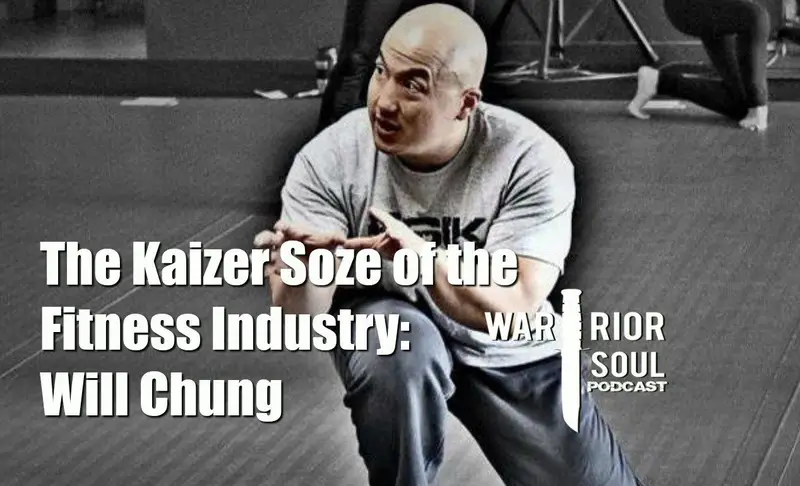
The Kaizer Soze of the Fitness Industry: Will Chung
Hosted by Chris Albert
The Warrior Soul Podcast
Will Chung is a third generation martial artist descended from Hwang Kee, the founder of Moo Duk Kwan, who influenced the likes of Chuck Norris.
Mentored by some of the greatest martial artists in the world, Will eventually moved his way into the fitness industry. His theories on movement and energy prevention have influenced the likes of Scott Sonnon, John Wolf, and others. Will came onto the show today to discuss some of the many techniques he uses to strengthen and arm his athletes against injury, all of which could be applied to the tactical athletes in the US Military Community.
Get your free Testosterone Optimization checklist: http://menshealth.warriorsoulagoge.com
Our Sponsor:

Transcript
Machine-generated from the episode audio and lightly edited — may contain errors.
Chris Albert (link to this point)
What is going on everybody? Welcome to this edition of the Warrior Soul Podcast. My name is Chris Albert and this show is where we deliver tools, tactics, ideas, talk about issues and introduce people to the Veteran community to help them to live their best lives. And the reason why we do this is because over the past decade and a half, we've heard so many people talking about the Veteran suicide rate. So many people talking about the rate of Veteran homelessness.
So many people talking about Veterans suffering from depression and chronic disease. But we haven't heard a lot of people delivering real solutions. So the idea of this show is to introduce Veterans to new ideas, new tactics, new practices that they can implement in their lives to make their lives better. And it's not just about preventing preventing Veteran suicide. It's about getting all Veterans to truly live.
And in today's episode, we have an absolutely amazing person. His name is Will Chung. Will is a trainer who's out of New Jersey right now, but he's somebody who you'll hear Ido Portal refer to during his seminars or somebody who you'll hear Pavel Tsatsouline, you know, the creator of the Russian kettlebell movement here in The United States. He'll refer to Will during his, during his seminars. And, I got indirectly introduced to Will, through Chad Waterbury, who's another guest we've had on here on the Warrior Soul podcast.
Chad's somebody I respect highly, and Chad is really at the top of this craft we call training. But Will, within two minutes of meeting him, I knew two things. Number one, I knew that he was a good person who wanted to bring the highest value to every relationship that he has and number two, I knew that he was extremely knowledgeable. This guy knows his stuff. He comes from a really long martial arts lineage.
He's coached some really high level athletes, some really high level martial artists and some really high level people. But the thing about Will is like, don't see him on the internet much. He doesn't have a website. He's got a Facebook page, but he doesn't brag about his accolades and he's not constantly posting about himself on social media. But through word-of-mouth, he's been able to develop this really awesome high end clientele and he's been able to have this amazing influence on the fitness industry by, you know, getting his ideas out there.
And he dropped some real knowledge bombs on this episode talking about things like posture, techniques with the kettlebell, you know, lot of really awesome tips and tricks to help to make yourself stronger and to prevent injuries. And, had a lot of fun talking with him and like I said, you're going to see how knowledgeable this guy is right off the bat. A couple of notes before we get into that conversation. We just opened up the Warrior Soul Fitness Academy. It's a private Facebook group on Facebook obviously.
But what we do in that group is it's a way of creating a community around what we do here on the Warrior Soul podcast. And we're all about connecting Veterans with other Veterans and getting Veterans to encourage other Veterans. It's not just Veterans on there, there's other people on there too, but everybody who's a member of the group to push each other forward, to get people to rise to a higher level and you'll find constant tips, tricks, techniques on there to help you to improve your nutrition, to improve your fitness. I'm doing Facebook lives on there each week and when you sign up for our newsletter, you get membership into that private Facebook group. You also get, access to our free testosterone optimization checklist.
These are techniques, and tools that you can use to increase your testosterone. Nothing on that checklist costs a lot of money or anything like that. They're all practices that you can start implementing right away and that's to preserve your life force. Testosterone is your life force as a male. It's what's going to keep you happy.
It's what's going to keep you productive and it's what's going to keep you pushing to make your life better. So that's one of my goals here is to help the veteran community to, increase and optimize their testosterone levels and their overall health, their overall mental acuity and their lives in general. In addition to that, you're going get a free twenty one day testosterone optimization workout. And again, all you need to do to get this stuff is to head over to www.warriorsoulagoge.com Click on the link on the main page and that will get you everything you need. Additionally, this podcast is brought to you by F Bomb Nutrition.
F Bomb makes delicious portable packets of fat. Now, things are absolutely awesome. I eat a couple of them every single day and my favorite are their Macadamia nut butters. These things taste like a crunched up Macadamia nut cookie in a little pouch that you can carry anywhere with you if you want and they're loaded with really healthy fats and a lot of awesome nutrition and our listeners here on the Warrior Soul podcast, they get 20% off their first order when they go to www.dropanfbomb.com and they use the code Warrior Soul at checkout. Ross and Cara, the people who run that company, they're really awesome people.
They're sending packets of this stuff overseas to the troops so that they can supplement their MREs with it and, really really great company. So go check them out. With that, let's get into this episode with the Kaizer Soze of the fitness industry, Mr. Will Chung. This is Chris Albert, and I'm here to remind you of one thing.
Someday, you're going to die. Now that's not some morbid statement or scary idea. It's solid fact. Your time here on this earth is limited.
[Music]
What's going on, Will? How are doing, man?
Will Chung (link to this point)
I'm doing great. How are you?
Chris Albert (link to this point)
Good man. Good. So we got to talk the other day and kind of an indirect introduction through Chad Waterbury and you know, I've been learning a little bit about you. I learned a lot about you during our conversation the other day And here's the thing, man. I gotta ask you this. You have been quoted by people like Ido Portal.
You are associated with guys like Chad Waterbury and Pavel Tsatsouline. We're talking about some of the the high experts of the fitness industry and you yourself are known as one of the high experts of the fitness industry, but you keep a really low profile and you've managed to spread your name without a website. How is that done?
Will Chung (link to this point)
Well, of all, Chad is awesome. I highly respect him. I think we both discussed how big fanboys we were growing up reading his articles on T Nation and being very influenced by his science and evidence based materials. For me to even consider him a friend and a peer, let alone to have the honor of doing seminars with him, you know, co teaching seminars with him has been a great honor for me, first off. Second off, you know, I don't know Ido personally, but again, a lot of he sent a lot of people my way via his camp.
I don't know what they're saying. I know it's positive. So it used to be like every, year after his camp, I would get multiple friend requests on Facebook and I'll be like, where did you hear about me? They're like, oh, I just got back from Ido's camp and people were saying great things. So I really appreciate whatever positive things people have been saying.
I have a tremendous amount for him and all these, you know, I was part of Pavel's second classing in this country to do kettlebells just out of curiosity before anyone even knew what it was. So, you know, he's been a huge influence on. I feel very appreciative to even be mentioned in their names, but I don't even feel worthy to be honest with you. Just do my little thing and that's all that's necessary.
Chris Albert (link to this point)
Well, it kind of makes you like the, you know, I know you said you're, you're a little bit like the Forrest Gump, but you're more like the Kaizer Soze
Will Chung (link to this point)
I've heard that I've heard that
Chris Albert (link to this point)
and trainers or Will Chung is gonna come after you.
Will Chung (link to this point)
I've heard that quite a bit, especially with my fighters. But yes, you know, more I would say more like the Hitch, the Will Smith character. My best friend of forty one years, he goes, you're like Hitch from that movie, Will Smith. Like, you know, you don't advertise, you're very selective of who you associate with. The philosophy behind that is I'm 46.
So I figure if the average mean life is somewhere in 83 or something, I'm already at the halfway mark, like I've already passed the halfway mark. So, you know, like Sinatra said, I want to live it my way and I don't mean selfish ly, but I don't want to live with regret. So I really value the time that I spend with people. And it, it you don't have to, know, as we talked about stories behind the scenes, you don't have to be someone known in the industry. There's a kid at a supplement store that I spoke to because I know the owner and the owner wasn't in.
So I was talking to the kid and he was asking me about stuff and I could see that he had an issue with his shoulder. I was like, God, because all my chiropractor said that said, So he being a meathead, physique competitor, I spoke his language. I said, Do me a favor next time before you do your chest workout, I want you to do an incline dumbbell curl, but I want you to do it specifically like this. And again, it seems odd. Like why would you do an incline dumbbell curl before you bench press?
But what that did is realign him and I could show you the screenshot of his DM to me goes, holy crap, everything you said it did, it did. Like what the heck, bro? Because that is so awesome. And then we exchanged phone numbers and he even messaged me yesterday. He's like, yo, in a couple weeks, I'll be back from Florida.
Can we get together for a training session to grab some grub? I'm like, absolutely at this young man and who he's affiliated with and sponsored by is the CEO is a good friend of mine. So I messaged the CEO and he said, man, thanks for, you know, helping our people. He that guy's tried to send me some of his top sponsored athletes. But again, people at the top of their game tended not be as open minded to new training and so forth. But my point is I am ingrained like the Kevin Bacon of Six Degrees. And all it is is I tell people dominate your market. If you train soccer moms, if you train high school athletes, if you train MMA fighters, excel. And when you dominate, they're so impressed that all of a sudden, word-of-mouth, their father, their mother, their brother, their sisters, their cousins, their teammates.
And that's what happens. Know, I start out with one high school kid who's the slowest kid on the soccer team. Get him to be the second fastest kid. The first fastest is also one of my guys. I end up training the whole team because they see they see the kid, they see the results, you know, same thing with all my UFC guys.
Even Frankie Edgar was really very he met with me once. I forgot how he first heard about me. He met with me once, really enjoyed it, wanted to me to join his team, but I had some ethical issues with some of the stuff he was doing that I thought was contributing to his issue. So, you know, you being Italian, an Italian American understand the way I worded it was, I don't want to be your Guma. You know, like, that's basically how I said it to him, you know. And, you know, he was like, kind of like, you know, so we didn't hook up that. But then, you know, because his wife is a was a pharmaceutical rep, so she's going to all these doctors, the orthopedics, you know, and you know, base they would ask like, Hey, how's Frankie doing? Blah, blah. She's like, yeah, you know, he's got whatever. My name kept popping up with all these doctors.
And that's like frustrating, because like, we already talked to this guy, They cut we didn't butt heads. It's just we didn't see eye to eye. So, so a nice kid, nothing personal gets him. Really I have nothing but great things to say about him hard worker. And then so his father, being the amazing father that he is hired me to prehab him for his knee surgery and then rehab.
So he ended up dropping like 20 pounds with me and I remember like Santino, Frankie's son got injured and his father just kind of like jumped up and popped up and Frankie's like damn old man, you're moving pretty fast. I see you getting lean. He goes, I'm telling you it's this kid. You gotta go see this kid. He goes, I'll pay for it.
You know, like that shows you what type of father he is that he loves his son so much that he's willing to exemplify it first and say I'm telling you this kid's good for you, you know, and that's how I got him and all these other people because of the example that I provide for people.
Chris Albert (link to this point)
Well, that's pretty awesome because, you know, we're kinda in an end with the Internet where a lot of trainers, they go online and it's kinda like you're trolling. You're not trolling in like the the over, but people go fishing. They troll for fish or they they try to troll nets and things like that. And you're trying to drag up whatever kind of clientele you can get. But you're in a position because of the way you conducted your business, you can really work with the people that you want to work with.
You can pick and choose based off of your own ethical considerations and based off of your own beliefs and your own code. And I think that's awesome.
Will Chung (link to this point)
And I feel very fortunate because I could name drop a lot of people like the US team doctor for US track and field and all these people who literally know all the top guys, all the top, you know, corrective exercise guys, strength and conditioning, power lifting, whatever. But what I can say that's provable in a court of law is that as many people as these people know, a lot of these people are actually paying me for my service. So it's one thing to say, hey, know what you and you know, he can give me a program or he could because we're all buddies.
But to actually put your money where your mouth is and actually hire someone to train you for two and a half years for three months, for six months or whatever. I think that speaks volumes and that's really where my proof resides. And it turned out really being just a lot of people in the industry have such fragile egos that they never credit you or do. So I kind of I kind of thought it was kind of funny. I'm a bit of a Marvel nerd.
I like superhero movies. So, you know, the whole Hail Hydra thing kind of became a moniker for me that I'm kind of everywhere but nowhere that people don't. They know me, but they don't know me, but they don't acknowledge me, but I am kind of connected. I kind of ran with that as a joke. I and I'm really pleased with it because now people are scared because they don't know who my clients are who aren't.
So someone's up will say, Hey, I was just at this place and that guy just spoke nothing but good things about you. I go, of course, I mean, because he doesn't know if we're buddies or not buddies. You clearly, what I call circle jerk people on social media, you know who they're affiliated But with me, I've influenced so many people and you know I've had to sign non disclosure agreements and keep my mouth shut and been privately tagged and things just because it's an inside thing that you can't reveal that this person is playing this role or this person is injured or this person is this. So I've had to keep my mouth shut about a lot of things and I feel the good fortune to work with people and to follow people throughout their careers from working as a Shelby Sheriff's Department to Biden's Secret Service agent to Homeland Security to counter terrorism to being one of the five men tasked with teaching defensive tactics and firearms for our agents, follow that career path. And then I remember after visiting him one time, and I sent him a picture goes, Oh, that's our house from San Diego. And his wife had noted that I'm the only person who has been to every single one of their locate wherever they were stationed that I was the only not even her family has visited their every single one of their homes. And that's what I believe in is supporting my guys from boot camp to, you know, civil affairs, you know, over at Quantico Teaching, like literally following their careers from a private all the way up to a staff sergeant from boot camp to Fallujah, you know, and post, you know, having kids, having a business. I'm a huge believer in resiliency, longevity, loyalty, know, I'm your huckleberry. Know, that what I believe is a true coach, not someone who just takes credit for, hey, I did this or did that.
That's a circle jerk party. I'm not interested in that.
Chris Albert (link to this point)
We're starting to starting to get into some of the big reasons why I wanted you to come on to this to talk to our audience of veterans and things like that. And I kind want to start this out by asking you, what are some of the biggest mistakes that people are making that are hurting their long term resilience?
Will Chung (link to this point)
First of all, jumping around too much without having an overarching theme. And what I mean by that is, and I kind of blame, I think Alwyn Cosgrove was really big in promoting the Bruce Lee quote about, you know, taking what is useful, discarding what is useless. And Bruce Lee started that even because again, me being a third generation traditional martial artist, My grandfather influenced Chuck Norris, a lot of people, Shaquille O'Neal, a lot of people in the those are the celebrities. But in in the real world, he he was the first guy to ever put physics in a martial arts book. He, you know, most of it, you know, the father of Taekwondo, Jhoon Rhee, recently passed away and Black Belt did an article on him.
There's a whole group picture of my grandfather and Jhoon Rhee as a kid sitting right by my grandfather. So he's been very influential in many people's lives without people realizing it. Post Korean War, so a lot of the orphan kids needed to defend themselves against people robbing, you know, these kids with no fathers to protect them because they died during the war. So my father, my grandfather taught them ethics, how to defend themselves and how to protect one another. And one of the great stories that was originally published in Chuck Norris's original book, autobiography was we have a pin.
My family crest is a fist with a wreath and a scroll underneath. That's a family trademark crest. So that's a Moo Duk Kwan crest, the school of martial virtue or brother. So Chuck Norris talked about how he used to walk around in the rough neighborhoods with this pin so people would surround him, see the pin and back off because they weren't so much afraid of one person. They were afraid of the repercussions of the other guys coming back.
Chris Albert (link to this point)
Gotcha.
Will Chung (link to this point)
To find him because we were such a strong, we took care of our own, you know, that kind of not mafia, but you know how it's like, oh, don't mess with the Corleone family. Very similar concept. You don't mess with that family. Even when I moved to Korea to go to high school, this guy was like, Oh, what do you do?
He did Taekwondo, and he's actually I'm still friends with him to this day. Then said, What do you do? So I told him, know, my grandfather's art. And he went and asked his instructor. So every time I was around him, he would flinch.
I said, What's matter? He goes, My teacher said, Your art's for killing and ours is for spoil. Was like, No, it's self defense. Like he got real flinchy, but there was no need for that. But my point being is that they don't realize that Bruce Lee had years of, you know, boxing, you know, Tai Chi, Wing Chun.
He had foundations so he could pick up wrestling box at different things. When you have no foundation and you jump around, it's like not being able to just even, you know, play tag and you think you could learn a little hockey and a little little MMA and a little this. That's what's wrong. Everyone thinks a weekend course makes you a specialist or a certified, you know, douchebag, know, with the abbreviations after your names, you know, because I've been mentored by some of the great people and lived with them and, you know, literally been trained like the old movie star. So I laugh at people who think they really have an education or call people mentors.
Just today, I found someone on Facebook said student of Will Chung. I asked the gentleman to remove that for me, please, because I don't I don't associate with him. I don't like to please not use my name.
Chris Albert (link to this point)
Yeah. That's that's something we're seeing more and more of out there. And and, you know, I think this notion of foundation I think what's happened over the years is is a lot of people are really uncomfortable with the notion of being a white belt. Right? Of of being a beginner, of of having a lot of things in front of you that you have to learn.
And everybody kinda just wants to jump to blue belt, the purple belt level and and then and move forward from there. But it does it takes years of building a foundation years of of, you know, getting yourself straight enough so you can move on to, you know, just the intermediate stuff before you get to the advanced stuff. And I think, you know, we saw that a lot power lifting a few years ago when the West Side method became really popular. We saw a lot of guys just jumping on the putting on chains and bands onto their barbells while they were squatting and let alone their form and their technique was awful. They needed to be working on that rather than worrying about accommodating resistance.
Will Chung (link to this point)
Correct. So, that's the biggest thing is really lack of work ethic. You know, people aren't willing to they think they can hack everything. You know, Chad and I have had this conversation about not being big fans of hacks. You know, we're all for shortcuts when you could take it, but again, that's based off of a foundation of learning, of education, of strength training, of structure.
And to me, that's the most important thing is because we are pouring ourselves for hashtags and likes, there's no true self worth, which is why we see these suicides, which is why we see this is why we see people who are so what I call Christmas story Italians, they're fragile. So, that being said, and we've talked about this too, you you talk about the reverb from a 50 cal or the trauma in terms of the inflammation of the brain. Well, that's reinforced because most of us are sitting here texting like this in a poor posture. So, the habit of unloaded poor posture and then all of a sudden take in, you know, I take in a bunch of coffee in the morning to get and pre workout to get amped. And then I take all this sugar, alcohol and stuff to bring me down is exactly what every Whitney Houston, Michael Jackson, Heath Ledger, all these people tried to self medicate up and down that they're so like, I call death by a thousand paper cuts that when there's a real pressure, a real wolf, they can't handle it because to them, just running around doing errands is an inconvenience or they deserve ice cream or to shop because they've just done what is their duty.
As you know, as any Marine, it's like you don't go into boot camp thinking you could reinvent the way they process boot camp and train and educate people on firearms. Like, well, I think we should do this. It's like really something like, Like, who are you to think to say that this is blasted and worked and stood up against the pressure of time? And it's the same thing with this that we need to and our goal is because we want for the next generation to be better than us. We want our children, we want our students, we want our clients to benefit from our mistakes, from the failures that we've done.
So that's where we want them to shortcut. But the one thing we can't shortcut them is the hard work. I tell people, that's why the most important thing is shared experience. People always want to watch my training session because they look on my, you know, social media and all they see is food and that's going out like, know nothing about your training because I don't really put out any information on training because I'm not looking to solicit anyone for a new client. However, I do get together with people and love food and eating.
Even Chad put up a post recently about how powerful it is to get together with people and just eat and bond with them. I concur with that. And that's one of my big things is I think Chow Time is a really important time to bond, to create nicknames, to understand each other's verbiage and language so I can relate to you and you could relate to me so that when the shit hits the fan, we're we're doing hand signals and you're not you're you're going to me. What? What?
What does this mean? Are we going are we on three? Like Yeah. What the fuck are we doing?
Chris Albert (link to this point)
That's Yeah. I I definitely hear you on that. I think that kind of human bond has to occur in in in any kind of team situation. On the on the aspect of resilience, I think that, you know, like you said, a lot of this stuff we're seeing related to traumatic brain injury that that could be induced by poor posture and things like that. What what types of daily, like, any kind of daily activity you you you would talk to people about, you know, because we do live in a world where where this thing kind of dominates.
And I I'd love to throw this thing out into the ocean and get rid of it forever, but we're kind of getting into this world where you're expected to answer an email in a certain amount of time. You're expected to respond to a message or something like that, respond to a text to communicate with your family members and your loved ones. How do we instill that kind of balance where we can keep ourselves from falling into that kind of hunched over hurdle position that people are falling more and more into these days.
Will Chung (link to this point)
I think you and Chad hit it best in your last podcast, meditation, but let me give you an actionable step because meditation is such a broad term like prayer. It's a very generic term, right? So you're talking to someone who's been raised in that culture and literally at one point for several years was meditating four times a day. That being said, it means nothing if it doesn't apply. Does all the years boxing or if I can't handle myself against a haymaker in a bar?
Like it means nothing if I know all these 50 different crane techniques, but you know, I can't handle a simple haymaker. Know that like that's ludicrous. It feels like I wasted my time. So something simple and I'll explain why this is so important is you breathe, you stand, I call it stacking and tracking, you know, and a lot of people, I have people stand in a V, right? Because that V position is a very, know, even in the military, right?
It's kind of like military stance, which is what the term military press came from, right? Until they started really bending their back so they couldn't really judge an overhead press, you know? But just like people naturally go to the same spot for their bench press or we see it for the bar, right? For upper body stuff, right? People go to the same notch to do their particular bench press.
Well, for a learning technique, you know, for body comp change, you want variability. But for strength and optimization, your feet should also have equidistant for your stance, for your deadlift, for different things. So that being said, V2I is what I consider a stacking tracking position. And what you do is, for example, you could just look out to the beach. I happen to live at the Jersey Shore so I can look out on the coast, but you want to look at somewhere close and inhale and then exhale and look very far and look close as you inhale and exhale and look very far.
First of all, if you do that for a little bit, you'll be amazed if you're not accustomed to it, how sore your eye muscles are the next day. And then the other thing that it teaches you, the main thing it teaches you, is it teaches you to go from microscope to telescope. Because what happens is a survival instinct is being able to adapt. Fixating on one thing is what's going to get you killed. It's like the woman in the red dress in The Matrix.
If you fixate on one thing, you know, it's like you see a beautiful woman walk by, you rear end someone because of your lack of spatial awareness. That depth of perception is so key because one of the reasons why Mike Tyson was so successful in his era, he was very short for a heavyweight. Most of the heavyweights were taller, leaner, longer. He was able to negate that whole Cus D'Amato style because I knew Teddy Atlas when he was working with Shannon Briggs and when Shannon Briggs was up and coming. And one of the key tenets is, can even just from a firearm perspective, could relate.
You could pick up a target doing this. You could pick a target moving laterally. You could time it. Mhmm. What's hard is something going forward and backward while going in other words, oscillating and changing depth.
That's hard to perceive.
Chris Albert (link to this point)
Mhmm.
Will Chung (link to this point)
How many people who don't need contacts or glasses as they age need reading glasses? Because they can't, right? Because they've lost the ability to look far, look close, look middle. They no longer train those muscles. So it atrophies, you know, some of it's also due to other stuff like glaucoma and diabetes and all this other stuff, but I'm talking about in terms of healthy individuals who just atrophy the muscles just like someone who you know, I'll do a seminar and I'll have people take a dry erase board and unscrew these imaginary light bulbs and most people can't get past like nine or 10 before their shoulders burn, but yet they can bench press, you know, 400 because they've, you know, they don't do this often.
Chris Albert (link to this point)
Yeah. Yeah. And it's yeah, I really do think it's about moving your body in different ways and finding that out more and more as I get older. And really finding those things that you haven't used in a while. Like, I just got a set of gymnastics rings and right just before coming out of this conversation, I hooked him up to the tree outside.
And you know, I was out there playing around with him, doing some pull ups on the gymnastics rings. One of the things I noticed about pull ups, I mean, can do, do over 20 pull ups on a bar, but on gymnastics rings, I'm really feeling it because I'm getting that twisting action with my wrist and I have more wrist mobility and you know, I'm not I'm not able to kind of like lock it in or anything like that. I'm feeling like I'm getting a much better workout out of it and and you know, I'm, I actually feel like I'm getting more mobility out of it. Like my shoulders can go. I can raise my arms higher after the workout before, which isn't necessarily true when I'm doing any other kind of workout.
Will Chung (link to this point)
Excellent. And I'll give you another suggestion just to think outside the box of how I think. Most people don't do it, and I could show you it on many different implements, including kettlebells and so forth. But you know how most of us grab the inside part of the ring, right? This U part, right?
Try gripping it on the top part of the ring where it's attached and pull because what you'll notice is you're strong with your grip, do re mi, the middle finger being the conduit and mi fa so. So you're either pulling stronger here or here. And that's what I do with my jiu-jitsu guys and my judo guys for their gi grappling. I never have them as my teacher used to say do re mi or mi fa so, never do re mi fa so. Because you'll death gripping will pre fatigue.
Chris Albert (link to this point)
Gotcha.
Will Chung (link to this point)
But having this in intelligent grip that oscillates so you're practicing more this because anytime we lose our grip is always at the pinky first.
Chris Albert (link to this point)
Can you describe that for the guys who are who are not watching this on YouTube, but maybe what
Will Chung (link to this point)
Absolutely.
Chris Albert (link to this point)
On on iTunes?
Will Chung (link to this point)
Absolutely. So grabbing the top of the the ring causes a round shape, right, of the hand. Correct?
Chris Albert (link to this point)
Gotcha.
Will Chung (link to this point)
Instead of a U, it's more like a concave versus convex, right? So the aperture. Because the reason why it's important for the hand to make a round shape, right, is because the shoulder is a rotational joint and the hand is the circumference to this rotational joint. So, when you grip things like a sledgehammer, you'll notice when you lever it up, you're going to be heavier with the okay, like you're making an okay sign.
Chris Albert (link to this point)
Yeah. With your index finger and your thumb. Right?
Will Chung (link to this point)
Correct to like you're holding an ice cream cone.
Chris Albert (link to this point)
Gotcha. Gotcha.
Will Chung (link to this point)
Or you're using a knife to thrust forward like a saber grip. Well, they would consider a saber grip. Articulating between those two, you'd be surprised. I work with all these boxers and so forth. I'll do articulation drills with them.
And they're like, we already know how to warm up. We don't need to know how to warm up. All of a sudden they're doing this and they're like, oh, why do I feel this in the arches of my feet? Why is why are my hips loosening up? I go because your fascia is all connected.
And if one joint rolls, the other start to roll like all bearing joints.
Chris Albert (link to this point)
Gotcha. Gotcha. Now, you know, you mentioned, fascia is all connected. You know, anytime you get a knot anywhere in your body, it could potentially affect the rest of your body. So if we're talking about guys who are going out there into the field, who who are dealing with, you know, walking with 80 pound packs for for 20 miles on end or even 10 miles, what depending on how crazy their platoon got that day.
You know, should guys be doing in order to recover from that and to prevent these kinds of knots from building up?
Will Chung (link to this point)
Two simple things. Number one, again, once you're stacked and tracked, basically just shaking. Mhmm. To to basically shake because the body naturally shakes just like a dog. Right? You know? It like when it wants to get up, it stretches, it shakes. An animal is scared, it gets very perceptive, it smells something, think it hears something and then it develops this anxiety because it's ready to fight or flight, right?
But animals naturally handle it by going, they tremor, they shimmy, they shiver. We can shake and then sway, the lymph nodes are here and in your groin area. Because I know a lot of guys when they were stationed, they couldn't go running because there's no distance in the camp to run because they could be sniped, so forth and so on. So I gave them stationary drills to pump their lymphatic system, what I call walking without walking, which work your stabilizers and builds the endurance of your ability to be able to stand all day with all this multiple gear over because the one thing is as we age, our one rep max, our reflexes, it declines.
Chris Albert (link to this point)
That's everybody.
Will Chung (link to this point)
The one thing that improves and is proven to improve is as you age is your slow twitch, your stabilizing muscles can improve, which is why Tai Chi Yoga can help an 80 year old with poor balance.
Chris Albert (link to this point)
Gotcha.
Will Chung (link to this point)
That can improve. So if we're talking about a 40 or 50 year old healthy guy, they could build the endurance of their grip, of their dorsiflexion, you know, just something as simple as pulling your toe again. I told you though, and this was publicly shared on social media. I don't think I'm betraying anyone's trust, you know, Joe DeFranco who's a well known trainer said, you know, I asked him to do like a 100 let's say and he was like, I only got the 30 but boy my hips feel amazing. I'm going to show you know Triple H and Stephanie McMahon because they're also have some joint issues too.
So I'm glad he got something out of that. Know, that's fantastic and I appreciate the you know, it shows you what type of person Joe DeFranco is and he's an accomplished guy, so he doesn't mind acknowledging and crediting somebody that he learned something from. It's that simple, conceptually speaking. But that ankle flexion, the reason why most people have hip and knee because we have artificially flat surfaces and that allows us to drag our feet like zombies in The Walking Dead and to wobble and hobble like Frankenstein, who is in theory a piece of a bunch of different body parts assembled. The more you can articulate your ankles, because they're meant to do this plantar and dorsiflex, and also even an invert, like trying to ride an airplane to be level.
And the reason why this joint does this is because the earth is round. There's nowhere in nature that is a completely flat or level surface. Even in a place that looks
Chris Albert (link to this point)
You're gonna get the flat earthers mad at you, man. You're about to you're about to get them hunting you down on social media.
Will Chung (link to this point)
This is so bad that we get to the point that I only have true three universal truths, you know, the you know, the gravity earth is rather now now they're trying to take that away from us as well. But that being said, let's okay. Let's say the earth is flat. I don't even want to argue with people. Let's say the earth is flat walk in an open field barefoot.
There's nothing that's actually flat meaning there's anthills. There's divots. There's rocks, which means you have to articulate and even Joe DeFranco's partner Smitty said to me, what am I supposed to do walk around with a bunch of like rocks and dirt in my house? I said no Legos are sufficient. He's like, you're such a smartass, you know, but it's like, but Legos aren't like anyone who stepped on a Lego like that that stalker mode.
That's I don't wanna piss off my wife because I I, you know, I had one too many beers and I came in late tonight. Like, everyone knows how to walk with their whole body when it comes to that type of survival mode.
Chris Albert (link to this point)
Yeah, the Lego is probably the most painful thing if step on it. No man, I've definitely noticed that. I've gone out barefoot. I walk around my complex out here barefoot every single day and you really notice it, especially if you're going over rocks, over pebbles. You begin to develop new sensory with your feet.
I haven't graduated to the point where I'm comfortable running barefoot or anything like that though because anytime I ever stump my toe, I'm like, oh my god. Like pain for fifteen minutes. And then and then they get pissed off. But but I definitely take those walks every single day.
Will Chung (link to this point)
But that's meditation. Even if you if you trot or jog or march for 10 feet, that's meditation because you're mindful. Whereas the other one, it's like, I'm already in a pattern. I have shoes that are forgiving. And that's why we rely on gear so much.
And I'm not against gear. I'm saying, look, utilize it. But something as simple as swaying and shaking will help resonate even, you know, just something as simple as I had a guy who's New Jersey State Troopers, they have a tactical team. They call it teams. It's an acronym for tactical entry, whatever whatever.
So whenever there's anything big like a mall shooting, they they they all have the the alerts. So they all they're they're always carrying their gear with them in their trunk. So they have to get all their bike in. You know, sounds cool. He's like, yeah, a lot a lot of it's just sitting around waiting waiting in the van, know, with all the tactical gear.
But that aside, he had attempted to be on that team for many years. CrossFit instructor, CrossFit certified, super fit, like abs, muscular, very well conditioned, awesome guy. Sean's his name. And so he started training with me and I also ended up training his wife as well, which goes to show you that that pattern, right? But something as simple as when he was trotting on his non dominant leg, I would always have him exhale and sink more because your dominant leg, you're more coordinated, you're better balanced on Your non dominant, you tend to lock and pop your hip out, which is why it doesn't absorb force.
So I would have him trot with the So it always hit that non dominant foot. His recovery went through the roof and he was like, why don't they teach us at the academy? Why don't more people know? Like, that's the common thing I get. And one of the things he asked me a question about was he had to one of the obstacle courses besides swimming and climbing and all this gear was taking like a mini bulldog and ramming down a knocking down a door, but being buttressed up against the wall.
So it's not like you had a lot of room to swing this. Right? So I said, Sean, let's look at this from a biomechanical point of You have lateral motion, you have this horizontal motion and you have this vertical axis, right? He goes, Yeah. So what I want you to do is I want you to roll and spinal wave. And I said, want you to pivot your foot. So I want you to like you're throwing up.
So we we have an arc again. So it's round, down, and his spinal waves, boom. He said, like a bunch of matchsticks that just it kindled. It was so easy. He couldn't believe because what do you do when you have a paper towel to this big and a string this long?
You coil it. You create more space dimensionally because you don't have that much space lateral to create force.
Chris Albert (link to this point)
Yeah. Spinal waves are something that, you know, my friend Brian Rose from London Real, he started doing those every morning. He heard that from Ido Portal. And I started doing them up against the door and and and really just kind of starting with my chin, trying to get my chin there, bringing my chest there, bringing my pelvis slowly, then coming back. And I'll do a few dozen of those every morning just to get my body warmed up a little bit.
That's a huge thing. A lot of people don't have that kind of spinal mobility anymore because they don't use it.
Will Chung (link to this point)
Yeah, but all that comes from martial arts. The Chinese call it chan si jin, which is silk reeling. So chan si jin, like they have a hand drill that basically equates with the yin yang symbol. All it looks like is it's just this. It's this and basically all that is, is every single shape your hand could make potentially.
So, you know, and then they do it with two hands, you know, and it's like this. And all that is, is, you know, that's articulation. So that's what tie it's just teaching you this kind of like thoracic heaving and that heaving is what you do when you're under like, you know, like when you're fighting, when the you have an adrenaline dump, it's like, it's this kind of primal kind of hulkish kind of thing. And we need to get in touch with that. I mean, that's why we are trying to appropriate where we are trying to survive.
I tell people if you have a four wheel drive vehicle and the four all wheel drive doesn't work, you complain about it, even though you rarely use it. Even if you rarely use it, you still want the option. I tell people from a movement perspective, you may never have to, know, heaven forbid, ever defend yourself or do this, but you want to retain the ability to. And I think that's key. And you talk about spinal waves.
We talked about it privately. You know, when I work with guys with PTSD, one of the first things I teach them is how to shock absorb, how to take force kinetically through their body. So it releases a ton of trauma. You'd be surprised and I'm not a big hokey pokey, know, hippie earthy kind of guy. I'm more a pragmatic guy.
But I've nailed people who are sexually abused, had trauma, who were in crashes, they're like, how do you know? Because you start to see the signs because there's trapped trauma in certain areas. Women purposely numb that area because they were abused there, They purposely try not to get sensation. So when you activate that area and start to flood blood in there, they get an emotional response. When I was a young kid, was like, What the heck is this?
And then I started talking to all these therapists and realizing that this is and then it's like commonplace for me now to identify it and see it even in the seminar.
Chris Albert (link to this point)
That's yeah, that's I hear that's a real common common issue with women as far as keeping trauma in their pelvis, keeping trauma in their genitals and things like that. You know, you've been really, really big with the Russian kettlebell training as we talked about at the beginning. And, you know, kettlebells become more and more popular these days. And, you know, I keep a kettlebell in my house. I think it's one of those pieces of equipment that people could keep anywhere and potentially get a workout in whenever.
But what kinds of things are you seeing people doing with kettlebells that maybe they shouldn't be doing or that they could be doing better?
Will Chung (link to this point)
Well, I don't care what particular certification it comes from. I know people in all of the different branches who actually certified and have worked with them privately. I have nothing against anybody's techniques. My basic thing is whenever there's any type of unnecessary jarring, in other words, when you hit the brakes, everything should decelerate. You shouldn't still have tissue boxes and dumbbells still flying.
Chris Albert (link to this point)
Gotcha.
Will Chung (link to this point)
So you shouldn't have things still moving and jarring because you do enough of that in in your combat or, sparring and all that kind of stuff, 50 cal machinery, you do enough in that and that's why you only get so many of them. That's why in your training you shouldn't reinforce that. One of the things that this will be exclusive to your podcast, you know, I don't do a lot of podcasts per se, but one thing I can tell you that's exclusive that I have yet to see anywhere else from a learning material perspective or anything is what I call a thumb under. You've seen people grab the kettlebell incorrectly by mistake, meaning what do I do with this kettlebell and do it, I curl it, but I specifically have a whole sequence of drills and series where I don't feel we're utilizing the actual design of the kettlebell as well as we could, right? So when you hold the kettlebell like this, it causes this position so your forearm has to marry and coil and support and kiss that kettlebell like this, which strengthens your rotator cuff muscles. So I have people do various thumb under snatches, press, I build them up obviously, but I have them go through progressions and I'm kind of known for this gooseneck, know, some guy was doing something and a lot of people have wrist pain because they're doing like explosive push ups and dynamic frog hops and plyos and it's because their shoulders are internally rotated and they're jammed like this. You never saw a 1950s secretary who never looked at their typewriter complain about carpal tunnel syndrome because their posture was good. So, that being said, I did a video once on social media and went a little viral in the sense that I was doing push ups on my wrist and doing clapping push ups. Some people were Oh, was like, Well, the tendon and ligament strength should be just as equally strong here as it is here.
And the reason why most people don't have this strength is because this fascia is so tight, is why this whole chain of their anterior delt and their pec that's why people pop their biceps all the time.
Chris Albert (link to this point)
Yeah, so just to describe that again it kind of looks like the way people do the false grip on the gymnastics rings. Correct almost like a like a looks like a gooseneck. I think you mentioned gooseneck. Correct. This is bent forward and then you're grabbing the kettlebell like this and then you're doing like external rotations with it, swinging things up.
You're married to it.
Will Chung (link to this point)
Try pressing a kettlebell with the kettlebell in front.
Chris Albert (link to this point)
Wow. That's pretty awesome. Yeah. It's it's phenomenal. Yeah.
I'll I'll try and I'll try and find that video of you doing the push ups. You can send that to me so so people can see it. And then, yeah, that's pretty awesome. I never thought about that before. That's really awesome.
Will Chung (link to this point)
But I do with dumbbells. Have version. I again, I've had Smitty in my house and he's like, what do you call this? I'm like, I don't know because I don't really care about what it's referred to. He's like, oh, I'm gonna call it the trunk press.
I'm like, okay, you can call it the trunk press. Don't really care. You know, I just care that you use it to be honest with you, you know, but this is because think about it, think of how strong this grip is. Extension is a lot we like, we know we can all curl more this way, right? So holding it this way, know, Larry Scott, for example, what are the reasons for his big biceps? Some may argue genetics, some may argue steroids, whatever. I'm not here to debate that. One thing that I can say that he was known for is wrist. Even at a seminar, he goes, I bet you I can out wrist curl, like two twenty five pounds, anybody else and do it like this.
So I actually have his form that was his because he had a company that sold like custom equipment that he believed in, you know, because he was from the Gironda philosophy of training. And so I asked because they usually custom build it. They're like, We may actually have one around here because they usually build it to order. So I thought that was kind of odd, but later what came out was again, Larry was suffering from Alzheimer's, so he wasn't working out. So I actually have his actual FormPet that he barely used.
Chris Albert (link to this point)
Wow.
Will Chung (link to this point)
So yeah, it's pretty cool. So that being said, that's the Forrest Gump of my life. I just happen to be that stupid lucky. I'm not that bright. So I just happen to be at the right place at the right time.
So his thing is this was anchoring it so low that you could roll and lever by rolling the shoulder down. And that's why his the Scott bench is super padded. It's not a conventional preacher. It's densely foamed. So, you can drive your elbows.
So, you have to initiate with the wrist curl. And then that wrist curl then levers and forces the elbow to tactically drive into the path, which then allows an exorbitant amount of weight to be utilized, which hence will add more bicep growth than a bunch of various things together.
Chris Albert (link to this point)
Lots and lots of muscle fiber improvement going on there. That's pretty awesome.
Will Chung (link to this point)
And proper sequencing. But think about it like, you know, are you stronger lifting someone this way or pushing a car this way or like this way?
Chris Albert (link to this point)
Right. Right.
Will Chung (link to this point)
Are you stronger benching this way? Or, you know, like the bend the bar, you know, you you're coiling your elbows down. Basically, you're You don't want to do this. This is a Gironda neck press, which I also teach to some people because it does really hit the upper fibers because of the alignment of where the pec inserts. Because the pec inserts, it's all these fibers here and then it ties right into here.
But again, with people with injuries, I don't recommend that kind of stuff.
Chris Albert (link to this point)
Yeah. Yeah. Well, a neck press, I mean, like as far as everything goes, that's that's something Vince was definitely known for. He didn't like bench press at all because he said it didn't work the pecs at all. Worked just worked the arms.
But yeah, if your shoulders out, I mean, just getting back there could be a problem.
Will Chung (link to this point)
Right. But a lot of good people who are very mindful are teaching people just to do it with dumbbells in the sequence. There are a lot of good people out there now. I think that there are people really out there doing good work, you know?
Chris Albert (link to this point)
Mhmm. Yeah. And you're definitely one of them, man. I some of this stuff is like blowing my mind right now and I hope the the audience is getting this too. We're coming toward the end of our time here and I wanted to ask you a couple more things.
Will Chung (link to this point)
Sure.
Chris Albert (link to this point)
Number one, you know, when you you said at the beginning of the conversation, you're you're kind of at past the middle point. I don't think you're too far past the middle point. We're kind of close in age, so I don't I don't think I'm too far past the middle point.
Will Chung (link to this point)
No, you know what I mean? Just looking from a sheer numbers point of view, we're we're past the midway point, right?
Chris Albert (link to this point)
Yeah. Yeah. And, you know, what do you foresee for yourself in the remainder of your career? And what you're gonna do? What are there any hills you have left to climb here?
And and if so, what do think they are?
Will Chung (link to this point)
A ton, actually, because I feel I'm on the point five where I know a lot of the old school guys, it be martial artists or whatever, and I know a lot of next gen guys. And I wanted to be the bridge between that, whether it's generations or even East versus West, right? Paul Chek, Charles Poliquin, they're all talking about five elements. They're all talking about, you know, different things that are, you know, based off of traditional Chinese medicine. That whole Taoist Chinese medicine theory, that's something I was raised in as a flaw.
I didn't even think of it as something separate. It's just how they lived, How my teachers lived, how my, know, could also be very eccentric. But my whole point is to infuse the traditional values of martial arts that, you know, because they've done it before. We're not reinventing the wheel here, right? And I purposely get all my material that I use to disintegrate a joint and I reverse engineered it to integrate.
So I'm looking to keep peace and neutralize force. I mean, the Chinese character move for martial is really sword and prevent.
Chris Albert (link to this point)
I actually got the tattooed on my stomach.
Will Chung (link to this point)
Did you?
Chris Albert (link to this point)
Yeah. Yeah. Yeah. Back when I was a a dumbass marine. But, yeah, I got the I have the character from martial on my stomach.
Will Chung (link to this point)
That you're a peacekeeper then. You're, you know, you're you know, when I worked with the tactical training unit at the NYPD, they had a really nice I don't know. I want to call it a cartoon, but like a a poster or sign. And it basically said it's it's what you fight for and why you fight. So basically they had a police officer in front of a baby carriage and then they had a terrorist hiding behind the baby carriage.
And that really stuck in my head. Know, I made a lot of you like your Simon Sinek, start with your why. So to me, the future is I want to share as much of what knowledge I have and I bust my guys balls all the time saying you guys are barely on the appetizers with me. You better get your asses going because I got a lot to share and I do, but I only work with the willing. So my big thing is to always work with people and I love working with people, you know, for me, just buy me a meal. It's not about the money for me.
It's just it's just bonding. It's, you know, having the good fortune of knowing some of the greatest people in what they do and learning from them. And I'm a great student. I love learning. I'm like, I have no problem being like, how do I do that?
What do I like, you know, and they teach I so many theories on weapons and aiming. I've heard so many wonderful people tell me stuff and I'm like, wow, that's pretty awesome. You know, I I never even knew that. And so my big thing is to really help the next gen before I move on and I'll end up, becoming that old crusty guy like all my old teachers who are kind of hard to get to these days. But like my uncle is 71, but he's still getting his legs straight up over his head.
I mean, God bless the guy. Yeah, so I give him a lot of credit. And to me, that's what I want to do is I just want to keep exemplifying and helping people. And I always put out a bat like, like whatever social media stuff I do, it's just, if it resonates with someone, I'd love to interact and I'd love to build rapport. I'm not looking for a quick bang and I keep getting invited to places for months because not only do I do a weekend seminar, but I work with their athletes, their staff, their clients, their you know, so I end up, you know, I'm booked because I got all this stuff going on, you know, every time I go back, I have more requests.
So then I have to see this person and that person and that.
Chris Albert (link to this point)
That's a great I mean, that's the best advertisement you can get. And I'm sorry to see, you know, I think that's how you you know, that's a great way of getting yourself everywhere And that's a great way of of running your business just by satisfying people providing them an amazing service and then letting them talk about it.
Will Chung (link to this point)
So, you know, my job is to basically, you know, be the Mr. Miyagi, to help some kid who needs help, you know, even if I had all the money in the world, I would still be working at a VA or YMCA or somewhere just help just because I really enjoy it, to be honest with you. And I believe in good karma. So I just focus on that. And like I said, work with a lot of veterans. I work with a lot of causes that most it'll never make it to social media because I think it's douchey to for it even to be known that that you do it.
Chris Albert (link to this point)
Yeah, man. So so if people want to get in touch with you, I know you don't have a website. I know you're you're on Facebook, right?
Will Chung (link to this point)
Yeah, I am on Facebook. I have an Instagram account, but it's mostly just me eating ice cream.
Chris Albert (link to this point)
You know, where can we see? I like ice cream.
Will Chung (link to this point)
My my Instagram account is at inner wills, i n n e r w i l l s
Chris Albert (link to this point)
gmail dot com.
Will Chung (link to this point)
Know, they could could DM me there. They can my email address for like work stuff is just the I call it the Chung Fu crew. So it's c h u n g f u crew c r e w at gmail dot com. So that's where I get all my inquiries for training and so forth and people who want to I basically train trainers around the world. When we get together in September, we're getting together for an intensive.
So it's four days of actual instruction, but most people usually come for a week because they come from like Moldova, The Ukraine and Barcelona. They're not coming for four days, they're going spend a whole week. So all I do is I take them on the beach.
Chris Albert (link to this point)
You're going be in Jersey?
Will Chung (link to this point)
Yeah, I host it here. You're more than welcome to come too, brother.
Chris Albert (link to this point)
That's awesome.
Will Chung (link to this point)
Four days of fun and pork roll egg and cheese and nice, nice.
Chris Albert (link to this point)
So so people are coming. It's an intensive on and you just go through different types of techniques is pertaining to stuff we're talking about today or is there there a specific structure as as far as the curriculum we're gonna go through?
Will Chung (link to this point)
It's mostly for trainers like it's a couple days I'll go over martial arts stuff because people are interested in that and then I'll go over and so I'll let people know so people who aren't interested in the martial arts stuff and just want to come for the training stuff they won't come the prior two days they'll come the latter four days, for example, you know, so people can be aware of, know, I've had a few people. It's all it's by invitation only, by the way. So I don't I don't solicit or any of that. But I've had some people who got permission to come for a weekend or for two days, you know, that which is more than acceptable. They all came, you know, one guy was training the Prince of Morocco, so he wanted to come in for a couple days.
I got him in for a couple days. And, know, I just again, we went and had dim sum in Chinatown in New York City, like, know, we'll shut down a whole restaurant and just like, and that's my running theme. Whenever I hang out with people, we lose track of time and we end up almost closing down the restaurant. That's that's and I always tip appropriately because we're taking up a table. I understand that we're taking up people's business, but I'm very I'm big on the food, bonding, laughing, learning, you know, one of my MMA fighters, was just telling, you know, I actually have to go to Chicago because he announced his wedding date and I'm going out with my family vacation.
So he changed his wedding date so I could attend his wedding, which I'm genuinely honored, but it shows the level of loyalty and respect. And a lot of my guys can say that that I was with them when they didn't have any money or this. Now they're, you know, because I introduced them to this person, they got a job. Then now they're in a completely different place in their life. And it's great to see these guys fifteen years later, you know, and to sit there and to be proud of the men and women that they've become.
You know, I've trained everyone for every major armed service in our military and even every institute from the Citadel to West Point to every faction. I've worked with somebody, if not more than one, in various factions. And I feel very honored to do my part, and I really believe in that. I do a lot to support trainers where I sponsor people to get educated and to travel and to train and I connect people. So, hey, you need an internship, you need an in into this person or this type of training, I will hook you up.
So my thing is to bring peace through and I'm plagiarizing my grandfather's mission, which is peace through human relations, you know. In Italy or Korea, a punch is a punch, a hug is a hug.
Chris Albert (link to this point)
Absolutely, absolutely. Well, sometimes. Sometimes. Italy, it's a little bit questionable sometimes. But maybe a little smack.
Yeah. But, Will, I wanna thank you for coming on today, man. It's been a real pleasure talking to you, and we're definitely gonna have to grab some dinner sometime either on the East Coast or the West Coast. Both baby or two. Absolutely.
Or both or both. I'd rather be out there though because the food's better on the East Coast. Don't tell anybody out here.
Will Chung (link to this point)
Finally, someone who admits it, right? Well, anytime you come visit your mom, your family, you're more than welcome here anytime.
Chris Albert (link to this point)
Absolutely, man. And and to everybody out there, you know, we had a lot of awesome lessons today and we're gonna be putting those up in the show notes for this episode. And you know what? I I think the biggest lesson of them all is to come into whatever you're doing. Whether that's training, whether that's that's cooking, whether that's being a marine, a sailor, an airman, a soldier, whether that's being a teacher or a police officer, but come into it with the best intentions and and with the the the desire to help people, the desire to make this world better, and the desire to spread knowledge to people who are asking for it.
So with that, guys, I wanna thank you for listening, and I want you to get out there, and I want you to live your best lives while you can.
Host of the Warrior Soul Podcast and founder of Warrior Soul. Worldwide trainer and nutrition coach, contributing author at Testosterone Nation and Muscle and Strength.