Podcast episode
Warrior Fitness: Deadlifts, Fasted Training, and Weight Loss
Hosted by Chris Albert
The Warrior Soul Podcast
Deadlifts, Fasted Training, and Weight Loss
In this week’s Warrior Fitness episode I discuss questions from members of the Warrior Soul Fitness Academy.
Deadlifts and Variations
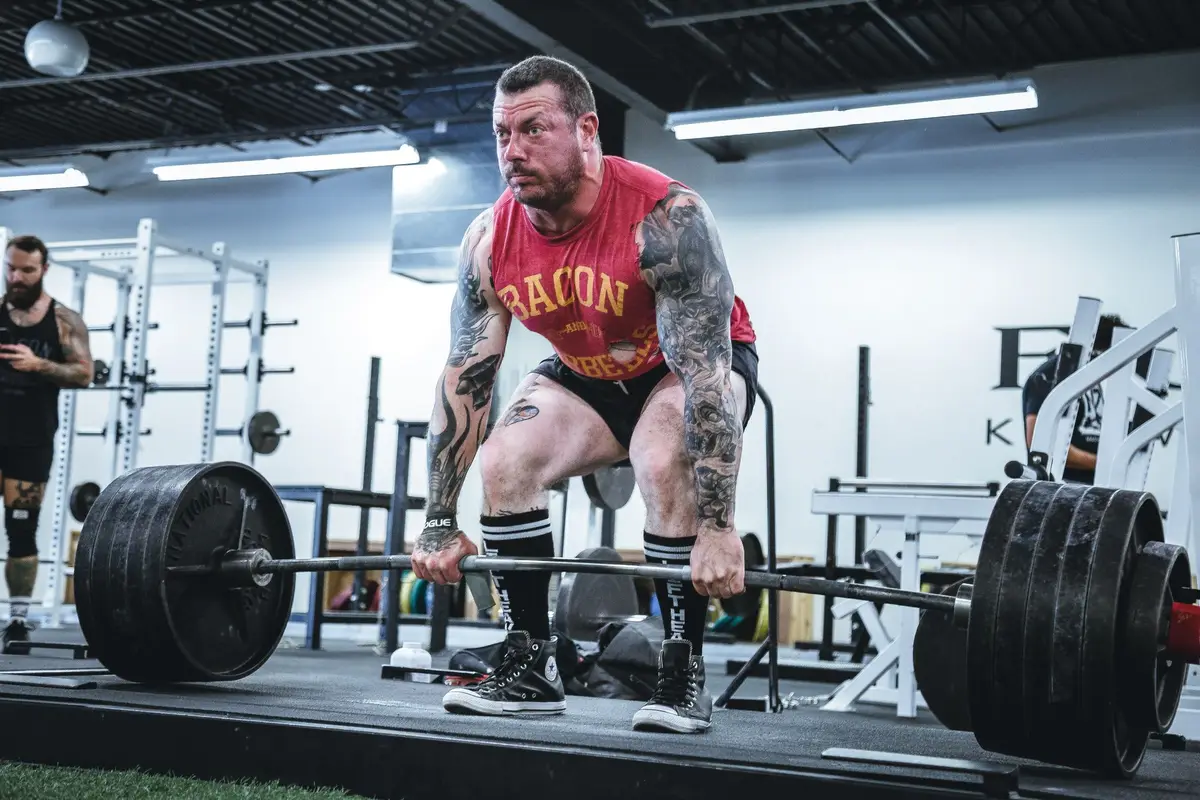
First, I talk about whether or not you should focus on doing different deadlift variations: conventional deadlifts, rack lifts, Romanians, and sumo.
While I do believe that each deadlift variation is useful, beginners should focus on perfecting the conventional deadlift first before moving onto variations.
Once you’re advanced enough, switching variations every three weeks can help you to strengthening weaknesses.
Weight Training Belts
Next, I discuss whether or not lifters should use weight lifting belts during their workouts. I see the value in using them if they are part of training for your sport (i.e. powerlifting or olympic weightlifting). Nevertheless, I do not see much value in incorporating them otherwise.
Fasted Workouts
Then I cover whether or not fasted workouts are effective. The answer here depends on a number of factors that I cover in the discussion.
Fast and Slow Metabolisms
Finally, I discuss weight loss for those with slow metabolisms. For those with slow metabolisms it’s not as simple as reducing calories and doing more exercise. Instead, you may need to vary calories on a day to day basis to get the metabolism fired up enough to actually get you to lose weight.
Transcript
Machine-generated from the episode audio and lightly edited — may contain errors.
Chris Albert (link to this point)
This is Chris Albert, and I'm here to remind you of one thing. Someday, you're going to die. Now that's not some morbid statement or scary idea. It's solid fact. Your time here on this earth is limited.
And we need to be reminded of this as much as possible for one simple reason, to live your best life while you can. This is the Warrior Soul Podcast.
What's going on, everybody? Welcome to the Warrior Soul Podcast, and this is the Wednesday fitness notes edition. Today, we're gonna be talking about a few different interesting issues. We're gonna be talking about deadlifts. Regular deadlifts, conventional deadlifts versus Romanian deadlifts versus rack deadlifts.
When should you use them? What are they good for? And and should use should you be using all of them? We're also gonna be talking about weight belts and whether or not a weight training belt is gonna help you or it's gonna hinder your progress. We're We're going to be talking about fasted workouts and whether or not they're a good idea.
And finally, we're going be talking about weight loss strategies for fast versus slow metabolisms. Now, if you haven't been here before, my name is Chris Albert and this is the Warrior Soul Podcast. The reason why we do this podcast for those of you out there who are US military veterans. The reason why I focus on you guys is because over the past decade and a half of war, The US veteran community has faced really high rates of suicide, chronic disease, and chronic rates of depression and veteran homelessness. And the big thing that I want to emphasize here, there's a lot of people out there raising awareness about these issues, and that's awesome.
I'm glad they're raising awareness about this, but I'm not just here to raise awareness or to talk about veteran suicide or to talk about any one of these issues. My focus is on getting all veterans to live their best lives. And if you're not a veteran, stick around because anything that we go over here could help you as well. All of these issues can help anybody. We just focus on the veteran community because that's where I come from and because that is a segment of our population that really, really needs this type of advice right now.
I also want to mention that this podcast would not be possible without our good friends at F Bomb Nutrition. They make awesome macadamia nut butters. They mix them up with chocolate. They mix them up with sea salt. They mix them up with pecan butter, with coconut butter, and they put them in these awesome portable packets.
And you can get yours for 20% off if you head over to www.dropanfbomb.com. Use the code Warrior Soul, and you'll get 20% off of your first order. The other thing I wanna mention here is that this podcast, the Warrior Soul Podcast, is part of a larger media platform called the Warrior Soul Agoge. And on www.warriorsoulagoge.com, We've got videos. We've got podcasts.
We've got blog articles. We've got so many things that can help you and can help you to live your best life. And we have different branches that we work through. Obviously, this is a podcast, and on the podcast, we publish interviews with amazing people. I've got, Sal Di Stefano from Mind Pump coming up next week.
I've got Adam Kokesh, the libertarian candidate for president of The United States and US Marine Corps veteran coming up the week after and really awesome interviews with awesome people. Wednesdays, we publish our fitness notes. And on Fridays, we go through Warrior Notes. And Warrior Notes are specific pieces of advice to help you to gain a stronger mindset. So definitely subscribe to the podcast if you haven't already.
Make sure you're writing a review for us up on iTunes. That's all we really ask for in return. We don't ask for anything else. It doesn't cost you anything, and it really helps us to spread word about the show. So with that, let's get into the subject matter for the day.
Deadlifts. Alright, so we see a lot of different variations of deadlifts, right? So we see conventional deadlifts, we see some people doing sumo deadlifts, we see some people doing Romanian deadlifts. Actually, Romanian deadlifts are are more of a supplement, but but we'll get into that in a second. We see some people deadlifting from a rack.
We see some people deadlifting with chains, some people deadlifting against bands. And and there seems like there's so many different variations of them out there. So I've got a few different pieces of advice here as to what each of these are good for and how you should be using these. How you should be using these in your own routine. So first things first, want to see this.
If you have not mastered the conventional deadlift yet, I highly suggest that before you go to any variation of the deadlift, you master the conventional deadlift. The same thing for, you know, if I was talking about squats or if I was talking about bench presses, master the basic movement first. The reason why you want to do that is because you want to get used to the loading pattern. You want to train your body and your central nervous system to respond accordingly to the exercise. And that takes a little bit.
So if you're in your first, first or second year of lifting, I highly suggest that you spend some time with the conventional deadlift, you master that, you advance with it, before you start moving into some of these other things. Now, with different variations of the deadlift, I I mentioned a few of them. There's the sumo deadlift. The sumo deadlift is a is a great variation. It really helps to strengthen the upper back.
It also helps to strengthen, the glutes, and it helps to strengthen the quads. But most of the time, the the main reason why somebody would be using a sumo deadlift would be for competition purposes. A lot of people pull better in competition using the Sumo deadlift than they do the conventional deadlift. What I would say is if you're gonna do Sumo conventional, there's also the, the the snatch grip deadlift, which is a wider grip. There's also the, deadlift off of platform, deadlift chains, all those.
But if you're gonna train, if you're gonna use the sumo to to compete in a powerlifting competition, I would say you still should train with the conventional deadlift. And the way I'd recommend doing this is by spending, you know, three weeks with the conventional deadlift, and then, you know, following that up with three weeks with the Sumo deadlift, and then maybe three weeks with another variation like the snatch grip deadlift. And the reason why I would say spend time with each variation and spend three weeks with it is numb number one, three weeks is the time it takes for your central nervous system to really get used to something. So after three weeks of advancement on a movement, you really want to periodize that movement out for another variation of the exercise in order to training your brain and your central nervous system to become stronger. And that's for more advanced lifters.
But the big thing to understand here is that it's not to say that sumo deadlifting is better than conventional deadlifting, or conventional deadlifting is better than sumo deadlifting, or that you know both of them are better than snatch grip deadlifts, is to say that each trains a specific area of your body. And that if you really want to get strong and you want to fill in all those holes with your in your strength, then you should spend some time with each variation. You should try to spend some time with the variations that are harder for you. For example, I I can deadlift well over 500 pounds on the conventional deadlift. I used to be able to do much more.
But I spend more time with the snatch grip deadlift and the sumo deadlift. Now why do I do that? Well, that's because I'm not as strong at those as I am with the conventional deadlift. So spending some time on my weakness really helps me to overcome that. Now there's another variation here that I do spend quite a bit of time with and that's the Romanian deadlift.
The Romanian deadlift really works the hip hinge. And the reason why I do the Romanian deadlift quite a bit is because it focuses on the posterior chain, the hamstrings. Normally I wouldn't work the Romanian deadlift in on a typical pull day. I would do it on a lower body day. That's where I would really normally I would do them after squats or after front squats.
I'll also work them in on days when I'm going to be doing some Olympic lifting. They make a really great warm up for cleans and for snatches. But they're a great way of working in the posterior chain. And so, you know, when it comes to choosing between all of these, I look at the Romanian deadlift as more of an accessory exercise than I do as a main movement. It definitely helps strengthen the glutes and definitely helps to strengthen the hamstrings and the lower back and everything, but I look at it as a supplementary exercise that helps me to train my hip hinge.
The other thing is, when we're talking about chains and bands, that's something I really wouldn't recommend working in until you're quite advanced. So until you've had significant strength gains, you're you're able to to, you know, pull a good bit of weight. And then once you're you're starting to train for maybe your your third or your fourth power lifting competition, then that's the time you can start working in bands or chains or things like that because they can help you to become stronger in specific segments of the lift. But again, that's not until your central nervous system is advanced enough to be able to respond to that accommodating resistance from the bands, the chains, and other types of implements that you might try to attach to the bar. I've seen people hang kettlebells from chains and all types of different things to try to make the deadlift harder.
And again, the key here is to master the conventional deadlift and then to work in, you know, different variations after you've mastered it to help to work on your weaknesses. And then from there, after you're quite advanced, then utilize the tools like the bands, the chains, everything else. So that covers the deadlift portion of this, and I know that this is a subject that a lot of people have questions on, so don't be afraid to head over to the Warrior Soul Fitness Academy and ask me more questions on this. It's it's something that, you know, when I look at think about these, these conventional lifts, the squat, the deadlift and the bench press, they're really lifts that you need to spend a lifetime mastering. Right?
They're really lifts that you need to spend a lifetime mastering. And it's it's the basis of strength, right? So if you are not spending quite a bit of time with these lifts or or you're just focusing on isolation movements, I highly suggest that you do include these lifts in no matter how much you're lifting. It really doesn't matter how much you're lifting. What matters is that you're practicing the form and you're getting your muscles and your skeleton and your central nervous system to work together to create that strength.
And if you're not, then you're really selling yourself short. You're putting your ability to get stronger and build muscle on a leash pretty much and keeping yourself from becoming as strong as possible. The next question is centered around weight belts and whether or not you should use a weight belt when you're doing these types of lifts. When you're doing the squat, the bench press, the dead lift. And I've trained with a weight belt, and I've trained without a weight belt in in different parts of my life.
I used to be a competitive power lifter, and the weight belt was part of the meet, right? You you would use the weight belt to help you lift as much as possible. I've also trained without a weight belt. What I will tell you is that my strength actually went up quite a bit when I stopped training with the belt. And the reason why it went up quite a bit was because I was actually training my core.
I was actually allowing my core to become stronger. When you have the weight belt, you're really pushing your stomach out against the belt, and that accounts for a good portion of your strength. And, you know, even when I was a power lifter and the and the weight belt would be a tool, I wouldn't put the belt on unless I was at a certain percentage of my one rep repetition max. But, you know, I see a lot of these guys walking around the gym right now, and they'll wear these belts. They'll wear them constantly.
They'll wear them during doing curls. They'll wear them doing, cable pull downs. They'll wear wear them while they're training their triceps. And I don't think that that's a great thing to do. I really don't.
I don't think it's actually training your waist. Some people say it's going to help you to keep your waist smaller. I think a stronger core is actually going to help to keep your waist smaller. I think actually strengthening your core is going to allow you to control that waist size a lot better than pushing out against a weight belt and constantly walking around with that thing. I also see a lot of girls walking around with girdles while they're in the gym.
A lot of the bikini girls are doing that. And again, I don't think that that's the best way to go about it. I think the way to make your waist smaller is to strengthen those muscles that are around your waist. And you're actually selling yourself short, you're keeping yourself on a leash when it comes to belt. Now, if you're concerned about injury, and you're concerned about, let's say, injuring your back on a heavy deadlift or on a heavy squat, or on a heavy overhead press or something like that, my advice to you would be this, put the ego aside.
Put the ego aside. Don't lift a weight that is going to potentially hurt your back, or potentially cause a catastrophic injury, because I'll also tell you that even with a belt on, you'd still get a lot of those back injuries. You could still get a lot of and I've seen it happen, I've had it happen. You know, the answer is this, if you are not a competitive power lifter, and you have no business lifting that 500 pound deadlift or anything like that, focus on doing a little bit less weight, perfect form for repetitions, and you'll be able to build quite a bit of muscle with a weight you can control. Right?
And for me, I used to be crazy crazy with the amount of weights that I would put on. Really had no fear when it came to the squat, when it came to the deadlifts or anything like that. And ego was a thing for me at one time. But what I've realized over the years is that I could have gotten a lot of benefit, lot more benefit, saved myself a lot of pain, a lot of injuries, by really working with a weight that I could control, and working with a weight that wasn't going to put me in danger. Because if you do injure your back, if you are putting yourself in that position and the injury does happen, then what's gonna happen?
You're gonna limit yourself and you're gonna potentially limit yourself not just for a few weeks or a few months, but for the rest of your life. And I'll tell you that that's not worth it. So put the ego to the side. Don't use the belt unless you're training for a powerlifting competition and that's a tool that you're using to train for that competition. And, you know, kind of stick with weights that you can control and keep your body in a place where it's going to keep moving forward and not be stopped dead stopped by injury.
The next question I want to handle here is around fasted workouts and whether or not people should be doing fasted workouts. This is something I also want to mention here. I've done both fasted workouts and non fasted workouts. And, typically back in the day when I was bulking, I would come into the gym after eating two or three meals of protein and carbohydrates. And a lot of times, you know, going into the gym after putting that much food in your stomach, I felt really, really down in energy.
And that makes sense because your body, when it's digesting, it's sticking a lot of resources toward your stomach and towards your digestive tract. It's pulling a lot of blood from the rest of your body to get there. And so a lot of times when when you're doing that, you're not getting as much as you cut out of your workout, you're going to feel less energetic. But that's not to say that that, you know, fasted is the best way. For me, it's all it's it's been a lot better and I've made a lot of my strength PRs while completely fasted.
Right? I've I've made some of my my best PRs. I I I front squatted 400 pounds the first time on a completely fasted workout. But some people don't like fasted workouts. Some people don't feel good when they've been fasted for a while.
And it's understandable as to why they wouldn't want to do fasted workouts. But my advice is this, if you're gonna do faster workouts, number one, make sure that you're good and hydrated. Alright, because being on a fast is gonna pull a lot of muscle glycogen out of your body. It's also gonna dehydrate you. So make sure you're drinking lots of water.
Also make sure that you're taking in a lot of salt, right? Because you'll lose electrolytes when you're dehydrated. And, you know, make sure that you are listening to your body. Listening to your body. If if you're feeling better on the fasted workout, then keep going with the fasted workout.
If if you're not feeling good with it, you know, try it for a couple of days. If you don't feel better, go back to doing something where you've had breakfast and then you go, you train. I definitely don't recommend eating within two or three hours of training, but getting something into your system earlier in the day could be a good idea for some of you. So and again, there there are no right or wrong answers here. Some stuff is gonna work for some people.
Other ideas and other tactics are gonna work for other people. Finally, I wanna mention this here because this is something that I faced as a trainer, you know, a lot with my clients, particularly working with online clients because in the online age everybody is looking for instant workout or instant results and they want to lose that weight right now. They want to lose it yesterday. And the idea of what you should do whether you have a fast or a slow metabolism, and particularly for those of you who have slow metabolisms and who are trying to lose weight. A lot of times you guys will try to put yourselves into a severe caloric deficit and you'll try to cut calories and and what you'll find is you're you're going on this low calorie diet for a while and then all of a sudden your body just stops losing weight or it's not losing weight at all even though you're eating practically nothing and doing cardio.
And what that typically means is that your body has become more efficient at burning the calories that you're putting into it. The the human body is extremely efficient at conserving calories. And so I see a lot of guys, they're they're they're and gals, they're trying to lose weight and they cut these calories and they're down like 1,500 calories and they're still not losing any weight. And one of the things you really need to do at the beginning of any diet, any training plan that you're doing is you really need to try to figure out what your metabolic baseline is. And that is what is the body weight at which your body is going to defend its fat mass.
Right, because your body doesn't necessarily like to give up its fat. Your fat is something we've evolved to collect because at one time it was a life saving thing for us. Right, it was a life saving thing. So, one of the things that people don't understand is that you can't just dive into a caloric deficit. A lot of times you might actually have to raise your calories for a bit before you start cutting them down.
And this would be the hardest thing I had to explain to people when I would be, just working with them, in a fitness regimen or on a weight loss regimen or anything like that. Is that I have to raise your calories a bit before we're going to cut them down and a lot of people would be like, what are you doing? It's a really hard thing to sell to people because there a lot of times people are just like, well I wanted to get a weight loss plan and you're not giving it to me. And the point is to understand guys is that you your body isn't just something that you can force into submission. Like your body has its own systems to stay alive.
It does things without your conscious approval, right? So if you just start trying to cut calories and you start trying to do tons and tons of cardio, a lot of times your body's going to be like well what the hell are you doing? I'm not going to let you do this, we're not going to give up this fat. So it'll slow your metabolism down and it'll do that by reducing the amount of thyroid hormone you're producing or reducing the amount of growth hormone you're producing or lowering your testosterone or any number of different ways. So you really need to try to work with your body.
You need to make your body as comfortable as possible in giving up that fat mass. So that might take some caloric fluctuations, might take, a lot of carb refeeds, it might take, you know, playing around with a lot of different things until you figure out what that is. But my big suggestion here is when you're starting, of course, try to figure out what your metabolic baseline is and there's a number of calculators you can use as far as figuring out what your basal metabolic rate is. Can find those online for free. But when you start, a journal. Learn about how your body responds to each thing you're doing. So if you've cut calories and a couple weeks later you haven't lost any weight, try adding some calories back in. Try doing that for a bit, see how your body responds and slowly raise those calories, they call that reverse dieting. Slowly raise those calories until you're feeling pretty good and then you know maybe cut them down a little bit for a couple of weeks and see how your body responds. If it starts losing weight, great.
You know, my suggestion would be to raise the calories back up for a little bit, keep yourself on that that reverse diet for for six, seven, eight weeks, and then go into a cut or something like that before you're actually going to to try to diet down. So that's what I got for today guys. I hope all this stuff made sense. Again, if you need to ask any questions about anything, head over to the Warrior Soul Fitness Academy on Facebook. It's free to join.
You don't have to pay anything or buy any supplements or anything like that to join up. 100% free and come on there. So with that guys, I want to thank you for listening to this edition of fitness notes, and I'll be talking to you all very soon.
Host of the Warrior Soul Podcast and founder of Warrior Soul. Worldwide trainer and nutrition coach, contributing author at Testosterone Nation and Muscle and Strength.