Podcast episode
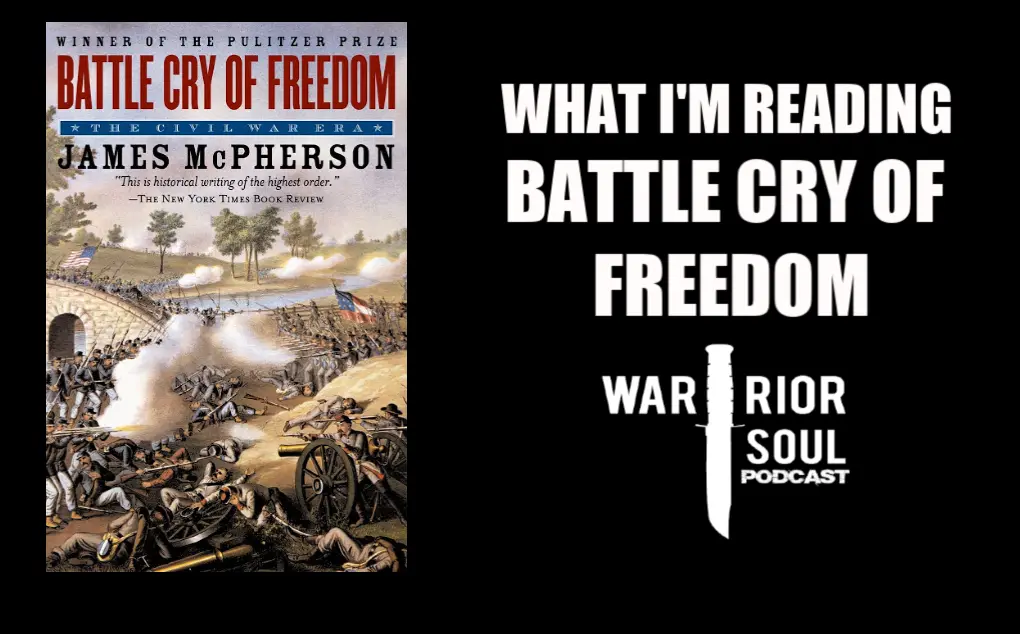
What I’m Reading | Battle Cry of Freedom
Hosted by Chris Albert
The Warrior Soul Podcast
Battle Cry of Freedom by James McPherson is known as the greatest single volume ever written about the Civil War...
Battle Cry of Freedom by James McPherson is known as the greatest single volume ever written about the Civil War, and I agree with that sentiment. It’s actually one of the best history books I’ve ever read.
In 2020, I’ve decided to make a concerted effort to learn more about the history of the United States. I’m doing this because many people these days are approaching our current political climate without any historical context, ignorant of our history.
McPherson’s chronicle of the Civil War is a window into the challenges our country faced at one of it’s most vulnerable moments. Understanding the leadership of the generals and political leaders, along with the sacrifices of the rank and file soldiers gives us insight as to how their decisions shaped the fate of our nation. It also helps us to understand many of the challenges we’re facing today.
You can get your copy of Battle Cry of Freedom at: https://amzn.to/2vmdBvs.
Transcript
Machine-generated from the episode audio and lightly edited — may contain errors.
Chris Albert (link to this point)
The Warrior Soul podcast is written, edited, and produced by me, Albert. Our mission is to provide tools, tactics, strategies, and ideas that help The US military veteran community to show up as the wisest, strongest, most capable versions of themselves in the civilian world. If you're not a veteran, stick around because anything we talk about will most certainly apply to you as well. This podcast is made possible with the help of F Bomb Nutrition. They make delicious packets of fats that you can carry around anywhere with you in little portable packets.
They make macadamia nut butters. They mix them up with chocolate. They mix them up with sea salt. They mix them up with coconut butter. They're absolutely delicious, and they're really good for you.
They don't have any sugar. They also make a lot of cheese snacks. They make meat sticks, and it's just a great company. These guys send packages of this stuff to the troops who are on the front lines overseas to supplement their MREs, and we didn't ask them to do that. They just did that on their own initiative.
Really great company. If you wanna get 20% off your first order of f bombs, head over to www.dropanfbomb.com and use the code Warrior Soul at checkout. This podcast is also brought to you with the help of Save the Brave. Savethebrave.org is a five zero one c three charity for veterans. They run camaraderie events that include fishing, golfing.
They also do a lot of work with Gold Star families. And unlike a lot of other organizations, their board doesn't take a salary. Really great organization that is doing amazing work. So go and check them out at savethebrave.org. With that, thank you guys so much.
Let's get into today's programming.
This is Chris Albert, and I'm here to remind you of one thing. Someday, you're going to die. Now that's not some morbid statement or scary idea. It's solid fact. Your time here on this earth is limited.
And we need to be reminded of this as much as possible for one simple reason, to live your best life while you can. This is the Warrior Soul podcast.
What is going on, ladies and gentlemen? Welcome to the Warrior Soul podcast. My name is Chris Albert, and this is where we deliver tools, tactics, strategies, and ideas to The US military veteran community to empower them to live their best lives so that they can show up as wiser, stronger, more capable human beings in the civilian world. And if you're not a veteran, stick around because anything I talk about here is most certainly going to apply to you as well. Today I'm going to do something that I haven't done in a while.
I'm going to talk about a book. Normally when I'm here I'm talking to somebody who's a lot smarter and a lot more capable than I am. And when I'm interviewing somebody, that is actually a lot easier than doing one of these solo podcasts where I've actually got to talk about something that I've read and talk to you about what it means to me and why you should read it too and what its impact could be on your life. And to be honest with you, I've been having a real difficult time putting this episode together. And that's because the book I'm going to review is the book Battle Cry of Freedom.
Now this is a a 900 page book. It's part of the Oxford series on American history. It won the Pulitzer Prize. It's by historian James McPherson, and it covers the civil war era. Not just the military aspects of the civil war, not just the generals, not just Lincoln, not just relations between the confederate states and the union, not just the economy, everything.
It's known as the greatest single volume on the civil war ever written. And the reason why I wanna cover it is because the political climate that we're in right now. I think a lot of people are approaching this political climate and a lot of modern day political issues without context. And the reason why this episode is particularly difficult for me to put together is because when we're talking about a 900 page historical book, number one, it's really difficult to cover that in a fifteen to twenty minute podcast. I could make this podcast three hours long and do a Dan Carlin, but I don't think that I have the talent that Dan Carlin has.
Actually, I know I don't have the talent that Dan Carlin has, and I know that you probably don't have the patience to deal with my lack of talent. So what I want to do here is I want to talk to you about what I got from this book, And I want to talk to you about, the larger context, which is approaching our modern politics, with some knowledge of American history. And why is this important? Well, I think that more and more Americans are existing in this country today without any knowledge of history. They're ignorant of American history in a lot of ways.
And I'm not just speaking about millennials. Right? Because I think millennials get beat up a lot of time. But even if you are a boomer or if you're from my generation, that in between generation, we didn't learn much about American history outside of some basic facts. Right?
We knew that George Washington was the first president. We knew that Abraham Lincoln was the president during the civil war. We knew that the civil wars fought between the North and the South, and that after the civil war, slavery was eradicated. And we knew that even though slavery was eradicated, that didn't eradicate racial injustice in the South. But beyond those basic facts, we we mostly don't know much.
Right? And when you get into a book like Battle Cry of Freedom, it takes you back into the historical context. And it gives you an idea of the ways in which this country was impacted by the civil war beyond just the slavery question. And when I say just the slavery question, that doesn't mean that I'm trying to minimize slavery. Slavery was a horrible injustice.
It was disgusting in my book, and it was an institution that was allowed to exist for far too long. Right? And when we talk about the history of The United States as much as we'd like to talk about it without acknowledging the mistakes of our past, I don't think we can do that. We can't. We have to acknowledge them.
But in acknowledging them, I think the mistake that a lot of people make is they say, well, The United States is not perfect. The United States was born of racial injustice all these different things, which is the case, but what they neglect to say is the following. Number one, perfect compared to what? The United States in its current form might not be perfect, but perfect compared to what? And the problem is that a lot of people compare us today to Utopia.
And when you think about what Utopia is, Utopia is supposed to be a place that's perfect in every way. The problem is that that place never existed, and every time somebody tried to create a Utopia, and I'm talking about Hitler, I'm also talking about Lenin and Joseph Stalin and Mao Zedong, I mean, just in those names that I just said alone, we're talking about men responsible for millions of deaths. Millions. And so, you know, to compare The United States to Utopia is just not fair. The other aspect of it is this.
Much of our history has been spent changing. Right? The United States that exists today is not the same United States that existed in 1850. It's not the same United States that existed in 1950 or 1970 or 1980 or at any point in history. Our country is constantly changing, and that's both good and bad. It's both good and bad because while I believe that that we needed to change, and we needed to eradicate things like slavery and racial injustice and and so many of the other inequalities that existed, The danger here is that we start to throw out the baby with the bathwater. And, you know, I have this idea in my head that I'm obsessed with. Right? This idea of freedom being something that is difficult to maintain. You know, I went over that list of men who, in their pursuit of utopia, killed millions of people. And the problem that a lot of historians and a lot of social scientists were trying to tackle during the twentieth century was the idea that men like that could exist, but not just that they could exist, that entire populations of people could go along with what they did. Right? There were so many studies on Nazi Germany and how Hitler could enlist an entire population into the eradication of nondesirable populations like the Jews.
When at that time, you know, we all think that people should have known better. Right? Had this occurred back in medieval times, we'd be like, oh, well, those people were, you know, still dumb. But but when we think about something like Nazi Germany, which was a technologically advanced society, an educated society, how does somebody convince a population like that to go along with the plan? And my opinion, and this is just one man's opinion, is that we as human beings were more naturally wired toward tyranny than we are toward freedom.
And if you think about it, right, this country, we've been in existence since July 4, 1776, of course, when we declared our independence. But our form of government has been in existence since 1789. Right? So that's two hundred and thirty one years that this idea of constitutional republic has been in existence. And when you think about that two hundred and thirty one years, that might sound like a long time to you and me.
But when we're talking about something like history, that's a moment in time. The Romans, when when we think about Rome, Rome, when it rose as a city till the time it fell as an empire, existed for a thousand years, right, in one form or another, It was a city, then it turned into a republic, and then it turned into an empire. And it existed for a thousand years. We've barely, barely, not even been in existence for a quarter of that time. So this thing we're in, this experiment, is still very much an experiment.
And if we forget our history, if we forget the context in which we've existed, well, the danger there is that we forget what it actually means to be free. We forget what liberty actually is. Because for the vast majority of our time as human beings on this earth, human beings in our current form they believe have been around for about fifty thousand years, and then the written civilization, the written history of civilization goes back about ten thousand years. For the vast majority of the time we know about, we've existed under authoritarian rule. And so I believe that a lot of us, while we have this innate tendency to go back toward that, and if we don't look out for it, if we're not vigilant, right, the price of freedom is vigilance.
We're not vigilant. Well, we could easily fall back that way. And so, you know, in 2020, I'm making a concerted effort to try to learn more about our history as a country. And that's why I started out with Battle Cry of Freedom because that is the most contentious period of American history. So like I said, I am not going to go through this whole book.
I am not going to make this a historical episode. I'm not going to go through the facts or anything like that. What I want to talk to you about is what you're going to get from this book if you read it. A few different very important things. And obviously with a book like this, 900 pages, everybody's gonna get something different from it.
Everybody's gonna focus on a different aspect. Some people are gonna focus on the facts. Some people are gonna focus on the military aspect. Some people are gonna focus on the economic aspect. But this is just what I got out of it, and I'd love to hear from you guys as to what you got out of it after you read it.
But the first thing that I got from this was the human personalities involved. Right? When we think about these historical figures like Abraham Lincoln or like Ulysses S Grant or Robert E Lee, the we I think we forget that they're they were actually human beings. That these were men with imperfections, that, you know, had their own fears and had their own anxieties. And I think that we often forget that these were men who were thrust into extraordinary circumstances.
When you think about Abraham Lincoln, for example, because I'm reading another biography about him right now that's called Lincoln, and that one's by David Herbert David Herbert Donald. I'm learning a little bit more about him, but in Battle Cry of Freedom, you learn about him, he was really a point of contention. Right? His election was kind of a straw that broke the camel's back for the South. Right?
He was hated. And when it came time for his inauguration, he actually had to be snuck into Washington DC. Had to actually be snuck into Washington DC in secret. Right? And a lot of us today, we think about the last presidential inauguration, and we think about, you know, all the things that were existing at that point.
And and and, you know, when we think about the idea of a president being snuck into the capital so that he could start doing his job, you know, that's that's insane. That's crazy. And I think, you know, despite the fact that that we revere Lincoln in that, you know, he many people consider him to be the greatest president of all time. I think we forget that he was a human being. And that he had his own fears, his own anxieties, that he was dealing with so many different things that would keep us up at night, that would keep us from sleeping.
And when I think about that, I think about this giant of a man. And I say that both literally, he was six foot four, but but also figuratively. I am so thankful that that man existed, because you see how his leadership really helped to keep this country together because we could have been divided permanently. The other human being that really stood out to me, and maybe this is just because of my own history, but was Ulysses S. Grant.
And, you know, again, another president of The United States, somebody we look at as a giant. Right? Somebody who has had such a mark on American history. But one of the things about Grant was that he had been kicked out of the army. He was an alcoholic.
And he, you know, had such a bad reputation that he couldn't get another command. He was broke. He was destitute. And then when the civil war broke out, that was the only reason he was able to get a command because there was such a shortage on generals. And you contrast him to somebody like McClellan.
McClellan, as opposed to Grant, was kinda like a golden boy. He graduated at the top of his class at West Point. He was considered to be one of the top generals in the army. And the thing about McClellan was that when it came to performing in battle in the civil war, he was a really really awful disappointment. He hesitated too much.
He was constantly just making second guesses about what he should do. And he was constantly blaming things on other people. He had no humility whatsoever. And you could contrast that to Grant, who who was a much more humble man at the time. Somebody who had made a lot of mistakes, who had learned from those mistakes, and then slowly worked to improve himself.
That is something that I think we should all consider in our own lives. Right? If you're facing a situation and you're constantly blaming others, and you're constantly, you know, ignoring your own faults and keeping yourself from improving and keeping yourself from changing and doing so at the expense not only of yourself but everybody around you, well, then you're gonna be in a much worse off place. And that was the case with McClellan. McClellan was eventually relieved of command.
He eventually ran against Lincoln in the election, and he lost. But, but he's somebody who the author is not very kind to. And you get a lot of that contrast, between those two human beings, Grant and McClellan.
The other aspect of this from the human side is thinking about the average human being who fought in this war, you know, the enlisted men. And, you know, I just saw that movie 1917, and one of the things you get from that is a really good picture of what trench warfare was like during World War one, and all of us hear about it. You know, we hear about the history of World War one and how technology outpaced the tactics and how everybody was locked in a stalemate and how people were running head on into live fire. And the civil war and world war one were were actually very similar in this regard. The technology had outpaced the tactics.
Most of the officers during the civil war had actually been told taught Napoleonic era tactics at West Point. And you think about what it must have been like for those human beings, those men who, you know, were far more under the thumb of their officers we are today. And you think about the bravery they had to have to come out on the battlefield and exchange shots and then lead charges and and things like that, and the amount of death they must have been surrounded by, the things they must have seen, for those who survived, the memories that must have been in their heads for the rest of their lives, it boggles my mind. And as a veteran, that's something that that I was thinking about throughout reading this book whenever he talked about the military aspects of the war. But beyond all this, beyond these these things I'm talking about here, the implications for our country. And it goes back to what I said toward the beginning of this podcast. You know, The United States never was perfect.
Never. Right? We were born of slavery. We had to deal with slavery throughout our history. There's been inequalities and injustices in The United States from its beginning.
But the one thing we have done is we've been able to change. We've been able to improve, we've been able to work toward a better union. When I finally got to the end of the book, that's what was ringing through my ears, That was what was going through my mind. The fact that, you know, if we're going to sit here and we're going to talk about The United States, yes, we do have to talk about all of its imperfections throughout its history. We have to understand why those imperfections occurred. But we also have to acknowledge that we've moved toward a better future, and that we're constantly moving toward a better future.
And we have to be vigilant to ensure that we're moving toward a better future. And that's why reading books like this is important. So that you understand. So that you understand how fragile this constitutional republic really is, so that you understand how lucky you are to be born in a time, in a place where so many have come before you to try to perfect this government that we're living under, this republic that we're living under, so that you understand that when somebody pulls a piece of history out of context and makes an argument that's just based off of their opinion, but they're trying to use historical fact and and spin it so that you understand the full context, so that you understand the complete story, so that you're not dragged one way or another, like so many people have been in the past under dictatorships in authoritarian rule, by men who were trying to move us toward utopia. And so that you understand that utopia doesn't really exist.
As much as you would like to create a perfect society, the best you can do is make a lot of mistakes as you go, acknowledge those mistakes, improve upon them, and then move forward. And that's what happened in this country during the civil war. And that's what you'll understand better if you read Battle Cry of Freedom. So, again, I'm sorry if I murdered anything here. I know there's a lot of people out in this audience who are history buffs and who are gonna probably take issue of any number of things I said and feel free to correct me because I'm not, you know, lord and savior of of history or anything like that.
But, you know, I hope you get the gist of what I'm saying here. And I hope also hope I didn't bore you. So I wanna thank you guys for for listening to this today. I tried to not take up too much of your time. There is so much to this book.
Like I said, it's 900 pages, and it starts all the way at the Mexican American war, which shaped a lot of the the officers and the generals who who, you know, created the history of the civil war. And then it goes all the way up until the surrender at Appomattox and the immediate aftermath of that. It doesn't go into the postbellum period of reconstruction. That is for another volume. Like I said, this is an entire series, But I highly suggest you read this book.
It's definitely worth the investment of time. 900 pages. It took me about a month and a half to read this. For some people it might take longer than that. For some people it might take less.
But I read an hour of it every day and you know, I was really I was almost sad when it ended. So I'll have links for you guys to grab this book up on the show notes for this episode. And again, I'm looking forward to hearing your thoughts. If you enjoyed this podcast, if you enjoy the Warrior Soul podcast in general, if you can, please do me a couple of favors here. Number one, please subscribe to the podcast.
Number two, please share these episodes out with anybody who you think could use this information. I'm not always talking about books. I'm talking about things to improve your lives. I'm talking with people who are a lot smarter and more capable than I am, so that they can deliver their tools to you. People like Gary John Bishop, who I'm going to be publishing a podcast in about a week from now after you're listening to this.
And he wrote a book called Unfuck Yourself and another book called Stop Doing That Shit. Really great books about how your subconscious affects your actions and how to keep your subconscious from affecting you negatively. I'm also talking to Austin Alexander who's got an awesome YouTube channel. He's an active duty navy guy. And he came on to talk about his business, how he built it, how he got to creating on YouTube, and what he's gonna do after he gets out of the Navy.
And I know a lot of you guys are still in and you're trying to figure out what you're gonna do, and hopefully you'll be able to gain some lessons from that. So definitely stay tuned for those episodes. If you want to support the podcast in other ways, we've got some ways of doing so. We've got the Warrior Soul shop where you can buy some amazing t shirts. We've got both graphic design and skivvy shirts that you can get for your wearing leisure.
And then I've also got a new site up. It's the Warrior Soul Academy. That's about warrior soul dot academy. And that's got a bunch of my books, my writings on fitness, on training, on nutrition, on building your own business. I've got a book on how to or not a book, a course on how to start your own ecommerce clothing company if you want to do that.
And I've also got a course up there about how to start your own lifestyle brand. So definitely some stuff for you to check out that's at warriorsoul.academy. And then finally, if you want to support yourself, you can join our private mastermind, the Warrior's Obituary Society. And the cool part about this mastermind is it's made for men who want to empower each other to live absolutely epic lives worthy of epic obituaries. It starts with an eight week development program.
We help you to get really clear on your vision, what you want out of life. Then we help to focus you on specific aspects of your life like your fitness, helping you to customize your own fitness plan, helping you to create your own personal finance plan. And all that happens in an eight week period and then you become a full member of the society and each week we're on live calls with the group and we are holding each other accountable to those goals. So if you want to check that out, that's at www.warriorobituarysociety.com. Once again, I want to thank you for listening.
Hope you enjoyed it. I'll be talking to you soon. Get out there. Live your best lives while you can. This is Chris and I am out.
Host of the Warrior Soul Podcast and founder of Warrior Soul. Worldwide trainer and nutrition coach, contributing author at Testosterone Nation and Muscle and Strength.