Podcast episode
Episode 28: Identifying the Enemy – What is Post Traumatic Stress Disorder?
Hosted by Chris Albert
The Warrior Soul Podcast
To listen on itunes: https://itunes.apple.com/us/podcast/the-warrior-soul-podcast/id1096901382?mt=2
Post Traumatic Stress Disorder has haunted the veteran community for the last decade, leading to high suicide rates and to many veterans not living optimal lives. But in this episode, we attempt to identify PTSD and its physiological components. We pose questions about the current military medical practice and we drive toward some potential answers to things we all might want to try to improve our lives. We get into the work that Andrew is currently doing with the Warrior Angels Foundation and we discuss ways that veterans can take charge of their own lives in pushing toward solutions to living their best lives.
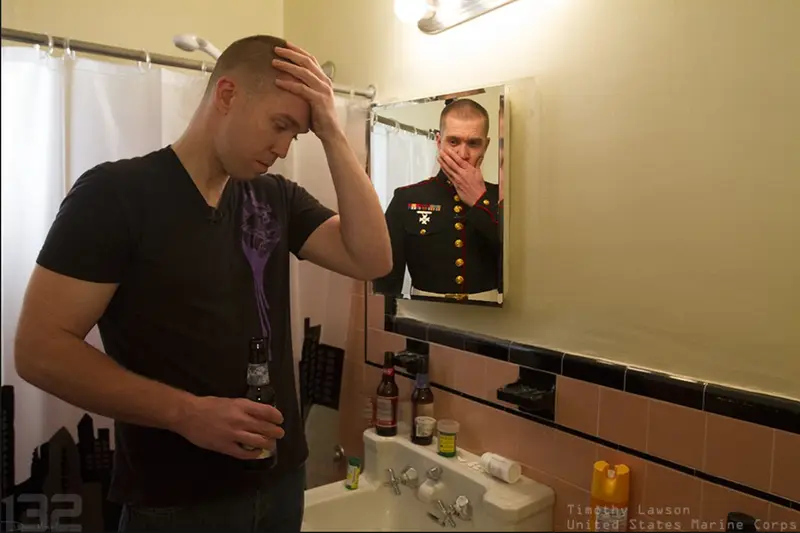
Photo credit: Devin Mitchell Veteran Vision Project http://veteranvisionproject.com/
Show Notes
For the Warrior Angles Foundation: http://www.waftbi.org
Watch Andrew’s Story :
Resources on Ketogenic Diets:
1. Chris’s Article on Saturated Fat: https://warriorsoulagoge.com/blogs/news/debunking-the-myth-that-saturated-fat-causes-disease
2. Keto Camp: http://www.warriorsoulketocamp.com
3. The art and science of low carbohydrate performance by Jeff Volek and Steve Phinney https://www.amazon.com/Art-Science-Low-Carbohydrate-Performance/dp/0983490716
4. Chris during his last bodybuilding competition after eating one meal a day for the entire prep.

Transcript
Machine-generated from the episode audio and lightly edited — may contain errors.
Chris Albert (link to this point)
When we think about post traumatic stress, we often think about medication, and we think about doctors, and we think about hospitals, and we think about only being able to take the medication that they give us. And while it is not my job to challenge doctors and their advice, it is my job to enlighten you on what I think is the key element in trying to heal yourself from anything, and that is deciding that you are going to get better, deciding that you are not going to allow your circumstances to rule you, deciding that you are going to take your life and change it for the better. Today, my cohost Andrew Marr and I speak about this issue. We talk about some of the success stories he's gotten from his work with the Warrior Angels Foundation. Andrew is a retired special forces operator who started the Warrior Angels Foundation to, what he says, fight for the medically oppressed.
And I think that's what we're truly dealing with right now, people who are being limited by the military medical model. A major component of what we talk about is that process of decision. We also get into some of the other things that play a role in creating the symptoms of PTS and depression, things like nutrition, things like hormones, things like exercise, or lack of exercise. But above all, we talk about taking charge and leading ourselves toward recovery. So without further delay, let's get into episode 28 of the Warrior Soul podcast.
This is Chris Albert, and I'm here to remind you of one thing. Someday, you're going to die. Now that's not some morbid statement or scary idea. It's solid fact. Your time here on this earth is limited.
And we need to be reminded of this as much as possible for one simple reason, to live your best life while you can. This is the Warrior Soul podcast. What's going on everybody? This is Chris Albert and welcome to the Warrior Soul podcast. This is episode 28. My God, 28 episodes we've done. Seems like yesterday when we were just getting this thing started. I'm here with my brother, my pal, Andrew Marr.
And we've just had some really awesome things happening over here at Warrior Soul. Tony and I just got back from London. Andrew just got back from Orlando, Florida, where he was attending a conference. Tony and I were actually out meeting with London Real, Brian Rose from London Real. And we, you know, took part took part in their super focus group.
I've been one of Brian's instructors for his business accelerator course for a while. And Tony and I both got interviewed. One of the interviews is up on our blog right now and Tony's interview will be up later on this week. But man, really exciting trip. Got to see lot about London Real itself and some of the people involved in that organization and and the people who are fans and they're absolutely amazing people.
Tony and I got really fired up. We got some awesome videos out there on YouTube just about our high jinks in London and and things like that. But we have some some more important business at hand right now. And to be honest with you guys, we're we're gonna do a show with somebody today and that person decided to cancel on us last minute. But, Andrew and I just wanted to come on and talk about one, some of the victories he's having over there with the Warrior Angels Foundation.
Some of the amazing things he's doing for veterans and helping them to battle things like traumatic brain injury and post traumatic stress. And two, we wanna get into some of these new things that we're getting into. Andrew, over the weekend learned quite a bit about the ketogenic diet and a lot of you might know I've been an advocate for the ketogenic diet for a while. I've also written about it for for quite an extent, so we'll get into that too. And we're gonna be getting into some of the different techniques and and things like that that you can use to to really improve your energy all day long.
And we'll talk a little bit about that later on. Just simple things that you could do every day. Just so your day is not dragging on so that so that you can be your best self when you want to be. You can't always be your best self, but you can create the conditions that are gonna facilitate your ability to perform like the best you can. So Andrew, brother, how are you doing, man?
Andrew Marr (link to this point)
Man, Chris, I'm I'm doing amazing. And I'm following you guys through your London escapades and, looked like a great time. One legged, you know, pistol squats and drinking mushroom coffee and, working out and in and out of the London Real Academy, Buckingham Palace. You guys are crazy all over the place. So enjoyed watching that.
We I got an incredible update, from one of the guys that, we're supporting through the foundation, and it's kinda what Chris was alluding to earlier. But I just wanted to share what this young man, wrote because it does a great it really hammers through the point of the decline that somebody can go through from post traumatic stress and traumatic brain injury, and then how they can pull themselves out of that. And then what is life like once they return to a level where they can function at a higher level. You know? And so without saying too much more, I'll read it.
And it's gonna take a few minutes, but bear with me because I think you'll really be moved by this this moving testimonial that we got, and then we're gonna dissect it further afterwards. So here it goes. Andrew, got off the horn with a doc the other day after my labs, and it looks like my body is responding very well to treatment. I wanted to share with you that I got approved for vocation rehab through the VA and I'm just finishing my first semester at a college in Nevada. This is significant because this is my fifth attempt at college since I discharged from the Marine Corps in 2007.
This is the first time ever that I'm taking a full load on campus, fifteen hours, and I'm making As and Bs without having dropped a class. Sure, I struggle a lot, but it is shocking how well I have been able to cope. Historically, I burn out after midterms and drop out. This year though, I felt the itch. I stuck it through.
Physically, I am strong. I had to drop my regular training program when school started, which sucks, but I plan to start back up next week after finals. Before school, though, I was reaching a pinnacle of strength that I had not realized in many years after starting the treatment last spring. I remember the first week after treatment, I added an exercise at the gym for each lifting day. After the second week, I added another.
I didn't stop all summer. I was loving the amount of challenge I could add to my plate and still meet with gains. I still hit the pull up bar when I can, and I noticed the other week that despite my interruption in training, I've not lost much strength. It seems like my muscles don't atrophy as fast as they used to, and I'm much more active in general before fatigue could wipe me out for days. No longer.
Other good news. With Voc Rehab in school, I'm realizing my dream career goal of being a national park ranger in Alaska. Over the past two months, I've scraped, scrounged, wheeled, dealed my way into a backcountry ski kit. It is the kit that I have wanted for fifteen years, and I wrote it off as a pipe dream. My bindings come in next Tuesday, and from there, I am good to go.
Next semester, I take a full course in backcountry skiing as well as avalanche and wilderness first responder certification. I'm also looking into taking ice climbing certification outside of college. As of now, I'm looking to take a job as beginning mountaineering guide on Mount Shasta next summer. Last year, I would have never believed that my body would be able to undertake the rigors of the high alpine day in and day out. This year, I feel stronger than ever.
I have set a goal for myself to summit Mount Denali by the age of 40. It's what gets me out of bed in the morning and has become quite the motivation of mine in everything I do. I stopped dreaming this big years ago. In other news, I picked up my trumpet that I never thought I would play again. I started studying the game of chess with my brother.
I read more book I read more books now for fun in a month than I used to in a year. I have taken up again my study of history and prehistory. I have started to rock climb and and snowshoe. I, get this, have even made a civilian friend or two at college. In short, I've taken up several hobbies when before there were none but group and individual therapy appointments.
All this is on top of school. Just last fall, I used to dread how long the days were. Now it's upsetting every day how fast time flies because there is so much I want to do and experience. What a transition. It's simply fucking amazing, Andrew.
From parents and siblings to friends and acquaintances, I would say that nobody really recognizes who I have become in such a short time this year. I must admit, I become emotional just thinking about this shit. In July 2014, I was taken via ambulance from Austin, Texas to the psych ward in Waco, 94 Bravo. I did my time there. I did my time in Temple at the Reintegration Residential dorms.
I did my time at the PTSD clinic in Waco. I tried the meds. I tried it all. That following summer of twenty fifteen, I backpacked 1,500 miles across the Sierra Nevada, trying to find a purpose for living. I realized that I was walking on my purpose and that being in the backcountry was the only time I truly felt at ease and content.
It took two more psych wards, but I managed to land in Reno to be close to the mountains where I lived homeless out of a storage unit until I couldn't afford an apartment. That was last year, chugging beer beer, smoking cigarettes, and trying to stay warm in a storage unit, looking up at the mountains, and wishing I had the money to get the gear to get out there. It was absolute shit. However, this year, I got the gear. This year, I am in an apartment.
I have made a home in a few short months. Haven't smoked a cigarette since I started TBI treatment, a fifteen year habit, and haven't had a drink in two weeks or more, I guess. I only drink on occasions now. Alcohol does not have a hold over me anymore. In almost two years of intensive VA treatment, I have made more progress with Warrior Angels and Doc Borden in two weeks.
I'm not knocking the VA, they've helped me a lot. But I knew before I left on my backpacking trip that I had reached the apex in the VA system. They told me I couldn't get any better, that I would just have to live a life of coping, but I always hoped I could get better. When I heard you and the doc on Joe Rogan show, I was like, that's it. I pulled over at the first Starbucks I saw off the freeway, and right there, I started my application.
Maybe people who don't know me don't recognize me because of the change, but I sure do. I recognize a person that I thought was long dead. I feel like I have been given my very own being back. It's like I am becoming the person I was nine years ago upon discharge, before I felt myself starting to slip. Back then, I had all the hopes, all the confidence, all the motivation to seize life.
I joined at 17, had my eighteenth in infantry training, and my nineteenth and twentieth in Haditha and Fallujah, Iraq. When I discharged, I wanted to get out and experience life so bad, and for a time I did, but it seemed to just keep getting harder. I just keep sinking and sinking for seven long years till mentally, I couldn't take it anymore. And I went to treatment. And I now know what the fuck was up with anything.
And I don't know what the fuck was up with anything, much less why. Well, now I'm back, and I'm doubly enthused because instead of four years of enlisted life to make up for in the civilian world, I now have thirteen. It truly feels like I have been given a second chance, and I'm starting to put down new tracks for the first time. It feels damn good to be in control and blazing my own trail again. Thank you from the bottom of my soul.
And then he went on a whole paragraph just asking what he could do now to help us help others, and he finished with great gratitude, and then his name. And, you know, Chris, I have a a a number. I too many to even list or remember of accounts like that. And now with over a 160 people that we've helped, so many stellar reports like that. Absolutely incredible.
Here's a young man who made the decision to serve his country and came out and was ready to take on the world. And he wasn't complaining about anything. He wasn't thinking anybody owed him anything, but he started to sink, and he just couldn't understand why. He asked the system to help him, and the help he got was not helpful. And he just continued to sink, finding himself homeless, drinking and smoking his days away until he realized, you know what?
I'm through with this. And I don't care if anybody says it can't be done. I don't care how long it takes. I don't care how much money it takes. I'm gonna find a way to live a life of purpose again.
And sure, we helped him getting everything straight hormonally and getting rid of inflammation, but he had to make the decision. I mean, that not an incredible story of somebody in one year going from just, thinking about there's no way out of it to now absolute living the purpose they've they have created for their life?
Chris Albert (link to this point)
Man, that that just fired me the hell up. I'm I'm I'm so motivated right now, just hearing that that story. And, you know, both you and I have been there as far as depression goes in in in dealing with difficulty. I think that when you come out of something like that, it's so crazy because it's almost like the clues were right in front of your face all along. Simple decisions that you had to make every day that built up into larger things.
And it's crazy when you come out of something like that because you realize that it was always within your grasp. It was always right at the tips of your fingertips. And you always have the opportunity to change every single day. It's just a matter of what he was describing there. He was describing himself as being trapped, being pinned in.
And he went from being trapped to seeing a world of possibility. And I think that that's one of the things when we look at PTS and the way it's treated in this society. You notice I don't put the D on the end of the S, on the end of PTSD. And the reason why I don't put the D on the end of PTSD is because I don't like to call it a disorder. And the reason why I don't like to call it a disorder is because it makes people think that it's entirely beyond their control.
It makes people think that they're abnormal. And if you start to make people think that they're abnormal, and that they are attracted to something, then they're going to act that way. They're going to manifest that behavior. But when you give somebody something, you know, and we're talking about a few weeks here, give this young man some hope, give this young man some let him take charge of something, Then he's going to grab it by the reins and he's going to ride that thing out to success. And that is fucking amazing.
That it goes beyond anything. That's awesome.
Andrew Marr (link to this point)
Yeah, it really is, man. It speaks like you're talking to Chris to the power of suggestion. And what I mean by that is tell that individual that, hey, you know what? You have a disorder. You have PTSD.
And you know what? Life is never gonna be the same. And you're just going to have to learn how to cope with it. And so what is what do most people redo when a medical professional tells them that? They're going to accept that as truth.
Right? They call it the voodoo hex. You tell somebody that they have three months or six months to live, guess what? They end up dying in three months or six months. And it's funny because they always use these three month increments.
It's like three, six, nine, or twelve months. But that speaks to the power of suggestion. And so if somebody says it, that person now perceives that to be true. And so I wanted what I wanted to talk about, Chris, is how we actually learn this neuroscience behind it and how that can affect something like post traumatic stress. So we know through a guy named Hebbs, doctor Hebbs, a famous neuroscientist who came up with what's called Hebbian law.
Hebbs law says that neurons that fire together wire together. Alright? And so what that means is when we think certain thoughts, neurons are gonna fire electrically in the brain, and they're gonna form neural networks. So if, if whatever that thought happens, it continues to happen, it's going to form that network so we can access that information easier. Right?
And then it goes from that thought into a and that's in the neocortex. That's the the newest part of the human brain. That's the last part of the brain that's evolved. It is the the part with all the folds in it that you see when you see any exposed brain. That's the neocortex.
If you think a thought long enough and you continue to build those neural networks, it's gonna go from the neocortex into the second brain called the limbic brain, the limbic system. The limbic system is where our emotions come from. Okay? All emotions are regulated in the limbic brain. And so it goes from a thought to a repetitive thought into the limbic system.
From the limbic system, it goes then to the cerebellum and the brainstem. And the cerebellum and the brainstem, well, what the cerebellum does is that is where we do unconscious, not unconscious, subconscious behavior, like walking. At one point in time, every single one of us did not have the neural network in our brain for walking. And so that's why you see babies struggling and jiggling and their muscles aren't working right. So many things has to happen in your body for you to be able to take a step.
The hamstring has to tighten on on one and they'll ask to let go on the other leg and the quadriceps have to tighten and there's just all kinds of processes going on that you don't have to consciously think about for it to happen. You just have to say, I'm having the intent to go from a to b, and guess what? Your body does does it all. Well, that's that's what the where the cerebellum comes in, and those messages didn't get sent down the brainstem to the spinal cord to the rest of the body to then push those messages out. So we think about this.
If post traumatic stress is a traumatic event in someone's life that happens, then that person then recalls that negative event that happened in the past. They can by thought alone, bring up all of the emotions, everything that the body experienced, its physiology, through its neurochemistry, and everything else in that past can bring it up to the present time, to the present event. And the body is going to replicate what it's feeling off that thought alone. Okay? Because it can't look outside.
It's just getting this information from the brain that this situation is happening again, and we're gonna respond in this way. So when a trauma happens to somebody, whatever it is, horrible as it is, if a person continues to think and bring up those negative thoughts or that trauma, and it continues to elicit that physiological response in the body, they have now just brought that past up into the future. And guess what happens at that point? At that point, your past now becomes your future because you are going to make you're going to feel the same way. You're going to think the same way, which will then cause you to and to make the same choices.
So you've just created a Groundhog Day type scenario in the brain first just by continuing to bring up these negative experiences. And so, again, so the thought, new thought, neocortex. Continue to have the same thought, you build a neural network. You know that neurons that fire together wire together. So if you start keep having that thought, that neural network is gonna wire together, and it's gonna be easier now to replicate that past trauma.
Thought then goes to the limbic system, which says, okay, let's produce these emotions. And the limbic system via the hypothalamus and the pituitary gland are then gonna send out those chemical messengers to the rest of the body saying, through this thought, we now know to act and feel like this. Rest of the body respond. And when you do that long enough, it then passes through and goes right to the cerebellum and becomes a automatic behavior. And you we can do this.
We do this with any type of behavior, any type of, thinking process, positive as well as negative. And so post traumatic stress is caused by the amygdala in the limbic system to release cortisol and other stress hormones to react to what they think is an acute stressor in their life. Problem is it's not acute. It's brought up by thought alone. So that's that process, Chris, where it goes from thinking to doing to now being.
Alright? And so that says, we've thought about it long enough. We've done it long enough, and now that's who we are because it's gone from a mood to a temperament to a physical trait. And it's happened through a learned process just through that. And oftentimes, it's being done so unconsciously by the individual because who consciously would wanna bring up something that they would make them react, emotionally to a certain thing.
And then when you build those networks over and over and over and over again, that's when somebody hears a loud sound and they wanna hit the deck. That's when somebody goes outside and they hear a a horn on a car, and now they're afraid of horns. That's when somebody goes to the store, they start having a panic attack, and they say, oh my god. I am just deathly afraid of being in public places and at grocery stores. But really, that's not it.
It's the it's the chemical it's the neurological, chemical cascade that's created by thought, and now it's manifesting physically, and you just all of a sudden become aware of where you are when those things are now coming forth. And so it's not the fact that you're in a grocery store. It's the fact that all of a sudden now you become aware of your emotions and you're trying to correlate it to something. The brain is trying to sync it up to something, and we say it's a store. We say it's loud explosions.
We say it's being in public places. But what it is is the amygdala being stressed nonstop, and it's running us and causing us to live by the hormones of stress.
Chris Albert (link to this point)
Nice. I mean You know, so, you know,
Andrew Marr (link to this point)
that's that's a that's a pretty cut and dry process, you know, of of of how it happens, Chris.
Chris Albert (link to this point)
As far as as far as your brain goes, I mean, you're constantly remaking cells in the body. You're constantly remaking cells in the brain. And, you know, it goes to show if if you think, like, you're in a world of shit, you're gonna end up in a world of shit. It's gonna happen. You know?
So one of the things I think we need to do, we need to be teaching people to do is to to really be a constant observer of your own thoughts and asking yourself, well, why am I thinking this? Why am I why am I feeling this fear right now? Why am I feeling this way? What is bringing this on? And really kind of doing these types of journaling exercises that we hear about a lot of different people doing.
I've been doing that a lot lately and that's been helping me out immensely. Asking yourself certain questions about, why is this a problem? If there's a problem in your life, ask yourself, why is it a problem? What is causing the problem? How can I solve this problem on my own terms and things like that?
And I think that, as far as everything you guys are doing over there at Warrior Angels Foundation, what I admire about you is that it's not just, hey, here, take a bunch of chemicals and go forth and do these things. You guys are actively trying to get people to decide to improve their lives. And I think that's important because it's one thing to say, go out there and take this, or go out there and try this, or let's raise awareness about this. But it's another thing to say, all right, well, it comes down to this, you need to make a change in your life. You need to make some sort of behavioral change.
And why don't we start with this protocol that we're doing, but let's make some decisions in your life that that are gonna lead to some better things. Let's let's make some decisions that are gonna get you out of this negative feedback loop.
Andrew Marr (link to this point)
Exactly. You know, and I wanna first and foremost say that I, I've been diagnosed with, PTS. So it's you know, it is a rated so called disability. But if you if anybody has, would like to speak more on it or have any more questions, please please send them. And and all this is coming from a place of love where I wish I would have had this information where you know, life happens, but I didn't have this information when my own personal train started coming off the tracks.
And so it's important to understand what happens when we elicit the stress response, the fight or flight response in our own body, which then causes us to live by the hormones of stress. And again, it goes back to we'll talk some neuroscience here, but we'll break it down where it's really easy to comprehend. The hypothalamus, okay, in the limbic system regulates pituitary gland, which regulates virtually all hormones that are released in the brain to go to the other glands in the body deliver that message. So the hypothalamus is it can't see out of your skull. So it is just getting a message through our five senses about what's going on in the outside world.
And so when it gets a message that there is a threat, whether it's real or not, it produces a fight or flight mechanism through the pituitary gland, which enables somebody to do just that, to hide, to fight, or to run. And what has to happen when those are at the highest priority? Well, all of our blood that runs all of our organs is scored in our viscera. Alright? So that that is from about your waist up all the way up to your clavicle.
Right? That's where all the idle organs outside of the brain, remain and stay. And so it is going to the body needs to mobilize energy. It needs to mobilize blood to fight, hide, or run. So it is immediately gonna take that blood out of that viscera, which supports all the organs in your body, and it's gonna push it to every extremity that you have.
So you could then can have the energy to do the things that you need to do. But let's talk about when you do that chronically and you live in a chronic fight or flight, reality due to thought. What that means is the blood is no longer in the viscera and your body is not worried about proper digestion. Your body is not worried about its immune system. Your body is not worried about making complex decisions, planning for the future, living in living, you know, happily in the present.
Why? Because the body thinks we have to mobilize this energy, this blood to deal with this acute stressor. And if we don't, we won't survive. So also in the brain, it does some very fascinating things. It's gonna take the blood that's in the front of our brain called the frontal cortex, and it's gonna move it back to the back of our brain where we're now where that's responsible for reflexive behavior.
And so now, by definition, we're not able to operate as intelligently as we could or should if we were in a state of balance, that blood has gone back there to the back of the brain and we are responding to stress. We are in pure reactive mode. And this is why it's easy when you've made this neural network based on past traumas and emotions to stay in there and not be able to figure out that, you know what? I the way that I'm thinking is killing me. It's causing me to be less intelligent.
It's removing all the blood that I need in my vital organs and pushing it elsewhere. It's opening up my immune system to sickness and disease. And by, again, by default, there there is bugs and bacterias in our body that we call opportunistic. In other words, there is pathologies that are just waiting for the opportunity to strike. I've been told that virtually every kind of sickness and disease you think is out there, we have in our body already.
It's just that our immune system is so strong, it's irrelevant. But when that chronic state happens for so long, that's when these opportunistic bacterias and bugs are going to strike. And what do they do? They punch holes in the the immune system, and it manifests as a symptom, as a sickness, as a disease. But again, if this is coming again from the stress response that is happening from something that is not an acute stress or life or death situation, then it's coming from a learned process that we've taught our body to do.
And many times, we've taught our body to do it so well that we don't even have to think about it. It just immediately goes into that mode and that's the place that we get stuck in. And yes, horrible things happen. We've all a lot of us who've been in the military have been a part of it. But I'm here to tell you, once you can start looking at your past through the lens of not getting emotionally, thrown off by it or wrapped up in it, then now you can look at it and that becomes wisdom.
When you can look at past events without any any emotional ties or attachments to it, you can just purely look at it to, hey, how can I better myself and better everybody else around me without the emotional ties, that's called wisdom? And if we continue to do the opposite of that, we're gonna continue to struggle with the term that we've called post traumatic stress. So what I'm saying is, Chris, it's a decision. Unfortunately, a lot of us don't know that we have the power to start, you know, to make our bodies sick, and we also have the power to make our bodies healthy. And it happens in that cycle right there.
You know what I mean? And I haven't heard any other science, broken down on post traumatic stress of how it occurs. And if we're just throwing medications at it, if we're just trying to talk somebody through psychotherapy, if we're just trying to throw other mind altering drugs about it, if the person cannot go back and look at that past event through the unemotional lens and convert that to wisdom, they're gonna continue to produce what was once a past event is now their future. Right? And and and that isn't critical.
How do we stop it? We stop it by becoming conscious of it. We become conscious of our thoughts saying, this thought has not been any good for me. It's not been any good for me. That's step one.
Right, Chris? That's step one. Catch those thoughts. And then you go through a system of trying to rewrite what's now a subconscious program. And you do it first by becoming conscious of it and stopping it, you know, and we'll outline the steps there.
But anything you want to hit on brother, after that long rant by me?
Chris Albert (link to this point)
I mean, no, it's not good, man. I I I completely hear what you're saying. I think that, yes, definitely depends on the person and definitely depends on that first step and and being able to like you like you said, observe yourself your your your thoughts objectively and observe your past objectively and see them with wisdom. I was thinking about this the other day and I was I was thinking about fear, and I was thinking about some of the things that drive fear, fear of making mistakes, fear of screwing up, fear of going out there and taking a chance on something because you think you're gonna fail. And I was thinking about the way we kind of set our society up.
When you come out of high school, you meet with guidance counselors, they're talking to you about your options on where you should go, what you're going to do when you get in the military, you meet with career counselors, you're talking about your best track for promotion and things like that. When you get out of the military, you meet with people who are trying to guide you through transition. And what I was thinking about was the fact that our society kind of tries to keep us all in this safe space, where we are going to be on this kind of path toward perfection, this path toward some sort of ideal typical life, you know, and we all have in our heads that ideal typical existence. You have the wife, two cars, picket fence around the house and things like that. And I think in some ways, the track record that we place on people who are getting out of the military is in some ways unfair because we just expect them to come out and just act normal. And in some ways, I don't know that normal is a good thing. I don't think you went into special forces to be normal.
I didn't go into the Marine Corps to be normal in the first place. So I think one of the problems is that the expectations we set for ourselves when we're getting discharged are not really our own expectations, they're expectations that that become imposed upon us, by society. And and because we don't meet those expectations a lot of the times, we end up being disappointed in ourselves and kind of tearing ourselves apart and saying, okay, well, I'm not feeling well right now. So, you know, I'm screwing this up completely and I'm messing my own life up and I don't deserve this and maybe they're right about me. Maybe they're right.
Maybe I am crazy. I think one of the things we need to think about more is the questions we ask ourselves when we're on that transition period. And rather than asking ourselves, well, how can I become successful? You ask yourself, well, what mistakes can I make
Andrew Marr (link to this point)
that I'm going learn the most about?
Chris Albert (link to this point)
Because when I think back on it, and I'm sure when you think back on it, you've learned the most probably from your mistakes rather than your successes. Because every mistake you make brings you closer to some semblance of success. Every time you screw up, every time you don't get to where you wanna go, every time you feel a little bit of pain, brings you a little bit closer to where you should be. And I think that rather than being afraid of that and rather trying to embark on these perfect paths of transition or exhibiting no behavior at all, I think that that one of the things we need to talk about is is, you know, what experiments are we gonna do? And if we do screw up, what are we gonna learn from it?
Andrew Marr (link to this point)
Yes.
Chris Albert (link to this point)
Absolutely, man.
Andrew Marr (link to this point)
And talking about fear, fear of failure, worrying about what society thinks. You know, we do we do learn from our failures if we're willing to look at it objectively and try to figure out, hey. How can I make better decisions to drive better outcomes? But when when you're living by fear, when you're worried about certainty, you know, meaning that, hey. I have to have all these things in place for me to feel protected, for me to feel like I am providing some kind of benefit to somebody else based solely on what they think about me, you know, things like that. When you're living that way, I think that you've limited yourself from going out and taking risk, and that's when you're gonna start failing.
You just start failing when you're doing your best, not trying to live in a life of certainty mapped out by a guidance counselor, a banker, a pastor, whoever, you know, a military transition dude. It comes from realizing, hey, man, how do I live a life worth living? And what would it take for me to to manifest that? And then going out and saying, okay. Well, if this is the end state, here's where I am now.
Let me make some manageable things and and chunk it put it into chunks to make markers that I need to get to. And if I don't get there, then I need to look back at that last chunk or maybe, you know, even more behind that before that and say, these are the reasons that I'm not driving the outcomes I think I should be driving. And if you're actually doing your best, those are start coming up and being illuminated really easily, really quickly. But the point is is one has to do their best. That didn't say be perfect.
It doesn't say to be something that you're not. It just says to be your best. And guess what? We can always get better. Alright?
I you're gonna be better tomorrow. But today, we're working as hard as we can to be the best that we can today. And sometimes that means, you know, failing. But failing to me is just it's data. It's data.
It's giving me feedback. It's a feedback mechanism that gives us, this readout to say, okay. We need to make some different choices or we need to do something else. You know what I mean, brother?
Chris Albert (link to this point)
I don't even think that's failure. I think that's defeat. And there's a difference between defeat and failure. Defeat is when you've actually been trying and you get bloody and you get bruised and, you know, you screw up. That's that's what I what I think, think we're all we should all go for.
We should all go for being defeated and humbled at some point. Right? Failure and I've said this before, failure doesn't look like anything scary. We're trying to failure like moss to a light bulb. Failure looks like your couch.
It looks like your Xbox. It looks like that pack of cigarettes that that marine was reaching for. The bottle of whiskey, that's failure. We love failure. We go after it.
If we don't have anything better to do, that's what we go straight to. And it's like moths to a light bulb. So I think, again, the thing is when you're trying to avoid those defeats, that's the problem. When you're trying to avoid getting bloody, that's the problem. It's being safe that leads to failure at the end of the day.
Andrew Marr (link to this point)
Yeah. Okay. I'm glad you I'm glad you explained it like that. So that failure that you're speaking about, that's what we were talking about earlier. It's a learned response.
And so most people, and I know I'm no different than this, are so resistant to change or anything that they have believed to be truth that it actually physically hurts in their body to think about doing it differently. So if the couch has become comfortable and you don't go outside or you just keep drinking and you don't wanna stop, well, guess what you've done in your brain? You've created a neural network that is fired on down the line that has released certain chemicals. And so what happens is you have got addicted to those chemicals. So fear has a certain chemical cocktail to it, a certain vibrational frequency to it that now your body has become completely, submersed in.
And because it's so regular, we think that that's comfortable. And so anything that comes different is gonna be fought off. That's where you have to say enough is enough. I know this isn't the life that I should be leading or the life that I wanted to lead, you know, a few years ago. That's when you have to start making those changes.
Those insights first comes with, I need to quit thinking this way because you're right, Chris. We get so addicted to those chemicals that that fear just takes over, and we're not able to make a better decision to get out of that chain of events.
Chris Albert (link to this point)
Yeah. That's that's just like our brother Tony says. You you gotta watch out about getting high off your own shit because every single drug that's out there, opiates, methamphetamines, we all have chemicals in our body that create those same sensations and we're able to produce them. It just takes a whole different things. Some things like dopamine are even more addictive and we produce it every day, every time we do something pleasurable.
We've really got to watch out for that. Again, I I think it comes back to to to things we're both saying here. You know, watch yourself. Observe yourself. You know?
Really think about why you're doing what you're doing. And, you know, there's resources out there like the Warrior Angels Foundation, some other good organizations as well, I really like what you guys are doing that can really help and that could point you in right direction. We've got a load of stuff on our website now that that that's completely free that can help you guys to to start something new, to learn about something new, to to try something new, at least point you in the right direction toward toward taking a new step in your life. And it's new things. When you try something new and I'm talking about this now because, like, it's just fascinating to me, but jiu-jitsu man.
You know, a few weeks ago, I was like trying to figure out a way to get out of the house because I hadn't been talking to anybody or anything like that. I've been in writing mode and creation mode and I needed something. And I was worried about like going out and trying something new or going someplace because I was like, oh, dude, I gotta get all this work done. But just going out to jiu-jitsu and using some of those those neural pathways that I hadn't used since high school or the Marine Corps when we're doing when I was in wrestling or doing combatives, you know, I it it completely revitalized my productivity. It made me feel really good every night.
I freaking I've been getting so much more energy, so much more of a positive attitude because of it, You know, and it could be something as simple as that. Could be something as simple as, you know, middle of a day just going outside and breathing in the fresh air, you know, smelling the leaves, know, going for a walk, feeling the actual air against your skin. It's a challenge to make me think because I know there's people out there who don't see the sun on their skin for days. Just doing small things like that can really, really add to your life and really set you on a path to trying new things, you know?
Andrew Marr (link to this point)
Yeah. You know, the end result of experience is an emotion. And like, like we said, if you, if you get caught up in that feedback loop where you're not experiencing anything new, then nothing new is going to happen in your life. So you have to open yourself up. You have to expose yourself to new things, to to becoming vulnerable, to doing new things, to seeking new experiences, and continue to do them at a rate where it just doesn't a one or or two time thing.
It keeps happening happening at such a frequent level that that positive experience process into the limbic system goes into the cerebellum and the brain stem. And now what are you doing? You're creating these new positive neural networks by seeking out new experience. And if creating new neural networks is learning, then redoing them over and over is remembering them, is the process of being able to remember it. And that's how we continue to shape our lives for the better.
That's how we pull ourselves out of these negative places that we don't want to be in. New experience, we need to drive. New experiences, we need to learn new things. That's why I look at, like, who what populations out there seem to live the longest and have a high quality of life. A lot of times, it's people in academia because they keep their brain sharp, because they continue to learn new things all the way through it.
And when you think about that, how many of us aren't seeking to learn new things? How many of us aren't seeking out to have new experiences? We're just caught up in, I'm gonna get up at this time. I'm gonna have coffee. I'm gonna take a shower.
I'm gonna drive the same way I always drive to work. I'm gonna work with the same people that I can't stand. Working who make me think the same thoughts and have the same emotions. I'm gonna have the same boss that I don't care for. I'm gonna drive home.
I'm gonna do and eat the same food. Me and my wife are gonna watch the same programs, and then I'm gonna go to bed, and I'm gonna do it all over again. What's changed there when that's your routine? What's new? Nothing.
So new experiences, Chris. Just like you said, man. Kitten out, jiu-jitsu, you know, absolutely.
Chris Albert (link to this point)
Absolutely. And and and, you know, another thing that you and I were talking about the other day, and I think that this this also adds to things because anything you put into your body also creates certain responses. And that it could be drugs, but what do we put in our body most? Food. When we think about what we eat, and I've been studying this for quite a while and I know you're also fascinated by it.
But what we eat can have a serious effect on the way we think. And I didn't realize this until I cut things like sugar out of my life. Until I cut things like artificial sweeteners out of my life. Because when I did, all of sudden things became a whole lot clearer. Now, I've been talking about the ketogenic diet for quite a while.
And I'm not necessarily saying that everybody needs to go on the ketogenic diet or anything like that. One of the reasons why I like the ketogenic diet as a tool so much is because it keeps your blood sugar levels stay. So when we think about things like when you eat like piece of bread or candy or some piece of junk, your insulin levels spike up, your blood sugar levels spike up, insulin gets released in the bloodstream and then your blood sugar goes way down. Now a lot of us don't really understand the impact that blood sugar can have on your thoughts, your mood, your appetite and things like that, but it can be serious. If you're getting regular spikes in your blood sugar, you know, for example, a lot of people they'll eat lunch, right?
And and they'll they'll have like a sandwich and potato chips and apple and things like that and then be ready for sleep. You know, that that 02:00 slump that people get. Went back when I was in the Marine Corps and we would have our MREs. I remember trying to fuel up and constantly having a snack on things like pound cake and crackers and things like that, that came in the MREs and constantly feeling like I need to stick Copenhagen snuff in my eyes to keep them open. I've actually done that.
That's not too fun. But you know, there's things that you can do as far as your diet goes. And I'm not saying you have to go full blown keto, but just eliminating certain junk from your diet can have a huge impact on your mood and can also have a huge impact on the way your brain performs.
Andrew Marr (link to this point)
Can you talk about the importance of blood glucose and what the actual what that why is that process a relevant process in the body? And then we'll jump into insulin from there.
Chris Albert (link to this point)
Yeah. Yeah. So the the big thing about blood glucose is this. Right? Your brain is fueled largely off of glucose.
Right? But you have to understand something about the the human body's capacity to store glucose, right? And so you have a limited amount of calories that you can store in your muscle tissue of glucose. You have a limited amount of calories that you store in your liver. But say you're just fueling exclusively off of glucose.
What happens when your blood sugar goes low? What happens is your thoughts begin to get cloudy. You begin to get brain fog. You end up getting tired, you might wanna take a nap, you don't have the energy that you feel like you should and your mood starts to fluctuate because you lacking the energy, you're getting hungry and things like that. And that in and of itself can trigger a lot of those other types of hormonal cascades that you're talking about.
Doctor.
Andrew Marr (link to this point)
Eating something that has a lot of sugar in it or a lot of process you know, carbohydrates that goes into the body. We have a limited amount of glucagon that we can store in the body. I've read up to like 2,000 calories. And then after that, any surplus of glucagon gets stored as fat. That correct statement?
Chris Albert (link to this point)
Right?
Andrew Marr (link to this point)
And so then that the what what how by eating sugar or carbs would make your blood glucose level spike or drop, Chris. And again, if you don't I know you're not a doctor, you're well read on this. But do you know the answers to that?
Chris Albert (link to this point)
It all has to do with the amount of insulin. Right? And so for those who don't know what insulin is, insulin is a hormone. And its job is to shuttle nutrients throughout the body to where they need to go. So its job is to send nutrients to one of three places.
It sends them to your muscle tissue, it sends them to your liver, or it sends it to your fat stores. If your muscle tissue and your liver are full and they've reached their capacity to store glucose or glycogen, they become glycogen when they get into the cells, your body shuttles them straight to fat cells. Now, what happens when you eat a lot of sugar or fast moving sugar, they call them simple sugars or bread or anything like that, you release more insulin. And the more insulin you release, the more rapidly the sugar in your blood starts to go down. Now remember that your brain is fueled off of your blood sugar.
So as soon as that blood sugar starts to go down, as soon as insulin comes out and starts shuttling that blood sugar into the muscle cells rapidly, and then start shuttling in the fat cells after the muscle and liver are all filled up, then the brain's fuel supply starts to go down. And so that's when you start to get drops in blood sugar after eating a significant amount of carbohydrates.
Andrew Marr (link to this point)
So we're in so much overload by what we've put into our body that the the glucagon, the sugar in the brain that we would use to function normally is taking up by the process of actually transporting that fast acting sugar elsewhere in the body.
Chris Albert (link to this point)
Correct. And not only that. Every time you that hormone, what's happening is it's each cell has a receptor site on it. Right? And so the muscle and liver cells, they each have receptor sites on the outside.
Just like say you were taking high doses of testosterone and you weren't taking DHEA and you weren't taking pregnenolone and you weren't move things to sustain yourself, what happens when you stop taking that exogenous source of testosterone?
Andrew Marr (link to this point)
Right, it no longer works.
Chris Albert (link to this point)
Longer works. It's on its own. Right? So similarly when insulin is constantly being bombarded against those cells, happens with the human body that we know from the work with the Warrior Angels Foundation?
Andrew Marr (link to this point)
Inflammation, right? It leads to inflammation.
Chris Albert (link to this point)
Well, and I'll get into the inflammation, but the body always seeks homeostasis, right? So the body is going to not respond anymore to those messages. If you knock too much on anything on the human body, it just stops responding. Right? And so what happens is rather than going makes it less likely that insulin is ever going to be able to get glucose into the muscle cells.
So the more insulin resistant you become, the more fat you store. And so you start to get things like love handles, visceral fat, things like that. Now here's where the inflammation
Andrew Marr (link to this point)
That's the word. Okay. I'm going to say before that, that's the word, right, Chris? When that of that process, it's insulin resistant. That means that insulin just can no longer do its job because it's been overtaxed for so long.
Chris Albert (link to this point)
Exactly. Insulin resistant. Now, when we think about what happens with fat, right, and this is the thing that people don't get about fat. There's good fat in your body, right? So there's benign fat and that tends to be gathered around your legs and you also have brown fat, brown adipose tissue that's gathered around your shoulders that can help to burn fat.
But visceral fat is its own animal. It's there to protect the internal organs. So because it's there to protect the internal organs, what it does is it starts to filter out a lot of the toxins that could potentially hurt us. So all that gets stored up in there. Right?
And fat is actually not just something that hangs out underneath your skin, it's an internal organ in and of itself. It produces hormones. And so fat helps to also create inflammation in the body because if you're throwing up all these toxins at it, then that's going to trigger off your body's inflammatory processes because your body is in a constant state of trying to protect itself. It sends off chronic inflammation and that can lead into a whole host of other issues, increasing more insulin resistance. Can lead to total body aches, joint problems, can lead to brain inflammation, can lead to a whole host of other issues.
Basically Type two diabetes, right?
Andrew Marr (link to this point)
Type two diabetes. Type two diabetes, heart disease, which we now know is caused by inflammation. Answer, the big three. Here's another one, Chris, that many doctors want to start calling Alzheimer's type three diabetes because of essentially what you just said. And that sends those inflammatory chemicals that disrupts that beta amyloid plaque, which we know disrupts that in the brain and is basically the root cause of that neurodegenerative disorder.
Chris Albert (link to this point)
Yep.
Andrew Marr (link to this point)
And inflammation is the root of all neurodegenerative disorders.
Chris Albert (link to this point)
Yeah. The book Grain Brain by Doctor. David Perlmutter. Yeah. That goes through that process in extreme detail.
That book honestly, when I picked it up, I picked up the first time in an airport and it changed my perspective on a lot of things. That was one of the first books that led me toward a lot of this line of thinking. But, you know, back back to what we were thinking about as far as, you know, things you can do, simple things you can do to to really improve your state of being. Well, like I said, one of them is is is taking care of getting rid of most of that sugar out of your diet, because that in and of itself will take care of a lot of the body aches you have. It will take care of your joints.
It will help to increase your sustainable energy, it will decrease your inflammatory processes, it will lower your blood sugar and that in and of itself can help you to think with a more clear head. Now the second step to that is even if you're not ketogenic to include fats in your diet. And the reason why you want to include fats in your diet is because fats actually have a very awesome anti inflammatory process of their own. You know, when we're talking about things like omega-3s, specifically omega-3s we had the author of When Brains Collide here Doctor.
Andrew Marr (link to this point)
Mike Lewis.
Chris Albert (link to this point)
Doctor. Michael Lewis, and he was talking about the extraordinary anti inflammatory power of omega-3s, but you have to launch the amount of omega-6s you're taking in, the vegetable oils, the nuts, and because those can promote inflammation. But, you know, getting things like like fish oil into your diet, getting things like regular seafood in your diet, if, you know, if you're a vegetarian, you know, doing things like spirulina, things like that that that can get a source of omega threes in your diet can really, really help you help you think better. And and and of course, we can get into what the ketogenic diet is, and and I'm just not trying to push anybody toward anything specific or anything like that. My point is just simple things you can do to clean things up and to really help to put yourself in a better mood.
Andrew Marr (link to this point)
Well, here's a fascinating thing about the ketogenic diet that I've found, you know, delving into further in that, you know, a whole wheat grain gets turned into what after you ingest it? Sugar, right?
Chris Albert (link to this point)
Yep. Yep.
Andrew Marr (link to this point)
And so we're we're doing all these things that we were thinking is is really good for us. And I was shocked to find, you know, that's just not the case. All these things that are are coming from wheat or grains turn the body doesn't see any difference. It's sugar, and it's gotta process it as sugar. Right, Chris?
Chris Albert (link to this point)
Right. Right. And and here's something that's freaking crazy. I had Ben Greenfield on this show, episode 19 and I specifically had him on for a reason.
He's the author of a book called Beyond Training. And what he looked at in the first chapter of the book, think it was, was triathletes. And so if you think about triathletes during the 1980s and 1990s, way they were eating and training, they were doing lots of long distance runs. Were on a diet that consisted mostly of whole wheat, like whole wheat peanut butter sandwiches, pasta every night, wheat germ, all these oatmeal with bananas and things like that. And it was like 6080% carbohydrates.
Look at the fatality rate of triathletes and Ben goes through it in the first chapter of the book. They were dropping like flies, heart attacks, torn aortic valves, severe heart disease. It's because of the inflammation, because of the insulin resistance. And it wasn't until athletes started getting into the ketogenic diet that you started to see this coming down. Now if you read a lot of the main running publications they still for some reason advocate a high carbohydrate diet but most of the top endurance athletes these days are high fat athletes And they just did, know, people say that you can't perform on a high carbohydrate diet. Doctor.
Jeff Bullock from the University of Connecticut just released a study in 2015. And what they did was they took, I think it was a group of 30 to 50 ultra endurance athletes. These are athletes who run a 100 miles more. I could be wrong in that number. But what they did was they had half the group eat a high carbohydrate diet and the other half of the group eat a high fat ketogenic diet for six months.
They brought them in for a trial run and it was a three hour run and during the run they took muscle biopsies, they took saliva, they took I think sweat samples and breath samples. And what they found amongst the ketogenic athletes was one, they had a much more extraordinary rate of fat oxidation. Now what that means is that they became fat burning machines. They were literally mobilizing their fat on the spot to provide energy for them. Now remember what I said about the difference between fueling yourself with fats and fueling yourself with carbohydrates.
When you fuel yourself with carbohydrates, have a limited supply of calories available to you. When you fuel yourself with fats, I mean, if you have 8% body fat on your body, you have thousands upon thousands of calories available for you to mobilize. So you don't have that limited supply. High carb diet guys had to sip on things through the whole run-in order to keep their energy going. The fat adapted guys did not.
The next thing that happened was the recovery rates. The recovery rates were as good or better than the high carbohydrate guys. So in this trial, in this experiment, which actually is one of most groundbreaking experiments ever done on this type of split, They demonstrated that not only were they able to do the ketogenic high fat people able to do this stuff, they're able to increase their performance through a ketogenic diet. And so what drives me along this line of thinking what also haunts me is the type of stuff we're giving guys out in the field in the military. We think about what was happening to triathletes in the 1980s and 1990s knowing the amount of inflammation that that kind of dieting was causing.
Knowing that a lot of our guys you know I think up until recently, the military, at least when I was in, we were doing long distance runs, long humps all the time, being out in the field all the time and eating a high carbohydrate diet. What you're setting them up for right then and there is an environment that's conducive for inflammation from the beginning, from their nutrition. And then when somebody goes and gets a traumatic brain injury, what happens there? Completely non neuro permissive environment, complete inability to help that situation. Somebody gets a rolled ankle, and it might not affect them while they're young between the ages of 18 and 22, but what happens when they're 27, 28 and they've been doing that for that long?
Or what happens when they get out of the military and they stop doing all the physical activity at all and their body still has all that inflammation? Plus on top of that, most of most of the guys I served with, we dipped Copenhagen, smoked cigarettes, drank beer, things like that too.
Andrew Marr (link to this point)
Dude, I was thinking, man, like, when I was operating, obviously, I had never heard the ketogenic diet, but if I was still operating now, you know what I mean? I would be before, or if I, if I was running the show, I run my team, I would have, I would check all my guys' ketone levels before every mission. And I'd be like, if somebody was severe, obviously, they're going to still do the mission. But I'm going to say, hey, man, monitor how you feel on this mission first. And I would track the guys who were in a state of ketosis.
And I think it would become evident that that's much better. Why? Because if you have to go twelve, twenty four, thirty six hours and you're in ketosis, now you're not reliant on that garbage to put in your body. You're running the body's running off of itself, right? So we just put back some essential salts back into our body and we're ready to rock and continue to perform at a high, high level.
And again, what my understanding is, Chris, is that when you're in ketosis, the brain is running about 75% off of fat and the other 25% off of sugar. And that's sugar that your body has then changed from fat into sugar. And I know you know more about that. You talk on that process and how does the body, if it doesn't take in sugar, how does it produce sugar out of this fat to meet those minimum sugar requirements that the body does actually need when in ketosis?
Chris Albert (link to this point)
So here's the thing. You actually don't need sugar when you're in ketosis at all. Can still remain in ketosis when you're at a very low percentage of sugar or carbohydrates as calories. Basically what happens is your body has to go through what's called a keto adaptation phase. And during the keto adaptation phase, basically you severely restrict carbohydrates for a period of like ten to fifteen days and you start to consume a diet that is 80% fat, maybe 20% protein, maybe 15% protein, percent carbohydrates.
You can also do different splits there. I've seen it as 70% fat, 20% protein, and 10% carbohydrates. But most people, it's the higher the number, the higher the percentage of fat, the quicker you're going to get into ketosis. Now, once you've been carbohydrate and glucose restricted for a while, your body starts converting your fat stores via your liver into ketone bodies. And there's two types of ketone bodies.
There's one called beta hydroxybutyrate and then the other one I can't remember. A more complicated name, but beta hydroxyzine is the main one. Once you get into ketosis and your body's doing this, your liver starts sending a steady stream of these ketone bodies up to bring the fuel. Now the beauty of this is that there is no fluctuation according to insulin levels, right? All you're doing is sending a steady stream so your energy is constant throughout the whole thing.
Now the other thing that we have to think about is what types of fats are going to get us into ketosis the quickest. When somebody is trying to adapt, a good way of doing things is using things that have what they call medium chain triglycerides. Medium chain triglycerides, they're shorter chain fatty acids and because of that they bypass the liver and go straight into the bloodstream to fuel the brain. Now this can start to get your brain used to burning fats. So that's when when you see people taking MCT oil and they're putting into bulletproof coffee, the reason why they're doing that is for the added an extra energy.
It also helps to shuttle some of the caffeine across the brain blood barrier and create some more sustained caffeine high without a crash. But MCTs, you get straight up MCT oil or you can get them from coconut oil. You take the take a large amount of coconut oil and MCT oil when you're in the adaptation phase. And then the other thing they have now, it's been developed by guys like doctor Dominic D'Agostino and Patrick Arnold is exogenous ketones. And exogenous ketones are actually shelf stable beta hydroxybutyrate that they powder down and and put into a drink that you can take.
And so if I were heading out to the field, and it was today and I know what I know now, the two things I'd have with me are little packets of MCT oil or coconut oil and, maybe a packet of exogenous ketones to take before we're heading out. And I've taken them before and I can tell you that when I have taken them, I've been extremely productive. Lots of energy, not a lot of hunger or anything like that. It is a temporary ketosis because you're using exogenous ketones to create ketosis. Your body didn't naturally get into it that way.
But while you're in that adaptation phase until your body actually adapts into ketosis, can help because the other thing that happens and this is why the ketogenic diet is not so popular during that ten to fifteen days that you're adapting, you feel like hell. You get what's called the keto flu and you can get headaches. And anytime your body's switching energy systems like that on top of detoxing from an addiction to sugar, your body's going to respond in ways that you might not like it. If you're thinking about doing this, one, I suggest reading up on it quite a bit. There's a few books that I'll put in the show notes for it.
And don't do it during a time period where you need to be productive like crazy.
Andrew Marr (link to this point)
So Chris, by taking exogenous ketones, will that bridge the that gap, so to speak, where you don't necessarily have to have a horrible, you know, process going to into keto adaptation mode?
Chris Albert (link to this point)
Right. It could definitely attenuate it. It can it can attenuate it, and it can can, you know, keep you from getting those severe headaches, severe migraines that can come along, the dips in energy, the moodiness, and things like that.
Andrew Marr (link to this point)
You might have already touched on it, but what is and I might be messing up the word, so correct me if I'm wrong. Neo, glucogenesis.
Chris Albert (link to this point)
Yeah. It's gluconeogenesis.
Andrew Marr (link to this point)
Gluconeogenesis. Got it.
Chris Albert (link to this point)
Yep. So this is the other thing in in where people get confused because a lot of bodybuilders, they're preparing for for a bodybuilding competition, will do a high protein, low carb, low fat diet. Right? And they'll confuse this with a ketogenic diet because it's a low carbohydrate diet. And a lot of people will vilify ketogenic diets because they think that ketogenic diets are the same as this kind of diet.
There's a huge problem when you're doing a really high protein diet and trying to go into ketosis. And the reason why it's a huge problem is because as you are trying to get into ketosis, and you limit your carbohydrate intake, what happens is your body finds a way to get fuel. So if you're not consuming fat, and if you are consuming a lot of protein, your body is going to find a way to get glucose because glucose is honestly its preferred fuel burning fuel source. And so when we think about people who eat tons of protein, what happens is your body starts converting that protein into glucose via what they call gluconeogenesis. And so what'll happen with a lot of these bodybuilders, they'll be eating like four hundred, five hundred grams of protein a day, even 200 grams of protein a day.
And a lot of that large percentage of that protein starts to get converted by the liver into into glucose, and it becomes carbohydrate, and it raises your insulin levels and knocks you out of ketosis. So
Andrew Marr (link to this point)
Bro, that right there is what caught the most attention from me when I heard that because that was shocking to me. I was like, wait a minute, protein, protein, you're telling me gets converted into sugar, which spikes insulin and could make us insulin resistant. I was like, what the fuck?
Chris Albert (link to this point)
Yeah.
Andrew Marr (link to this point)
How how long I've been, like, thinking that you need, like, two or three grams of per kilogram, if you're gonna be, competitive in anything. I was like, how long have I been abusing my body and didn't even realize it thinking that I was eating correctly, doing a, a low carb and hitting tons of protein. I was like, holy shit, dude. I guarantee you I'm insulin resistant and I had no fucking clue.
Chris Albert (link to this point)
Oh yeah, dude. I did. So back when I was a bodybuilder, I went and got my blood tested and I was a very low body fat percentage. I was probably like 7%, 8%. And I'm talking like a few years ago when I was heavy into NBC competitions.
I hadn't eaten carbohydrates in weeks, I went and got my blood tested. I was pre diabetic cause I was eating three fifty grams of protein a day. Could you Yes. And it blew my mind at the time. But that's one of the reasons why I started looking into things and started studying things.
Now, think about this too. You're converting protein from meat into or mostly meat into sugar. What happens during that process? There's a chemical conversion that happens in your body. What happens when you have chemical conversions in your body?
Toxins get released. All the byproducts. So not only are
Andrew Marr (link to this point)
To you mention that, that is you taking energy to add that extra step to rob you of the energy you could have put towards some thing else.
Chris Albert (link to this point)
Right. Right. And that is that also I mean, that's one of the reasons why bodybuilders do it because they call it the thermogenic effect of food. So protein burns way more energy because it's harder to digest. It's harder to process.
But you're also releasing sulfur and ammonia and all these other things that can cause and raise inflammatory levels. And all of these things can play into all of the stuff that we're talking about earlier. You know. I think at the end of the day, if you look because I've been I've done this. I've I've looked amazing.
I've gotten on bodybuilding stage. I've won competitions. But if you look like a masterpiece and you feel like a garbage dump, that's not that's not worth it to me. I mean, there's Yeah. Yeah.
Andrew Marr (link to this point)
What's the point? Right? Yeah.
Chris Albert (link to this point)
Right? For for some people, it might be. But if I can't run up a flight of stairs, if I can't do simple math, if I can't write, if I can't do my job because my brain's mushy, if relationship's gone to shit because I don't have energy at the end of the day, then then that's gonna have a negative quality on my life. And the trophies I have over here behind me, they're not worth it. And if I could take some of that time back, I learned from it and everything like that, but if I could take some of that time back, would have been pretty cool.
Andrew Marr (link to this point)
Well, let's talk about you, perform forming on the ketogenic diet because I've seen the pictures from your last event, which you were absolutely fucking jacked. And you were running the ketogenic ketogenic diet on that one. Correct?
Chris Albert (link to this point)
Right. And and so I I hadn't I'd been doing the ketogenic diet for for a few years now.
Andrew Marr (link to this point)
Okay.
Chris Albert (link to this point)
Just to refresh people. I I don't know if they've they they've heard me talk about this on YouTube, the way I came to ketosis was out of desperation. And I hadn't even read anything about it. I was going through a really, really bad ulcerative colitis flare. Like I was bleeding quite a bit.
Was near anemic and I needed to figure out something I couldn't eat. And so I started to assess what was making me have the attacks. And so I would eat individual foods by themselves and try to determine what kind of effect it was having on my digestion and whether or not it was making me run to the bathroom. And so I got down to figuring out that the only two things that weren't making me run to the bathroom were grass fed beef and coconut oil. And so what I would do was I would eat one meal a day, I would have grass fed beef and the rest of the day, would have coconut oil, and then mix it up in coffee.
And so I was drinking that up, drinking that all throughout the day. Now, I was expecting to become this skinny fat, like emaciated looking person because it had been drilled in my brain if you're not eating eight meals a day, if you're not eating, you know, 300, 400 grams of protein a day, you're gonna get skinny fat. If you're not eating carbohydrates, gonna get skinny fat. But after a few really difficult days during a week, long period, all of a sudden, I started to feel really good. Right?
And then I said, Alright, let me get over to the gym. I went over to gym and started training. A couple of weeks later, I'm looking at myself and I'm like, wow, like what the heck is going on here? I'm getting more and more muscular, more and more lean. And I was squatting really heavy at the time.
Like I was squatting, I'm only about, I'm just about, I was just cracking 200 pounds at the time, about 180 now. I was squatting four zero five pounds for reps, was nothing. But to the grass and everything. I was doing all kinds of amazing things and I was like, why the hell is this working right now? So that's when I started doing a lot of reading.
Read Doctor. Jeff Volek and Stephen Phinney's book, The Art and Science of Low Carbohydrate Performance. I read I started getting into Perlmutter. I started, you know, looking at a lot of the things that Dominic D'Agostino was working on as far as ketones go. And what I've discovered was, and I have an e book that we have on the site too, and there's a bunch of articles on our blogs, but there's a few things about the ketogenic diet that a lot of people don't understand.
One, the reason why one of the ways that ketosis was used was to keep people from muscle wasting. So when you take your dependence off of glycogen, which stores in the muscles, you actually ensure that your body is not going to focus on muscle as its primary method of catabolism, right? So it's not going to try and eat your muscle for energy. It's going to go after your fat stores. As long as you have enough fat stores to fuel yourself, then you're going get leaner, And that's where you're going to really start to see some muscularity and things like that.
And because you're sparing muscle tissue, you're not going to lose strength. You're not going to lose energy, you're not going to lose functionality. So that's pretty freaking awesome. The other thing was that the ketogenic diet was originally used to treat epilepsy to stop people from getting seizures. Because what they were finding was that those insulin fluctuations were actually having an effect on the frequency of seizures.
So that's one of the reasons why my brain was working so well and why I was so productive. And then, as I moved forward into it, I started to feel like I had unending energy. Your mitochondrial density, it has a huge effect on your mitochondrial density. And I was able to really get a lot better endurance than I had. Was able to run a spark race.
And I maintained my body weight while training for that spark race because it's always been hard for me to be around two hundred pounds. While I was training for that Spartan beast, I stayed at two hundred pounds. Not only that, and this completely is anecdotal story, but I went to Electric Daisy Carnival. And I know everybody's gonna be like, hey, techno hippie and everything like that. But it's a rave out in Las Vegas with my girlfriend, give me a break.
She's ten years younger than I am. But we went out there and I didn't eat anything but coconut oil. I barely drank water. I was dancing, moving all over the place in the desert sun for three days. I come back that day, we go right to the gym.
And I had a personal best on the front squat at three eighty five pounds. And at this point, I was probably one hundred and ninety five pounds.
Andrew Marr (link to this point)
Dude, that's so crazy, man. That's so wild. That's one of the reasons a lot of the reasons I've been diving in, man, is your personal experience and bringing this new knowledge to light. But just keeping yourself in a ketogenic state, going for three days, nonstop, raving, having a good time. I didn't sleep much. Then go come back, go right into the gym, and do a PR in the front squat.
It's unheard of.
Chris Albert (link to this point)
Yeah, dude. And then the last bodybuilding show, which which was, one of the reasons, and I'll post a picture of it in the show notes. I was eating one meal a day.
Andrew Marr (link to this point)
Yeah.
Chris Albert (link to this point)
I was eating one meal a day. I would have, you know, like I said, would have coconut oil, MCT oil, grass fed butter, things like that. But I would eat like one solid meal a day and I was eating under 60 grams of protein a day. So So that's the thing. Protein, in my opinion, it's an essential nutrient, but it's so overrated in terms of building muscle.
The actual research says that you only need about 0.45 to 0.6 grams at the most to build muscle per pound of body weight. The whole one, two, three grams protein per pound of body weight. If you're doing that, the likelihood is that you're probably just poisoning yourself and taking yourself out of an optimal state.
Andrew Marr (link to this point)
Yeah, it's growth science, right?
Chris Albert (link to this point)
Yeah, exactly. And again, my point is not to push the ketogenic diet on anybody. I think there's a lot of ways to do things and I think that every person is different. There shouldn't be one cookie cutter approach to this, but this is a potential tool for one, all you active duty service members out there. I know it would be hard to put it together, but if it was possible to include things like coconut oil and exogenous ketones in your kit, I think that those are definite tools that could help you.
And two, to just get rid of sugar out of our lives to keep those inflammatory levels a little bit lower, while you're active duty and while you're a veteran. And even if you're just a civilian out there, we could all benefit from having less processed sugar in our lives and less inflammation. And it could point us toward a really awesome course for ourselves.
Andrew Marr (link to this point)
No doubt. And if you guys don't know out there, obviously, Chris, in addition to having been a world class at bodybuilding, he's a world class trainer, and he has lots of high profile clients. But so this is somebody who knows what he's talking about and he's implemented in his own life and he'll put the pictures in the show notes. Take a look, I mean, he is a impressive physique to say the least. But here's what we're going to do.
Chris is going to train and coach me to get into ketosis. And he's going to take over the training program and we're going to monitor it and measure it for the next ninety days. And we're make that public to everybody along the way. So anybody that's wanting to learn more about this, who's wanting to replicate it, or wondering, you know, can I do this? We'll put together a solid program and we'll tape, you know, me going through the process, Chris coaching me through the process, and we'll publish the results, whatever they are.
But we'll all be better for it because we'll have a a model here of how somebody can actually apply this to their life.
Chris Albert (link to this point)
Absolutely. And and and not only that, Angel, what we're gonna do here is is we're gonna, be creating a gathering point for everybody that if they wanna do experiments like this on themselves, if they want to to do a trial run with ketosis, if we want to if they want to, you know, figure out what things they should be looking for in their own blood to to really increase the performance or to figure out these types of problems. If you're trying to start an exercise routine and you need to know the basics, if you are trying to figure out how to to to perform at your peak mentally and and and try to find your own flow state, We're gonna be putting all this stuff out there for free, and it's it's gonna come out there very shortly in in our new Warrior Soul Life Academy. I think that's what we're gonna call it. We we might decide to call it something else down the line, but but there's going be an opportunity for all of you out there to try this stuff.
And not only try it, but to really come together as a community and to balance things off of each other, because it's not just about what you talk about, it's what you do. It's what you do at the end of the day. And if we just sit here and talk about this stuff, and we don't guide you guys toward your own best life, then at the end of the day, it's something different. We had, like I said, the beginning of the show, we had somebody who was supposed to come on to this show today, canceled on us, 20 before. And he was somebody who claims that he's trying to help veterans and things like that.
And he might be, I think that the research that he's doing is amazing, but he missed an opportunity to talk to his base that he was going to be speaking to. And we don't want to be like that here. We want to really give you something that's going to make an impact on your life, that is going to have, be something that you do at your home, you know, immediately this week, today, the next hour, and things like that. So, so be on the lookout for that.
Andrew Marr (link to this point)
Yep. It's Solutions based, it's the taking action based, proactive based. That's what Warrior Soul is all about, taking these things so we can put them into our mix to live our best lives, so we can improve ourself, elevate our self and elevate everybody that we come across. And that's how we continue to make this a better place. So super stoked, Chris, to get the academy up and running and get all this and open source to all this information.
You know what mean? Just because it's the right thing to do.
Chris Albert (link to this point)
100%, man. It's it's gonna be awesome, and I I I can't wait to see, what kind of awesome changes what more awesome changes we can we can make in this community and and, you know, what kind of successes and and awesome things that people do as a result of it. Because I'm sure that that all the amazing veterans that we have in this community the one thing that I've seen is that every one of them wants to help. Every one of them there's not a veteran I've ever run into that doesn't wanna help other veterans, that doesn't wanna help this country become better, that doesn't wanna help their communities become better. And and I that's what what makes me so excited about doing this stuff.
So what what else do we have coming up this week? We've got some new awesome shirts that came out in our lifestyle lifestyle line. We just created one that says fear is a liar. And it's got a skull and crossbones on it. And it says, death comes for us all.
And I just, I wanted to design that one because, and the reason why I'm talking about it is because it really gets down to a message that I think is primary for this podcast. And that is that you have a limited time on this earth. You have a limited number of days you're going to be here. And a hundred years from now, everybody you know, know me, Andrew, some of this technology gets going, most of us are going to be dead, right? And you need to live while you're here.
Why spend one second, one instant in misery? Happiness is not worth and unhappiness is not worth it and unhappiness comes from fear. And fear at the end of the day is a manifestation of your mind that you're accepting. It's a liar. And its only job is to keep you from doing the things that you want to do with your life.
Think about that. Are you going to give it that control? Are you going to give it the ability to tell you what to do? Are you going to take this one chance that you have knowing that in this great vast universe, you were given the gift of life on this planet, in this country, in the Western world, where you have access to information, to running water, to books, to anything you want in a matter of instance, are you gonna take this opportunity and are you gonna run with it? Because if you don't, you're a fool.
You've got to decide to do it. That's all I got as far as, everything today. Andrew, you wanna add anything to that? No.
Andrew Marr (link to this point)
Oh. Cool. That's it, man. You summed it up. I thought it was beautifully stated.
I'm excited about the Warrior Soul Ranger panties. So look for me in some pictures and some cool places coming up in 2017, and we're sold range
Chris Albert (link to this point)
ranger panties.
Andrew Marr (link to this point)
Silkies for Let me take the marine. What are they calling?
Chris Albert (link to this point)
We're that's gonna be the uniform. Ranger panties and silkies. So Yeah. That's gonna be the uniform whenever we take road trips. If if we ever have public events, and everybody's gotta be gotta gather, we're not wearing suits, brothers.
Everybody's wearing ranger panties and silkies.
Andrew Marr (link to this point)
But No doubt. Excited about that. Excited about the new hoodie. Some good stuff out there.
Chris Albert (link to this point)
Awesome stuff, man. Cool, guys. So, that wraps up Warrior Soul Podcast episode 28. And from Chris and Andrew, live your best life, guys. Have a good week.
Host of the Warrior Soul Podcast and founder of Warrior Soul. Worldwide trainer and nutrition coach, contributing author at Testosterone Nation and Muscle and Strength.