Podcast episode
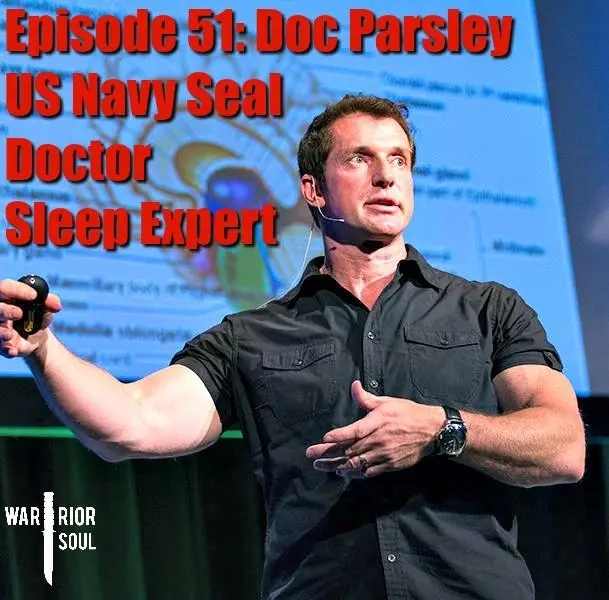
Episode 51: Dr. Kirk Parsley – U.S. Navy Seal, Medical Doctor, and Sleep Expert
Hosted by Chris Albert
The Warrior Soul Podcast
Doctor Kirk Parsley spent years as an enlisted Navy Seal. Then, after briefly leaving the Seal Teams, Doc Parsley decided to go to medical school. Once he graduated, Doctor Parsley returned to the Seal Teams as a Physician where he was the Undersea Medical Officer at Naval Special Warfare Group One.
Doc Parsley knows what it takes to be fit, tough, and to get through any challenge, but unlike most other wellness experts, he argues that the most important factor is sleep. And since he’s spent years helping some of the toughest men in the world get through some of the most difficult and trying situations, we believe him. This episode is full of knowledge gems that anyone can use to optimize their health, fitness, wellness, and life.
Here’s Doc Parsley’s full Tedx Talk:
Doc Parsley’s Twitter: @docparsley
Doc Parsley’s Sleep Remedy: http://www.docparsley.com/shop/
Transcript
Machine-generated from the episode audio and lightly edited — may contain errors.
Andrew Marr (link to this point)
Warriors, this is Andrew Marr. And today, I wanted to talk to you guys about the book that we have coming out later this fall called Tales From The Blast Factory, and it's about my trial, my family's trial and experiences with the symptoms of traumatic brain injury and then what it takes to pull yourself out of that and live a life of purpose and fulfillment. And why do TBIs matter? Well, they matter because close to four hundred thousand individuals have been diagnosed with a traumatic brain injury in the military since two thousand to twenty fifteen. Of that, up to fifty percent of those will develop a major mental disorder after diagnosis.
And the conventional model has been psychotherapy and medication, which in most cases further exacerbates the problem. And it does that because it doesn't treat the underlying condition. And that's the basis of the book. We wanted to show what that life looks like, the life of an operator, what happens when disaster strikes and you step into the unknown and everything that you once knew is not the way it is anymore. And then we wanted to talk about and show the process of that healing process and talk about the Warrior Angels Foundation.
And since then, we've brought that same level of healing that I've received to hundreds of others while delivering our message of hope and a viable solution to millions. And it was thinking, visualizing, and believing it in our minds first brought it into existence. And we wrote this book, my brother and I, Adam, so others could do the same thing. The name of the book is Tales From The Blast Factory. You can sign up to get on the prelaunch list.
They'll get you all kinds of cool Warrior Soul Binnies at www.talesfromtheblastfactory.com, and you can also preorder on amazon.com. That's Tales From The Blast Factory. You can preorder on amazon.com and talesfromtheblastfactory.com.
Chris Albert (link to this point)
Hey, guys. It's Chris here, and I just wanna tell you about our new sponsors. You know, one of the things that I'm always talking about here on this podcast and on the Warrior Soul Agoge YouTube channel are the benefits of ketosis and the benefits of including healthy fats in your diet. They help to protect your brain. They help to reduce total body chronic inflammation.
And honestly, I can say this with confidence, including fat in my diet has made me a better person. Why? Because it's given me lasting energy. I can go throughout the day. I don't get hangry.
I don't get moody because I haven't eaten. And I'm able to feel better and perform better because of the fats I include in my diet. Now, one of the problems and I completely understand this is that a lot of people don't have access to fats in their daily lives. Know, when I was in the Marine Corps, I was out in the field, there was very little possibility that I was ever going to have access something like coconut oil or avocado oil or macadamia nut oil. Well, when I went to Paleo FX this year, I ran into some really good people from F Bomb Fuel.
And what they've done is they've put together individualized packets of good, healthy and delicious fats. They've got avocado oil, macadamia nut oil, MCT oil, coconut oil. On top of that, they've got some really delicious nut butters. Their macadamia nut butter is absolutely amazing. I've never really tasted anything like it.
And it all comes in this extremely portable packet that you can take with you anywhere. They've also got some portable salad oils that you can take with you as well. If you're eating a salad, you can put them on top of those or you can pour them over your food. These are a lifesaver for anybody who wants to live a healthy fat adapted lifestyle. And the best part is that the company is run by some really good people.
They have a really strong desire to do good. And they've got a really strong desire to help out veterans. And we're working on some things for the future where they're gonna be able to do that. So if you wanna check this stuff out, and I promise you if you try this macadamia nut butter or any of their other products, you're not gonna be disappointed. Check them out at www.fatissmartfuel.com.
You know, over the last few years, I've put a concerted effort into trying to become a better person. I don't drink anymore. I don't smoke anymore. I don't womanize anymore. I've been in a dedicated relationship for a while now.
I work out every chance I get. I try to push myself physically. I hit the weights, I run, I do jiu-jitsu. But one area of my life that I've consistently been lax on, and this has been true my whole life, is sleep. You know, I've constantly burnt the candle at both ends.
And I thought that I was a better person for it. One thing that I've started to realize recently is that despite the effort that I put in, despite all of the exercise I put in and despite the good diet, getting the healthy fats in and everything like that. When I don't sleep, I miss things, You know, and maybe I'm able to get stuff done, but it's not my best. I'm not giving a 100% at that time. I'm just getting things done to get them done.
And it's hurt me. And it's hurt not only me, it's hurt this business, it's hurt this show, it's hurt my relationship with my woman. And it's kind of opposite of everything I've ever been taught at any point in my life. And it's probably the opposite of everything you've been taught. I used to think that if you get eight hours of sleep a night, you're not doing what you need to do.
You're not pushing everything. You're not putting everything into your life. You're not putting everything into your business, your job, whatever it is. Now there's a lot of us who served in the military and who are still serving in the military who think this way too. But starting to realize the cost.
You know, it's a day of not feeling your best here. It's a missed opportunity there. It's not giving a 100% on something that is potentially important. You know? And I'm putting a conservative effort now.
Concerted. Concerted. Maybe I didn't get enough sleep last night. But I'm putting a concerted effort now to try to get eight hours of sleep, especially after listening to our guest from today's episode, that's Doctor Parsley.
Doctor Parsley served in two professions where sleep is pretty much scarce. He was a Navy SEAL and he served for fifteen years. And he's a physician. And I don't know if you know much about physicians, but as they're going through their residencies, they are consistently sleep deprived.
But he taught me some really interesting things. If don't sleep for, if you miss a couple hours of sleep, like say you get six hours of sleep at night for a week, that's the equivalent of having a blood alcohol content of point eight to point one zero. Legally drunk. It's absolutely insane how much we deprive ourselves of sleep. And because of that, how much we are depriving ourselves of life, health, and productivity.
So I'm gonna stop yapping my trap here and I'm gonna let you get it straight from the expert. And now let's get into this episode with Doctor Kirk Parsley.
Chris Albert (link to this point)
This is Chris Albert, I'm here to remind you of one thing. Someday you're going to die. That's not some morbid statement or scary idea. It's solid fact. Your time here on this earth is limited.
And we need to be reminded of this as much as possible with one simple reason, to live your best life while you can. This is the Warrior Soul Podcast.
Chris Albert (link to this point)
Hello, everybody. Welcome to the Warrior Soul Podcast. I'm over here with my brother, Andrew. And today, we are absolutely privileged to have an amazing person on this podcast, doctor Kirk Parsley. Doctor Parsley is a medically re are you medically retired, sir?
Kirk Parsley (link to this point)
No. Just I just did my time and left, man.
Andrew Marr (link to this point)
Nineteen years.
Chris Albert (link to this point)
Retired Navy SEAL, medical doctor, and a sleep expert. He has an amazing TED Talk. And this is gonna be a fascinating podcast for me because I'm one of these guys who was surviving off of four or five hours of sleep, and I thought I was gonna be alright. But I've realized over the years that I've been doing this that cognitively, there's certain things that I'm missing. I'll I'll I'll get interrupted in my sentences.
I'll be a little bit slower later in the day. And, you know, as somebody who suffers from an autoimmune disease, ulcerative colitis, I'm constantly worried about things that are gonna shut my body down. So doctor Parsley, first off, thank you so much for coming on.
Kirk Parsley (link to this point)
Hey, man. It's my pleasure. Great great organization, and and I'm I'm proud to to be a part of it and for you guys letting me on as a privilege. So thanks.
Chris Albert (link to this point)
We just mentioned a little bit about your background, but but can you talk about, you know, how you you decided on joining the Navy SEALs, and then maybe how you decided on becoming a doctor, and how you became interested in sleep?
Kirk Parsley (link to this point)
Yeah, sure. I mean, I could eat up two hours with that, but I'll give you guys the Reader's Digest version. I'm sure audience wouldn't want to hear it all. But, yeah, I mean, I was actually, you back in the day, know, Spec War was a considerably different crowd than it is now before they sort of had any, you know, fanfare and and, public image. And, you know, I I was I was a was a pretty high level competing athlete most of my life.
You know, played football, track and field, you know, did a lot of martial arts and that was kind of my outlet. I I was a terrible student, liked I liked racing cars, I liked chasing girls, I liked sports, I didn't care about school at all. So, you know, when time, you know, when, you know, the time came for me to leave high school four years after I started, I was still a sophomore. Most people didn't know that, but I just, you know, I negotiated about three or four months before to to go get my GED and join join the military. I wanted to be a SEAL, you know, ostensibly from what I'd seen on TV and movies that it was the toughest training in the world, and I wanted to be the toughest guy in the world.
So, Hey, it made sense. And I, you know, dropped out of high school, essentially went and got my GED, went into the SEAL teams, you know, had a great experience there. But you know, as the saying goes, I met a girl and, you know, things changed. And so, yeah, it's kind of, was, you know, plus I was in during the, during the Clinton administration, which was kind of a boring time to be in spec war, you know, a lot of police action, not really anything that you trained to do, not anything super exciting. So, you know, I, I kind of felt like it was a young single man's job and I was becoming neither.
So decided to move on and actually got out, started going to college. Thought I was going be a physical therapist. Started working at San Diego Sports Medicine Center as a physical therapy aid, moved up to a physical therapy assistant while I was there. Know, got married, had kids, all that. And then when I was, you know, and then the doctors I worked there with, they talked me into becoming a doctor.
You know, it's pretty soon after I started working there, figured I didn't really want to be physical therapist. It was a little too limited for me. And these guys talked me into being a doctor, which I thought it was like the dumbest idea ever. I'm like, dude, you realize I'm a high school dropout and like I barely passed the GED. I didn't, you know, I didn't even pass that with flying colors.
But yeah. So I started looking in medical schools literally, you know, this is pre internet. So you go to the bookstore, you check out Kaplan's books and you look to see, you know, what GPAs and MCAT scores would make you competitive to which schools. And that's when I found out the military had their own medical school. And I was like, all right, so they're going to pay me to go to medical school instead of me paying somebody else.
And I mean, knew the game of the commitment, you know, you give a little, they make you pay it back and it was worth it to me. So I figured I'd get back to the SEAL teams as their physician and that was exciting to me. I figured it wouldn't change my medical career that much to go through medical school, but it sure would be easier on my family. So got back to the SEAL teams at like a very fortuitous time. As you guys know, every initiative that they start out, that they start takes about ten years to actually happen.
And so I got there just at the time when all the funding and the reality of building our first sports medicine facility was a reality. And so they put me in charge of building that clinic and I got to supervise the build out of it. Of course, I had a great background in that. And I got to participate in hiring all of the people that we needed. Our, you know, our first nutritionist, our first drinker.
Andrew Marr (link to this point)
This on the West Coast, right Kirk?
Kirk Parsley (link to this point)
Yeah, this is the West Coast guys. Yeah. East Coast guys already had a facility for maybe a year and a half before this. So, you know, I got I got, you know, I got to, you know, like I said, hire our first nutritionist, our first strength and conditioning coach, our first athletic trainer, our first, you know, exercise physiologist, our first PT, or like, and you know, and then started bringing pain rounds through and ortho rounds through.
And then I was the dumbest guy around. So we've all been in the military. What does the dumbest guy do? Supervise. So they put me in charge of the facility.
And so what would happen, because my, you know, my office was in this rehab gym. I mean, you guys know the gig was Spec Warrior, you know, or your SOFAs, you know, people, you know, they go on to do their physicals or their annual checkups or whatever whatever the Navy or Army or Marines or whatever says they have to do, they go do it. But they just they just flat out lie. Right? They check out, no.
No. No. Nothing's ever happened to me. I've never I've never felt sore, sick, or nauseous, or dizzy, or anything. I've and because they don't wanna be disqualified.
Right? But what would happen is, you know, I'd been a SEAL recently enough to where there were still, you know, probably forty, fifty SEALs there, you know, around the teams that I'd been a SEAL with. So they'd come in and close the door and say, hey, man. Can I talk to you about something? And they tell me what's really going on with them.
And they, you know, they were having a bunch of symptoms that I wasn't really quite sure what to make of, but it wasn't disease. And unfortunately, you know, I'm a medical doctor and what medical doctors get trained in is how to recognize and diagnose and manage disease. And they were coming to me and saying, you know, I'm just not quite me. Like, know, it takes me five times leaving my house before I'm actually on my way to work, and then I usually miss one of the exits on my way to work. And, you know, it takes me three hours to send an email that used to take fifteen minutes. You know, I feel emotional. I'm short with my wife. I'm short with my kids. My body composition shifting. Know, I work out harder than I ever have.
My diet's cleaner. My workout routine is smart, and I'm doing everything right, and I'm just getting worse. And I feel like crap. And, yeah, like, you know, give me a hand. Let me know what's going on.
And I'm sitting there going, shit, I don't know. Like, that's not disease. I mean, it's all, you know, sub disease. So, I mean, they weren't depressed, but they, you know, they had a lower mood. They didn't have anxiety, you know, they didn't have an anxiety disorder, but you know, had more anxiety than they would have ordinarily had.
There was, you know, just a bunch of shifts and stuff. And like I said, I'm a high school dropout, so not, I'm not the smartest guy around and about a 100 patients into this. It just kinda clicked in my head. I'm like, I think every single person I've talked to has told me they take Ambien every night. So I went back through my records, and sure enough, every one of them had said that.
I'd initially thought, you know, this was 2009, so I had initially thought, well, you know, eight years of combat, this could be adrenal fatigue. So learned a lot. Are you guys still there?
Andrew Marr (link to this point)
Yep.
Kirk Parsley (link to this point)
Alright. Everything got quiet, so maybe you dropped off. So I learned a lot about adrenal fatigue, studied, you know, of course, the beauty of my job being the West Coast SEAL doc, I could call up other professionals and just, you know, tell them, hey, I love your TED Talk. I love your book. I love whatever.
You know? Could I could I come train with you? Could I consult with you and all that? So I thought, you know, maybe this is adrenal fatigue. I worked pretty hard on that theory for a while.
Had some success with it. I wouldn't call it great, maybe 40% success with that. And then this whole sleeping idea came up and I knew nothing about sleep. And if, you know, unless you're talking to a physician who specializes in sleep, he doesn't know any he or she doesn't know anything about sleep either because I didn't have a single class on sleep in medical school. And so I had to go back to college level kind of textbooks and figure out, all right, well, what is sleep?
Like what goes on with you, you know, when you sleep and what doesn't go on when you don't sleep? And, you know, pretty quickly kind of through educating myself, maybe over a few months of reading and talking to some people, was like, man, just about every single symptom that these guys are complaining of could be explained by sleep. And then, of course, you guys know Mark Gordon, and probably about a year after I I was I was dead set that sleep was was it, and sleep was everything, and that was all their problems. And we can talk about what I did and sort of the success rate I had in treating those guys, which was, you know, really astonishing. I had amazing turnarounds with these guys just focusing on their sleep and getting them off of sleep drugs.
But about a year, year and a half after I started doing that, went to one of, I went to a conference where Mark Gordon was lecturing on TBI. And I had a few guys that I knew had TBI, I'm like, well, you know, let me go see what this guy has to say about TBI and see if there's anything I can add to help my dudes out. And so I went to his lecture and he starts throwing up his case reports and he starts throwing up his labs, which are really close to the labs I draw. And the labs look almost identical and the symptoms look almost identical. And then I'm like, crap, maybe this is all TBI.
So then I sort of started integrating those two and know, learned a lot from Mark, did some studying on my own, trained under some other guys. And I'm like, you know, at this point I don't really care. I mean, I don't care if it's adrenal fatigue. I don't care if it's, you know, chaotic or sleep, or chronic sleep deprivation, or TBI, or CTE, or whatever the hell acronym you want to throw out there. The beauty of it is that the treatment for all of it, the stuff that seems to make guys get better, there's about a dozen things that seem to really work.
Those work regardless of what the diagnosis is. So, you know, the point is to get guys back to optimal health and optimal performance. And so that's what I focused on for years. Got in a lot of trouble for it because it was, you know, non traditional stuff. It was non standard of care.
Navy didn't like me doing it. Got out, kept doing it. You know, guys kept calling me and, you know, now of course the way the, you know, the way the game the way the game unfolds always is, you know, now they, you know, now they pay me to come and teach their positions to do the stuff they wouldn't allow me to do when I was there. You know? So.
Chris Albert (link to this point)
Well, I got a question about setting up this this center that you had. Yeah. It seems like over the last, like, ten to fifteen years, things have really changed as far as what we know about nutrition, what we know about resilience, and and and how different things lead to resilience. Did you have to go through, like, several different iterations of of staff members in in creating this? Because a lot of the the the nutritionists, the trainers, the the people in the medical community, I know they're not willing to go down this non traditional route.
Kirk Parsley (link to this point)
Yeah. And yeah, unfortunately that is true. You know, despite the fact that we brought in just some, I mean, just flat out amazing people. I mean, some of the people that we managed to snag from professional sports teams and the Olympic Training Center and stuff, it just, I mean, was in awe that the people that were willing to come work with us and oftentimes for a pay cut. And I was like, just like, man, this is a great group of people, but you know, the way the military works, I mean, you get new leadership in priorities change, and all of a sudden there's not that much funding.
These guys are on continuing resolution, and they're having to get side jobs to make ends meet, and then that guy leaves, and then another guy leaves. And so that's changed quite a bit. And unfortunately, I mean, unfortunately I'd been around long enough to know that was going to happen. And what I've been proposing for, geez, I'd say probably six or seven years, is a standalone facility. And and we've got lots of people that are willing to fund it.
There's so many philanthropic organizations that are willing to fund it, you know, to to fund the testing of it. But what what we really need, the only true solution is we have to get away from standard care. Right? We have to get away from standardized care. And and it and this very simple metaphor is the computers in the military.
Right? So what type of computers do you get in the military? They're crap. Right? And the reason they're crap is because by the time the military goes through all of the steps needed to actually buy that computer, It's ten years old.
It's ten years out of date, man. It's not like it's a worthless piece of plastic by the time they install it. And the medical system is the same way. I mean, we we are dealing with, if you think about it, we are dealing with the first time in history that we have all of this amazing equipment that is that is able to, is way more dynamic and is able to withstand way more than the organism inside the equipment. Right?
Like the person, like that part that we're actually trying to protect, that can't handle all the crap that the equipment can handle around it. So we're breaking people at a rate and in a way that's never happened before. And that's, you know, that's only going to get worse as equipment keeps getting better. And so what that requires, I mean, you think about every time you get an advancement in a weapon system, you know, know, how often does that happen? I mean, right?
I mean, stuff happens every day, every few months, every year at least. Like there's some big advancement in a weapon system, but we think we can just keep giving people Motrin and treating them like we did in the 50s.
Andrew Marr (link to this point)
And and too, Kirk, when you look at the the maintenance, especially with you talking about military equipment, how much time and effort is put into maintaining equipment? And then we're just saying, hey. Do the same thing for the human body if humans are more important than hardware. You know what I mean?
Kirk Parsley (link to this point)
Yeah. And we all know the truth, right? I mean, it's like, yeah, it's great. It's great that we get higher resolution nods with perception capabilities, or you know, like better vehicles, better body armor, all that stuff's great, man. Love it. But we also know the fact that the, you know, wins the combats of the guys, Right?
They it's the training of the guys. It's the how much it's the type of guys we get into the system. It's the and then and it's the intensity that they train with. It's the frequency of the training with them. It's how much money we put into training them.
You know? And and that seems to be very well understood by the leadership of the military. What seems to be completely disconnected is the fact that you actually need to maintain that. I mean, you think mean, think of the special forces guys like an f one car. Right?
It's a formula one car. And the military is trying to do, you know, a maintenance schedule and, you know, treat it like it's a Honda Accord or something. Doesn't work. These are highly specialized machines that need different treatment. They need different maintenance schedules.
And what's gonna require is just an open mind. And I'm not saying that we need to be dropping LSD on active duty military guys or something like that. What I am saying is that we need a modular system. We need a system that is approved by the DOD and that will send the DOD or, like, even if it's not DOD, what you know, whatever level we could get, SOCOM level approval to send guys through these places, and we make them modular. Right?
So you like, you have this MRT, this magnet that seems to be really helping people with TBIs. As long as that works, keep it in. When something else comes better, that goes away and something else comes in. You know, transcranial ultrasound seems to help some people. We put that in there.
If that's outperformed by something else, we move it on. Right? We do the same thing with equipment. As soon as we get a superior piece of equipment, we get rid of that. The system needs to be modular.
It needs to be DOD approved, but it can't be run by DOD, or we're gonna run into the same problems we do with the computers.
Chris Albert (link to this point)
Yeah. It just seems to me there's so many obstacles. You spoke about Doctor Gordon and what he's found regarding hormones. And it just seems to me that there's so many obstacles to allowing active duty troops to to get the hormonal therapy they need, to get the hormone replenishment that they need. And it's it's insane because I guess up until a couple of days ago days ago based on a tweet, you know, you you were able to get that kind of treatment to be transgendered, but you weren't able to get that kind of treatment to feel normal.
Kirk Parsley (link to this point)
Yeah. Yeah, and what's more asinine about it is, know, we're, I mean, the first concept that everybody needs to know is that we don't know shit about the human body. Right? So if we we understand about one per you know, you know, two fifths of five eighths of 1% of what's going on in the body. There's it it's so much more complex than we want to pretend like it is.
But there's all these political and social prejudice against all sorts of things. Right? I mean, the social examples are legion, right? I mean, I mean, you know, marijuana wasn't even outlawed for marijuana. Marijuana was outlawed for hemp because they didn't want hemp competing with DuPont's nylon ropes.
Mean, that's how marijuana became an illegal substance. Know, steroid, you know, sex hormones became steroids. They became anabolic steroids and they had this connotation that they were used by idiot bodybuilders or they were used by professional athletes to cheat in sports. Well, guess what, man? Those damn things exist in every man on the planet.
They exist in our body and they were higher when we were younger and they're lower when we're older and they're lower when we're sleep deprived and they're lower when we're injured and they're lower when we're depressed and they lower when we're stressed. And those things have a lot to do with our performance. But there's sex hormone, and it's a specific type of sex hormone. I mean, you could give men all the estrogen you wanted, nobody would freak out about it, but you give them testosterone, that'll freak them out. He can get
Chris Albert (link to this point)
Andrew and I were saying that and I think there's a joke Andrew came up with, you know, if you if genders are this amorphous thing that can be malleable, what if you went up to the military and said, hey, I wanna be super manly alpha, perform a man. You know?
Andrew Marr (link to this point)
We should yeah. We we should get the millennials
Kirk Parsley (link to this point)
to identifying with some kind of uber uber uber human species. Yeah.
Andrew Marr (link to this point)
Right.
Kirk Parsley (link to this point)
But, I mean, think of it I mean, even take it away from that. I mean, what if what if your insulin levels were too low? Would we treat that? Of course. Right?
What if what if your thyroid was too low? Would we treat that? Of course. Like, what if, you know, any of the hundreds of hormones in your body, if those things are off, no problem treating them. But that's testosterone.
You know, people use that to hit home runs illegally or get bigger muscles, and that's, that makes it bad. The dumbest, I mean, it's completely nonsensical. I mean, it's completely nonsensical. It would be
Andrew Marr (link to this point)
Think of it like this. Go what ahead, Kirk.
Kirk Parsley (link to this point)
If I, if, if you came into my office and I tested you for mineral or vitamin deficiencies, right? And I came back and I'm like, you know, you're you're deficient in these seven vitamins. I'm gonna give you these seven vitamins in a supplement except b twelve because that's really controversial and people use that to cheat in sports. So you can't have that one. Like, everybody like, who who would think that's a reasonable idea?
But that's exactly what we do with hormones. Exactly what we do with hormones.
Andrew Marr (link to this point)
Yeah. It's it's crazy. It's like we're gonna outlaw people from getting up early because that gives them an edge on the competition. It just never made any sense to me. But, you know, talking about the no sleep mindset in soft, we're we're trained to be able to function without sleep.
Those type of individuals specifically mentally have shown to be mentally tougher. So how does that transition into regular life when now maybe somebody gets out of the military and they're running a business or they're living life, they're trying to perform at optimal level, and they're still operating, you know, on three to five hours of sleep at night. You know, how long can that go on before the you know, starts causing real detriment to the body and and their performance and overall well-being?
Kirk Parsley (link to this point)
Yeah. So I mean, that's that's the unfortunate there's some unfortunate aspects to that. But I mean, as you mentioned, you know, the the mill you know, the military itself is replete with all sorts of really sophisticated psychological manipulation. And and and that's how, you know, that's how we you know, that's how the military changes people's lives in twelve weeks. And yeah.
But, you know, one of the examples of that, of course, is special forces. And one of the things that, the military does in general is that they sleep deprived people because we know that sleep depriving people who have a propensity or proclivity for, or sort of genetic sort of risk factors for psychiatric disease are more likely to exhibit that psychiatric disease if they're sleep deprived. So that's one of the reasons boot camps sleep deprives people, because we wanna get rid of anybody in that environment. And then, you know, special forces take that to another level. And then special forces take that even to a higher level is that we wanna see who can actually perform really well when they're sleep deprived.
That oftentimes gets confused with this concept that these people aren't affected by it. Right? So, you know, like, when we were chatting for the show, we talked about Jocko, you know, Jocko's forty, you know, four thirty club, and Jocko's a dear friend of mine. I love the guy to death. I respect the hell out of him.
You know, but he, you know, he's got these people who are, you know, set on one mindset and they set on a certain set of goals and so they're doing these things. And and I got no problem with that. I mean, there's seasons in life as long as you're treating everything seasonally and you're not saying I'm gonna do this for the rest of my life. Yeah. Sure.
Go for it. Beat yourself down. Like, we've all beaten ourselves down. Right? The military beat the hell out of us for a while.
We came out of it, you know, more resilient, stronger, whatever. I mean, there there's benefits to all of that. But what needs to be clear to people is that there has never been any research at any point in any walk of life in any country under any scientific body that I'm aware of that show that anybody performs as well without adequate sleep as they perform with adequate sleep. So, you know, an article came out a couple of years ago about this genetic variant of these super sleepers. And I got just inundated with these emails and texts and tweets and all of this.
So like, here you go. Like here's the proof that not everybody needs the same amount of sleep. Not true at all. I mean, what it, it didn't show that anybody could get away with less sleep. What it showed is that not everybody suffers to the same extent, which should be obvious.
Right? I mean, if you are you know, let's take Ultramarathons. If I won if I were able to run one Ultramarathon, it would probably be the end of me. Like, know, it'd take everything I ever had to be able to get through there. I'm not built for Ultramarathons.
My body composition isn't made for muscle fibers aren't right. My body size, my mechanics, all of that sucks for that. But, you know, there are little dudes who can run ultramarathons all day and there's reasonably sized guys. I mean, you know, David Goggins, and reasonably big, you know, pretty big dude. There are people who can do that.
But does that mean it's good for him? Absolutely not. I mean, it's still destroying his body. He's still breaking himself down. He's just not breaking down as fast as I would.
And so what happens when we get this military mindset, we go in and we do our, you know, we do our we do our military work. We do our spec op work. It, you know, makes it even worse. And and we just we start drinking our own Kool Aid and we start thinking, you know, we're invincible. Like, we can just push through it.
Andrew Marr (link to this point)
You know, I've done this before. I've done this before.
Kirk Parsley (link to this point)
I've done this before, and it's true. We have done it before. But every time you do it, it gets a little harder, and it gets a little harder to recover. And you add that to, you know, some aging, some metabolic shifts, some gut biome shifts, hormonal shifts, some extra stress, having kids, having a wife, all that type of stuff starts eating into your ability to be resilient. And if you think that you can just keep doing that because you could do it when you're 20, you know, it's it's as silly as, you know, an eighty eighty year old man doing keg stands.
I mean, it's it's the same type of mentality. We're we're just just it just can't be done forever. It can't be sustained forever.
Chris Albert (link to this point)
Yeah. One of my problems here is that I really love getting up very early in the morning. Like, I love being up at 4AM, and I love and, you know, I think Jocko talks about this too. It's kinda like the opportunity cost. Right?
So so he'd rather have that time than not have that time. And for me, that's what's been the problem because my girlfriend doesn't get home till 11PM, and then I still wanna get up at 4AM to try to get everything done early. And, you know, just lately, I've been feeling really numb. You know, my my mental capacity is a little bit lower. I find myself getting frustrated easier.
I find myself getting anxiety attacks. And, you know, it's I'm in remission from ulcerative colitis now, but I'm always constantly worried that my autoimmunity is gonna come back and kinda take over, which it has in the past.
Andrew Marr (link to this point)
Yeah.
Chris Albert (link to this point)
But you you talk about this this putting faith in kind of a gamble in your in your TEDx talk. What what should somebody like me do? It's is it really just putting your faith into it and and seeing what you can do?
Kirk Parsley (link to this point)
Yeah. I mean, you know, the the the reality that nobody wants to hear, I mean, I, you know, I, I lecture all over the world, all different bodies, you know, all the, all different, you know, types of organizations. And, and one of the things that they're really, you know, I I'd say comes up just about every lecture, you know, every time I lecture, especially any first responders or law enforcement, you know, the questions that come up at the end of the you know, is they want me to tell them that two plus two doesn't equal four, That they can do shift work and be healthy. Well, you can't. Like, you just can't.
You can't sleep deprived yourself and be healthy. You can't sleep you can't you can't sleep off of your circadian rhythm and be healthy. Does that mean that you can't survive it? Absolutely not. But it's no different than saying, you know, we all used to hear this adage all the time, right?
It's like, Well, my grandfather smoked two packs a day for twenty years and fifty years and he didn't die of lung cancer. So obviously, right? I mean, that's the logic. And that we're doing the same thing with sleep. Like, can you function? Can you get through stuff? Yeah, you can for sure. And if you're really determined and you're pushing yourself really hard, can, you can do probably a pretty decent job of it.
Does that make it a good idea? Probably not. I mean, it might make it a good idea for a specific project, for a specific focus, you know, for a specific amount of time. But if you want to be the best you that you can be, there is absolutely nothing in the world. There there's not a single modality.
There's not a single drug. There's not a single nutritional supplement or drink or shake or program that you can find that's more beneficial than sleep. And there is also nothing that's going to break you faster than sleep deprivation. That is the number one thing that's like you can eat like crap for twenty years or sleep like crap for twenty years. I guarantee you, you're gonna be way worse off by sleeping like crap.
You know, there's a reason we use sleep deprivation as a, you know, as a, you know, sort of a torture technique, as a way to get people to talk. Right? It breaks you down and it breaks you down quick, man. And for you, like somebody with autoimmunity, guess when your immune system restores? Stages three and four sleep, man.
Like that's when it's happening. That's the only time your immune system is getting better. That's when you're that's the only time you're truly repairing is when you're sleeping. You know, when you exercise, you don't get stronger. We all know that.
Right? When you lift say, like, if you wanna be strong, you wanna be enduring, doesn't matter. You know, we'll use strength as a simple example. You wanna be able to lift more weights. You lift more weight than your body can lift.
What does that do? It damages your muscles. It tears them down and breaks them down. Cells literally rupture. They bleed, you know, enzymes into your blood that we can measure and say, you know, you've done this much damage to your muscle tissue.
When those muscle tissues repair, though, they repair a little stronger, a little thicker, a little more resilient, a little able a little more able to produce a little more force. And then the next time you do that same amount of work or a little bit more, you can do a little bit more, and that's how you get stronger. That's true with every single thing. That's true with your memory. That's true with trying to learn something.
That's true with trying to create something. It doesn't matter. The only time you're getting better at anything is while you're sleeping. You're always getting worse while you're awake. If I taught you how to play the piano at 08:00 in the morning, gave you, you know, two hour piano lesson, and then said, want you to come back at 06:00 tonight and I'm gonna see how much you remember.
You're gonna remember less than you remembered when you left. Okay? You're gonna be worse off than after your lesson. Once you go home and go to sleep, however, though, you're gonna come back about the same as you left that morning before or maybe a little bit better. So you actually by going to sleep, you actually learn something that you wouldn't have learned if you hadn't slept.
You can add another layer to that, put a nap in between that and say, I'm gonna teach you piano lesson from, you know, 10AM to noon. And then I'm gonna have you take a nap, you know, three hours later, and then come back three hours after that, and we're gonna do a test and you'll perform better than you left your morning lesson. And then you go home and go to sleep that night, you'll perform better than you left your evening lesson and learn twice as fast. You know, I've done this with some mixed martial arts guys, you know, who are trying to really buff up on, you know, one one component of their of their game that is, you know, isn't their strong suit and they're trying to learn a lot of skills really fast. You know, they're like, know, sleep is it.
And if you think about it and if you've I mean, you alluded to my TED Talk. If you listen to my TED Talk, I mean, I mean, I can't say that it's a fact. It's a it's a philosophical argument, but it's a pretty damn strong one in my mind that, you know, being asleep for a human being, you know, modern day, not a big deal. But, you know, just a hundred years ago, two hundred years ago, definitely two thousand years ago, very dangerous place, very vulnerable place to be. If we could have evolved to sleep less, would have made sense to do it.
And the people who slept less would have been rewarded by longer lives and better performance and all that other stuff. We would, and maybe we did, right? Maybe humans used to sleep sixteen hours and we evolved like down to the minimum was eight. But so far there's no evidence that anybody does better with anything significantly less than eight hours of sleep.
Andrew Marr (link to this point)
Kirk, what do you recommend or what's been shown to be useful for somebody to kind of downshift out of the sympathetic mode into the parasympathetic and be able to actually go into sleep? Because I know that's probably a big problem for a lot of people and probably a lot of people you come across say, I just can't fall asleep. Yeah. So what are you what's your recommendations there?
Kirk Parsley (link to this point)
Yeah. I mean, so I mean, there like like anything else, I mean, it's complex. There's a lot of variables involved. For men, one of the for men, one of the best things to do is just to exercise. And and the reason for that is that what causes sleep pressure and by and by sleep pressure, that's a, you know, that's a medical term, but it it's it's pretty it's pretty aligned with what it sounds like intuitively.
You know, it's that drive when you when you lay down in bed. It's like it's that drive that's just like pushing you to sleep. It's like, I'm done for the day. I'm going to sleep. That that mental drive we call sleep pressure, and that's what's and then and what drives that is a chemical called Adenosine.
So some sort of, you know, basic physiology is essentially all the energy that our cells use to do what they do, regardless of what type of cell it is. They use something called ATP, and ATP gets broken down into ADP and AMP, and then eventually gets broken down into just a, which is adenosine. So one of the reasons that men have less trouble falling asleep than women is because we have more muscle mass and approximately the same size brain. So we can build up a lot. Well, we just have a lot more lean mass.
Like we have bigger lungs. We have bigger livers. We have bigger everything. Right? Men are just bigger than women, but the brain size isn't that much difference.
You know, pretty small difference in the brain size. So we build up this adenosine. We go to sleep pretty easily. Now if a man's really stressed out as soon as the adenosine goes away and the sleep pressure gets cleared, that they tend to wake up in the middle of the night. Women have a harder time falling asleep.
But, you know, to your point, you know, what what can we do to balance the autonomics? And for your listeners who don't know, I mean, just think of autonomic nervous system as your automatic nervous system. Right? It's doing everything that you aren't thinking about. It's keeping you balanced.
It's keeping you standing upright when you're, you know, when you're standing in one spot. It's keeping your eyes tracking. It's keeping your heart rate. It's keeping your blood pressure. It's keeping, you know, muscular tension.
It's keeping all sorts of things going on in your body, liver functions, you know, your immune function. All that stuff is to some degree being regulated by this automatic nervous system. And we have one side of it that's a very stressful response. And when it we max that out, we call that the fight or flight system. Right?
That's the maximum sort of sympathetic. And then maximum parasympathetic is actually deep sleep, stages three and four of sleep. Sometimes the parasympathetic is called rest and digest. You know, fight or flight is one side of it. Rest and digest is the other.
And so those have to be balanced. Well, what balances those? Just about anything you can think of. Right? One of the reasons people overeat so much is if you overeat, eat a bunch of food that weighs heavily in your digestive system.
I just told you it's a rest and digest system, so you start it starts stimulating your parasympathetics. You can do that through breathing exercises. You can do that through meditation. You can do that through progressive muscle relaxation. You can do that with the M Wave.
You can do that with heart rate variability training. You can do that with yoga. You can do that with all sorts of things. You can increase your parasympathetic tone. You can get rid of sympathetic tone by increasing parasympathetic tone, but you can also get rid of the stress or sympathetic tone by decreasing stimulants and decreasing stimulation.
Right? There's a reason those words sound a lot alike because they're really the same thing. So if your brain is wired and scared and anxious about something, it's not that much different than drinking caffeine all day. It has very similar effects on your brain and your body. But, you know, that is the, you know, that's one half of what we call sleep hygiene.
You know, your audience may or may not have heard of sleep hygiene. What I always tell people, I try to explain it conceptually. So what is sleep hygiene? Well, think about a three or four year old kid. You know, do you let a three or four year old kid just run wild and bang on bang on drums and, you know, you know, play with stuff and watch television, whatever, and they just pick them up and put them in a bed and turn the light off and walk out of the room?
No. That wouldn't work. We all know it wouldn't work. Why? They need time to settle down.
We gotta relax their nervous system. They gotta quit interacting with their environment. They get, you know, they need a bedtime routine. They gotta slow down. That's what that parasympathetic and sympathetic balance is.
That's half of the sleep hygiene. The other half of the sleep hygiene is getting rid of the of the light, the photo period, what the blue light that's that goes in our eyes that simulates our brain to tell our brain that it's daylight and it's time to be awake. And so that's what all the glasses are about and the computer apps and the new, you know, the new phone apps and whatever that takes the blue light out of your screen. So it's really just those two components.
Chris Albert (link to this point)
You you mentioned exercise. Is there a particular kind of exercise that people should do? And is there a particular time of day they should do it to keep their circadian rhythm in order?
Kirk Parsley (link to this point)
Well, I mean, it's it that can get complex because it it depends on what you're trying to do. So if you if you want everything to be very regular, you know, let's say, you know, you're, you know, you're regular Joe, you live in you live in the suburbs, you you know, work nine to five, you do the same thing every day, and, you know, you're gonna plug along in this pathway for thirty or forty years, whatever. That that's a different thing than somebody who travels a lot or professional athlete who, you know, who's traveling for games and having to, you know, do some practices in the morning, some in the evening, whatever. But I use exercise as a tool. So daily exercise, and by that, I don't necessarily mean lifting weights or running whatever.
By that, I just mean being active enough to get some sweat going and to get a little bit of mobility work. I mean, you could you could clean your house vigorously enough to get, you know, to qualify as exercise in my book, if you're just talking about being active enough to be healthy. If you have performance goals, you need to work towards that sport and whatever it's gonna drive performance in in that realm. You know, the exercise I recommend is the is the exercise that people will actually do, but you can place exercise. So, you know, we talked about a little bit about circadian rhythms, and I don't wanna get too geeky and down in the weeds with with that.
But, you know, basically, our our we we evolved on this planet to use the sun as our cue to know when to be asleep and when to be awake. And then every time we travel or every time we, you know, just defy that through artificial lights, shift work, like military jobs, like whatever we want, you know, for whatever reason, we def we defy that, we have to figure out ways compensate for that. So you can use exercise as a way to compensate for that. So as an example, if I'm somewhere, if I've traveled and I know I'm gonna feel like falling asleep two or three hours before I should fall asleep if I wanna be on schedule with my new environment, then I would put my exercise really late in the day. Because if I put my exercise really late in the day, it's going to push my desire to go to sleep back two to three hours.
And that's going to help me get on track. If the opposite is true, then I wanna work out really early in the morning. I wanna stimulate my body when my body isn't actually ordinarily stimulated. I wanna increase that sympathetic tone earlier than it would have. I wanna increase that adrenal function earlier than it would have happened if I didn't exercise, and so I'd place that in the morning.
However, if we're just talking about simple Joe living in the suburbs doing the same thing every day all the time, it doesn't matter that much as long as it's, know, a fairly regular activity. Now if you're looking for performance, physical performance tends to correlate pretty well to peak body temperature, which is somewhere around noon, you know, between noon and 2PM. So if you're, you know, if you're looking to, you know, perform the best during your exercise, whether it's strength or endurance, that, you know, kind of that's your ideal window for that.
Chris Albert (link to this point)
How about sex? You get all sweaty during that too.
Kirk Parsley (link to this point)
Yeah. Well, sex has benefits all around.
Andrew Marr (link to this point)
Score. Yeah.
Kirk Parsley (link to this point)
There's obviously, there's the physical aspect of that, which is a form of exercise. There's also a lot of neurochemistry that changes during that. And a lot of that neurochemistry drives towards sleep. Or at least it was meant to evolutionarily. I think it still works on men.
You know, the postulate is that, you know, if you have sex and, you know, of course the idea behind sex mammals is to reproduce. So if you have sex, you're trying to impregnate the woman. So after you have sex, you should leave her alone and let, you know, your sperm a chance to reach the egg. So it tends to work really well for men to fall asleep, but over, you know, a few hundred years maybe, there's been some shifts in DNA and evolution and social expectations where I think it now makes women wanna talk. But it's supposed to make them wanna sleep as well.
But, yeah, so, you know, there there's definitely some good definitely some good chemical changes that go on in I
Chris Albert (link to this point)
the gotta ask this just because I know there's a buttload of Marines who listen to this, but what about sex for yourself or sex with yourself?
Kirk Parsley (link to this point)
You know, great sleep aid, but also also has been proven over and over again that mental health, mental well-being, stress, concentration, short term memory, all sorts of problem solving skills, all this stuff is highly related to sexual activity, whether it's with a partner or, you know, with nobody else involved. I've worked with one woman who specializes in this type of research and training, and, you know, she says that most of the research bores out I wanna say it's it's either 50 or 60 years old, that you should actually have an orgasm every day until about 50 or 60 years old, and then it tapers down to, like, every other day or something. It is, you know, kind of the ideal thing for health if you're looking for, you know, the benefit the benefits of, you know, what you know, whatever litany of benefits that sex has, which are more than I could articulate. It's not my area of expertise.
Andrew Marr (link to this point)
Well, we definitely like litany of benefits. Yes. You know, if that's gotta be through sex, then so be it. That's probably why I've been able to perform such a high level for so long. Kirk, so how damaging is it to be on a reverse cycle for six months?
Or is that something that you can bounce back from quickly if you're able to go back into a good sleep hygiene routine?
Kirk Parsley (link to this point)
No, I mean, the younger you are, the more resilient you are. And there's a lot of reasons for that. I mean, some of that's DNA degradation, some of that's hormonal, some of that's you know, just damage, connective tissue, inflammation, you know, physiological and anatomical shifts. You know? But really, you know, like I said, there there's there's probably nothing more damaging, you know, if, you know, if the military said, you know, we're either gonna, you know, completely invert your circadian rhythms for six months or we're gonna feed you crayons for every meal for six months, you you should probably go with the crayons.
Chris Albert (link to this point)
Definitely go for that.
Kirk Parsley (link to this point)
Yeah, I mean, there's not much that breaks you worse than that. But, you know, the key is just to, you know, there's a couple of things. One is to prepare for it the best that you can, and the other thing is to recover as quickly as you possibly can. And what and and and it's it's kind of an interesting thing. I mean, over my career, I've I've run across a few things that were just so counterintuitive to me, and one of them is is preparing for sleep deprivation.
Right? So if I, you know, if I told you, hey, man. I'm going to next month, I'm gonna starve you. Right? That's that's part of the program.
And it's just there's no way around it. That's just what we're gonna do. Next month, you're gonna eat, like, you know, 500 calories a day every day for a month. Well, what would you do this month? I would go You'd eat it you'd eat as much as you could. Right? Like, you'd stock up on calories. You're about to starve. Right?
Or, you know, but for some reason of, you know, another physiological need, you know, let's take the other way. You know, let's take sex and masturbation. It's like, alright, you're not going to be able to have any sort of sexual satisfaction for a month. What are you gonna do? Like, I'm gonna overdo it this month.
Now let's take sleep. If I told you I'm gonna sleep deprive you next month, eighty five percent of the people will tell me they're gonna practice not sleeping so that they'll be ready to not sleep next month. Exactly the opposite. Right? If you know you're going on a deployment, if you know you're gonna be off schedule for a while, get all the sleep you can possibly get.
When you're out, you know, when you're up forward deployed and you know you're gonna go out for three or four days, and you have a couple of days, you know, time beforehand, you know, of course, we know there's a billion things to do, but anytime you can get any sleep, get that sleep. And then when you come back from whatever that is, come back from whether it's coming back from that one off or whether it's coming back from that deployment, the key is to pay that debt back as quickly as possible. It's just like credit card debt. The longer you let it linger, the more detrimental it is. The more, you know, the more minimal the payback you give, the longer it takes to pay it back. And then, you know, it'll it'll just destroy you. So the the best thing that you can do is to pay that sleep debt back as as quickly as you possibly can. So if you can come back and sleep for twelve hours a day for, you know, two months, you'll probably pay back all your sleep debt and you'll probably be as healthy as you were before the whole thing started or pretty darn close to it.
But if you come back and, you know, now you got a staff job and boss expects you to be there early and stay there late and you're, you know, you're gonna sleep, you know, barely any more than you did when you were deployed, you're gonna you're gonna break down quick. And we've seen those guys. Like, you know, we've seen we've all seen those guys.
Andrew Marr (link to this point)
Sure. You know, that was gonna be my next question. We just answered it, and that was gonna be can can you catch up on sleep, and can you actually pay it forward? But I think that was clearly articulated. Is eight hours the the a good rule of thumb?
Kirk Parsley (link to this point)
Yeah. It's just that, though. It's a rule of thumb. So where that number comes from, it it's not it's not a single study, but the but the study that started it all was done by William Dement as Stanford sleep researcher who's actually considered the, you know, the grandfather of sleep medicine. He did something that he called a bunker trial.
So he took a bunch of World War II bunkers, you know, little pill boxes, and he put, you know, he put just a cot, and I don't even know if it was a toilet or if it was just, you know, kinda like a, you know, 10 gallon paint can with a toilet lid on it or whatever, but there's nothing in there but a toilet and bed. And there were no windows, and it was cool, and it was dark, and he would lock these people in there for fourteen hours a day, and then let them out for ten hours a day, and they could do whatever they wanted to. You know, these were by and large college students, because no one else has the time to do this or would do it for the amount of money he could pay. But what they found, it's been done across a bunch of different cultures now, and a bunch of different socioeconomics, you know, cohorts, and a bunch of different age groups, and it always turns out the same. When you first start doing this to people, you put people in a cold dark room where they don't have any idea what time it is.
There's no chance of stimulation. There's nothing for them to do except sleep or lay awake in a dark room in a bed. They sleep for about twelve and a half hours a day when they first start. Over the course of anywhere from three to six weeks, at the end, you know, by by the end of say six weeks, almost every single person in that group, and by almost, I mean, ninety nine point six, ninety nine point seven percent of people will be sleeping seven and a half hours plus or minus half an hour. And they're doing various things when they leave for those ten hours, but it's not like any of them are going out and running ultramarathons or something or, you know, competing in power lifting or something.
So if you have a very vigorous job or a very vigorous, you know, life to where you're really putting out and doing some really tough things outside of that sleep period, you probably need more than that seven and a half hours. But that's where the rule of thumb comes from, and it's ubiquitous. It comes out every time. To my knowledge, there has never been any one of these trials where they allow people to pay back their sleep debt, and anybody comes back to anything significantly different than that. Or, you know, if it do, it's maybe one out of a thousand or one out of ten thousand people that are coming back, you know, with a statistical, significant change from that seven and a half hour to plus or minus half an hour.
Andrew Marr (link to this point)
That's fascinating. I know everything is everybody is an individual case, but is there any recommendations you would have or give for supplementation prior to sleep or to aid sleep?
Kirk Parsley (link to this point)
Well, of course, you know, I'm biased in that I, you know, I created a sleep supplement specifically to get SEALs off of their sleep drugs, which is
Andrew Marr (link to this point)
Let's hear all about it.
Kirk Parsley (link to this point)
Yeah. So so that was really, that was something that just came about once I started studying sleep. I'm like, well, damn, these sleep drugs really seem like they're not doing, anybody any favors, and they're not. And and by and by sleep aids, I said sleep drugs, but, you know, sleep aids, we'll call them. I'm talking about over the counter, and I'm talking about prescription, and I'm talking about alcohol as a sleep aid as well, which is a common sleep aid.
And what it does is it is it disrupts what we call the sleep architecture. So when you sleep, we expect you to have very predictable brainwave patterns, and those brainwave patterns correlate with breathing patterns and pulse and heart rate variability and movement. And when we add all this stuff together, we create something called it's called a hypnogram, and it's this really graphic, you know, very easily understandable graphic representation of what stage of sleep are you in and for how long. When you take sleep drugs, sleep aids, it messes with that sleep architecture. Well, you know, one of the things I ask in my lectures, I do it, you know, partly for fun, but, you know, partly to make the point of how sort of surprising it is.
You know, most people can't define sleep. Like if I said, you know, tell me what sleep is, ninety percent of people just kind of flounder don't really know. Interestingly, doctors who specialize in sleep don't even all agree what sleep is. But we all have, an experiential sense of what of what it means to be asleep. So we know what it feels like to be asleep, and we know when we're asleep and when we're not asleep, but we can't necessarily define it. You know, the I guess the important aspect of all of that is that when you're talking about sleep drugs, sleep aids, sleep supplements, if they're distorting that sleep architecture and it's not looking like what we know, and it doesn't have to be ideal, but, you know, there is an idealized version. It's a cartoon version, so it's not exact. But there is an idealized version of what sleep stages should look like. And if you aren't and if what you're what you're using to help you go to sleep changes that, then it makes it not look like that version, then you're not really getting the benefits of sleep. Whether or not you agree to the definition of sleep or not, we can say, well, the the normal things that happen during normal people's sleep is not happening with you, or this graph would look the same as everybody else's graph.
So as an example, you know, when I had all these SEALs who had all these problems that I couldn't understand, and I started learning about sleep, and I wondered how much sleep was impacting it, and, you know, one of the things that, you know, one of the things that people overlook is, you know, something as simple as the hormones, you know, like I wanted to fix their hormones right away, but Navy wasn't going to let me fix their hormones because that was taboo. But then I learned, well, actually all their sex hormones are made during stages three and four of sleep. That's when their growth hormone is made. That's when their testosterone is made. That's when their immune system is functioning at its highest.
That's when they're repairing all of their damaged tissues. So that's the really important part. And I would send these guys in to get a sleep study on their Ambien or their Xanax or their alcohol or their over the counter sleep aid, which is usually Benadryl essentially, Diphenhydramide, but they would come back with 99% stage two sleep. Well, what's stage two sleep? Stage two sleep is what we call a transitory stage.
Right? So we don't really think stage two does anything except set you up for the next phase. So you're really not getting any sleep. You're really unconscious. It looks a lot more like if you if you, you know, if somebody gets in a motorcycle wreck and ends up in a coma, or somebody gets knocked unconscious and you put electrodes on their brain, that's what that looks like.
You know, that's what this supposed sleep is actually looking like. So they're they're not getting the benefit of sleep. Now how much of the benefits are they not getting? I can't tell you that. Right?
I mean, they're that's you know, that's gonna vary from person to person, but we can tell you that the reason that they're sleeping is to do lots of things. There's lots of things that are supposed to be repairing, lots of things that are supposed to be shifting, lots of things that are supposed to be going away, lots of things that are supposed to be building up, and those things just aren't happening, so you really aren't sleeping. So it's really no different than eating, you know, that your body isn't designed to digest and being surprised that your nutritional state isn't all that great.
Chris Albert (link to this point)
Well, when you're talking about hormones, and I know that insulin is antagonistic to certain hormonal production, would it make sense to try to go to sleep in a low insulin state?
Kirk Parsley (link to this point)
No, what makes sense is just to have really good insulin sensitivity. And that's done by controlling diet, that's done by exercising frequently, but it's also done by getting regular quality sleep. One of the interesting things that most people don't realize is that if you deprive yourself of two hours of sleep, so instead of getting eight hours of sleep, you sleep six hours, the next day your insulin sensitivity in many of your tissues is decreased by about 30%. Your testosterone levels are decreased by about 30%. Your inflammatory markers are raised by about 30%.
Your thyroid So you're heading function
Andrew Marr (link to this point)
toward is diabetes, heart disease Yeah.
Kirk Parsley (link to this point)
So if you're kind of like a metabolically broken average Joe, 40 year old dude who, you know, has not really stayed in great shape and hadn't totally destroyed himself, but you're kind of on the edge, you're essentially probably waking up as a diabetic. If you're a little healthier, you're probably waking up as a pre diabetic or sort of a metabolic syndrome type health level. And if you're diabetic, you're waking up sort of in diabetic crisis, you know? And that's just one hormone we're talking about, right? But you know, again, like you take away those two hours of sleep, it's not just the hormones.
I mean, it is the hormones, but there's so many hormones involved. I mean, you have your appetite, say, for the next day, that that's completely derived by how well you sleep. You know, there's a neuro regulation of appetite. It's your brain that's telling you whether or not you're hungry. It's not your muscles. It's not your liver. It's not your heart. It's your brain.
And we know if we take two hours of sleep away from you, your insulin sensitivity is lower, which means what? You need more glucose. Your body's gonna crave glucose. But your body also perceives this rapid change in blood glucose level, and insulin sensitivity is possible famine, so you want to eat a bunch of fat as well. Enter freaking donuts, because they're what?
High in fat and high in sugar. And of course you're tired, your neurochemistry is all screwed up, you haven't gotten rid of all the adenosine, have lots of neurotoxins, so what do we do about that? Well, we try to block the adenosine by putting them caffeine in there and making ourselves more awake. We try to do all these compensatory things, but your sex drive is lowered, your immune system is lowered, your ability to communicate, your ability to be empathic, to understand emotions, to express your own emotions accurately, to categorize emotional events, to remember things, to be able to formulate new ideas with new information that you've learned, to predict the most likely consequence of an action that you take right now, all of that stuff is altered. Every single one of those things is altered by a single night of short sleep.
And there's been a lot of work done, for decades where they try to compare, well, how bad is the performance, right? Well, let's compare it to blood alcohol levels. So when somebody's really drunk, really stupid drunk, we know they aren't performing well, and just about any respect, know, about anything we'd ever measure ourselves in, they're not performing well. What does it take to be functionally drunk, sleep deprivation wise? Well, being awake for seventeen hours in a row, not, right, that's not a huge deal, right?
Lots of people are awake for seventeen hours in a row. But being awake for seventeen hours in a row, and driving home at the end of those seventeen hours, you perform on par with somebody with black with a blood alcohol level of point zero five. Okay. That's, you know, in most countries that's not legally drunk. Like, I don't know why it's called legally drunk.
Should be called illegally drunk, but you know what I mean? Yeah, it's not, you know, you're not so impaired that you're not allowed to be driving, but you're up to twenty four hours and you perform on par with somebody with a blood alcohol level of point zero eight to point one. Now I can tell you when I was working in hospitals and when I was working as a CO, I can't even tell you the number of times I drove home after being awake for thirty six hours straight or forty eight hours straight or something ridiculous like that. But, and then, you know, forty eight hours, being awake for forty eight hours is ridiculous. It's like a, it's on par with a blood alcohol level of like 0.2.
So, I mean, you're just like a, you're just a hot mess. You can't do anything. So, you know, people's arguments and retorts is, well, I don't stay up for twenty four hours. I don't stay up for forty eight hours. You know, that doesn't apply to me.
But guess what? How many people sleep six hours a night instead of eight hours a night? Answer is 83% of America roughly. Right? If you sleep six hours a night for eleven consecutive nights, you perform exactly as though you haven't slept for twenty four hours.
You do that for twenty two days in a row. You perform exactly as though you haven't slept for forty eight hours. So the first response I get to that is bullshit because I've been sleeping six hours a night for this many years, and I'm not performing as though I haven't slept for forty eight hours. But the interesting thing is that bunker trial I told you about where we sleep adapt people, figure out how much sleep they need. Thing that we added on to that test after several years is after we sleep adapted people, we tested them.
Tested them in anything you want to test them in. Playing the piano, typing with their left hand, lifting heavy weights, endurance activities, problems solving, driving cars, doesn't matter. We tested them, gave them a baseline test after they were sleep adapted. Then we took away two hours of sleep. Come back, test them the next morning.
How do you think you did? They'd say, I didn't do as well. I was tired. Day two, same thing happens. Day three, maybe same things happen.
But day four, every single one of them say, I'm completely adapted to this new schedule. I did as well as I've ever done. And you can show them the data. It's like, nope, you did worse. Here's the data right here.
Shows that you did worse. And they'll argue with you. You know, they'll argue with the researchers and tell them they got it wrong, that they know they did as well. And it's, you know, I use the metaphor a lot of my talks about, you know, people drinking. Alright, a guy goes to a bar, has a beer, no big deal, he has two beers, he's like, maybe I better wait a while before I drive home.
He has three beers. Maybe I shouldn't drive home. Four beers. Like, I'm fine. I can go.
You know? It's the same you lose that introspection. It's the same type of thing. So that's why, that's why people don't buy it when you tell them how bad their performance is. And you see all these thirty day challenges all over the world, you know, thirty day sugar challenge, thirty day vegetable challenge, thirty day meat challenge, I don't know, all sorts of dietary exercise challenges, thirty days this and that.
I ask people for a week. Make sleep your number one priority for a week. Your number one priority. Just eight hours of sleep every night for one week. That's your number one priority.
Make it your priority. Make it happen. At the end of that week, if you don't feel any better, you can say that I'm a quack and you'll never have to listen to anything I ever say again. So far nobody has ever done that and come back and said, feel better with less. They all come back saying, man, I feel fantastic.
I cannot believe how screwed up I was. I thought I was feeling normal. It's like trying to convince a drunk person they're drunk. The drunk person will never believe they're drunk. The next day, they'll believe they're drunk.
So that's what we're doing. Right? We're giving them seven days of good sleep. So now they're completely sober, and they go, man, I was really drunk.
Andrew Marr (link to this point)
Kirk, I wanna hear about your your personal sleep hygiene routine. And do you have a wake up hygiene routine? And then, you know, what benefits have you noticed in your life that you can speak on once you invoke these?
Kirk Parsley (link to this point)
Well, I mean, I mean, I would love to say that, you know, I was super clever and I figured all this out for myself and did all sorts of amazing things, for my own performance. But, I, I was probably helping SEALs sleep better for, you know, get off of sleep drugs and alcohol and so forth, and sleep better. Was I probably doing that for a year before I'd thought, maybe I should try this on myself and see if it makes a difference for me. You know, I chose two professions that didn't value sleep, right? I mean Special Special Forces Forces doesn't doesn't value sleep, and then, you know, medicine doesn't value sleep.
I mean, they're both just that same type of mentality, just beat your head against the wall harder, keep running harder, and you'll eventually break through. But, I mean, I can tell you that I was a basket case. I didn't realize I was a basket case. I just thought, you know, I wasn't quite as good as I used to be. But, you know, I I just turned 47, I don't know, four months ago or something like that.
I can tell you I'm in way better physical shape and cognitive shape right now at 47 than I was at 37. And that's 100% because of sleep. I haven't changed my diet much. The only thing I've really changed about my fitness routine is I exercise a hell of a lot less than I used to just because I was completely overdoing it. Know, but it's primarily a sleep issue.
I mean, I had psoriasis. I was losing my hair. I was just anxious as hell. I mean, my cell phone would ring and I would, like, immediately panic that, I don't know, freaking the president was calling to kick me out of the military or something that, you know, something to happen tragic with one of my children or something. And and why?
Because my cell phone rang? Like, no no rational thought to it whatsoever. I was moody. My body composition sucked. I My performance in every sport that I wanted to do sucked.
And like I said, I mean, I didn't put it together for myself. I put it together once I started seeing these great changes these team guys' lives and what they were coming back and telling me, I mean, it just really seemed hyperbolic to me. It just seemed ridiculous. I'm like, come on. Like, I I appreciate yeah.
I I thought they're, you know, just trying to make me feel good. You know? I'm like, come on. Like, really? I mean you know, you're 40, like you're 45 years old and you're really PR ing like, you know, the same sport you've been doing for twenty years.
And I'm like, Yeah, man, I really am. And, you know, you know, so I started applying it to myself. But like I said, I mean, there's, there's no limit to what it does for you. I mean, it if if you if you're looking for performance optimization, you can put butter in your coffee and order drugs off the Internet and do all that other kind of crazy biohacking crap if you want to, but, know, this is, you know, this is, the body you're living in is about 200,000 years old and it took millions of years to evolve. Best, you know, odds are the smartest, you know, the smartest keeper of the information and the smartest operator for the system is what's built into the system.
And, you know, what turns out to be true is that sleeping, how you evolve to sleep and exercising the way you evolved to exercise and keeping a diet that's somewhat close to how you evolved to eat and keeping a stress level that's fairly well correlated to sort of the way we evolve. Those are your biggest performance enhancing tools right there. And I'm not completely pooh poohing on all of the, you know, different biohacking techniques and devices and gadgets and, you know, wearables and metrics and, you know, things to improve yourself. I'm like, I'm all for that stuff, but, you know, that stuff is the icing on the cake. That's, you know, that's the two to 3% difference at the end.
It's the lifestyle that makes all the difference. And so for me, you know, it's nothing fancy. I mean, do everything I can. I'm actually a nine hour night guy. I've just found I've just found that to be true through lots of different sort of metrics of my own and studying myself.
You know, I'd I'd prefer if I were a seven hour guy. That'd that'd be easier for my life. You know, I'd get I'd have more day more daylight to get stuff done. But, know, I'm a nine hour night I'm a nine hour guy night, and I do what I have to do to get that time. And, you know, it's all the same sleep hygiene that everybody else talks about.
There's no magic to it. You decrease the photoperiod, you decrease the blue light in your eyes, you know, three to four hours before you go to sleep. You know, that sleep supplement that I derived to help get SEALs off sleep drugs, there's nothing in there except what ordinarily gets concentrated in your brain from the time the sun goes down until the time you go to sleep is about a three hour period it takes for all these nutrients to concentrate in your brain and drive you to sleep. And so I take my sleep supplement that kinda condenses that three hours down to about thirty minutes and then, you know, helps, you know, helps compress all that. And, like I said, decrease the stimulation to my brain, decrease the light in my eyes, get myself on a schedule, you know, stick to it.
It's, you know, my my sleep schedule is just as important as my workout schedule. It's just as important as my work schedule. It's just as important as my tax schedule as everything else. I mean, it's it's a non negotiable aspect of my life and,
Chris Albert (link to this point)
know, it's mess. You miss an hour or two, do you have like a set day where where you'll catch up or anything like that?
Kirk Parsley (link to this point)
No. I mean, my, you know, my advice is now and always has been that if you miss any sleep, the ideal thing is to pay that sleep debt back as fast as you can. I could pay it back with a two hour nap the next that same day, I'll do it that day. If I can't catch up until the weekend, then I'll catch up on the weekend.
Andrew Marr (link to this point)
Now I I've used your the sleep remedy products, I I highly recommend it to anybody out there that that's listening and and thinking, you know, or wondering, this for me? It's a phenomenal product. Kirk, I know you had a book coming out talking about some of the stuff that we just talked about. Can you speak a little bit to the audience about your book, when it's out, and where they can find it?
Kirk Parsley (link to this point)
Yeah. The book's on you can preorder the book on Amazon right now. The book is basically a little deeper level of everything we just talked about. It starts out with just a little bit about the basics of sleep physiology. You know, what we evolved to do during sleep, why we do it, what it takes to get good sleep.
And then I just kind of break it down into performance metrics. What I found kind of surprising, you know, probably only surprising because I'm a doctor, but you know, my whole education system was around disease and disease prevention and disease medication and disease management. So, I tried to talk a lot about that and it's true, you know, that sleep does increase your risk of cardiovascular disease and stroke and cancer. It's actually classified as a Type 2A carcinogen by the World Health Organization. We know it increases your risk for psychotic diseases and depression and all sorts of stuff and diabetes and obesity and all that stuff.
But at the end of the day, people just don't really seem to care that much about the disease. That's way down the road. So the book is, the book just has a high emphasis on how sleeping well improves your performance and how to game that system. So of course, my foundation is lifestyle and that's sleep nutrition, exercise, stress control, mindset, you know, all of the stuff that goes into just lifestyle management. But then after that there's mitigating techniques, right?
There's, There's supplements, there's nutritional supplements, there's little gadgets you can use that'll help put light in your eyes early in the day to help shift your circadian rhythm. There's things you can do to block, to help you go to sleep at night. You know, noise is an issue for you or if, you know, darkness or coolness and, know, all of those types of devices and gadgets, you know, they're all game. You know, they're all part of the game and they're all things you can use to enhance performance. But, you know, if you say if you wanted to compete in Tour de France, you don't go, you know, if you're forty pounds overweight, know, the first, you know, the first step isn't to go buy a $50,000 bicycle, it's to lose 40 pounds and then, you know, then start getting better and better bikes and fine tuning that type of stuff.
So that's kind of the approach I take on it. And I just break down performance into, you know, like cognitive and physical and emotional and, you know, that and and just, you know, talk through how that stuff works.
Chris Albert (link to this point)
Kirk, where can people find you on the Internet and and and your product and your website? And are you on Twitter or any of the social media?
Kirk Parsley (link to this point)
Yeah. I'm on all the social media platforms. I I think, you know, because I did a lot of this stuff myself, which was foolish, I'm I'm an IT moron. I should have never done any of it myself.
Andrew Marr (link to this point)
Me too. Too.
Kirk Parsley (link to this point)
So, I mean, some of my handles are Doc Parsley and some of them are Kirk Parsley, whatever. The easiest thing is just to go to my site. It's docparsley.com. It's doc and then there's like the herbparsley, docparsley.com that has my, you know, that has my Twitter on it, my Instagram, and my Facebook, and my LinkedIn, and all that stuff. You can get to it from there.
Or you can, you know, search for me search out for me either Kirk Parsley or Doc Parsley on all on all those platforms.
Chris Albert (link to this point)
Awesome. Awesome. Andrew, anything else?
Andrew Marr (link to this point)
No. It's been very enlightening, and I just wanted to get Doc Parsley on because he's so knowledgeable in this area. And I know what he was talking about as far as, you know, the SEALs having those problems are pretty ubiquitous across the board in the military, special operations arena or not. You know? So we just wanted to get you on, Kirk, and and deliver this information so they could have it.
You know? And you've been doing it for a while, but now it's we got it up and, you know, it's out there forever.
Chris Albert (link to this point)
And I can tell you I'm definitely going to be sleeping eight hours a night for the next week at least. And I I'll definitely report back to you on how I feel.
Andrew Marr (link to this point)
I wanna hear it, man. I wanna hear it. And if it's amazing, you gotta put it on the podcast. You gotta throw it out there and let it break now.
Chris Albert (link to this point)
Oh, dude. I'll scream it from the mountaintops. I'll I'll I'll be all over the place doing it.
Andrew Marr (link to this point)
I think secretly, Kirk, I just wanted to have you on here because I was ready to put Chris's head through the door because he refuses to give up on this. I'm going to bed at eleven and getting up on poor bullshit. And thank you. Maybe we can at least give him a try a week.
Kirk Parsley (link to this point)
Alright, man. Sounds great.
Chris Albert (link to this point)
Definitely. Definitely. Well, I wanna thank everybody out there for listening to this. This is one of the most enlightening podcast I I've had the pleasure of doing. And one of the things that I think this is gonna lead to is a significant change for a lot of people's lives.
And it's amazing how much the little things that we don't think about, you know, your your sleep can can really affect you in every single way. And I'll definitely be reporting back my results, and I commit to all of you and to doc Parsley and to Andrew that I'm going to sleep for eight hours for the next seven nights at least.
Andrew Marr (link to this point)
Well, and and again, in the military, what made anybody good was mastering the fundamentals, the basics, not some, you know, g'd up optics or anything else. Become a master of the iron sights. Well, the same thing in your own life. Master the basics of sleep. Master the basics of diet, nutrition, and and then start looking at what those benefits are.
But we can't be jumping like Doc said to go buy a, you know, a crazy expensive bike and be forty pounds overweight. So just reiterating, master the basics and life will improve. And this is a prime example.
Chris Albert (link to this point)
And realize that it's part of you being the best version of yourself and and living your best life.
Andrew Marr (link to this point)
Absolutely.
Chris Albert (link to this point)
Awesome. And and and with that, ladies, gentlemen, everybody out there, and a big thank you to doc Parsley for coming on. We will talk to you next time. What's going on guys? I hope you enjoyed that episode with doctor Kirk Parsley.
I want to let you know about a few other things going on at Warrior Soul. As you know, we sell clothing, but we also sell fitness knowledge products. Now you hear a lot about things like ketosis and the paleo diet and different nutrition modalities. Well, what we've been doing now because we see there's a lot of information going around out in the internet, we want to make sure that you're getting good information, the very best information. And so what we've done is we've started putting together publications and fitness courses and knowledge products that you can use to build your best life.
Right now, we are selling a awesome package that contains the Warrior Soul Keto Camp course and the Warrior Soul Fitness Foundations course. Now, the both of these courses are awesome. The fitness foundation course includes everything you need to know about optimizing your digestion, optimizing your sleep, optimizing your hormones, and building your own diet, your own nutrition plan, and your own training plan. Warrior Soul Keto Camp goes a little bit more into depth on ketosis and we show you how to get through keto adaptation, how how to fat adapt so that your body is burning fat for fuel rather than glucose. It gives you lasting energy and it really helps to lean you out and to enhance your performance because you're not dependent on glucose which goes up and down in your bloodstream.
You've got a steady source of fuel throughout the day. So we wanted to get these courses out there and we're putting out them out there extremely inexpensively. They're only $47.97. In a lot of places, these courses would cost upwards of $506,100 dollars. So definitely get over to www.warriorsoulketocamp.com and you'll get access to these amazing courses and so much more.
Beyond that, we also put together an awesome private mastermind that again costs very little. It's only 7.97 a month and we're giving it away for thirty days for free. That's thirty your first thirty days in this thing for free where you're gonna get free workouts every single day, new recipes every single week, and guidance from our fitness team. It's called the Warrior Soul Agoge. Basically the way it runs is we post up new workouts every single day that you're going to be able to do.
We post both a gym workout and a home fitness routine. So definitely check that out. Like I said, it's only $7.97 a month. Really inexpensive and we're giving it away the first thirty days for free with no obligations to pay whatsoever. So if you want to check that out, just head over to our main website at www.warriorsoulagoge, that's agoge.com and you'll be able to do so.
So again, I hope you enjoyed this episode. Make sure that you check out the show notes if you're interested in Doctor Parsley's Sleep Remedy, and definitely check out my brother Andrew's new book, Tales from the Blast Factory. If you've served in the military ever, not not just in the past ten years, but ever, and you haven't felt right, you need to read this book. Traumatic brain injury is more ubiquitous than we actually think it is.
And we're not only talking about the problem, we're also talking about potential solutions that you can implement in your life and advocating for potential solutions for the US government to implement so that we begin to actually protect our service members rather than just throwing them out to the wind. Hope you have an amazing week and we will be back to you soon with another great episode. We got Brian Mackenzie, the endurance expert coming up this week. Talk to y'all soon. Peace.
Host of the Warrior Soul Podcast and founder of Warrior Soul. Worldwide trainer and nutrition coach, contributing author at Testosterone Nation and Muscle and Strength.