Podcast episode
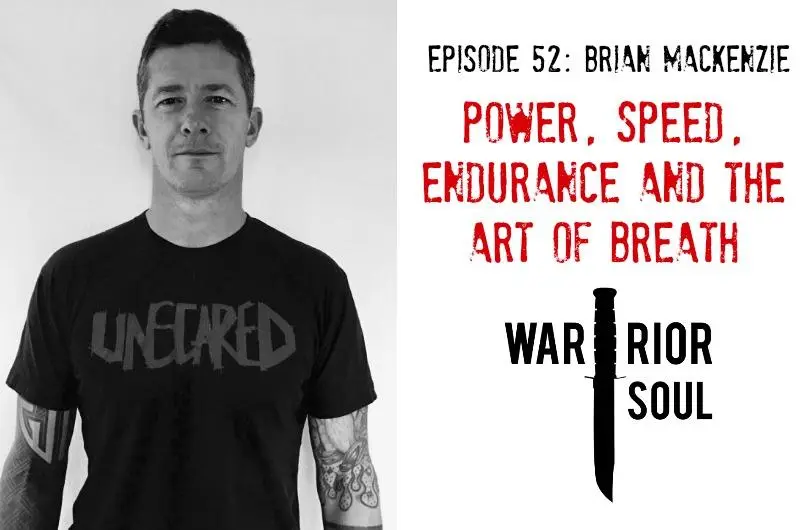
Episode 52: Brian Mackenzie: Power, Speed, Edurance, and the Art of Breath
Hosted by Chris Albert
The Warrior Soul Podcast
Brian Mackenzie is a human potential specialist. He has spent the last 2 decades in human performance learning about movement and physiology. He is the innovator of the endurance, strength and conditioning paradigm. He has studied performance, movement, hypoxia, breathing mechanics, principles and methods, along with heat and cold exposure. He has spent a lot of his time training and understanding in and around the water, desert and mountain environments. He finished Ironman (Canada 2004), has run the Western States 100 and the Angeles Crest 100 mile endurance runs with success in using methods he developed.
He co-authored the book Power Speed Endurance, NYTimes Best Seller UnBreakable Runner, and UnPlugged. Brian co-founded and created Power Speed Endurance (PSE), which specializes in movement & skill development in sport. He has taken on a quality vs quantity approach for every aspect of the coaching and programming he’s put out. MacKenzie’s programs have taught more than 400 seminars worldwide and provided programming for thousands of athletes from beginner to elite via the PSE platform and private consultation.
MacKenzie and his programs have been featured in Outside Magazine, Muscle & Fitness, Men’s Health, Competitor Magazine, Runners World, Triathlete Magazine, Men’s Journal, ESPN Rise, The Economist, Tim Ferriss’ New York Times bestsellers “The 4-Hour Body” & “Tools of Titans”, Scott Carney’s best seller “What Doesn’t Kill Us”, Men’s Running UK, LA Sport & Fitness, Muscle & Performance Magazine, and Rivera Magazine. Mackenzie has worked with professionals including Dr. Andy Galpin (CSUF Professor/Researcher & co-author of UnPlugged), Dr. Justin Mager (Health Incite, Marin CA), Dr. Brian Hickey (Florida A&M University Exercise Physiology Professor & PSE BIKE head Coach), and Dr. Andrew Huberman (Stanford Medicine Associate Professor at Huberman Lab). Mackenzie has also worked with athletes, special operators, and MIL/FIRE/LEO with the likes of Laird Hamilton, Jamie Mitchell (10X Molokai to Oahu Paddleboard Champion and big wave surfer), Dusty Payne, Kai “Borg” Garcia, Pat Tenore (RVCA creator/founder), Oahu’s North Shore Lifeguards, UFC Light Heavy Champion Jon “Bones” Jones, CrossFit Games athletes including Rich Froning Jr (4X CrossFit Games Champion), and Annie Thorisdottir, James Newbury (2017), Olympic Gold Medalists Erin Cafaro (2X Olympic Gold Medalist in Rowing – W8+, Wife) and Taylor Ritzel (2012 Olympic Gold Medalist –W8+). He has worked with several other professional and elite level athletes in sports spanning from Triathlon, Running, MMA, Swimming, Cycling, Rowing, Surfing, Base Jumping, to invitations to work with Special Operations (US Navy SEALS, Army Rangers) and many other Military and Federal Units, and is working with Stanford Medicine / Huberman Lab on Research surrounding his work.
Web Site: https://powerspeedendurance.com/
Instagram: @iamunscared
Twitter: @BrianMackenzie

Transcript
Machine-generated from the episode audio and lightly edited — may contain errors.
Andrew Marr (link to this point)
Warriors, this is Andrew Marr. And today, I wanted to talk to you guys about the book that we have coming out later this fall called Tales From The Blast Factory, and it's about my trial, my family's trial and experiences with the symptoms of traumatic brain injury and then what it takes to pull yourself out of that and live a life of purpose and fulfillment. And why do TBIs matter? Well, they matter because close to four hundred thousand individuals have been diagnosed with a traumatic brain injury in the military since two thousand to twenty fifteen. Of that, up to fifty percent of those will develop a major mental disorder after diagnosis.
And the conventional model has been psychotherapy and medication, which in most cases further exacerbates the problem. And it does that because it doesn't treat the underlying condition. And that's the basis of the book. We wanted to show what that life looks like, the life of an operator, what happens when disaster strikes and you step into the unknown and everything that you once knew is not the way it it is anymore. And then we wanted to talk about and show the process of that healing process and talk about the Warrior Angels Foundation.
And since then, we brought that same level of healing that I've received to hundreds of others while delivering our message of hope and a viable solution to millions. And it was thinking, visualizing, and believing it in our minds first brought it into existence. And we wrote this book, my brother and I, Adam, so others could do the same thing. The name of the book is Tales From The Blast Factory. You can sign up to get on the prelaunch list.
They'll get you all kinds of cool Warrior Soul bennies at www.talesfromtheblastfactory.com, and you can also preorder on amazon.com. That's talesfromtheblastfactory. You can preorder on amazon.com and talesfromtheblastfactory.com.
Chris Albert (link to this point)
Hey, guys. It's Chris here. And I just wanna tell you about our new sponsors. You know, one of the things that I'm always talking about here on this podcast and on the Warrior Soul Agoge YouTube channel are the benefits of ketosis and the benefits of including healthy fats in your diet. They help to protect your brain.
They help to reduce total body chronic inflammation. And honestly, I can say this with confidence, including fat in my diet has made me a better person. Why? Because it's given me lasting energy. I can go throughout the day.
I don't get hangry. I don't get moody because I haven't eaten. And I'm able to feel better and perform better because of the fats I include in my diet. Now one of the problems and I completely understand this is that a lot of people don't have access to fats in their daily lives. When I was in the Marine Corps, I was out in the field.
There was very little possibility that I was ever going to have access to something like coconut oil or avocado oil or macadamia nut oil. Well, when I went to Paleo FX this year, I ran into some really good people from F Bomb Fuel. And what they've done is they've put together individualized packets of good, healthy and delicious fats. They've got avocado oil, macadamia nut oil, MCT oil, coconut oil. On top of that, they've got some really delicious nut butters.
Their macadamia nut butter is absolutely amazing. I've never really tasted anything like it. And it all comes in this extremely portable packet that you can take with you anywhere. They've also got some portable salad oils that you can take with you as well. If you're eating a salad, you put them on top of those or you can pour them over your food.
These are a lifesaver for anybody who wants to live a healthy fat adapted lifestyle. And the best part is that the company is run by some really good people. They have a really strong desire to do good and they've got a really strong desire to help out veterans. And we're working on some things for the future where they're gonna be able to do that. So if you wanna check this stuff out, and I promise you if you try this macadamia nut butter or any of their other products, you're not gonna be disappointed.
Check them out at www.fatissmartfuel.com. What's going on everybody? This is Chris Albert, this is episode number 52 of the Warrior Soul podcast. And I have to say that today's guest is somebody I'm extremely excited about. Brian Mackenzie is a strength and conditioning coach, He's been in the fitness industry for a very long time.
He started out back in the day with CrossFit Endurance. Brian's contribution to this field is in an area where a lot of people had a lot of issues for a very long time. Endurance sports. Endurance athletes have classically broken themselves and then broken themselves again. Repetitive use injuries are common in endurance sports, those who train for triathlons, those who train for marathons, and those who've trained in the military, a lot of us do a lot of distance running.
Brian had a different skills based approach that kept people away from running countless miles and doing that repetitive stuff that was causing so many injuries and so many health problems amongst endurance athletes. Brian is also currently traveling around the world doing seminars on the art of breath. And that's something that we often don't think about. We often don't think about how breathing and its importance to how important breathing is to our health, to our performance, to our mental well-being. And Brian is bringing that to light through his seminars.
Andrew just came back from one of his seminars up in Northern California, and he couldn't stop raving about it. I have to say that this is one of the best episodes we've done. Know that I've said that about a lot of guests, but this was a truly amazing conversation. And with that, let's get into episode number 52 with Brian Mackenzie, strength and conditioning coach and endurance specialist extraordinaire.
Chris Albert (link to this point)
This is Chris Albert, I'm here to remind you of one thing. Someday, you're going to die. Now that's not some morbid statement or scary idea. It's solid fact. Your time here on this earth is limited.
And we need to be reminded of this as much as possible for one simple reason, to live your best life while you can. This is the Warrior Soul podcast.
Hello, everybody. Welcome to the Warrior Soul podcast. Andrew and I are here today with endurance expert and all around badass, Brian Mackenzie. Brian, how are doing today, buddy?
Brian Mackenzie (link to this point)
I am excellent, gentlemen. Thank you for having me on.
Chris Albert (link to this point)
I knew Andrew just took your art of breath seminar, and, I know he's got tons and tons of questions for you. You know, I've heard a lot about your seminars. I've heard a lot about what you do. I've I've met you in person, and and you're an awesome, awesome guy. Read a lot about you.
How did you get into specializing in endurance and in the art of breath?
Brian Mackenzie (link to this point)
It's an it was it's an interesting thing only in that I wasn't very good at it. So I never had really a background in endurance. I had a background in short course sprinting, skateboarding, surfing, and I got coached into doing a triathlon, I think in two thousand and one, two thousand and two. And I did horribly at it, even though I trained my ass off for it. I did really well on the swim, because I had a swimming background.
And then I started to fall off on the bike, although I did decent on the bike and then the run, just was abysmal at, and I was passed by several overweight people who encouraged me to keep going. For somebody who's been a lifelong athlete, I've never really been overweight or really unhealthy to a large degree. It was a very humbling experience. And it was one that said, it was one of the, it was the first time in my kind of professional career that that was where everything changed. And I was able to say, you know what?
I wanna understand this better, so I'm gonna learn. And I chose not to go and take everybody's word for everything. Chose not the dogmatic approach of education. Although I was engaged in the educational process, I was working my way through exercise science, I just felt the tracing paper was not my way of learning. That's, I'm grateful that I've chosen that path.
I more or less spent a decade or more understanding a lot of what the endurance world was about and what it wasn't about. Or what it wasn't about for me. I first spent a lot of time slogging out a lot of miles and a lot of time on my feet into my bike or on my bike seat. And I learned really early that that was one way to do something, but that was not the only way to do something. And I think this is where a lot of us, whether we're athletes, whether we are in the military, whether we are in a professional career of any sort, get lost and we start to become sheep.
And I know Andrew's story to some degree, these are very similar paths as to how I felt I needed to figure things out on my own because the people that I was surrounding myself were only doing it one way and that one way wasn't very effective for me. And it wasn't very effective for the athletes I was working with. And at the time, the athletes I was working with were your general population when I first got into training people. And it's progressed into elite level athletes. The irony of it all is elite level athletes don't start doing what a lot of the general population are doing.
They're not just going out and slogging out miles, they're actually getting faster and stronger and more skilled in learning a process at something, and that was what I really learned. And so that's really morphed or really embodied, the whole process of that has morphed itself into what it is I do for a living, I guess. And that is to understand mastery of some sort and not mastery of some sort, mastery of any sort, really to what I find intriguing. And breathing, I guess, fit right into that sucker when I put on a training mask for the first time, because I made fun of a training mask. And that was how I rolled into the breathing world.
Made fun of a training mask. I had never used a training mask. I'd just seen people running around with them, thought they looked like fools. And then I really was like, well, I just caught myself, you know, really not knowing anything about something and having an opinion about it. And then that forced me to actually get one, or well, a buddy of mine gave me one and put it on.
And instantly when I put the mask on, something changed. And I changed the way I was breathing and I changed the way I was positioned and I became more aware of something. And regardless if it set elevation on that thing or not, it still changed something. And that spearheaded a conquest into understanding more. And that that's been for man, that's been up for over five years now.
Andrew Marr (link to this point)
So Hey, Brian. What what leads to that process? Because that that's something in and of itself to say, hey. You know what? I've caught myself.
I've consciously caught myself, and I realize that I'm not giving something an opportunity, and I have an experience for myself. I mean, we can jump into the breath work that led from that, but what was the process for you to be able to, as a man, come to those conclusions and say, I need to go about this differently and try it for myself?
Brian Mackenzie (link to this point)
It's the same thing that I see. It's interesting. You know, I see this in so many, like, young guys and not necessarily females because females are really they don't typically follow this process, but the anger and the opinionated process that I can have or the insecurity that surrounds that is the catalyst for me to be like, shit. I I I'm I'm I now know I need to go a different route. I now know I need to go learn something.
And the interesting thing is, is I was just having a conversation with my buddy, Kenny Kane, who's in Santa Monica. He's one of the deepest guys I know and he's such a phenomenal coach. He did standup comedy for like twenty years and he's so, so deep. But we both were talking about the really the the process for enlightenment or for spirituality or for being in a place of just mastery or getting better at something is one thing, and it's the desire to learn. And there's nothing more than that.
And when I think I know something, it doesn't even matter if I have a tidbit of it. Like, let's just take this breathing thing. I don't know shit on it, comparatively speaking, as to the totality of what there is to understand of it. So the fact is is I wanna constantly learn more about it. I don't know.
I barely know anything on endurance training. I just understand what it is I put myself into. And so there's so much more to understand with it, which is why I can connect the breath work and strength and conditioning and movement into endurance training now. So it's now, it's all one thing, but it's still trying to master this whole thing. And I really think it comes down to learning, I really think the catalyst for the whole thing is the insecure behavior that happens to where it's like, oh, I already know how to do that or I know what that is or I'm doing it this way, just this way.
And that becomes the process of me going, oh yeah, there's that thing. And that happens within relationships, that happens within everything I do, you know, to where it has to become a part of that process. The moment that I think I've got something nailed down and have a real good opinion about it, then you know, it's time for me to really put the ego aside and start learning more.
Chris Albert (link to this point)
Well, that takes an immense amount of self awareness and self knowledge to be able to do something like that. You know, I've I've been in the fitness industry for a long time, and so many people, they'll they'll get into something, and then ego just takes over. And, you know, they don't wanna appear as weak or they don't wanna go against the grain or they they they just think that they're they're doing the right thing, so they don't wanna hear anything else. Have do you have, like, a meditation practice, or, have you have you gone through a self awareness kinda transformation, from a younger age, in order to be able to do that? What what about you allows you to be able to do that?
Brian Mackenzie (link to this point)
Yeah. I mean, there's been there's a lot of key things. Like I've got a I've obviously got quite a number of tattoos, but I I've actually got a couple tattoos. I got one on my right hand. It's 1974, which is the year I was born.
And then I got one on the other hand. It's 1998, which is the year I consider that I kinda woke the fuck up. And I decided that I needed to change something that I was using as a coping mechanism. And whether you wanna call that alcoholism, drug addiction, or whatever is fine. That became an identity for quite some time, being somebody who needed recovery.
And I think we all can understand that to a large degree and what those things are or those identities are. And and and those have their their place in in time, but it's no different than me taking on the identity of a runner per se or or what you know, what else. And so I there have been really high level things that have happened in my life to where I've made these decisions to where it's a life altering decision. And that was the first real time that that happened. And so I think that was a pivotal point in my life.
I don't consider myself a recovering alcoholic or recovering drug addict by any means. I consider myself a human being. And the behaviors that I've been able to witness not only from drug addicts and alcoholics are the same things I've witnessed in athletes and professionals and every other human being that I've walked along this planet with. My thing has been I need to surround myself with people, including a wife, who doesn't put up with bullshit, or the things that allow for the coping mechanisms that don't bring us into kind of a more, I would say reality, I'd say. Like being a higher sense of self.
Like, hey, if I'm gonna talk to my wife that way, she's gonna check it. Or if I'm gonna talk that way and my wife's around, she's gonna check it and be like, hey, what was that? And it's like, woah, what did I just do? And I become aware of that. So I think my thing has been to surround myself with people.
Making the decision in 1998 was huge, right? But there have been several decisions along that process, which hey, deciding to do a triathlon, that was a major decision that ended up taking me down a route that inevitably became a career for me and showed me things. Then putting on a training mask or even meeting my wife or even making the decision to leave Southern California after forty years and move to the middle of nowhere Oregon. The ability to engage in, you know, to have conversations with people that I wouldn't typically have conversations with. These are daily things that I think I really strive for based on the thing that it's like, if I'm not making some sort of radical life changing decision every three months, there's a problem.
And I constantly want to improve what I'm doing, but I'm not necessarily looking for the meaning of anything, I'm just literally trying to share what it is I'm learning along the way and never losing sight of having fun, kinda like that kid, you know, just being a kid the rest of your life. I think that's the most important process because if you lose sight of being a kid, that's when money, that's when fame, that's when power all become really, really important. And although those things can be a part of growth and what we're doing, I honestly don't believe that, I honestly believe that the fun of it should never lose that sight, and being a kid should never exit that place. And if it does, that's when it loses, that's when all the money, all the power, all the fame loses any credibility, loses any ability to help transfer anything that you are trying to achieve.
Andrew Marr (link to this point)
It's it's about doing what you love, and there's a new song out by the Dirty Heads, a a band I really love, and it's called vacation. And they're talking about how their life is a vacation because they love their occupation. And I think that's so true, man. When you really love what you're doing, like, it's not work, and it's not about the status or the money that that comes with it. And and you hinted on it, keeping the right people around you.
What's your process for identifying if if the people in your inner circle are getting you closer to where you think you wanna go or or further away?
Brian Mackenzie (link to this point)
It takes some time. I I'm you know, I it's a it's a fortunate and unfortunate process, I think. I'm arguably the most trustworthy person I know, and my wife loves and hates that. Mhmm. Only because, you know, I've had a number of people in my life that have been fairly toxic after time or even done some fairly toxic things.
But you know, I'm always willing to give somebody a shot. So it's, you know, it's like, know, and hey, maybe I'm that toxic person in their life too. But I trust, I give everybody a shot, man. And people all the time are kinda ask, Hey, or reach out. Like we just had a kid out here, he's a good friend now from London.
And, and he reached out literally like six months ago, sent me a message on, think Twitter or Instagram. And he had a marketing background in the music industry, and he left the music industry and was getting into training. And he just felt like reaching out because he thought what I was putting out was was interesting, and and it and it sparked more things in him. And and he just wanted to touch base with me, and he said, hey. If there's anything I could do to help you guys, because I do have some stuff and I see some things you could be doing differently.
And instantaneously, here's how it works is now we have this thing called social media, which I love and I hate, know? And it's like, but it's there and it's created this place where people exist and don't have to exist. You know, you can hide behind things and you don't necessarily need to know how to socialize, but you also got this incredible tool that connects people globally, you know? And now I've got this friend and we flew him out and he was here with me for three weeks and he was here, you know, he did a lot of stuff with us and got to play and got to see the world with us and got to help us with stuff as well and got to show us what he was capable of. And I think the process becomes something like being open to anybody and anything and any possibility.
And I think possibilities are infinite. And if you're just not willing to see possibilities and things, I just don't have time for you. That's as easy as it gets. People who are really rigid and have in their ways or what they're doing, I just kinda slow exit on. I've got some friends at some pretty high levels right now, and the commonality with these people is that they just see so many possibilities and they try and connect so many people together.
And that's the whole thing. And Andy Galpin and I, who I just co wrote Unplugged with, were talking about this yesterday. And it's like, dude, if I go and get like, think he's going on Joe Rogan August 9. And I'm so stoked for him for that because he's wanted to do it for so long. And the inevitability of him getting on Joe Rogan means that anybody in his network now has more ability to climb to another level.
And that doesn't mean everybody's gonna go on Joe Rogan or anybody's gonna go on Joe Rogan for that matter, but it's just an example of a friend who I work with who's now gonna be raised up to another level based on another guy's platform who has interest in him, and that raises everybody up around him, who he's in touch with. And that's how life works. And unfortunately, like Chris was alluding to earlier, is it's like in the fitness industry, it's like you go and you start to learn something, you become a know it all at something and everybody has this thing they know and nobody can tell them different. I mean, look at nutrition, man. What a fucking mess.
It's insane. And nobody's come up, know, there's this guy that, who's, there was a guy who pointed something out not too long ago and it's not important who he is. But he's like, There has been nothing profound that has happened in nutrition in forty years, fifty years. Nothing. Nobody's done anything revolutionary.
They haven't. But yet everybody has an opinion of what's the best thing to eat. Yet I've seen vegans who look incredibly good. I've seen vegans who look like they're dying. I've seen people who do well on high protein, who do well on high carb, who do well on low fat, high fat, every fat, like dude, I've seen it all.
And that's the thing. And I'm like, so you're sitting here telling me that this is the only way to do it, yet everybody over here looks like they're doing it just fine. And we're missing the point, man. We're missing the entire point of this whole thing. And and and and like it's you know, just because I went and wrote some programming and did some stuff on endurance training doesn't mean I have the way to do endurance.
There are a 100 ways up the mountain, man. It's just I'm just sharing what we're what we've done along the way. And I think that's
Chris Albert (link to this point)
And the thing is, Brian, I def I I definitely wanna get into nutrition in a second. I I one thing you guys have alluded to in both of your stories here is I think, the the benefit of suffering. In my opinion, you cannot see the matrix. And by the matrix, I mean, the the reality of possibility unless you've been in a really bad state or unless you've been tested somehow. And I think that there's so many people who just haven't been tested.
And because they haven't been tested, anytime any difficulty comes up in their lives, they shut down. They're not able to see the possibilities of what's out there. But I think that in a lot of ways, both you and Andrew, because you've gone through some suffering, because you've you've you've dealt with some bad situations in the past, One, that allows you to see the good in any situation. But two, it it really allows you to step back for a second and look at the different possibilities that are out there that you can take and and not see everything as a zero sum game.
Brian Mackenzie (link to this point)
No. I I couldn't agree with that more. I I I think failure, which can which can involve suffering, means possibilities. That that's all that means And I catch myself probably daily, at least with one thing, where I'm trying to have somebody tell me what to do or give me the answer to something, which is also the problem. Like with the clinic we're doing, the seminar we're doing with our breath, it's like we lay out all these principles and components of breath work in a fashion that like allows you to understand if you're taking a short, fast inhale and a long exhale, what that means.
Or if I'm taking a long, slow inhale and a fast, short exhale, what that means. You know, so it's almost like you give people the possibilities of all this stuff, but then at the end I'll have people go, hey, is there any way you can just tell me what to do? It's like, We just
Andrew Marr (link to this point)
It's so much easier, man, to give that responsibility away and just say, hey. Give me the program, and and I'll follow it. But that puts you in the driver's seat, ultimately, again, when you're saying, hey. I have to test this out for me and find out what's the best way to apply it in my own life, into my own unique experience and environment. And that, I think, was one thing that's always, you know, driven me closer to your work.
And then I you've always said that, hey. Here's how we're doing it. Try it for your fucking self and make up your own mind. I don't think better advice could be given.
Brian Mackenzie (link to this point)
Yeah. Well and and that's dude, that that took a that took a long time to be able to say. You know? Because it's like you get caught up in the world of like, oh, I got this thing to sell. Like, I've got the secret.
Like I remember when I got into the fitness industry, you know, when I really got into strength and conditioning and all the fitness stuff, everything was a credit card swipe with this program that was gonna alter everything you've ever done. And to a large degree, some of that's still around, right? But it's like, there is no secret, man. It's hard work, and it's like, what do you wanna understand? This is why martial arts, I think, are gonna Like, they're already on the uprise again, but they're I think martial arts inevitably will be part of this elite human unit, regardless of being able to fight, I think because of the belt system.
When you are a white belt, nobody wants to roll or fight with you because you're dangerous and you're a liability. And you have to learn the fundamentals and the skills. And then you get your next belt, whether that's blue or whatever system or yellow, whatever system you're in, right? And it's, hey, you've learned enough to earn your right to come and dance over here. But if you get out of control, I'm going to show you exactly where your holes are.
And you learn for a very long time, arguably about ten years to get a black belt in any system. You learn respect, you learn honor, and you learn how to, what mastery is about. And I think it's just something that's been lost within sport and even in the world we exist in, nutrition as well. It's just this fascinating thing. And it's like, what do you wanna learn?
Yo, you don't wanna learn anything, you just wanna be told what to do and go do it.
Chris Albert (link to this point)
That's one of the coolest things. I I started jiu-jitsu this year. And
Brian Mackenzie (link to this point)
Yes, Chris.
Chris Albert (link to this point)
Walking into the gym the first day, it was like you know, I was I was about two hundred pounds. I I'd been a power lifter my whole life. I got broken in half by a dude who was about a hundred and thirty pounds. And that's where I was like, alright.
I've got some stuff to learn here. And and the cool thing is, as a white belt and as somebody who's been in the fitness industry, it's cool for me just to be able to be a white belt and to learn from actual masters who who've done this and and to be put to the fire every day and say, alright. You know what? Those are your holes right there. That's your weakness.
You're not learning this properly, and and it's right there in reality for you. Cold and hard, but it's awesome. And I fucking love it.
Brian Mackenzie (link to this point)
Yes. Yes. I have a guy, down in Southern California. His name's Jeff Harrison. And he's been my he's been my instructor since like kind of day one when I walked in.
And you know, I showed up one day, he's like one hundred and sixty pounds, dude. You know, and I'm close to two hundred. And you know, I walked in one day and I was like, yeah, do a lot of privates with him because I live up in Oregon. So when I come down, I just want to get as much as I can. And I was like, I think I need to fail today.
And he just stared at me and shook his head, okay? And it took me a month for my throat to recover from being choked out in the manner that he choked me out. And it's like, dude, there's so much to learn. And just like, even that process of I need to fail today, to a guy who might be a lot smaller than me, but is going to make me suffer hard. And the lessons are so important.
And it's like, dude, you just don't know. I don't know shit. You know? It's such a fun process, man.
Andrew Marr (link to this point)
That to me is the whole the whole point of suffering, and it and we can get lost on it or or lost in it in that self suffering. But if it's for a higher calling or a higher purpose or it contributes to significance or meaning in your life, well, then now that makes that sacrifice, that suffering worth it because it's working towards something that is bigger than yourself. And I think, you know, you just outlined it. I mean, that's the process of why it's so important.
Brian Mackenzie (link to this point)
Yeah. Yeah. And I I I think that plays a large role in in in in things like the military and why they've used concepts like this, you know, for training and especially with like special forces, you know, where it's this kind of suffering mentality to understand who is actually a team player and understands things, you know? And the same goes for, you know, law enforcement and fire and these jobs and these places that require the ability to think outside of self. And that's the importance of these things.
We've basically it's not that social media is a bad thing. It's that if it gets used in a manner that's not in this way we're talking about right now, if it's not respected, if it's not honored, then it gets misused. And so that anybody coming in trying to be a black belt is just wailing away and behaving in a manner that's just not, you know, conducive to the way that things should be done. And so we have a society that literally is just looking for everybody to give them answers. You know?
Andrew Marr (link to this point)
Yep. And then, speaking in a running context, I can remember back in 2007, 2008, I'm in the special forces qualification course. We call it the Q course. Yep.
And we're training, and, you know, the the the output is significant. And these assholes that I'm running with are wanting to run, like, sub six minute miles for, like, 10 miles. And I just came to the conclusion, like, man, I don't think I'm built for this, but this is what I wanna do. So what the fuck? And so I went to the Internet to strike looking for different answers or different ways that we could apply on how to improve, you know, running technique, endurance, and efficiency.
I come across Brian Mackenzie, CrossFit Endurance, start implementing the principles that he's outlined there. And I was drawn to it because he says, the way that the running world is built is breaking people off and setting them up for injury, and it's not sustainable. And through my experience, we found a different way to do it with not as much, you know, work required or more intense work in shorter durations. And I was like, man, I love the sound of that. I remember we got back from SERE training, which is survive, escape, resist, evade, and you just broke off after that.
You go a long time without eating, captured and put in captivity, all all these other things. But we had to do a a time trial right after that, and I ran, like, a fifteen minute two mile. It was not good. And one of the instructors pulled me aside. He's like, hey.
There's plenty of big dudes in SF, but they can all perform physically. He's like, everything else that you're you're doing is on point, but you have to be a complete guy to run with this unit. No pun intended. So he's like, fix this hole. And that was all the motivation I needed to get get the shit straight.
And so I started implementing Brian's principles through CFE CrossFit Endurance. Eight weeks later, after implementing one of the programs, I went from a fifteen minute two mile to a sub twelve minute thirty second two mile. Now that's not anything to write home about, but at six foot two, two thirty, and not changing my my dietary habits, that was an incredible jump that I was able to sustain for the rest of my career. So it was putting these principles into place. So CrossFit's endurance has since evolved, Brian.
What's been that process of that evolution, and what is it looking like today with the Power Speed Endurance?
Brian Mackenzie (link to this point)
Well, first, I that that makes that puts a smile on my face. Yeah. That that that guys like you were were looking at, you know, that found something like that back then because in essence, that's exactly why it was designed was like, hey. Here, put this out there because there's gotta be people who who who are looking for something else to do. You know?
And and and and we had a lot of success, man. We there was a lot happening back then and and it's such a good it's such an interesting thing that when you think it can only be done a certain way and then you come in and you do it differently and all of a sudden there's just this huge change. And the power outage, the power output outage, the power output from fifteen minutes to twelve and a half minutes in two miles for a guy your size is so enormous. It's crazy, which begs to show the efficacy of the skill development of what happens inside of eight weeks the ability to kinda do that. And I think that's the essence of what we did. The transition's really just been, we felt that CrossFit was on its own big mission towards the games and what they were doing. And my evolving wasn't necessarily really in line with everything CrossFit was doing. Don't get me wrong.
I love and cherish the idea of what CrossFit means, and I still believe today that it's arguably the greatest movement screen you could use for an athlete, used correctly. And that's the problem with people, is that large groups of people don't want to understand that. They just wanna look at something from the outside and make a judgment on it. And I think that's exactly what happened with the endurance world, is the endurance world was never really meant to, I don't think coaches necessarily were out there to say, Hey, let's just have people slog miles and destroy themselves without ever learning how to run. I think a bunch of people went out and started running for the first time and had some degrees in the similar, in exercise science, physical education, etcetera, and saw results that happened from starting to do something.
And things trickle down, and the marathon becomes this thing that people have to do. And how do you train for it? It's 26.2 miles. I mean, first thing that comes to thought is, well, I gotta get up, I gotta get my mileage up. Like I gotta be able to run a few miles, you know, least fifteen, twenty miles if I'm gonna run 26.
And so that's the thought process. But the evolution of what we've done has been, well, what if we actually learned the mechanics or the positioning and the understanding of how to run first, and what that means, and how to be connected to your body weight, and how not to compensate and develop compensations that inevitably lead to problems. And then we'll just turn the intensity up and allow the athlete to develop through the intensity because, I mean, as we're starting to find out, there's such thing really as just anaerobic training. We're never just anaerobic. We've always got some aerobic component to it.
So it's really the development of your physiology along with the skill training. And we just had a couple people out here at the house who trained for a week. And it's a gal who was a first time, her and her husband signed up for a half marathon, and she came and she had all these ideas of what she should be doing, and we really just kinda blew her lid apart. And we did a lot of skill training and I strapped a heart rate monitor on her and I didn't let her have the heart rate monitor. I just recorded it.
And as we were going through a lot of the skill training, I asked her what she thought her heart rate was at. And she's like, I don't know, like maybe like 140 or 150. And you know, every single time I was asking her what was going on with her heart rate, she was up towards 170. And we were just doing skill development. So we have to, you know, a lot of us don't even realize that doing things that we aren't skilled at requires a lot of physiological response too.
And we get caught in this dogmatic thing that I need to be working hard or slugging things out in a specific way to do things. And this is really the transition of what we've done with Power Speed Endurance from CrossFit Endurance. And it's not that it was It's been a, let's look at the totality of what it is we're doing as people. And like if most of the people that follow what we do, they aren't elite level athletes. Elite level athletes come to me personally and ask me to consult with them, which is an easy thing to do.
And it's not a, hey, write out a, or let me follow an online program. That's what the rest of us do. Because we have jobs, we have kids, we have things that we're doing. Elite level athletes get up in the morning, train, go to bed, come back, eat, take a nap, go to the bathroom, go train again, and they do this on and on and on every single day. The rest of us don't do that.
You know, we have jobs. It's So like, how do you maximize that? Well, what are elite level athletes doing that make them so good? Well, they all started at shorter distances or doing less, but in an intense, almost highly skilled fashion. You can look at soccer, you can look at swimming, you can look at water polo, can look at any sport, running.
No great marathoners started off marathon. They started at the 1,500 meter or 3,000 meter distance, and they got insanely fast. And the interesting concept of this is that to get fast, you actually have to be skilled. You have to be good at it. You have to be very skilled at it.
And so the transition over became this thing of like, well, how do we continue to do this? Well, let's take a look at how breathing plays a role in this. And it just so happens that when you don't breathe correctly and that mouth falls open and I'm doing something, I'm out of position. And so now we've figured out a way to get the breathing implemented into this and start getting people more nasal breathing while they're training to understand position and develop the sinuses better and develop as a better athlete or even a better aerobic capacity without actually having to go out and say, I'm running at a 140 heart rate for an hour and a half every day this week so that I can start to develop my aerobic levels. And it's like, you don't even need to do that really.
Like you really don't, because if we keep you nasal breathing, you're going to be high, much higher aerobically than you could be with your mouth open. Because the irony is, is that the moment that mouth opens, you are pretty much setting off your sympathetic cascade. And so we've learned that we're learning how to connect all these dots with what we're doing with Power, Speed, Endurance, and bringing them full circle to where we're creating a, we're looking at things more of like a lifelong approach to training for the general population and people who wanna be ready in any given instance. Meaning, if I wanna go run a marathon and I'm following this thing, I could probably show up and no problem. And I don't have to be running fifty, sixty, 70 miles a week to do that.
Andrew Marr (link to this point)
Can you speak a little bit more about the open mouth breathing as opposed to nasal breathing? What are some of the pros and cons with that? Because when we learned that a week and a half ago, two weeks ago at the art of breath, it was a profound takeaway from the knowledge bomb that you dropped there. So Yeah.
I'd love to drop another knowledge bomb, please, Brian.
Brian Mackenzie (link to this point)
Yeah. Yeah. Not a problem. You know, it's been interesting because, you know, I, we I first got introduced really to breath work in yoga and that way it was years ago. I mean, we're talking probably fifteen years ago and I was like this, I was doing yoga all the time and, you know, I was in Ashtanga and there was, you know, there's specific breath flows that you're supposed to be doing.
And it's also supposed to be nasal. That said, I think the work of Doctor. Patrick McKeown has been pivotal in getting people to understand, and he wrote the book, The Oxygen Advantage, on understanding the nasal breathing. He comes from the Buteyko world, which is a Russian system for breathing. So it's a Russian methodology for breathing.
And he helped point out some things. And I've had a couple conversations with him. We've talked about mouth breathing and nasal breathing. And at first I was kind of taken aback by it and I'm like, oh, just because I open my mouth and I breathe doesn't mean I'm as stressed out as you're claiming. And the irony in it is if you spend enough time actually nasal breathing, you start to learn that, oh shit, there is definitely a change that starts to happen.
And so the change is this, is that, and here's the physiology on it. You've got a nasal cavity, and you've got these two holes that go up that are about the size of a straw, and they enter into a sinus cavity, which humidifies the air, and then it pulls down into your lungs. Your nose is a part of your respiratory system, in that it also has two filter systems, right? Where I've got hair in my nose, which filters particles, and then I've got these sinuses as well. And if I'm breathing more with my nose, I'm also emitting a gas called nitric oxide.
The other part of the immune response, the other part of the filter system is your mucus. And that mucus plays a place in your immune system as well. So it helps keep away things that essentially entering into your lungs could be damaging, right? So the nose is responsible for keeping you in more of a parasympathetic tone, okay? This means that you're going to be a you're going to be a lot bit less reactive or stressed out, okay?
There's a direct correlation, or not correlation, connection between nasal breathing and your vagus nerve, which your vagus nerve's a part of your parasympathetic system. And when the vagus nerve is innervated through breathing, it has your major organs, including the brain, really start to calm down and stay in a more calm state. This also has the vasculature of the system open up or vasodilate. This is important for getting blood flow. When we go into a sympathetic state, so this, it's on the flip side of that.
So think fight, flight, freeze. These are short term specific events that are happening. This is also why we go and train, right? Because we're not active enough and we're not hunting like we were, we're not running from things like we were. This is where it was set up, to kind of be in these heightened states, right?
So we train to induce these things and then we're supposed to down regulate parasympathetic out of that. Well, the interesting thing about the sympathetic state and tone is that the mouth opens and draws in air and it can draw in a lot of air really, really fast. And it's not that we're trying to get more air in quickly, it's we're trying to offload CO2. And when I open my mouth and breathe through my mouth, I can offload a ton of CO2 quickly. And when I offload CO2 quickly, I set myself into a sympathetic tone.
So that sympathetic tone then vasoconstricts things and has us in a more heightened state. And I've got blood constriction not only to the heart and the brain, but also to other organs. The heart and the brain just tend to be the more important ones. So if you've ever done like things like Wim Hof technique, breath of fire, holotropic breathing, and you've used your mouth, well, breath of fire, you wouldn't use your mouth. And that's why we use with what we do is nose.
But when you use your mouth for anything like these hyperventilation techniques, we call them super ventilation techniques because they're on purpose, you will get a very, very, very fast heightened state in a sympathetic tone from these by using the mouth first, okay? So if you're using just your mouth, you get these heightened states. That reaction is vasoconstriction occurring in the brain and the body, in the heart, okay? And so the brain reacts to a lot of this, and it dumps chemicals, and so we get all of this stuff happening when it goes down. And so this is part of that sympathetic place where if I'm working out and I'm mouth breathing a lot, you're just trying to offload CO2.
And the reason we're trying to offload CO2 is because when we are stressed and there's inflammation, mitochondria work harder. And when, you know, it's just like when we work out. It's why our breath rate goes up, right? Mitochondria go to work, our body goes to work, and the exhaust of that per se, of mitochondria working, it's oxidative or it's burning up glucose, okay, or creating glucose, we are offloaded, the exhaust of that is CO2. And so carbon dioxide travels up, well, it's a bicarbonate in the blood and it's offloaded into the lungs as CO2.
And that's the way we get rid of CO2. And so that is why we actually breathe. We do not breathe because we need oxygen. Our bodies need oxygen to survive and live, but we breathe because carbon dioxide burns and it leaves that burning feeling and it tells us to breathe.
Chris Albert (link to this point)
That's one thing we've been hearing out a lot about lately, and I just wanna say this for the audience out there, is mitochondria and mitochondrial density. And the way to think about these are kinda like the energy centers of your cells. Is that correct, Brian?
Brian Mackenzie (link to this point)
You are correct. They are the batteries, the powerhouses, the nuclear reactors of your body. And there are true, I'm reading a book right now on mitochondria. It's like one of the most extensive books, but broken down in more basic terms on it.
And they are equated, I believe the number's a million billion, basically mitochondria in your body.
Chris Albert (link to this point)
It's crazy.
Brian Mackenzie (link to this point)
Yeah, yeah, yeah. It's insane that, you know, and the more you have, the healthier you are. And the better you breathe, the better you utilize oxygen, which also has to do with your CO2 tolerance, the more you develop.
Chris Albert (link to this point)
Now do do you use any other quantification methods besides just the heart rate? Do do you go into heart rate variability and things like that?
Brian Mackenzie (link to this point)
I have. I I I have. I measure a lot of different stuff. And I I really think so, I mean, even this morning, like, I was testing pH levels again just with some different breathing protocols and nitric oxide levels, which you can do with saliva. I use heart rate, I'll use oxygen concentration levels, we'll use respiration rate stuff, which aren't really that effective or they're not really accurate.
I think the respiration rate stuff has a real long way to go. Know, because I can be doing one breath a minute and it's telling me I'm at like nine a minute, which is really off. But I use a ton of different stuff. I've used heart rate variability. I think we believe we, you know, and I alluded to this earlier is that we believe we understand more than we do.
And you know, the irony of that statement, and you know, I wrote a book called Unplugged that just came out with Doctor. Andy Galpin. And I was in my mom's car when I was in Southern California, and this'll come back around, but there was an alert that came up on her screen in her car and it said flash flood warning. And there wasn't a cloud in the sky, but there was definitely clouds out in the desert. There were thunderheads.
And my immediate thought with that was that there was a time when we understood the weather and by looking at it and understanding how humid it was, that there was potential for flash floods without having something to actually tell us there was gonna be a flash flood, right? You would've heightened your awareness to some degree. And this coming back to your question about the things that I use, the number one thing I use is what I feel. But I've used the technology like heart rate, heart rate variability, mood, urine color, pH strips, O2 concentration levels, you know, all of these things to connect back to my mood or what I feel, you know? And I think what we're inevitably attempting to do with the technology is to tell us how we actually should be feeling, you know, versus just actually feeling.
Chris Albert (link to this point)
It's very, very true. I see a lot of people tethering themselves to a lot of different contraptions lately.
Andrew Marr (link to this point)
Yeah. And so I I have Power Speed Endurance, Brian's first book, and then just read Unbreakable Runner. But is that what you just talked about, Brian? Is that pretty much the central thesis of Unplugged, how to tap back into your
Brian Mackenzie (link to this point)
100%.
Andrew Marr (link to this point)
Yeah. Okay.
Brian Mackenzie (link to this point)
Getting back into more of a conscious state. And and, you know, it's we we gotta use consciousness to to to rewire the unconscious. And being unconscious 95% of our day for most of us is, that's autopilot, man. That's your autonomic nervous system to a large degree. And you know, that's the reason why we talk about people just doing some breath work in the morning and the night.
Just do 10 breath cycles, man. Those 10 breath cycles that we talk about just doing something in the morning will literally alter the day of how you're actually breathing and going through things. It's just like training. It's why your resting heart rate starts to drop if you start training correctly and working with your body well enough, right? And so the idea was is that because Doctor.
Andy Galpin and I have such a unique relationship in that, you know, he really didn't like me at first when he found out who I was on the interwebs. And he was like, yeah, this guy just talks a lot, blah blah blah. And then he then he was like, wait. I just listened to something he said, and and and he listened to something I had said. And he was like, that actually makes sense.
He goes, we need to look at that. And that's how things should work. And him being a PhD, a scientist, and me being a guy who explores and really looks at something and really takes on this mastery type scenario with it, that's how we wanted to communicate with people. Like, look, everybody's got all this technology on and they're using it, but most people aren't using it for anything other than to tell them what they should be doing. And that's not how tech is supposed to work at all.
But we're basically putting ourselves right back in the same situation we've done with sugar, with soda, with smoking, with all of these things, but now we're doing it with tech. And like we've had problems with new nutrition world and sugar getting out there and people telling us what to do. And it's like, you know, the same thing can be said with the tech, is that it's, you're creating a dependency on something versus actually taking a realistic look at it and how it's making you feel and what's going on with it. And there was a time that, you know, we didn't have a problem with sugar.
Andrew Marr (link to this point)
Yeah. I I like to look at them as tools. Tools to for a specific end. You know what I mean? And if you're not looking at that point, then it just gets the round robin about, am I entertained or not?
And it's something about entertainment, and that's how, unfortunately, a large amount of people fill up their days. But with conscious breathing, I remember that when I first came across that concept, I was at Walter Reed, and I was being put through all these diagnostic tests, for traumatic brain injury. And, basically, they hooked me up to an HRV, heart rate variability, and they said, how do what do you think about you breathing? Is it is it good? Is it causing any problems?
I'm like, what do you mean? I'm like, I'm breathing fine. I don't have any issues with it. They're like, you just took 25 breaths in that last minute. By definition, you're hyperventilating.
And I was like, well, what the fuck does that mean? They're like, you're highly in a highly sympathetic state, and it's induced right now because of breath. And so just learning that right there and then learning how to control breath or be conscious of breath and downshift that into the parasympathetic, the rest, and the digest process, I mean, that's information that you can enact right now and walk away in your life and be better for it. And how easy or how difficult has it been to help people to come to that understanding, Brian, in the workshops?
Brian Mackenzie (link to this point)
I think getting people in the workshops to come to that understanding isn't the difficult part. Well, I think that's actually that's the like the, oh moment. But what's interesting about what you're talking about, Andrew, is I stumbled onto this information. And I had to figure this information out that you're bringing up right now for myself. Nobody was talking about it the way they were.
We have a mechanism in place in our medical system for asthma that is to give somebody a steroid. And I have personally seen more than a dozen cases of people who just followed some simple breathing protocols, they didn't even go into the Buteyko method, that have altered their asthma without drugs, without doing anything. And I'm not saying it's a cure all, but I am saying, why the fuck isn't this the first line of what we're talking to people about? It's insane to me that I stumbled on clearing a guy's concussion from football in two days, and he had been concussed for like two weeks. Yep.
A guy with two or three people now who I personally work with who had TBIs who came to me and just said, Hey, can I get some, do you think this could help? Well, I know it won't hurt. Yeah, absolutely. Here, and all of a sudden, life changed. Life got better.
My world changed. I can think clearly. I'm not freaking out. I'm not going through, I've got, dude, I can't even talk about the amount of guys that I'm talking to in Special Forces right now who are legitimately using this stuff to alter the PTSD symptoms that are going on already. And it's a fucking, it's mind boggling to me. But on the flip side, the DOD is actually sponsoring a project that I just got involved with on understanding this. So they're trying to make their way through it. The problem is, is they just, nobody, government, the military, our systems in place for state move like a three toed sloth.
And so what we already know and what we're figuring out and what we're doing with people is going to be, we're gonna be ten years ahead of it, you know?
Chris Albert (link to this point)
Yeah, it's crazy though, because we we think of all these diseases. We're there's so many people out there who have autoimmune diseases right now, you know, ranging from asthma to ulcerative colitis. I suffer from ulcerative colitis. We got tons of people with Crohn's, rheumatoid arthritis, all these different things. And the medications for these diseases really don't do much.
I suffered from ulcerative colitis, crazy ulcerative colitis flare ups. I mean, suffering so much, so much pain, not being able to sit down for fifteen minutes without having to run to the bathroom. And every drug they gave me didn't do shit, didn't do a goddamn thing for me. And then the only thing that worked were two things. One was changing my diet, and two was cannabis.
And those are the only two things that really ever worked for me. When I bring this up to doctors, though, they're like, well, that's a placebo effect, or that's you know, maybe it's this this other medication that we were doing for you, and that worked for you. But but it's crazy how closed minded a lot of different organizations and the powers that be are to to looking at these alternative things.
Brian Mackenzie (link to this point)
Yeah. It it will. And and, you know, it's unfortunate because the educational system that we've created is a dogmatic unit of tracing paper. And they can't, because they've created a business out of this thing, they're not willing to change the lines. And I'm gonna get into some stuff that's gonna piss off some people.
Send it. Unfortunately, science has now taken on the mask of what religion has. And science is now all about power. And I'll just use nutrition as an example. There's a movie that just came out called What the Health?
And I think that veganism and vegetarianism is perfectly fine if it works for you. And there are days, there are certain meals I go that I'm only eating veggies or, you know, I don't eat a lot of fruit, but like I'm only eating veggies, right? There's no meat in it, right? I don't need to go and pick up a bunch of studies and say that your studies don't work because there's actually studies that show and prove that a different way of eating can be much more effective. There is research coming out right now on the ketogenic diet that surpasses anything that veganism or vegetarianism has shown.
But do we need to get up and start saying that veganism and vegetarianism is the wrong way? And so my point to this is not that there's anything wrong with veganism or vegetarianism. It's that there are very different things that are going on that we don't understand all of this stuff and trying to prove one correct, one right over the other is nothing more than my struggle for power. That is what religion did, but they did it with control.
Chris Albert (link to this point)
Right. And it and that's the thing, man, because if you look at one of the things that the ketogenic diet is trying to do right now is is trying to gain legitimacy because for the past sixty, seventy years, people have said fat is the freaking devil. And the thing is what we're showing what we've been seeing now is that people are having amazing results. The ketogenic diet was the thing that helped me with my ulcerative colitis. And, you know, you have this recent news about coconut oil that comes out.
Right? And and American Heart Association. The American Heart Association looking to to to demonize coconut oil, say it was never good for you. But you look at that, and you ask yourself, where do coconuts come from? Well, coconuts don't get grown in The United States. What does get grown in The United States?
Well, a shitload of wheat, shitload of corn, and and and other types of crops crops like that that lend itself to a low fat diet. And so you gotta ask yourself, one, where are the dollars coming from? And and two, what are their weapons of choice? They have these peer reviewed journals. If you look at the peer reviewed journals and you go through the peer review process, what happens there?
While you send an article in, it goes to two scientists who are within the the accepted academic norms and usually within certain industrial groups. And then those two scientists decide on whether or not the journal get the article gets published or not. And so what you have is this, like, very narrow paradigm that people are following and or or that the the powers that be are recommending. And when bullshit, excuses come out for why the ketogenic diet is is not a good thing or or why you you you shouldn't follow it, or you get people saying that that the ketogenic diet is is is animal cruelty, which it's not because, you know, most people who follow the ketogenic diet, they actually most of their most of their food is plants, you know, along with some fats and very little animal protein. And it it it's just insane to me, man.
And I'm going off and getting all my heart rate's going up right now just talking about it.
Brian Mackenzie (link to this point)
Yeah. And here's the thing. Is animal I I don't believe anybody I know, especially in the nutrition world, although there's a lot of douchebags in either side, believes that animal cruelty or the way that we've been doing, we've been raising animals is the way to continue. That is definitely not what anybody is saying. And in fact, I, you know, I don't know where vegans came up with the idea that they were here to save the fucking planet, but I will tell you right now that in my observation and learning curve, it is not vegans who actually understand conservation work.
It's actually hunters. And people men and women who hunt and understand how to hunt and what they're doing with hunting and how to save national parks and lands and how the ecosystem actually works. And, you know, that there's this you know, which look, everybody has their place. And the fact is, is that if you're sitting here trying to prove your way of life, or your way of eating, or your way of doing something is the way everybody else should be doing it, you just missed the mark.
Chris Albert (link to this point)
Yep.
Brian Mackenzie (link to this point)
You missed it big time. It's not
Andrew Marr (link to this point)
And I I think we'd be better off if, you know, these ideologies basically say, hey. This is the catch all. This is the end all. This is this is the totality of this, and there is no other way. This is the one best way.
You you apply that ideology, that line of thinking to anything in life, and I tell you what, you're dealing with some difficult and you're you're headed for destruction because that's the process. Anytime somebody tries to tell you what you should do for your life and this is the best for your well-being, now we're in trouble. But if we could just speak from experience and say, this is what's working for me, then we'd be better off for it.
Brian Mackenzie (link to this point)
This is where the popularity game scares me a ton, you know? And I've had some decent, like I've been able to create a decent following with what I've done, and not on purpose, but it scares the shit out of me because I look and I read and I research and I pay attention and I'm doing this stuff. And our existence basically, the reason we're here and the most dominant thing on this planet is largely because of our ability to convince more than 150 people to follow us. And so when we get a bunch of sheep that are willing to actually buy into something and not have to get on their own learning curve with it, And when I say that, I mean not follow tracing paper. I think tracing paper is important for a lot of the basics, but you gotta understand how to get outside the lines of this.
And I used the tracing paper analogy that came from this kid, Charles Oxley, who's the kid from London that I flew out. Think the tracing paper analogy is great. And there's no reason not learn how to trace first, right? But you gotta understand that life ain't tracing paper. Life is gonna be far outside of that.
And if you are gonna get in line and just start following anybody because they do something, you've missed the point again. And that's what scares me is I don't want a bunch of fucking followers following me. And it's weird when I used to go to CrossFit events or CrossFit Games events, which it wouldn't happen now because I've distanced myself enough from it, But walking around and not being able to go take a leak, you know, because you gotta take pictures with people, like that's weird to me. That is very strange, and I don't know that I ever want to get used to something like that. You know, this weekend I was with Jon Jones and helping him out prior to his fight, his world championship fight.
And I'm back there and there is The Rock. There is Gordon Ramsay. There is every who's who of what what. And these people are gracious as hell with all of these weirdo fans who just wanna take a picture and wanna show people that they were with them. And it's like, when did it get to that?
Like when did my life get to the point to where I needed to do something like that, and versus going out and learning and creating and doing something to inspire people to do something great? And I understand doing that, and people loving you for doing that, and taking a stand and drawing a, you know, and showing people a different way. But don't just follow people into the blind light and start regurgitating what everybody else is saying. Understand what it is you're doing. Learn what it is you're talking about.
You know, don't be trying to prove your way of life is not what how we're going to make this world a better place. And that's that's the consistent thing with our history, literally, is our behavior.
Andrew Marr (link to this point)
Mhmm.
Brian Mackenzie (link to this point)
Yeah.
Andrew Marr (link to this point)
And you you spoke about it with the educational platform, and I think in large part, it's made us reliant on on fact based learning. And what I mean by that is just being able to pull up the dates, the facts, but not being able to think critically about it. So we can teach somebody how to pass a test, a standardized test, and what all the dates are they need to know about it, but what good does that do them in their everyday practical life? And so that ability to think critically and how does this apply to me? Does it benefit my life?
Does it benefit does this allow me to help benefit other people's life? To me, that's the litmus test. Not whether, you know, getting a picture with somebody and posting that up on social media.
Brian Mackenzie (link to this point)
Critical thinking man. I think it's the most important thing we've got. And too many people do not understand what critical thinking means. And you know it doesn't mean blasting something because you don't like it. It means if you feel like you need to blast something because you don't like it, time for you to go understand that, time for you to go about And that comes back to the first thing we talk about, what is that thing that makes me do that?
And that's part of that where I get, something fires me up or tweaks me in any way, I know instantaneously I've got to go understand it. I've gotta go learn about it because I'm using something that I don't know anything about, like media or attention. Like we don't watch TV anymore. We don't have regular TV. I have Apple TV and we watch movies and TV videos And from time to time, I don't watch the news, I don't pay attention to this stuff.
It's insane when you don't do that, and then you put it on, and then you watch your parents or you watch your friends when they turn on a football game or the news, and all of a sudden they start spinning up, and it's like, how does this really affect you? How does it really affect your life? What if it all ends tomorrow? How would how would how would this affect you right now listening to this? You're not living.
You're not you're not living in any moment. You're you're fucking living through that thing. It's trying to get you spun up.
Chris Albert (link to this point)
Brian, one question I have because, you know, in large part, all the things we've been talking about have affected the fitness industry on mass, you know, as far as the the types of communications, the democratization of communication. And I think it's led to good and bad. We've got new knowledge about everything. I think I think to some extent, if CrossFit didn't come around at the same time as the the communications revolution, it wouldn't have ever been as big as it is now. What advice would you give to a young trainer who's out there or or somebody who's thinking about getting into the fitness industry?
What advice would you give to them about how to run their business or how to get into this industry in a way that's gonna help people and that's that's going to also allow them to have a successful business?
Brian Mackenzie (link to this point)
I think it'd be this, and and this would go to anybody. Because all I'm doing is I'm participating in fitness or human performance or strengthening, whatever you wanna call it, right? This is just my medium that I use in order to try and show how I've been creative in my own life and and how I'm trying to help the world be a better place. Right? You could do that with cooking.
You can do that with finance or banking. You know, you could do that with whatever you want. And I think the the the biggest thing is is this, is there is nothing new in this world. There is nothing new. It's only how you see it and how you're able to paint it or draw it.
And your take on that is going to be your creativity, your light. And how you express that light is very important. Never lose sight of respect and honor and those who've come in place of you or in front of you and inspired you in your work. For instance, Doctor. Nicholas Romanov inspired what I first learned about running and endurance and I've always paid homage to him for that.
They may or he may want more than that, but I feel like I have always paid homage to that and I'm doing that now. I came in contact with the training mask. I pay homage to training mask because that's where it started. And I feel like it still has some valid points, right? That said, I don't need to have a relationship, I still pay respect to that device.
I've worked with Wim Hof. I will always pay homage to Wim Hof. He's a friend of mine. He's a dear friend. We've shared some very intimate moments.
You know, he stayed with me. He had some great beef pox. So, you know, there's work that was done there, you know, that I pay homage to that. And it's obvious that, and I've given credit to that and I've pushed people to his platform. You know, there's all these things that we learn from and are inspired from, like Doctor.
McKeown's work in Oxygen Advantage. Like I didn't come up with this concept on my own, like with a lot of this stuff. I started learning about it and I'm reading other books and I'm, you know, but he got me thinking about CO2 in a different way than I was thinking about O2, and oh, wow, I need to do this. And there's a lot of things that have been inspired through that. That all said, what I come up with, what I do, is my light.
That is my my canvas. And and know that you're not creating something new, but that you're just painting a a different fucking thing. And it's no different than artwork. And we look at like a Salvador Dali and and and or or we look at Dali's work compared to Monet's work. They're two painters to a large degree.
Right? But they're both doing very different things to some degree as well. And it's just a different way of looking at it. And if you can get that in your head, is to, I need to come in and learn something and master something and spend some time with it and understanding it for my own so that I can then communicate that out to the world, That's what this is about. On the most basic fundamental level, we're talking cellular here.
We are designed for sharing information and reproduction. And until we become immortal, those two concepts exist at the highest level.
Andrew Marr (link to this point)
Boom. Yeah. That was that was awesome, Brian. I mean, it's such similar philosophies in in the way we try to do things at Warrior Soul and and what you just said. And me and Chris have had a unique opportunity to be around elite athletes, actors, operators, politicians just like you.
And, you know, it comes down to the people that I really wanna be around, we really wanna associate ourselves with are are just what you said, man. Somebody who realizes what true inspiration is and fill figures out a way to take ownership of their own life and and to go out and produce something and then to report back on it. And, you know, that to me was what CrossFit Endurance was about. Now power, speed, endurance, the art of breath, and that's taking theory and putting it into practice and then being your own scientist about it. You know what I mean?
And that's why we highlight your work. We pay homage to your work. And at the end of the day, can you put the theory into practice, and how does it apply to you and your life? That needs to be the metrics.
Brian Mackenzie (link to this point)
Yep. Awesome, man. I love it.
Chris Albert (link to this point)
Yeah. Real quick question because I definitely wanna be respectful of your time. And I wanna know what is your morning routine like? What what do you do when you wake up, and how do you how do you center yourself in the morning?
Brian Mackenzie (link to this point)
I'm usually up sometime between four and 6AM. It just depends on where I've been or what I've been doing.
Chris Albert (link to this point)
Do you use an alarm clock or?
Brian Mackenzie (link to this point)
No, no, no. Unless I have to get on a flight early, which usually when I do have an alarm and I've gotta get up early for a flight, I get up before the alarm anyway. I don't like the use of alarms. I don't like changing, I don't like the tech thing of like, know, sleep became a problem for me. And I've finally gotten it to where sleep's not a problem for me anymore.
And I like that. I don't wanna use alarms to get me up to go to work or do something. So when I roll out in the morning, I get up and I'm ready to rock. I typically will come in and do the dishes in the morning because it's task prioritization. My wife doesn't get a, you know, I have a minor military background as well.
And I recognized a lot of the things that happened in the military and why they happen in the military in the manner they do. And, you know, we are human beings and we are an animal and we need tasks. And part of that, you know, would have been making the bed. My wife typically will sleep in a little longer than I did do. That said, I don't make the bed then.
So I get up, I'll go do the dishes. You know, and this is something Laird Hamilton really kinda wrapped around my head with what he did, you know? And and one time I tried to do his dishes because I was with him on in his place on in Hawaii. And I got up in the morning and started doing his dishes because I got up before him and he got up and walked in and he goes, Don't do that. I looked at him like, Oh shit.
I'm like, I'm sorry. And he goes, No, that's what I do. He goes, that's how I start my day and how I click things off and feel like I've accomplished things. And I was like, no problemo. And I'm like, isn't that odd?
You know? That's the thing, is, so I start clicking this stuff off and I'll, I typically always will do the dishes in the morning. And then I do a hydration routine that I'll start. I'll either do that or I won't do it prior to starting some breath work in the morning. And then I'll I'll go through a breath work sequence.
It varies on what I'm doing and what I'm testing out. Largely, it involves some heavy duty cadence work with some with with some super ventilation work and stepping up and getting, the CO two tolerance level higher and higher and higher that I feel like I've really got my body to where I want it to. Then I start moving around a little bit, getting the body moving. And then I either work out or I take the dogs on a long walk, and then my wife and I will attack the day and prioritize the day and what we need to do. And then it's just onward with work and whatever I'm doing.
I usually end the day with heat and ice, which is always just a you know, it kinda just helps just end the day for me, man. Just it's a good thing.
Chris Albert (link to this point)
And with your hydration routine, is there any particular thing you use? Is it a mixture of
Brian Mackenzie (link to this point)
So I'll chug a tablespoon or two of apple cider vinegar, first thing. And then I do about five or seven kinda big strokes of a salt, typically Himalayan pink salt, into twenty, thirty ounces of water. And I mix in like some live probiotics into that stuff, and I drink that first thing in the morning. That just keeps, that just starts my hydration process off.
Chris Albert (link to this point)
Yeah.
Brian Mackenzie (link to this point)
I learned from doing this altitude training thing that captures respiratory water, you do it for an hour and it's an interval cycle, which is another conversation for another time probably about, you know, using breath work for altitude training, but it captures respiration, water, and you would be blown away at how much water you blow off in an hour. Wow. Insane, man. So, you know, when you sleep all night, you're just breathing, right? So I wake up and I and I I I you can just I notice the difference immensely if I drink water in the morning or I forget.
Chris Albert (link to this point)
Yeah. That's one of the things in doing the ketogenic diet is is I lose water very quickly.
Brian Mackenzie (link to this point)
Yep.
Chris Albert (link to this point)
And that that apple cider vinegar, water, lemon juice, and salt, it saved my life. Absolutely saved my life.
Brian Mackenzie (link to this point)
Yep. It's game changer. Very little carbohydrates. Carbohydrates need more water.
Chris Albert (link to this point)
Absolutely. Absolutely. Well, Brian, I have to say, dude, we we've done a lot of interviews, but we've had very few outstanding conversations. And I think that this is an absolutely outstanding conversation, and and I seriously wanna thank you so much for it. Where can people find you on the Internet?
Do you hang out on Twitter, on on Facebook?
Brian Mackenzie (link to this point)
Little active on Twitter. I'm not as active on Twitter. I still am to some degree. It's BrianMackenzie, Instagram is iamunscared.
And that's where I'm at on kind of the interwebs. The other the training and all the stuff we're doing within human performance is with powerspeedendurance on Instagram, and you can find powerspeedendurance on Twitter as well. And then the website is obviously powerspeedendurance.com. We've got PSE Breathe on there, we've got PSE Run, we've got, my favorite, like I follow PSE Tactical and it is easily one of the best programs I've followed in a very long time. I don't write it, So it's Rob Wilson and Daryl Wang, who's a PJ.
They write the program and it is a lot of fun. And it just keeps me kinda in that tactical space per se to where it's like, I could kinda go do anything at any time type of thing, but yet I still like having the ability to put load on, and I like to climb mountains, do stuff like that, and you know, it's it's a really fun program for me, so that's what I follow.
Chris Albert (link to this point)
Awesome. I'll make sure to keep that in the show notes. Andrew, you you have any last words over here?
Andrew Marr (link to this point)
No. Again, we did the art of breath workshop a couple of weeks ago. It's phenomenal. I highly recommend it. I highly recommend Brian's books, his platforms, and I took away information that I could apply that very day and decided not if it was benefiting me.
And, of course, it was. So I brought it home. Me and my wife are now we have a AM and PM breathing session, and now we're introducing it to the children. So these are things that you can take away. Actionable information to improve your life, and that's what Brian's putting out.
So, Brian, awesome. It's been awesome talking to you, man.
Brian Mackenzie (link to this point)
Gentlemen, thank you so much. I had I felt the same way about the conversation.
Chris Albert (link to this point)
Love it. Awesome. And and for all of you out there, we will definitely get all of these links up on the show notes, and you'll be able to find Brian on the Internet. And I wanna thank you all for listening to this episode of the Warrior Soul podcast. I hope you enjoyed it, and get out there and live your best lives.
Host of the Warrior Soul Podcast and founder of Warrior Soul. Worldwide trainer and nutrition coach, contributing author at Testosterone Nation and Muscle and Strength.