Podcast episode
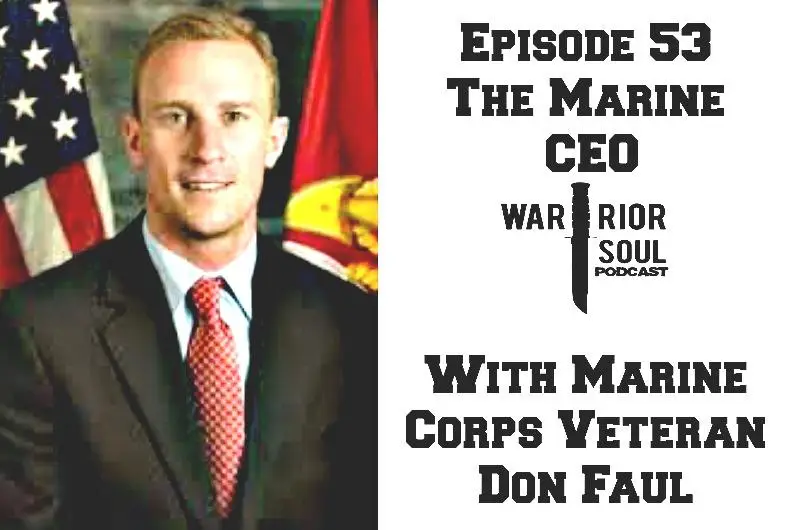
Episode 53: The Marine CEO with Marine Corps Veteran Don Faul
Hosted by Chris Albert
The Warrior Soul Podcast
Don Faul is the CEO of Athos, a tech company that makes smart clothing that detects muscle activation for better performance. Don served as a United States Marine Corps infantry and reconnaissance officer and has previously worked for Google, Facebook, and Pinterest.
In this episode, Don gives amazing advice to veterans seeking to make their ways in the civilian world.
– How he made it through a rough transition out of the Marine Corps
– How he secured his first job at Google
– Where he found his greatest source of support in his quest to become a tech executive.
– Leadership tactics he uses as a CEO and what carried over from the Marine Corps.
– His personal practices and daily routine.
– Why veterans should be hopeful as they make their own transitions to civilian life.
You can find Don on Twitter at https://twitter.com/donfaul
You can find Athos at https://www.liveathos.com/
Transcript
Machine-generated from the episode audio and lightly edited — may contain errors.
Andrew Marr (link to this point)
Warriors, this is Andrew Marr. And today, I wanted to talk to you guys about the book that we have coming out later this fall called Tales From The Blast Factory, and it's about my trial, my family's trial and experiences with the symptoms of traumatic brain injury and then what it takes to pull yourself out of that and live a life of purpose and fulfillment. And why do TBIs matter? Well, they matter because close to four hundred thousand individuals have been diagnosed with a traumatic brain injury in the military since two thousand to twenty fifteen. Of that, up to fifty percent of those will develop a major mental disorder after diagnosis.
And the conventional model has been psychotherapy and medication, which in most cases further exacerbates the problem. And it does that because it doesn't treat the underlying condition. And that's the basis of the book. We wanted to show what that life looks like, the life of an operator, what happens when disaster strikes and you step into the unknown and everything that you once knew is not the way it is anymore. And then we wanted to talk about and show the process of that healing process and talk about the Warrior Angels Foundation.
And since then, we've brought that same level of healing that I've received to hundreds of others while delivering our message of hope and a viable solution to millions. And it was thinking, visualizing, and believing it in our minds first brought it into existence. And we wrote this book, my brother and I, Adam, so others could do the same thing. The name of the book is Tales From The Blast Factory. You can sign up to get on the prelaunch list.
It'll get you all kinds of cool Warrior Soul Venice at www.talesfromtheblastfactory.com, and you can also preorder on amazon.com. That's tales from the blast factory. You You can preorder on amazon.com and talesfromtheblastfactory.com.
Chris Albert (link to this point)
Hey, guys. It's Chris here, and I just wanna tell you about our new sponsors. You know, one of the things that I'm always talking about here on this podcast and on the Warrior Soul Agoge YouTube channel are the benefits of ketosis and the benefits of including healthy fats in your diet. They help to protect your brain. They help to reduce total body chronic inflammation.
And honestly, I can say this with confidence, including fat in my diet has made me a better person. Why? Because it's given me lasting energy. I can go throughout the day. I don't get hangry.
I don't get moody because I haven't eaten. And I'm able to feel better and perform better because of the fats I include in my diet. Now one of the problems, and I completely understand this, is that a lot of people don't have access to fats in their daily lives. Know, when I was in the Marine Corps, I was out in the field, there was very little possibility that I was ever going to have access to something like coconut oil or avocado oil or macadamia nut oil. Well, when I went to Paleo FX this year, ran into some really good people from F Bomb Fuel.
And what they've done is they've put together individualized packets of good, healthy and delicious fats. They've got avocado oil, macadamia nut oil, MCT oil, coconut oil. On top of that, they've got some really delicious nut butters. Their macadamia nut butter is absolutely amazing. I've never really tasted anything like it.
And it all comes in this extremely portable packet that you can take with you anywhere. They've also got some portable salad oils that you can take with you as well. If you're eating a salad, you can put them on top of those or you can pour them over your food. These are a lifesaver for anybody who wants to live a healthy fat adapted lifestyle.
You know, one of the problems I think that veterans face when they come into the civilian world is that when you're in the military, there's a whole lot of people looking out for you. You've got your squad leader. You've got your team leader. You've got your platoon sergeant. You've got your platoon commander.
You got your company commander, you know. And and all these people are there to kinda catch you when you screw up. And you you might get your butt chewed. You might get yelled at. You might even get a little bit of punishment.
But their job is to train you and to guide you towards success. And when we get into the civilian world, we don't have a squad leader sitting there telling us how to do things. You know? Nobody's pushing us to to do anything beyond the bare minimum in the civilian world. And I think that, you know, this isn't just veterans.
You know, there's there's so many veterans out there who who've done great things, but this is a function of life here in America in this day and age. Well, the gentleman I'm interviewing for today's episode, mister Don Faul, he was no different. You know, he got out of the marine corps and he wanted a job in Silicon Valley. You know, that's a place that is very unlike the military when you get into the tech industry up there. It's very unorthodox.
Lot of out of the box thinking, although there is a lot of out of the box thinking in the military at certain levels. Silicon Valley is a different animal. And so even though he was a graduate of the United States Naval Academy and had served as an officer, multiple combat deployments, and had a fantastic resume. He had a great deal of difficulty in securing his first job. But eventually after persisting, he got that job and that job was at Google.
And then he went from Google over to Facebook. And then from Facebook over to Pinterest. And today, he's the CEO of a company called Athos. And they make athletic wear. It's smart athletic wear.
And, it's it's absolutely fascinating. It actually can examine the ways your muscles are activating while you're training. And it gives tons of helpful data to help you to perform better. But the real gems in this episode are the pieces of advice that Don gives to other veterans and other people. You know, I talk I'm talking to veterans, but I know there's a lot of you out there who might never have served.
He gives them some lessons on persistence, on resilience, and on not giving up. And there's some amazing lines at the end of this episode and, actually wrote it down and I posted it on Instagram, where Don talks about the fact that there is no industry and no company where veterans haven't made an impact. So if you're out there and you're struggling to find your footprint and you're struggling to find your place, understand something. The place is there. You just have to work to get there.
And with that, I'm gonna stop smacking my gums. Let's get into episode number 53 of the Warrior Soul podcast with Don Faul.
This is Chris Albert, and I'm here to remind you of one thing. Someday, you're going to die. That's not some morbid statement or scary idea. It's solid fact. Your time here on this earth is limited, and we need to be reminded of this as much as possible for one simple reason, to live your best life while you can.
This is the Warrior Soul podcast.
Hello, everybody. Welcome to the Warrior Soul podcast. Today's guest is a gentleman by the name of Don Faul. Don is the CEO of a company called Athos, and he is a United States Marine Corps veteran, and and we're very honored to have him on today. Don, can you can you tell our audience a little bit about yourself, your background, where you came from?
Don Faul (link to this point)
Absolutely. Well, first off, thanks for having me. I really appreciate the opportunity to to talk to you for a few minutes today.
Chris Albert (link to this point)
Our pleasure. Our pleasure.
Don Faul (link to this point)
Yeah. So my background, as you mentioned, I'm a marine veteran. I went to Naval Academy undergrad, graduated from there, spent about six years on active duty in the marines, Was a infantry officer out on the West Coast with a unit called First Light Armor Reconnaissance Battalion. Did a tour with fifteenth MEU in 2001. And did my second tour with First Force Recon Company as a platoon commander there.
I did another deployment with them in early two thousand three. Transitioned off active duty at the end of two thousand three. I moved up to The Bay Area to go to grad school, got my MBA and transitioned to work in the technology industry. And so I've spent about the last ten, eleven years now working in tech. I've spent, you know, time at a couple of different companies, started at Google, spent a couple of years there, then transitioned to Facebook where I worked for about four to five years.
Was at Pinterest after that. And then joined my current company, Athos, about a year and a half ago.
Chris Albert (link to this point)
Wow. That's a that's a heck of a background, man. When when you were transitioning out of the military and you were trying to get into tech, what kinds of issues did you run into? And if you did run into issues, how did you overcome those issues as far as finding a job, getting in with a company, things like that?
Don Faul (link to this point)
Sure. Yeah. The transition was was certainly challenging for me. You know, when I was getting off active duty, had really enjoyed, you know, my time in the marines, but I was definitely ready to kinda take the next step in my career. A challenge was for me, I had no idea what that step should be or, you know, what was even possible.
You know, the entire private sector, you know, being a civilian was brand new to me. I didn't know which industries to look at. I didn't know which types of jobs to look at. I didn't know which ones I was qualified for. Felt like grad school was a good opportunity to kind of buy a little bit of time and figure all that stuff out, but found out pretty quickly after coming off to grad school that I had to make a decision about, you know, where I wanted to spend my first summer.
So I was kind of back in the job exploration process pretty quickly. You know, once I started, you know, I narrowed it down to technology and, you know, honestly, that was kind of my best guess at the time. I studied engineering undergrad in college, enjoyed that, had always kind of been into technology as a consumer and figured it might be an interesting industry to check out. When I started interviewing, you know, kind of caught the next set of challenges. I felt like, you know, every role I interviewed for wasn't the right fit.
Every job, you know, requirement that I read, every job listing I read felt like it was, you know, describing someone else. You know, everyone started with, hey, we're looking for a leader that's got five to seven years of consumer technology experience. You know, not a single tech company was was explicitly looking for someone with with my type of background.
Chris Albert (link to this point)
Mhmm.
Don Faul (link to this point)
And then so once I started interviewing, you know, became really challenging. You know, it felt like the types of questions I was getting asked and have great answers to, I didn't know how to talk about my experience in a way that made sense to the person sitting on the other side of the table. Got a lot of no's, you know, talked to a lot of recruiters, a lot of hiring managers who didn't really know what to make of my background, had a lot of respect for for our service, but but didn't really understand how that type of experience could be relevant in in the technology industry.
Chris Albert (link to this point)
One question I I definitely wanted to get into was how did you deal with that frustration? What you know, getting no after no and going to job interviews and and having somebody in front of you who who might respect your service but really doesn't understand where you're coming from at all, how did you mentally get around that?
Don Faul (link to this point)
You know, I I I guess, you know, there were two things that were enormously helpful to me. I you know, first, I guess if you if you learn anything in the military, it's it's how to deal, you know, with challenges, how to kind of adapt and overcome and stay patient and persist. And so, you know, I knew that while it was really challenging, every conversation got a little bit easier. And every person I talked to, I felt like I had a slightly better understanding of of what it would take. And so I was just really, really determined, you know, to learn as quickly as I could, you know, to get as many reps, as many interviews, as many conversations as possible.
And then, you know, make sure that I was the most prepared person they talked to. You know, I didn't have the experience necessarily on paper that they were looking for, but I, you know, I was determined to ensure that when I walked in the room to have that conversation, nobody would have prepared better than I did. So, you know, that was the first piece, just being kind of doggedly persistent, not taking no for an answer. The second thing actually, you know, was was really all the all the help and support I got from other veterans. You know, I I when I first moved out here, I felt like I was the the only veteran in in the Bay Area, but quickly discovered actually that there were quite a few vets who had made the transition.
And so my you know, the first real shot that I got was, you know, an an interview at Google. And that interview, that conversation came from another veteran, another Naval Academy grad, submariner who had been working at Google for a while and was nice enough to grab a few minutes and share some advice and pass my resume along to the right person. So I think those two things were really instrumental for me.
Chris Albert (link to this point)
That's pretty awesome. Persistence and and definitely making those connections and trying to trying to find people who can help you along your way. So you get the first job there and and you come in. What types of things did you experience when you first came in and and, what happened that you didn't expect and and how did you deal with that?
Don Faul (link to this point)
Sure. So, you know, my first real job work experience in tech was working at Google in 2005. And, you know, it's funny. I had sat down with my manager, the person who was hosting me for the summer to talk about which project I wanted to work on. And you rattled through a long list of descriptions that made absolutely no sense to me.
And I remember the last project you described was, Hey, we're launching the AdSense API. And so I said, you know, quickly thereafter, Yeah, that one sounds great. I'd love to work on that. Because it was the only one I could remember. And I I quickly went back after that and and had to look up what API meant and stood for.
And and, you know, trying to get a sense for what I'd signed myself up for. And when I showed up on that first day, I, you know, I admit I was pretty intimidated. I didn't know a whole lot about technology. You know, I felt like I'd kind of fooled someone to get my foot in the door that I would flail over the course of the summer. And I was actually quite pleasantly surprised that a lot of the things that I'd learned while on active duty, you know, paid dividends pretty quickly in that environment.
And all the things that I was worried about, this notion of understanding, you know, the kind of the specifics of the domain, understanding technology. I had this perception that, oh, if you're gonna be successful in tech, you know, you have to understand how to write code. It turns out that, you know, being able to to influence people and build relationships and bring people together around a common goal Turns out that, you know, being really disciplined about executing and hitting deadlines and and doing doing your work with the highest quality, being someone that could be relied upon, it turns out that those things were just as valuable in the technology industry as they as they were in the military. And so, you know, after after, you know, a week or two, I found that, hey, this this doesn't all sound like Greek anymore. And I've already been able to have have an impact.
And I that gave me, you know, kind of increasing confidence over, you know, the first couple months of my time at Google. And I was able to actually work on something really meaningful. I was able to add value, across the the broader team. And then I was able to help other people from a leadership perspective, work through some of the interpersonal challenges, you know, that they were facing day to day. And so that was really for me coming out of that that three month internship at Google.
I kind of walked out of that internship that with confidence that I could have an impact in this industry and that I'd really enjoy working in technology in a leadership capacity.
Chris Albert (link to this point)
When did you get to the point where you actually started to to have leadership over a team and and and actually have a few few different people under you in the civilian sector? And and when you did, how did it differ, if it differed at all, from leadership in the Marine Corps?
Don Faul (link to this point)
Yeah. So I, I decided to go back to Google. So I interned for three months between my first and second year of grad school. And then I went back to join full time in 2006. And at that point, I came into a leadership role.
So I think I assumed a small team, maybe four or five people that I got a chance to kind of grow to probably somewhere in the neighborhood of 20 or 30 over the course of next year or so. And, you know, it's interesting. I think probably the biggest thing that I had to learn was some of the cultural nuances that made the way that people communicated and people made decisions a little bit different from the Marine Corps. As you can imagine, the the cultural context switch between, you know, Marine Corps particularly coming out of the infantry and Google, know, couldn't be more extreme in terms of how people communicated and how teams work together. And so I had to be very, very conscious of, I think there were two things that really stood out.
One, learning the importance of communicating and sharing context and making sure people understood kind of the why behind decisions. You know, there was that was certainly a part of my role in the Marine Corps, but, know, there were times for good reason when it didn't make sense to go into all the context that, you know, what your team, you know, unit expected from you as a decision and a path forward. In tech, I found pretty quickly that there was an expectation around understanding the why in the context behind the work that the team was doing. And so I had to index in that direction. The second piece was, you know, really understanding how decisions were made.
You know, if there's a spectrum of, you know, on one end, very directive, hierarchical, this is the way that we would do things coming from the tops down on one end and completely consensus based decision making on the other end of the spectrum. You know, Google was more towards the latter. You know, it was an environment where, you know, even the person who joined the team one week earlier expected to have some, say or or conversation decision that was made. And so I had to learn that part of building trust with with my team was making sure that they felt included in decisions and balancing, you know, making sure I struck the right balance between, you know, sharing context and making sure that we could get the appropriate opinions on the table and then making a decision that it was not a a consensus based environment. We, you know, we there were times when we had to make a decision to move the ball forward.
So, you know, those are two big ones. I guess the last one that I'd mentioned was I definitely had a few missteps here and there. You know, I remember I had a member of my team pretty early who, you know, was responsible for preparing something for a meeting with my boss, with my manager. And I'd asked this person if, you know, she wanted to review the materials ahead of the meeting and she kind of looked at me with this, who's this new guy? You know, what do you know?
Kind of back off. And so, you know, I said, great. And we walked into the meeting. I didn't take a look at any of the materials and it was a disaster. And, you know, we came out of that meeting and remember thinking to myself, all right, dial it back, dial it back.
Let's be really soft with this feedback. And we had a, you know, a conversation that from my perspective was, you know, dialed back about 20 levels from the the way I would might've communicated it in the marines. And this person walked out of the room mortified, like, is this crazy marine that we just hired and, you know, off, you know, yelling at people, etcetera. So that was a pretty early learning for me that I had to really modulate the way that I communicated with the team.
Chris Albert (link to this point)
So you had actually dialed it back from the beginning, but but they it was already considered too aggressive for that environment or was it it it it was just a little bit too much for them?
Don Faul (link to this point)
Yeah. You know, I think from my point of view, it was very soft. And so I'm sitting there congratulating myself for for, for handling it so well. And then, you know, twenty minutes later, one of my friends is like, what the heck did you say to so and so? She thought you went crazy in there.
So, you know, I learned that I hadn't dialed it back quite enough and and had to be more thoughtful about the way that I, you know, shared feedback and communicated.
Chris Albert (link to this point)
Did you have any techniques for that as far as just because we we have a lot of veterans who listen to this podcast, and and a lot of them are trying to get out into the civilian workforce, and and and really trying to find their own their own footprint and and, or make their own footprint and find success out there. Did you have any mental techniques that you used as far as trying to dial back or or self talk or anything like that?
Don Faul (link to this point)
Yeah. There were a couple you know, it's interesting when at Google, Google had invested pretty early at that point in a number of trainings around communication, sharing feedback leadership. And I was admittedly very skeptical of all of them, feeling like I'd spent the previous ten years going through every leadership training you can imagine, but they were actually quite impactful. There were kind of two that came to mind for me. One was there's a book written by a guy named Fred Kofman called Unconscious or Conscious Business.
And it's really about communication and some very simple frameworks that help people communicate and interact with other folks on their team. And there was the second training I went through that had a very simple feedback construct, which was in any time I had to share feedback, was SBI, situation, behavior, impact. This is the situation, the context, the meaning that we're in, here's the behaviors you know, that that you exhibited, and here's the impact that I think they had on me and on others. And learned that that simple construct provided for a much more constructive conversation and then learned some active listening techniques, you know, asking open ended questions, checking in with that person, asking that person to play back what they heard from you. There were a series of really simple tools that ended up being incredibly impactful for me.
I'd say my time at Google, some of the things I learned about how to transition, you know, the the leadership experience that's so exceptionally valuable that you take away from the military. And I didn't I you know, you didn't have to start from scratch. I just had to learn how to apply those same exact skills and experiences in a very different cultural context. And and some of those simple tools were immensely valuable in that respect.
Chris Albert (link to this point)
So you kinda did the tour of Silicon Valley as far as, you know, employment and and things like that, did the culture change between Google and Facebook and Pinterest a whole lot, or or was it very similar up there?
Don Faul (link to this point)
So, you know, there are a I I'd say there are a number of mainstays that were consistent across each organization. And I think in some respects are things that are relatively characteristic of Silicon Valley, at least, you know, in my experience. And so some of the things that I enjoy most about technology, about the technology industry, I've I really love the fact that, you know, generally most of the organizations are trying to build a very meritocratic impact based culture. So it's not about, you know, what degree you have. It's not about what school you went to.
It's not about how long you've been at a particular place. It's not about what your title is. None of that stuff matters. You know, what matters is the impact you have on helping the team and the company, you know, achieve its results and achieve its mission. And that was so, so energizing and refreshing to me.
And that was a, you know, very, very consistent part of the foundation of the culture at each of those companies. Generally, really in each case, a deep, deep belief in the importance of its people. You know, with Google, Facebook, and Pinterest, you know, it was a massive massive priority. The amount of time that was put into finding the best people in the world, the the perfect fit, and then a very proactive investment in those people and helping them grow and helping them develop. That was also very, energizing.
You know? But all environments where, you know, that believe in kind of rigorous debate and and and making sure that the best win. Again, and they can come from any corner of the room. It doesn't matter, you know, who has the idea. It's all about getting the best ideas on the table.
And then, you know, just a very fast paced environment where the you know, it was a focus on bias bias for action. You know, Silicon Valley's bent on on challenging the status quo. That's something I've always been really energized by. You know, in in some respects, I felt like the environment we came from in the military was well, just assume the status quo is right. In Silicon Valley, it's almost the inverse of that.
Assume the status quo is wrong. There's got to be a better way of doing things, and that really kind of embodies the culture across all these organizations. So I think there's a host of things in that respect that are really, really similar. And then there are certainly nuances and differences between all of the cultures. And in many respects, they really embody some of the personality traits of the founders of each of those companies.
So Google, with Larry and Sergey, two PhD candidates in computer science, there was a deep respect for engineering and the quality of code and the quality of thinking and the rigor around ideas. At Facebook, Facebook, you know, with Mark Zuckerberg, very much a hacker mentality. And so very, very different in that respect. Rewarding people who broke things, who were aggressive, who challenged the status quo. At Pinterest, Ben and Evan, you know, from the very, very early days, and this is evident in the product, a deep respect for the beauty of the experience, the thinking, you know, the thought that goes into every single pixel, every single, you know, word that's on the website is carefully thought after because it affects the overall experience.
So, you know, a lot of similarities, but also some differences that really support this type of company that each of those founders is trying to build.
Chris Albert (link to this point)
Yeah.
So each company, it's funny to me because each company you worked with was Google Google was kind of already had already come to fruition. Facebook, it I what what year did you end up at them?
Don Faul (link to this point)
From 2008 to 2012.
Chris Albert (link to this point)
So so they're kind of like you know, they they they they've gotten to their their, I guess, could say, critical mass point where it's starting to spread at that point. And then Pinterest is kinda like this new thing. So you kind of been at different companies at different point in points in their development. And I've heard you talk about this thing called the product market fit, where you're trying to find the best market for your product and determine the best user experience. What did you take away from being at companies at each of those stages?
And, you know, was there anything, any bits of advice you could give new entrepreneurs who are trying to get into those spaces?
Don Faul (link to this point)
Yeah, absolutely. Yeah. You know, as you pointed out, I joined each of those respective companies at a slightly different stage. And in some respects I've gone kind of earlier and earlier throughout my career. You know, I joined Google in 2006 full time and the company was on fire, growing like gangbusters.
And so what I learned there, it was a relatively large organization, probably probably 5,000 employees neighborhood when I joined, probably 20,000 when I left. Facebook was about 400 when I joined, probably about five or 6,000 when I left, and Pinterest was about 35 or 40 when I joined. And then Athos was about similar size. You know, at Google, I really learned it was all about learning how to scale. You know?
So how do you how do you continue to grow? How do you grow an organization, and grow a business at at a unbelievably rapid rate? Probably at that point, the fastest growing business in terms of customers in history, later probably eclipsed by Facebook. And so in that environment, it was all about, you know, really scaling on two dimensions. How do you scale your culture?
You know, we were there was a point at Google where there was no constraints on how many people you could hire other than getting it through the quality bar. So we were growing so quickly, literally we could hire as many people as we could find who met our standard for hiring. And so in that type of environment, so unbelievably important to make sure that while you're growing the team, you're ensuring that the critical elements of the culture, you know, which are the foundation of any future success are preserved. And so you're hiring the right people. Are you keeping the quality bar high to those when those new people join?
Are they being trained and indoctrinated into the way that that the organization, operates? And so learned that and also learned how to scale a business. So how do you how do you figure out how to deliver a great experience to millions of people, in real time? At Facebook, I joined slightly earlier. So while Google was relatively, well established organizationally, you know, we had we had training and there was a means of doing performance reviews and onboarding.
At Facebook at 400 employees, you know, growth was also on a tear. We just launched in you know, the company had just launched its ad products. Very little of that organizational infrastructure and foundation existed. We hadn't established our values yet. The onboarding, you know, we jumped in a room and, you know, we'd have a number of folks come into the, you know, and and talk and write on the whiteboard.
And so really at Facebook, I learned how to start to lay the foundation to support building a great culture and got to participate in some of that work around how do you train managers? How you help people grow in their career? How do you chart out career paths? How do you, you know, we were the first team there to open, you know, multiple large offices outside of of Palo Alto in Menlo Park. So how do you preserve your culture and operate well when you have multiple teams in different offices around the world?
So that was a great experience for me. Pinterest, even earlier stage. So I joined Pinterest, we had 35 or 40 employees when I joined. At that point, everyone reported to Ben, our founder and CEO. And so we had no other managers at that point and quickly had to think about how does the organization evolve?
We didn't have a revenue model at that point. We had to launch the ad product after the fact. We had to figure out how to scale growth. And and I got a chance to work on some other functions outside of operations where I started my career. So got to work on marketing and do some work on human resources and some other parts of the business.
Athos, you referenced product market fit. Each of the three companies that I started with, Google, Facebook, and Pinterest were were post product market fit. And so in a nutshell, you know, product market fit is about figuring out that kind of magical intersection of this product or experience you've built and a market segments that has a desperate need and demand for that. And so, you know, what ends up manifesting at that point when you have product market fit, you can really start to focus on growth and scale. At the first three companies, they were post product market fit.
So they had gotten to that juncture and we were in scale phase where the problems were all about growing the business, growing the culture when you're adding tons and tons of more customers. At Athos, when I joined Athos, we were definitely pre product market fit. You know, we had this incredible technology asset. We had really talented team that achieved from a technology perspective, a series of things that no one else had ever achieved before. We had this unbelievable opportunity in market.
We knew there was demand for the experience we were working on, but we hadn't fully dialed it in yet. And I knew that coming in and that was a big part of what attracted me to the company. I hadn't, you know, I hadn't, I saw that as a challenge that I had not yet had a chance to tackle. It was an opportunity for me to learn a new set of skills and understand what does it take to lead and build a successful team in a pre product market fit company. And gosh, what a learning experience it's been for me.
Some things are very consistent, some things are fundamentally different, require a different type of leadership and a different type of thinking in terms of building the organization. So I've certainly made a ton of mistakes over the last year and a half, but it's been an amazing learning experience and really energizing for me.
Chris Albert (link to this point)
Tell us about Athos and and how you came in contact with us with Athos and and and exactly your product, I think, is fascinating. You know, tell tell us a little bit about that product.
Don Faul (link to this point)
Sure. So Athos is a we're a sports performance technology company. We make performance based layers, so they they they fit like normal spandex that you might wear to train. We make shorts, and leggings shorts for men, leggings for women, and shirts for men, that have sensors embedded into the apparel that capture muscle activity. And so we can see which muscles are firing real time while you're training.
And so we build a set of products for for athletes, coaches, and trainers that help them get more out of their training experience. And so the long term vision of the company is to build an experience for every athlete at every level. So if you train in any capacity, if you work out in any capacity, irrespective of how serious you are, irrespective of your goals, we're building an experience that makes sure that you are getting the absolute most out of your training by bringing together this incredibly valuable physiological data, you know, what your muscles are doing in real time and cutting edge research on strength and conditioning and how the human body actually works. And so sometimes, you know, we say we're building an experience that's akin to having a world class trainer planning every single one of your workouts and giving you coaching and feedback in real time to make sure that every single minute you spend training is delivering the most results for you depending on what your goals are. We're starting to sorry.
Chris Albert (link to this point)
Go ahead. Oh, I was gonna say that's absolutely fascinating.
Don Faul (link to this point)
Yeah. So it's a really interesting and, you know, coming back to, you know, your question, I, you know, when I left Pinterest, I took some time off. My wife and I had our second child and, you know, I wanted to take the time to really look around and figure out what was it, what the right next step was. I had a feeling, really enjoyed building. So I enjoy the earlier stages of companies.
And so I knew I wanted to do something that was a little bit earlier stage. And, you know, for me, I've always felt fortunate every place I've worked in tech and actually my time in the Marines as well. There was a really deep connection to the mission, to the product, to the company, to what we're trying to do in the world. And so, I had a former colleague of mine who is now an investor who I worked with at Facebook, who connected me with our two founders at Athos knowing that I, you know, on top of loving tech, I've always been really passionate about sports and fitness and human performance. And I got a chance to meet our two founders, got a chance to see and use the product.
And, you know, at that point, you know, it was pretty clear that this was the perfect opportunity for me. It sits at the intersection of two of my passions. You know, I've always been a big believer, in, you know, I think the next five or ten years, the way that people think about fitness and health and wellness broadly is gonna be fundamentally changed by technology. You know, technology has not really had a massive impact on the way that people train. It's not really an embedded part of the experience, but there is so much opportunity to help people get better results from the way they eat, from the way that they sleep, from the way that they train.
We're starting to see it creep in now with elite athletes who are using technology to inform how they train. And, you know, in the next five years, that's gonna, you know, get down to every single athlete in the mass market. And and we fundamentally believe that, you know, in in five years, you know, the clothing you wear to the gym won't be just about covering your body. It's gonna be about capturing data that ensures that you're getting the absolute most out of your training. So that really, really resonated with me as a consumer.
The product was unbelievably unique. The data that we have access to is really powerful. And I saw an opportunity. I was incredibly impressed with our two two co founders, DJ and Chris, and, you know, felt like I can have an impact. So it's been, it's been an amazing ride.
Chris Albert (link to this point)
That's very cool. I've I've been in the, fitness industry for a while now, over a decade, since I got out of the Marine Corps. And, you know, products like this fascinate me. I it just amazes me how much technology is coming out, the whole self quant quantification movement and everything. Are is there a challenge here with actually educating your consumer base on on the value of the product at all? Are you trying to to expand beyond coaches and and people with a knowledge of of muscle activation?
And and if so, how are you trying to do that?
Don Faul (link to this point)
There's no there's no question. You know, our our long term focus is is building an experience for for every athlete. So really a mass market experience. But we're actually starting today with, professional and division one athletes. So that's our target market today.
And the reason is because in the professional division one space, you have really sophisticated coaches and trainers that understand how to take our data, which is incredibly powerful and can inform really unique important decisions, but requires some knowledge about strength and conditioning. And so today, we're working with strength coaches, with athletic trainers who are working with pro athletes across the five major leagues in The US, with some of the top d one collegiate athletic programs in The US to help athletes improve their strength conditioning, to help them recover from injuries, to help them avoid injuries by managing the overall stress and load on the body. Over time, we know for the average consumer, they don't want data. They just want insights and recommendations that they have confidence will help them achieve their goals. So if you think about the experience of going to a personal trainer, if you have a great coach or a great trainer, you trust that person knows what he or she is doing.
And they'll they'll do things like plan every workout for you and make sure that workouts aligned with with your goals, your body, your preferences. While you're training, that coach will be standing next to you giving you cues that are really simple and easy to understand. Most of the products on the market today really fail on one of two dimensions. They're either very simple, but are based on very superficial data, like how many steps you've taken, or they're very complex, very difficult to understand and require a ton of knowledge around strength and conditioning. And so, you know, the opportunity for the mass market is is really at the intersection of, you know, having the data that is valuable enough that you can extract really meaningful, really powerful insights that truly helps every athlete get better, but delivering that experience in such a way that makes it incredibly simple and seamless, for that athlete to make changes.
Chris Albert (link to this point)
Wow. Wow. One one question I had is, you're you're a CEO, and and you're you have two founders. And it takes an immense because I'm I founded my company. I I know it takes an immense amount of trust to to hand your baby over to somebody and to say, you know, here's the keys to the car.
Drive me to the goal. How how is that experience for you?
Don Faul (link to this point)
Yeah. You know, I've been I've been incredibly fortunate in that respect. And, you know, I'll tell you that the, probably the single most important thing as I look to find the right fit was finding the right founder or set of founders. You know, obviously the mission of the company had to be there. You know, I had to I had to be a role where I felt like I could help and have an impact.
It had to be something I was I was passionate about. But, you know, for me, making sure that there was a really good fit with with the founders of the company was really critical. And, you know, because you're going on this, what is gonna be a and even if you're successful, an incredibly challenging journey. Lots of ups and downs, you know, lots of weeks where where, you know, you just can't seem to get anything right. Lots of of, you know, rigorous discussions and debates about how to proceed in a particular path.
And and the only way you navigate through that is if you have a, you know, a leadership team that's incredibly well aligned that has deep trust. And, you know, I was impressed from, you know, minute one with both DJ and Chris, our two founders. They're they're both brilliant, brilliant entrepreneurs, brilliant technologists. They understand the technology landscape. They understand the consumer.
They had built this amazing product. You know, to this day, you know, they they invented this thing four years ago. There's still not another product like it in market. It's that hard to challenge. They've got the grit and perseverance that I think is core to any of any successful and amazing entrepreneur.
And they're both incredibly humble, low ego, team and company first entrepreneurs. You know, to to both of them without reservation, the the most important thing is is how how they can show up and help the company and their teammates win. And, you know, that is such a like an admirable trade in both of them and has been so powerful for the company. You know, there's so few organizations, companies, you know, where the nature of the leadership team is static all the way through growth and success. You you and I think the most successful organizations have leaders that are humble and self aware to say, okay, as the organization grows, how does my unique set of skills and strengths best support this company?
And so, you know, we, because we're, you know, we're doing it together. It's, you know, it is a partnership, every single day. And really the conversation for us was relatively straightforward. It's how do we align our time and our work against and our strengths and the things we're passionate about that we're great at with the work that needs to get done to help Athos win. And that's really how the the the the kind of the roles fleshed out.
And I was fortunate enough to have two guys who, you know, cared more about the team winning and the organization winning than, you know, the that kind of specifics of of kinda how we chose to to divide and conquer on responsibilities.
Chris Albert (link to this point)
And and what kind of advice would you give to other CEOs who who were, taking this kind of role with with two founders who or or another founder who, had, you know, brought this baby to fruition and and and now you're you're getting the keys? What what kind of advice would you give to other people in your position?
Don Faul (link to this point)
Well, I think one of the things that's really, really, really critical is, you know, I like, Athos could not there's no chance Athos could be successful without DJ and Chris. And that was true from the beginning, and that will be true in the future. They're so, so, so instrumental. And Athos also can't be successful if we don't have a really, really strong open relationship with each other. And, you know, the biggest piece of advice I guess I would give is, you know, there has to be, if you're gonna come in and you're fortunate enough to have, like, I feel so fortunate that I was able to come in.
I didn't start this company. You know, I'm not the entrepreneur. You know, I do my best to come in every day and help the team win. And I'm lucky that I was able to meet these two incredible guys who had who had, you know, achieved this amazing thing that gives us a shot to build something really, really meaningful. And so, you know, if you're if you have a similar opportunity, your partnership with those founders and and the relationship you have has to be, you know, really built on this strong foundation of trust and transparency.
So do we deeply trust each other? Can we be deeply open with each other? You know, do we have we had an open conversation about how we're going to partner to help the team win? Where do I spend my time? Where do you spend your time?
How do we work together? How do we ensure that, you know, when we show up in front of the team, it's as one unit, one leadership team working together to help the organization win. You know, you hear so many cases of that transition not going well because there wasn't that type of alignment, there wasn't that type of trust. And so I think those conversations, making sure that, you know, everyone is aligned on the long term mission and vision of the company, everyone's aligned in terms of from a principles and values perspective. What type of company do you wanna build?
What type of culture do you wanna build? There can be no misalignment on that stuff because it'll show up immediately. And then, you know, making sure that everyone's aligned and okay, how is our work? How are we gonna show up every day and support each other and support the team? And is that crystal clear from day one?
And when it gets a little off track, which it will, of course, do we have the type of relationship where we can be really open with each other and trust that that conversation is gonna be grounded in what's best for the company and what's best for each other and helping the entire organization be successful.
Chris Albert (link to this point)
Absolutely amazing advice. Don, what's your daily routine like? What do you do from, you know, when you wake up in the morning to come into work and how do you wind down from the
Don Faul (link to this point)
Sure. So, you know, I'll start. Right before I go to bed at night, we put our I have three little girls. So we put our girls to bed. I pack my bag every night for the gym the next morning, kind of leave it right right in the bedroom ready to go. When I wake up, I wake up usually around 05:15, 05:20, kind of grab my bag.
I'm out the door. Well, usually, if my daughter's up, we'll change her and and hand her off to to my wife. I head to the gym, so I go to the gym. I've been doing CrossFit now for about two years. So I go to go to the gym, get a workout from six to seven, excepting Thursdays when we do a a track workout as a company.
And so I'm working out, usually done by about 07:00, swing by Philz to grab a coffee, and then I'm usually at work by about 07:10, 07:15. At work, in meetings, in and out, usually head home around somewhere around 05:36. You know, when I'm not traveling, I'm trying to make sure I'm home every night to have dinner with the family and spend some quality time with the girls and then help my wife put them to bed. So that's the routine.
Chris Albert (link to this point)
Wow. Yeah. Very, very regimented.
And that's one of the common things I see see amongst, successful people. They keep their their routines, you know, straight away. And and and the routine is kind of kind of it gives you a lot of freedom as to doing those things that you wanna do. Let's, one last question, and and and I think that this is, gonna be a thought provoking one. Let's go back, you know, fifteen, sixteen, seventeen years, and and we're in Annapolis, Maryland, and it's graduation graduation day.
And, know, you're you're midshipman Faul about to become second lieutenant Faul. What piece of advice would you give to yourself?
Don Faul (link to this point)
I think the the advice I would give to myself at that point would be to to kind of remind myself that as as I embarked upon really, really having the opportunity to be a leader, you know, to to lead marines for the first time, reminding myself that it was all about them. And that sounds pretty straightforward, but, you know, I I went through a little bit of a phase after I graduated where, you know, you're you graduate, you spend four years at the academy thinking about getting the heck out of there, getting to the fleet. And I think I lost sight for a little bit on the notion of like what it meant to be a servant leader. And, you know, I remember showing up at my first units and, you know, had 30, you know, 30 marines I was responsible for running around like a chicken with my head cut off, trying to make sure that every single little thing got done and was fortunate to have an amazing CO who kinda called me in and after about two weeks of letting me thrash myself, he asked me how I thought things were going.
And I responded, I think it's going pretty well, sir. You know, we're getting all this stuff done. And he, you know, in a very, very, direct way told me I was failing and reminded me that it wasn't my job to do all the work. It was my job to to support my marines and and make sure that they have what they needed to be successful. And, you know, I was I was somewhat embarrassed at that point to have to be reminded of that.
But, you know, if if there's kind of one truism that, you know, for me that that underlies, you know, my career, you know, the every opportunity I've had has been about being able to be to be a part of, and in some small way shape great teams of amazing people. And the leaders who I've admired and respected the most in my career have been servant leaders. And so, you know, was lucky that I was able to get that back on track pretty quickly, but that would be the biggest advice. And, you know, we do, I do leadership, we do leadership training and it's the first thing that I always lead with, with new leaders. You know, remember it's not about you, it's about your people.
Your job is to help them win and to serve them. So that that would be my advice.
Chris Albert (link to this point)
Yeah. That's that book they have at, Sandhurst. What is it? Lead to Serve, I think it's called. Yeah.
That's, some amazing advice there. Anything you wanna you wanna finish off as far as, you know, advice to the audience or or anything else there that that that you wanna get across to the listeners here at the Warrior Soul podcast?
Don Faul (link to this point)
You know, the last thing that I would close with, you know, if there are folks out there who are thinking about their transition, you know, I mentioned earlier, that was a really hard time for me. And there were many moments along the way. And I talked to a fair number of vets who were going through the transition who I think have a similar experience. You go through this, you leave this environment that you're very familiar with. You know, you've learned how to be a Marine or a soldier or a sailor, what, you know, whatever it is.
And all of a sudden you're in this brand new environment and everything feels new. And so many people I certainly do did go through this crisis of confidence. I'm not going to make it. I'm not going to get a great job. I can't possibly make it in tech.
Maybe I, the only thing I can do is go do X, Y, and Z because that's what vets can do. That's what people keep telling me. And, you know, what I would just share, you know, with all those folks, you're going through that now, or if you're about to go through a transition, you will likely go through this. And, you know, having had the opportunity now to be a bit on the other side of that and talk to a lot of folks who go through it would just reinforce that while the transition is challenging and hard, you know, there are amazing opportunities on the other side of it. And there is no industry, there is no company, there is no role that exists where there isn't a successful veteran who has made the transition, who's having a huge impact.
Because fundamentally what you learn on active duty or you learn in your time of service about leadership, about getting things done, about navigating through adversity is what every single organization on the planet needs. And so in that respect, you know, there are a world of opportunities if you just do what you did best in the military, which is persist and keep at it.
Chris Albert (link to this point)
Wow. Wow. That's the, again, thank you so much for that advice and thank you for coming on today. Where where can people find you online? And, one, what is the Athos website?
And two, are are you on Twitter or Instagram or any of the other social medias?
Don Faul (link to this point)
Yes. So, I am, you can find me online. I'm on LinkedIn. I'm on Twitter. My Twitter is just Don Faul, d o n f a u l.
Our our website is www.liveathos.com. You can also check me out. I'm also obviously on Facebook as well. So feel free to to reach out there.
Chris Albert (link to this point)
Well, Don, again, Semper Fi, thank you so much for coming on here and to to the audience at home, you know, these are a lot of really amazing lessons for somebody who's been there and done that, who who came out of the military and who found himself a an awesome career and an awesome opportunity, not just to to make money, but also to to shape lives and to shape culture. And, you know, I think that's a great example for any of you out there who are looking to do the same. So with that, thank you for listening to the Warrior Soul podcast, and we will be back at you next week.
Hey, guys. I hope you enjoyed that episode with mister Don Faul. I thought it was absolutely amazing and there's certainly so many lessons on persistence, resilience, and leadership that we can all get from Don and his quest to become a tech executive and his current status as a CEO. You know, part of what we're trying to do here is, you know, it's not just about running a podcast. What we're really trying to do here is to help you.
To help you to transform yourself into the person you want to be. Into the person you should be. And that's why we put out so much content on the Warrior Soul Agoge. Everything from fitness, to leadership to military news to different pieces of knowledge that are gonna help you and guide you along your way to become the best version of yourself. So if you liked this episode, please head over to www.warriorsoulagoge.com.
That's a g o g e, and check out the content. We've got tons of other podcasts, tons of videos, tons of articles for you on fitness, on leadership, on health, on self optimization. And if there's not something up there that you really wanna know about, just let us know, and we will get the person, we will get the expert, and we will get them on here on this podcast, or we will get some information about that up on the site. We work for all of you, and we hope that all of you are putting the effort in that you need to to live your best lives. So with that, thank you very much for listening to us today, and we will be back at you next week with another awesome episode.
Host of the Warrior Soul Podcast and founder of Warrior Soul. Worldwide trainer and nutrition coach, contributing author at Testosterone Nation and Muscle and Strength.