Podcast episode
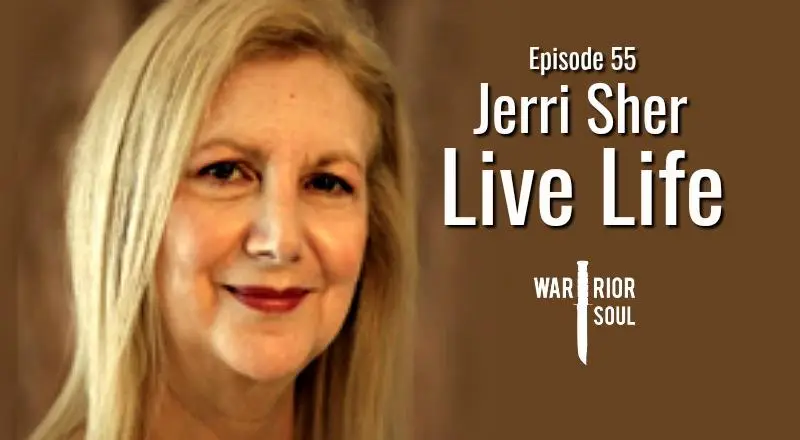
Episode 55: Live Life with EMMY Award-Winning Filmmaker, Jerri Sher
Hosted by Chris Albert
The Warrior Soul Podcast
Jerri Sher is a two time Emmy Award winning film maker. She is a master story teller, and through her stories, she is on a mission to make this world a better place.
The biggest things you’ll get from this episode are in understanding Jerri’s immense passion for what she does and the sheer determination that got her where she is today. She was not born in Hollywood and the odds were stacked up against her when she began her film career. She got herself to where she is today through her work and her sheer determination.
Jerri is currently working with Andrew to bring his story to the screen through the project Quiet Explosions, which will be based off his book Tales From the Blast Factory: A Brain Injured Special Forces Green Beret Journey’s Back from the Brink.
To learn more about Jerri: http://jerrisher.com/index.html
To learn about the Live Life series: http://jerrisher.com/live-life-tv-series.html
Transcript
Machine-generated from the episode audio and lightly edited — may contain errors.
Chris Albert (link to this point)
What's going on everybody? This is Chris Albert. And last night, I got an email, and that email was from a young marine. And the marine told me that his best friend had just committed suicide. And he asked me, how do I get through this?
How do I go on? And the answer to this question is not an easy one. I know that there's so many of you out there who've been through similar situations, whether it be through one of our brothers or sisters' suicides, whether it be through the loss of a family member, the death of a loved one, or some other personal tragedy. And the best thing that I can tell you is this. The only thing that's gonna get you through situations like this is gratitude.
And I say that because it's gratitude that I think should be guiding all of us through our lives. It's not the tragedy that's going to bring you down. It's how you view the tragedy, how you view the tragedy and how you allow it to affect you. I'm not telling you not to be sad, not to feel grief. I want you to feel that grief.
I want you to feel the sorrow. But what I want you to do is to integrate it into your being and allow it to make you stronger. You don't let that grief make you weaker. You don't let that grief bring you down. You allow it to make you stronger.
You do so because you realize something. You'll realize that you need to be grateful for the fact that your friend was in your life. You need to be grateful for the experiences you had. You need to be grateful for the choice that's in front of you right now. And that choice in no uncertain terms, whether to give up, allow this to make you weaker, or whether you allow it to make you stronger.
Reason why you want to do this, even though it's the harder thing to do, is so you can go on to help others. For the past decade and over, veteran population has been wracked by suicides. We've been wracked by tragedy. We've been wracked by the loss of our brothers and sisters. But for each of us, this opportunity exists.
The opportunity to tell everybody how we got through it, how we face those demons and slow them, how we became stronger because of our experiences. Through that, what we can do is build a generation, a generation of veterans who went through their military service and came out better for it. A generation of veterans help to lead this country, lead our nation, help other veterans take their rightful place as leaders in this country. And through that, we'll all be making the world a better place. And I know you don't necessarily care about the world right now.
What you care about is your own hurt. I'm telling you, if you're able to tell your grandkids about how you got through this situation, if you're able to tell other marines, other soldiers, other sailors, other airmen, how you got through this situation. You're gonna leave your mark on this world. You're gonna leave this world a better place. I'm telling you this because I've realized something over the past few episodes that we've done.
One of the essential aspects of being human and of healing is storytelling. Last week, we had Scott Mann on. Scott was a Green Beret veteran, an expert on leadership. And Scott thinks that storytelling is part of our human fabric. It's it's what makes us human.
He says it's an essential part of leadership. And I agree with him. I agree with him 100% because it's through that type of storytelling that we're going to be able to impart on others how we got through difficult situations, how we overcame them, and how we accomplished great things. For today's episode, we have a master storyteller. Got two time Emmy award winning filmmaker, Jerri Sher.
Jerri tells stories about people who made comebacks, who've overcome immense difficulty, make their own lives better and to make others' lives better. And what impressed me about her the most was her desire to help people through her work, through her art, and her immense passion for what she does. And though we go quite a bit in this episode into Jerri's craft and how she goes about her work and and the things she does that make her successful. What I think a lot of you are gonna get out of this episode is a lesson on resilience. Jerri wasn't born into the film industry.
She had the odds stacked up against her when she decided to get in the film industry. She wasn't from Hollywood. She was a woman, and she never went to film school. She was actually in the trucking industry prior to getting into film. But which set Jerri apart and what still sets Jerri apart is her vision.
Wasn't about what she had at the time. It was about where she wanted to go and what she was gonna do to get there. So as you're listening to this episode, I want you to think about where you're going, where your vision is. I want you to understand that it's not about how much money you have right now. It's not about how much success or whether or not you're surrounded by an entourage or anything like that.
It's not about how big your house is or how nice your car is. It's about where your vision is, where you want to go, what are you willing to do to get there. And when tragedy befalls us, when we're met with an obstacle, how are you gonna view that obstacle? Are you going to allow it to bring you down, or are you going to make that decision that you need to make in order to allow that difficulty, that tragedy, that obstacle to make you stronger, to make you more resilient, and to allow you to get back to this world to make it a better place in your story. So with that, let's get into episode number 55 with Jerri Sher.
This is Chris Albert, and I'm here to remind you of one thing. Someday, you're going to die. Now that's not some morbid statement or scary idea. It's solid fact. Your time here on this earth is limited.
We need to be reminded of this as much as possible for one simple reason, to live your best life while you can. This is the Warrior Soul podcast.
Hello, everybody. Welcome to the Warrior Soul podcast. This is Chris Albert. And lately on this podcast, we've been talking about stories. We had Scott Mann last week talking about telling your own story.
And today, we have a very special lady on this episode, Jerri Sher, and she makes a living by telling other people's stories. Jerri has produced some wonderful work. She's an Emmy award winning filmmaker. And Jerri, how are doing today?
Jerri Sher (link to this point)
I'm great, Chris. Thank you so much for having me on your podcast. It's really an honor to be with you and Andrew today.
Chris Albert (link to this point)
Well, it's the pleasure is all ours. Jerri, can you tell us a little bit about your background? I know you're a a fellow East Coaster just like me from Massachusetts. Tell us a little bit about, who you are and where you come from.
Jerri Sher (link to this point)
Okay. Well, I have an unusual background, three different careers, and I've been in California for fifteen years now, but I spent most of my life in Massachusetts, raised my family in Marblehead, and I have Bachelor of Fine Arts. I went to, University of Massachusetts and then to Springfield College for my master's degree. And I was a professor for my first part of my career. I taught art and then I went into the trucking world and I spent eighteen years in business trucking and learned, which I didn't know then, how to become a producer.
And then I wrote a story about a woman in the trucking business, and that's how I got into the movie business.
Andrew Marr (link to this point)
That's so fascinating. Jerri, what what what was the inspiration to write that story after eighteen years in the trucking business? And did you foresee that that would lead you to Hollywood?
Jerri Sher (link to this point)
No, actually, it was such an odd thing that happened. I got this idea in the middle of the night, like at three in the morning. Woke up and somehow it was almost like downloaded to me about the cure for HIV AIDS. And I thought, well, I'm not a doctor. I'm not a scientist.
Why am I getting this information? But I started writing about it and so it's a medical mystery about the cure for HIV AIDS and the woman protagonist in it is a woman in the trucking business. So it's really my story. So then I realized that I'm supposed to be telling stories about healing and health. That's kind of what happened in the movie business and in television.
I've been really focused on things that will help society, things that will help other people to heal in an unusual way.
Chris Albert (link to this point)
A lot of our podcasts, at least in the first 10 episodes, if you go through, there's kind of a theme there about resilience, and that's integrating the hard times that you've had into your life and into your being and and using them to make yourself stronger. What have you learned about resilience from telling these stories? What what what what about people creates resilience in them and gives them strength during times that they need it?
Jerri Sher (link to this point)
Well, most of the protagonists and people that I have worked with and seen and interviewed, they have to get to rock bottom before they can turn their lives around and come back up again. So most of them really are at the brink, the brink of either suicide or just leaving the world, leaving their family. And then they feel like they want to turn it all around. That's the resilience in that. Now the resilience in some other people like myself it's different.
It's that I cannot sit still for one minute like I'm creating every second like I just want to do more for the world. I want to help more people. I want to get the word out to more people. So I think there are different kinds of resilience. The people that are sort of checking out of society and then they want to come back and live again.
And then there are people who are another crust of the world who just want to do more and keep going. And I believe that happened to me from studying with Tony Robbins. Anthony Robbins is a terrific guy and I've been to many, many of his seminars. I've been to his castle in Del Mar and I believe that's why I have nerves of steel and can work, like, twenty hours a day.
Andrew Marr (link to this point)
And nerves of steel is right. And me and Jerri just spent the last weekend together. And Jerri is going to be directing a new film, a documentary based on our work with the Warrior Angels Foundation and Dr. Gordon. And I've just seen you as a woman on a mission, and it's so it's so inspiring and and fulfilling to see that magic take hold of somebody else and then just go and and produce crazy, almost unfathomable results.
But Jerri was able to go in the crowd and find people to invest or partner with in this movie that she had absolutely no relationship with too prior. What does it take to have that type of self confidence, Jerri, to go and to talk to somebody and try to translate that into an actual getting them on your team, helping you to reach your vision?
Jerri Sher (link to this point)
Well, it's really interesting. I think the one word that sums up everything is passion. I just am myself. I am myself and the passion comes through. It's in my being.
I say when I make a movie, I'm eat, sleep and drinking the movie. I'm eat, sleep and drinking you and Dr. Gordon. Know every inch of you. I know everything about you.
I delve into the story in such a way that you're in my brain all the time. It's the only way that I can work. It takes over my whole being basically and I think that translates to the people I'm talking to when I'm having a conversation with a new person or a stranger and I tell them about the story and I feel it so much inside of me that that's translated to them and all these few guys that I met over the three days we were together in San Diego I've had conversations with them like innumerable times since we've been back and emails and it's just it keeps going. So it's very exciting to me to think that through the pool of people that listen to your podcast and who are interested in your book, they will come on board because we need we need a team. We need a whole bunch of people.
A movie is very collaborative, and it takes an army, a village, or whatever you wanna say.
Andrew Marr (link to this point)
Yeah. Jerri, how long did it take for you to develop that self confidence? Because, again, that that is all could be all the difference between somebody attaining what they want and then are getting, you know, wrapped up in a temporary setback. Did you always have that level of passion and self confidence, or is that something that you developed over the years through multiple careers?
Jerri Sher (link to this point)
Well that's really an interesting question. I remember when I was eight years old in elementary school I won an art contest. It was a mask I had to create and I won the first prize and I think at that moment I knew I was going to be an artist. And I've always had high goals. I'm the oldest of four children.
I had very supportive parents. We didn't have a lot but we had a lot of love and whatever we needed. And I just think that yes it got better and better as my life continued. I had a lot of successes early on. I would win things.
I would create. I became like the business manager of the high school newspaper. Just different things, president of the USY and I think it's sort of like a ladder. And I was going up the ladder, rung by rung by rung. And then once I won the Emmy, I'm at the top of the ladder.
Chris Albert (link to this point)
You mentioned collaboration, and that's something I'm figuring out as an entrepreneur. You know, I when I first got into all this stuff, I I would be kinda like a solo warrior, just just kinda battling. Don't get me wrong. You know, we're still at the point where we're looking for good people, and we're trying to bring them on. But when you're looking for people, and you're trying to to build your team, to create something, what is it that you look for in them?
What what types of traits do you look for in somebody that you're gonna work with, You're pretty much getting married to throughout the project. Are those things that you look for?
Jerri Sher (link to this point)
Oh, that's so important. You are so right. So I want them to be fascinated with me because if they're fascinated with me, I'm fascinated with them. And they have to have a fascinating personality. They have to be open, they have to be able to take direction, they have to be trustworthy.
There's so many things. Mean I ran into so many people in this business that are I call them wannabes and they really don't accomplish anything. I don't want people who just talk about what they're going to do. I want them to do it. So people who talk about what they can do isn't good enough.
They have to actually do it And you to kind of sift through and find the right people. I also feel in movie making you need to get the best people like the best sound editor and the best composer. They're really good at what they do and I rely on them just like they rely on me because not everybody can do every job perfectly. It's such a wide spectrum of what we all have to accomplish. Mean even the people who do my transcriptions they have to be excellent at making transcriptions.
So I think that it's important to get people who care about the project, care about Warrior Angels, care about brain illness and disease who maybe it touched them and their own family so they really care about it. But you know pretty well pretty soon if they're going to work out. I think that if people aren't going to work out, I can tell just by maybe one conversation with somebody.
Andrew Marr (link to this point)
Wow. And that's just having, again, you defined your life's purpose or your your professional purpose, and and that is to put out things that improve society, culture, and the end state is the world. So it's really easy when you have that end state that you're working to. It helps you to to sift through that. Jerri, I wanna speak about the LIVE LIFE series.
Can you give us a little bit of a background and where our audience can can find that series when it comes out? Because it's so powerful.
Jerri Sher (link to this point)
Yes. Thank you for mentioning it. So I had the pleasure of meeting Dr. Emmett Miller in 2006 at Esalen at Big Sur. I had just come off another movie and I was exhausted and I went up there for the weekend and I took a little course called having fun with guided imagery.
And I did not even know what guided imagery was but I'm very open and I wanted to learn about it. And Dr. Miller developed mind body science in the early 70s where you can actually control yourselves through your thoughts. And this to me was fascinating. I spent three days with him and I gave him my card.
I said I'm really loving your work. If you ever want me to make a movie about it let me know and I left and two days later he called and we became quite good friends and he started to tell me about some of his patients who he had helped over the years and I knew there was a very big story there. Originally I thought I would make a documentary but then it got so big that I had so many stories I ended up making a television series with 12 different protagonists. The first one was about a little boy who had a brain tumor at the age of nine and the parents were told he would be dead in one year and they did not want this to happen so they tried to find alternatives to keep him alive and this is what the story is about. I followed him for ten years he's now 21 graduated college amazing boy and now the series got picked up by Discovery Communications.
You can read about it on my website which is www.jerrisher.com I'll spell that for you J E R R I S H E R dot com and there's a page on there for live life so you can read about all the 12 stories and the different migraine headache bipolar disorder diverticulitis and on and on and on. So we don't know yet when it's going to air but just join our Facebook page so you can know or just keep checking on my website and we'll let you know as soon as we know an air date.
Chris Albert (link to this point)
We'll definitely be including the links to all those in the show notes as well on the page for this podcast. As far as telling those stories, I know that when first hear them, it's got to be immensely difficult, seeing the pain and seeing the heartache that people are going through. Can you tell us about how you approach people in these types of difficult situations? And how do you keep yourself mentally focused on on telling their story?
Jerri Sher (link to this point)
Well, here's the thing. I have to get to know intimately. So my thing is if they're a victim, they're a victim first and then they become a hero usually. I get to know them on their own level. I go to their house or I go to their office or I sit in the car with them or I go for lunch and I just let them talk and I and I know what they're about and I take copious notes.
I never ever bring cameras in until I really know somebody well and that I have their trust. With the case of Will, I went to his family's home and I spent days there and I got to know the family and I ate dinner with them and I watched them do prayers at night and everything. Mean you have to know somebody really well for them to open up to you. By the time I come in with cameras they have such trust with me and the two of us just sit together. I have a very tiny tiny small crew on purpose so that we're not freaking anybody out with lots of people and basically I just talk to them.
So I'm asking them questions and I'm getting the story for movie or the film but they just think they're having a conversation with me like they did for the past few times they were with me. And that's how it happens. And I also am a 100% focused. I don't have anything else in my mind. I keep a blank slate, so my mind is completely wiped out, and I'm just devoted to them at the time.
Andrew Marr (link to this point)
Jerri, can you speak about the process that it takes to find that one right family? Because I know we had this conversation off air, and you were telling me for every one person you film, you probably did 20 specific interviews to find that right story. Can you talk about that process and what that looks like for you?
Jerri Sher (link to this point)
Sure. Of course. Well, it's very difficult to find people who will translate well on camera because they have to have a certain look, they have to have a good voice, they have to be natural, they can't be nervous and a lot of people freak out when the cameras come. So I have to have the instinct in me to know if they're going to be good on camera. I mean even if they have a great story if they're dull or they don't look good or they can't speak it's useless.
So not only do I need somebody that has a compelling story but I need somebody who's going to be able to translate that well on camera. It takes a lot to find the right people. A lot of times I film people and they end up on the cutting floor, the cutting room floor. We joke about it but if it doesn't work in the story and they they did a bad job or you know I can't cut it or edit it properly then I can't use it. So I have to have enough good footage that I can create and craft a really great story.
It's probably the hardest part of my job is finding the right people. Once I have the right people, the rest is easy.
Chris Albert (link to this point)
Can you tell us about a situation where things might not have been going the way you saw them going at first, and how you overcame that? You know, some sort of difficult situation that you got yourself into and how you got out of it?
Jerri Sher (link to this point)
Yes of course. So this happens on every film set. The thing is you have to be a problem solver and you have to do it quickly. So I was on a set a long time ago in Massachusetts in Cambridge I believe it was and we were filming I was the producer of a film to help out a boy who was getting his MFA at NYU Tisch and we were shooting on the on the porch and there was a huge street in front of the house pretty big and there were cars going back and forth and of course the cars were you know they were roaming and they were making a lot of noise and we were trying to get a dialogue shot on the whole porch and we had a very actor from New York who had come in. And there was no way we could shut down the street because we didn't have permits for the street.
We only had permits for this private house. So I said, okay, I've got a solution. And I had to think quick. And I got a wheelchair which was on the set to help us do dolly moves because we couldn't afford a dolly so we had a wheelchair and I put somebody in the wheelchair and I had two PAs stand with them at the side of the street and I said okay I'm gonna give you a walkie talkie and we'll do a rehearsal. When we're ready to shoot I want you to very very slowly walk this wheelchair with this person in across the street hold up the traffic the cars will stop and that's what we did.
So I did the walkie talkie and said okay we're gonna take the shot and they would one guy would go on the right, one guy would go on the left, hold up the traffic and the other guy, the third guy, would walk this wheelchair across very very very slowly and we would get the shot. There would be not one shot.
Andrew Marr (link to this point)
Oh I love it.
Chris Albert (link to this point)
That's awesome.
Andrew Marr (link to this point)
That is outside the box thinking if I ever heard it. That's that's so creative. That that's awesome. What was the response from the crew after you guys got that shot? Bet you were the hero of the day.
Jerri Sher (link to this point)
Oh, yeah. They couldn't believe it. And then similarly the next day something really horrible happened where across the street from this house the guy decides to put on a new porch and he's got his workers and contractors there and they're banging you know like crazy and the noise was like horrific and we just didn't know what we were going to do. I figured out okay so I went over there and I bought everybody lunch and I told the guys let's have a two hour lunch today and anyway we got all our shots or all our dialogue outside when they were eating their lunch.
Chris Albert (link to this point)
Wow. Wow. That's that's pretty awesome. You you definitely could have you definitely could have served in an infantry unit with that kind of creativity. That's that that would have been definitely been an asset there.
What about surprises? Has has anybody ever really, really surprised you in in working with them, or, you know, what surprises you about people?
Jerri Sher (link to this point)
Well, I think because I'm so careful in pre production, I don't have too many surprises once I start filming because all of the problems that could happen, all of the surprises that could happen, I try to eliminate them in the beginning. Like I have three backups for everything. So in other words, I know crazy things happen in this business, so I try to have a backup for a backup. So there wasn't a big surprise that happened in New York City when I was working on 42nd Street and that was out of my control basically. I mean the city was supposed to move a building, a 7,000,000 pound theater and we had our crew there and we were ready to film and the city shut them down and decided they weren't going to let them move the building that day.
So here I had a whole crew and I couldn't do the work and that was a big surprise. But I tried to salvage it by interviewing I did Man on the Street. I said okay let's go the corner and just have people sign a release and talk to them about what's happening on the street. So I always try to make lemonade out of lemons so to speak. Because surprises will happen and sometimes they're completely out of my control.
In that case I'm not gonna go up against the city of New York. But we lost a little bit of time and a little bit of money, but two weeks later we went back and then they moved the building and then we had everybody there and we filmed it.
Andrew Marr (link to this point)
That's an incredible story. I wanna talk about Quiet Explosions a little bit, and that's the working title for the for the film Jerri's doing. How do you go from an idea to an actual in product, Jerri? Can you tell us, you know, the steps, the sequences, and the different aspects of that of going from an idea to a full fledged this is a film?
Jerri Sher (link to this point)
Yes. Of course. Meanwhile, I love the title of your book, Tales The Tales From The Blast Factory. And it's just to translate that into a movie, that particular title might be difficult because it's a long title for people to remember. And that's why I I put Quiet Explosions because it's sort of an oxymoron.
That could change. I mean, Honestly I've gone through three, four, five titles in movie because people will say something in an interview and all of a sudden I'm like oh my god that's a title, that's great. So we're just using that as a working title, Quiet Explosions. But basically we start with know, what's the story gonna be about? And, you know, I know from reading your book in the galleys way back in January, I know what the story is gonna be about.
But then it mushrooms because it's not just a military story. I mean, there's the the sports aspect. Mean look at these poor guys in football and soccer who get you know beat up in the head and they're not whole again and so that's another aspect. And then I have first hand information from my husband who lost his short term memory twenty years ago when he was in surgery for fourteen hours. Now I spoke to Dr. Gordon about that. There were many people, lay people, civilians who have had a car crash or motorcycle accident or been in surgery and they end up with no memory. So this goes to everyone. Kind of a universal theme. Military is one aspect, sports is another and civilians is another.
And that's what I want to do. Weave these stories together. Your story, how you got healed, what happened prior before, what you were like before, what you were like in the transition, what you're like now. The same with say a football guy that we start with. What's it going to be like to treat this man?
Have Dr. Gordon start treating him, find out from his family what he was like, what he's like before and hopefully the results after and so on. So the story will take place we're also going to do some interviews with doctors who endocrinologists who knew Mark fifteen years ago and thought he was crazy or this wasn't going to work and now they've completely changed and turned around. So that'll be a big part of the story too.
Chris Albert (link to this point)
Yeah there's so many angles to this issue And and it, you know, stemming from the human part of the story, the actual person going through, what's going on. You know, right now we have thousands of veterans across the country who who have been potentially affected by TBI that don't realize that they've been affected. We have thousands of people across the country and across the world who potentially have been affected by this issue and who haven't been who don't realize it. But we also have that aspect of the doctors in the medical industry, and their idea of sticking to the status quo, and not questioning the quote unquote truths that have been told to them, not venturing outside the box to think. And I think that that's such such a great platform to be able to reach people, to get them to see things from another way.
Because for all intents and purposes, when we talk about medicine, there's so many people out there who are still in the matrix. And they take everything that somebody who has a white coat on, what they say is the word of God sometimes. And we don't question, we don't advocate for ourselves as patients, we end up down these rabbit holes.
Jerri Sher (link to this point)
Yes, absolutely. And what you said is in one of my stories, one of the guys in Live Life says, Oh, the doctor god. Everyone thinks he's the doctor god. Well, there's a lot more to it than that. Look 5,400,000 people have TBIs in the country and one hundred and fifty four men are veterans because it commits suicide each week.
If I can have this movie come out and make that number quite less than I've done my job. I mean, we basically want to inform and educate the public, so they know there are alternatives, there are possibilities, there are solutions, and there are cures.
Andrew Marr (link to this point)
So, Jerri, you formulated well formulated your idea, what impacts you want to have, what do you have to do to raise those funds if you don't have the big backing by one of the major film companies.
Jerri Sher (link to this point)
Yeah. Because studios don't wanna do something like this. They wanna do, you know, Wonder Woman. Okay. So we're gonna raise the money by all the people who are involved, who wanna be involved in several ways.
One way is people need tax deductions. There are people who are 70 and it is a law that they have to take money out of their IRA every year and they will be taxed on that money unless they give it to a charity. If they write the check for Warrior Angels for the movie they will not be taxed on that money and they have to use that money once they're 70. Now there are plenty of people who need just tax deductions because they make a lot of money and they're philanthropists so we want those people as well. Some people will want product placement.
There are companies and corporations like a soda company for instance or a cracker company or pharmaceutical company or a clothing company. I could figure out a way to put their products in the movie in a very subliminal subtle way and we give them credits at the end of the film and their logo they can give us money from their marketing department or their public relations department. We also have people who might want to invest. You know some people like to diversify. They want some stocks and bonds.
They want some real estate and they want to put they call it fun money, gambling money, movie money. We have that as well. There are so many ways that people can get involved. Mean we have you know hundreds if somebody wants to be an extra in the movie or if they want to be executive producer they just give us a certain amount of money and we make that happen.
Andrew Marr (link to this point)
Would you think Jerri, in your in your experience isn't what would you say of somebody who wanted to invest in a movie hoping to get a return on that investment? What would your your advice be?
Jerri Sher (link to this point)
I would say if it's their bread and butter money, you would never do that because bread and butter to live, you have to have a definite guarantee and nothing in life is a guarantee. But for many people, it's fun money. It's money 10% of whatever they have and they wanna do something unusual. They wanna to do something different. They want to do something because they care about the cause.
They care about veterans. So they care about what the message is. Eventually they'll get their money back. It takes a while. It takes time but usually they'll get the money back.
But it's not for somebody who is living day to day on a paycheck.
Chris Albert (link to this point)
Yeah. And I think that the thing here is also the cause. And we're talking about something that, like we said before, is not just affecting veterans, though it is affecting veterans en masse, it's also affecting the entire population. And and, you know, when you start to pull the curtains back, and you start to actually look at some of the things that have been done to try to treat these ailments, and you start to understand that a lot of the treatments and the drugs and the therapies, there's never been any demonstrated statistical significance to show that these therapies and drugs and treatments have efficaciousness on patients suffering with PTSD who are veterans. And when you start to really analyze this, and you start to pull the curtains back, you'll find that a lot of the treatments are based on BS.
And to hear about somebody who's actually been able to overcome this, who's beaten the seventy to eighty percent failure rate that these treatments have, I think is inspiring. And it's a way for people to really start to put a dent into these issues that we're having centered around what could potentially be something that's a huge roadblock to our development as not only as a class of citizens, but as a country.
Jerri Sher (link to this point)
Well, you're so right. I mean, this is the first time a movie will be made and and the world will hear and see a solution to this problem. There has never been a film about the solution. There's usually a film about all the problems but not how to solve it. And I basically think that the people that are going to come forward are the people that care about the cause.
There might be somebody who lost someone to this brain illness and maybe they want us to make the movie in memory of that person and at the end of the film it says in memory of and it's their father or brother sister or whoever. I really believe that the people that come forward are going to be people who really care about the cause. It's such an important cause to society and we can really change. We can change the way people look at this illness and help them and there's a solution which people don't know. So it's my job to make sure this movie gets made.
I'll say by hook or by crook it will get made but we'd like to start sooner than later. We want to have this happen as soon as possible. So anybody who can get on the bandwagon can email me at aoljerri13@aol.com for anything that you can help with. I mean honestly if somebody wants to be executive producer and go to all the film festivals and be in the limelight we have that spot available for the right money.
Andrew Marr (link to this point)
Jerri, let's talk about some of these titles that so many of us see, but we really don't really know what they mean. So I wanna start with director. What is the director's job and what does that really mean to the overall success of the film?
Jerri Sher (link to this point)
The director is the person who's responsible for making sure the movie gets made on time, on budget, and she or he interacts with, the shots every day, how the movie's gonna get shot, the locations, the people, what stories to tell, what what to ask. It's it's sort of like leading the band, leading leading the troops. She's a psychologist. She's a nurse. She's a cook, everything.
And I'm saying she because it's me. But running the show.
Andrew Marr (link to this point)
What would be the difference between the a producer and the executive producer?
Jerri Sher (link to this point)
The executive producer is the one who who brings the money, gets the money, that puts up the money. And then they don't really have to do anything else. They don't have to even be there. I mean, once they write the check you know they don't have to be there. They can be there but they don't have to be.
The working producer which is me in this case and hopefully some other people is the person who decides how the money will be spent, who will be hired, which crew members, figuring out where the money will where the movie will go afterward. So the producer is sort of like the nuts and bolts of how this gets put together.
Andrew Marr (link to this point)
Now do you ever have run into problems where the executive producer is not clear on their role and they wanna try to put their 2¢ into that and you have to kinda be real upfront with them and say, hey. I'm sorry, but you're not making the calls?
Jerri Sher (link to this point)
Not usually. Because I usually have a way of having lunch or dinner or breakfast with somebody when they when they, you know, come up and say they wanna be executive producer and here's a check. And we go over everything. And I'm I'm pretty clear. I try to be crystal clear so that they don't have expectations. If you set the stage properly, they won't have their own expectations.
They'll just want to sit with the glory when it's finished and reap the benefits as shaking hands and being in the limelight and having their name in lights.
Chris Albert (link to this point)
Jerri, I want to ask you this. You're a woman and you're a director. And what I want to ask you is what types of things and what types of difficulties have you had to overcome as a woman and a director in Hollywood?
Jerri Sher (link to this point)
Oh boy. That's a big question. There's so few women you can count them on one hand. When I was younger and I was producing for three different men, after I did Three Different Guys and I was so successful, I said to my husband I want to direct my own movie. And I went to these three guys and told them that and they said well you cannot.
Number one you're a woman. Number two you live in Massachusetts and number three you never went to film school so forget it. And when they said that I said I'm going to make my own movie. I wrote, directed and produced my first 35 millimeter feature. I collected the money from 105 different corporations and it almost killed me but I did it and I call that my film school.
But basically it's hard. We have to prove ourselves, we have to be better than any man. I luckily had the experience in the trucking industry where I was the first woman in the trucking business for eighteen years in the Northeast Corridor. So I'm used to being in a man's world. So I don't look at it as a man or a woman.
I look at it as the best person for the job. Who's gonna get the job done best? And usually in this case it's me because I can translate Andrew's story better than anybody. This is my wheelhouse. I have done so much with healing and health and compassion and empathy.
There's no one better to do this. So it's not about me being a woman. It's about I'm the best person for the job.
Chris Albert (link to this point)
Yeah. You know, and and that's the the thing I think that I appreciate about you and and just the the conversations that I've had to had with you yesterday and today. You know, I don't see a sense of any victimhood in you at all because of any difficulties that you've experienced and you just got out there and you did the work and you're doing the work and you're doing what you need to do to make your mark on this world. And I think that's amazing.
Jerri Sher (link to this point)
Thank you. Well, say to me, how do you get jobs? I go I create my own. I write my own books. I write my own stories.
You don't have to sit back and say woe is me. Oh there's no work out there for me. You create your own. I made a movie in Santa Monica about a homeless guy and I was giving back to society. I was helping people by making that and that's when I won the Emmy.
Andrew Marr (link to this point)
Yeah. It's funny how the world can thank you or or find a way to highlight your work when you've just purely made it about helping somebody else and taking yourself out of it. And then I found like things just float effortless to you at that point. Have you seen the same thing in your life and your work, Jerri?
Jerri Sher (link to this point)
Yes. I find that when I don't have an agenda for any particular reason of profiting or something like that and I just do in my then it all comes back to me twofold or tenfold actually. I mean I have to be good to other people and they will be good to me. I mean honestly I'm good to everybody whether it be the guy selling fruit at the fruit store or my T Mobile guy. I mean there's a T Mobile guy who helped me with my phone and it was because of him that I met his brother on a cruise ship who ended up selling Live Life.
And it's a kind of a crazy story how that happened, but it was because I was nice and brought candy at Valentine's Day to my T Mobile guy.
Andrew Marr (link to this point)
Wow. So be nice to your mobile phone providers out there, people. You never know what might happen. Yeah.
Chris Albert (link to this point)
Be nice to everybody. And I think that's the thing. Like, there's so many people out there who think that they're they're they're better than their circumstance. Well, they are better than their circumstances. But the word is, I think, you know, better than everybody else.
And they they act like they walk on water and they think that they're too good to talk to people, and they think that they're too good to have that human interaction. And if there's one lesson that Jerri's bringing to us today, that in order to be successful, you do need other people, and you never quite know exactly who that person's gonna be. So you know, the guy next to you on a bus who you offer your seat to, that could be the key to starting the next aspect of your life. And I talk to a lot of veterans out there who are going through some difficult times, and the big piece of advice that I have for them is always gratitude. Being thankful for what they do have, being thankful for what they have been given, and showing that gratitude in the way that they treat other people.
Jerri Sher (link to this point)
Well, I love what you said about gratitude because you're so right. I mean, you never know who's sitting next to you. If you read The Celestine Prophecy by James Redfield, you'll realize that people don't come into your life randomly. It's for a reason, and you have to find out what that reason is.
Chris Albert (link to this point)
Was that book, Jerri?
Jerri Sher (link to this point)
Celestine Prophecy by James Redfield.
Andrew Marr (link to this point)
Yeah. We'll put that in the show notes. Jerri, you recently released a book and has became an, an Amazon national bestseller. Can you tell us a little bit about that book? How you got the idea and some of the people you got to help promote it?
Because I think that's a very awesome story.
Jerri Sher (link to this point)
You know, I have to wear many compartments and many hats. So I write a lot, and I wrote this book called How to Have a Successful Bridal Shower A to Z with more than 500 creative ideas. I do a lot of entertaining through the movie business and I had two daughters. I had two weddings for them and I do a lot of parties all the time. I did so much entertaining in the trucking business and I find that if you give somebody a nice theme they have a good time.
They don't remember what they ate at the party but they certainly remember if they had a good time. So I wrote this book and because I met a woman from my past when I was 16 years old in Fall River she was involved with Andrew's book and she told me about your story and I said hey by the way I wrote this book it's been sitting in my computer I don't know if it's any good would you take a look at it and since that's her wheelhouse I trusted her and she said she read it and said this is amazing it's got to get out there right away. Because she believed in it the story and my work I got it out there. So it's now a national bestseller on the kindle on Amazon and the paperback is coming out in about a week week and a half two weeks. So we hope everybody enjoys that it's packed full of millions of creative ideas for any party and I already started the sequel which is parties galore and more a to z.
So hopefully when we get this movie on its road we'll have a big celebration and I'll be able to create a theme for that.
Andrew Marr (link to this point)
Oh you better believe it one of my favorite blurbs are endorsements for the book, and I'm paraphrasing. Jerri can fix me here, but it was I'm sorry there's only 27 letters in the alphabet because we wanted to to extend it so much more because Jerri had so many great ideas. What what was that? What was that blurb?
Jerri Sher (link to this point)
Roger Kisson, who is a very pronounced prominent, public relations man in New York and LA, he he wrote the quote, that, you know, I'm so sorry at this, know so few letters in the alphabet because there should be a 100 so we could have get more ideas from Jerri Sher's book. It was very sweet and and, he's amazing and and and for a man to say that that was great because a lot of men don't don't go to bridal showers.
Andrew Marr (link to this point)
Yeah. Well, they're not real men if they don't wanna go to a themed bridal shower in my opinion. What about the the Las Vegas party planners? It was highly it was received well by them too. It not
Jerri Sher (link to this point)
Don Hume who was the preeminent party planner and event planner in Las Vegas who worked with Steve Wynn on opening all his hotels. He gave us an amazing quote. So if you go to Amazon and go to, you know, just put in the name how to have a successful bridal shower you can read all about that. Oh it's on my website too the jerrisher.com on the author page. That's that has the book The Twig Painter the book I wrote about the cure for HIV AIDS it's a great read and people will love that book.
The regular book or the Kindle.
Chris Albert (link to this point)
Awesome. Jerri, as somebody who wears a lot of hats, being an author, a filmmaker, How do you organize your time? Where when are you most creative? How do you split your creative time between your written work and your films? And how do you how do you keep yourself going through the task and staying focused on each other?
Jerri Sher (link to this point)
Well, my most creative time is the middle of the night. Now I was away for a month and a half in February guest lecturing on a cruise ship in Australia, New Zealand and Tahiti. And it was a pleasure and it was a privilege to do that but I had to work in the middle of the night when I wasn't lecturing on all my other projects especially the movie because I had just met Andrew. So you know I work a lot of hours but to me it's like it's like a high, it's like drugs, it's like fun, it's not work really. When you're so passionate about something it's not work anymore.
But I do decompartmentalize my brain. So if I'm with my grandchildren and I'm reading a bedtime story I don't think of anything else but that child. And if I'm with my husband on so to speak a Saturday night date at a movie or whatever I don't think about anything else. So I'm 150% into what I'm doing at the time and that's how I accomplish everything I think.
Chris Albert (link to this point)
And do you do a lot of delegating? And I'm not just talking about on the specific project, but in your life, do you delegate certain things? Sometimes I find myself getting wrapped up in our social media while I'm trying to create something, and then I have to stop what I'm doing to do a post or something like that. Do you to do you have to delegate a lot of your
Jerri Sher (link to this point)
I wish I could delegate it, but I it's it's hard because I'm sort of I micromanage a lot myself and I'm not too good about letting people do things for me because even if they do it for me then I have to double check it. One of the guys in Boston who was my sound boom guy said to all the crew, Hey, you know, it's a Jerriality. He calls it a Jerriality because I'm so specific about everything. I took it as a compliment. Someone else said, I'm a cross between Jodie Foster and Barbra Streisand.
Well, that's great. I'd love to be that.
Andrew Marr (link to this point)
I love it. I just want to highlight what led me to Jerri or what led us to each other. She spoke of earlier, somebody that was helping us with the book thought that Jerri would be a good fit to turn this into an actual film. And from there, me and Jerri started to dialogue, and I got familiar just like she's become familiar with me. I'm familiar with her work because this is something very near and and dear to me that needs to be shown in the right light.
And that offers and highlights a solution. And so doing my due diligence, getting in, learning about Jerri's work, and I found out her work has a mission statement, and that it must benefit the world in some capacity, that it has to highlight the positive elements of life as opposed to the negatives. It doesn't mean she doesn't show the negative, but she just shows what can happen through those positive forces. And then from there, I flew in to take a meeting with her out in LA, and she showed me her work. And when I saw the whole series, and it was about taking outside the box approaches, alternative approaches to health after the medical system had told these 10 to 12 specific stories that there was no help.
Well, every time this person came out was able to regain life. And she had a phenomenal cast of healers that I knew all of them by name. Because when you get into this way of living your life, it's kind of natural for those things to come across. So it was so incredibly in sync and in sequence with what I had hoped for this project that it became absolutely abundantly clear to me that Jerri was the right person based on her past work and the reason probably as important or most important, the reason for why she's putting out her art, and it is art. And I think that was just so special and just drew it to me that I just again, I'm so thankful, Jerri, that we got brought in, and now we're gonna get to part partner on telling this incredible story that we know will help people to have a better life.
Yes.
Jerri Sher (link to this point)
Oh my god. You couldn't have said it better anyway. I feel the same way. I'm I'm so deeply grateful that I met you and that I'm gonna get to tell this incredible story. If anyone out there has some ideas I'm totally open to any possibility of you know if there's a way to get to every single veteran and every veteran puts in $5 or however we we think of outside the box to raise the money for the film I'm open to anything and I would love to speak to anyone who wants to help us in any capacity.
Chris Albert (link to this point)
Awesome. I have one more question for you, Jerri, before we get off, and and it's gonna be kind of a weird question, but but bear with me here. You are telepathically transported to another universe and another planet. And you end up there, and you're surrounded by people, human beings, and none of them has ever heard or listened to or or watched any of your movies. All your written work is nonexistent.
What and but but these people need your help, and they need you to tell them the secrets of life, and you have three sentences to do it, what would you tell them? Wow.
Jerri Sher (link to this point)
I have three sentences to tell them the secrets of life?
Chris Albert (link to this point)
Yes. Or or things that you've learned over your time in in in the movie business and throughout your life.
Jerri Sher (link to this point)
I would say the first thing is be true to yourself and listen to your heart. That's the first one. Be true to yourself and listen to your heart. Treat other people as if you want to be treated yourself and that you may not see them again. Like it's the last time you'll be with them.
And also enjoy the journey like everything you do. Don't worry about the past because it's gone. Don't worry about the present because it hasn't happened yet. Worry about now right this minute. Just care about now.
Be present.
Chris Albert (link to this point)
Wow. You did outstanding at that. I pulled that question right out of beta mode, and you were you were right on top of it. That's amazing. That's awesome.
Andrew Marr (link to this point)
Yeah. Great advice, Jerri. Just I'm Well, very happy about that
Jerri Sher (link to this point)
I try to live my life that way.
Andrew Marr (link to this point)
I I can say for a fact that spending a good amount of time with you, is absolutely the case. And Jerri is authentic, and it comes out of every possible meaning and mode of communication and interaction with her. And that's why we're so excited to have you on today to talk about
Jerri Sher (link to this point)
Well, I am so delighted that you asked me, and I'm hoping we can do this again once the movie is like, you know, three quarters done.
Andrew Marr (link to this point)
Yeah. You better believe it. Absolutely.
Chris Albert (link to this point)
Jerri, I wanna thank you so much for coming on today, and we will have all your contact information, your website up on the show notes. Is there anything you want to end with?
Jerri Sher (link to this point)
Well, I just want to say that I'm so inspired by you guys. I think, you know, veterans, no one really realizes what you do for the world, and I hope in some little way I can help the world see that.
Chris Albert (link to this point)
Outstanding. Jerri Sher, everybody. Thank you so much for coming on, and we will be back at you with another great
Jerri Sher (link to this point)
so much, guys. Thank you.
Chris Albert (link to this point)
Hey, guys. It's Chris here, and I just wanna tell you about our new sponsors. You know, one of the things that I'm always talking about here on this podcast and on the Warrior Soul Agoge YouTube channel are the benefits of ketosis and the benefits of including healthy fats in your diet. They help to protect your brain. They help to reduce total body chronic inflammation.
And honestly, I can say this with confidence, including fat in my diet has made me a better person. Why? Because it's given me lasting energy. I can go throughout the day. I don't get hangry.
I don't get moody because I haven't eaten. And I'm able to feel better and perform better because of the fats I include in my diet. Now one of the problems, and I completely understand this, is that a lot of people don't have access to fats in their daily lives. When I was in the Marine Corps, I was out in the field, there was very little possibility that I was ever going to have access to something like coconut oil or avocado oil or macadamia nut oil. Well, when I went to Paleo FX this year, I ran into some really good people from F Bomb Fuel.
And what they've done is they've put together individualized packets of good, healthy, and delicious fats. They've got avocado oil, macadamia nut oil, MCT oil, coconut oil. On top of that, they've got some really delicious nut butters. Their macadamia nut butter is absolutely amazing. I've never really tasted anything like it, and it all comes in this extremely portable packet that you can take with you anywhere.
They've also got some portable salad oils that you can take with you as well. If you're eating a salad, you put them on top of those or you can pour them over your food. These are a lifesaver for anybody who wants to live a healthy fat adapted lifestyle.
The best part is that the company is run by some really good people. They have a really strong desire to do good, and they've got a really strong desire to help out Veterans. We're working on some things for the future where they're going to be able to do that. So if you want to check this stuff out, and I promise you if you try this macadamia nut butter or any of their other products, you're not going to be disappointed. Check them out at www.fatissmartfuel.com.
Hey, guys. This is Chris again, and I hope that you got a lot out of that episode with Jerri Sher. And just want to let you know that if you're looking for the show notes for this or any other episode, they're up at www.warriorsoulagoge. That's agoge.com. And the Agoge is our website and we called it the Agoge.
A lot of you are like, well, what the heck is an Agoge? Well, the Agoge was the ancient Spartan Academy. That's where young boys went in at the age of seven and they came out at 25 as Spartan Warriors. The reason why we called it that was because we wanted to give you something more. There are a lot of veterans websites and pages out there, and a lot of them are focused on entertainment.
We think that that's a good thing. It helps to build brotherhood. It helps to build us as a community. And they're telling stories and they're doing some amazing things. But if we tried to do that, there's so many pages and websites that could do it better than us.
And what we wanted to do was to give you the tools, the tactics and stories that are going to help you to live your best life, help you to become better. And so when you come to our website, you're going to find some amazing podcasts, some awesome videos, some articles that are going to help you to optimize your mind and your body. We talk about things like nutrition, exercise, leadership, and things that are going to help you to carry yourself to where you want to go. So get a chance, come over to check us out at www.warriorsoulagoge.com, and we'll be back at you next week with another amazing episode. Talk to you guys soon.
Host of the Warrior Soul Podcast and founder of Warrior Soul. Worldwide trainer and nutrition coach, contributing author at Testosterone Nation and Muscle and Strength.