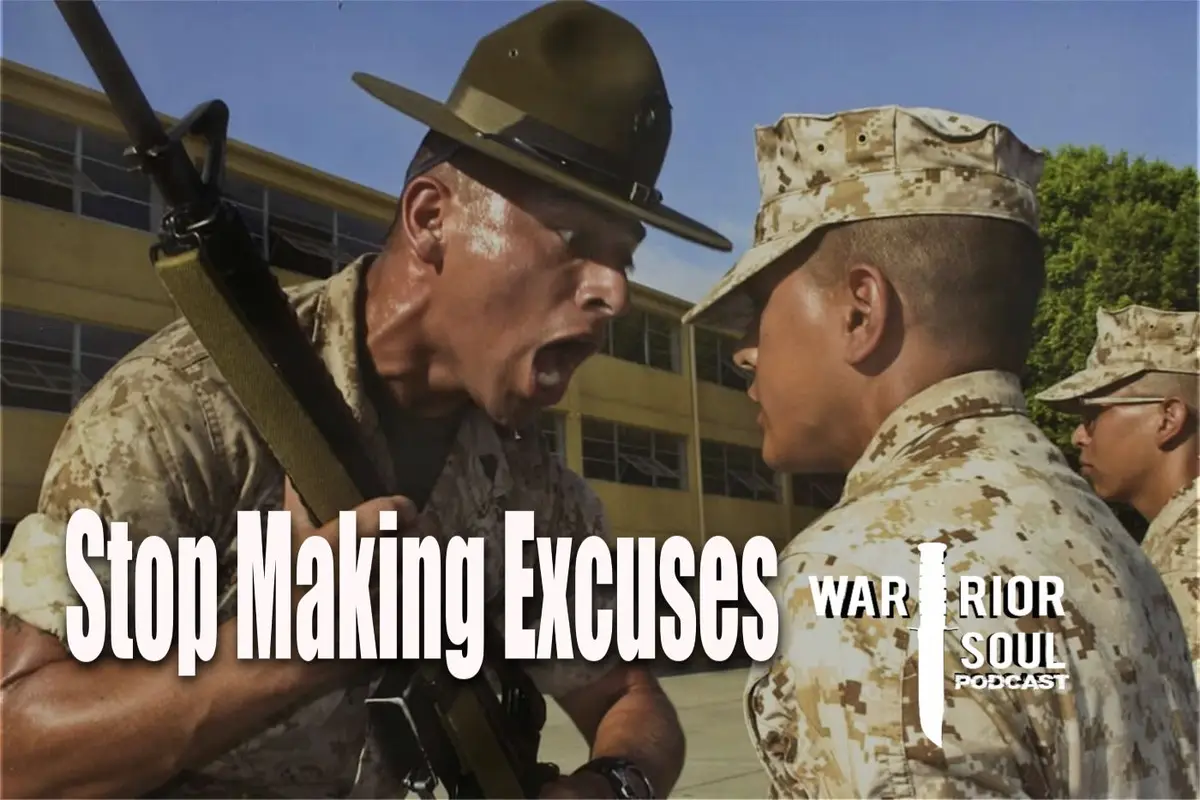
Stop Making Excuses
At some point in our lives, we all begin making up stories for why we haven’t done what we want to do in life. These stories are commonly known as excuses. The problem with excuses is that they all sound logical, at least to us. We can’t work out because we just don’t have time. We can’t start that business because it’s just not the right time. I can’t be on time for work because of my kids. The biggest problem is with the word “can’t.” When that word appears it signals that you’re telling yourself a lie. It’s a lie because you can. You just haven’t prioritized it.
Exercise
- Get up, go over to the mirror. Look yourself in the eyes and tell yourself the excuses you’ve been telling yourself for why you can’t do the things you want to do.
- Then get a journal and write down what you’re losing because you keep making those excuses.
- Rather than telling yourself you can’t do it, figure out a plan for how you can.
Transcript
Machine-generated from the episode audio and lightly edited — may contain errors.
Chris Albert (link to this point)
This is Chris Albert, and I'm here to remind you of one thing. Someday, you're going to die. Now that's not some morbid statement or scary idea. It's solid fact. Your time here on this earth is limited.
And we need to be reminded of this as much as possible for one simple reason, to live your best life while you can. This is the Warrior Soul podcast. You know, yesterday, I posted a picture on Instagram for the Warrior Soul Agoge account, and it was a picture of a bolt carrier group from a service rifle. And it was a disgusting bolt carrier group, rusty, dirty, filthy. And for those of you who had never served in the military, you might not know this and you might, but those of us who served in the combat arms in the Marine Corps or the Army, we're obsessive about our weapons, obsessive about keeping it clean, obsessive about keeping it in working order.
And, you know, regardless of what types of excuses the caretaker of that weapon might have had, very few of them would have been accepted by the NCO who was in charge of them. Right? And and a lot of us have heard it all. Right? You know, every excuse imaginable.
I didn't have time and it wasn't wasn't able to do it. You know, I any number of a 100 excuses. That person who had been the caretaker of that bolt carrier group would have been smoked. Right? Would have been told to go dig a hole, would have been put on watch, would have been, you know, severely reprimanded.
And and there's even a potential for NJP if you are that's called nonjudicial punishment for those of you who never served, if you are negligent with your weapon. But, you know, here's the thing. The reason why I posted that and a lot of times people will post pictures of this stuff up on veterans accounts just to get a rise out of the crowd, make them angry, you know, trying to get them to comment, share, and, you know, all the things that that those of us who try to get good at social media, try to get the audience to do, that would have been the reason for posting it. But the reason why I posted it yesterday wasn't for that. It was to make a point.
For a lot of people listening to this podcast, there was a time in our lives where we didn't tolerate excuses of any sort. We held ourselves and those who we were in charge of to a higher standard. And during that time, we knew what true responsibility was. For a lot of us, when we get out of the military, for some reason we forget about that. That very, very important aspect of what we learn in our youth as marines, as soldiers, as people who are doing a job where people can get hurt, killed, severely maimed.
And the weight of that responsibility on our shoulders tells us who we really are. Right? It tells us exactly who we are, and it lets us know where we stand, what we need to improve upon. And I think one of the big problems that we have in this community is that when we get out, a lot of times we fail to hold ourselves to that same standard. So what I'm gonna be talking about today is how to deal with the excuses that we make for ourselves.
How to deal with what we tell ourselves to accept mediocrity. And before we get into that conversation, I just have a couple of quick announcements. Number one, if you didn't know, this is the Warrior Soul Podcast, and my name is Chris Albert. And if you haven't been here before, this podcast is centered around helping US Military Veterans to live their best lives after service. And to do that, we provide tools, tactics, ideas, talk about issues, and introduce you to experts and individuals who have amazing stories to help you along on your way.
And the reason why we do this is because over the past decade and a half of war, a lot of veterans have been, you know, not in the best state. We've had an extremely high veteran suicide rate, extremely high rate of veteran homelessness, and more and more veterans are suffering from chronic diseases like diabetes every single day. And rather than fall into line with everything else we're seeing out there in the veteran community right now as far as entertainment, shows, and and, you know, things like that, which there's nothing wrong with that. I'm not talking crap about anybody. But rather than just talking about veteran suicide and letting everybody know that veteran suicide is going on, we wanted to deliver some real solutions.
And the way we do that is by education, teaching our audience about things that they can do to improve their lives and make their lives amazing. We don't just want to stop veteran suicide. We want all veterans to truly live amazing, awesome, fulfilled lives that they can be proud of and just as proud of their civilian lives as they were of their military lives. Beyond that, I also have to let you know that this podcast is brought to you by f bomb nutrition. F bomb makes awesome delicious packets of fats, and they make, these amazing nut butters.
I'm a big fan of their macadamia nut butters. They mix them up with chocolate, with sea salt, with pecan butter, and, our listeners get 20% off when they go to www.dropanfbomb.com and use the code Warrior Soul. That'll get you 20% off of that. They're a great company. They're sending packages of this stuff out to the troops on the front line, and, you will not be disappointed if you get yourself some.
So back to the subject at hand. Like I said, you know, there's a lot of stuff that we would have never ever tolerated while we were serving that we tend to start tolerating in our civilian lives. And among those are are are excuses that we make for ourselves for for not meeting that standard. So what are the type typical types of excuses we see? And for those of you who haven't served, these might relate to you a little bit more than talking about a bolt carrier group.
But, you know, I hear from a lot of people, you know, I really wanna get in shape, but I just don't have time. I just don't have time to do it. I also hear, you know, I I've been waiting to start this project, you know, that could be a business, that could be, you know, putting together a bookshelf, it could be could be anything. But I just haven't found the time to start. Right?
The typical excuses always revolve around time. Not having time for this, not having time for that. And here's the thing guys, you know, particularly when it comes to fitness, because I think fitness is kind of the center of everything. If you're letting your fitness go, if you're letting your body go, if you're letting your health go, then everything tends to go down from there. You know, your mental wellness starts to go down.
Depression starts to set in. You find yourself with less energy to do anything. Right? So if there's anything you could start with and start to to take charge of in your life, and stop making excuses for it's it's a lack of fitness. So we'll go with that at first.
And so what I want you to do right now is or or after you listen to this, it doesn't it doesn't matter. You get up, you go over to the mirror, and you think about what you wanna do that you're not doing. And I want you to look at yourself in the eye, and I want you to say the excuse, the reason you have for not doing it right now. And I want you to say it, and I want you to stare yourself right in the eye while you're saying it. And when you do that, you know, I don't I don't know you, I don't know exactly who you are, but you're probably going to feel an utter sense of humiliation.
You're gonna feel an utter sense of, you know, not feeling good about what you just said to yourself in the mirror. And I know this sounds really simple, and and the point of this isn't to make you feel bad about yourself. I I'm not trying to make you do that. But what I'm trying to do is to get you to understand how dumb it is to tell yourself that you can't do something. Right?
That word I can't. Right? That's that's the dumbest phrase in the human language or in the in the English language. I can't do this. You can do it, you're just not putting the time into it.
Alright? We all have the same twenty four hours in a day. And the reason why you're not doing it isn't because you can't, it's because you haven't prioritized it. Because it's not important enough for you to do it. But then I want you to think about, you know, what I just said.
You know, if you're if you're lacking in fitness or if you're not doing what you, what you told yourself you would do, you know, and we'll take fitness for this case. Think about what you're losing by not doing it. Right? That number one, that that feeling of self respect for accomplishing something and for putting the time into yourself and investing in yourself and making yourself better. You know, you're feeling that that loss.
Right? That loss of self respect. But not only that, you're taking an impact on your health. And if you're telling yourself that, well, I can't train because I got a family and I gotta make money and I gotta do this. Well, guess what?
If something happens to you because you're not healthy, you know, if you you get a stroke, you get a heart attack, you you get diabetes and you can't work anymore, well, you're not doing your family any favors in that case if you're not healthy. Right? You become another person in the house who's gonna be dependent on whomever's gonna take up your slack because you're not gonna be able to work anymore. Right? Not only that, even if you don't get sick, you're not gonna be at your best.
You're not gonna be at your best for your job. You're not gonna be at your best for your family. If you're in a crappy mood because you feel bad because you're not taking care of yourself, you're not investing in yourself, you hate your own body, then how are you gonna act to your wife, to your spouse, to your kids, to the people who you're supposed to be serving at work, to your clients, to to whomever, you're not gonna be your best. So any excuse you make about not doing something that you're supposed to be doing, it all comes back and it bites you in the ass somehow. And that's why excuses are horrible.
Right? When we when we try to make excuses for not doing something we should be doing, then all we're really doing is lying to ourselves. We're creating an elaborate ruse because eventually it's gonna come back and it's gonna take its toll on you somehow. So rather than saying I can't do it right now, start asking yourself, well, how can I make it happen? Alright.
And again, we'll go back to fitness as our example. You know, if you're trying to to get in shape, well, and and you don't think you have time, well, you're probably telling yourself that, hey, I I gotta go spend an hour or two in the gym a day, and I I really don't have time to do that. Well, what? You don't have to spend an hour or two in the gym a day. Right?
You can actually exercise anywhere you want. Right? You can get up every hour and do a set of squats or a few sets of squats, or you could do a few sets of push ups or or you could do a few sets of burpees. Right? If you don't have money for the gym right now, you definitely don't need the gym.
You can do body weight exercises. Right? Actually, studies show that it's far more beneficial and healthy for you to work out throughout the day in small sessions than it is to spend an hour a day in a single workout. Right? If you're getting up every hour and doing, you know, a few sets of squats, maybe maybe three to five sets of 10 repetitions of body weight squats, and you're doing that a few times a day, you can actually potentially get more benefit from that than a full blown session at the gym.
Right? There's ways of doing this. Maybe you are watching TV with your family at night, and you get up every hour during the or get up every commercial break, not every hour. You get up every commercial break, and you do a set of five burpees. Right?
By the end of the by the end of the show, you know, where is there, like, three or four commercials? By the end of the show, you'll have 20 to 30 burpees done. Right? That's that's awesome. That's great workout right there.
Right? You can increase it. You wanna do 10 burpees, or 15 burpees, or 20 burpees during the commercial, you know, you can get that up, maybe do a 100 by the end of the show. That'd be pretty awesome as well. Right?
And you don't just have to do burps. Can do push ups. Can do squats. You can do lunges. Whatever.
Whatever. I'm just saying that the excuse that you don't have time to train, that's just an excuse. Right? Maybe you're injured. Maybe you hurt your back.
Right? And and and that's a common thing I hear as well. Well, maybe you can't do squats, but you do something else. Right? Maybe you can can do some push ups.
Maybe you can, you know, do a few, body weight lunges. Alright? There's always something you can do. I've seen people in wheelchairs training. I've seen people without arms and legs training.
Right? There's always something that you can do. And that's my point, guys. Rather than just sitting there and telling yourself you can't do something, find a solution. Try to make it happen.
And you know what's funny about finding solutions? When you find solutions to things, you start to find solutions to other things in your life, and you start to develop a mentality. And so, you know, that garage that needs to be organized, you'd start to tell yourself stop telling yourself, I can't do that right now. I don't have time. And maybe you can start scheduling time to do it, so that your wife's not nagging you that the garage needs to be organized next weekend, and and having it take take a toll on your relationship.
You know, if you've been wanting to start a business for a long time, and you just haven't done it because you either haven't had the money or the time or anything like that, you could start to find solutions, and you could start to figure out ways to bootstrap that business. We live in the Internet age, guys. And if you're sitting on your butt waiting to start a business, you know, that's not the way to go. You can start building a brand on social media. You can start communicating with people.
You can start doing videos. You can start talking about whatever area your business is in. And by doing that, you can start to create a built in audience for whenever you do have the money to set up a product or or to to set up a real business. You can start doing it right now. You start getting the word out.
And that's the big thing. You know, this isn't gonna be a long one today, guys, but but and this is almost so basic that it's common sense. But for a lot of people, when you get yourselves when you get down on yourselves, you start to become blind. And you start to become blind to all the different opportunities that are out there sitting right in front of your face. Sitting right there waiting for you to take advantage of them.
So do yourself that favor. After this episode, get up, head over the mirror, tell yourself the excuses you've been telling yourself, feel that pain, that bit of humiliation you get by looking at yourself in the eye and telling yourself a lie. And then change it from I can't do it to how am I going to be able to do it. And then pull out a notebook and write down all the different ways that you are going to be able to make what you want to happen happen. That's all I got for today, guys.
I wanna thank you for listening to this. Again, this is the Warrior Soul podcast, and, you know, we do these every week. And every Monday, we're publishing an interview with some top expert. This Monday, we have an awesome episode coming out with mister Kazy Tauginas. Actually, by the time you're listening to this no.
Yeah. Next Monday, mister Kazy Tauginas, he was an actor in Equalizer two alongside Denzel Washington, and he's got an amazing story. The guy used to be a restaurateur. He started his business when he was 21 years old. Became a golden golden gloves boxer while he was owning his restaurant, Right?
A twenty four hour diner. After he did the boxing, he decided that he wanted to be an actor. So he burned the burned the ships, went over to the New York Film Academy, studied to become an actor, and today he finds himself in feature films like The Equalizer two and John Wick. So definitely an inspiring person, inspiring podcast, and he came on to talk to our veteran community. Whatever you guys are doing, wherever you are, get out there, get up, do what I said, and live your best lives while you can.

Host of the Warrior Soul Podcast and founder of Warrior Soul. Worldwide trainer and nutrition coach, contributing author at Testosterone Nation and Muscle and Strength.